Brand reputation monitoring is the practice of continuously tracking how your company is perceived across digital channels — including review sites, social media, news outlets, and increasingly, AI-generated search results. As of 2026, this discipline has expanded beyond traditional social listening to include how AI assistants like ChatGPT, Perplexity, and Google Gemini describe and recommend your brand to millions of users daily.
This article covers how brand reputation monitoring works in practice, which signals actually matter for your business, and how to build a monitoring system that captures both human conversations and AI-generated brand perceptions. You’ll walk away with a clear framework for protecting and strengthening your brand’s standing — across every surface where decisions are made.
Key Takeaways
- Brand reputation monitoring now spans traditional review sites, social platforms, news media, and AI search engines — missing any channel creates blind spots
- AI assistants form brand opinions from training data and real-time retrieval, making editorial mentions and structured citations more important than ever
- Sentiment analysis has evolved: 2026 tools use large language models to detect nuance, sarcasm, and context that older keyword-based systems missed
- Monitoring without a response workflow wastes data — every alert needs a clear owner and escalation path
- The brands that show up positively in AI recommendations are the ones with consistent, high-authority mentions across trusted publications
What Brand Reputation Monitoring Actually Covers in 2026
Brand reputation monitoring is the systematic process of tracking, analyzing, and responding to public perceptions of your company across digital channels. It encompasses review management, social listening, media monitoring, and — as of 2026 — AI citation tracking.
The scope has changed significantly since 2024. Traditional monitoring focused on three surfaces: social media mentions, online reviews, and news coverage. Those still matter. But a fourth surface now demands equal attention: how AI models represent your brand when users ask for recommendations, comparisons, or advice.
According to a 2025 Gartner forecast, traditional search engine traffic will decline by 25% by 2027 as users shift toward AI-powered answer engines. That shift means your brand’s reputation is shaped not only by what humans write about you, but by what AI systems synthesize about you from their training data and real-time retrieval sources.
The Four Monitoring Surfaces
- Review platforms: Google Reviews, G2, Capterra, Trustpilot, and industry-specific directories where customers rate your products and services
- Social media: Mentions, hashtags, comments, and conversations across X, LinkedIn, Reddit, TikTok, Instagram, and Facebook
- News and editorial media: Coverage in trade publications, mainstream outlets, blogs, podcasts, and YouTube — including unlinked brand mentions
- AI search engines: How ChatGPT, Perplexity, Google Gemini, Claude, and Microsoft Copilot describe, recommend, or omit your brand when answering user queries
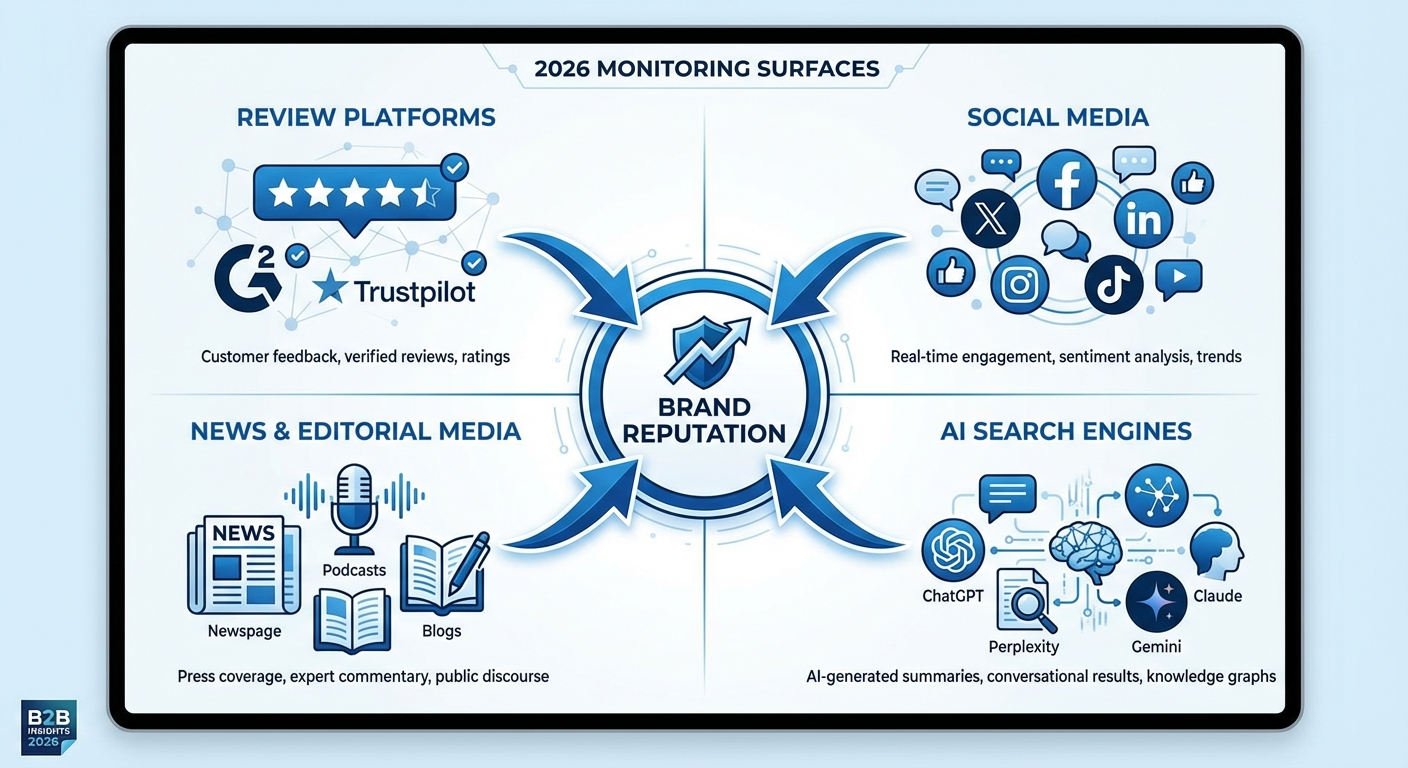
Monitoring only one or two of these surfaces leaves critical blind spots. A brand might have stellar Google Reviews but get consistently omitted from ChatGPT recommendations in its category. Or it might receive positive AI citations but face a growing sentiment problem on Reddit that hasn’t surfaced in structured reviews yet.
Why Reputation Monitoring Has Become More Complex Since 2024
Two forces reshaped brand reputation monitoring between 2024 and 2026: the mainstream adoption of AI search and the fragmentation of consumer attention across platforms.
AI Search Changed the Stakes
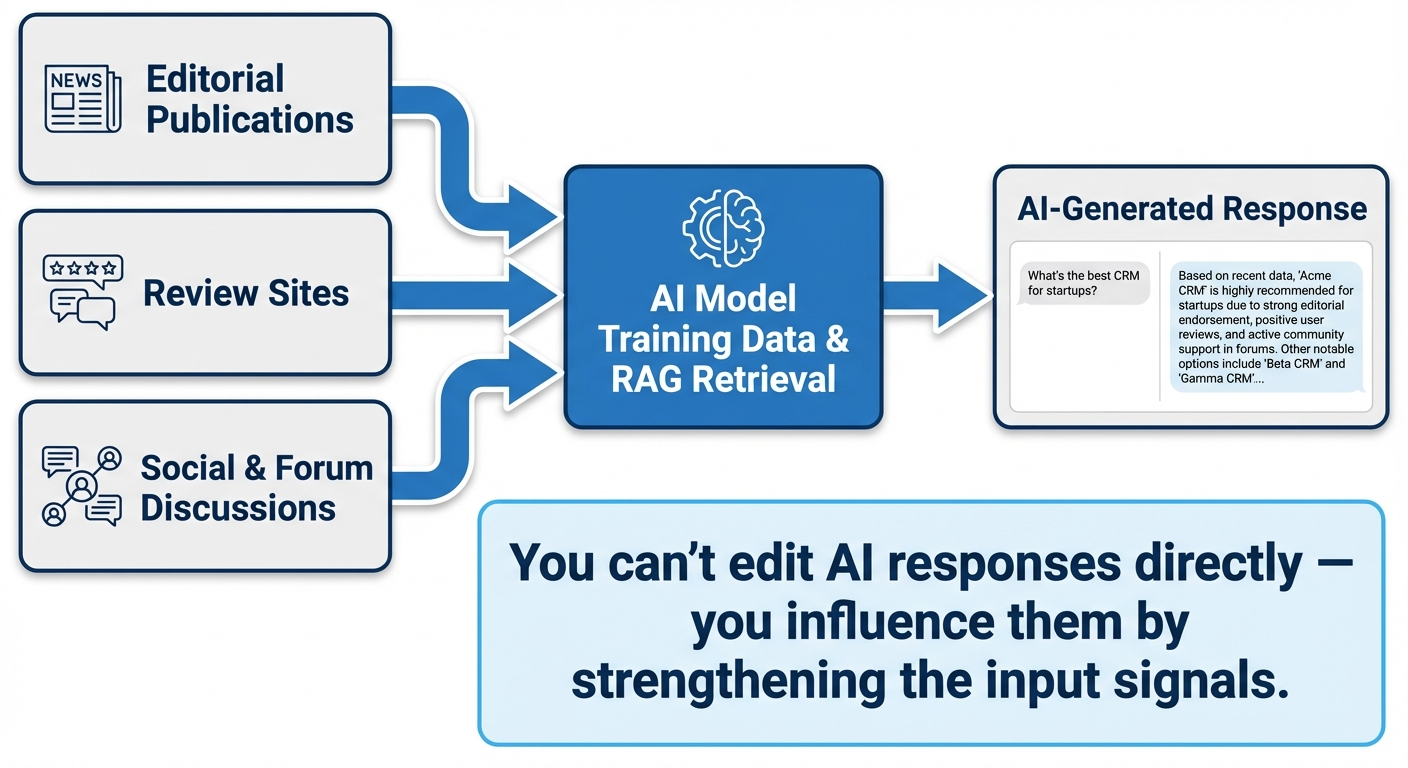
When a potential customer asks ChatGPT “What’s the best project management tool for remote teams?” and your brand doesn’t appear in the response, you’ve lost visibility at a decision-critical moment. Unlike traditional search, where you could see your ranking and optimize for it, AI responses are generated dynamically. The brand perception embedded in AI models is shaped by what those models learned from their training data — and by what retrieval-augmented generation (RAG) systems pull from the live web.
This creates a new monitoring requirement: you need to know whether AI mentions your brand, in what context, and with what sentiment. Monitoring AI citations is no longer optional for B2B brands competing in established categories.
Platform Fragmentation Accelerated
Consumers now form brand opinions across more touchpoints than ever. A 2024 Edelman Trust Barometer study found that trust in brands is shaped by an average of 7–10 digital touchpoints before a purchase decision. In 2026, those touchpoints include AI chat interfaces that didn’t exist at scale three years ago.
For monitoring teams, this means a single-platform tool is insufficient. You need a system that aggregates signals from reviews, social, editorial media, and AI platforms into a unified view.
How to Build a Reputation Monitoring System That Works
Effective brand reputation monitoring isn’t about subscribing to a tool and waiting for alerts. It requires a structured approach: define what you’re listening for, choose the right combination of tools, establish response workflows, and connect monitoring data to business decisions.
Step 1: Define Your Monitoring Scope
Start by mapping every surface where your brand could be mentioned or evaluated. For most B2B companies, this includes:
- Your company name and common misspellings
- Product names and feature-specific terms
- Key personnel (CEO, founders, public spokespeople)
- Competitor brand names (for comparative context)
- Category terms that AI might associate with your brand (e.g., “best CRM for startups”)
Don’t limit your scope to positive-intent monitoring. Track neutral and negative signals too. A mention that associates your brand with a competitor’s data breach — even incorrectly — needs immediate attention.
Step 2: Choose Tools That Cover All Four Surfaces
No single tool covers every monitoring surface well. Most brands need a combination:
- Social listening and media monitoring: Platforms like Meltwater, Brandwatch, or Mention track social conversations and news coverage at scale. These handle surfaces one through three.
- Review management: Tools like Birdeye, Podium, or GatherUp centralize reviews from Google, G2, Capterra, and industry-specific sites.
- AI citation monitoring: Specialized tools track how your brand appears in responses from ChatGPT, Perplexity, Gemini, and other AI platforms. Services that track brand mentions across AI search platforms fill the gap that traditional social listening tools miss entirely.
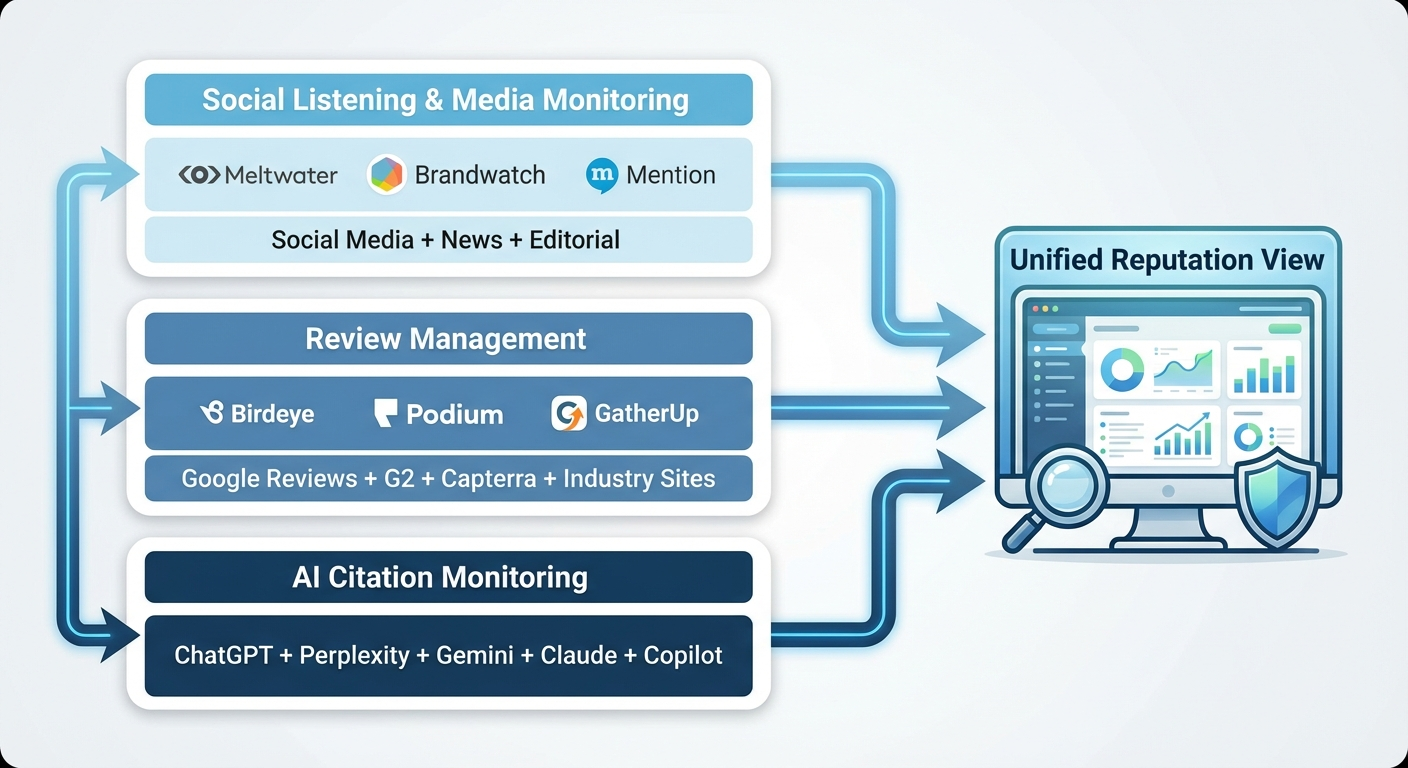
The emerging best practice in 2026 is to use a primary social listening platform for broad coverage, a review aggregator for customer feedback, and a dedicated AI monitoring layer for LLM citation tracking. Dedicated brand monitoring tools can help you evaluate which combination fits your budget and team capacity.
Step 3: Set Up Alert Thresholds and Escalation Paths
Monitoring data is only useful if it triggers action. Configure alerts for:
- Sentiment shifts: A sudden spike in negative mentions (e.g., 30% increase in negative sentiment over 48 hours)
- Volume anomalies: Unusual mention volume — positive or negative — that could indicate a viral moment or emerging crisis
- Competitor comparison mentions: When your brand appears alongside competitors in reviews, editorial content, or AI responses
- AI citation changes: When an AI model that previously recommended your brand stops doing so, or when a competitor starts appearing in your category’s AI results
Every alert needs an owner. Marketing handles social sentiment shifts. Customer success handles review patterns. PR handles media coverage spikes. Without clear ownership, alerts create noise instead of action.
Step 4: Connect Monitoring to Business Outcomes
The most common mistake in brand reputation monitoring is treating it as a reporting exercise rather than a decision-making input. Your monitoring system should feed directly into:
- Product development: Recurring complaints about specific features signal roadmap priorities
- Content strategy: Questions customers ask in reviews and social channels reveal content gaps
- AI visibility strategy: Gaps in AI citations point to where you need more high-authority brand mentions in publications that AI models learn from
- Crisis preparedness: Emerging negative trends flagged early give your team time to prepare responses before stories escalate
Sentiment Analysis in 2026: What Has Changed
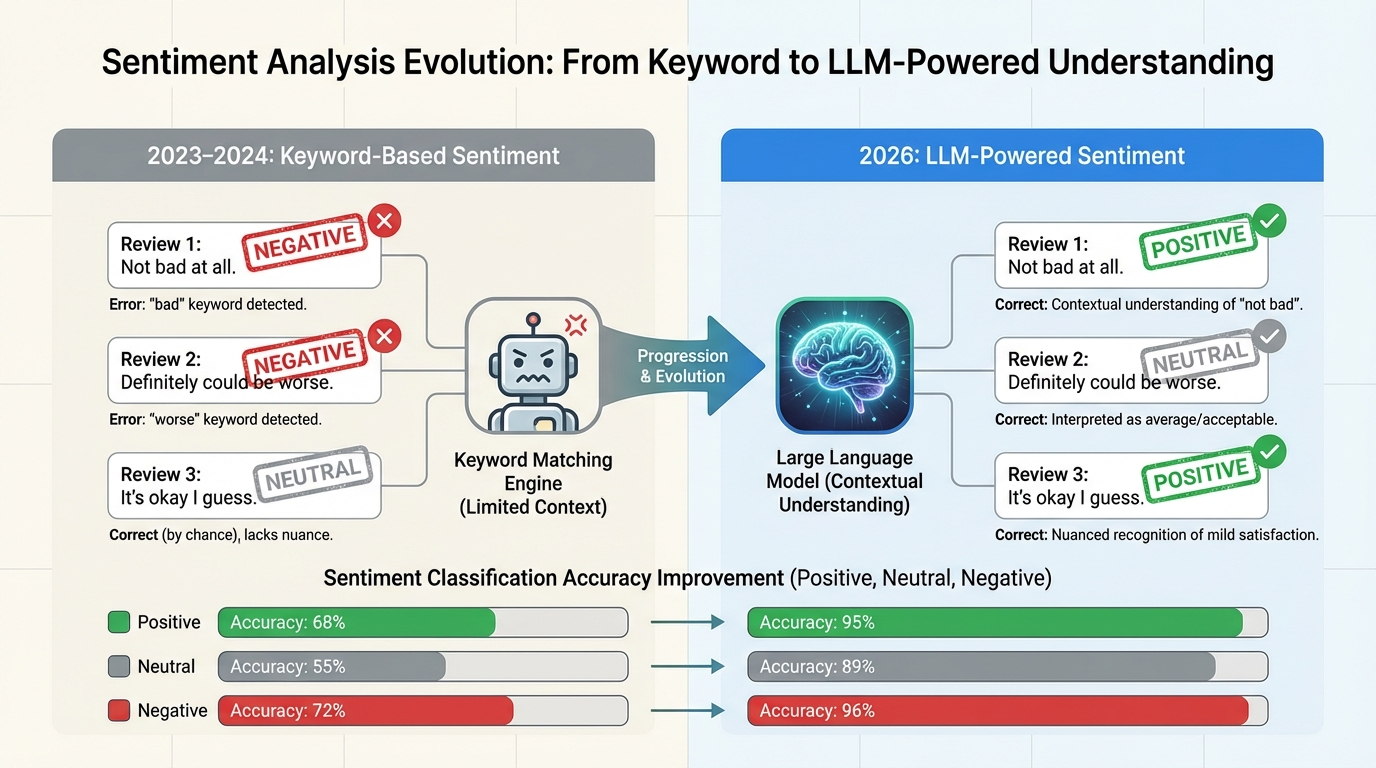
Sentiment analysis is the automated process of classifying text — reviews, social posts, comments, AI responses — as positive, negative, or neutral. In 2026, this technology has matured significantly compared to the keyword-matching systems of earlier years.
Modern sentiment analysis tools use large language models to understand context, sarcasm, conditional praise (“great product, terrible support”), and mixed sentiment within a single review. This matters because older tools frequently misclassified nuanced feedback, leading to inaccurate reputation dashboards.
Where Sentiment Analysis Adds the Most Value
- Review aggregation: Automatically categorizing thousands of reviews across platforms by sentiment and topic saves hundreds of hours per quarter
- Social conversation tracking: Detecting early negative sentiment trends on Reddit or X before they reach mainstream media
- AI response evaluation: Analyzing the sentiment of how AI assistants describe your brand — not just whether they mention you, but how they characterize you
- Competitive benchmarking: Comparing your sentiment ratios against competitors reveals relative reputation strength
For a deeper look at how sentiment data feeds into monitoring strategy, explore brand sentiment analysis as a standalone discipline.
How to Monitor Your Brand in AI Search Results
AI citation monitoring is the newest — and often most overlooked — layer of brand reputation monitoring. Unlike social media or review sites, AI platforms don’t have a public feed you can browse. You need to systematically query AI models and track how your brand appears in responses over time.
What to Track in AI Responses
- Presence: Does your brand appear when users ask category-level questions? (“What are the best email marketing platforms?”)
- Position: Where in the response does your brand appear — first, third, or as an afterthought?
- Context: Is your brand described accurately? Are features, pricing, and use cases correct?
- Sentiment: Does the AI frame your brand positively, neutrally, or with caveats?
- Consistency: Do different AI models (ChatGPT vs. Gemini vs. Perplexity) describe your brand similarly, or are there discrepancies?
Agencies like BrandMentions solve the consistency problem by placing contextual brand mentions across 140+ high-authority publications that AI models actively learn from during training. This approach influences how AI systems build brand-category associations over time.
You can begin tracking your AI presence manually using tools like ChatGPT brand mention checks, Perplexity tracking methods, and Gemini monitoring approaches. For automated, ongoing tracking, specialized AI rank trackers for brand mentions are emerging as essential components of the monitoring stack.
Why AI Citations Differ from Traditional Mentions
A traditional brand mention on a blog or in a review exists at a specific URL. You can find it, read it, and respond to it. An AI citation is different — it’s dynamically generated based on what the model learned and what retrieval systems pull in real time. This means:
- The same query can produce different brand mentions on different days
- AI models update their knowledge bases on irregular schedules, so your brand’s AI reputation can shift without any public event triggering it
- You cannot “respond” to an AI citation the way you respond to a review — you influence it by strengthening the signals AI models learn from
Understanding this difference is critical. Brand mentions directly impact AI search visibility, which means your monitoring system needs to track AI outputs and your influence strategy needs to target the inputs AI models consume.
Measuring Brand Reputation: Metrics That Actually Matter
Collecting data without knowing what to measure creates dashboard clutter. Focus on these metrics to turn monitoring data into business decisions:
Quantitative Reputation Metrics
| Metric | What It Measures | Why It Matters |
|---|---|---|
| Mention volume | Total count of brand mentions across all channels over a defined period | Indicates overall visibility and awareness trends |
| Sentiment ratio | Percentage of positive, neutral, and negative mentions | Reveals whether perception is improving or declining |
| Share of voice | Your mention volume compared to competitors in the same category | Shows relative market mindshare |
| AI citation rate | How frequently your brand appears in AI responses for category queries | Measures discoverability in the fastest-growing search channel |
| Review score trend | Weighted average review rating over time across platforms | Tracks customer satisfaction trajectory |
| Response time | Average time between a negative mention and your team’s response | Correlates directly with crisis containment effectiveness |
Share of voice deserves special attention because it contextualizes your mention volume against competitors. A brand with 500 monthly mentions might feel satisfied — until it discovers competitors receive 3,000. Relative measurement prevents false confidence.
For structured approaches to pulling all of these metrics into a single view, a brand mentions report template can standardize how your team reviews and acts on reputation data each month.
Qualitative Reputation Signals
Numbers alone don’t capture reputation. Supplement quantitative metrics with:
- Theme analysis: What specific topics recur in negative mentions? (Pricing? Support response time? Onboarding experience?)
- Influence weighting: A negative mention from a publication with 500,000 monthly readers carries more weight than a post on an inactive forum
- AI narrative accuracy: Are AI models describing your product correctly? Inaccurate AI descriptions — even neutral ones — can mislead potential buyers
Common Mistakes That Weaken Reputation Monitoring
Even well-resourced teams make avoidable errors that reduce the value of their monitoring programs. Here are the most frequent ones:
Monitoring Without a Response Plan
Collecting data without defined response workflows means problems get observed but not resolved. Every monitoring alert should have a designated owner, a target response time, and an escalation path for high-severity issues. Without this, monitoring becomes an expensive observation exercise.
Ignoring AI Search Entirely
Many teams still treat AI search monitoring as “nice to have.” In 2026, with AI assistants handling a growing share of product research queries, this blind spot has real revenue consequences. If a competitor appears in AI recommendations and you don’t, prospects may never reach your website at all.
In campaigns across 67+ B2B companies, the BrandMentions team found that brands with consistent editorial mentions achieved AI recommendation rates 89% higher than those relying solely on traditional SEO. Monitoring your AI presence is the first step toward improving it.
Over-Relying on Automated Sentiment Scores
Automated sentiment analysis is powerful but imperfect. Periodically audit your sentiment data manually. Check whether the tool correctly classifies industry-specific language, product jargon, and context-dependent statements. A review saying “This tool is sick” might be positive in one context and ambiguous in another.
Treating All Channels Equally
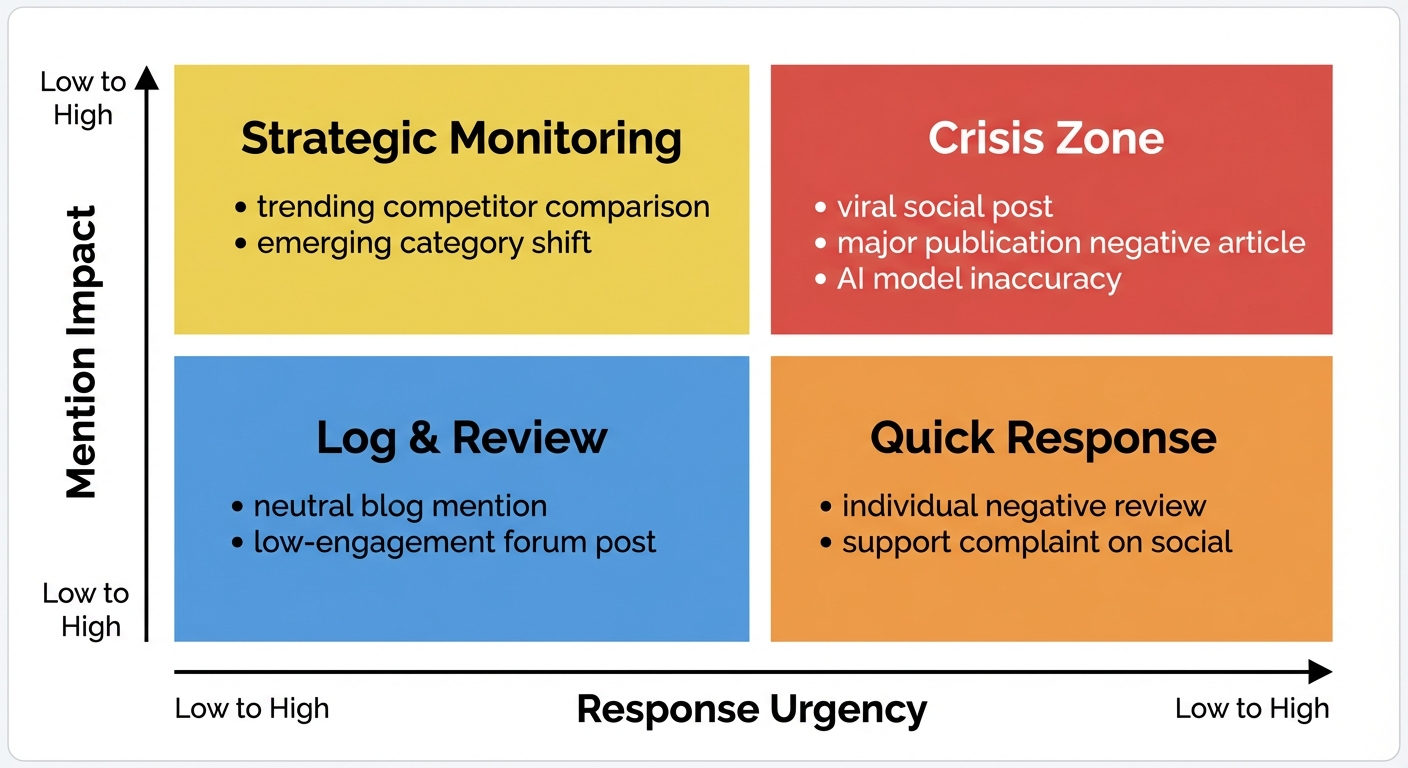
Not every mention carries equal weight. A negative Reddit thread with 200 upvotes has more impact than a single negative tweet with zero engagement. Weight your monitoring alerts by channel influence, audience size, and engagement level to prioritize effectively.
How Editorial Mentions Strengthen Both Reputation and AI Visibility
Brand reputation monitoring reveals gaps. Filling those gaps requires a proactive strategy. One of the highest-leverage actions for both traditional reputation building and AI visibility is earning consistent mentions in high-authority editorial publications.
Here’s why this works across both surfaces:
- For human audiences: Editorial mentions in respected publications build credibility, improve search rankings through entity authority signals, and create a bank of positive content that pushes down negative results
- For AI models: Large language models learn brand-category associations from their training data. When your brand appears frequently in trusted publications alongside your category terms, AI systems build stronger associations between your brand and relevant queries
This dual benefit makes editorial brand mentions one of the most efficient investments for reputation management in 2026. Unlike paid advertising, which stops working when you stop spending, editorial mentions compound over time — they remain in publication archives and continue influencing both human readers and AI training datasets.
For a deeper exploration of how this mechanism works, see how brand mentions work and how to increase brand mentions in AI search.
Building a Reputation Monitoring Cadence
Consistency matters more than intensity. A structured cadence ensures monitoring data drives ongoing decisions rather than sitting in dashboards no one reviews.
Daily
- Review automated alerts for sentiment spikes, volume anomalies, and negative review notifications
- Respond to high-priority reviews and social mentions within your target response time
- Check AI citation dashboards for any significant changes in brand presence
Weekly
- Review sentiment trend data across all four monitoring surfaces
- Identify emerging themes in customer feedback — new complaints, feature requests, or competitive comparisons
- Share a summary with product, marketing, and customer success teams
Monthly
- Generate a comprehensive brand mentions report covering all channels
- Compare share of voice and sentiment ratios against competitors
- Assess AI citation performance: which queries include your brand, which don’t, and what’s changed
- Use findings to adjust content strategy, outreach priorities, and product roadmap inputs
Quarterly
- Audit your monitoring tool stack — are you still covering all relevant surfaces?
- Review and update alert thresholds based on past quarter’s activity
- Benchmark reputation metrics against industry standards using brand tracking tools and brand awareness measurement tools
Frequently Asked Questions
What is the difference between brand monitoring and brand reputation monitoring?
Brand monitoring tracks mentions of your brand name across digital channels. Brand reputation monitoring goes further — it analyzes the sentiment, context, and influence of those mentions to assess how your brand is perceived overall. Reputation monitoring includes sentiment analysis, competitive benchmarking, review management, and increasingly, AI citation tracking. Think of brand monitoring as the data collection layer and reputation monitoring as the analysis and action layer.
How often should I check what AI says about my brand?
Check AI citations at least weekly for your most important category queries. AI models update their knowledge bases and retrieval sources on irregular schedules, so your brand’s presence can change without warning. Automated AI brand mention tracking tools can run these checks continuously and alert you to significant changes.
Can I respond to negative AI citations the same way I respond to a bad review?
No. AI citations are generated dynamically from training data and retrieval sources — there’s no “reply” button. To improve how AI describes your brand, you need to strengthen the underlying signals: earn more positive editorial mentions in publications AI models learn from, correct inaccurate information in public sources, and build stronger entity authority across trusted websites. This is a longer-term effort, but it’s the only reliable approach.
Do small businesses need brand reputation monitoring tools?
Yes, though the tool stack can be simpler. Small businesses can start with Google Alerts (free), a review management platform for their industry, and periodic manual checks of AI search results for their category. As the business grows, adding social listening and AI citation monitoring creates a more complete picture.
How does brand reputation monitoring connect to SEO?
Reputation signals and SEO signals increasingly overlap. Positive brand mentions build entity authority, which influences both traditional search rankings and AI recommendations. Brand mentions for SEO strengthen your domain’s topical relevance, while review scores and sentiment data appear directly in search results through rich snippets and Knowledge Panels. Monitoring both disciplines together gives your team a unified view of digital visibility.
Your Next Step: Audit What AI Says About Your Brand
Most companies start brand reputation monitoring with social listening and review management — both essential. But the competitive edge in 2026 belongs to teams that also monitor how AI systems describe their brand in real time.
Start with a simple audit: ask ChatGPT, Perplexity, and Gemini the top five questions your prospects would ask about your category. Note where your brand appears, where it doesn’t, and how it’s described. That baseline reveals the gaps your monitoring system needs to cover — and the editorial signals you need to strengthen.
If you want to see how your brand currently performs across AI search engines and traditional media, request a free AI visibility audit to get a clear picture of where you stand and what to prioritize.