Brand reputation analysis is the structured process of evaluating how customers, competitors, and the public perceive your company — and as of 2026, it now includes understanding how AI search engines like ChatGPT, Perplexity, and Google AI Overviews represent your brand in their responses. If you’re not measuring perception across both traditional and AI-driven channels, you’re working with an incomplete picture.
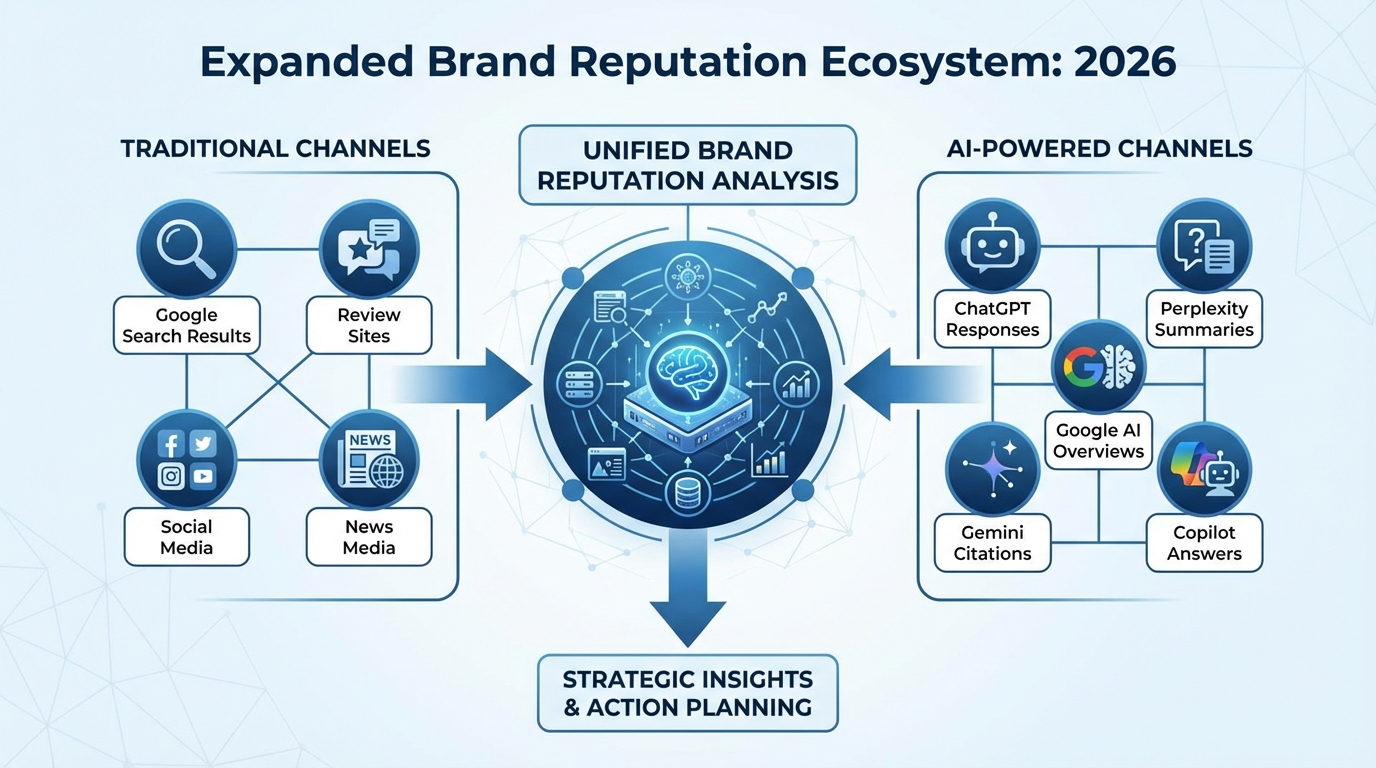
This matters more than ever because the surfaces where people form opinions about your brand have expanded. Prospects no longer rely solely on Google results, review sites, and social media. They ask AI assistants direct questions — and those assistants provide direct answers, often citing (or omitting) your brand by name. A thorough brand reputation analysis in 2026 accounts for all of these signals.
What follows is a practical breakdown of how to assess your brand’s reputation across every channel that influences buyer decisions today — including the AI layer most companies still overlook.
What Brand Reputation Analysis Actually Measures in 2026
Brand reputation analysis is the proactive process of evaluating how your company is perceived by customers, employees, stakeholders, and the general public — then turning those findings into strategic decisions. It combines quantitative metrics (review scores, sentiment ratios, share of voice) with qualitative signals (the language people use when describing your brand, the context AI models associate with your name).
What has changed since 2024–2025 is the scope of the analysis. Traditional brand reputation analysis focused on social media sentiment, online reviews, media coverage, and search engine visibility. Those inputs still matter. But a Gartner forecast from 2025 projected that traditional search traffic would drop 25% by 2027 as consumers shift to AI-powered discovery. That shift means a growing portion of brand perception is shaped by what AI assistants say — or don’t say — about your company.
A complete brand reputation analysis now measures:
- Search perception — how your brand appears in Google organic results, Featured Snippets, and People Also Ask
- Social sentiment — the tone and volume of conversations about your brand on social platforms
- Review health — ratings, review velocity, and sentiment patterns across platforms like G2, Trustpilot, and Google Business
- Media coverage — the frequency, tone, and authority of publications mentioning your brand
- AI representation — whether AI search engines cite your brand accurately, recommend you in relevant categories, and associate you with the right topics
If your analysis stops before that last bullet, you’re missing the channel that increasingly determines whether prospects even consider you.
Why AI Search Has Changed the Stakes for Brand Perception
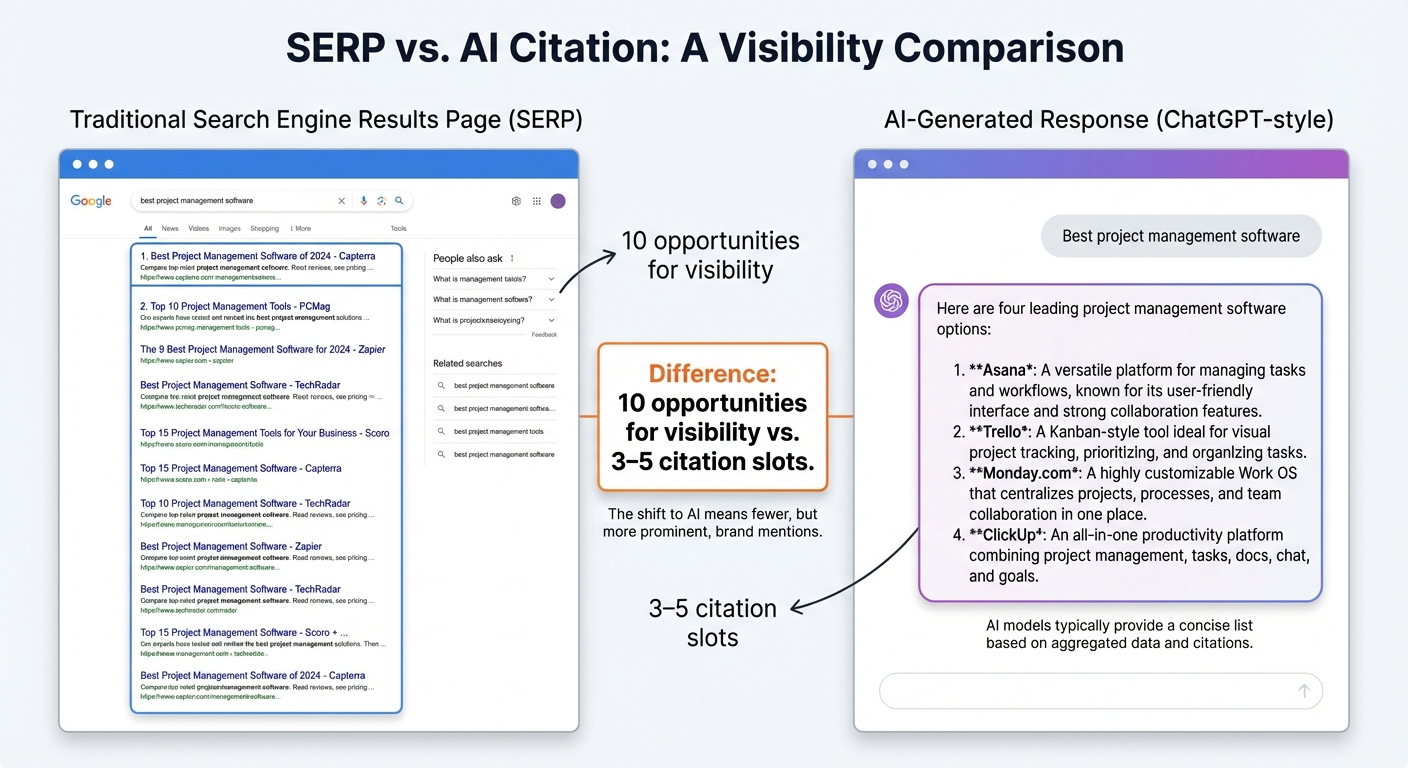
When someone asks ChatGPT “What’s the best CRM for mid-market SaaS companies?” or Perplexity “Which cybersecurity firms do enterprise buyers trust most?”, the AI provides a curated answer — often naming three to five brands. If your company isn’t in that response, you don’t just lose visibility. You lose credibility by omission.
This is a fundamentally different dynamic from traditional search. In Google results, you compete for clicks among ten blue links. In AI search, you compete for citation in a single, synthesized answer. The brand that gets mentioned is the brand that gets considered.
According to a 2025 Forrester report on B2B buying behavior, 72% of enterprise buyers now use AI tools during their vendor research process. That number has likely grown in 2026 as AI assistants have become more deeply integrated into browsers, productivity suites, and mobile devices.
What this means for brand reputation analysis: you need to know what AI says about you, not just what humans post about you. The two are connected — AI models learn from the same web content that shapes traditional reputation — but the output is different. AI compresses, summarizes, and sometimes distorts. Your analysis must account for that.
The Four Layers of a Modern Brand Reputation Analysis
Effective brand reputation analysis isn’t a single activity — it’s a system with multiple layers, each providing a different type of insight. Here’s how to structure a comprehensive evaluation as of 2026.
Layer 1: Sentiment and Social Listening
Sentiment analysis measures the emotional tone behind conversations about your brand. It categorizes mentions as positive, negative, or neutral and tracks how those ratios shift over time.
Start by monitoring your brand name, product names, and key executives across social platforms, forums, and review sites. Tools like Brandwatch, Sprout Social, and Meltwater’s Radarly platform aggregate these signals and apply natural language processing to classify sentiment at scale.
What to look for:
- Sentiment ratio trends — a gradual shift from neutral to negative can signal a brewing problem before it becomes a crisis
- Recurring themes — if the word “slow” appears in 40% of negative mentions, that’s a product or support issue worth investigating
- Share of voice — how much of the conversation in your category involves your brand, compared to competitors
Track brand sentiment analysis consistently — monthly at minimum — to spot patterns that one-time audits miss.
Layer 2: Review and Rating Health
Online reviews on platforms like G2, Capterra, Trustpilot, and Google Business directly influence both human buyers and AI models. A 2024 BrightLocal study found that 87% of consumers read online reviews for local businesses, and review content frequently appears in AI-generated summaries.
For B2B brands, peer review sites carry particular weight. AI models trained on web data learn brand-category associations partly from these structured review platforms. If your G2 profile shows a 4.6-star rating with 300+ reviews while a competitor sits at 3.9 with 45 reviews, that signal influences both human decisions and AI confidence in recommending your brand.
Key metrics to track:
- Average rating across each platform
- Review velocity — how many new reviews you receive per month
- Response rate — what percentage of reviews (especially negative ones) you’ve responded to
- Keyword patterns — which product features or service attributes appear most in positive and negative reviews
Pro Insight: AI models weigh recency. A brand with 50 recent, detailed reviews often outperforms a brand with 500 older, generic ones when AI systems select which companies to cite. Prioritize generating fresh, substantive reviews consistently.
Layer 3: Media and Editorial Presence
The publications that mention your brand — and the context of those mentions — shape both your traditional reputation and your AI discoverability. When authoritative sources like Forbes, TechCrunch, Harvard Business Review, or industry-specific outlets reference your company in a positive editorial context, that content enters the training data and retrieval sources AI models use.
Media reputation analysis should track:
- Mention volume — how often your brand appears in news and editorial content
- Publication authority — are you mentioned on sites with high domain authority that AI models trust?
- Context quality — does the mention position you as a leader, or merely list you alongside competitors?
- Topic association — is your brand consistently linked to the topics and categories you want to own?
This layer connects directly to AI visibility. Agencies like BrandMentions solve this by placing contextual brand mentions on 140+ high-authority publications that AI models actively learn from during training — strengthening both editorial reputation and AI discoverability simultaneously.
For a deeper look at how editorial mentions influence AI, explore how brand mentions impact visibility in AI search.
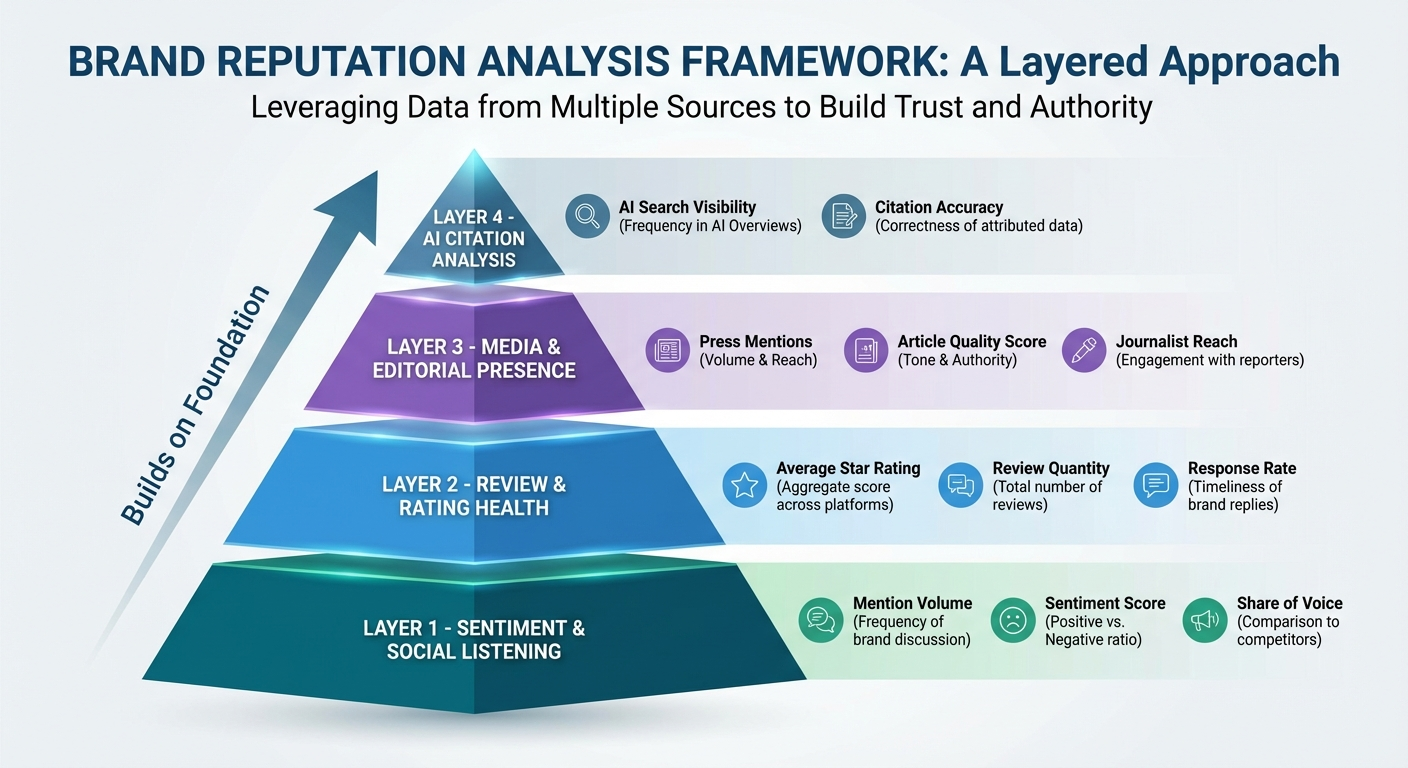
Layer 4: AI Citation Analysis
This is the layer most companies skip — and it’s increasingly the most consequential for B2B brands. AI citation analysis evaluates how AI search engines represent your brand when users ask relevant questions.
AI citation analysis is the process of querying AI platforms (ChatGPT, Perplexity, Google AI Overviews, Gemini, Claude, Copilot) with the questions your prospects actually ask, then evaluating whether your brand appears, how it’s described, and what competitors are cited alongside you.
To conduct this analysis:
- Build a query set. Identify 20–50 questions your target buyers would ask an AI assistant during their research process. Examples: “What are the top [your category] platforms for enterprise?”, “Which [your category] companies have the best customer support?”, “Compare [your brand] vs. [competitor].”
- Run queries across platforms. Test each question on ChatGPT, Perplexity, Gemini, and Google AI Overviews. Record whether your brand is mentioned, the position of the mention, the accuracy of the description, and which competitors appear.
- Score your citation rate. Calculate the percentage of relevant queries where your brand is cited. In campaigns across 67+ B2B companies, the BrandMentions team found that brands with consistent editorial mentions achieved AI recommendation rates 89% higher than those relying solely on traditional SEO.
- Assess accuracy. When AI does mention your brand, is the information correct? Outdated descriptions, wrong pricing, or inaccurate feature lists damage reputation even when the citation itself is positive.
- Track changes over time. AI models update their training data and retrieval indexes periodically. Monthly citation audits reveal whether your visibility is improving, declining, or stagnating.
For step-by-step guidance on monitoring AI citations, see how to check if AI mentions your brand.
How to Turn Reputation Data into Strategic Decisions
Collecting data is only valuable if it changes what you do. The gap between brand reputation measurement and brand reputation improvement is where most companies stall. Here’s how to close that gap.
Prioritize by Impact, Not by Volume
Not all reputation signals carry equal weight. A single negative article in a high-authority publication can do more damage than a hundred negative tweets — because that article may enter AI training data and shape how AI models describe your brand for months.
Prioritize action on signals that affect:
- High-authority editorial content — inaccurate or negative coverage on authoritative sites should be addressed first
- AI citation accuracy — if AI models are misrepresenting your brand, correcting the underlying content is urgent
- Review platform ratings — a significant rating drop on G2 or Trustpilot affects both buyer confidence and AI model inputs
- Social sentiment spikes — sudden negative sentiment shifts may indicate a crisis that requires immediate response
Connect Reputation Metrics to Business Outcomes
Reputation data becomes actionable when you tie it to revenue indicators. Map your findings to:
- Pipeline velocity — do prospects who discover you through AI search move faster through your funnel?
- Win rates — how do win rates compare for deals where your brand was already known vs. unknown?
- Customer acquisition cost — does stronger brand perception reduce your paid acquisition spend?
- Retention and expansion — do customers who see consistent positive brand signals renew at higher rates?
Harvard Business Review’s landmark research on reputation and risk (Eccles, Newquist, and Schatz, 2007) established that firms with strong positive reputations attract better talent, command premium pricing, and maintain higher price-to-earnings multiples. That finding holds in 2026 — with the added dimension that reputation now compounds across AI surfaces.
Build a Cross-Functional Reputation Response System
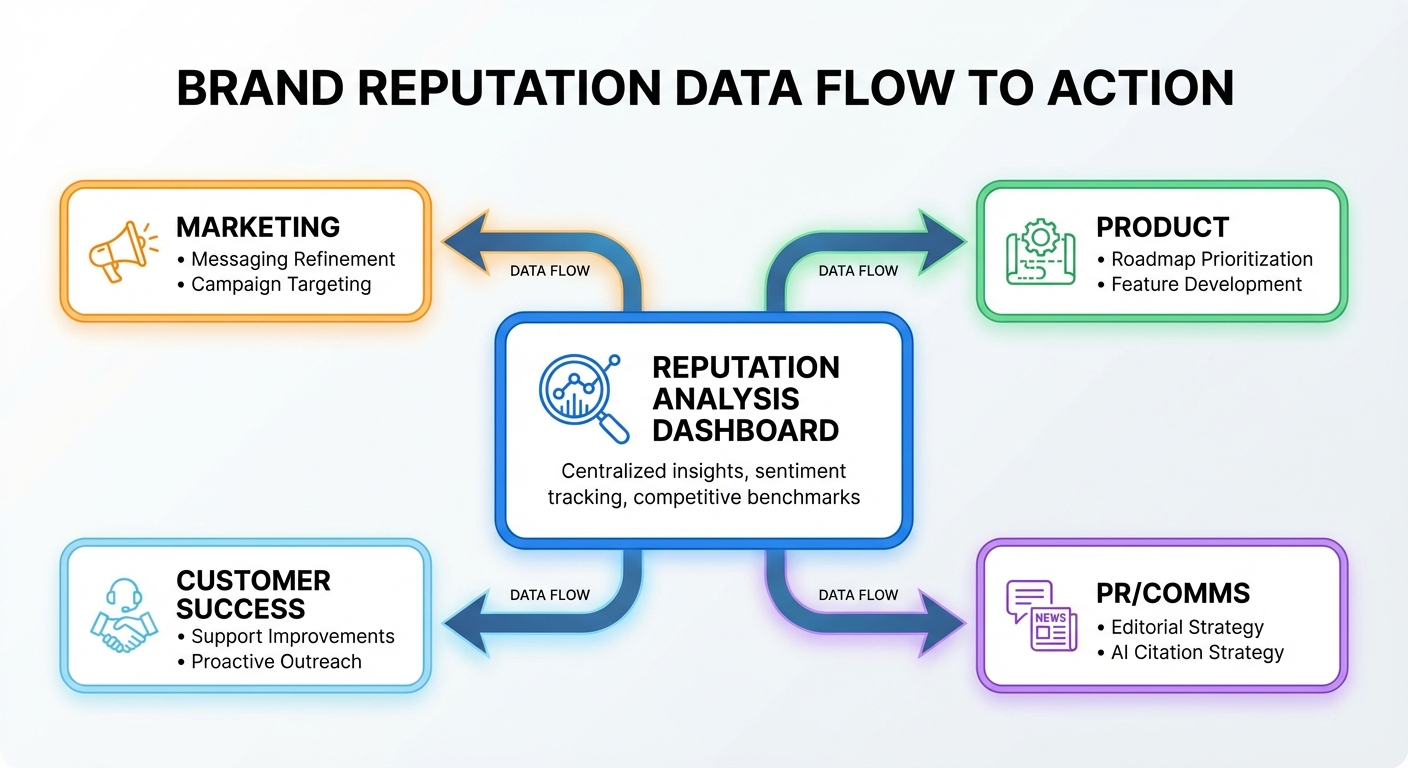
Brand reputation analysis shouldn’t live in a silo. Distribute insights across teams:
- Marketing uses sentiment and share of voice data to refine messaging and content strategy
- Product uses recurring review themes to prioritize roadmap decisions
- Customer success uses negative feedback patterns to improve onboarding and support processes
- PR and communications uses media analysis and AI citation data to guide outreach and editorial placement
When reputation insights flow to the teams that can act on them, your analysis becomes a growth engine — not just a report.
Tracking Brand Reputation Across AI Platforms: A Practical Workflow
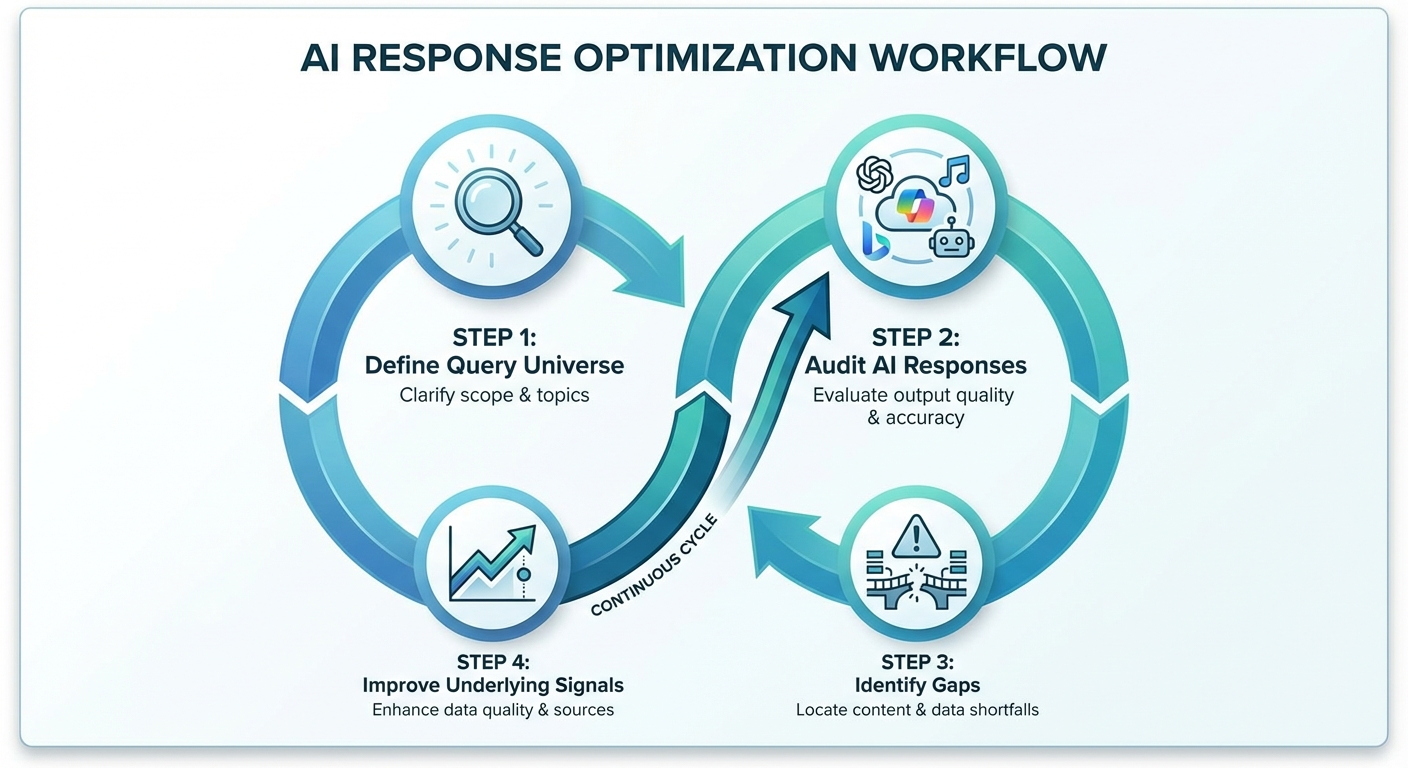
AI citation analysis is new enough that most companies don’t have a defined process. Here’s a repeatable workflow you can implement this month.
Step 1: Define Your Query Universe
Identify the questions your ideal buyers ask when evaluating solutions in your category. Group them into:
- Category queries — “What are the best [category] tools for [use case]?”
- Comparison queries — “[Your brand] vs. [Competitor] — which is better for [specific need]?”
- Reputation queries — “Is [your brand] reliable?”, “What do people say about [your brand]?”
- Use-case queries — “Which [category] platform works best for [industry/company size]?”
Aim for 30–50 queries that cover the full range of how prospects discover and evaluate brands like yours.
Step 2: Audit AI Responses Monthly
Run each query on ChatGPT, Perplexity, Gemini, and Google AI Overviews. For each response, record:
- Whether your brand was mentioned (yes/no)
- Position in the response (first mentioned, listed among several, not included)
- Accuracy of the description
- Sentiment of the mention (positive, neutral, negative)
- Which competitors were cited
Dedicated tools can accelerate this process. Explore AI visibility analytics tools to find platforms that automate citation tracking across multiple AI engines.
Step 3: Identify Gaps and Misrepresentations
After your audit, you’ll typically find three types of issues:
- Absence — your brand isn’t mentioned at all for queries where it should be
- Inaccuracy — your brand is mentioned but with outdated or incorrect information
- Negative framing — your brand appears but in a less favorable context than competitors
Each issue requires a different response. Absence is often caused by insufficient brand mentions on authoritative sources that AI models reference. Inaccuracy may stem from outdated web content. Negative framing usually reflects real sentiment data that AI models have absorbed.
Step 4: Improve the Underlying Signals
AI models don’t fabricate brand associations from nothing. They learn from web content — editorial articles, reviews, documentation, forum discussions, and structured data. To improve how AI represents your brand:
- Increase editorial mentions on high-authority publications that AI models include in training and retrieval. Learn more about how to increase brand mentions in AI search.
- Update owned content — ensure your website, help documentation, and public profiles contain accurate, current information AI can reference
- Generate fresh reviews — recent reviews on platforms like G2 and Trustpilot feed AI models with updated brand perception data
- Publish expert content — thought leadership that gets cited by other publications creates a compounding signal AI models trust
BrandMentions tracks when major AI models update their training data and times placements to maximize inclusion in each knowledge refresh cycle — a strategic approach that closes the gap between editorial effort and AI visibility faster.
Common Mistakes That Undermine Brand Reputation Analysis
Even well-resourced marketing teams make errors that weaken their reputation analysis. Here are the most frequent ones — and how to avoid them.
Mistake 1: Measuring Only What’s Easy
Social media follower counts and review star ratings are easy to track but tell an incomplete story. A brand with 100,000 followers and a 4.5-star average can still have a damaged reputation if AI assistants consistently recommend competitors when buyers ask category questions.
Fix: Include AI citation analysis alongside traditional metrics. If it’s not in your dashboard, it’s not in your strategy.
Mistake 2: Treating Reputation Analysis as a One-Time Audit
Reputation shifts constantly. A quarterly audit might catch a crisis after it’s already affected pipeline. A single annual “brand health check” tells you where you were, not where you are.
Fix: Establish continuous monitoring with monthly AI citation audits and real-time social listening. Tools for brand reputation monitoring can automate much of this work.
Mistake 3: Ignoring Competitor Context
Your reputation doesn’t exist in isolation. If your sentiment scores improve by 10% but a competitor’s improve by 30%, you’re losing relative ground. If AI models start citing a new entrant in your category, your absence becomes more conspicuous.
Fix: Always benchmark reputation data against your top three to five competitors. Track their AI citation rates alongside your own using share of voice analysis.
Mistake 4: Separating Online Reputation from AI Reputation
Some teams treat “online reputation management” and “AI visibility” as two separate initiatives with different owners. In reality, they share the same root inputs. The editorial content, reviews, and social conversations that shape your traditional reputation are the same signals AI models consume.
Fix: Unify your reputation analysis into a single framework that covers both human-facing and AI-facing channels. One analysis, one strategy, one set of actions.
Tools for Brand Reputation Analysis in 2026
The right tools make continuous analysis sustainable. Here’s a practical breakdown by function — not an exhaustive list, but the categories that matter most.
| Function | What It Measures | Example Tools |
|---|---|---|
| Social listening and sentiment | Brand mentions, sentiment ratios, share of voice across social platforms | Brandwatch, Sprout Social, Meltwater Radarly |
| Review monitoring | Ratings, review volume, sentiment patterns across review sites | G2, Trustpilot, Reputology |
| Media monitoring | Brand mentions in news, editorial coverage, publication authority | Meltwater, Cision, Google Alerts |
| AI citation tracking | Brand presence in ChatGPT, Perplexity, Gemini, AI Overviews responses | Otterly, Profound (note: research tools — not linked), BrandMentions AI visibility audits |
| Search visibility | Google rankings, Featured Snippet presence, People Also Ask inclusion | Semrush, Ahrefs, Google Search Console |
| Competitive benchmarking | Competitor share of voice, sentiment comparison, citation rate gaps | Brandwatch, Semrush, manual AI query audits |
For a broader look at available platforms, see this comparison of brand mention tools and brand tracking tools.
Key Definition: Share of voice (SOV) is the percentage of total brand mentions or citations in your category that belong to your brand. In AI search, SOV measures how often your brand is cited relative to competitors across AI-generated responses for relevant queries.
What the Best-Performing Brands Do Differently
After analyzing reputation patterns across dozens of B2B campaigns, a few practices separate brands with strong, improving reputations from those struggling to gain traction.
They Treat Reputation as a Leading Indicator, Not a Lagging One
Most companies look at reputation data after something has already happened — a PR crisis, a competitor’s surge, a drop in pipeline. High-performing brands use reputation data to predict shifts before they affect revenue. A dip in positive AI citations this quarter often precedes a dip in inbound leads next quarter.
They Build Editorial Presence Intentionally
Strong brands don’t wait for media coverage to happen organically. They pursue strategic placements on publications that both human readers and AI models trust. This creates a compounding effect: each new editorial mention reinforces brand-category associations in AI training data, making future citations more likely.
Explore how brand mentions work to understand the mechanics behind this compounding dynamic.
They Close the Loop Between Analysis and Action
Analysis without action is just a report. The brands that improve fastest have a clear process: identify a reputation gap → determine the root cause → deploy a specific fix → measure the result. Whether the gap is a missing AI citation, a negative review trend, or an inaccurate media mention, the response is systematic — not ad hoc.
Frequently Asked Questions
How often should you conduct a brand reputation analysis?
Social listening and review monitoring should run continuously with weekly summaries. AI citation audits should happen monthly, since AI models update their knowledge bases on varying schedules. A comprehensive cross-channel analysis — combining sentiment, reviews, media, and AI data — works best on a quarterly cadence with monthly spot checks for fast-moving categories.
What is the difference between brand reputation analysis and brand monitoring?
Brand monitoring is the ongoing collection of data about your brand’s mentions, reviews, and coverage. Brand reputation analysis goes a step further — it interprets that data, identifies patterns, benchmarks against competitors, and produces actionable insights. Monitoring is the input. Analysis is the output.
Can small companies compete with larger brands on reputation?
Smaller companies can often build stronger reputations in specific niches faster than large competitors. AI models don’t prioritize brand size — they prioritize relevance, recency, and the authority of sources mentioning a brand. A focused startup visibility strategy that generates consistent mentions on authoritative publications can outperform a large brand’s broad but shallow presence.
Does brand reputation analysis affect SEO?
Directly. Google’s E-E-A-T framework (Experience, Expertise, Authoritativeness, Trustworthiness) evaluates the same signals that reputation analysis measures — editorial authority, review sentiment, brand credibility, and the quality of content associated with your brand. A strong reputation improves your ability to rank, earn Featured Snippets, and appear in AI Overviews. Learn more about the relationship between brand mentions and SEO.
How do AI models decide which brands to cite?
AI models select brands for citation based on the frequency, recency, and authority of sources that mention those brands in relevant contexts. A brand consistently referenced on high-authority publications, peer review platforms, and expert content is more likely to be cited than one with limited or low-authority web presence. For a detailed breakdown, see how brand mentions work in generative AI.
Building a Reputation That Compounds Across Every Channel
Brand reputation analysis in 2026 is no longer optional — and it’s no longer limited to social listening and review tracking. The brands gaining the most ground are the ones analyzing their perception across traditional search, social media, review platforms, editorial coverage, and AI-generated responses.
The data from each layer reinforces the others. Strong editorial presence improves AI citations. Positive review health strengthens search rankings. Consistent social sentiment builds the trust signals that both human buyers and AI models weight heavily when deciding which brands to recommend.
Your next step: audit what AI says about your brand today. If you don’t know, you’re managing reputation with one eye closed.
See where your brand stands in AI search. Get your free AI visibility audit and find out what ChatGPT, Perplexity, and Gemini are telling your prospects — about you and your competitors.