
AI citation forecasting uses machine learning to estimate which papers will gain citations, how fast they will climb, and how influential they may become, usually as a probability or a range rather than an exact number. It works from historical citation patterns, paper metadata, and text signals. Treat this as a research-oriented explainer, not a tool roundup or a build-your-own-model tutorial. By the end you will know what it predicts, how the models work, what data they read, and where the predictions break down.
One thing to settle first: forecasting is not the same as measuring. Citation analysis looks backward at influence that already happened. Forecasting points forward at influence that has not.
What AI Citation Forecasting Means
AI citation forecasting is the practice of predicting a research output’s future citation behavior from signals available now, expressed as an expected count, a rank, a velocity, or the probability of crossing a threshold. The target can be a paper, a patent, an author, a journal, a venue, or a whole research domain. The output is almost never a single hard number. It is a range or a probability, because citation accrual is noisy and slow.
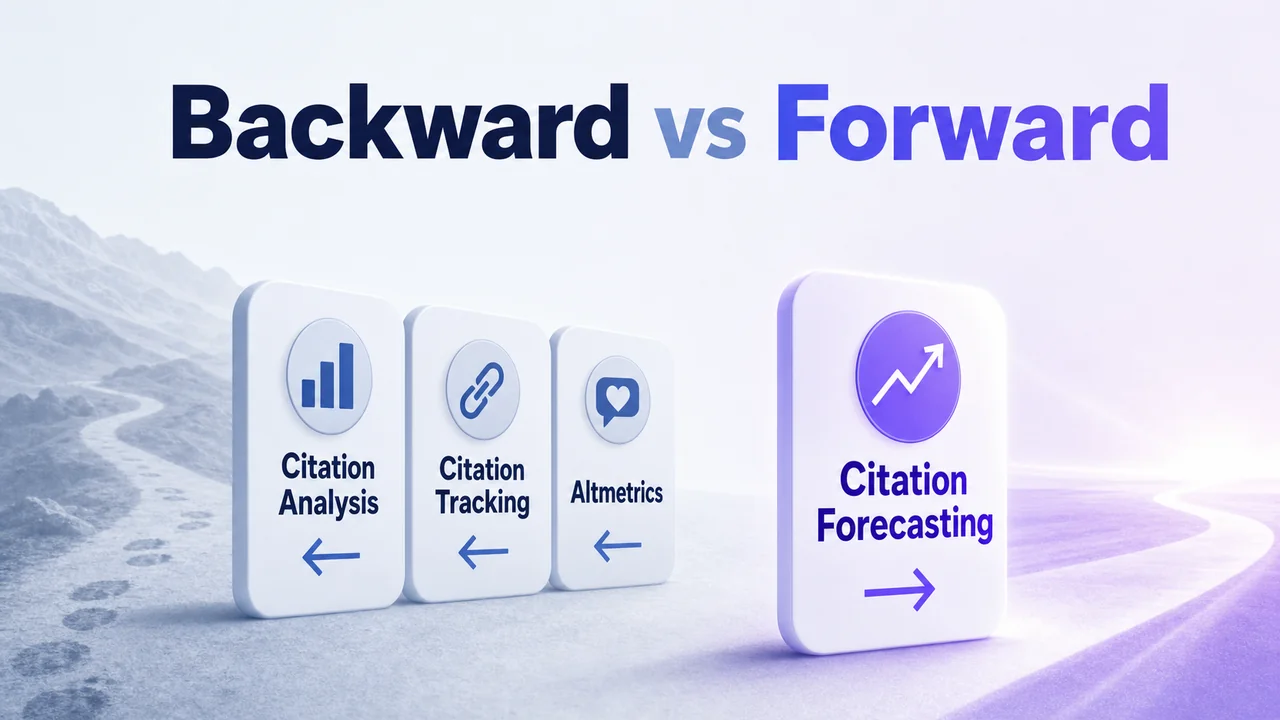
The most common confusion in bibliometrics is exactly this split between measuring past influence and predicting future influence. The table below pins down where forecasting sits.
| Concept | Direction | What it answers |
|---|---|---|
| Citation forecasting | Forward | How many citations will this paper likely get, or will it pass a threshold |
| Citation analysis | Backward | How influential has this work been, and how is it connected |
| Citation tracking | Present | Who is citing this work right now, as it happens |
| Altmetrics | Present to near-term | How much social and usage attention is this work getting now |
Bibliometrics, the broad field of measuring scholarly output, sits over all four. Scientometrics is the same idea applied specifically to science. Forecasting is the one piece that commits to a claim about the future, which is why it carries the most uncertainty and the most value.
Why AI Citation Forecasting Matters
Forecasting earns its place because waiting for citations to accumulate is slow, and decisions cannot wait. A paper may take two or three years to show its real impact in some fields. Institutions, funders, and publishers want a directional signal long before that window closes, even knowing that citation count is an imperfect stand-in for value.
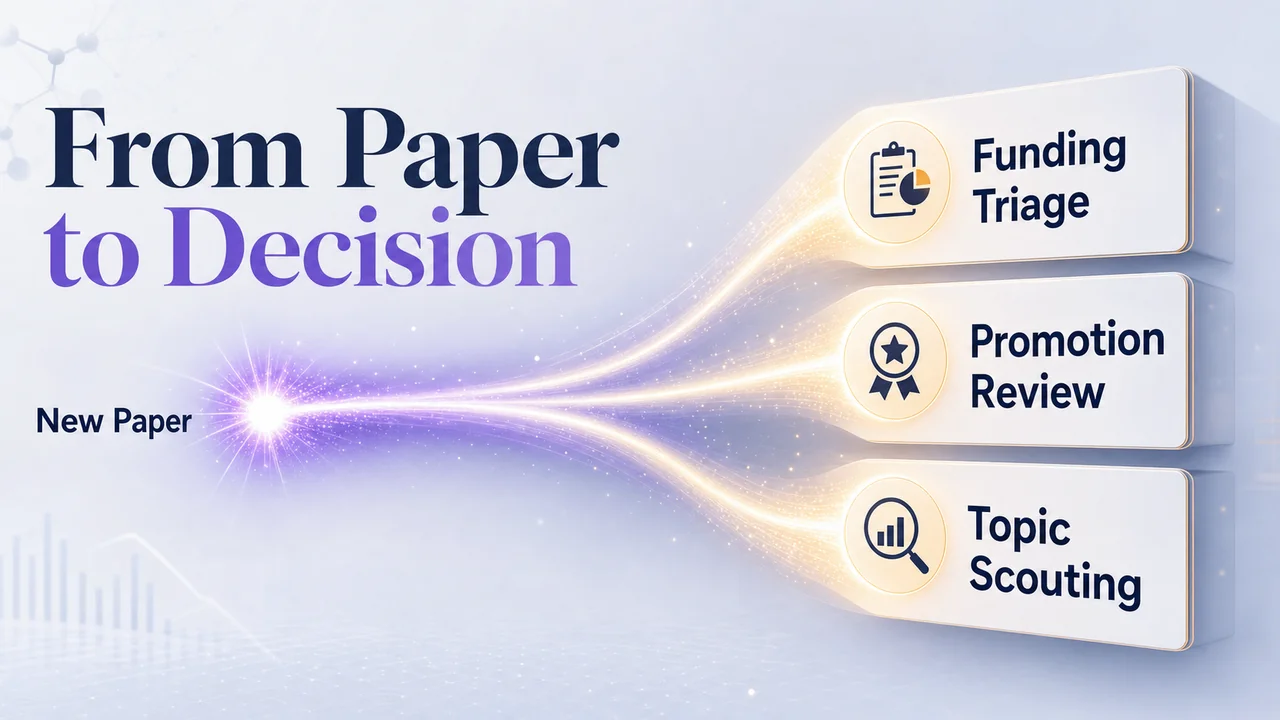
Researchers use early forecasts to spot likely breakout work before the citation curve confirms it, which helps with literature triage and collaboration choices. Universities and grant bodies fold forecasts into prioritization, review shortlists, and promotion cases, where a probability score narrows a long candidate pool to a workable one. Publishers and research offices lean on the same signals for topic scouting and portfolio planning, deciding which emerging areas deserve a special issue or an acquisition push.
The honest framing matters here. A forecast is decision support, not a verdict on scholarly worth. It tells you where to look first, not what is good. And the citation-lag problem never fully goes away: in slower fields, the work that matters most can stay quiet for years before anyone cites it.
How AI Citation Forecasting Works
A forecasting model learns the relationship between what a paper looks like early on and how its citations unfold later, then applies that pattern to new work. The pipeline runs in a predictable order, and one step in particular separates an honest model from an overstated one.
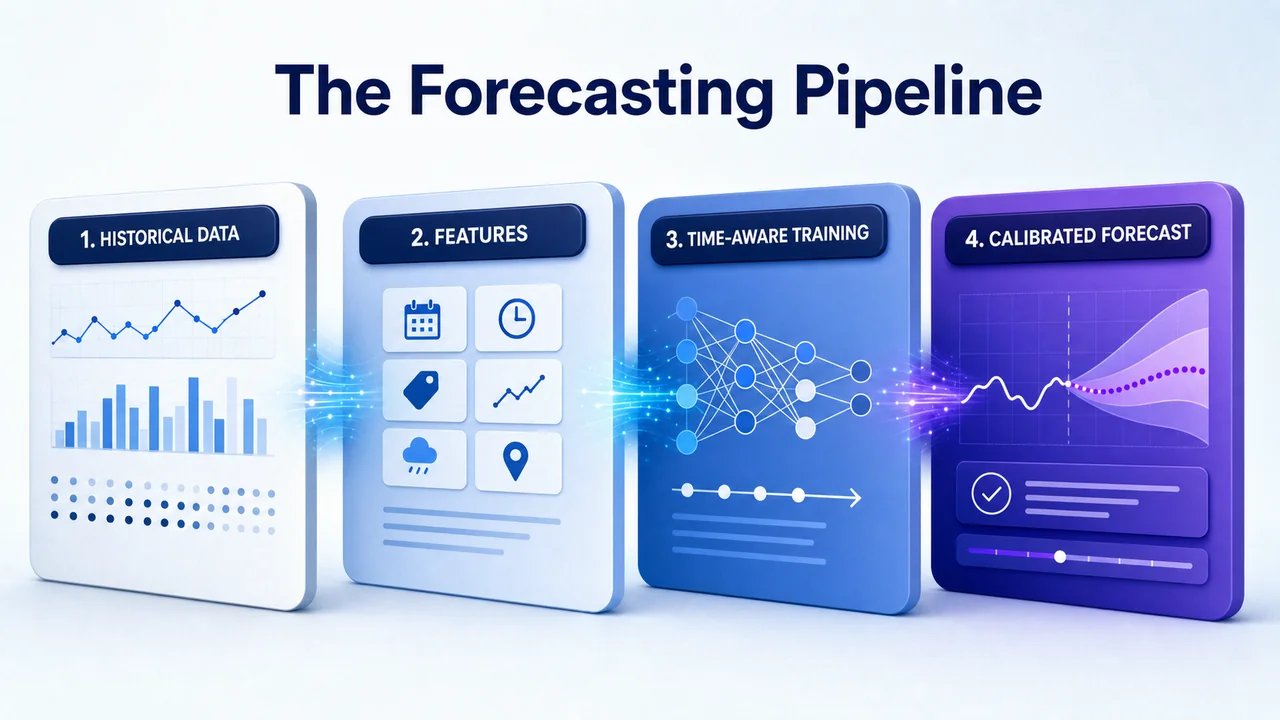
- Collect historical citation trajectories for papers whose outcomes are already known, so the model has labeled examples to learn from.
- Engineer features from metadata, text, network structure, and any early usage signals, turning a messy paper record into numbers a model can read.
- Train on a time-aware split, where the model only sees information that existed before the forecast date, then test against a real future citation window.
- Calibrate and output the prediction as an exact count, a rank, or a class probability, depending on what the decision needs.
The step people get wrong is the split. A random train-test split lets the model peek at information from after the paper’s forecast date, which leaks future knowledge into training and inflates reported accuracy. Strict temporal splits fix this. A model that looks brilliant on a random split and mediocre on a temporal split was never brilliant, it was just leaking. When you read an accuracy claim, the first question is which split produced it.
Main Model Families and What Each Does Best
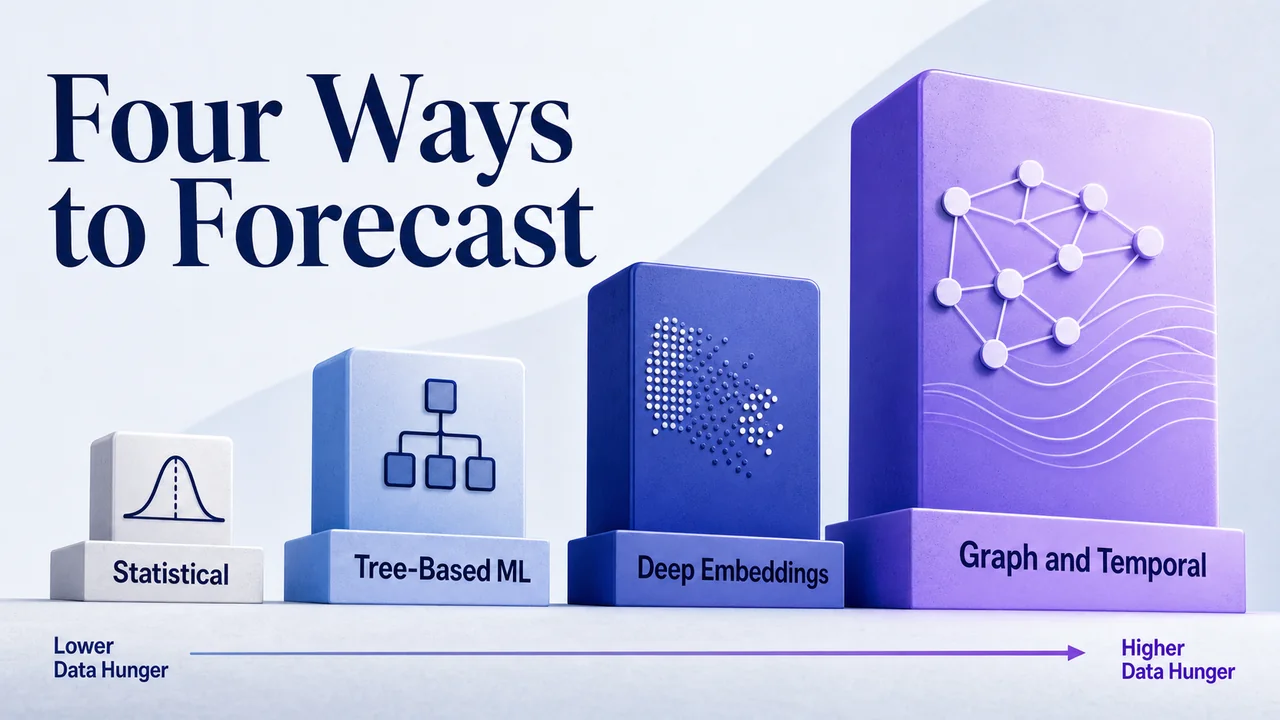
Citation forecasting draws on four broad method families, and each fits a different data situation. The right choice depends on how much data you have, whether you need to explain the prediction, and whether you care about a single number or a curve over time.
| Family | Examples | Best at | Trade-off |
|---|---|---|---|
| Statistical time series | ARIMA, exponential smoothing | Aggregate trends and simple citation series | Weak on text and network signals |
| Regression and tree-based ML | Linear regression, random forests, XGBoost | Mixed metadata, easy to interpret | Needs hand-built features |
| Deep learning and embeddings | SciBERT, SPECTER2, CNNs, LSTMs | Semantic novelty in titles and abstracts | Data-hungry, harder to explain |
| Graph and temporal | Citation networks, point-process models | How influence spreads over time | Complex, scale-sensitive |
The pattern across these is a trade between flexibility, interpretability, and data appetite. Deep embedding models capture meaning that bag-of-words methods miss, but they want large clean corpora and they resist explanation. Tree-based models give you a feature you can point to and defend in a review meeting.
And here is the part that surprises people: a simple statistical baseline often beats a flashy neural model when the dataset is small, noisy, or narrowly scoped. Reach for complexity only when the data can feed it. To understand which signals carry weight when a model decides to surface a source, the work on factors behind AI citations covers adjacent ground.
What Data and Signals the Models Use
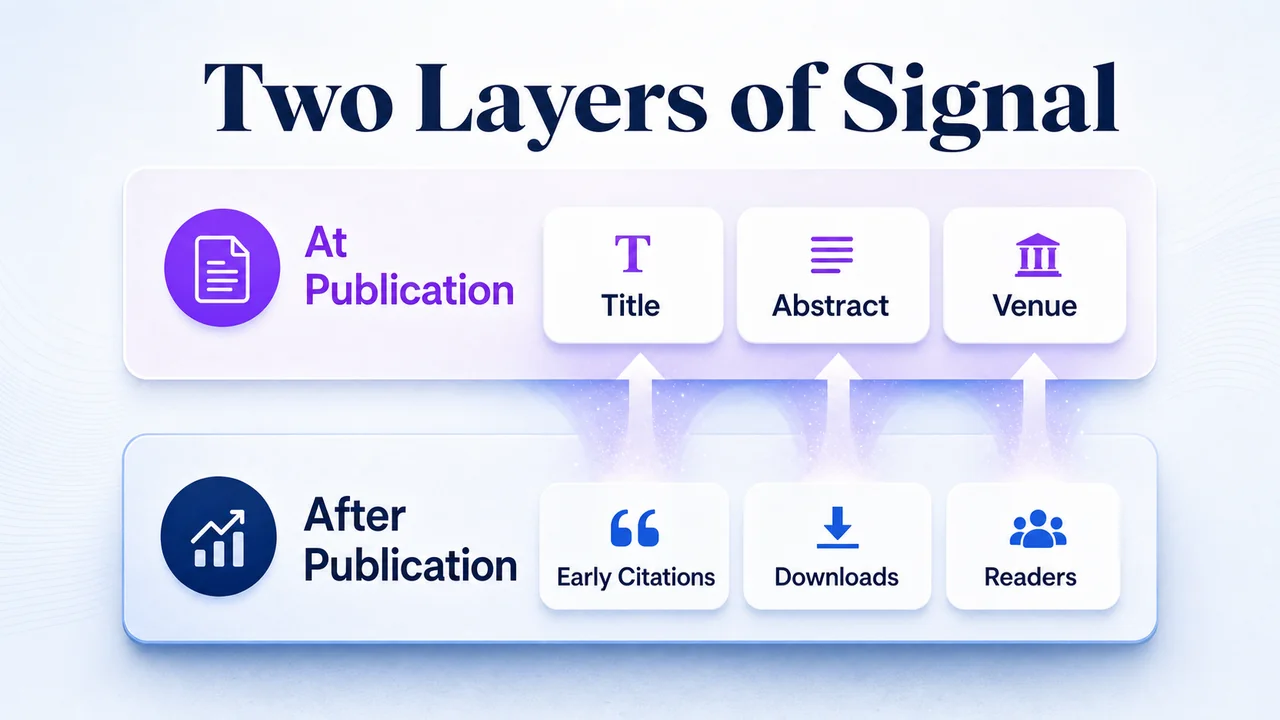
Citation forecasting splits its inputs into two layers: what you can see the day a paper goes live, and what only appears once the paper is in circulation. The split matters because the most useful signal changes over the paper’s life.
| Signal layer | Inputs | When it helps most |
|---|---|---|
| At publication | Title, abstract, keywords, references, authors, affiliations, venue prestige, collaboration structure | Day one, when no citations exist yet |
| After publication | Early citations, downloads, readers, social mentions, usage metrics | Once the paper has circulated for weeks or months |
| Structural | Reference diversity, topical novelty, author centrality, proximity to influential work | Across both windows, as network context |
Semantic features from the title and abstract carry most of the weight at launch, because they are all a model has before anyone cites the work. Once the paper is live, early citation counts and download patterns become the stronger predictor, often quickly. The recurring pattern is that text-only models are strongest on day one, while hybrid models that add usage signals pull ahead after a citation window opens. The same logic governs how machines weigh sources elsewhere, which the guide to how AI crawlers pick sources explores for a different surface.
See where AI answers put your brand
Twenty minutes with a senior strategist: where the major engines point buyers in your category, who gets named instead of you, and a straight read on what a programme would change.
Book a strategy callHow Reliable the Predictions Are
Citation forecasting is probabilistic, not exact, because citations are heavily skewed, delayed, and uneven across fields. A handful of papers collect most of the citations while most collect very few, which makes precise count prediction genuinely hard. Forecasting rank or a high-versus-low impact class is usually far easier than nailing an exact number.
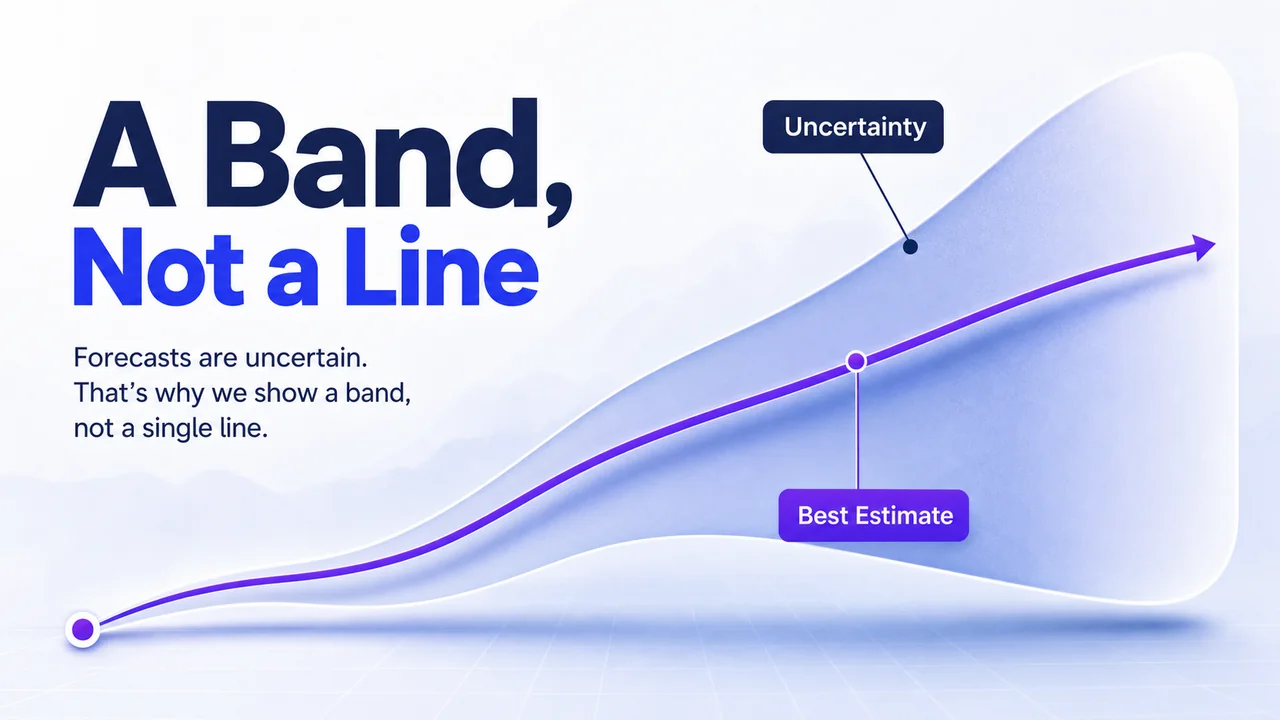
Reliability shifts with field, language, time horizon, and the quality of the training corpus. A model trained on English physics papers will not transfer cleanly to Spanish humanities work. The further out the horizon, the wider the error. The metrics below tell you what is actually being measured, and reading them in plain English keeps you from over-trusting a single headline figure.
| Metric | What it tells you | Read it as |
|---|---|---|
| MAE and RMSE | Average size of the count error | How far off the number tends to be |
| Spearman correlation | How well predicted rank matches real rank | Whether the ordering is right |
| AUROC and AUPRC | How well it separates high from low impact | Whether the classifier sorts well, especially on rare hits |
| Calibration | Whether a 70 percent probability really means 70 percent | Whether you can trust the probability itself |
The two reasons models quietly degrade are temporal drift and dataset bias. Citation behavior changes over time, so a model trained on older data slowly loses its edge, and a corpus skewed toward certain venues or languages bakes that skew into every forecast. A model can still be genuinely useful for triage even when it is nowhere near precise enough to predict an exact citation count. Precision and usefulness are not the same bar.
Common Misconceptions and the Honest Takeaway
Four misreads come up again and again, and clearing them is what separates a careful user of forecasts from one who over-trusts them. The myth-versus-reality view below is the fastest way through.
| The myth | The reality |
|---|---|
| More complex models always win | Simple statistical baselines often beat deep models on small, noisy, or narrow datasets |
| High predicted impact means high quality | A forecast predicts attention, not rigor, usefulness, or correctness |
| A model generalizes across fields | A model trained in one discipline often fails cleanly in another |
| Citation count measures influence | It misses slow-burn work, negative citations, and non-citation impact entirely |
That last point is the one worth holding onto. Citation count is a proxy, and a leaky one. It rewards work that gets cited fast and quietly undercounts work that shapes a field through teaching, software, or ideas that diffuse without a formal reference. Where the field is heading is better calibration, validation that holds across disciplines instead of one journal, and temporal models that can explain why they predicted what they did. The repeated takeaway across the research is consistent: use a forecast as a directional signal, never as a verdict.
Frequently Asked Questions
Can AI predict citation counts accurately?
AI can predict citation rank and high-versus-low impact reasonably well, but exact counts remain hard because citations are skewed and delayed. Picture two papers in the same field: a model can often tell you which one will be cited more, yet still miss the precise totals for both by a wide margin. Treat the output as a probability or a range, not a fixed number.
What data do citation forecasting models use?
Models use publication-time signals like title, abstract, keywords, references, authors, and venue prestige, plus post-publication signals like early citations, downloads, and reader counts. Structural inputs such as reference diversity and an author’s position in the citation network add context. Text signals matter most before any citations exist, while usage signals take over once the paper has circulated.
Which machine learning model works best for citation prediction?
No single model wins everywhere, and the best choice depends on your data size and your need to explain the result. Tree-based models like random forests and XGBoost handle mixed metadata well and stay interpretable, while transformer embeddings such as SciBERT and SPECTER2 capture semantic novelty when you have a large corpus. On small or noisy datasets, a simple statistical baseline frequently outperforms both.
Is citation count a good measure of scholarly impact?
Citation count is a useful but imperfect proxy for impact. It captures formal academic uptake but misses slow-burn work that gains influence years later, negative citations that disagree with a paper, and non-citation impact through software, teaching, or policy. Use it alongside other signals rather than as the single measure of worth.
Do citation forecasting models work across different academic fields?
Most models lose accuracy when applied outside the field they were trained on. Citation norms differ sharply: a count that signals a breakout in one discipline is routine in another, and citation speed varies by years between fields. A model validated only on one journal or domain should be retrained or revalidated before you trust it elsewhere.
AI citation forecasting works when you treat it as a directional signal backed by good data, strict temporal validation, and a clear view of its limits. The field is moving toward better calibration and cross-field validation, so the forecasts you act on this year will read more honestly than the ones from a few years back. Start by asking which split produced any accuracy claim you see, because that one question filters out most of the overstated results. For related terms, explore the AI visibility glossary and our AI citation network resources.