
AI brand impersonation is no longer a niche phishing trick. It is a scalable trust attack that lets a criminal pose as your brand across websites, email, social, apps, ads, and even synthetic voice in minutes. You will learn what it is, how the attack chain works, the forms it takes, and the defense model that actually holds up against AI-generated fraud. The short version: the threat moved faster than the old playbook, and the brands that treat it as an ongoing operational risk are the ones that stay protected.
What AI Brand Impersonation Means
AI brand impersonation is the use of generative AI or synthetic media to pose as a real brand, executive, support team, or product, usually to steal trust. The goal is rarely the impersonation itself. It is what the impersonation unlocks: stolen credentials, diverted payments, malware downloads, fake purchase flows, or support scams that drain time and money.
AI is the force multiplier here, not always the whole attack. A lookalike domain is an old tactic. What changed is that AI now writes the convincing copy, clones the brand voice, and generates the assets at a speed and polish that used to take a skilled human days.

It helps to separate impersonation from the terms it overlaps with, because precise language sharpens detection.
Phishing
Phishing is the broad tactic of tricking someone into handing over sensitive information. Brand impersonation is often the costume phishing wears, but phishing can also pose as a coworker or a generic service with no specific brand attached.
Spoofing
Spoofing is faking a technical signal, like a sender address or a domain header, so a message looks like it came from a trusted source. Impersonation can use spoofing, but it can also use a brand-new lookalike domain that passes every technical check.
Typosquatting
Typosquatting registers near-match domains, like swapping a letter or adding a hyphen, to catch users who mistype or skim. It is one delivery method for impersonation, not the whole scheme.
Account takeover
Account takeover hijacks a real account the brand already owns. Impersonation builds a fake one from scratch. Both end in customer harm, but the response differs: one is a recovery problem, the other is a takedown problem.
Deepfake-enabled fraud
Deepfakes use synthetic audio or video to imitate a real voice or face. When that synthetic media impersonates your spokesperson or executive, it becomes the most convincing form of brand impersonation, because it removes the doubt a text message leaves behind.
The practitioner reality worth holding onto: a modern impersonation attack is built to create legitimate-looking trust signals, not obvious spam. The criminal wants the customer to feel safe, not suspicious.
Why AI Brand Impersonation Matters
AI brand impersonation matters because the damage lands on your customers and your revenue before it ever shows up as a security alert. The first sign is usually a confused customer, not a flagged log entry.
A customer who trusts your name will share a password, approve a payment, or download an app because they believe the request came from you. That trust is the asset under attack.
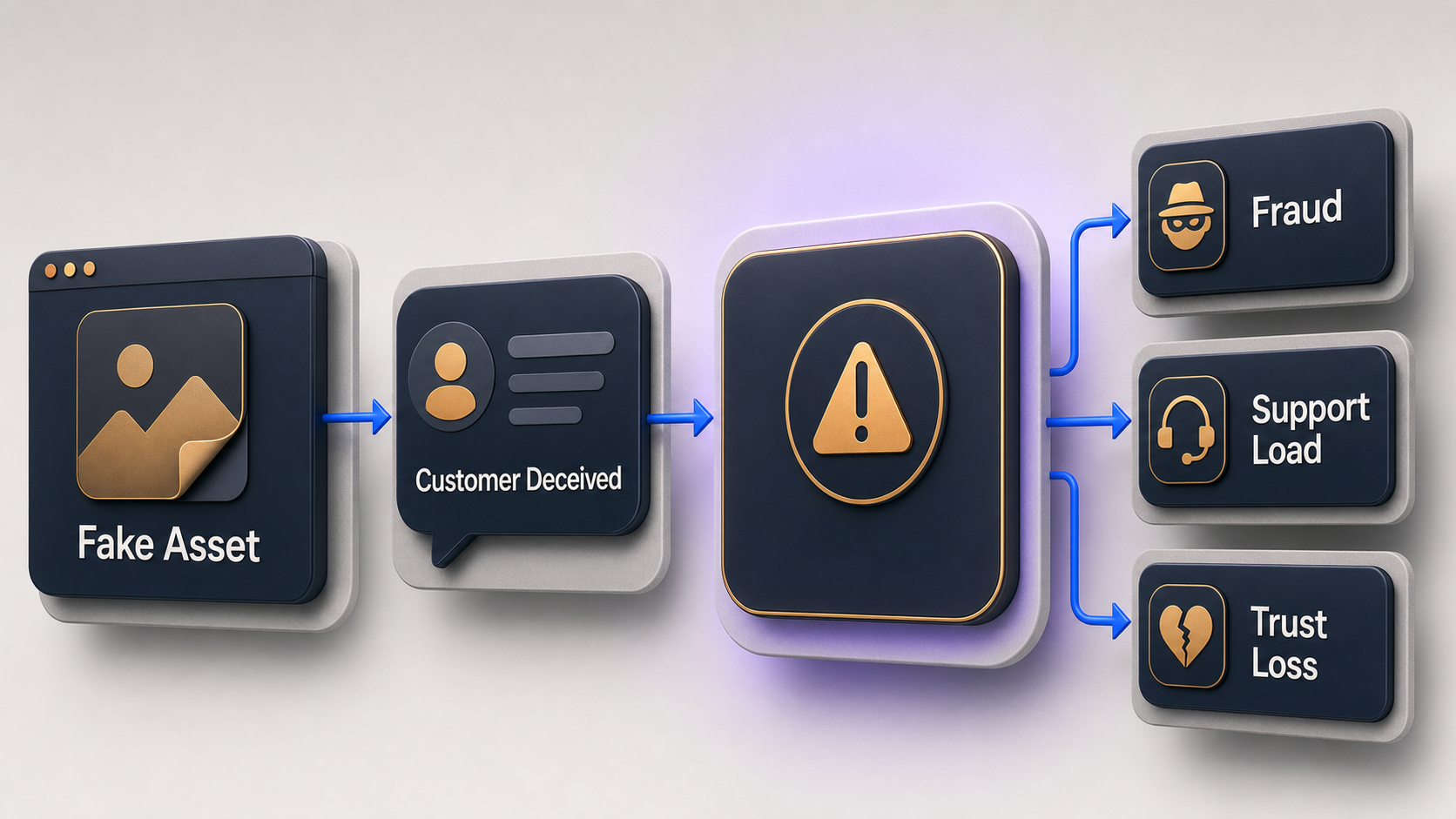
The business consequences stack up fast. Chargebacks and refund requests pile in from people who paid a scammer. Your support team fields calls about orders nobody placed. Fake ads using your name burn through the goodwill you spent years building, and sometimes burn your media budget too when scammers bid on your brand terms.
Speed is the part most teams underestimate. A fake site, ad, or social account can spread to thousands of people before a registrar, platform, or legal team finishes a takedown. The window between launch and removal is where almost all the damage happens. By the time the threat is confirmed, the customers are already deceived.
This is why impersonation belongs on the revenue and customer-experience agenda, not just the security one. The cost shows up as lost sales, refunded fraud, and a brand reputation that takes a hit every time a customer gets burned in your name. Tracking how your brand is represented across channels is part of the same discipline as broader brand reputation monitoring.
How AI Brand Impersonation Works
AI brand impersonation works by removing the friction at every stage of the attack, so a criminal can generate, clone, publish, and distribute a convincing fake faster than a defender can react. Defenders rarely see one isolated fake site. They see a coordinated campaign running across several channels at once.
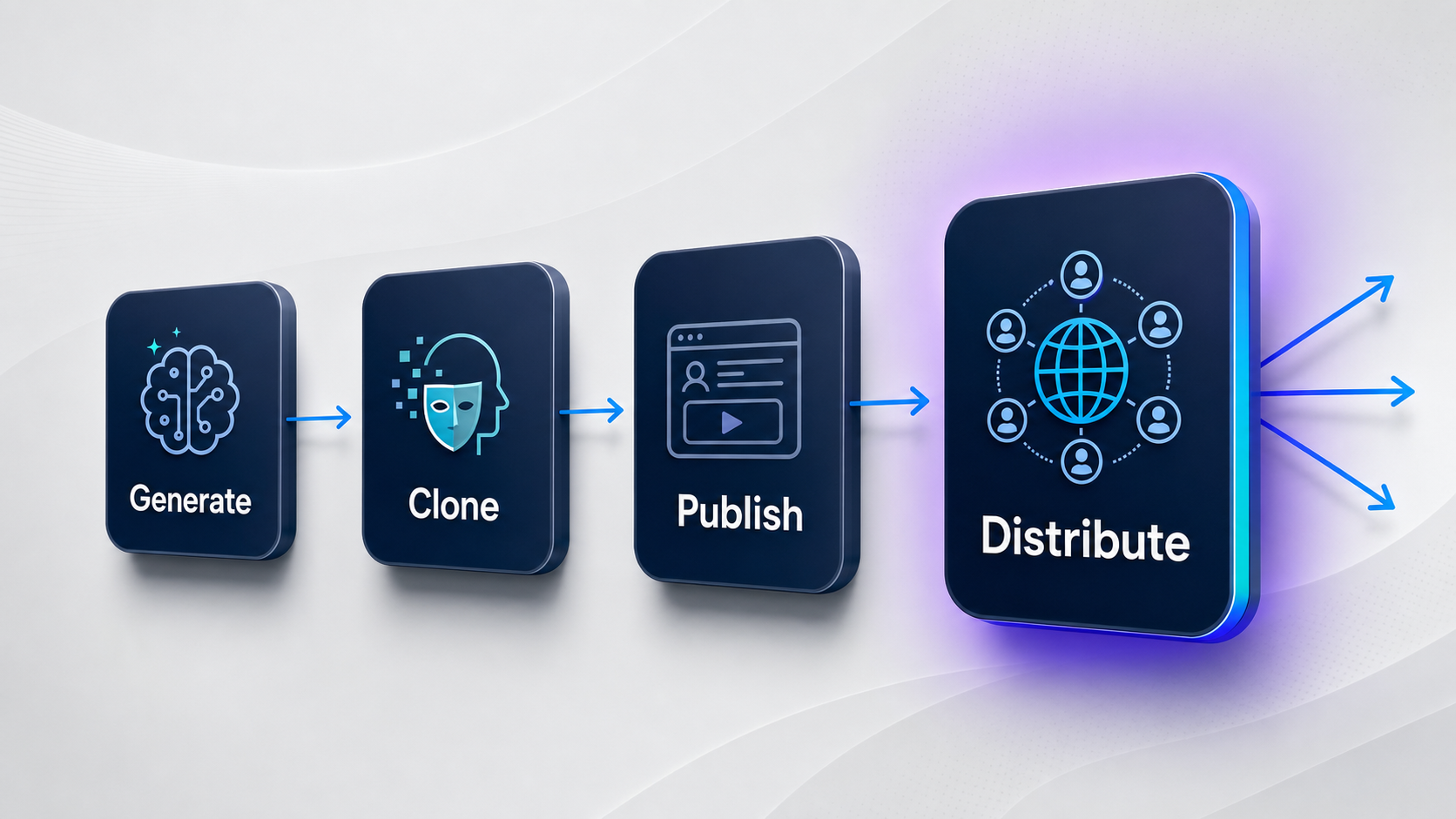
Break the attack into four stages.
Step 1: Generate the Content
AI writes the convincing emails, landing-page copy, social replies, ad text, and call scripts. It matches your tone, uses your product vocabulary, and reads like your real marketing. The old tell of broken English is gone.
Step 2: Clone the Assets
Logos, screenshots, support-page layouts, executive bios, and product descriptions get lifted or regenerated to look authentic. A login page can be a near-perfect copy of yours, down to the footer links.
Step 3: Publish the Infrastructure
Lookalike domains, disposable hosting, fake social handles, cloned app-store listings, and paid search ads spin up in hours. Because the hosting is cheap and disposable, the attacker can afford to lose half of it to takedowns and still profit.
Step 4: Distribute and Test
The campaign goes out across email, SMS, social DMs, comments, search ads, and even support channels. Attackers run variations until one converts, then scale the winner. Each version can look slightly different, which is exactly what defeats a static keyword block.
The throughline: AI reduces effort, multiplies variation, and makes detection harder because no two fakes have to be identical. You are not chasing one fake. You are chasing a moving set of them.
Common Forms and Channels of AI Brand Impersonation
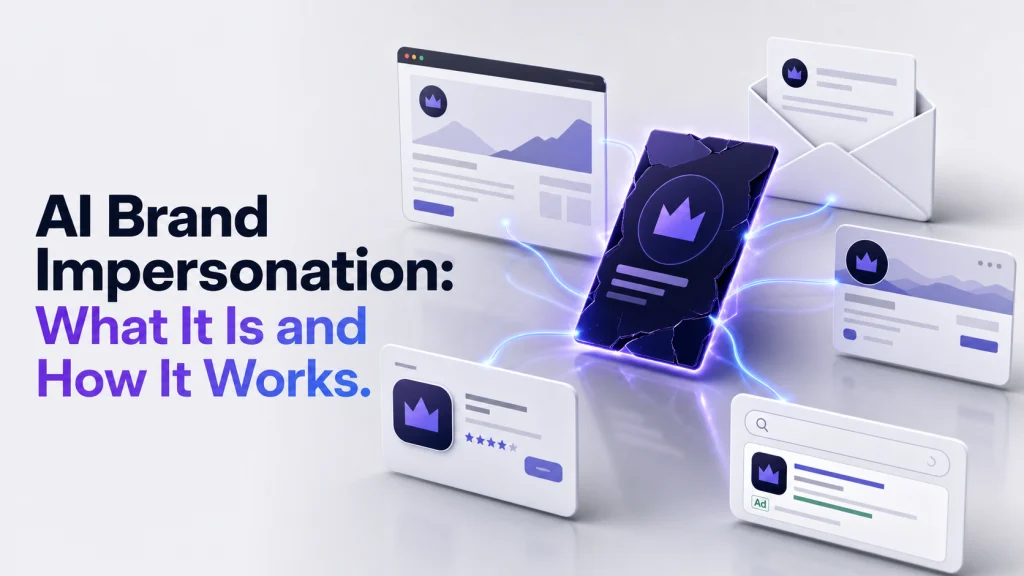
AI brand impersonation takes a handful of recognizable forms, and each one exploits a specific trust signal. Knowing the signal being abused is the fastest way to spot the fake, because the giveaway is usually a context mismatch, not bad grammar.
| Form | Trust signal abused | Most common victim action |
|---|---|---|
| Fake websites | Logo and layout familiarity | Entering login or payment details |
| Email impersonation | Channel authority and urgency | Clicking a link or paying an invoice |
| Social media cloning | Expectation of fast brand replies | Sending a DM with account details |
| App-store fraud | Store legitimacy and brand cues | Installing an app and granting access |
| Paid search deception | Top-of-results authority | Following an official-looking ad |
| Deepfake audio or video | Perceived insider access | Approving a request under pressure |
Fake websites
Lookalike landing pages, login portals, checkout pages, and support centers built to harvest credentials or payments. They reuse your visual identity so closely that a quick glance never catches them.
Email impersonation
AI-written messages that mimic your support tone, invoices, security alerts, or executive outreach. The polish is the problem: these read like something your real team would send.
Social media cloning
Fake brand accounts, executive impersonation, cloned bios, and reply hijacking on platforms where customers expect quick interaction. A scammer who replies faster than your real team can intercept the conversation. Catching these early is why so many teams lean on social media monitoring tools that surface new accounts using your name.
App-store fraud
Fraudulent apps or tool listings that borrow your brand cues to look official and then collect logins or device data. The store’s own legitimacy lends the fake an authority it has not earned.
Paid search deception
Ads that imitate your official campaigns and route users to scam pages or affiliate traps. The top-of-page position reads as endorsement, which is exactly the signal being abused.
Deepfake audio and video
Synthetic calls or videos that imitate a support rep, executive, or spokesperson to manufacture urgency and legitimacy. A cloned voice on a phone call removes the hesitation a suspicious email would trigger.
Across all six, the modern detection lens is the same. Stop looking for spelling errors. Start looking for context that does not fit: a domain that is almost right, a request that breaks your normal process, a channel your brand does not use for that message.
Misconceptions That Weaken Defenses
The assumptions that leave teams exposed are usually the comfortable ones. They made sense five years ago and quietly stopped being true.
The first is that poor spelling and clumsy grammar give the scam away. AI-generated content is polished and context-aware now. A flawless email is not proof of legitimacy, and waiting for an obvious mistake means you miss the first wave of fraud entirely.
The second is that only large, famous brands get impersonated. Smaller and mid-market brands are often more attractive targets precisely because their defenses are thinner and their customers do not expect to be impersonated. Trust is the target, and a regional brand’s customers trust it just as much as a global one’s.
The third is that spam filters and one-off keyword blocks are enough. They are not, because attackers rotate content, domains, and formats constantly. A block that catches today’s fake misses tomorrow’s variant. Email hygiene is a baseline, not a solution.
The fourth, and the most expensive, is treating this as an email problem. Brand impersonation is a cross-channel identity and trust problem. A fake support account on social, a cloned app, and a deceptive search ad never touch your inbox. A real defense covers monitoring, verification, takedown, and customer communication, working together, not just a sharper spam rule.
See where AI answers put your brand
Twenty minutes with a senior strategist: where the major engines point buyers in your category, who gets named instead of you, and a straight read on what a programme would change.
Book a strategy callHow Organizations Detect and Reduce Exposure
You reduce exposure by building a cross-functional response, not by buying one tool and calling it done. Effective defense depends on speed and coordination, because the damage happens in the window before takedown. Here is the workable model.

Step 1: Monitor Externally
Watch beyond your own systems. Scan domains, social platforms, app stores, search ads, and messaging channels for assets using your name or visual identity. The attack lives outside your perimeter, so your visibility has to as well. Many teams run this through dedicated brand tracking tools that flag new mentions and lookalike assets.
Step 2: Verify Identities
Set clear rules for what is real. Publish your approved domains, list your official social handles, and use callback procedures for any sensitive request. Train internal teams and tell customers where your brand actually lives, so a fake stands out.
Step 3: Escalate Fast
When you find a fake, capture evidence immediately: screenshots, URLs, timestamps, and the hosting details. Have your escalation path mapped before you need it, so nobody loses an hour figuring out who to call.
Step 4: Remove the Asset
Report to the registrar, hosting provider, or platform, and route legal review where it is needed. Takedown readiness is the difference between hours and weeks, and hours is what protects your customers.
Step 5: Inform Your Customers
Tell people the fake exists and what your real channels are. A short, clear notice cuts the scam’s conversion rate and rebuilds the trust the impostor tried to spend.
One control set worth naming directly: SPF, DKIM, and DMARC are email authentication standards that make it harder to spoof your domain. Treat them as baseline email hygiene, not a complete answer, because they do nothing for a fake social account or a cloned app.
The detection signals that matter most are asset reuse, domain similarity, suspicious publisher history, unusual ad behavior, and identity overlaps that should not exist. And the work spans teams. Brand, fraud, security, legal, and support all pull from one response plan, because a fake that fools customers is everyone’s problem at once.
Treating Impersonation as Ongoing Operational Risk
AI brand impersonation is a scalable trust attack, not a spam problem you clean up once. It spans websites, email, social, apps, ads, and synthetic voice and video, and it moves faster than any single takedown.
The defense holds when four things run together: monitor externally, verify identities clearly, respond quickly, and keep brand, security, and legal aligned on one plan. The brands that stay protected are the ones treating impersonation as a standing operational risk, the same way they treat fraud or downtime.
The threat is only getting cheaper and more convincing to run. Acting now is what keeps your customers, and your name, on the right side of it. Review your brand touchpoints today, across every channel, so you can spot impersonation before your customers do.
Frequently Asked Questions
What is AI brand impersonation?
AI brand impersonation is the use of generative AI or synthetic media to pose as a real brand, executive, or support team in order to steal trust and then credentials, payments, or data. AI generates the convincing copy, cloned assets, and adaptive messages that make the fake believable across email, websites, social, apps, and ads.
How is AI brand impersonation different from phishing?
Phishing is the broad tactic of tricking someone into giving up sensitive information, while brand impersonation is the specific disguise that often carries it. You can have phishing with no brand involved, and you can have impersonation that never sends an email, such as a fake social account or a cloned app. Impersonation is the identity layer, phishing is one delivery method.
Can small businesses be targeted by AI brand impersonation?
Yes, and they often are. Smaller and mid-market brands make appealing targets because their defenses tend to be thinner and their customers do not expect them to be impersonated. The attack runs on trust, and a regional brand’s customers trust it as much as a household name’s, which is exactly what a scammer needs.
What are the most common signs of a fake brand account or website?
The reliable signs are context mismatches, not spelling errors. Watch for a domain that is almost right but slightly off, a request that breaks the brand’s normal process, an urgency that pressures you to skip verification, or a channel the brand does not usually use for that kind of message. Polished writing is no longer a sign of legitimacy.
How do you report or remove a fake brand impersonation page?
Start by capturing evidence: screenshots, the full URL, timestamps, and any hosting details. Then report the asset to the relevant party, the domain registrar or host for a website, the platform for a social account, or the app store for a fraudulent app, and route legal review where the case needs it. Speed matters most, so having the escalation path mapped in advance is what keeps a takedown to hours instead of weeks.