
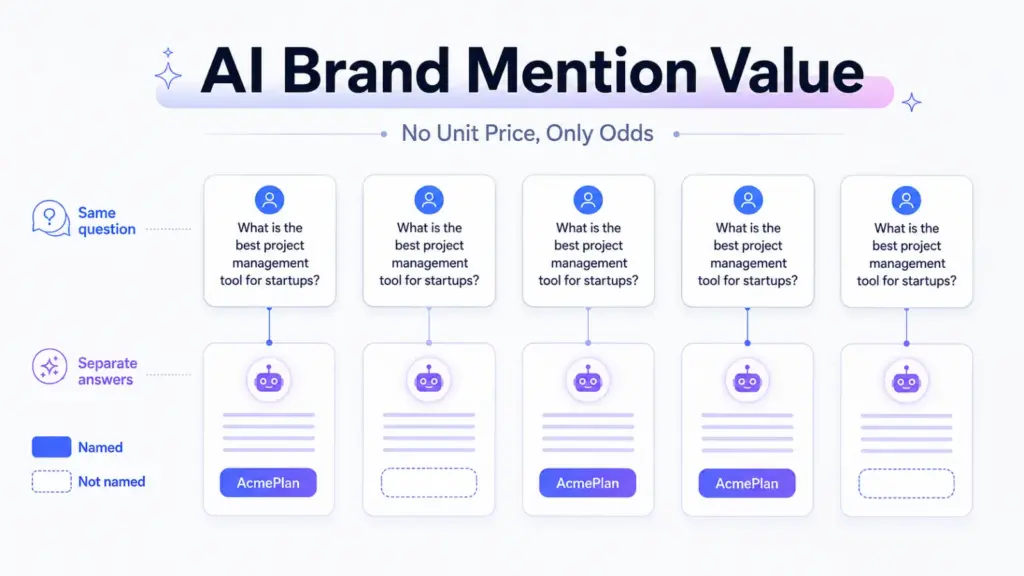

Ask what an AI brand mention is worth and you expect a figure back. There isn’t one, because the mention isn’t a thing you own.
It’s an event inside an answer a model builds on the spot. Run the same prompt tomorrow and the answer can name someone else.
That’s why AI brand mention value resists the single number buyers want. What you can price is the placement that causes mentions. What you can measure is how often they happen, and to whom.
Quick Summary
- An AI brand mention is an event in a generated answer, not an asset sitting on a page.
- The placement that earns the mention carries the only price a market sets.
- Value depends on the question behind the answer, not on the mention count.
- Prompt coverage and citation share are numbers you own, not rates you can look up.
Why an AI Brand Mention Has No Fixed Price
It has no fixed price because the mention is produced at the moment someone asks, not stored anywhere in between.
A backlink is a durable artifact. Someone published it, it sits in the page source, and you can open the page a year later and find it still there.
An AI mention works the other way. The assistant assembles its answer from whatever it retrieves in that second, so the same question can name you on Monday and skip you on Tuesday.
Nothing changed on your side. The retrieval did.
One question also rarely triggers one search. Assistants break it into separate retrievals, a behaviour called query fan-out. Your brand can win some of those and lose the rest inside one answer.
You aren’t buying a slot. You’re raising the odds that the retrieval finds you.
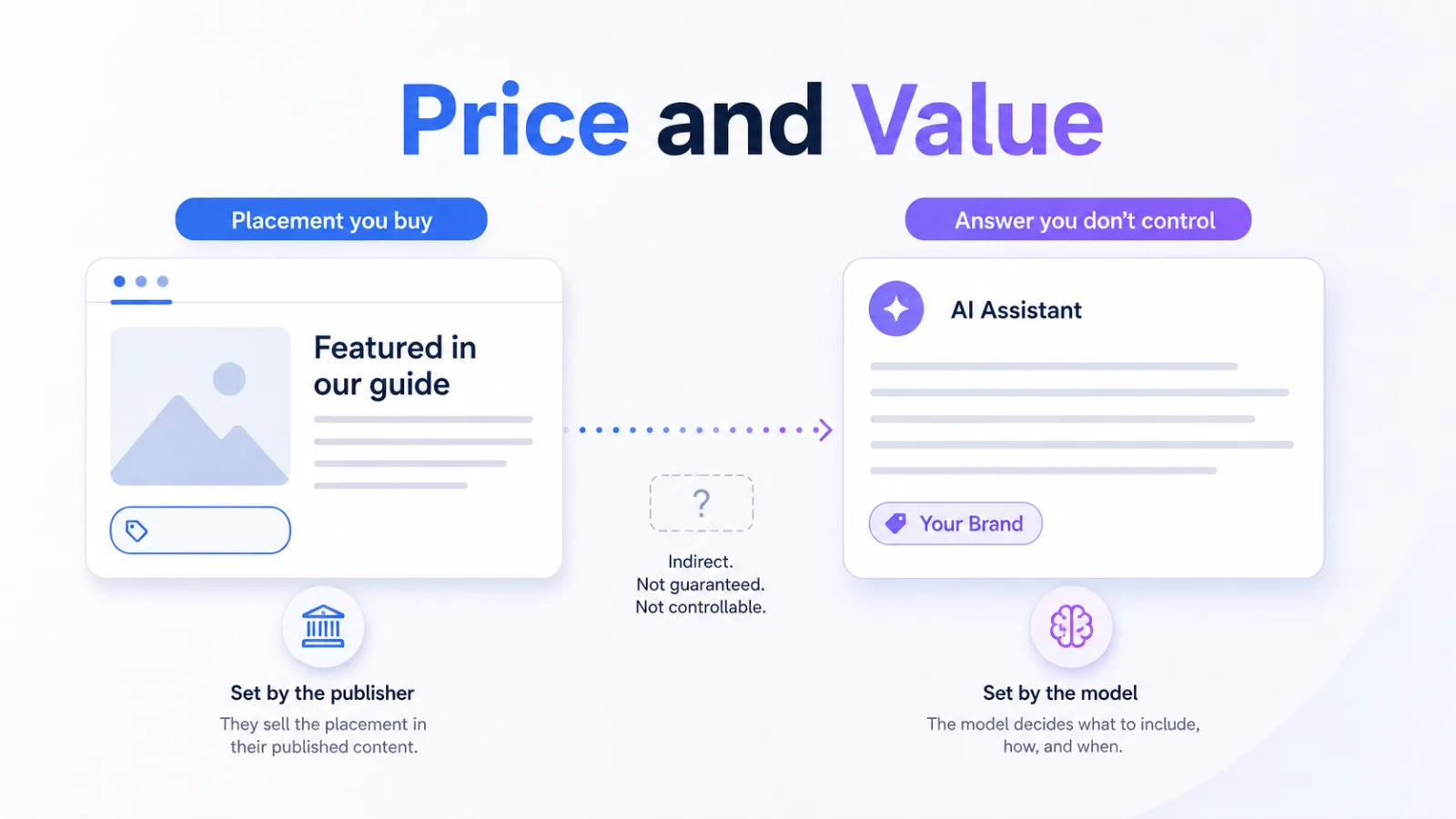
Price and Value Are Two Different Numbers
Buyers use the words interchangeably, and the confusion is expensive.
Price is what a placement costs. An article on a publication assistants retrieve often, a listicle entry, a commissioned data study: those carry market rates. You can get quotes for them.
Value is what being named in that answer does for you. It depends on who asked, what they were deciding, and whether the answer sent them anywhere.
The two come apart fast. A cheap placement inside the question your buyers ask beats an expensive one nobody’s assistant reads.
| The question | What it measures | Who sets it |
|---|---|---|
| What does it cost to get mentioned? | The price of the placement | The publisher or the agency |
| What is the mention worth? | The decision it moves | Your own funnel |
| How often am I mentioned? | Coverage across the prompts you care about | Your measurement setup |
Only the first row has a market rate. Our brand mentions service pricing breakdown covers what that side of the trade costs.
What Decides Whether a Mention Is Worth Anything
Four things move the number, and mention volume isn’t one of them.
The Question Behind the Answer
A mention inside “best tools for X” reaches somebody choosing. A mention inside “what is X” reaches somebody reading.
Same mention, different worth. Buying-stage questions are where the value sits, and they’re a small slice of the questions your category attracts.
How You Get Named
Being listed among five options is weaker than being the recommendation. Being the recommendation is weaker than being the recommendation with a reason attached.
Read the answer, not the alert. A monitoring tool that counts mentions treats all three as one.
Whether the Source Gets Retrieved
The placement only pays if the assistant pulls that page when the question comes up. Publications differ enormously here, and the gap doesn’t track their traffic.
That’s the part worth diligence before you buy, and it’s the part most placement pitches skip.
What the Answer Says About You
A mention can hurt. If the model names you as the expensive option or the one for enterprise buyers, it’s shaping the decision away from you.
Whether mentions affect AI visibility is settled enough; whether yours help you is a separate question you have to read for yourself.
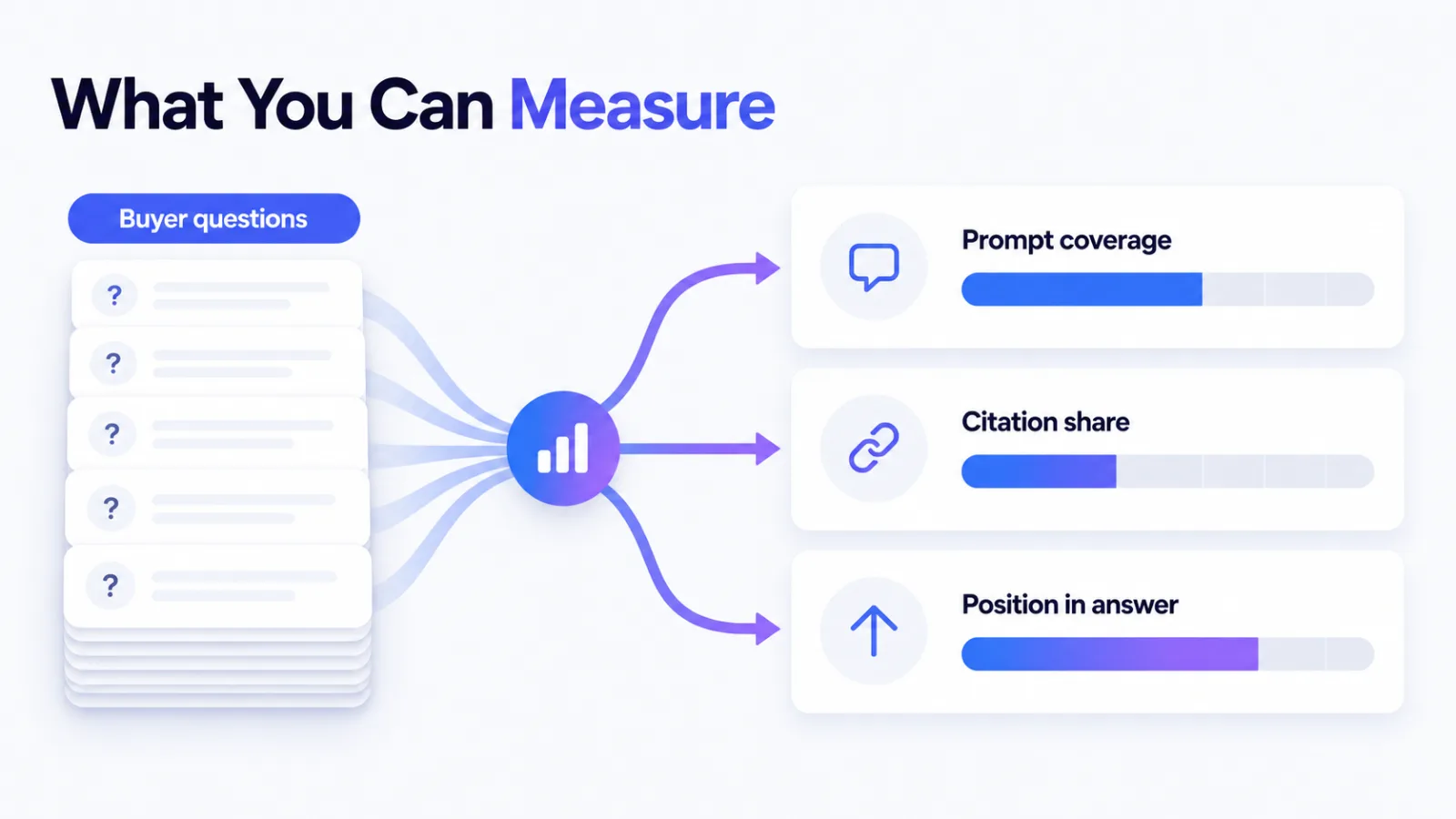
What You Can Measure Instead
Three numbers replace the price you can’t get. All three are yours, produced by your own testing rather than quoted by a vendor.
Prompt Coverage
Prompt coverage is the share of the questions you care about where your brand appears at all.
Build the list first: 20 to 40 questions a real buyer would type, weighted toward the ones asked close to a decision. Coverage against a list you invented tells you nothing.
Citation Share
Citation share is how often your own domain is the source the answer cites, out of all the sources it cites in that answer set.
It matters because a citation sends traffic and a bare name doesn’t. Both count as mentions, and they’re worth different amounts.
Position in the Answer
Where you land inside the answer decides how much of the mention the reader takes in. First option named and last option named are not the same result.
You can track brand mentions in AI search across all three of these on a fixed schedule, which is what makes the movement readable.
How to Put a Number on It Anyway
You get there by working backwards from a decision, not forwards from a mention.
Pick one question family that maps to a real buying decision in your business. Something a prospect types when they’re close to choosing.
Measure how often you appear in the answers to it. Then take what one of those decisions is worth to you when it goes your way.
Those two multiplied together is your working number. It’s yours, it moves, and it beats any figure quoted as an industry average.
Run it again next quarter. If coverage rises and nothing else changed, you’ve learned what the placements bought.
Frequently Asked Questions
Can you buy an AI brand mention directly?
No. You buy a placement the model might retrieve, and the mention follows or it doesn’t. Anyone selling a guaranteed mention inside a named assistant is selling something they can’t control.
Is an AI brand mention worth more than a backlink?
They do different jobs. A backlink is a durable signal you can audit, and a mention is exposure at the moment somebody asks. The mention is worth more when the question sits close to a purchase, and worth less when it doesn’t.
Do unlinked AI mentions carry any value?
Yes. A mention without a link still puts your name in front of the person reading the answer, and it feeds the entity signals models lean on later. It won’t show up in your referral traffic, though.
What should I pay for a placement that drives mentions?
It depends on the publication and the work behind it, which is why quotes vary so widely. Price the placement on its own merits, then judge it afterwards on the coverage it produced.
How often should I re-measure?
Quarterly is enough for most brands, monthly if you’re running placements continuously. Measuring weekly mostly records model noise, and you’ll read it as movement when it isn’t.
Start With One Question Family
Take the question your best customers ask right before they buy. Run it five times in the assistant they use and write down whether you’re named, how, and who else is.
That’s your baseline, and it costs an afternoon. It’s worth more than any published figure on what a mention is worth, because it’s the only one measured on your business.