
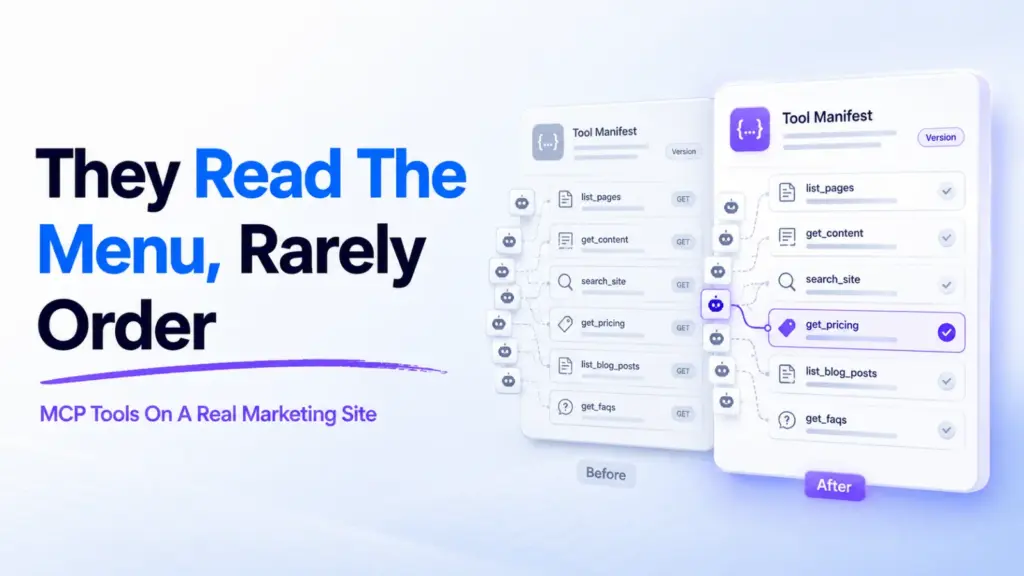

You’ve probably been told that AI agents are about to start using your website’s tools instead of reading its pages.
We shipped the tools to find out. The agents showed up, read what was on offer, and left.
Over 75 days, 4,457 distinct clients fetched our MCP tool manifest and 21 ever called a tool. That’s under half a percent.
The case for MCP for SEO and GEO teams is instrumentation, not traffic. It gives you a log of what agents ask for. It does not give you visitors.
Discovery is solved. Invocation isn’t close.
What We Put On the Site
We exposed a set of MCP tools on a working marketing site, not a demo, and logged every request against them.
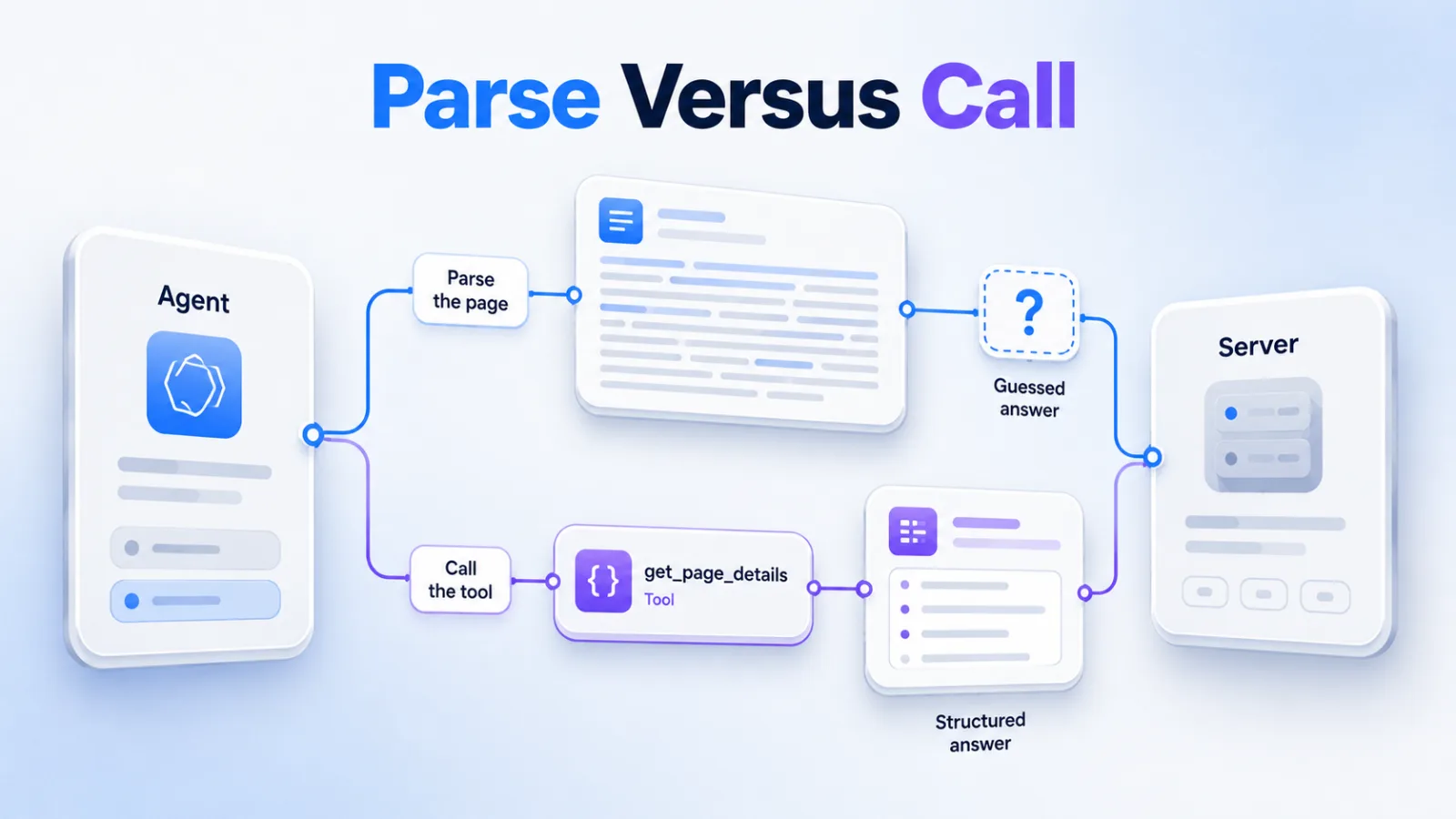
MCP is a protocol that lets a model call a function on your server instead of parsing your pages. Rather than reading a pricing page and guessing, an agent asks for the pricing tiers and gets structured data back.
Ours cover the things a buyer asks about: services, industries, pricing tiers, programme details, publication network, case stats, engagement rules, and a search across our FAQs.
Thirteen of them got called at least once. The manifest that lists them sits at a fixed endpoint, which is how an agent discovers what’s available.
What 75 Days of Logs Say
The manifest gets hammered and the tools sit idle.
| Event | Count | Distinct clients |
|---|---|---|
| Tool manifest fetched | 9,997 | 4,457 |
| Pages read normally | 14,595 | 2,236 |
| Tool called | 77 | 21 |
Read the middle row first. More distinct clients fetched the tool manifest than read our pages, so this isn’t a handful of bots poking an endpoint. Discovery is genuinely broad.
One caveat worth stating plainly: a single client accounts for 1,873 of those manifest fetches, or 19%. That’s why the distinct-client count is the number to trust, and the raw event ratio isn’t.
Even after discounting it, the shape holds. Thousands discovered the tools. Twenty-one used them.
Why the gap is this wide
It’s this wide because reading a manifest is free and calling a tool is a decision.
A crawler fetching your manifest is doing what crawlers do. Calling a function means an agent is mid-task, has decided your tool answers its question, and is willing to spend a step on it. Almost nothing is at that stage yet.
The other half is that most agents hitting a marketing site aren’t agents at all. They’re training crawlers, and a training crawler has no task to complete. We broke that split down in reading your own server logs.
There’s a third reason, and it’s the one people miss.
An assistant answering a question doesn’t visit one site and interrogate it. It issues a spread of searches and synthesises whatever comes back, which is query fan-out.
A tool call needs the agent to be committed to you already. Fan-out is built to avoid committing to anyone.
The 77 Calls Are More Useful Than the Number Suggests
Small as it is, the call log is the highest-quality intent data on the site.
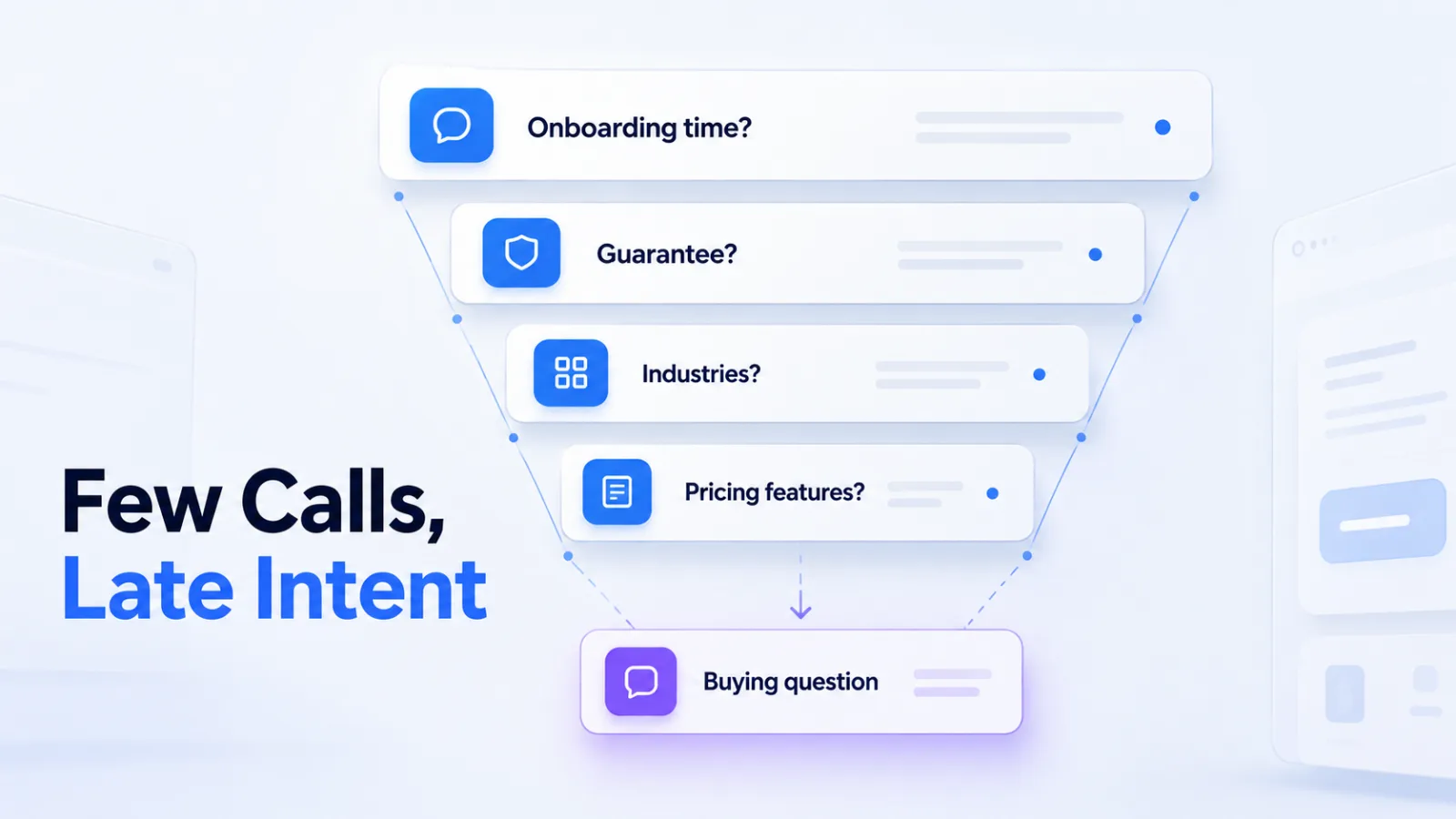
Our FAQ search tool records what was asked. Over the same window the queries were “how long does onboarding take” three times, “industries” twice, “guarantee” twice, and “pricing tier features” once.
Nine questions, and every one of them is a late-stage buying question.
Nobody asked what a backlink is. They asked how long onboarding takes and whether there’s a guarantee, which is what a person asks when they’re deciding, not researching.
Compare that to organic search, where the same site collects tens of thousands of impressions from queries that never convert. Nine tool calls told us more about buyer hesitation than a quarter of Search Console did.
What we changed because of it
The onboarding question came up more than any other and had no direct answer anywhere on the site. We added one to the pricing page.
That’s a real edit, driven by nine data points, on a channel most teams haven’t instrumented.
Should an SEO or GEO Team Ship MCP Now
Ship it if the cost is a day and you want the instrumentation. Don’t if you’re expecting traffic.
The honest case for doing it now is that it’s cheap, it’s reversible, and the logs it produces are useful immediately even when call volume is near zero.
The case against is that anyone promising agent traffic from MCP this year is selling something our own numbers don’t support.
There’s also a measurement trap here. Tool calls tell you what agents asked your server, and they tell you nothing about whether you got named in the answer. Those stay separate problems, and the second one still needs the method in tracking brand mentions in AI search.
Priority order for a small team
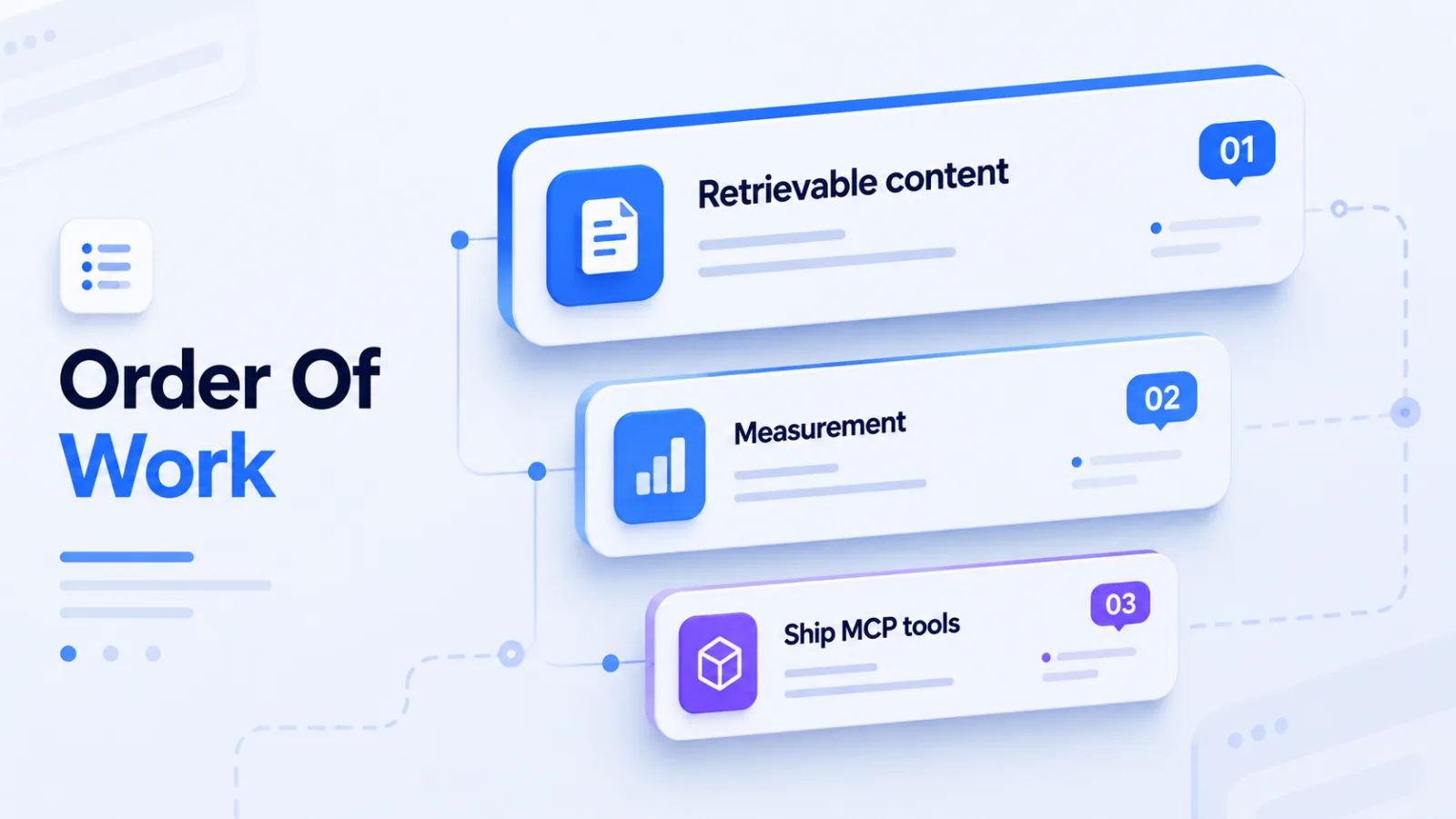
MCP sits below the basics and above nothing.
If your pages aren’t being retrieved at all, MCP fixes none of that. The work that does is covered in how AI crawlers pick sources.
Ship MCP after your content is retrievable, not instead of making it retrievable.
The same ordering applies to tooling budgets. Money spent on tools for ChatGPT brand mentions buys you visibility data you can act on this quarter. Money spent on MCP buys you a log that gets interesting later.
What We’d Do Differently
We’d have instrumented the manifest from day one, because the discovery number turned out to be the interesting one.
We’d also have built fewer tools. Thirteen got called at all, and the top four carry most of the volume. The rest were speculative, and speculative tools are how you end up maintaining an interface nobody queries.
Build the four a buyer would ask about. Add more when the log tells you to.
And we’d have separated the manifest from the file-based standards earlier. Those are a different mechanism with a different audience, set out in llms.txt vs robots.txt.
Frequently Asked Questions
Is MCP worth it for a small marketing site
Only if you treat it as instrumentation rather than a traffic channel.
A day of work buys you a log of what agents ask for, which nothing else on your site records. Expect near-zero call volume for now and you won’t be disappointed.
Does exposing MCP tools help my rankings
No. There’s no evidence MCP availability affects classic rankings or AI citation rates, and our own data can’t test it either.
Treat it as a separate surface, not an SEO tactic wearing a new name.
How is MCP different from llms.txt
llms.txt is a file an agent reads. MCP is a function an agent calls.
One hands over text and hopes it gets used. The other answers a specific question with structured data and records that it was asked.
Why did more clients fetch the manifest than read the pages
They did because manifest endpoints are cheap to poll and get picked up by scanners that never render a page.
It also means discovery isn’t the bottleneck. Whatever is holding agent tool use back sits after discovery, not before it.
Can I see which agent called a tool
Partly. We could attribute 5 of our 77 calls to a named agent and the rest arrived unlabelled.
Plan for weak attribution, and don’t build reporting that assumes you’ll know who called.
Ship Four Tools, Not Thirteen
Pick the four questions a buyer asks right before they choose you. Expose those as tools, log every call, and leave the rest.
You won’t get traffic from it this year. You’ll get a short list of the questions agents ask on your behalf, which is worth more than the call count suggests.
If you’d rather have that instrumented alongside the citation work itself, that’s what our enterprise citations programme covers.