
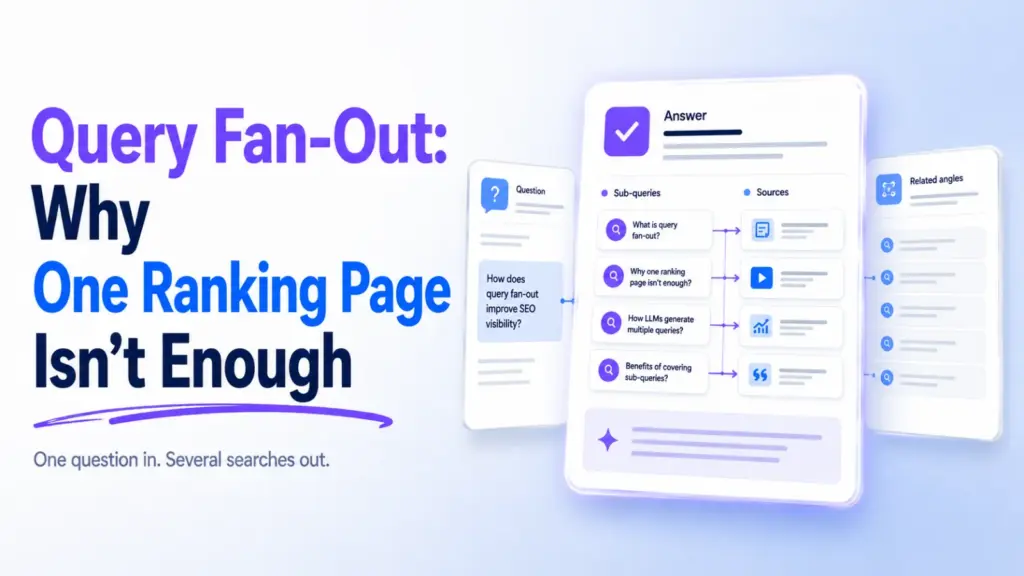

You rank for the exact phrase. The AI assistant still recommends someone else.
That gap is rarely a ranking problem. It’s a fan-out problem.
Query fan-out is what happens when an AI search system takes one question and splits it into related searches. It runs those in parallel and writes one answer from whatever comes back.
Google has publicly described this technique as part of how AI Mode works.
You aren’t competing for the question the user typed. You’re competing across every sub-question the system generated on their behalf.
The Short Version
- One typed question becomes multiple machine-generated searches before anything is retrieved.
- You can be the top source for the original phrase and absent from every sub-query.
- Fan-out is why two near-identical prompts return different brands.
- Coverage across sub-questions beats depth on one exact phrase.
- You can observe it directly by asking the same buying question five different ways.
What Query Fan-Out Is
Query fan-out is a retrieval technique. The system decomposes a question into narrower searches, runs them across subtopics and sources, then synthesises the results into one answer.
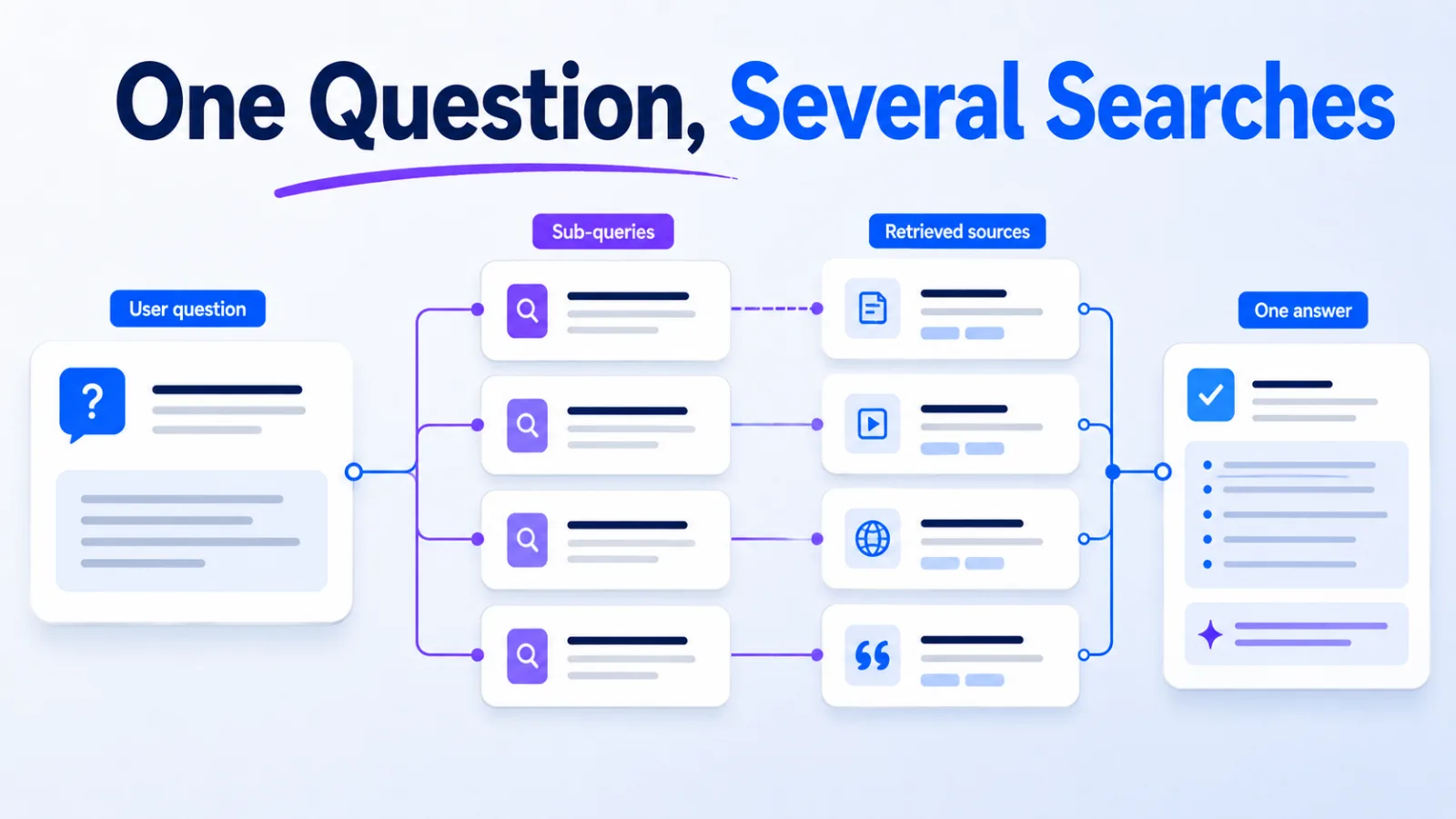
Ask “what’s the best way to track brand mentions in AI answers” and the system doesn’t run that string. It runs the pieces.
Something closer to: what tools track brand mentions, how do AI answers cite sources, what is AI visibility monitoring, how do you measure share of voice in ChatGPT.
Each of those pulls its own set of sources. The answer is assembled from the union.
Why the system does this
It does this because a single query returns a single slice of the index. Several narrower queries return a wider, more reliable set, which matters when the output is one synthesised paragraph rather than ten links a person can judge for themselves.
It’s a quality mechanism. It also breaks how most teams think about keywords.
Why This Breaks Keyword-Level Thinking
It breaks because keyword-level thinking assumes a one-to-one relationship: one query, one results page, one position you either hold or don’t.
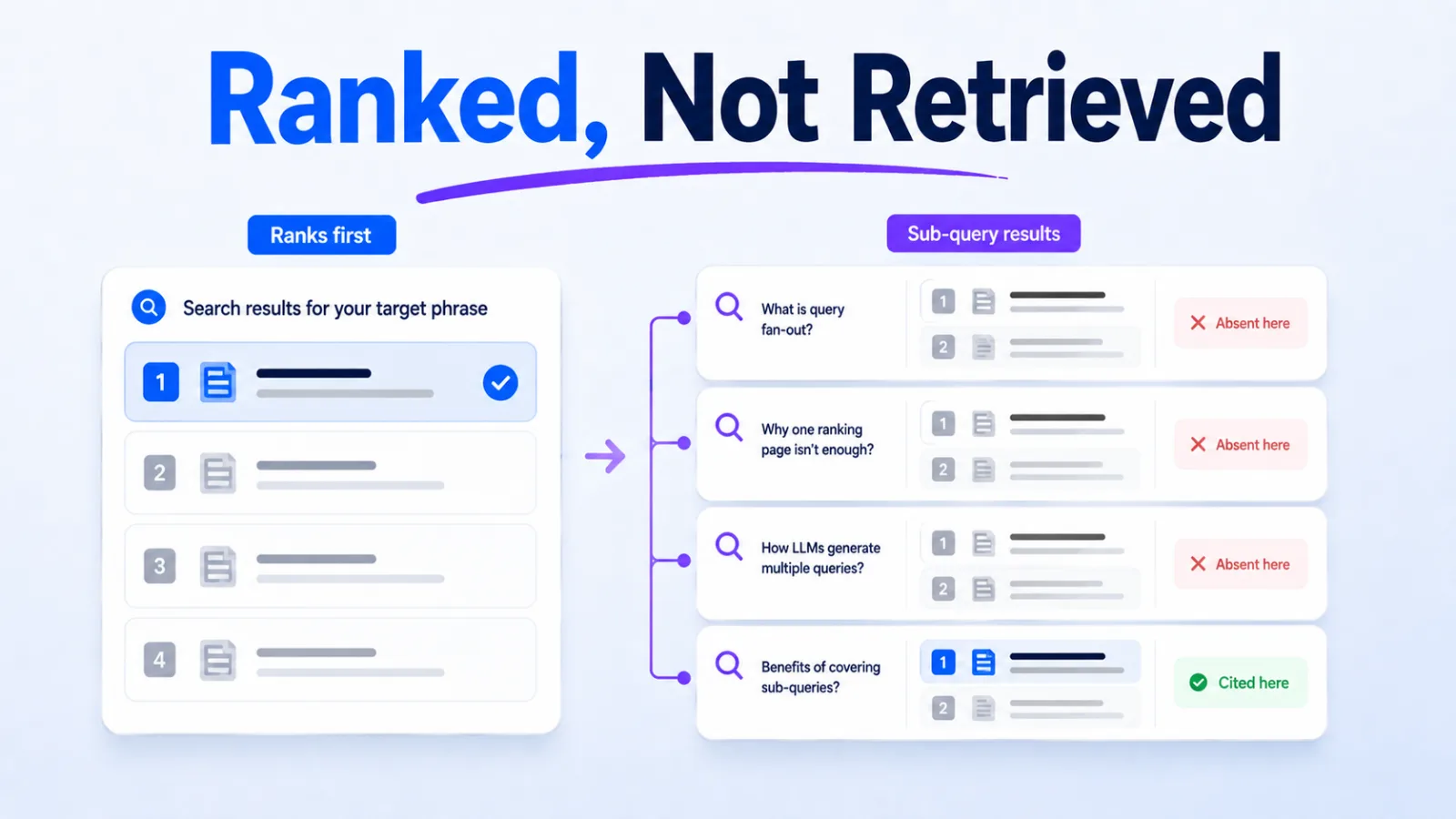
Fan-out makes that one-to-most. Your page has to be retrievable for sub-questions nobody typed and you never targeted.
You can rank first and still be invisible
Being the top classic result for the parent phrase does not guarantee you appear in any of the generated sub-queries.
Those sub-queries often skew more specific, more comparative, or more procedural than the phrase a person typed. If your page only answers the headline question, it has nothing to offer the fan-out.
Two people asking the same thing get different answers
This is the part that confuses teams monitoring their own visibility.
Small differences in phrasing produce different decompositions, which produce different retrieved sets, which produce different brands in the answer. The variance isn’t random and it isn’t a bug. It’s fan-out doing its job.
We covered what that means for measurement in SEO vs GEO.
How to See Fan-Out on Your Own Category
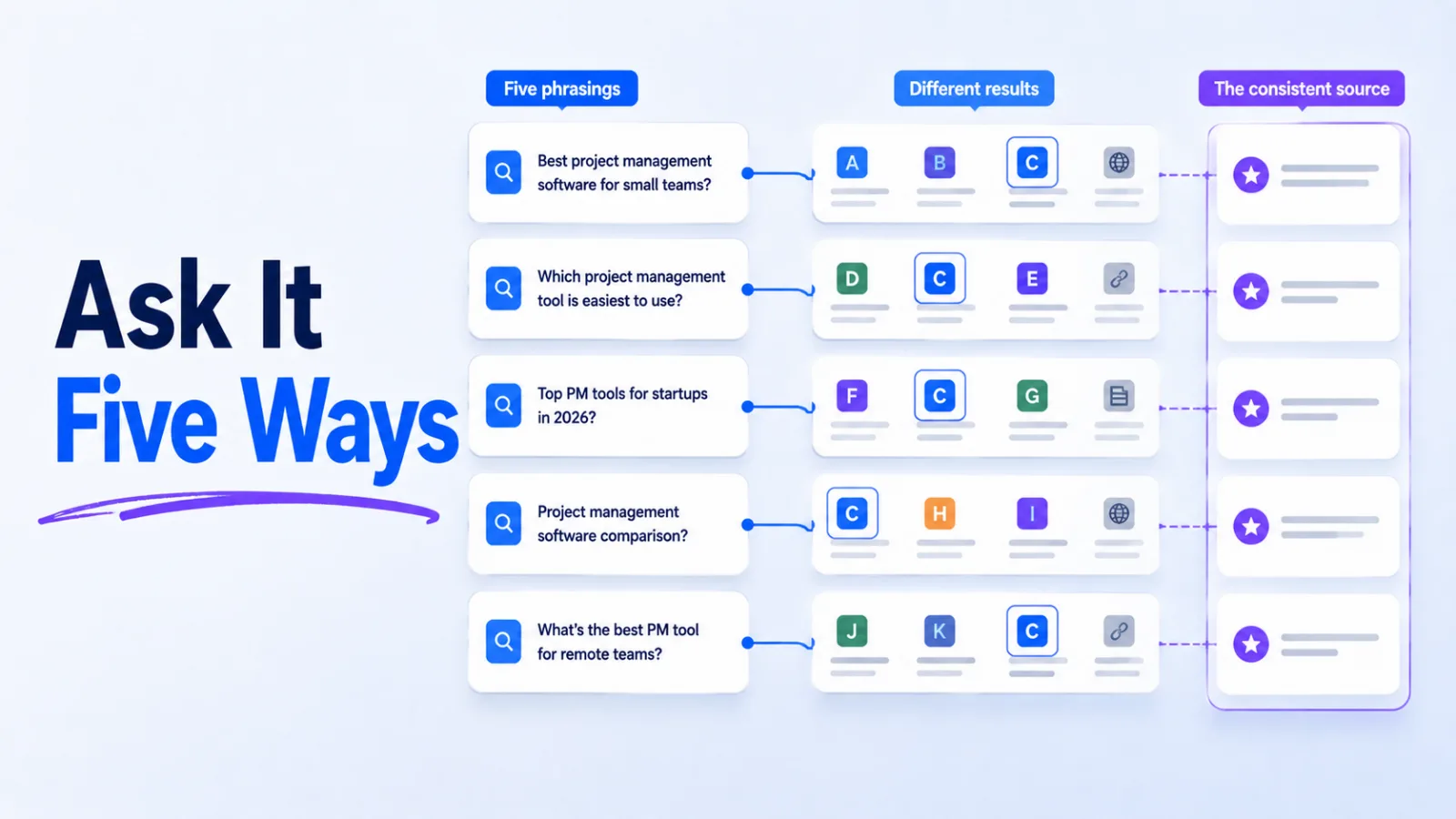
To see fan-out working, take one buying question and ask it five ways, then compare which sources appear each time.
Write the parent question the way a buyer would
Not your keyword. The sentence a person would say out loud when describing their problem.
Rephrase it five ways without changing the intent
Change the wording, the specificity, and the framing. Ask it as a comparison, as a how-to, as a recommendation request, as a problem statement.
Record who gets cited, not whether you do
The competitor appearing in four of five runs tells you something your rank tracker never will.
Look at what the cited pages have in common
Usually it’s specificity. Pages answering a narrow question completely get pulled into more decompositions than pages covering a broad topic shallowly.
What to Do About It
Cover the sub-questions, not the headline
A page that answers one question well is retrievable for one thing. A page that answers its obvious follow-ups in their own clearly headed sections is retrievable for each of them.
This is the practical argument for real heading structure over walls of prose. Each section becomes independently retrievable.
Make each answer stand alone
A passage pulled out of context has to still make sense. If a section only reads correctly after the two sections above it, it won’t survive extraction.
Stop optimising for one phrasing
Exact-match targeting was already weak. Under fan-out it’s counterproductive, because the phrase you optimised for may never be among the queries run.
Build coverage across a cluster, not depth on one page
A cluster of pages each owning one sub-question outperforms one page trying to own the parent. That’s the same logic as topical clustering, with a sharper reason behind it.
The mechanics of what gets retrieved are covered in how AI crawlers pick sources.
What Fan-Out Doesn’t Mean
Worth being straight about the limits, because this concept attracts overclaiming.
It isn’t a ranking factor you can optimise directly
There’s no fan-out setting. You can’t see the generated sub-queries, and no tool has access to them.
Anyone selling you a “fan-out optimisation” service is selling inference dressed as measurement.
It doesn’t make keywords useless
Keywords still describe demand. They’ve stopped describing the retrieval unit, which is a different claim.
It doesn’t replace the fundamentals
A page that can’t be crawled can’t be retrieved for any sub-query. Fan-out changes what you cover, not whether the basics matter.
Frequently Asked Questions
Is query fan-out the same as semantic search
No. Semantic search is about understanding what a query means. Fan-out is about issuing multiple queries instead of one.
They work together, and they’re separate mechanisms.
Can I see the sub-queries a system generates
Not directly. They aren’t exposed in any interface or tool.
What you can do is infer the shape of them by rephrasing a question repeatedly and watching which sources appear consistently.
Does fan-out happen in every AI answer
It depends on the system and the complexity of the question. Google has described it as part of AI Mode, and simple factual lookups don’t need it.
Assume it’s happening for anything comparative, exploratory, or recommendation-shaped, which is most commercial intent.
How many sub-queries does one question generate
Nobody outside those systems knows, and any specific number you see quoted is a guess.
The useful framing is that it’s more than one and varies by question, which is enough to change what you do.
Should I create a page for every sub-question
No. That’s how sites end up with dozens of thin pages competing with each other.
Cover sub-questions as clearly headed sections inside a strong page, and give a sub-question its own page only when it’s a genuine standalone intent.
Ask Your Buying Question Five Ways
Take the one question a customer asks right before they choose a vendor.
Ask it five different ways in ChatGPT and Google’s AI Mode this week. Write down every brand cited each time.
The brands appearing in four or five runs are the ones the fan-out keeps finding. That’s your real competitive set, and it’s rarely the one in your rank tracker.