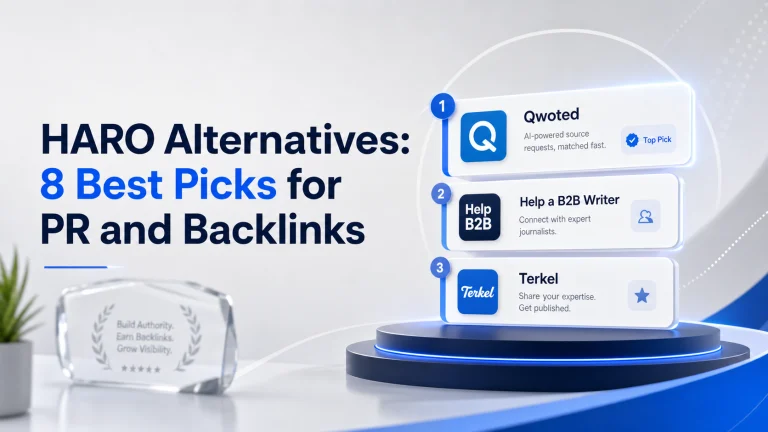
A HARO outreach service gets your experts in front of journalists who are asking for sources, either through a request platform you monitor yourself or a managed team that pitches for you. For most teams, Qwoted is the strongest platform, Source of Sources is the best free option, and PressHERO is the pick if you want it fully managed.
ResponseSource leads for UK and European PR, and Help a B2B Writer wins on SaaS relevance. HARO itself isn’t one obvious destination anymore, so the real decision is matching speed, geography and workflow to your team.
The list below ranks ten options across self-serve platforms and done-for-you services, with pricing notes and best-for labels so you can shortlist fast.
What is a HARO outreach service?
A HARO outreach service connects your brand to reporter requests, expert roundups and reactive PR opportunities where journalists are looking for sources right now.
The original Help a Reporter Out platform shut down and its brand moved to Featured.com, so the market split into two camps: self-serve request platforms you monitor yourself, and managed outreach services that pitch on your behalf.
The practical outcome you’re buying is the same across both: brand mentions, editorial links, and media coverage that also feed AI search trust signals. What changes is who does the work.
A free platform rewards a team that checks requests daily. A managed service earns its fee when in-house bandwidth is the bottleneck.
The best service fits your speed, geography and workflow, not the loudest brand name. A US SaaS founder and a UK consumer PR lead will rationally pick different tools from the same list.
Is There Still a HARO Subscription?
A HARO subscription in the original sense, the free thrice-daily email from Help a Reporter Out, no longer exists. Cision rebranded HARO as Connectively and then shut it down, and Featured.com took over the HARO brand afterwards. Featured relaunched HARO in 2025 as a free, ad-supported email service with three daily emails, so the original format is back under Featured’s ownership.
So when you search for a HARO subscription today, you’re choosing between successors. Source of Sources is the closest to the old daily email, while Featured runs the HARO name with its own submission model.
Don’t sign up for everything. Two request feeds you’ll actually read beat five you’ll mute within a month.

How We Ranked the Best HARO Journalist Outreach Services
This list is evaluated against six criteria, applied in the same order to every entry so the ranking reflects fit rather than popularity. Free or public pricing scored higher only when the service still produced strong placement quality, because a cheap tool that earns nothing isn’t a bargain.
- Placement quality: the caliber of publications and the odds a pitch turns into a real mention.
- Journalist and source quality: how vetted the requests are and how much spam you wade through.
- Niche fit: whether the request pool matches your category, especially B2B and SaaS.
- Pricing transparency: public, predictable pricing beats opaque custom quotes.
- Workflow ease: how fast you can spot, prioritize, and respond to a relevant request.
- DIY versus managed support: platforms and done-for-you services judged separately, so you compare like with like.
Geographic fit shaped several rankings, since UK and APAC-focused platforms serve different request pools than US-centric ones. Outdated or spam-heavy tools that are hard to evaluate ranked lower even when they remained well known.
One practitioner note carried through every decision: fast approval cycles and tight niche relevance usually outperform sheer pitch volume, so a smaller stream of relevant requests beats a flood of mismatched ones.
The 10 Best HARO Journalist Outreach Services, Ranked
Each entry leads with a one-line verdict, then explains what it is, why it earns its place, and who it fits. Platforms and managed services sit in one list, so read the best-for label before the price.

1. Qwoted: Best Overall for Verified Journalist Requests

Qwoted is a reactive PR platform where journalists post requests and vetted sources respond, built for teams that want clean source quality over raw volume. It suits business, tech, finance, and healthcare brands that can move fast on a relevant query.
What sets it apart is verification. The platform filters out low-quality pitchers, and its Pitch Intelligence feature surfaces lower-competition requests so you spend effort where the odds are better.
The free tier is genuinely useful for testing, though the two-pitch monthly limit and a delay on free pitches push serious users to upgrade quickly. In practice, the signal-to-noise ratio is the real reason teams stay.
- Best for: Teams that want verified requests with strong source quality.
- Pricing model: Free tier available; paid Pro plans are offered. Check Qwoted’s site for current plan details.
- Standout feature: Verification plus Pitch Intelligence for lower-competition queries.
2. Featured: Best for Curated Expert Roundups

Featured is a publisher-facing platform that curates expert responses into articles and roundups, and it now owns the HARO brand after acquiring it. It fits brands that want consistent placements without managing direct journalist back-and-forth.
The model is the differentiator. Instead of racing to reply to a reporter on deadline, you submit considered answers that editors select from, which makes placement efficiency per response higher than chasing live queries.
The trade-off is control: you don’t build a direct relationship with the journalist, and short-format submissions limit follow-up. For repeatable mentions over relationships, that compromise works.
- Best for: Brands wanting repeatable placements without inbox management.
- Pricing model: Free plan at $0; Lite from $29/month billed annually ($39 monthly); Pro from $79/month billed annually ($99 monthly); Pro+ from $239/month billed annually ($299 monthly). Team plans start at $159/month billed annually.
- Standout feature: Curated submission model with strong placement efficiency.
3. Source of Sources: Best Free HARO Replacement

Source of Sources is a free, email-based journalist request service built by HARO founder Peter Shankman, and it’s the closest thing to the original HARO workflow. It fits anyone who wants a familiar daily request email without a subscription.
The appeal is low friction and low spam. Requests arrive by email, an honor-system moderation approach keeps quality reasonable, and there’s no paywall to evaluate.
The catch is discipline: free email digests reward the team that actually reads them every day, and there’s no dashboard to manage pitches at scale. As a budget anchor for a consistent monitor, it’s hard to beat.
- Best for: Startups and teams that monitor email daily.
- Pricing model: Free, no paid tiers.
- Standout feature: High-quality request emails with very low spam.
4. ResponseSource: Best for UK and European PR

ResponseSource is a journalist request service with strong email-alert workflows and broad UK media reach, including traditional print, radio, and TV. It fits UK and European PR teams that need region-specific coverage rather than global volume.
Its strength is the established UK footprint and access to traditional outlets that newer platforms rarely surface. Category-based subscriptions let you filter to the beats that matter, which keeps the request stream relevant.
The limitation is geography: a US-only brand will find the request pool skewed away from its audience. For regional fit, that focus is the feature.
- Best for: UK and European teams targeting traditional media.
- Pricing model: Paid subscriptions; contact ResponseSource for current pricing.
- Standout feature: Strong traditional media presence across the UK.
5. Dot Star Media: Best for Real-Time Social Request Alerts

Dot Star Media is a monitoring service that surfaces journalist request posts from X and Bluesky, with optional digests and team delivery. It fits fast responders who want to catch requests before slower email digests circulate them.
Speed is the whole point. Exact-match keyword filtering and regex options narrow the noise, and alerts can land in Slack or Teams so a request hits your team in seconds, not hours.
The free US and Canadian tier lowers the barrier to trying it. The limitation is scope: it monitors social posts, so the pool depends on which journalists actually post there, which still skews toward UK consumer beats.
- Best for: Teams that want near-real-time social request alerts.
- Pricing model: Free for journalists to send requests; paid subscriptions for sources come in three tiers (5, 10 or all 29 topics) with a 14 day free trial and no card required.
- Standout feature: Exact-match filtering with Slack and Teams delivery.
6. Help a B2B Writer: Best for B2B and SaaS Relevance

Help a B2B Writer is a free platform connecting B2B writers with expert sources, with daily request emails sorted by category. It fits B2B and SaaS brands that care more about topic fit than total request count.
The narrower focus is the advantage. A tighter, B2B-only pool means less irrelevant noise, and category selection plus domain authority cues help you prioritize the requests worth answering.
Because it’s free and niche, request volume is lower than the big general platforms, so it works best as a high-relevance supplement rather than a sole source. For SaaS teams, the topic match alone often justifies the daily check.
- Best for: B2B and SaaS brands wanting niche-relevant requests.
- Pricing model: Free.
- Standout feature: Category selection with domain authority cues.
7. SourceBottle: Best for APAC and Lifestyle Coverage

SourceBottle is a free source-request platform with strong reach across Australia, New Zealand, and Singapore, plus lifestyle and small-business coverage. It fits brands targeting APAC markets or consumer verticals where competition is thinner.
Its value is a different regional pool that most US-centric tools miss, often with lower competition per request. It also surfaces nontraditional opportunities like giveaways and sponsorships alongside standard queries.
The trade-off is lower volume and a geographic skew that limits its usefulness for US-only B2B brands. When APAC reach matters, it opens doors other platforms don’t.
- Best for: Brands targeting APAC and lifestyle coverage.
- Pricing model: Free to use; check SourceBottle’s site for any paid add-ons.
- Standout feature: Low-competition requests outside the US.
8. ProfNet: Best for Specialist, High-Trust Placements

ProfNet is a Cision-owned expert-source network that connects journalists to credible sources, and it survived the Connectively shutdown. It fits academics, healthcare professionals, and organizations that need high-trust placements over volume.
The differentiator is the caliber of the request pool. ProfNet skews toward serious, higher-value sources and away from the low-quality noise that floods open platforms, which makes it strong for specialist and technical topics.
The cost is transparency and price: public pricing isn’t clearly listed, and it’s firmly a paid, quality-first option. If credibility matters more than reach, the trade is worth it.
- Best for: Academic, healthcare, and specialist sources.
- Pricing: No public rate card, subscription priced by institution type and seats
- Standout feature: High source quality through a Cision-owned network.
9. Muck Rack: Best for a Full PR Workflow

Muck Rack is a media database and PR suite with journalist discovery, outreach, and monitoring, built for teams that need more than reactive request alerts. It fits agencies and in-house PR teams running a repeatable media operation.
Its strength is scope. Rather than only reacting to requests, you can find journalists, manage relationships, and track coverage in one system, which suits proactive outreach at scale.
The obvious limitation is price and fit: enterprise pricing puts it well beyond a solo founder, and it’s overkill if all you want is HARO-style query monitoring. For a team building a media engine, the workflow depth pays off.
- Best for: Agencies and PR teams building a full media operation.
- Pricing model: Annual enterprise-style contracts; contact Muck Rack for a quote.
- Standout feature: Large media database plus end-to-end PR tools.
10. PressHERO: Best for Fully Managed Outreach

PressHERO is a done-for-you digital PR and outreach service built around earning high-authority placements through HARO-style pitching. It fits brands that want monitoring, pitching, and placement handled end to end.
The value is removing the daily burden entirely. Instead of watching request feeds, you hand the work to a team that pitches on your behalf, which suits companies where internal bandwidth, not budget, is the constraint.
The trade-off is cost and control: managed retainers cost far more than a platform seat, and you delegate the messaging. When bandwidth is the bottleneck, that’s exactly the point.
- Best for: Brands wanting fully managed placement execution.
- Pricing model: Monthly retainer plans; contact PressHERO for current pricing.
- Standout feature: End-to-end managed pitching and placement.
Who Provides Journalist Outreach as a Fully Managed Service?
A fully managed journalist outreach service monitors requests, writes pitches, and follows up on placements so your team only approves quotes. PressHERO is the managed option in this list; the other nine are platforms or tools you run yourself.
Before you sign a retainer, ask three questions. Who writes the pitches, and do you approve them? Which publications counted as placements last quarter? What happens when a month produces nothing?
A managed provider that won’t answer those plainly isn’t worth the fee. And no honest provider guarantees placements, because editors decide what runs.
See where AI answers put your brand
Twenty minutes with a senior strategist: where the major engines point buyers in your category, who gets named instead of you, and a straight read on what a programme would change.
Book a strategy callComparison Summary Table
Use this table to shortlist the request platforms and monitoring tools in one scan. Muck Rack and PressHERO sit outside it because they’re a full PR suite and a managed service, covered above.
| Rank | Service | Best Use Case | Pricing Model | Platform Type | Geographic Focus | Standout Feature |
|---|---|---|---|---|---|---|
| 1 | Qwoted | Verified requests, strong sources | Free tier; Pro ~$99/mo | Self-serve platform | Global, US-strong | Verification plus Pitch Intelligence |
| 2 | Featured | Curated expert roundups | Free Starter; paid ~$49/mo | Self-serve platform | Global | Curated submission model |
| 3 | Source of Sources | Closest free HARO model | Free | Email platform | Global | Low spam, high quality |
| 4 | ResponseSource | Traditional UK media | From ~£20/mo | Self-serve platform | UK, Europe | Traditional media reach |
| 5 | Dot Star Media | Real-time social alerts | Free US/CA; UK from ~£40 | Monitoring service | UK-strong | Slack and Teams alerts |
| 6 | Help a B2B Writer | B2B and SaaS relevance | Free | Email platform | Global | Niche B2B requests |
| 7 | SourceBottle | APAC and lifestyle | Free | Email platform | APAC | Low-competition pool |
| 8 | ProfNet | Specialist, high-trust | Paid, custom | Self-serve platform | Global | Cision source quality |
We picked these services against six criteria: placement quality, journalist and source quality, niche fit, pricing transparency, workflow ease, and whether the offering is self-serve or managed. Platforms and managed services were scored separately so the comparison stays fair, and geographic fit broke ties where it materially changed who a service serves.
Which HARO journalist outreach service fits your team?
The right choice depends on whether you want DIY requests, a team workflow, or fully managed outreach. Match the service to your constraint, not to a generic best-overall label.
- Startups: Source of Sources, for free, low-friction access you can monitor daily.
- SaaS teams: Help a B2B Writer for niche relevance, or Qwoted if you want broader request volume.
- Agencies: Muck Rack, for the full media database and outreach workflow.
- UK-focused PR: ResponseSource, for region-specific requests and traditional media.
- Full-service outreach: PressHERO, for done-for-you placement execution.
Free tools win when someone on your team checks requests every day and can reply fast. Managed services win when internal bandwidth is the real limit and you would rather buy back the time.
If you’re weighing reactive PR against other tactics, our guide to editorial link building services covers the adjacent options, and the full list of HARO alternatives goes deeper on platform-by-platform fit. For proactive pitching to bloggers rather than journalists, see how to pick a blogger outreach service.
Shortlist Two Services and Test Them This Week
The best HARO journalist outreach service is the one that survives your real workflow. Free platforms reward daily attention, managed services buy back your time, and regional tools win on local fit.
Pick two services from this ranking that match your budget and geography. Run them for two weeks and count how many relevant requests each surfaces. When you land a story of your own to announce, a media alert journalists actually open is the proactive next step.
Frequently asked questions
Is HARO still active?
The original Help a Reporter Out platform shut down, and its brand now lives under Featured.com. HARO-style reactive PR is still very much alive across the platforms in this list. When people say “HARO” today, they usually mean the whole category of journalist request services.
What’s the best free HARO alternative?
Source of Sources is the best free option, since it recreates the original HARO email workflow with low spam and no paywall. Help a B2B Writer and SourceBottle are also free and worth running alongside it for niche or regional coverage.
Which HARO service is best for UK PR?
ResponseSource is the strongest pick for UK and European PR, with reach into traditional print, radio and TV. Dot Star Media complements it with real-time alerts from UK journalists posting requests on social platforms. Confirm current rates before committing to an annual plan.
How many placements can you expect from HARO outreach?
Output depends far more on response speed and niche relevance than on the platform. A consistent operator answering relevant requests daily earns a steady trickle of mentions over months, not a sudden burst.
Are editorial mentions from journalist outreach still worth it?
Yes, because editorial placements create both links and brand mentions that AI assistants like ChatGPT and Perplexity read. A quote in a credible publication correlates with stronger AI visibility, not only classic rankings. That dual return is why reactive PR holds its value.