Ahrefs Content Explorer finds thousands of pages that mention your brand — but as of 2026, the real value of those unlinked mentions has shifted well beyond traditional backlink reclamation. Unlinked brand mentions now influence how AI search engines like ChatGPT, Perplexity, and Google’s AI Overviews decide which brands to recommend. Knowing how to surface them in Ahrefs — and what to do once you find them — gives you a compounding advantage across both traditional and AI-powered search.
This article walks you through the exact process: how to find unlinked brand mentions in Ahrefs, how to filter and prioritize them for maximum impact, and how to decide whether a mention is worth converting into a backlink or more valuable as an AI visibility signal on its own.
Key Takeaways
- Ahrefs Content Explorer is the fastest way to surface unlinked brand mentions at scale — but filtering matters more than volume.
- Unlinked mentions on high-authority editorial sites now serve double duty: backlink opportunities and AI training data signals.
- Prioritize mentions by Domain Rating, organic traffic, and editorial context — not just raw count.
- The “highlight unlinked domains” feature in Ahrefs Content Explorer isolates sites that have never linked to you.
- As of 2026, monitoring brand mentions is no longer optional — AI models update their knowledge regularly, and consistent editorial presence compounds over time.
- Not every unlinked mention needs a backlink request. Some mentions build entity authority for AI search without a hyperlink.
What Is an Unlinked Brand Mention?
An unlinked brand mention is any reference to your company name, product, executive, or branded term in online content that does not include a hyperlink back to your website. The mention exists in the text, but there is no clickable link for readers — or search engine crawlers — to follow.
For example, a SaaS review blog might write “tools like Acme Analytics help teams track conversion rates” without linking to acmeanalytics.com. The brand name appears. The context is positive. But no link equity passes.
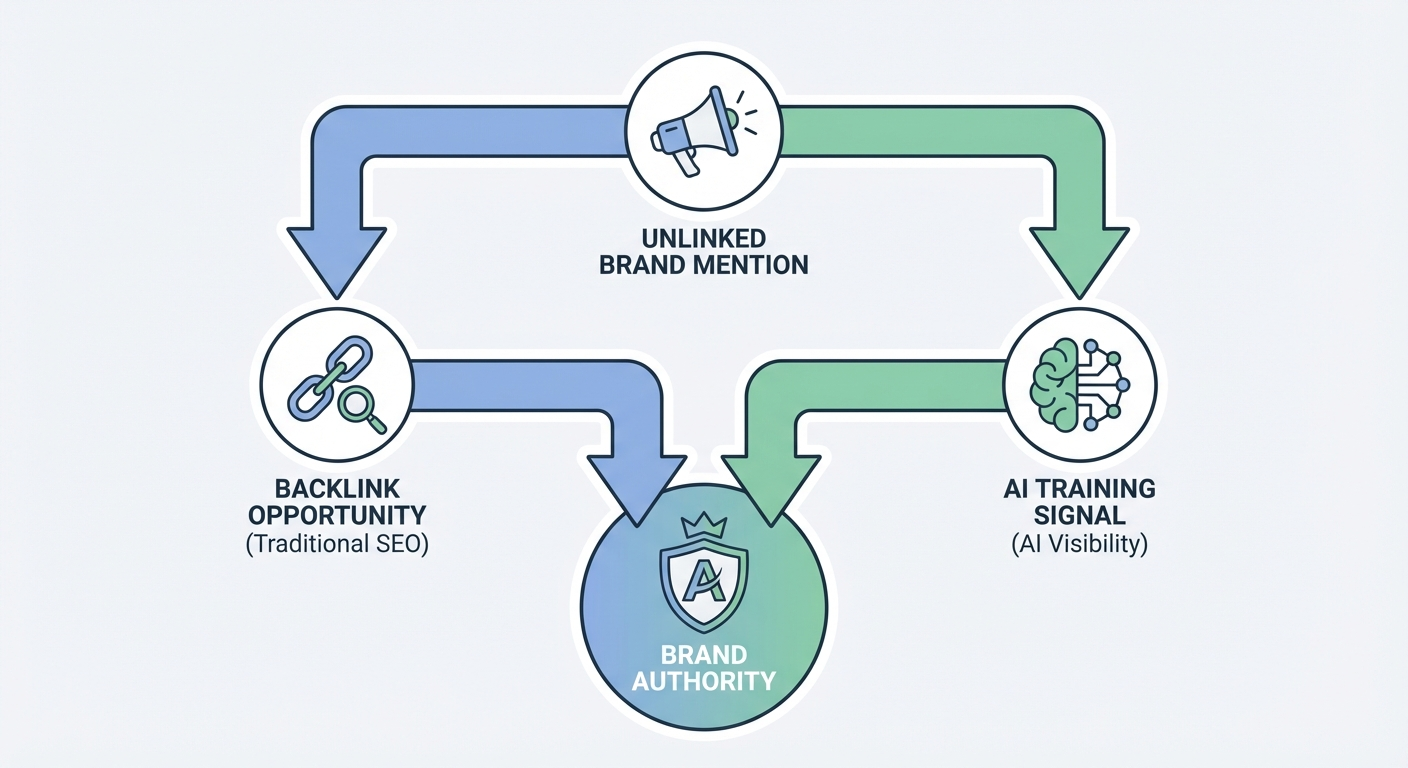
In traditional SEO, unlinked mentions represent missed backlink opportunities. In 2026, they represent something additional: signals that AI models use when learning which brands are relevant to specific topics and categories.
Why Unlinked Mentions Matter More in 2026
Unlinked brand mentions have always been useful for link reclamation. What has changed since 2024–2025 is how AI search systems use them.
Large language models like GPT-4o, Gemini, and Claude learn brand-category associations from their training data. When your brand appears repeatedly on high-authority editorial sites — even without a hyperlink — AI models build a stronger association between your brand and the topics those pages cover. According to research by Ahrefs published in 2025, brand mentions show a 0.664 correlation with search and AI visibility, outranking even backlinks and keyword placement as a signal.
This means unlinked mentions now serve two purposes:
- Backlink conversion — Reaching out to the author and requesting a link still passes PageRank and strengthens your domain authority.
- AI entity reinforcement — Even without a link, the mention trains AI models to associate your brand with specific topics, products, and categories. Over time, this increases the probability that AI assistants will recommend your brand in response to relevant queries.
Google’s John Mueller confirmed in a 2021 Google Office Hours session that unlinked mentions do not pass traditional SEO link value. That remains true. But the landscape has expanded. AI search engines — ChatGPT, Perplexity, Google AI Overviews, Copilot — do not rely on hyperlinks alone. They rely on contextual co-occurrence: how often your brand appears alongside relevant topics in trustworthy sources.
This is why monitoring and acting on unlinked mentions in Ahrefs is no longer just a link-building tactic. It is a core component of brand mention strategy for SEO and AI discoverability.
How to Find Unlinked Brand Mentions in Ahrefs Content Explorer
Ahrefs Content Explorer is a search engine for web content, powered by a database of billions of pages. It is the most efficient tool for finding unlinked brand mentions at scale. Here is the step-by-step process.
Step 1: Search for Your Brand Name
Open Content Explorer and enter your brand name in the search bar. Set the search mode to “In content” to capture mentions across full page text, not just titles.
Append -site:yourdomain.com to exclude results from your own website. For example:
"Acme Analytics" -site:acmeanalytics.com
This returns every page in Ahrefs’ index that mentions your brand name but does not live on your domain.
Step 2: Highlight Unlinked Domains
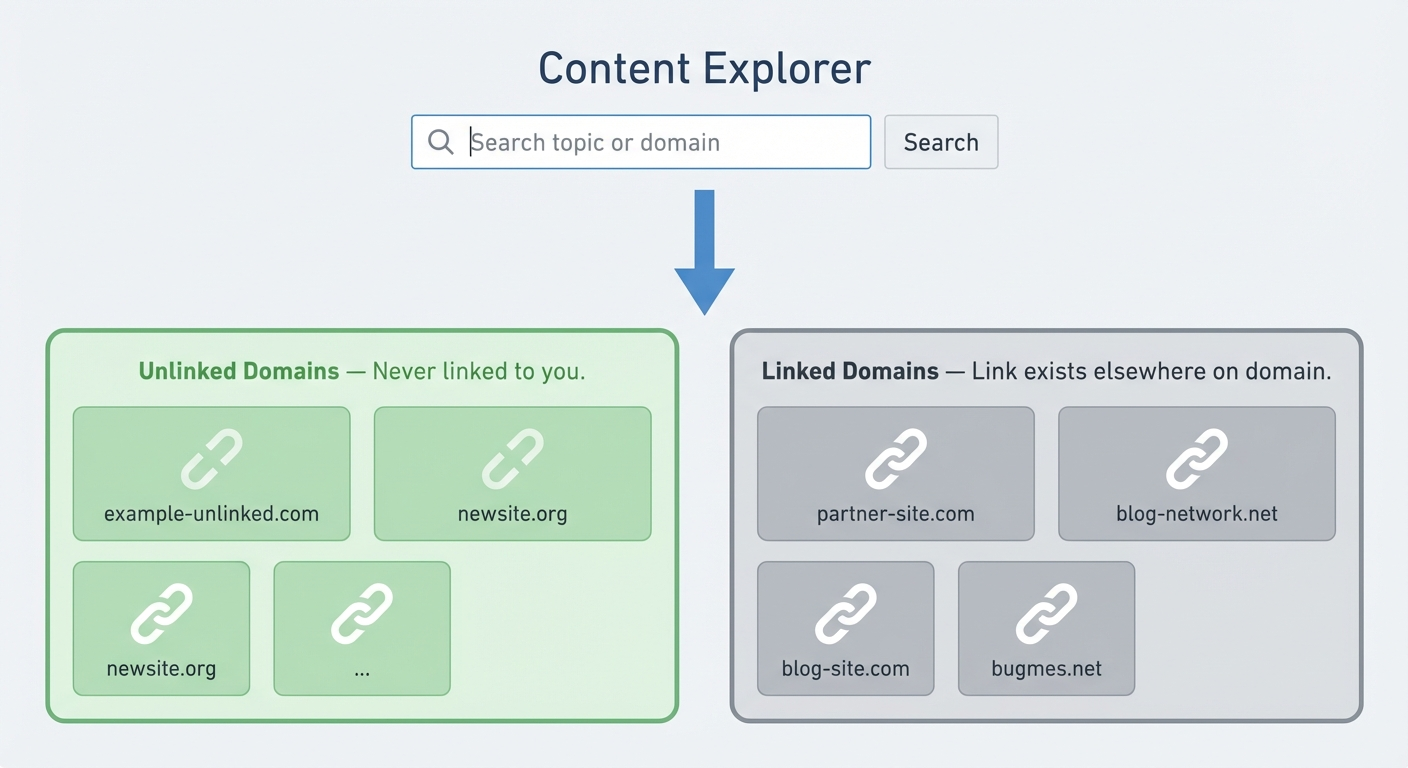
Click the “Highlight unlinked domains” button and enter your root domain. Ahrefs will highlight every result where the mentioning domain has never linked to your website. These are your highest-priority opportunities — sites that know your brand but have no existing link relationship with you.
The remaining, non-highlighted results represent pages on domains that do link to you somewhere else. These are still worth reviewing — the specific page mentioning your brand may not include a link, even if another page on the same domain does.
Step 3: Apply Filters to Prioritize Quality
Raw mention counts are misleading. A search for a well-known brand can return tens of thousands of results. Filtering narrows the list to mentions that are actually worth your time.
Apply these filters in Ahrefs Content Explorer:
- Domain Rating (DR): Set to 30+ minimum. Pages on higher-DR domains pass more link equity and carry more weight as AI training sources.
- Page organic traffic: Set to 50+ monthly visits. This ensures the mentioning page is live, indexed, and receiving real traffic — not an abandoned or de-indexed page.
- Language: Filter to English (or your target language) to remove irrelevant results.
- Publication date: Filter to the past 6–12 months to prioritize recent mentions. Authors are far more likely to update recent content than years-old posts.
After applying filters, export the results to CSV. Check the “Only pages with highlighted domains” box if you want to focus exclusively on domains that have never linked to you.
Step 4: Verify Unlinked Status With Screaming Frog
Ahrefs’ “highlight unlinked” feature works at the domain level. To confirm that a specific page does not link to you, you need a page-level check.
Import your exported URLs into Screaming Frog. Use the Custom Search feature with a “Does not contain” regex filter:
<a [^>]*\bhref\s*=\s*"([^"]*yourdomain.com[^"]*)
Replace yourdomain.com with your actual domain. Screaming Frog will crawl each URL and flag pages that do not contain a link to your site. The pages that pass this filter are your confirmed unlinked brand mentions.
Pro Insight: Set Screaming Frog’s crawl depth to 0 and uncheck all spider options under the “Basic” tab before running this check. Otherwise, the tool will attempt to crawl each site fully, which takes significantly longer.
Beyond Your Brand Name: Other Mention Types Worth Tracking
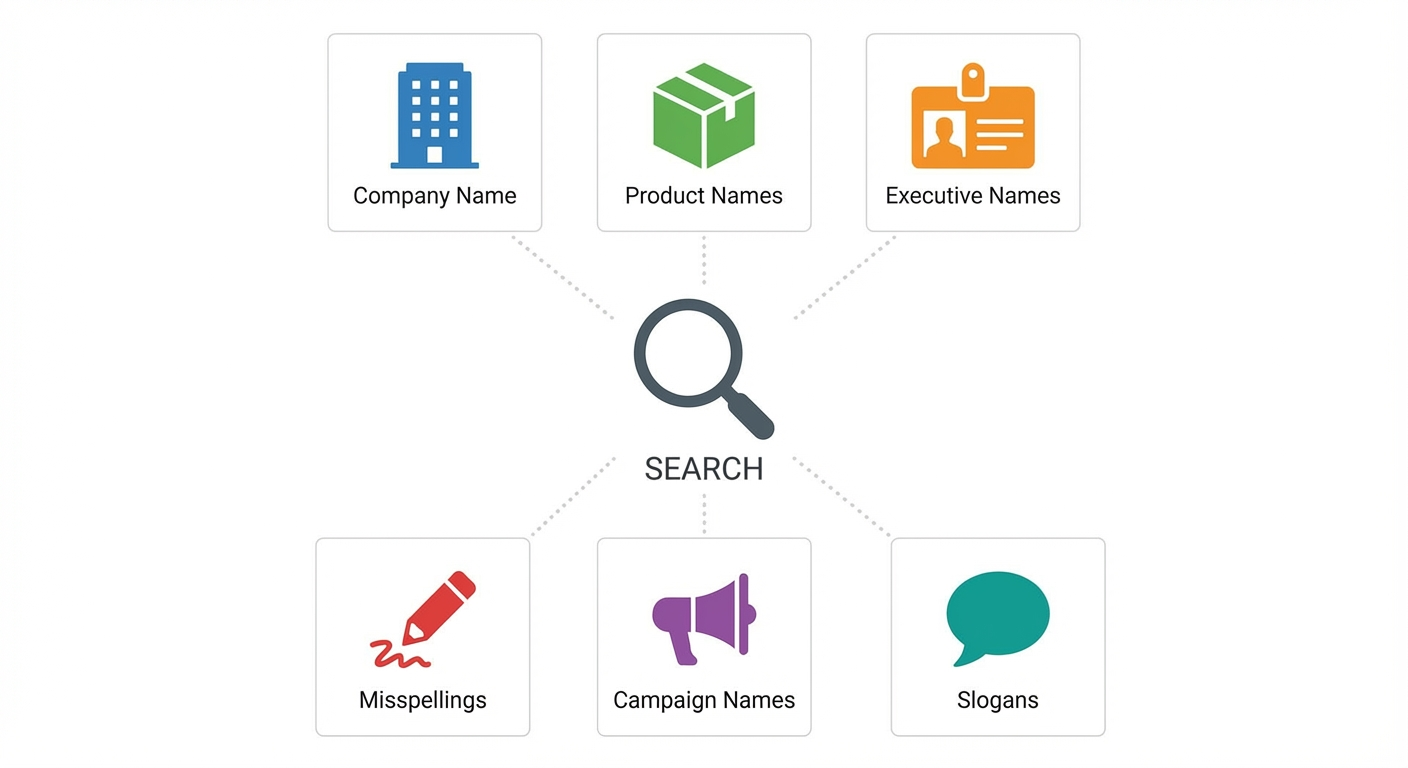
Most teams search only for their company name. This misses a significant volume of mentions. Run separate searches in Ahrefs Content Explorer for:
- Product names: Individual tools, features, or service lines (e.g., “Acme Conversion Tracker”)
- Executive names: Founders, CMOs, or frequently quoted team members
- Campaign or framework names: Branded methodologies, signature reports, or recurring content series
- Common misspellings: Use a domain typo generator to identify frequent misspellings of your brand — these often result in broken links pointing to nonexistent domains
- Branded slogans or taglines: Phrases uniquely associated with your brand
Each of these represents a separate Content Explorer search. Run them individually, apply the same quality filters, and merge the exported results into a single prioritized list.
How to Prioritize Which Mentions to Act On
Not every unlinked mention deserves outreach. Some are on low-quality pages. Some are in negative contexts. Some live on sites that never link externally. Prioritization separates productive outreach from wasted effort.
Evaluate Authority and Traffic
Use Ahrefs’ Batch Analysis tool to pull URL Rating (UR), Domain Rating (DR), and estimated organic traffic for your list of confirmed unlinked mentions. Sort by UR descending. Pages with higher UR pass more link equity if you secure a backlink.
Check Whether the Site Links Out
Open each high-priority page and check whether it contains any external links at all. Some publications — particularly news databases, product directories, and certain enterprise blogs — have editorial policies against external linking. If a page links to no external sites, outreach is unlikely to succeed.
Assess Editorial Context and Sentiment
Read the actual mention. Is your brand referenced positively or neutrally? Is the page a listicle, a review, a how-to guide, or a passing reference? Mentions in editorial contexts — where the author is actively discussing solutions in your category — convert at higher rates than passing name-drops.
Negative mentions require a different approach. Rather than requesting a link, address the concern directly. Correcting misinformation protects your brand narrative in AI training data, which matters as much as the link itself. Learn more about how brand mentions shape AI perception.
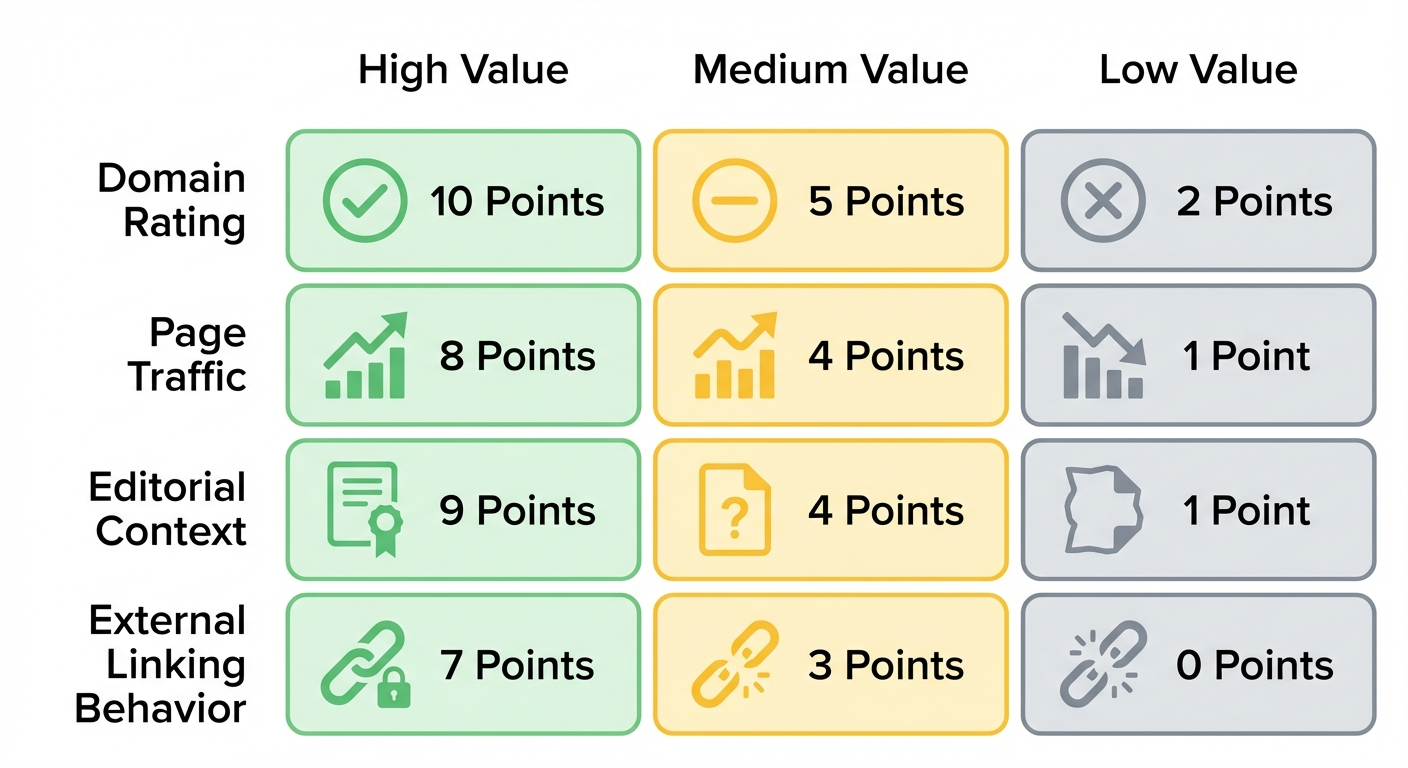
A Simple Scoring Framework
For each confirmed unlinked mention, assign a score across four criteria:
| Criteria | High Value (3 pts) | Medium Value (2 pts) | Low Value (1 pt) |
|---|---|---|---|
| Domain Rating | DR 60+ | DR 30–59 | DR below 30 |
| Page Organic Traffic | 500+ monthly visits | 50–499 monthly visits | Under 50 monthly visits |
| Editorial Context | Detailed, positive mention in relevant content | Neutral or brief mention | Passing reference or negative tone |
| Links Out to Others | Links to multiple external sources | Links to 1–2 external sources | No external links on page |
Mentions scoring 9–12 points are your top tier. Focus outreach there first. Mentions scoring 4–8 are secondary. Below 4, the mention still contributes to AI visibility but is unlikely to convert into a backlink worth pursuing.
Outreach That Actually Converts Mentions Into Links
The outreach email for unlinked mention reclamation is one of the simplest in all of link building — but most teams still get it wrong by being too generic or too pushy.
What Works
- Lead with gratitude. Thank the author for mentioning your brand. This is genuine — they wrote about you without being asked.
- Explain how the link helps their readers. A hyperlink gives readers a direct path to the resource the author already chose to reference. Frame it as improving their content, not helping your SEO.
- Provide the exact URL. Make it effortless. Include the specific page you want linked and suggest natural anchor text that fits their existing sentence.
- Keep it short. Three to five sentences. The author does not need your brand’s origin story.
What Doesn’t Work
- Mass-sending identical templates to every mention on your list
- Offering link exchanges, guest posts, or “collaboration” in the same email
- Following up more than twice — persistence beyond two touchpoints crosses into annoyance
- Reaching out to mentions that are months or years old without a specific, timely reason
Tip: Reach out within 24–48 hours of a new mention going live. Authors are significantly more receptive to updating a post they published recently than one from last year. This is where Ahrefs Alerts becomes critical — set up mention alerts for your brand name and key product terms to catch new mentions as they appear.
Setting Up Ahrefs Alerts for Ongoing Monitoring
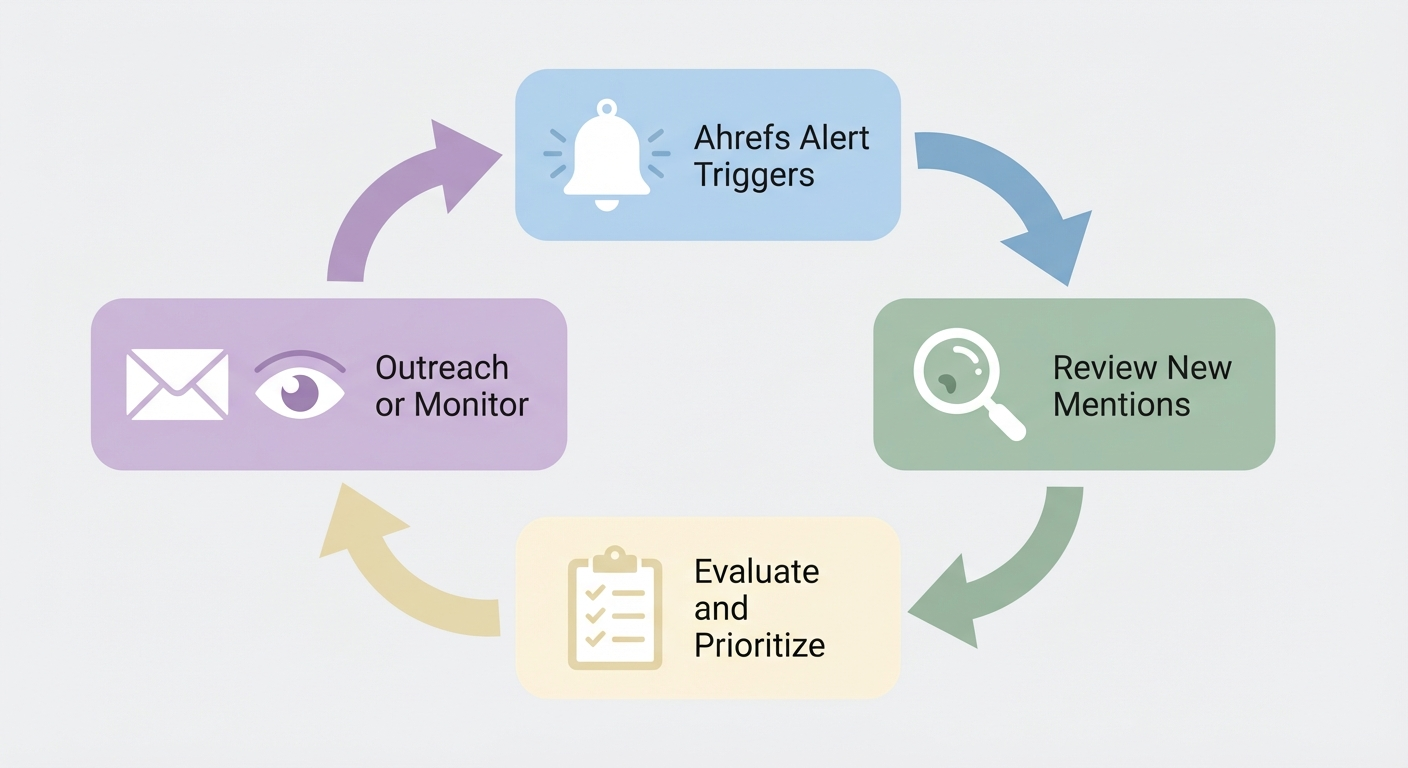
Finding unlinked mentions is not a one-time project. New mentions appear continuously — and if your brand is growing, the volume increases over time.
In Ahrefs, navigate to Alerts → Mentions → New Alert. Enter your brand name as the search query. Exclude your own domain. Set the notification interval to weekly.
You can use advanced operators in the alert query. For example:
"Acme Analytics" OR "AcmeAnalytics" OR "Acme analytics"
This captures common variations and misspellings in a single alert. Set up separate alerts for product names and executive names.
Each week, review the alert results. Check each new mention for link status. If unlinked and high-priority, add it to your outreach queue. If already linked, note it as a positive brand signal and move on.
For brands that also need to track how mentions appear in AI search platforms, Ahrefs Alerts covers the web — but AI-specific monitoring requires additional tools that track citations in ChatGPT, Perplexity, Gemini, and AI Overviews.
The AI Visibility Angle Most Guides Miss
Almost every guide on unlinked brand mentions focuses exclusively on converting them into backlinks. That was the right approach in 2020. In 2026, it is only half the picture.
When your brand appears on a high-authority publication that AI models include in their training data — sites like Forbes, TechCrunch, Search Engine Journal, industry-specific trade publications — the mention itself builds entity authority. Entity authority is the strength of the association between your brand and a specific topic or category in AI knowledge systems.
This means some unlinked mentions are more valuable as AI visibility signals than as backlinks. A mention on a DR 90 news site that never links externally still trains ChatGPT, Gemini, and Perplexity to recognize your brand as relevant to your category. Spending time requesting a link that will never come wastes effort that could go toward securing new mentions elsewhere.
The strategic question for each unlinked mention is not just “can I get a link?” but “does this mention strengthen my brand’s AI discoverability, with or without a hyperlink?”
Agencies like BrandMentions approach this differently. Rather than treating every unlinked mention as a link reclamation task, they evaluate whether the mention already serves its purpose as an AI training signal — and focus outreach energy on high-conversion opportunities where both a backlink and an AI signal are achievable.
Reverse Image Search: A Hidden Source of Unlinked Mentions
If your brand produces original visuals — infographics, charts, data visualizations, custom illustrations — other sites may embed those images without crediting you. These are unlinked visual mentions, and they are easy to find.
Right-click any original image on your site and select “Search image with Google” (or use TinEye). Google will return pages that use the same image. Click through each result and check for attribution. If the image appears without a link to your site, you have a clear, justified reason for outreach — the author used your content and should credit the source.
Visual mention reclamation has a higher conversion rate than text-based outreach because the author used your intellectual property. The ask is straightforward and reasonable.
Competitive Gap Analysis: Finding Mentions Your Competitors Have That You Don’t
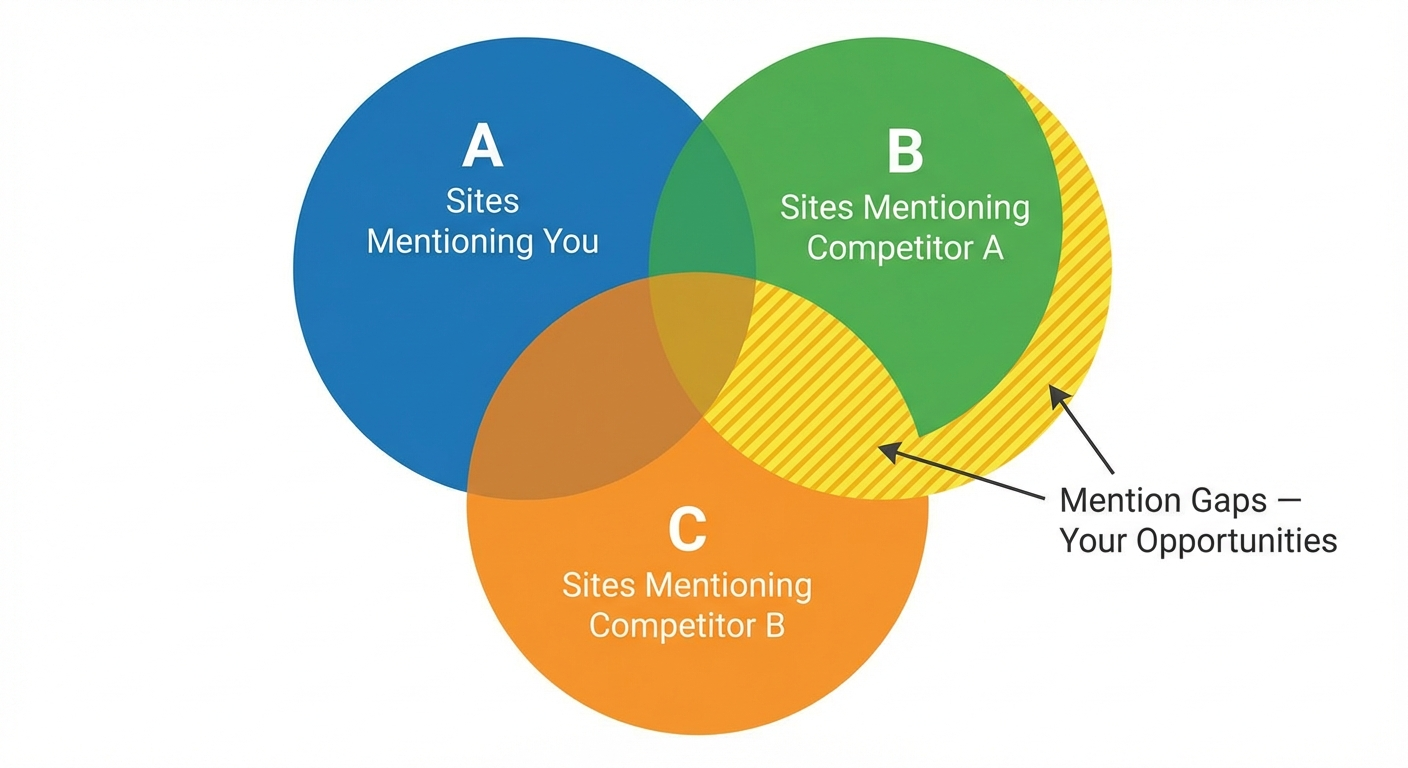
Ahrefs Content Explorer is equally useful for analyzing where your competitors are mentioned. Search for a competitor’s brand name, apply the same quality filters, and export the results.
Compare the list of sites mentioning your competitor against the sites mentioning your brand. Pages that mention one or more competitors — but not you — represent content gaps. These are publications and authors who are already writing about your category but are unaware of your brand.
This is not traditional unlinked mention reclamation. It is proactive mention acquisition: reaching out to authors and editors of relevant content, introducing your brand, and offering a resource, data point, or expert perspective that earns you a mention in their next update or future article.
In campaigns across 67+ B2B companies, the BrandMentions team found that brands with consistent editorial mentions across category-relevant publications achieved AI recommendation rates 89% higher than those relying solely on traditional SEO. Competitive gap analysis is where that consistency starts.
For a deeper look at how this works, explore how AI brand mentions compound over time.
Common Mistakes to Avoid
After reviewing how most teams approach unlinked mention reclamation, several patterns consistently waste time or damage relationships.
- Pursuing every mention regardless of quality. A mention on a DR 8 forum with no traffic provides negligible value — as a backlink or an AI signal. Filter aggressively.
- Ignoring negative mentions. A negative or inaccurate mention trains AI models just as effectively as a positive one. Address misinformation directly. Correct the record wherever possible.
- Treating this as a one-time campaign. New mentions appear continuously. Without ongoing monitoring (via Ahrefs Alerts or equivalent), you miss time-sensitive opportunities.
- Requesting links from sites that never link out. Check external linking behavior before you send outreach. No amount of follow-up will change a publication’s editorial policy.
- Focusing only on backlinks. Some mentions are more valuable as AI training signals than as links. Not every outreach email needs to ask for a hyperlink.
Ahrefs vs. Other Tools for Finding Unlinked Brand Mentions
Ahrefs Content Explorer is the most comprehensive option, but it is not the only one. Here is how it compares to alternatives commonly used for this purpose.
| Tool | Best For | Limitations |
|---|---|---|
| Ahrefs Content Explorer | Scale, filtering, “highlight unlinked domains” feature, export to CSV | Requires paid subscription; domain-level unlinked highlight (page-level needs Screaming Frog verification) |
| SEMrush Brand Monitoring | Real-time alerts, sentiment tracking | Smaller content index than Ahrefs; less granular filtering |
| Google Alerts | Free, simple setup, catches new mentions | No quality metrics, misses many mentions, no export or filtering |
| BuzzSumo | Social engagement data alongside mentions | Not designed specifically for unlinked mention identification |
| Brand24 / Mention | Social media and web monitoring, sentiment analysis | Less useful for SEO-specific prioritization (no DR/UR data) |
For most B2B brands, Ahrefs Content Explorer combined with weekly Google Alerts provides the best balance of depth and coverage. Add an AI visibility analytics tool to cover mentions in ChatGPT, Perplexity, and Gemini — platforms that Ahrefs does not monitor.
Frequently Asked Questions
Does Ahrefs automatically show which mentions are unlinked?
Ahrefs Content Explorer highlights domains that have never linked to your website using the “highlight unlinked domains” feature. However, this operates at the domain level. A domain may link to you on one page but mention you without a link on another. To confirm page-level unlinked status, verify using Screaming Frog’s custom search or a similar crawling tool.
How often should I check for new unlinked brand mentions?
Set up Ahrefs Mention Alerts for weekly notifications. For brands with high media exposure, daily alerts may be appropriate. Supplement alerts with a monthly manual Content Explorer audit to catch any mentions the alert system missed.
Are unlinked mentions worth anything for SEO without a backlink?
Google’s John Mueller confirmed in 2021 that unlinked mentions do not pass link value in the traditional sense. However, as of 2026, unlinked mentions on authoritative publications influence AI search systems — ChatGPT, Perplexity, Gemini, and Google AI Overviews — by reinforcing brand-topic associations in training data. This makes unlinked mentions valuable for brand visibility in generative AI, even without a hyperlink.
What is a realistic conversion rate for unlinked mention outreach?
Conversion rates vary by industry, brand recognition, and outreach quality. Based on publicly available data from Ahrefs and BuzzStream, expect 5–15% of outreach emails to result in a link addition. Reaching out within 48 hours of publication and personalizing each email pushes conversion toward the higher end of that range.
Can I use Ahrefs to find unlinked mentions of my competitors?
Yes. Search for any brand name in Content Explorer using the same process. This is a powerful way to find publications that cover your category but have not yet mentioned your brand — creating opportunities for proactive outreach and future mentions.
Your Next Step: Audit, Monitor, Compound
Finding unlinked brand mentions in Ahrefs is a repeatable, high-ROI process when approached systematically. Start with a comprehensive Content Explorer audit for your brand name and key product terms. Filter for quality. Verify at the page level. Prioritize based on authority, traffic, editorial context, and AI visibility potential.
Then set up ongoing alerts so new mentions land in your inbox weekly. Over time, this creates a compounding effect: more mentions lead to stronger entity authority, which leads to more AI recommendations, which leads to more organic mentions — a cycle that builds on itself.
The brands that treat unlinked mention monitoring as an ongoing discipline — not a one-time audit — are the ones showing up consistently in both traditional search results and AI-generated answers.
Want to understand where your brand stands in AI search today? See where your brand appears across ChatGPT, Perplexity, and Gemini — and identify the gaps that unlinked mentions can close.