A social media monitoring tool tracks brand mentions, keywords, and conversations across platforms so you can respond faster, protect your reputation, and inform strategy with real data. That definition hasn’t changed much over the years — but what these tools need to do in 2026 has shifted dramatically.
AI search engines now pull brand sentiment data from social platforms. Customers expect responses in minutes, not hours. And the volume of conversations spread across TikTok, Reddit, LinkedIn, Threads, Bluesky, and dozens of niche communities makes manual tracking impossible. The right social media monitoring tool doesn’t just collect mentions — it turns unstructured noise into decisions your team can act on.
This article breaks down what actually matters when choosing a social media monitoring tool in 2026, which features justify their cost, and how monitoring connects to a broader visibility strategy that extends into AI search.
What You’ll Learn
- How social media monitoring has changed since 2024 — and what that means for tool selection in 2026
- The specific features that separate useful tools from expensive dashboards
- How to evaluate tools based on your team size, budget, and monitoring goals
- Where social media monitoring connects to AI visibility and brand citation strategies
- A practical comparison framework for shortlisting the right platform
- Common mistakes teams make after purchasing a monitoring tool — and how to avoid them
What a Social Media Monitoring Tool Actually Does
A social media monitoring tool is software that scans social platforms, forums, blogs, news sites, and review pages for mentions of specific brands, keywords, or topics. It aggregates those mentions into a single dashboard, often adding sentiment analysis, trend data, and engagement metrics.
The core functions include:
- Mention tracking — capturing every instance your brand name, product, or chosen keywords appear online
- Sentiment analysis — classifying mentions as positive, negative, or neutral using natural language processing
- Competitor monitoring — tracking what people say about rival brands using the same keyword and mention logic
- Alert systems — notifying your team in real time when mention volume spikes or sentiment shifts
- Reporting — visualizing trends over time so you can measure campaign impact and brand health
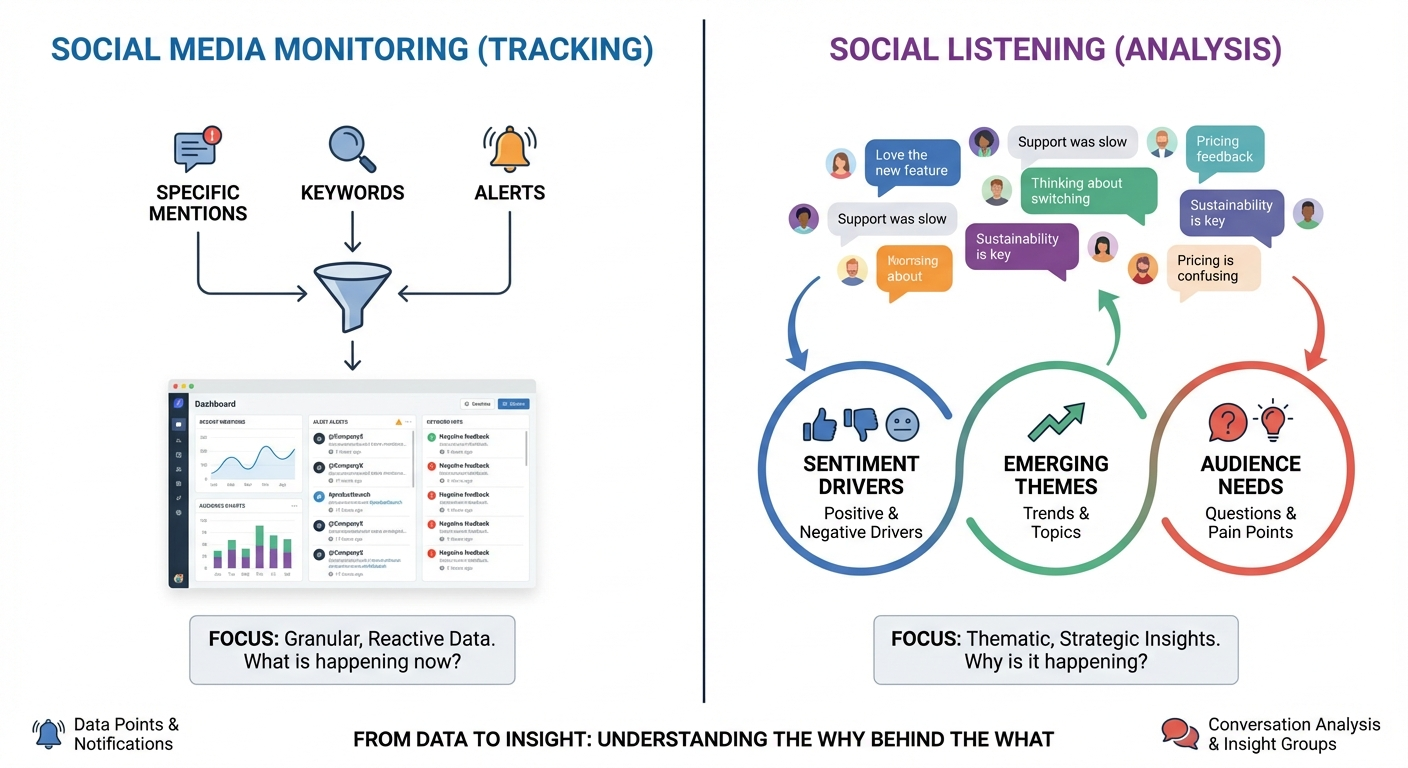
Most tools also offer some form of social listening, which goes deeper than mention counting. Listening analyzes the context, themes, and emotions behind conversations — helping you understand why people feel a certain way, not just that they mentioned you.
What Changed Between 2024 and 2026
If you evaluated social media monitoring tools in 2024, the landscape looks different now. Three shifts matter most.
Platform fragmentation accelerated
Bluesky, Threads, and Mastodon gained meaningful user bases. Reddit’s influence on purchase decisions grew. According to a 2025 Pew Research Center report, adults under 30 now split their social time across an average of six platforms — up from four in 2023. A monitoring tool that only covers X (formerly Twitter), Facebook, Instagram, and LinkedIn now misses critical conversations.
AI search engines started using social signals
ChatGPT, Perplexity, and Google’s AI Overviews increasingly reference brand sentiment data that originates on social platforms. A product with overwhelmingly positive Reddit threads and consistent editorial mentions shows up differently in AI-generated answers than one with scattered or negative social presence. This means your monitoring data now has implications beyond social strategy — it connects directly to how brand mentions impact visibility in AI search.
Real-time expectations tightened
A 2025 Sprout Social Index found that 70% of consumers expect a brand response on social media within 24 hours, and 40% expect it within one hour. Tools with 12- or 24-hour data refresh cycles no longer meet the speed required for reputation management. Near-real-time processing is now a baseline expectation, not a premium feature.
Features That Actually Justify the Cost
Most social media monitoring tools advertise similar feature lists. The difference between a useful tool and an expensive one you’ll abandon in three months comes down to how well these features actually work in practice.
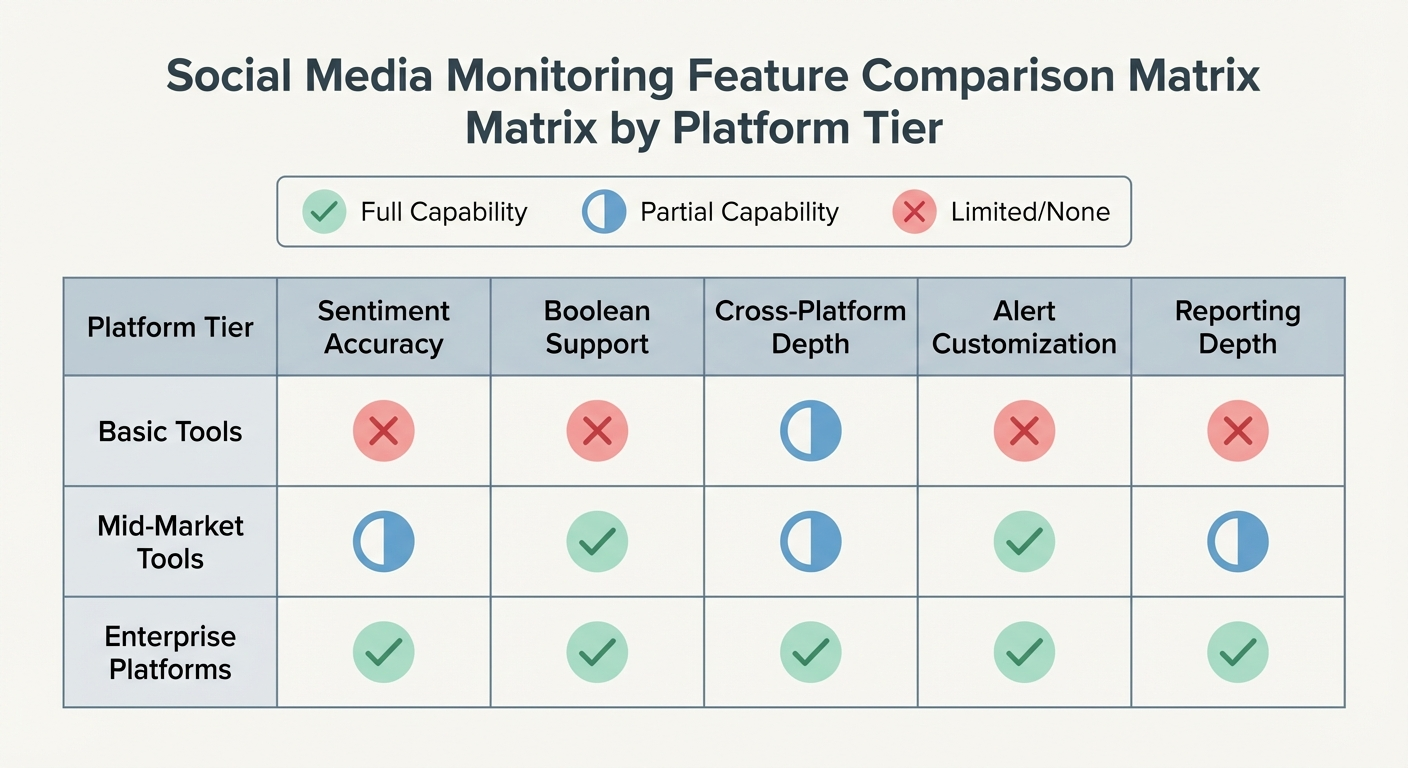
Accurate sentiment analysis
Every tool claims sentiment analysis. Few handle sarcasm, context, or industry-specific language well. Before committing, test each tool with real mentions of your brand — especially negative ones that use indirect or colloquial phrasing. If the tool classifies “well, that’s one way to handle a product launch” as neutral, its sentiment engine isn’t ready for your needs.
Boolean and advanced query support
Basic keyword matching generates noise. You need Boolean operators (AND, OR, NOT) and the ability to build complex queries that filter by language, location, platform, and author type. Without this, you’ll spend more time sorting through irrelevant results than acting on insights.
Cross-platform coverage depth
Check which platforms a tool monitors — and how deeply. Some tools track X and Facebook comprehensively but only scrape Instagram captions (not comments or Stories mentions). Reddit monitoring varies dramatically between tools. TikTok comment monitoring remains limited across most platforms as of 2026 due to API restrictions.
Alert speed and customization
Real-time alerts matter most for crisis detection. Evaluate whether alerts can be customized by volume threshold (e.g., mention count doubles within two hours), sentiment shift (e.g., negative sentiment jumps 15% in a day), or specific keyword combinations. Generic “you got mentioned” notifications don’t help busy teams prioritize.
Reporting that connects to business outcomes
Dashboards filled with vanity metrics — total mentions, follower counts, impressions — tell you very little. Look for tools that let you track share of voice against competitors, correlate mention spikes with traffic or conversion data, and segment reports by campaign, region, or product line.
Integration with your existing stack
A monitoring tool that lives in isolation creates more work, not less. Confirm integrations with your CRM, marketing automation platform, project management tools (Slack, Asana), and analytics platforms. The goal is for monitoring insights to flow into existing workflows — not require a separate login and manual export process.
How to Evaluate a Social Media Monitoring Tool for Your Team
The “best” tool depends entirely on your team size, budget, monitoring scope, and what you plan to do with the data. Here’s a practical evaluation framework.
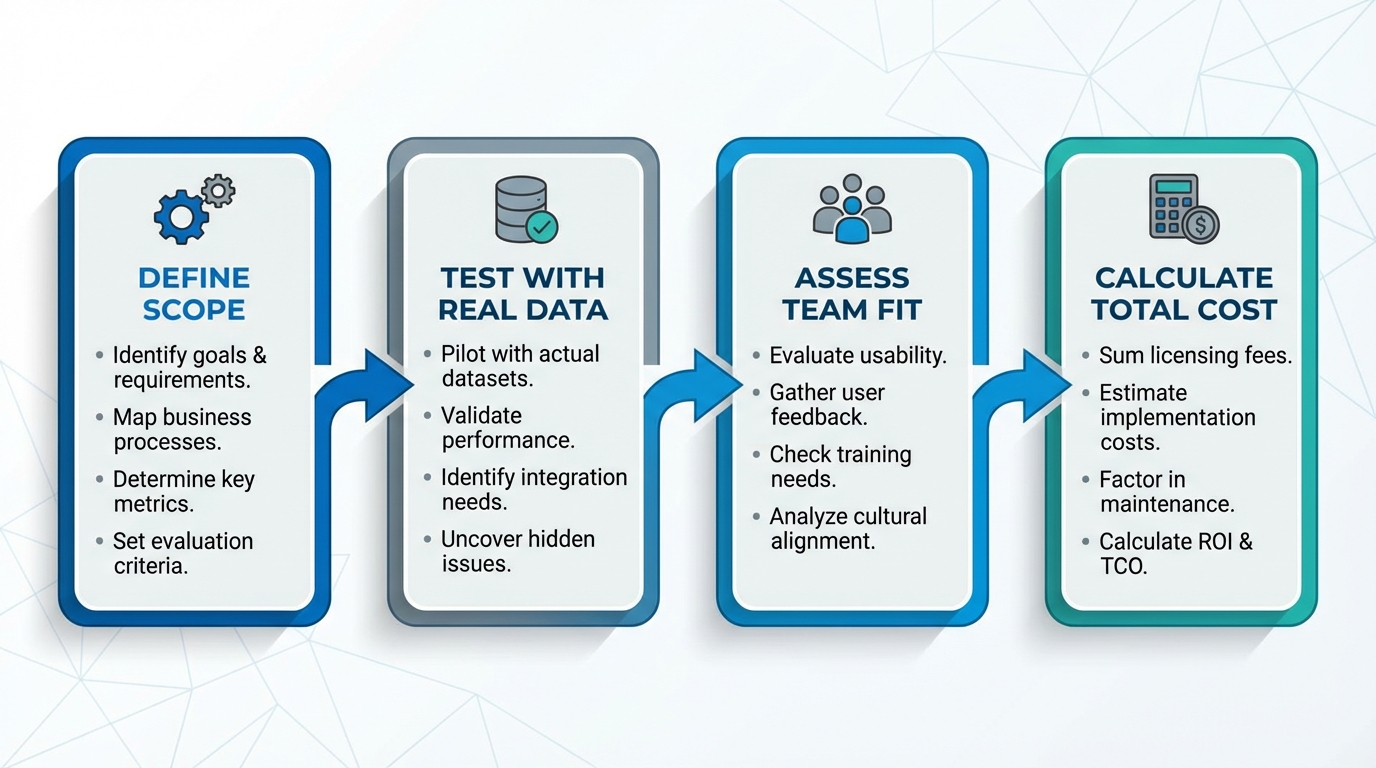
Step 1: Define your monitoring scope
Answer these questions before reviewing any tool:
- How many brands or products do you need to monitor?
- Which platforms matter most for your audience?
- Do you need competitor monitoring? How many competitors?
- Are you monitoring for crisis detection, campaign measurement, customer feedback, or all three?
- Do you need multilingual monitoring?
Your answers determine whether you need an enterprise platform or a focused mid-market tool. A B2B SaaS company monitoring one brand across LinkedIn and Reddit has very different requirements than a consumer brand tracking five product lines across eight platforms in four languages.
Step 2: Test with your own data
Never choose a monitoring tool based solely on demo environments. Every reputable platform offers a free trial — use it with your actual brand names, competitor names, and industry keywords. Evaluate:
- How many relevant mentions does it capture versus what you find manually?
- How accurate is sentiment classification for your specific mentions?
- How quickly do new mentions appear in the dashboard?
- Can you build the specific queries and filters your team needs?
Step 3: Assess the team experience
A powerful tool that requires a dedicated analyst to operate won’t work for a three-person marketing team. During your trial, ask: can a mid-level marketer set up a query, interpret the dashboard, and take action within 15 minutes of logging in? If the learning curve requires weeks of onboarding, factor that cost into your decision.
Step 4: Calculate total cost of ownership
Sticker price rarely tells the full story. Account for:
- Per-seat costs if multiple team members need access
- Mention or query limits that may require upgrades
- Add-on costs for features like advanced sentiment, historical data, or specific platform coverage
- Implementation and training time
Where Monitoring Meets AI Visibility
Social media monitoring and AI visibility strategy are converging. Here’s why this matters for your brand in 2026.
Large language models like GPT-4, Claude, and Gemini learn brand-category associations from their training data. That training data includes social media conversations, editorial content, forum discussions, and review sites — exactly the sources your monitoring tool tracks. When your brand appears consistently in positive, contextually relevant conversations across high-authority platforms, AI models build stronger associations between your brand and your category.
This creates a feedback loop:
- Social media monitoring shows you where your brand is (and isn’t) mentioned
- Those mentions — especially on platforms AI models learn from — influence how AI search engines reference your brand
- Improving your mention profile across authoritative sources strengthens both your social reputation and your brand presence in AI-generated answers
Agencies like BrandMentions solve the second half of this equation by placing contextual brand mentions on 140+ high-authority publications that AI models actively learn from during training. But the insight that tells you where gaps exist often starts with monitoring — knowing which conversations include your competitors but not you.
Key insight: Your social media monitoring data is also your AI visibility audit. Every platform where competitors are mentioned and you’re absent represents a gap in how AI models understand your category position.
If you’re exploring this connection further, see how strategic brand mentions drive AI discoverability across platforms like ChatGPT and Perplexity.
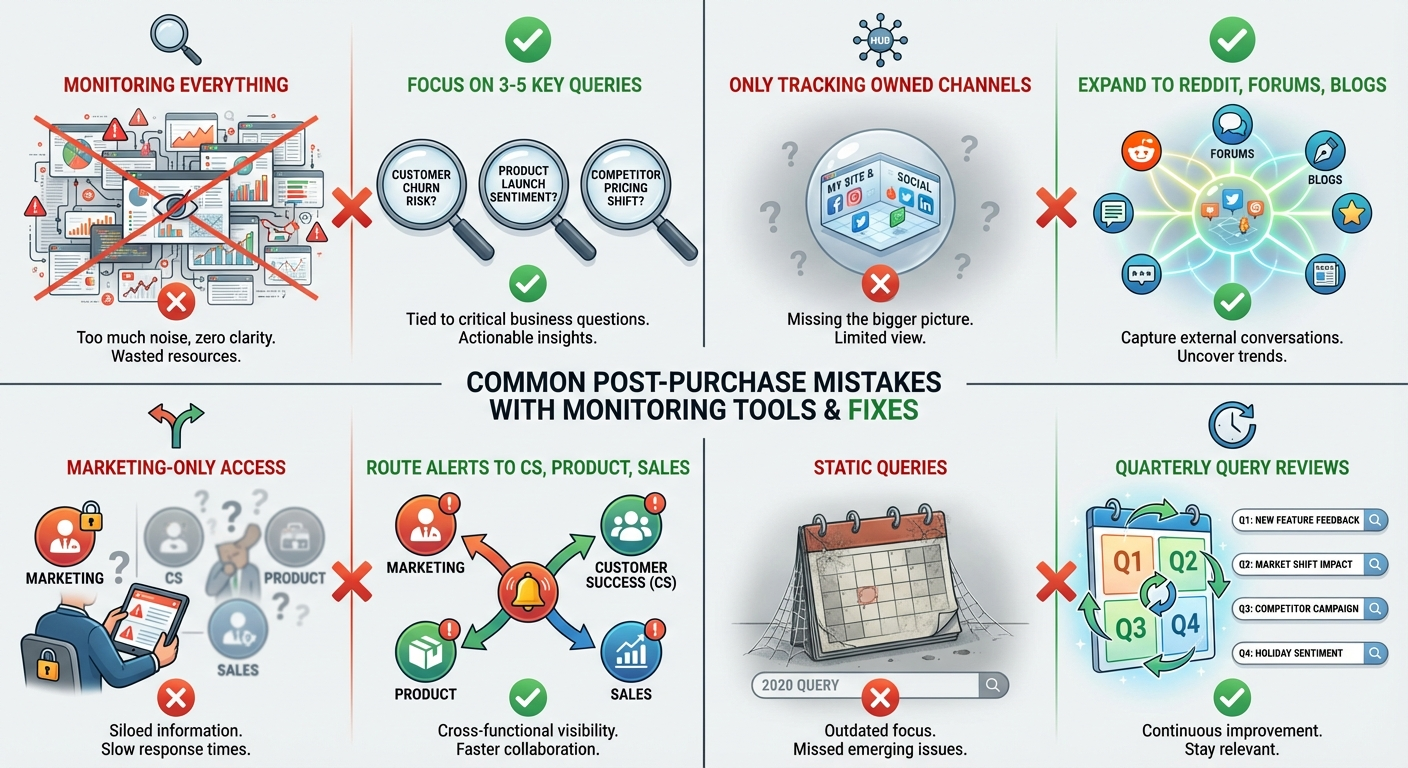
Common Mistakes After Buying a Monitoring Tool
Purchasing a tool is the beginning, not the finish line. These are the most common failure patterns.
Monitoring everything, acting on nothing
Teams often set up dozens of keyword queries and then drown in data they never analyze. Start with three to five focused queries tied to specific business questions. Expand only after you’ve established a consistent review and action cadence — daily for crisis-relevant keywords, weekly for competitive and campaign tracking.
Ignoring the data outside your owned channels
Your brand’s social profiles are only a fraction of the conversation. Reddit threads, Quora answers, niche forums, and blog comment sections often contain the most candid customer feedback. If your monitoring setup only tracks mentions directed at your brand handles, you’re missing the conversations that shape buying decisions.
Treating monitoring as a marketing-only function
Customer service teams need monitoring data to catch complaints early. Product teams need it to identify feature requests and pain points. Sales teams need competitive mention data to sharpen positioning. Configure your tool to route relevant alerts to each team — not just the social media manager’s inbox.
Never revisiting your query setup
Markets shift. Competitors launch. Product names change. Review your monitoring queries quarterly. Remove keywords generating noise and add terms reflecting new campaigns, product launches, or competitive moves. A query setup from six months ago may be tracking conversations that no longer matter while missing the ones that do.
How to Connect Monitoring Data to Brand Reputation Strategy
Monitoring data becomes valuable when it informs action. Here’s how to bridge the gap between dashboard insights and reputation improvement.
Build a mention baseline
Before launching any campaign or strategy shift, document your current mention volume, sentiment ratio, share of voice versus top competitors, and platform distribution. This baseline lets you measure the impact of every action you take going forward. Without it, you’re guessing.
Identify high-impact gaps
Look for platforms or conversations where competitors are consistently mentioned and you’re absent. These gaps represent the highest-leverage opportunities. If your competitor appears regularly in Reddit buying advice threads for your category but you don’t, that’s a specific, actionable problem — not just a “brand awareness” issue.
Tools designed for brand reputation monitoring help you structure this gap analysis systematically, especially when you’re tracking across both traditional social platforms and AI search surfaces.
Create a response protocol
Define who responds to what and within what timeframe:
- Positive mentions: Marketing team engages within 24 hours (thank, amplify, share)
- Negative mentions: Customer service responds within 2 hours; escalation path defined for high-severity issues
- Competitor mentions in your category: Marketing reviews weekly; sales reviews for outbound positioning
- Spike alerts: Designated team lead triages within 30 minutes during business hours
Feed insights into content and placement strategy
Monitoring data reveals what your audience talks about, how they describe their problems, and which sources they trust. Use this to inform your content calendar, your messaging, and your brand mention strategy for SEO and AI visibility. If monitoring shows frequent conversations about a specific pain point your product solves, that’s a content topic — and potentially a placement target for brand mentions on high-authority editorial sites.
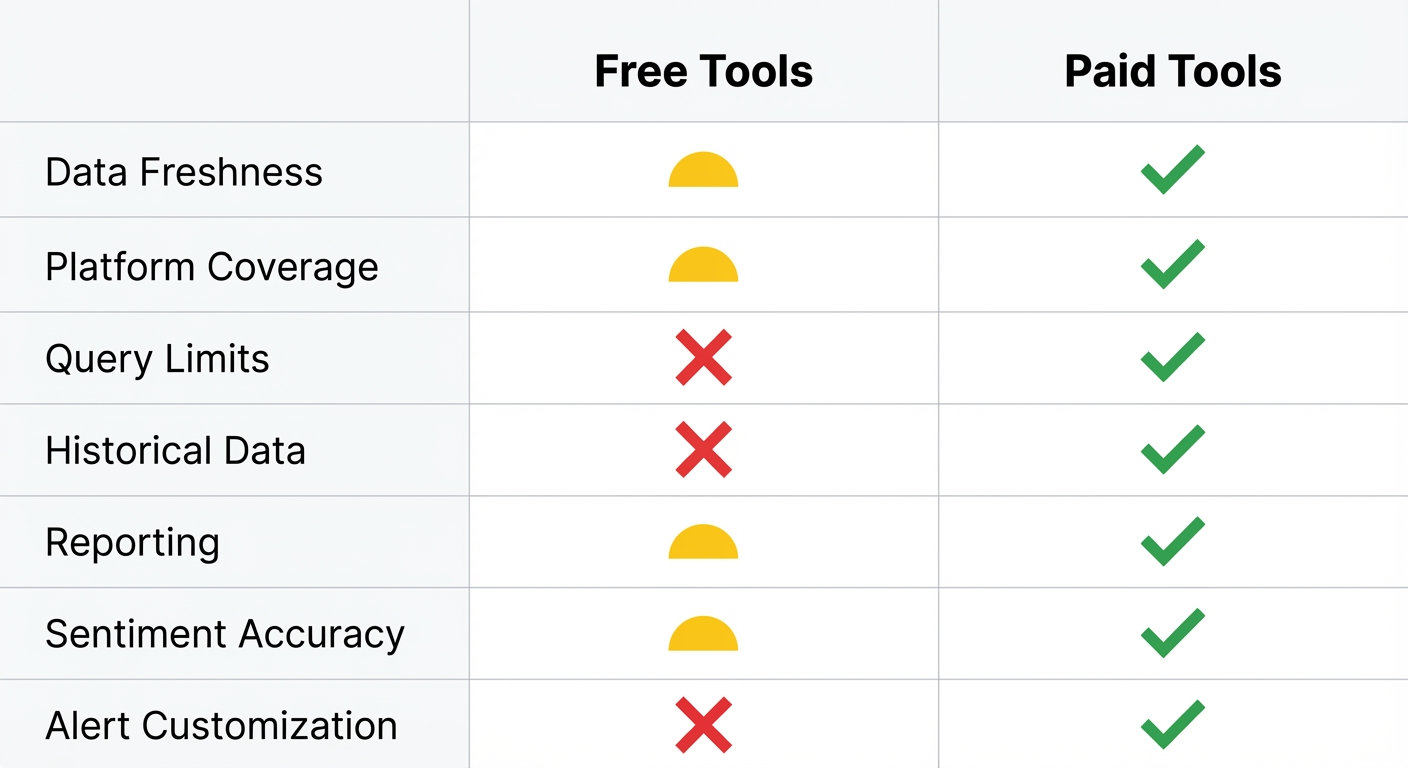
Evaluating Free vs. Paid Social Media Monitoring Tools
Free monitoring tools exist, but they involve tradeoffs you should understand clearly.
What free tools handle well
- Basic mention alerts for a single brand name
- Surface-level sentiment on major platforms
- Ad-hoc competitive checks
- Testing whether monitoring adds value to your workflow before committing budget
Where free tools fall short
- Data freshness: Free tiers typically refresh data every 12–24 hours — too slow for crisis detection
- Platform coverage: Most free tools cover only two or three platforms comprehensively
- Query limits: You may be restricted to one or two keyword queries, making competitor and industry monitoring impossible
- Historical data: Free tiers rarely offer more than seven days of historical mentions
- Reporting: Export and visualization options are limited, making it difficult to share insights with stakeholders
Practical recommendation: Use free tools to validate that monitoring matters for your business. Once you’ve confirmed the value, move to a paid tool that matches your scope and team size. Mid-market tools between $50 and $200 per month cover the needs of most B2B marketing teams with one to three brands to monitor.
For a broader look at tools across the monitoring ecosystem, including those designed for AI search surfaces, see this roundup of brand monitoring tools and how they compare.
How Social Media Monitoring Supports Your Broader AI Visibility Strategy
In campaigns across 67+ B2B companies, the BrandMentions team found that brands with consistent editorial mentions and positive social sentiment achieved AI recommendation rates 89% higher than those relying solely on traditional SEO. The monitoring data was instrumental in identifying which platforms and conversation types correlated most strongly with AI citation improvements.
Here’s how monitoring feeds into a complete AI visibility strategy:
- Audit current mention landscape — Use your monitoring tool to map where your brand appears, where it’s absent, and how sentiment compares to competitors across social, editorial, and forum sources.
- Identify AI-relevant platforms — Focus on sources that AI models are known to learn from: Reddit, Wikipedia, major news publications, industry-specific editorial sites, and review platforms. Tracking brand mentions across AI search platforms helps you understand which sources carry the most weight.
- Close gaps with strategic placements — Where monitoring reveals competitor mentions dominating your category conversations, targeted editorial placements on high-authority sites build the associations AI models need to recognize your brand.
- Measure impact over time — Continue monitoring to track whether mention volume, sentiment, and share of voice improve — and whether those improvements correlate with increased AI visibility using AI visibility analytics tools.
This isn’t a one-time project. It’s a compounding strategy where monitoring data continuously informs placement decisions, and placement results continuously show up in monitoring data.
Frequently Asked Questions
What’s the difference between social media monitoring and social listening?
Social media monitoring tracks specific mentions, keywords, and hashtags in real time. Social listening goes deeper — analyzing the context, themes, and emotional drivers behind those conversations. Most modern tools combine both functions, but the depth of listening capabilities varies significantly between platforms.
How much should a social media monitoring tool cost in 2026?
Mid-market tools suitable for small to mid-sized B2B teams typically cost between $50 and $200 per month. Enterprise platforms with advanced listening, AI-powered sentiment, and broad platform coverage range from $500 to $2,000+ per month. Free tools work for basic single-brand monitoring but lack the speed, depth, and reporting needed for serious reputation management.
Can social media monitoring data improve my brand’s AI search visibility?
Yes. Monitoring reveals where your brand is mentioned — and where it’s absent — across the sources AI models learn from. This data helps you identify which platforms and conversations to target with strategic brand mentions. Consistent positive mentions on high-authority platforms strengthen the brand-category associations that influence AI recommendations in tools like ChatGPT, Perplexity, and Gemini.
How often should I review my monitoring setup?
Review your keyword queries and alert configurations quarterly. Markets shift, competitors launch new products, and your own messaging evolves. A monitoring setup that hasn’t been updated in six months will miss relevant conversations and track irrelevant ones.
Do I need a separate tool for AI brand mention tracking?
Traditional social media monitoring tools track social platforms, blogs, forums, and news sites — but most don’t monitor what AI assistants actually say about your brand. Dedicated tools for checking whether AI mentions your brand fill this gap. For a complete picture, use both: a social monitoring tool for traditional platforms and an AI-specific tool for tracking citations in LLM-generated responses.
Turning Monitoring Into Action
A social media monitoring tool is only as valuable as the decisions it informs. The tool itself doesn’t improve your reputation, close competitive gaps, or build AI visibility. Your team does — using the data the tool provides.
Start with focused queries tied to real business questions. Test before you buy. Establish a response protocol that routes insights to the right teams. And connect your monitoring data to a broader strategy that includes how your brand shows up not just on social platforms, but in the AI search engines your customers increasingly rely on.
If you want to understand where your brand stands across both social and AI search surfaces, see where your brand shows up — and where it’s missing.