
SEO competitor analysis is the process of researching the websites that outrank you in search results — studying their keywords, content, backlinks, and technical setup — so you can build a smarter strategy to surpass them. As of 2026, this process has expanded well beyond traditional Google rankings. Your competitors now show up in AI Overviews, ChatGPT responses, Perplexity summaries, and Gemini citations. A modern competitor analysis accounts for all of these surfaces.
This article walks you through a practical, step-by-step system for conducting SEO competitor analysis that reflects how search actually works in 2026 — across both traditional and AI-driven results. You’ll learn how to identify the right competitors, extract actionable intelligence from their strategies, and turn that data into a plan that moves your rankings forward.
- How to identify your actual SEO competitors (not just your business rivals)
- A repeatable keyword gap analysis process that surfaces real opportunities
- How to evaluate competitor content quality and search intent alignment
- What to look for in a competitor backlink profile — and what to ignore
- How to assess competitor visibility in AI search engines like ChatGPT, Perplexity, and Google AI Overviews
- A framework for turning competitor intelligence into prioritized action items
Who Are Your Real SEO Competitors?
Your SEO competitors are the websites that rank for the same keywords your audience searches. They are often not your direct business competitors.
A B2B SaaS company selling project management software might compete commercially against other software vendors. But in organic search, its competitors for informational keywords like “how to improve team productivity” could include publications like Harvard Business Review, niche blogs, or media companies. Understanding this distinction is the foundation of useful competitor analysis.
How to find them without guessing
Start with your 15–20 most important keywords — the terms that drive revenue or qualified traffic. Search each one in Google and note which domains appear repeatedly in the top 10 results. The domains that show up across multiple keyword searches are your true organic competitors.
SEO platforms like Ahrefs, SEMrush, and Moz automate this by comparing your domain’s keyword profile against their full index. Enter your domain, and these tools return a list of competing sites ranked by keyword overlap. This is faster and more reliable than manual searching, especially when you’re tracking hundreds of keywords.
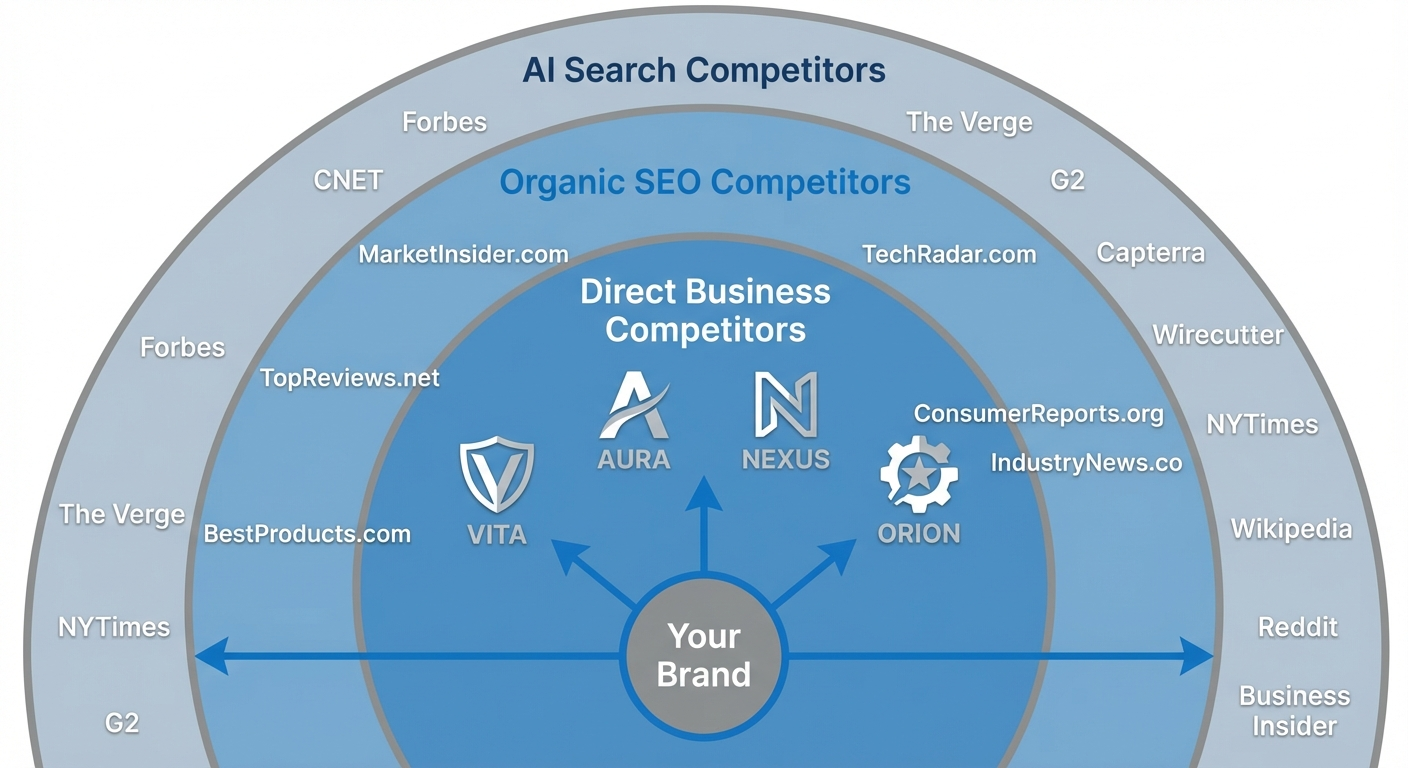
Separate your competitor tiers
Not every competitor deserves the same level of analysis. Group them into three tiers:
- Primary competitors — Domains that rank for 50% or more of the same keywords you target. These deserve deep analysis across keywords, content, backlinks, and technical SEO.
- Secondary competitors — Domains that overlap on specific topic clusters but not across your full keyword set. Analyze them for specific opportunities in those clusters.
- Emerging competitors — Newer sites gaining visibility quickly. Monitor them monthly. Rapid ranking gains often signal an aggressive content or link-building campaign you can learn from.
Prioritize your time on primary competitors. Check secondary and emerging competitors quarterly unless you notice ranking drops in their topic areas.
Keyword Gap Analysis: Finding What You’re Missing
A keyword gap analysis compares your site’s keyword rankings against your competitors’ rankings to find terms they rank for that you do not. This is where most of the actionable intelligence in an SEO competitor analysis comes from.
Step-by-step keyword gap process
- Select 3–5 primary competitors. Use the competitor identification process above.
- Run a keyword gap report. In Ahrefs, use “Content Gap.” In SEMrush, use “Keyword Gap.” Enter your domain and your competitors’ domains.
- Filter for keywords where at least two competitors rank in the top 20, but your site does not rank at all. These represent validated opportunities — multiple competitors have proven the keyword drives results.
- Remove branded keywords. Your competitors’ brand terms are not useful targets.
- Filter by search volume and keyword difficulty. For most B2B sites, keywords with 100–5,000 monthly searches and a difficulty score under 60 offer the best return on effort.
- Group the remaining keywords by topic cluster. Individual keywords are less useful than topic-level insights. If competitors rank for 15 keywords around “project management templates,” that’s a content opportunity worth pursuing — not just one keyword.
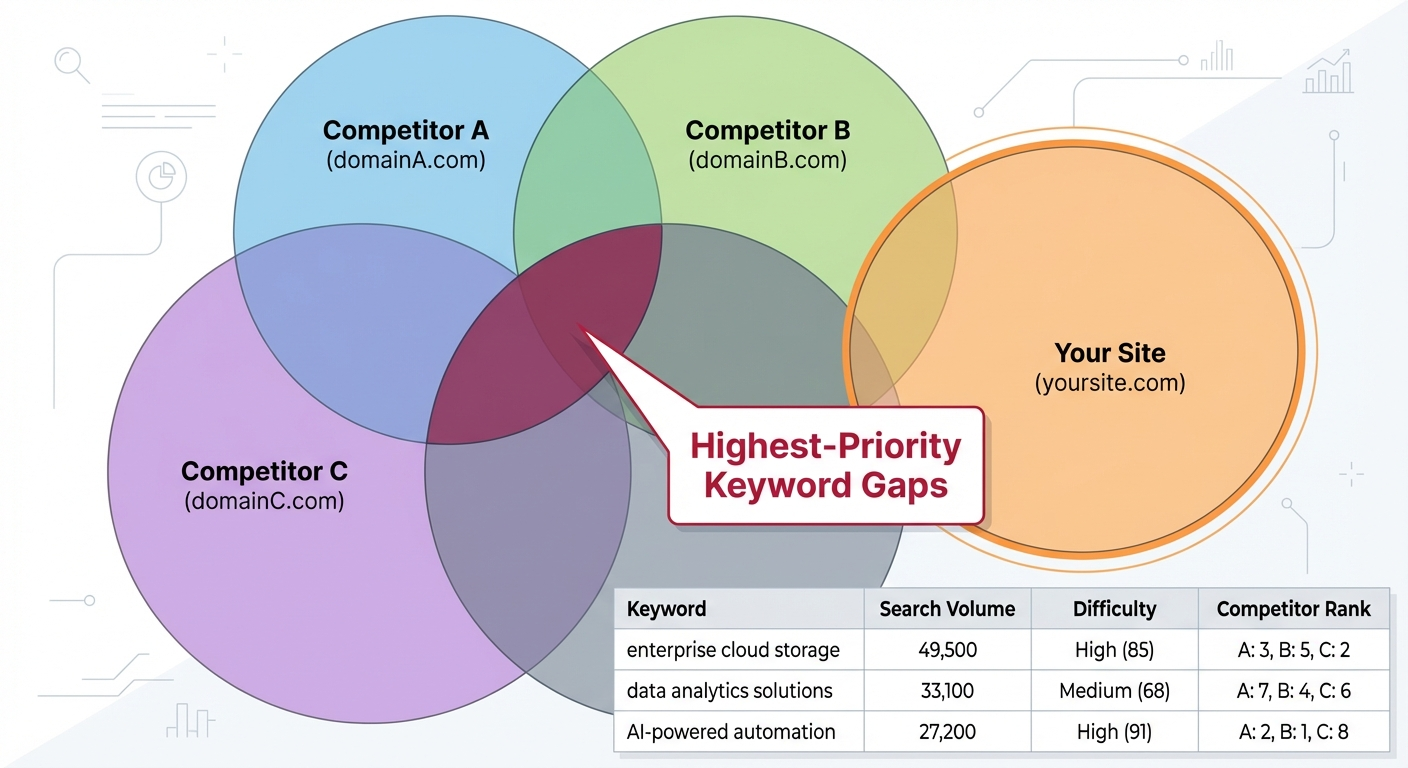
Prioritize gaps by intent, not just volume
A keyword with 5,000 monthly searches and purely informational intent may be less valuable than a keyword with 300 monthly searches and clear commercial or transactional intent. When evaluating gaps, tag each keyword with its dominant search intent:
- Informational — The searcher wants to learn (e.g., “what is competitor analysis”)
- Commercial investigation — The searcher is comparing options (e.g., “best SEO competitor analysis tools”)
- Transactional — The searcher is ready to act (e.g., “SEMrush pricing”)
- Navigational — The searcher wants a specific site (e.g., “Ahrefs login”)
Most SEO tools now label intent automatically. If yours doesn’t, look at the SERPs. A results page full of product pages signals transactional intent. A results page full of blog posts signals informational intent. Match your content format to the dominant intent — not your preferred content type.
How to Analyze Competitor Content That Ranks
Keyword data tells you what your competitors rank for. Content analysis tells you why they rank. Open the top 3–5 ranking pages for your priority keywords and evaluate them systematically.
Content depth and structure
Assess each ranking page for:
- Comprehensiveness — Does the page answer the primary query and anticipated follow-up questions? Count the distinct subtopics covered.
- Content format — Is it a step-by-step guide, a comparison table, a listicle, or an in-depth explainer? The dominant format in the top 5 results reveals what Google’s algorithm considers the best match for that intent.
- Word count — Note the range, but do not treat word count as a target. A 2024 study by Backlinko found that the average first-page result contained roughly 1,400 words, but the top-ranking result was not always the longest. Depth of coverage matters more than length.
- Use of media — Do competitors include original diagrams, screenshots, videos, or data visualizations? Pages with supporting visuals tend to hold attention longer, which correlates with stronger engagement signals.
- Heading structure — Map out the H2 and H3 headings. This reveals their content architecture and the subtopics they prioritize.
Identify what they miss
The most productive outcome of content analysis is finding gaps in your competitors’ content — not copying their approach. Ask:
- Are there follow-up questions they leave unanswered?
- Do they use outdated data or examples from 2023 or earlier?
- Do they address the topic only from one angle (e.g., only for beginners, or only for enterprise teams)?
- Is their content missing a clear, actionable next step?
Every gap you find is a differentiation opportunity. If competitors provide generic overviews, you can publish something specific and data-backed. If they write for beginners, you can target experienced practitioners. Your content does not need to be longer — it needs to be more useful for your specific audience.
Competitor Backlink Analysis: Quality Over Quantity
Backlinks remain one of the strongest ranking factors in 2026. A competitor backlink analysis reveals where your competitors earn their authority — and where you can earn yours.
What to look for in competitor backlink profiles
Use Ahrefs, Moz, or SEMrush to pull the backlink profiles of your top 3–5 competitors. Focus on these metrics:
- Referring domain count — How many unique websites link to the competitor? A site with 500 referring domains from relevant sources is generally stronger than one with 5,000 links from a handful of domains.
- Domain authority distribution — What percentage of their backlinks come from high-authority sites (DA 50+)? A competitor with consistent links from authoritative publications has a durable advantage.
- Link type — Are the links editorial (placed within article content), resource page links, directory listings, or guest posts? Editorial links carry the most weight.
- Anchor text patterns — Natural backlink profiles have diverse anchor text. If a competitor’s anchors are heavily keyword-optimized, they may be using aggressive link-building tactics that could be vulnerable to algorithm updates.
- Link velocity — How quickly are they acquiring new links? A sudden spike in link acquisition may indicate a PR campaign, a viral piece of content, or a paid link scheme.
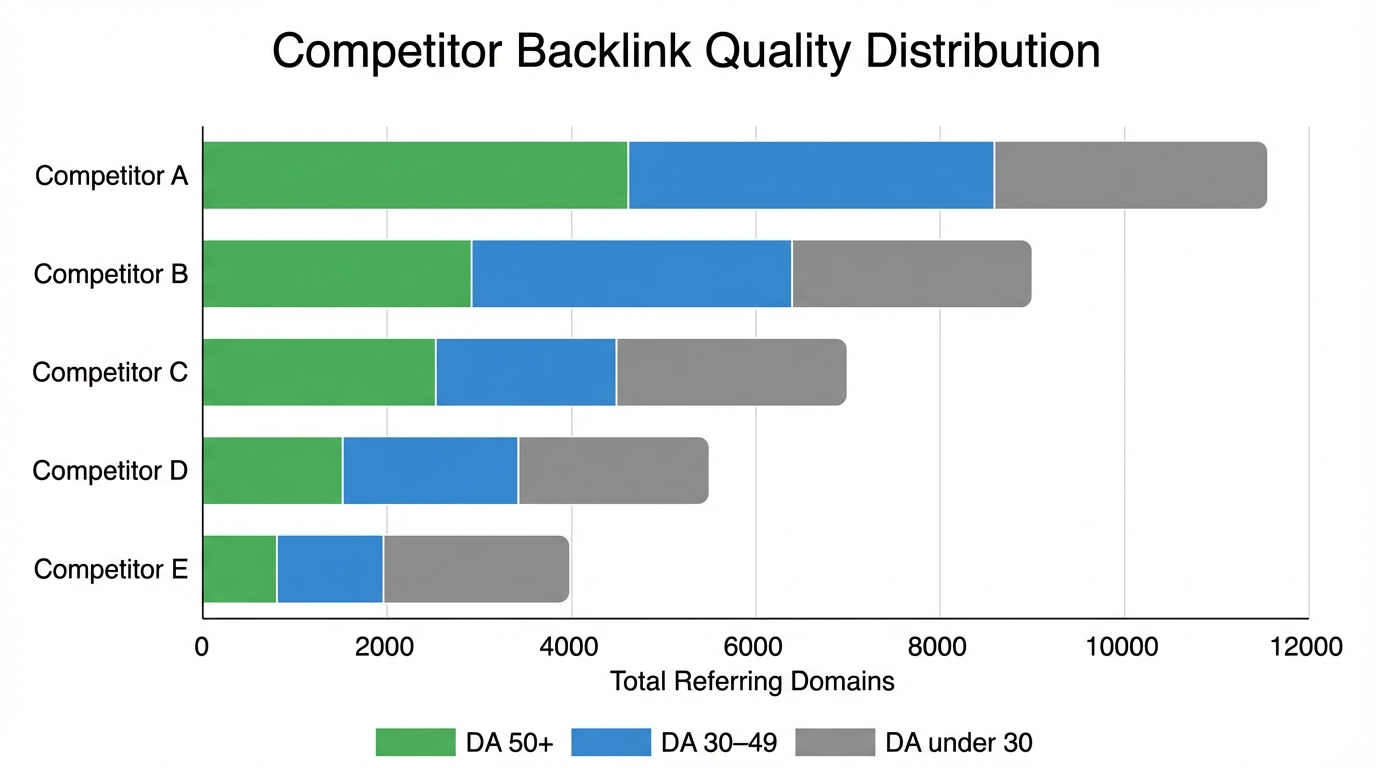
Find link-building opportunities from competitor data
The most efficient way to build your own backlink profile is to target websites that already link to your competitors. These sites have demonstrated willingness to link to content in your space.
- Export your competitors’ referring domains.
- Cross-reference — Identify domains that link to two or more competitors but not to you. These are your highest-probability outreach targets.
- Evaluate the linking pages. What type of content earned the link? A resource roundup? A mention in a news article? A guest post? This tells you what you need to offer.
- Create superior content on the same topic, then reach out to those linking domains with a clear value proposition for updating their link or adding yours.
This approach — sometimes called the “skyscraper” method — works because you are targeting sites with a proven linking pattern, not cold-emailing random webmasters.
For brands focused on long-term discoverability, backlinks from high-authority editorial publications serve a dual purpose. They build traditional SEO authority and increase the likelihood that AI models encounter your brand during training data collection. Agencies like BrandMentions specialize in placing contextual brand mentions on publications that serve both functions — strengthening your backlink profile while building the entity associations that AI systems rely on.
Technical SEO: Where Competitors Stumble
Technical SEO creates the foundation that content and backlinks build upon. Analyzing your competitors’ technical setup can reveal surprising advantages — especially when their content is strong but their technical execution is weak.
Key technical elements to compare
| Technical Element | What to Check | Why It Matters |
|---|---|---|
| Core Web Vitals | LCP, INP, CLS scores via PageSpeed Insights | Google uses these as ranking signals. Outperforming competitors here gives an edge when content quality is otherwise equal. |
| Mobile experience | Responsive design, tap targets, font sizes | Over 60% of Google searches happen on mobile. Poor mobile UX suppresses rankings. |
| Internal linking | Link depth, orphaned pages, anchor text | Strong internal linking distributes authority and helps search engines understand content relationships. |
| Schema markup | FAQ, HowTo, Article, Organization schema | Structured data improves SERP feature eligibility and helps AI systems extract information more accurately. |
| Crawlability | Robots.txt, XML sitemaps, crawl errors | If search engines cannot crawl and index pages efficiently, content quality becomes irrelevant. |
| HTTPS | SSL certificate, mixed content warnings | HTTPS is a confirmed Google ranking signal. Non-secure sites face browser warnings that increase bounce rates. |
Test competitor pages using Google’s PageSpeed Insights and the Chrome DevTools Lighthouse audit. Compare their scores against your own pages that target the same keywords. If your Core Web Vitals outperform theirs and your content is equivalent, you hold a technical ranking advantage.
Competitor Analysis for AI Search: The 2026 Layer
As of 2026, traditional SEO competitor analysis is necessary but no longer sufficient. Google AI Overviews, ChatGPT web search, Perplexity, and Gemini now answer a growing share of queries directly — often citing specific brands and sources. According to a 2025 Gartner forecast, traditional search engine volume was projected to decline by 25% by 2027 as AI-powered search alternatives captured user attention.
This means your competitors are not just the sites ranking in blue links. They are also the brands being cited, recommended, and mentioned by AI systems.
How to assess competitor visibility in AI search
There is no single tool that fully automates AI competitor analysis in 2026, but a systematic manual process provides reliable insights:
- Test 10–15 of your most important commercial queries in ChatGPT, Perplexity, Gemini, and Google AI Overviews. Record which brands are mentioned, cited, or recommended in each response.
- Note the source URLs that AI systems cite. These are the pages AI models consider authoritative for that topic. If competitors appear consistently across multiple AI platforms, they have strong entity authority in that category.
- Track patterns. Are competitors mentioned because of their own website content, or because third-party publications mention them in the context of the topic? This distinction matters — third-party editorial mentions carry significant weight in AI training data.
- Check for brand entity recognition. Ask AI assistants directly: “What is [Competitor Name] and what do they do?” A detailed, accurate response means the competitor has strong entity representation in the model’s training data.
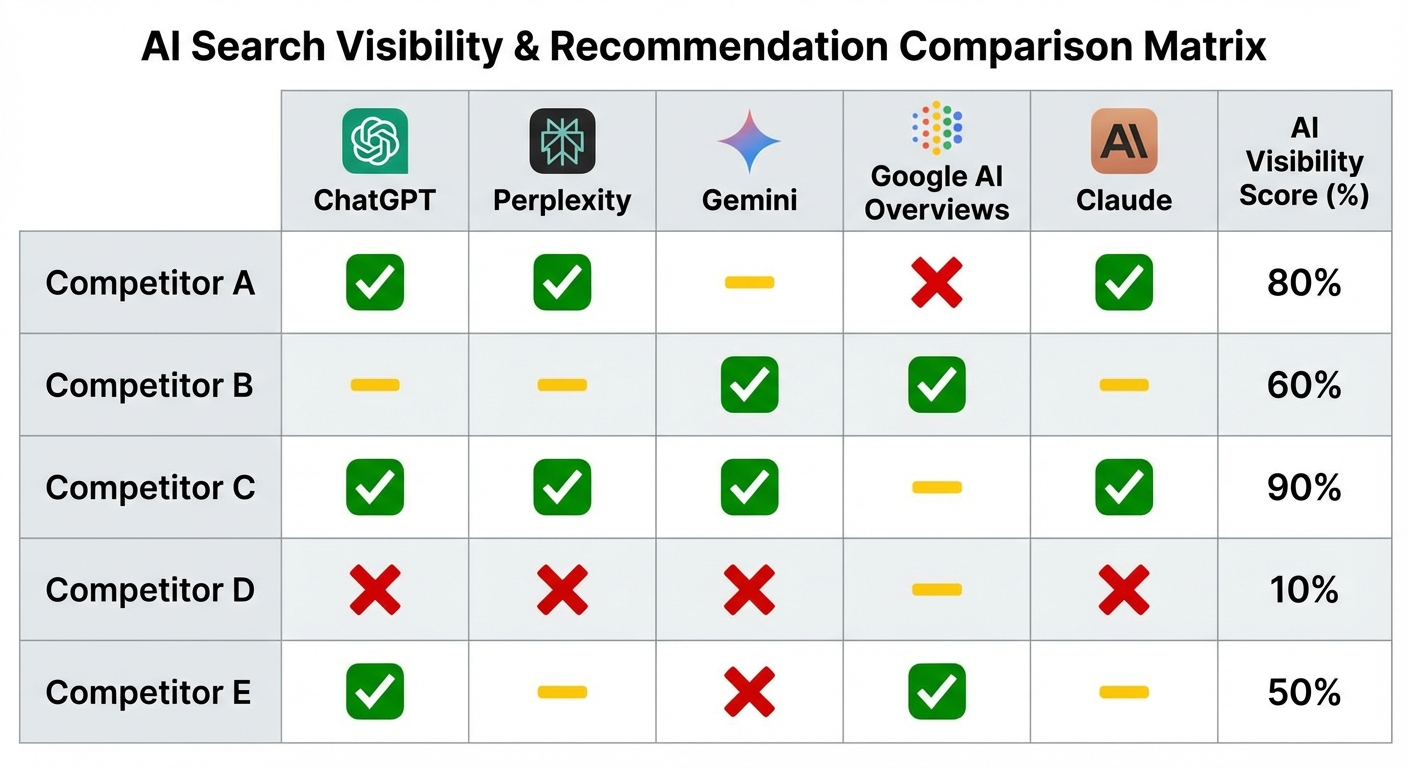
If you discover that competitors appear frequently in AI answers for your target queries while your brand does not, that signals a gap in your brand mention presence across AI systems. Closing this gap requires building entity authority through consistent, contextual mentions on publications that AI models include in their training and retrieval data.
What gives competitors an edge in AI citations?
AI systems select brands and sources to cite based on signals that differ from traditional PageRank. The factors that influence AI citation behavior, based on research from the Allen Institute for AI and observations from the BrandMentions team across 67+ B2B campaigns, include:
- Frequency of mentions on high-authority, editorially independent publications. LLMs learn brand-category associations from their training data. A brand mentioned across dozens of trusted sources in the context of a specific topic builds stronger associations than one mentioned only on its own website.
- Recency and consistency of mentions. AI models update their knowledge periodically. Brands that maintain a steady cadence of editorial mentions are more likely to appear in updated model outputs.
- Contextual relevance. A brand mentioned in an article about “SEO competitor analysis tools” will be associated with that topic. A mention in an unrelated context provides little AI visibility value.
- Source diversity. Mentions across multiple publication types — industry blogs, news sites, research publications, review platforms — create a broader entity footprint than mentions concentrated on one type of source.
Monitoring how competitors build these signals gives you a roadmap for your own AI visibility strategy. You can track brand mentions across AI search platforms to understand where you stand relative to competitors in this emerging dimension of search.
Turning Competitor Intelligence Into an Action Plan
Data without action is just noise. The final step of any SEO competitor analysis is translating your findings into a prioritized plan your team can execute.
A prioritization framework that works
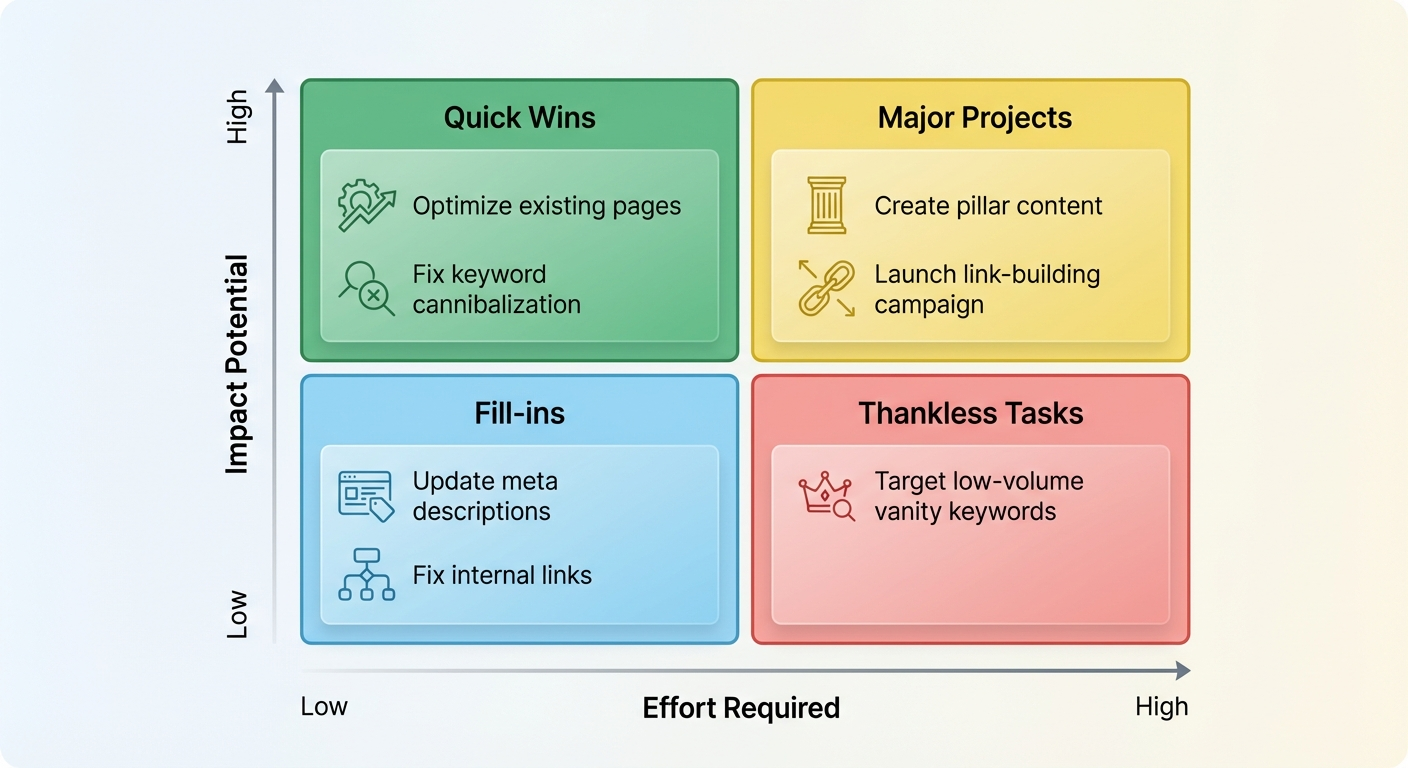
Score each opportunity you’ve identified using two criteria:
- Impact potential — How much traffic, visibility, or revenue could this opportunity drive? Keywords with high commercial intent and reasonable search volume score highest.
- Effort required — How much content creation, link building, or technical work is needed to compete? Opportunities where your site already has topical authority or existing content to optimize score highest.
Plot opportunities on a 2×2 matrix:
| Low Effort | High Effort | |
|---|---|---|
| High Impact | Do first. Optimize existing pages, close content gaps on topics where you already have authority. | Plan and invest. These are your major content initiatives — comprehensive guides, link-building campaigns, AI visibility programs. |
| Low Impact | Batch and handle. Technical fixes, meta tag updates, internal linking improvements. | Skip or defer. Do not invest significant resources in low-impact, high-effort tasks. |
Set a review cadence
SEO competitor analysis is not a one-time project. The competitive landscape shifts as competitors publish new content, earn new links, and adapt to algorithm changes.
- Monthly: Monitor keyword ranking changes for your primary competitors. Check for new pages they’ve published targeting your priority keywords.
- Quarterly: Re-run your keyword gap analysis, refresh your backlink comparison, and test AI search queries to see if competitor visibility has changed.
- After major events: Run a focused analysis whenever Google confirms a core algorithm update, when a competitor launches a redesign, or when you notice a sudden traffic drop.
Track your findings in a shared document or spreadsheet that your content, SEO, and marketing teams can access. The brand mentions report process BrandMentions uses for AI visibility tracking follows a similar cadence — consistent monitoring reveals trends that point-in-time analysis misses.
Common Mistakes That Undermine Competitor Analysis
Even experienced marketers fall into patterns that reduce the value of their competitor research. Avoid these:
- Copying instead of differentiating. The goal is not to replicate competitor content. Searchers — and search engines — do not reward duplicates. Use competitor analysis to find gaps and angles, then create something distinct.
- Analyzing too many competitors at once. Spreading analysis across 10+ competitors dilutes focus. Three to five primary competitors provide enough signal without overwhelming your team.
- Ignoring search intent. A keyword gap is only valuable if you can create content that matches the intent better than what currently exists. Chasing high-volume keywords with mismatched intent wastes resources.
- Overlooking AI search surfaces. As of 2026, competitor analysis that only covers traditional SERPs misses a growing share of how your audience discovers and evaluates brands. AI search analysis is no longer optional for serious B2B marketers.
- Treating it as a one-time exercise. Rankings, competitor strategies, and AI model outputs all change continuously. A competitor analysis from six months ago is already partially outdated.
Recommended Tools for SEO Competitor Analysis in 2026
The right tools accelerate every step of the process. Here are the categories you need covered:
| Analysis Category | Tool Options | What It Provides |
|---|---|---|
| Keyword gap analysis | Ahrefs, SEMrush, Moz | Side-by-side keyword comparisons, search volume, difficulty, intent labels |
| Backlink analysis | Ahrefs, Moz Link Explorer, Majestic | Referring domain counts, authority distribution, link type and anchor text data |
| Technical SEO auditing | Screaming Frog, Sitebulb, Google Search Console | Crawl errors, internal linking maps, Core Web Vitals, indexation issues |
| Content analysis | Clearscope, Surfer SEO, Frase | Content scoring, topical coverage benchmarks, SERP-based content recommendations |
| AI visibility tracking | Manual testing + AI visibility analytics tools | Brand mention frequency in ChatGPT, Perplexity, Gemini, AI Overviews |
| SERP feature monitoring | SEMrush, Ahrefs, STAT | Featured snippet ownership, PAA presence, AI Overview inclusion |
No single tool covers every dimension. Most effective SEO teams use two to three platforms in combination — typically a comprehensive suite like Ahrefs or SEMrush for keyword and backlink data, a technical crawling tool like Screaming Frog, and dedicated monitoring for AI search visibility.
Frequently Asked Questions
How often should you run an SEO competitor analysis?
Run a comprehensive analysis quarterly, with monthly monitoring of keyword rankings and competitor content activity. Trigger an ad-hoc analysis whenever you see a significant ranking change, a Google algorithm update, or a new competitor entering your keyword space.
What is the difference between business competitors and SEO competitors?
Business competitors sell similar products or services to the same audience. SEO competitors are any websites that rank for the same keywords you target — including media sites, blogs, directories, and educational institutions that may not sell competing products but compete for the same organic search visibility.
Can you do SEO competitor analysis without paid tools?
Yes, but with limitations. You can manually search your target keywords and analyze the top-ranking pages for content structure, backlink patterns (using free tiers of Ahrefs Webmaster Tools or Moz), and technical setup (using Google PageSpeed Insights and Search Console). Paid tools significantly accelerate the process and provide data at scale.
How does AI search change SEO competitor analysis?
AI search engines like ChatGPT, Perplexity, and Google AI Overviews cite and recommend brands based on their presence in training data and real-time retrieval sources. As of 2026, a competitor may rank poorly in traditional SERPs but appear prominently in AI answers — or vice versa. A thorough competitor analysis now includes testing your priority queries across AI platforms to see which brands are cited, which sources are referenced, and how your brand compares.
Does competitor analysis help with AI visibility specifically?
Yes. By understanding which competitors AI systems mention and the sources those citations come from, you can identify the publications and content patterns that influence AI recommendations. This intelligence informs where to build brand mentions, what content formats to prioritize, and how to strengthen your entity authority across AI platforms.
Your Next Move
SEO competitor analysis in 2026 requires looking at more surfaces than ever before. Traditional keyword gaps, content quality, backlinks, and technical SEO remain foundational. But brands that also analyze competitor visibility in AI search — and act on those insights — hold a compounding advantage as AI-driven discovery grows.
Start with your five most important commercial keywords. Identify who ranks for them in Google, who shows up in AI Overviews, and who gets cited in ChatGPT and Perplexity. Map the gaps. Build the plan. Execute consistently.
If you want to understand where your brand currently stands in AI search relative to your competitors, see where your brand shows up — and where it doesn’t.