OTA brand monitoring is the practice of tracking how your hotel, airline, or travel brand appears, ranks, and gets reviewed across online travel agency platforms — and, as of 2026, across AI-powered travel search surfaces like ChatGPT, Perplexity, and Google AI Overviews. It combines reputation management, competitive pricing intelligence, and distribution oversight into a single discipline that directly affects your booking volume and revenue.
If you operate in travel and hospitality, your brand’s presence on OTAs like Booking.com, Expedia, and Trip.com is your digital storefront. But the rules changed fast between 2024 and 2026. AI assistants now answer accommodation questions directly, often pulling from OTA reviews, editorial content, and structured data to make recommendations — sometimes without the traveler ever visiting an OTA listing page.
That shift makes monitoring more complex and more important. You need to know not just what guests say about you on Booking.com, but whether ChatGPT recommends your property when someone asks for “the best boutique hotel in Savannah.”
This article breaks down how OTA brand monitoring works in 2026, what to track, which tools and methods actually move the needle, and how to extend your monitoring strategy to cover AI-powered travel discovery.
What You’ll Learn
- What OTA brand monitoring covers — and why it’s broader than review tracking alone
- The seven data points worth monitoring across OTA platforms in 2026
- How AI travel assistants are reshaping where your brand needs to appear
- A practical monitoring workflow you can implement this quarter
- How to detect and respond to trademark misuse, rate parity violations, and review manipulation
- Tools and services that support OTA monitoring at scale — including AI visibility tracking
What Does OTA Brand Monitoring Actually Cover?
OTA brand monitoring is the systematic process of tracking your brand’s visibility, reputation, pricing accuracy, and competitive positioning across online travel agency platforms. It goes well beyond reading guest reviews — though reviews are part of it.
A complete OTA monitoring program tracks seven distinct data categories:
- Review volume and sentiment — What guests say about you on Booking.com, Expedia, TripAdvisor, Google Hotels, and regional OTAs
- Star ratings and ranking position — Where your property appears in OTA search results for your destination and category
- Rate parity — Whether your published rates are consistent across OTAs and your direct booking channel
- Content accuracy — Whether your room descriptions, photos, amenities, and policies match across platforms
- Trademark compliance — Whether competitors or affiliates bid on your brand name in paid search or misrepresent your brand in OTA advertising
- Competitive benchmarking — How your pricing, reviews, and availability compare to your comp set on each OTA
- AI search visibility — Whether AI assistants recommend your property when travelers ask conversational travel questions
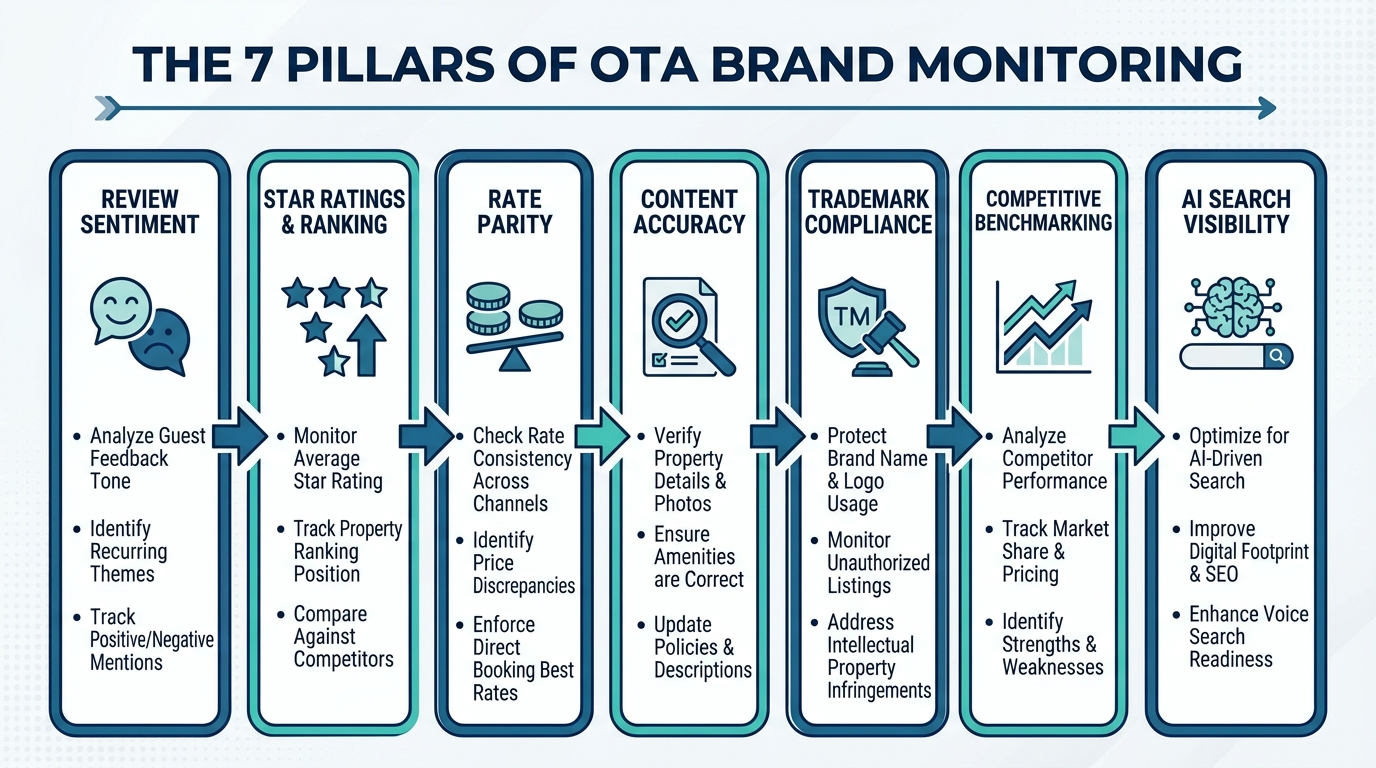
Most hotel operators focus on the first two — reviews and ratings. That’s a starting point, not a strategy. The properties outperforming their comp set in 2026 monitor all seven categories continuously.
Why OTA Brand Monitoring Matters More in 2026
Three forces have made OTA brand monitoring more critical — and more complex — than it was even two years ago.
OTAs Drive the Majority of Hotel Bookings
OTAs now account for more than half of all hotel bookings globally, according to SiteMinder’s 2025 Hotel Booking Trends report. Booking.com alone commands roughly 69% of the European OTA market, per Statista. In the U.S., Expedia Group and Booking Holdings split the majority of online travel spend.
When the platform where most of your guests discover you also controls their first impression — through ratings, ranking algorithms, and review visibility — monitoring that platform is a revenue function, not a PR task.
AI Assistants Are Becoming a New Discovery Channel
As of 2026, travelers increasingly ask AI assistants for travel recommendations before opening an OTA. A traveler might type “best family-friendly resort near Orlando under $300/night” into ChatGPT or Perplexity and receive a curated shortlist — drawn partly from OTA review data, editorial content, and structured travel databases.
Brian Harniman’s analysis on LinkedIn captured this shift clearly: once AI strips out the friction of OTA browsing and delivers answers directly, the OTA brand itself becomes less visible to the consumer. Your property brand, however, either appears in that AI-generated shortlist or it doesn’t.
That makes monitoring your brand’s presence in AI outputs a necessary extension of OTA brand monitoring. If AI assistants cite your property — with accurate descriptions and positive sentiment — you gain a booking channel that costs zero commission. If they don’t mention you at all, you’ve lost a discovery touchpoint entirely.
Rate Parity and Trademark Violations Are Getting Harder to Catch
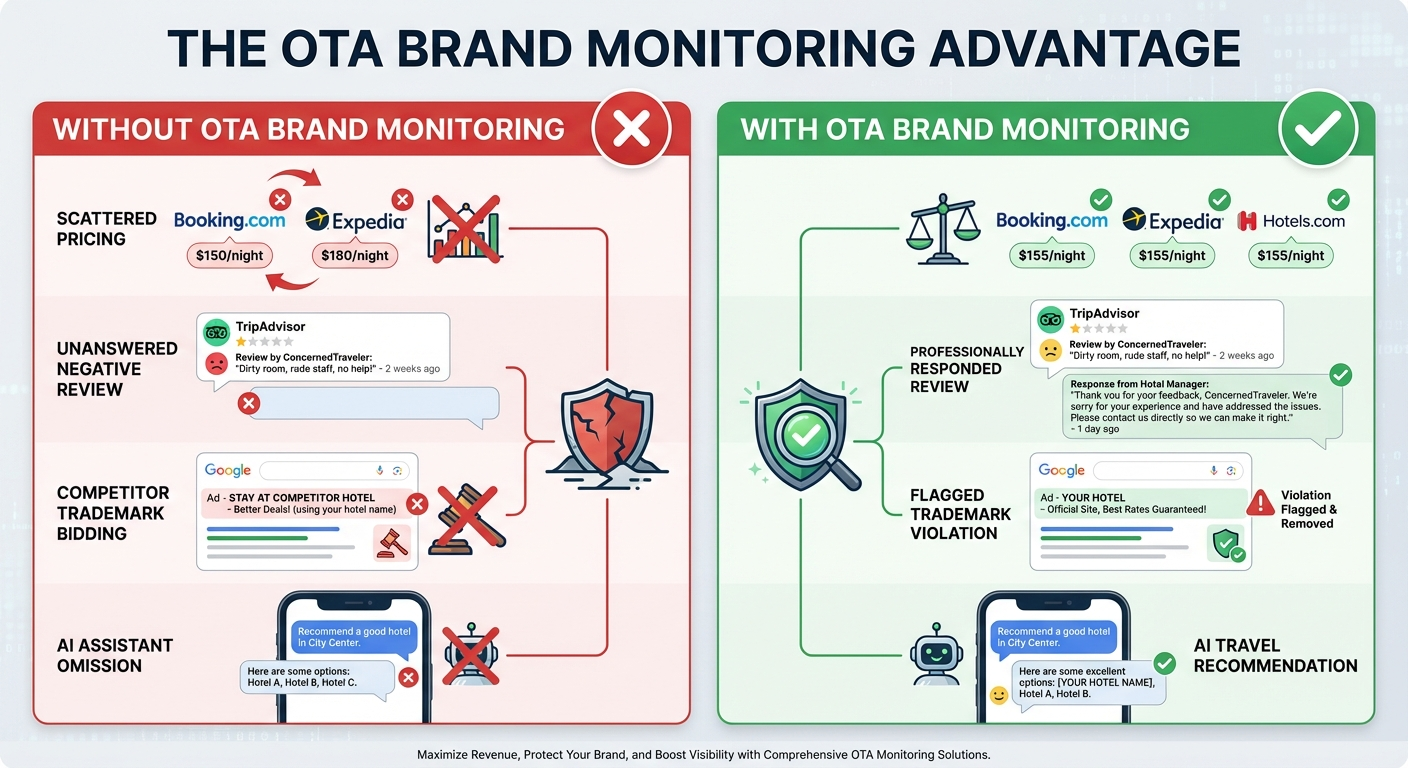
The proliferation of meta-OTAs, resellers, and affiliate networks means your rates and brand name can appear in places you never authorized. A 2024 BrandVerity study found that trademark bidding violations in travel paid search increased year-over-year, with affiliates and sub-affiliates frequently using hotel brand names in ad copy to divert clicks.
Without active monitoring, you pay for the consequences: inflated cost-per-click on your own brand terms, rate confusion that erodes guest trust, and commission leakage from bookings that should have been direct.
How to Monitor Your Brand Across OTA Platforms
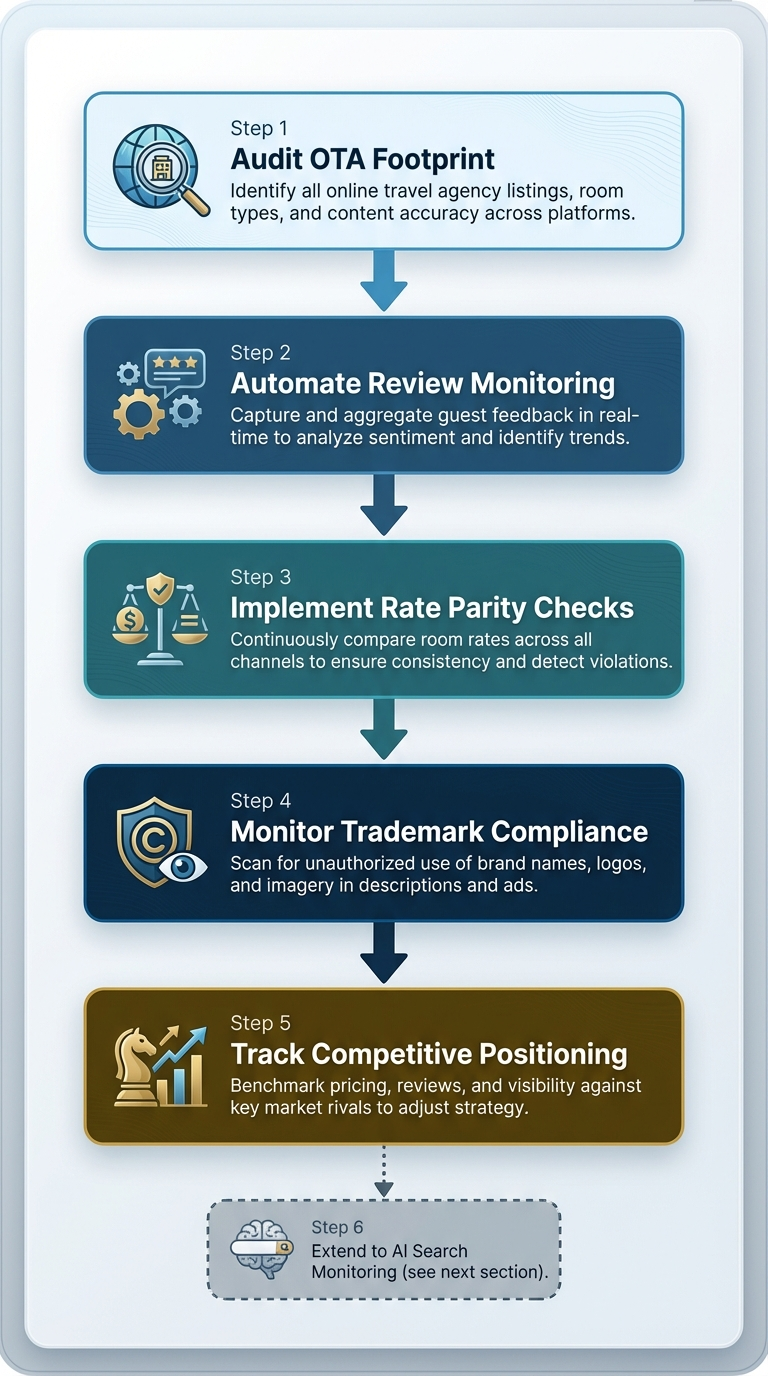
Effective OTA brand monitoring requires a structured workflow — not sporadic review checks. Here’s a practical system you can implement with a small team.
Step 1: Audit Your Current OTA Footprint
Before you can monitor, you need to know where you exist. List every OTA where your property is currently listed. Include global platforms (Booking.com, Expedia, Agoda, Trip.com), regional platforms relevant to your feeder markets, and metasearch engines (Google Hotels, Trivago, Kayak) that aggregate your OTA listings.
Check each listing for:
- Correct property name and branding
- Current photography (updated within the last 18 months)
- Accurate room types, amenity lists, and policies
- Consistent pricing across platforms
- Active review management (responses within 48 hours)
This baseline audit reveals gaps immediately. Many properties discover outdated photos, incorrect cancellation policies, or missing room categories on secondary OTAs they set up years ago and forgot about.
Step 2: Set Up Automated Review Monitoring
Manual review checking doesn’t scale. Use a brand reputation monitoring system that aggregates reviews from all your OTA listings into one dashboard. This lets you track:
- New review volume per platform per week
- Average sentiment score and trending keywords
- Response rate and average response time
- Rating trajectory (improving, stable, or declining)
Prioritize responding to negative reviews within 24 hours. According to a 2024 TripAdvisor study, properties that respond to reviews see higher conversion rates than those that don’t — and only about 40% of hotels currently respond to OTA reviews, per SiteMinder’s data. That gap is your opportunity.
Step 3: Implement Rate Parity Checks
Rate parity monitoring compares your published rate across every OTA and your direct booking channel at regular intervals — ideally multiple times per day. Rate shopping tools like OTAScanner, Lighthouse (formerly OTA Insight), and SiteMinder’s Business Intelligence module automate this process.
When you detect a parity violation — say, a wholesaler reselling your rooms at a lower rate on an unauthorized OTA — you can trace the source and enforce your distribution agreements. Consistent rate parity protects your direct booking revenue and keeps OTA partners satisfied with fair competition.
Step 4: Monitor Trademark and Paid Search Compliance
If competitors or affiliates bid on your brand name in Google Ads or Bing Ads, they divert travelers who were already searching for your property. BrandVerity, the most widely used tool for this in travel, automatically scans paid search results across geographies and flags unauthorized trademark usage in ad copy and display URLs.
For hotel chains and OTAs alike, trademark monitoring is a cost-protection measure. Every diverted click costs you — either in lost direct bookings or inflated paid search spend to defend your own brand terms.
Step 5: Track Competitive Positioning
OTA brand monitoring isn’t just about your own brand. You need context. Track your comp set — the three to five properties travelers are most likely comparing you against — on the same metrics:
- Their average OTA rating vs. yours
- Their pricing relative to yours for the same dates
- Their review volume and recency
- Their ranking position in OTA search results for your destination
Tools like Lighthouse’s Competitor Benchmarking Suite and SiteMinder’s Business Intelligence dashboard let you pull this data without manual spot-checking. When a competitor drops their rate significantly, you see it in near real-time and can decide whether to respond or hold firm.
Extending OTA Monitoring to AI Search Surfaces
As of 2026, a growing share of travel research happens inside AI-powered interfaces — ChatGPT, Perplexity, Google AI Overviews, Gemini, and Copilot. These systems draw on OTA review data, editorial travel content, and structured databases to generate recommendations.
This creates a new monitoring requirement: you need to know what AI says about your brand when travelers ask travel questions.
What AI Assistants Pull from OTA Data
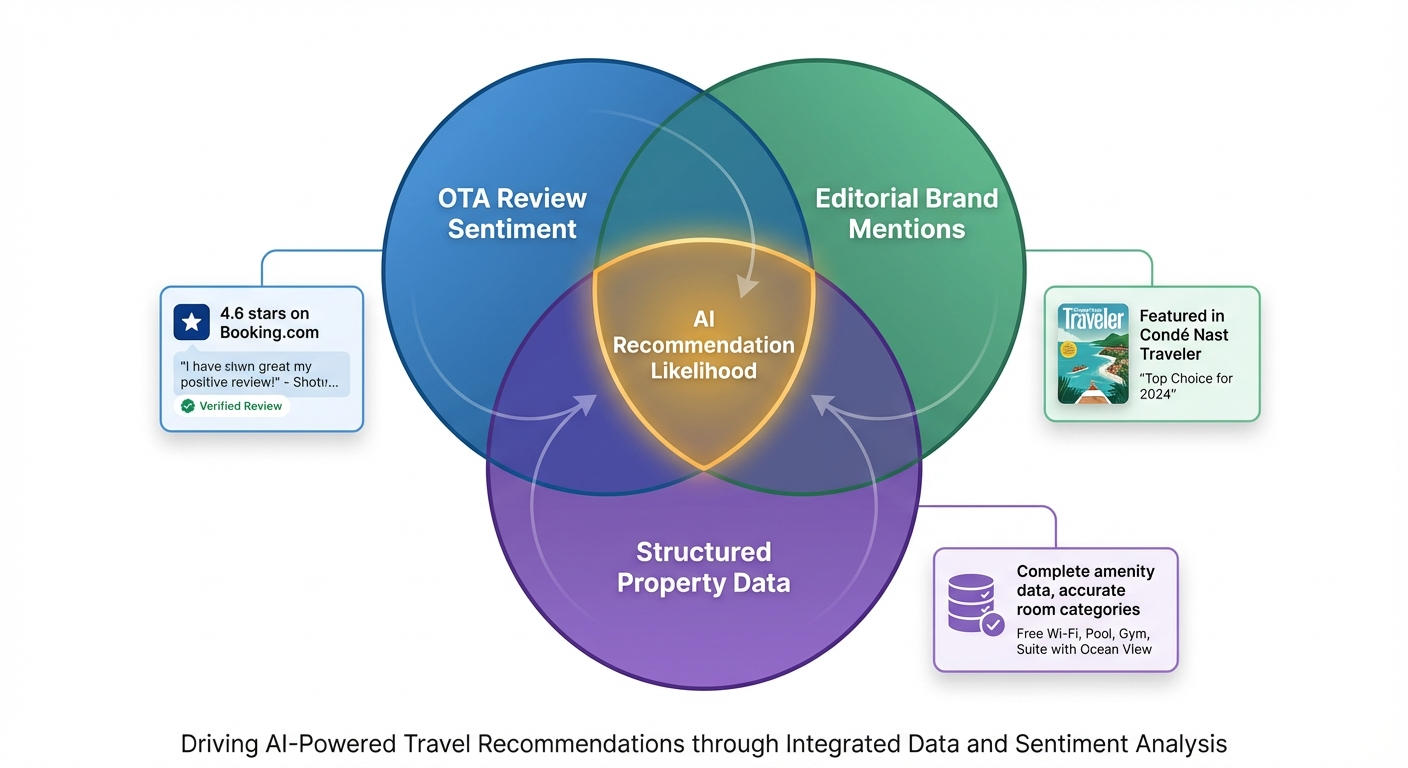
When a traveler asks ChatGPT “What’s the best hotel near Times Square for under $250?”, the model’s answer is shaped by:
- Aggregated review sentiment from OTA platforms and Google Hotels
- Editorial mentions on travel publications, blogs, and destination guides
- Structured data — property descriptions, star ratings, amenity lists — from indexed OTA pages
- Brand authority signals — how frequently and consistently your brand appears across trusted sources
If your OTA reviews are strong, your property descriptions are rich and accurate, and travel editors have written about you — AI assistants are more likely to recommend you. If your OTA presence is thin, your reviews are mixed, and no editorial content mentions your brand, AI will recommend your competitors instead.
How to Monitor Your Brand in AI Travel Recommendations
Start by querying AI platforms manually with the questions your target guests are likely asking. Test prompts like:
- “Best [property type] in [your destination] for [your target guest segment]”
- “Top-rated hotels near [landmark] under [price point]”
- “Where should I stay in [city] for a [occasion — anniversary, family trip, business travel]?”
Document whether your property appears, how it’s described, and what competitors are cited alongside you. Run these checks across ChatGPT, Perplexity, Gemini, and Google AI Overviews — each model draws on different data sources and updates at different intervals.
For systematic tracking, tools that monitor brand mentions across AI search platforms can automate this process and alert you to changes in your AI visibility over time.
Pro Insight: AI models update their knowledge at different intervals. A positive review surge on Booking.com today may not influence ChatGPT’s recommendations for weeks or months — but it will influence Perplexity (which has real-time web access) almost immediately. Your monitoring cadence should reflect these differences.
Building the Content Layer AI Needs to Recommend You
OTA listings alone aren’t enough. AI models weigh editorial mentions and brand authority heavily when generating travel recommendations. To strengthen your AI visibility:
- Earn editorial coverage on travel publications that AI models include in their training data or retrieve in real-time
- Ensure consistent brand information across your website, OTA profiles, and third-party directories
- Build a content footprint that associates your brand with specific travel categories, destinations, and guest segments
Agencies like BrandMentions approach this systematically — placing contextual brand mentions on high-authority publications that AI models actively learn from, timed to coincide with knowledge refresh cycles. In campaigns across 67+ B2B companies, the BrandMentions team found that brands with consistent editorial mentions achieved AI recommendation rates 89% higher than those relying solely on traditional SEO.
For travel brands, the same principle applies. Your OTA reviews provide the sentiment signal. Editorial mentions provide the authority signal. Together, they determine whether AI assistants recommend your property.
Tools and Services for OTA Brand Monitoring in 2026
No single tool covers all seven monitoring categories. Most hotel revenue teams combine two to four solutions depending on portfolio size and budget. Here’s a practical breakdown by function.
Review Aggregation and Sentiment Analysis
These tools collect reviews from multiple OTAs into one interface and provide sentiment scoring, keyword extraction, and response management:
- ReviewPro (Shiji Group) — Enterprise-grade review aggregation with AI-powered sentiment analysis across 175+ OTAs and review sites
- TrustYou — Aggregates reviews and generates a TrustScore that correlates with OTA conversion rates
- Brand24 — Tracks brand mentions and reviews across social media and OTAs, with brand sentiment analysis capabilities
Rate Shopping and Parity Monitoring
- Lighthouse (formerly OTA Insight) — The most widely adopted rate intelligence platform, collecting 1.7 billion hotel rates daily across 300,000+ competitor properties
- OTAScanner — A rate shopping tool focused on competitor pricing analysis across OTA channels
- SiteMinder Business Intelligence — Integrates rate monitoring with channel management for properties using the SiteMinder platform
Trademark and Paid Search Monitoring
- BrandVerity — The industry standard for travel trademark monitoring, used by Booking.com, major hotel chains, and airlines to detect unauthorized brand bidding in paid search
AI Visibility and Brand Mention Tracking
- BrandMentions — Tracks how and where your brand appears across AI search platforms (ChatGPT, Perplexity, Gemini, Google AI Overviews) and places strategic brand mentions to strengthen AI discoverability
- Manual AI auditing — Regular structured queries across AI platforms to document your brand’s current recommendation status
Competitive Benchmarking
- Lighthouse Competitor Benchmarking Suite — Tracks competitor rates, reviews, and availability in a single view
- STR (CoStar Group) — Industry benchmarking for RevPAR, occupancy, and ADR against your comp set
For independent hotels with limited budgets, start with Lighthouse for rate intelligence and a review aggregator like TrustYou or Brand24. Add trademark monitoring only if you have significant brand search volume. Layer in AI visibility tracking as your monitoring program matures.
For hotel groups and chains, a comprehensive stack — review aggregation, rate parity, trademark monitoring, competitive benchmarking, and AI visibility tracking — is table stakes for protecting revenue across a portfolio.
Common OTA Brand Monitoring Mistakes to Avoid
Even properties that invest in monitoring tools often undermine their own efforts with these patterns:
Monitoring Reviews Without Acting on Patterns
Tracking review sentiment is pointless if you don’t use the data operationally. If “slow check-in” appears in 15% of your negative reviews across Booking.com and Expedia, that’s a front-desk staffing issue — not a reputation issue. The monitoring tool surfaces the signal. Your operations team has to fix the root cause.
Ignoring Secondary and Regional OTAs
Many properties monitor Booking.com and Expedia closely but neglect Agoda, Trip.com, MakeMyTrip, or regional platforms where their feeder markets actually search. If 20% of your guests come from Asia, your Agoda and Trip.com listings deserve the same monitoring rigor as your Booking.com profile.
Treating Rate Parity as a One-Time Check
Rate parity violations are dynamic. A wholesaler can undercut your rates on Monday, correct by Wednesday, and do it again Friday — all without triggering a weekly spot-check. Automated, multi-daily rate parity monitoring is the only reliable approach.
Overlooking AI as a Distribution Surface
The biggest monitoring blind spot in 2026 is AI search. Most hotel revenue teams haven’t added AI visibility tracking to their monitoring workflows yet. That’s a window of opportunity — the properties that check whether AI mentions their brand and actively work to improve their presence will capture early-mover advantage as AI-assisted travel booking grows.
How OTA Algorithms Decide Your Ranking — and What Monitoring Reveals
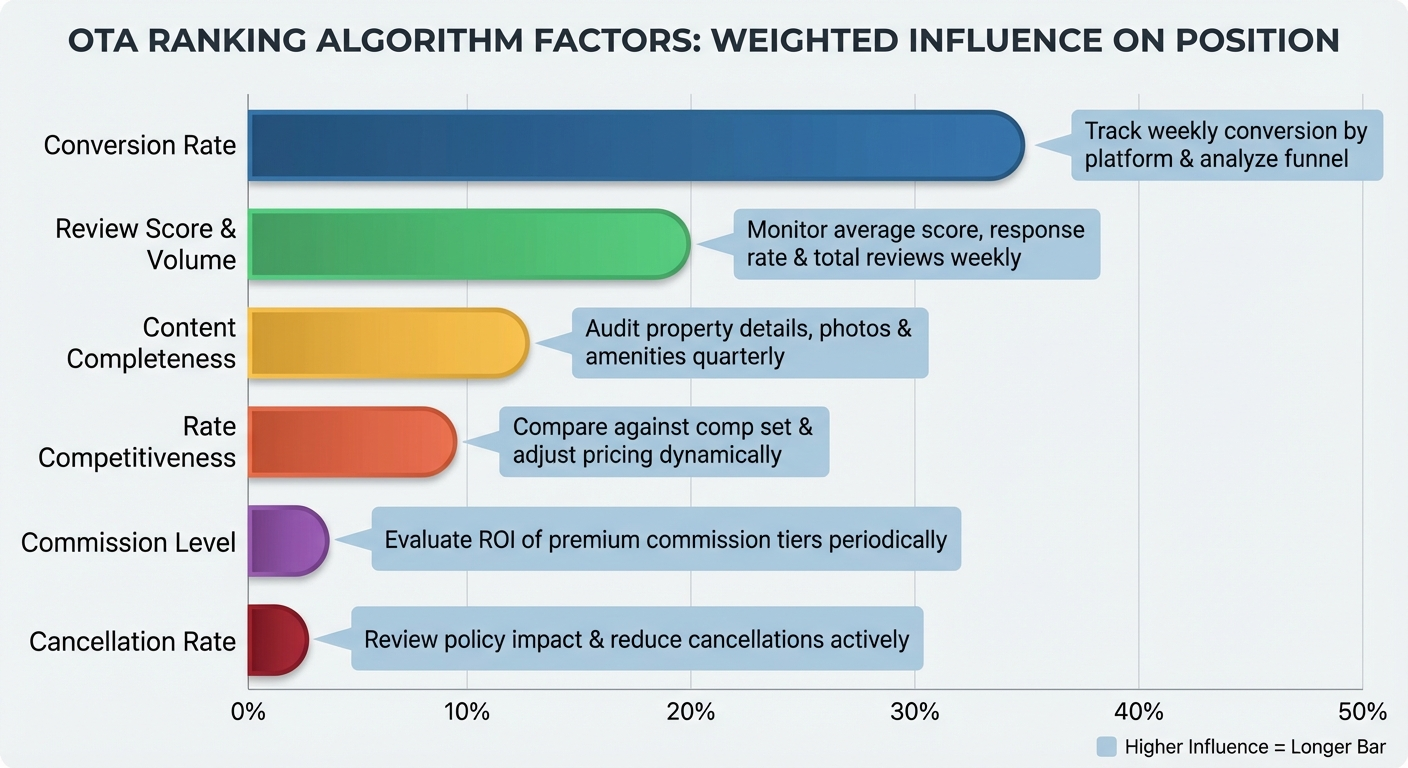
OTA platforms use ranking algorithms that determine which properties appear first when a traveler searches for a destination. These algorithms weigh multiple factors, and monitoring each one tells you exactly where to invest effort.
- Conversion rate — Properties that convert a higher percentage of profile visitors into bookings rank higher. Monitoring your conversion rate by platform reveals where your listing underperforms.
- Review score and volume — Higher ratings and more recent reviews improve ranking. Monitoring review velocity — how many new reviews you receive per week — shows whether you’re keeping pace with competitors.
- Content completeness — Listings with more photos, detailed descriptions, and complete amenity data rank higher. A content audit during monitoring catches gaps.
- Rate competitiveness — OTAs favor properties that offer competitive pricing. Rate monitoring reveals whether you’re priced out of your comp set.
- Commission level — Some OTAs allow properties to increase commission in exchange for better ranking. Monitoring the ROI of commission adjustments ensures you’re not overpaying for visibility.
- Cancellation rate — Properties with lower cancellation rates rank higher. Monitoring this metric by OTA helps you identify which platforms generate the least reliable bookings.
When you monitor all six factors together, you build a diagnostic picture of your OTA performance. A ranking drop isn’t random — it’s caused by a specific factor you can identify and address.
Building a Monitoring Cadence That Scales
OTA brand monitoring fails when it’s treated as a project instead of a process. Here’s a cadence framework that balances thoroughness with practical workload.
Daily (automated):
- Rate parity scans across all connected OTAs
- New review alerts with sentiment flags
- Availability and inventory accuracy checks via channel manager
Weekly (15–30 minutes of human review):
- Review response audit — have all reviews from the past 7 days been addressed?
- Competitive rate comparison for the next 30, 60, and 90 days
- Ranking position check on your top three OTAs for your destination
Monthly (strategic review):
- Review sentiment trend analysis — are ratings improving, stable, or declining?
- Content accuracy audit across all OTA listings
- AI visibility check — query three to five AI platforms with your target travel questions
- Trademark compliance scan (if applicable)
- Competitive benchmarking report — share of voice across OTAs vs. comp set
Quarterly (strategic planning):
- Full OTA footprint audit — add emerging platforms, remove underperforming ones
- ROI analysis by OTA channel — commission cost vs. revenue contribution
- AI visibility trend assessment — is your brand appearing more or less frequently in AI recommendations?
- Adjust monitoring tools and workflows based on what the data reveals
Frequently Asked Questions
What is OTA brand monitoring?
OTA brand monitoring is the practice of systematically tracking your brand’s reviews, ratings, pricing, content accuracy, trademark compliance, and competitive positioning across online travel agency platforms. In 2026, it also includes monitoring how AI search assistants reference your brand in travel recommendations.
Which OTAs should I monitor first?
Start with the platforms that generate the most bookings for your property — typically Booking.com, Expedia, and Google Hotels for most U.S. properties. Then add regional OTAs that match your feeder markets. If you receive significant Asian bookings, Agoda and Trip.com are essential. Use your channel manager data to prioritize by actual booking volume.
How often should I check my OTA reviews?
Set up automated alerts so you’re notified of every new review in real time. Respond to negative reviews within 24 hours and positive reviews within 48 hours. Conduct a deeper sentiment analysis weekly to identify recurring themes. A brand mentions report can consolidate this data across platforms.
Does OTA brand monitoring affect AI search visibility?
Yes. AI assistants like ChatGPT and Perplexity draw on OTA review data, editorial content, and structured property information when generating travel recommendations. Strong OTA reviews, accurate property data, and editorial brand mentions all increase the likelihood that AI surfaces your brand. Monitoring your AI visibility is now a natural extension of OTA brand monitoring.
What tools do hotels use for OTA brand monitoring?
Most properties combine a rate intelligence tool (like Lighthouse), a review aggregation platform (like ReviewPro or TrustYou), and a channel manager (like SiteMinder) for operational monitoring. For trademark compliance, BrandVerity is the travel industry standard. For AI visibility tracking, brand monitoring tools that cover AI search platforms are an emerging category.
How do I detect rate parity violations across OTAs?
Use an automated rate shopping tool that scans your published rates across every connected OTA multiple times per day. Lighthouse, OTAScanner, and SiteMinder Business Intelligence all offer this capability. When a violation is detected, trace it back to the distribution source — often a wholesaler or affiliate reselling your inventory — and enforce your rate agreements.
Moving From Monitoring to Action
OTA brand monitoring generates data. Data without action is overhead. The properties that gain a competitive edge from monitoring are the ones that connect insights to operational changes — updating a listing photo that review analysis flagged as outdated, adjusting rates when competitive data shows a pricing gap, or building the editorial content footprint that AI assistants need to recommend them.
The monitoring discipline itself isn’t complicated. The challenge is consistency, and having the right tools to automate what should be automated so your team can focus on the decisions that actually affect revenue.
If you’re unsure where your brand stands across OTAs and AI search today, start with the audit. Map your current footprint. Check what AI says about your property. The gaps you find will tell you exactly where to focus first.
See where your brand stands in AI search — get a free AI visibility audit.