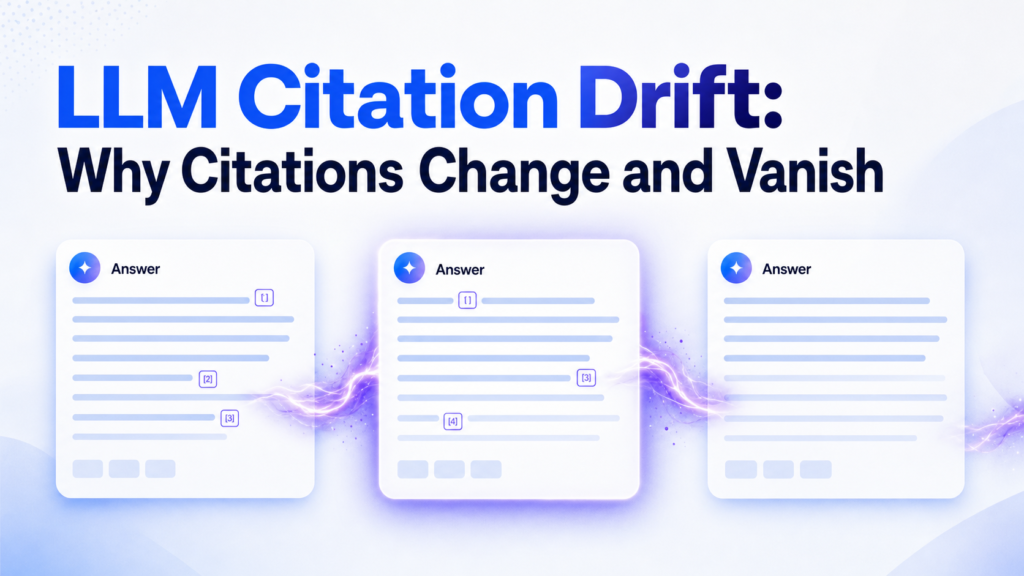

In LLMs and AI search, the same question can produce different citations, or none at all, on the next run. That instability has a name. LLM citation drift is when the source references an AI engine cites change across repeated prompts, follow-up turns, or time-separated queries. A source that backed an answer this morning can vanish, get swapped for another, or shift to a different page by tonight. This matters because a single AI citation screenshot proves almost nothing about durable visibility, and because anyone relying on cited sources needs to know how shaky that ground actually is.
The short version below sets up what you will take away, then the rest of this guide explains the mechanics, the types, how researchers measure it, and the misconceptions that trip up most teams.
The Short Version
- Citation drift means AI source references change across runs, turns, or time, even when your prompt does not.
- It is distinct from hallucination and from search ranking volatility, and conflating them leads to wrong fixes.
- Drift shows up as disappearance, mutation, substitution, or fabrication of cited sources.
- You only see drift by repeating the same query and comparing source overlap over time.
- Citations are dynamic signals, not permanent guarantees, so measure stability instead of counting one-off appearances.
What LLM Citation Drift Means
LLM citation drift is the instability of source references in AI answers when you repeat a prompt, send a follow-up, or ask the same thing days apart. The answer text can stay roughly the same while the sources underneath it shift, drop out, or get replaced.
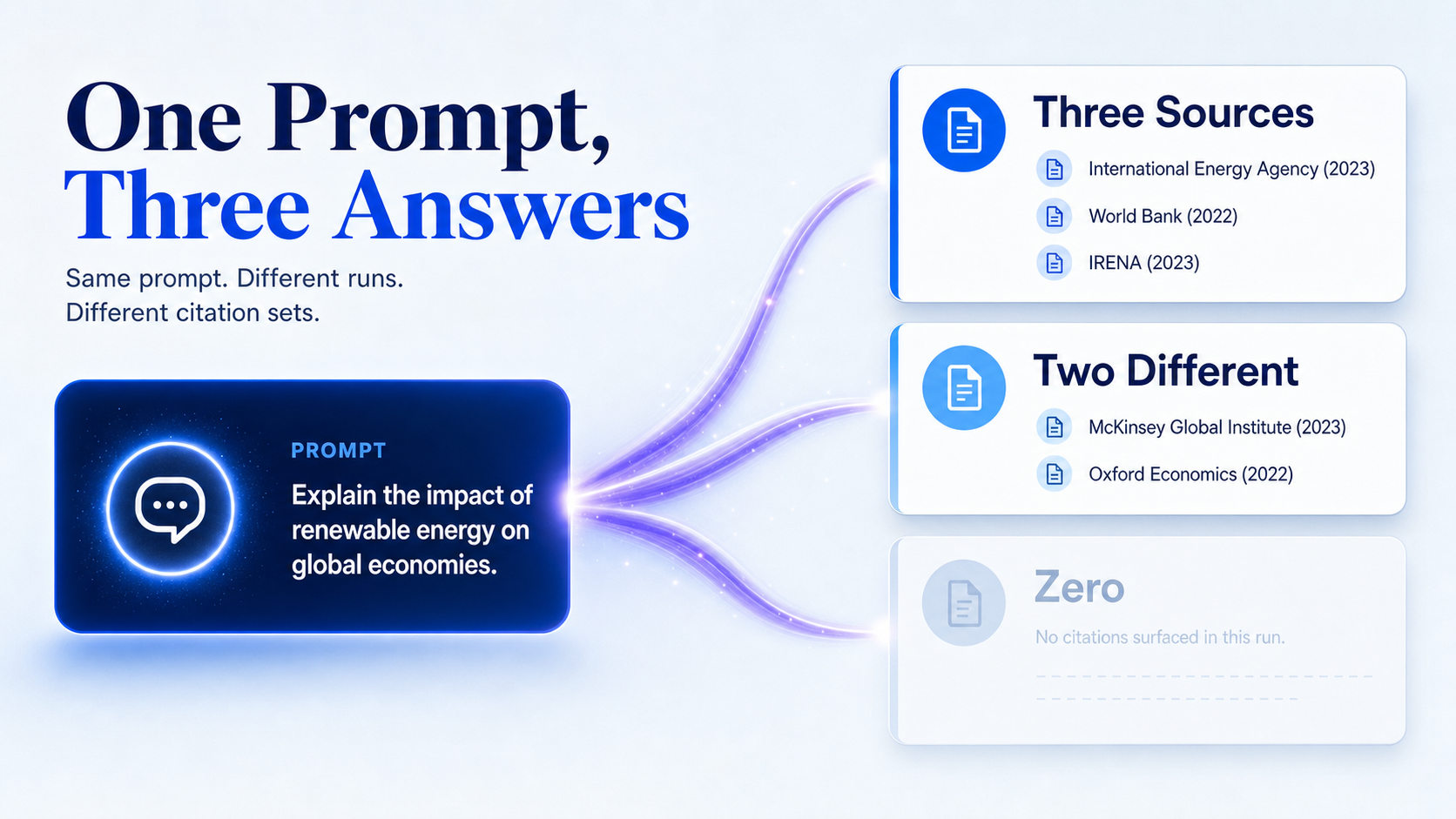
You will notice three forms first. A source appears on one run and is gone on the next. A source stays but the cited page or URL changes. Or one source gets swapped for a different source filling the same role in the answer.
Here is the boundary that trips people up. Drift is not hallucination. An answer can be broadly correct, even well-grounded, while its citation set still rotates from run to run. Hallucination is about the content being wrong. Drift is about the references moving.
Drift is also not search ranking volatility. In classic search, results reshuffle but the page index stays relatively knowable. In an AI answer, the model is not handing you a stable ranked list. It is generating a response and attaching sources, and that attachment behaves more like a dynamic recommendation than a fixed footnote.
That recommendation framing is the cleanest mental model. Think of AI citations less like a bibliography stapled to a paper and more like a playlist that regenerates each time you press play. Teams often treat one good AI citation screenshot as proof of stability. It is one snapshot, nothing more.
Why LLM Citation Drift Matters
Citation drift matters because unstable sources break the two things people expect from AI answers: repeatable sourcing and durable visibility. If you cannot reproduce where an answer came from, you cannot trust it as evidence, and you cannot prove your brand is reliably present.
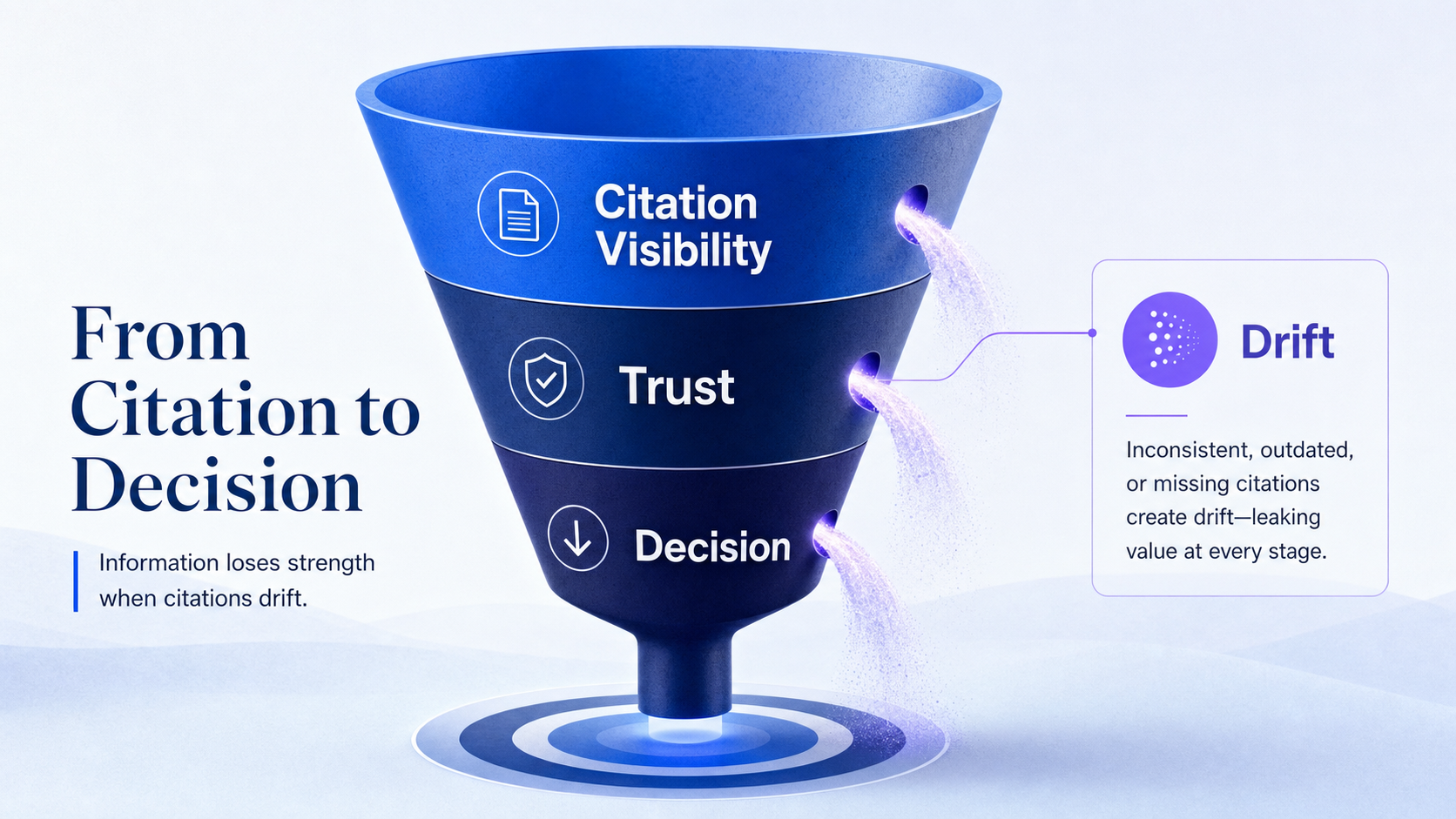
For analysts, buyers, and researchers, the cost is confidence. You cite an AI answer in a report, a colleague reruns the query, and the sources are different. The claim now looks shaky even when it was sound. Repeatability is the currency of research, and drift spends it.
For brands and publishers, the cost is false comfort. Getting cited once does not mean you hold the position. Your content can surface in an answer this week and disappear next week with no edit on your side and no obvious trigger. That pattern alone should change how you read a single citation.
Why this matters: drift forces a reporting shift. Counting one-off appearances overstates your presence. You have to track citation behavior across runs and over time, or your visibility numbers describe a moment that already passed.
The stakes climb in high-consequence categories. When a buyer in healthtech or fintech leans on cited sources to vet a vendor, inconsistent references undermine the decision itself. Both sides feel it: the person consuming the citation and the brand that wants to be referenced reliably. If you are building a measurement program around this, our guide on what to track in AI visibility separates the metrics that survive drift from the ones that flatter you.
How Citation Drift Happens in AI Search
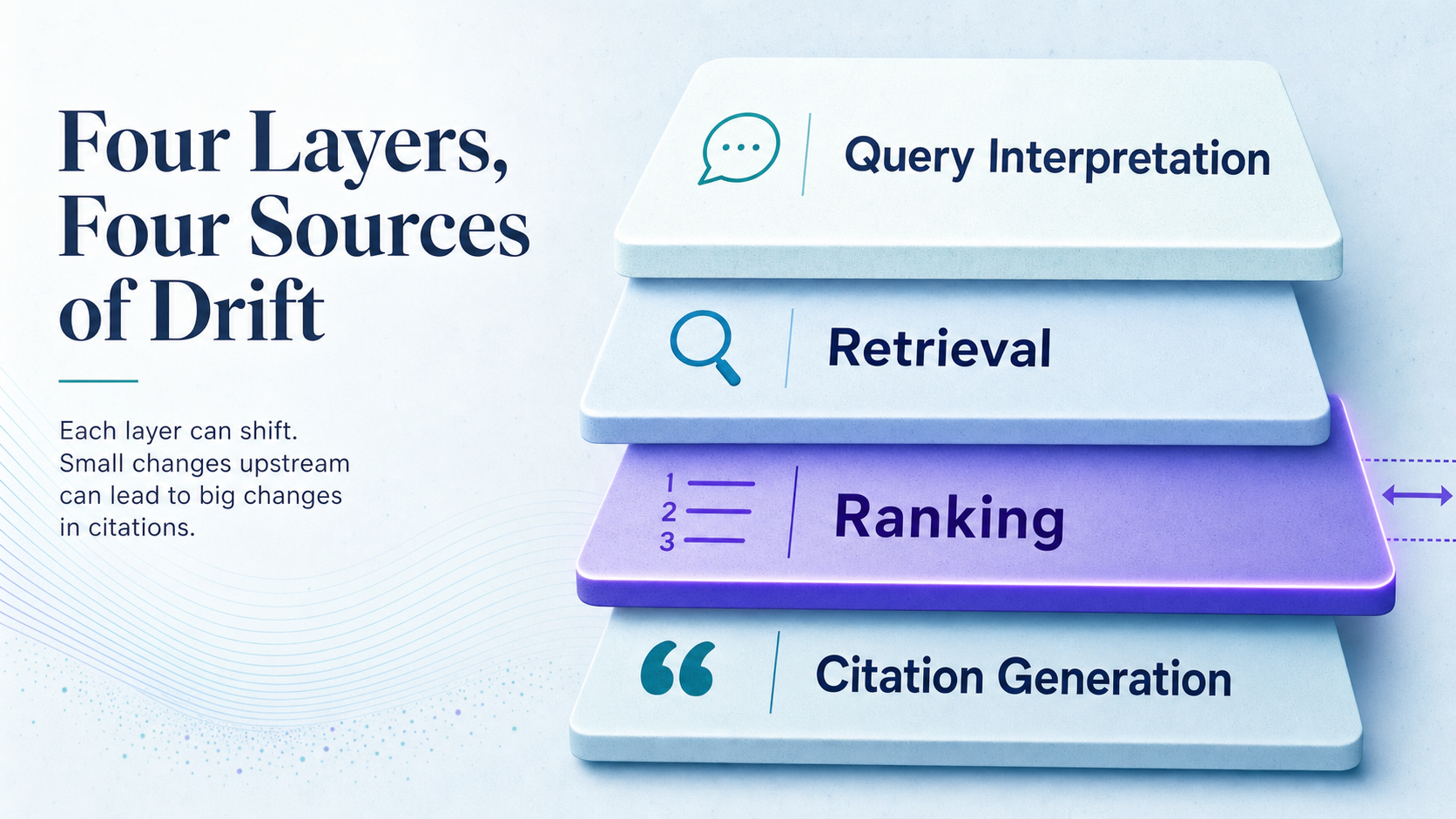
Citation drift happens because the cited source is produced by a chain of moving parts, not a fixed lookup table. Four mechanisms drive most of what you see, and they can each change independently of the others.
Retrieval Changes
The pool of sources an engine can draw from shifts constantly. Fresh indexes pull in new pages, recency weighting reorders what counts as current, and a source that was reachable yesterday can fall out of the available set today. When the retrieval layer refreshes, the cited set moves with it. This is part of how AI crawlers pick sources in the first place, and the selection logic is not frozen.
Model and Pipeline Updates
An AI answer engine is layered: query interpretation, retrieval, ranking, then citation generation. Any one layer can be updated without the others. A new model version, a tweaked retrieval setting, or a changed citation step can each alter which sources appear, so drift can show up the day after a platform ships an update you never saw announced.
Prompt Sensitivity
Small wording changes move the citation set more than they move the answer. Add a word, supply extra context, or send a follow-up turn, and the retrieval step receives a different signal and pulls different sources. In practice, minor prompt edits often rewrite the citations while the answer text barely changes.
Probabilistic Generation
Citations are generated, not emitted from a rules engine. The model samples its output, so even a near-identical prompt can produce a different reference list. This is why two runs that read almost the same can still cite different pages: the variation is built into how the response is produced.
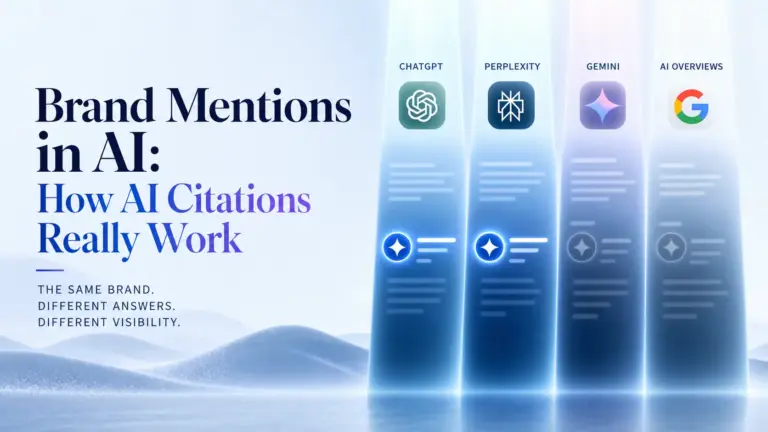
Platform behavior compounds all of this. ChatGPT, Perplexity, Gemini, and Google AI Overviews do not share one source-selection logic, so the same query can drift differently on each. A source that is stable in one engine can rotate heavily in another.
The Main Types of Citation Drift
Citation drift shows up in four recognizable forms. Naming the type you are seeing tells you what is likely causing it and whether it should worry you.
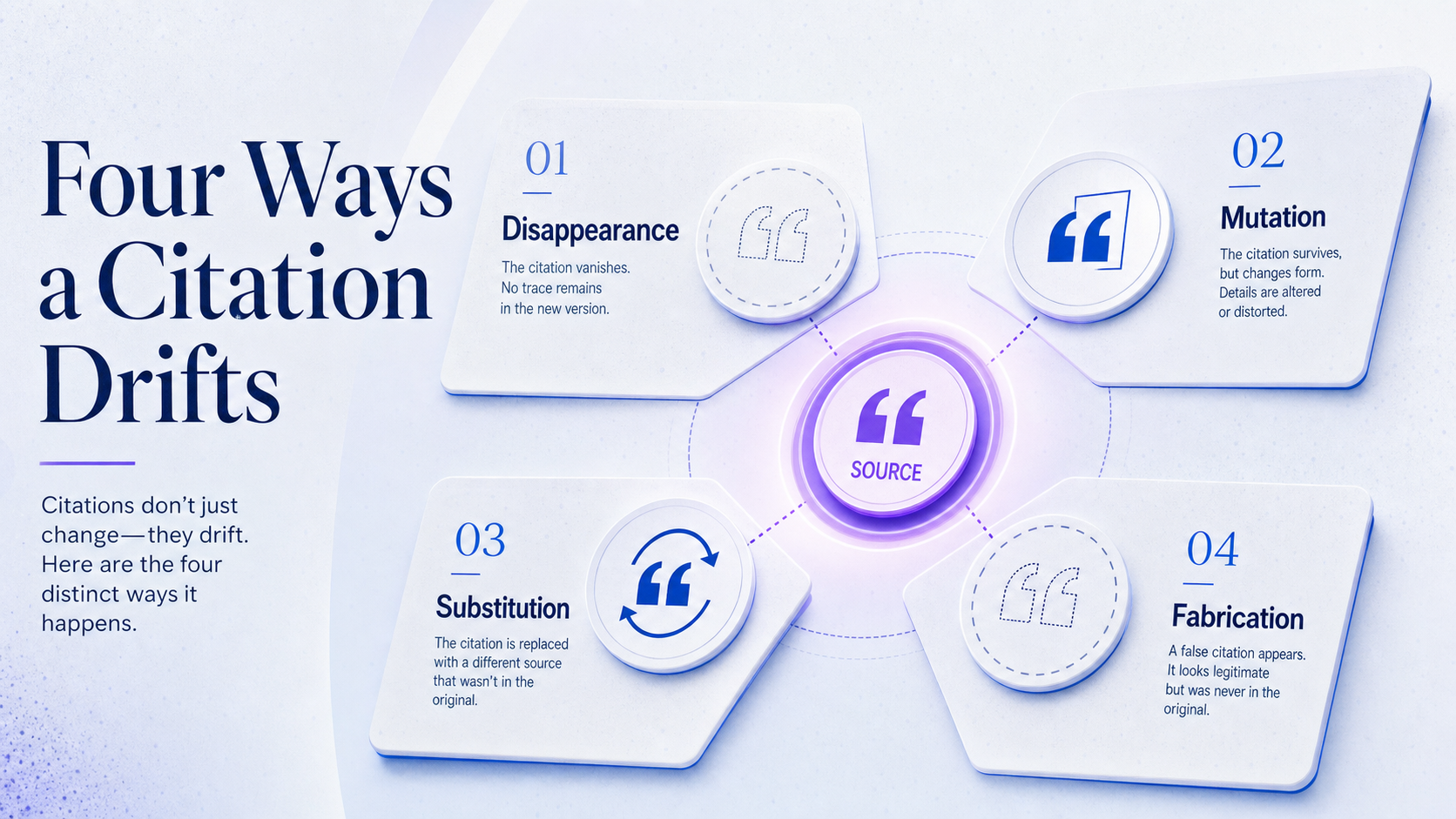
| Drift type | What it looks like | What usually causes it |
|---|---|---|
| Disappearance | A source cited on one run drops out entirely on the next | Retrieval refresh, recency reweighting, source falling out of the available pool |
| Mutation | The source stays, but the cited page, section, or URL changes | Index updates, the engine reattaching the same domain to a different page |
| Substitution | One source is replaced by another that fills the same query role | Probabilistic generation, prompt sensitivity, competing sources of similar strength |
| Fabrication | A citation is invented, mismatched, or does not support the claim | Generation without grounding, weak retrieval, the model filling a gap |
One distinction changes how you track it. Some systems mostly rotate domains, so the brands cited swap in and out. Others hold the domain steady but rotate URLs within it, so your homepage stays cited while the specific page keeps moving.
URL-level drift is typically more volatile than domain-level drift. If you track only domains, you can look stable while the actual pages winning citations churn underneath you. That gap is exactly where teams misread their own visibility.
How Researchers Measure Citation Drift
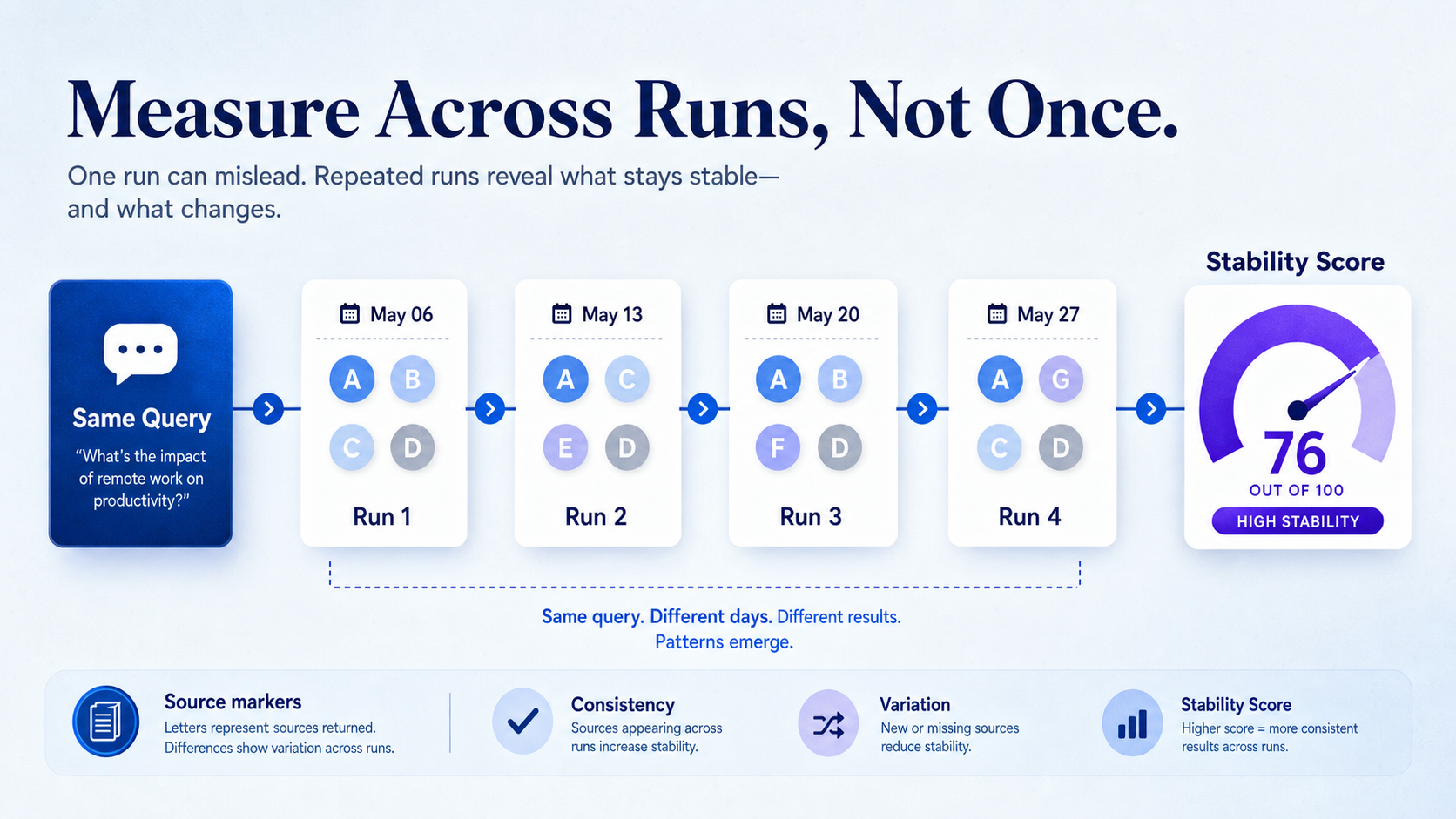
You measure citation drift by repeating a query and comparing how much the cited sources overlap, across runs and across time. A single output tells you nothing, because drift only becomes visible when you have more than one snapshot to compare.
Two testing approaches do the work:
1. Repeat Testing
Run the same prompt several times in a short window, then compare the source sets. High variation across back-to-back runs points to probabilistic and prompt-driven drift.
2. Time-Separated Testing
Compare today’s sources for a query against last week’s or last month’s. Variation here points to retrieval refreshes and platform updates rather than sampling alone.
From those comparisons, a few plain-language metrics carry most of the signal. Source survival rate is the share of sources that reappear on the next run. Reappearance rate tracks how often a source comes back after dropping out. Substitution rate measures how often one source is replaced by another. Fabrication rate flags how often a cited source fails to support the claim.
Researchers also use overlap-style stability scores, a Jaccard-similarity comparison of two source sets being the common one. You do not need the formula to use the idea: the more two runs share the same sources, the more stable the citation footprint. Both controlled studies and large-scale snapshot tracking land on the same pattern, which is that citations are frequently unstable even when the prompt does not change.
What to track, at minimum: the prompt, the run date, the cited sources per run, and a stability score across runs. Hold those four columns and drift stops being invisible.
See where AI answers put your brand
Twenty minutes with a senior strategist: where the major engines point buyers in your category, who gets named instead of you, and a straight read on what a programme would change.
Book a strategy callCommon Misconceptions About Citation Drift
Most confusion about citation drift comes from treating AI citations like static facts. They are not. The table below clears the misreadings that lead teams to the wrong conclusion.
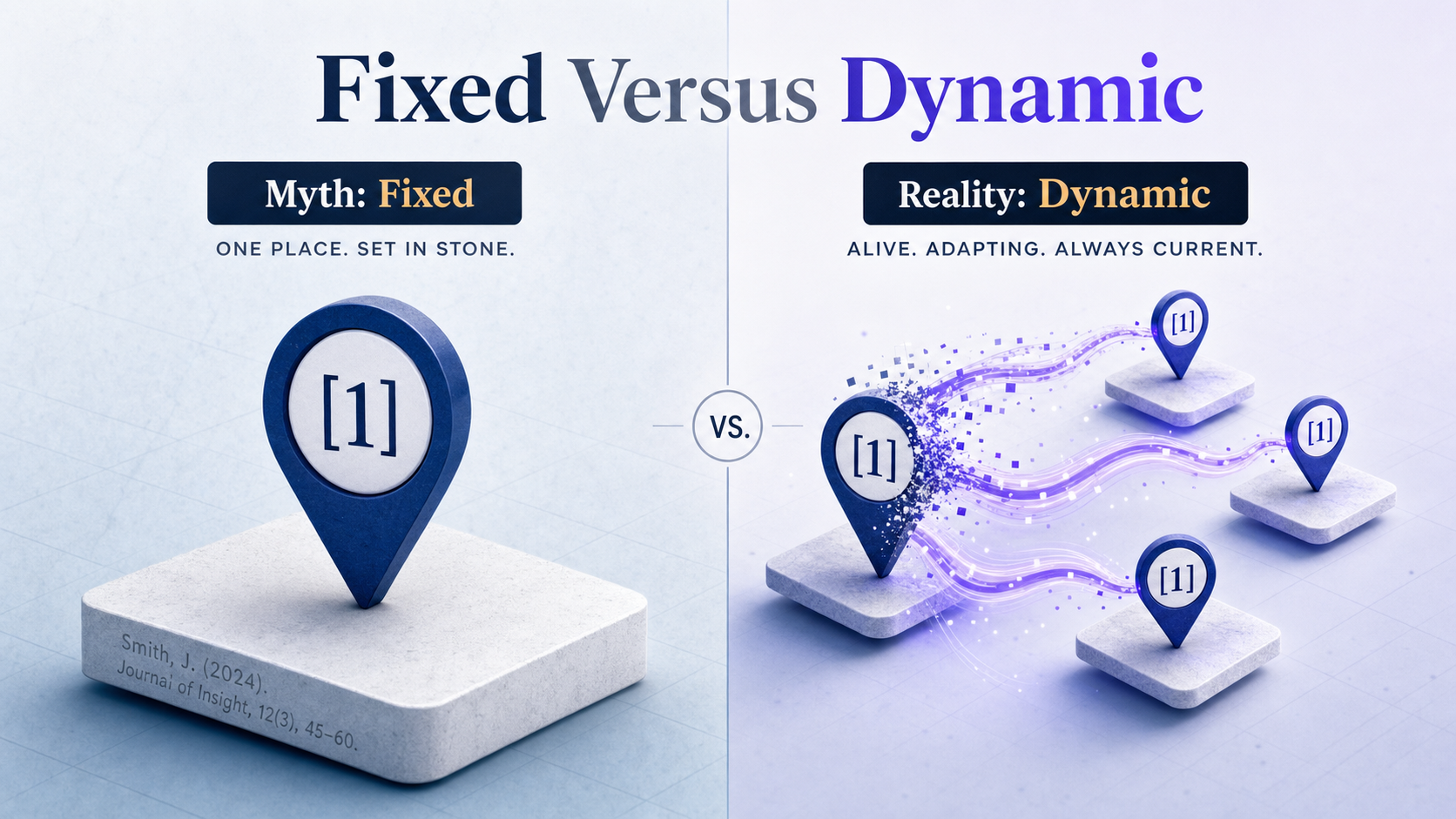
| Myth | Reality |
|---|---|
| Citations are fixed once you see them | Citations are dynamic outputs that change as the platform, index, and model change |
| The same prompt returns the same sources | Identical prompts can return different sources because generation is probabilistic |
| A cited source is automatically reliable | Being cited does not mean the source is accurate or that it supports the claim |
| Brand mention and citation are the same thing | A model can name a brand without citing it, and cite a source without naming the brand |
| Any drift means you are losing visibility | Some rotation reflects broader source coverage, not total loss of presence |
That fourth row deserves a beat, because brand mention and citation get blurred constantly. A citation is a linked or attributed source. A mention is the brand named in the text. You can have one without the other, and the gap between them is its own problem worth tracking. If you want the clean definitions, the AI visibility glossary draws the line between mention, citation, and reference.
The drift-is-always-bad myth is the costliest. If an engine rotates among several of your own pages, your domain is still present and your topical coverage may be widening. That is a different situation from a competitor substituting you out, and treating them the same wastes effort. Watching how brand mentions move in LLMs over time tells you which one you are looking at.
The practical correction: the question is not “did we get cited once?” It is “how stable is our citation footprint?” One visible citation is not proof of durable source authority. It is a single frame from a film that keeps re-cutting itself.
What to Remember About Citation Drift
Citation drift is the instability of source references in AI answers across repeated prompts, follow-up turns, and time-separated queries. Hold that one sentence and most of the confusion clears.
It is normal behavior in LLM-based answer systems, not a one-off bug you can patch. The sources move because the pipeline that produces them moves. Treat citations as dynamic signals, not permanent guarantees, and you stop being surprised when one vanishes.
The measurement lesson follows directly. Focus on stability over time and across platforms, not on peak visibility from a single lucky run. The right unit of analysis is the footprint, not the screenshot.
Frequently Asked Questions
Why do citations change even when the prompt stays the same?
Citations change on identical prompts because AI answers are generated probabilistically and the retrieval layer feeding them refreshes constantly. The model samples its output, so it can attach a different source set each time, and a fresh index can surface or drop pages between runs. The answer text often stays similar while the references underneath it rotate.
Is citation drift the same as hallucination?
No. Hallucination is when the content of an answer is wrong or invented. Citation drift is when the source references move, change, or disappear across runs, regardless of whether the answer is correct. An answer can be accurate and well-grounded while its citation set still drifts. The two overlap only in one case: fabricated citations, where a hallucinated source is also a drift event.
How do you measure citation drift in AI search?
You measure it by running the same query multiple times, then comparing how much the cited sources overlap. Track the prompt, the run date, the sources cited per run, and a stability score across runs. Repeat testing in a short window reveals sampling-driven drift, while time-separated testing reveals drift from index refreshes and platform updates. A single output cannot show drift, because drift is a comparison between snapshots.
Can citation drift be positive?
Yes, in one specific case. If an engine rotates among several of your own pages, your domain stays present and your topical coverage may be broadening rather than shrinking. That looks like drift but signals depth, not loss. It turns negative when a competitor’s source consistently substitutes for yours, which means you are being displaced rather than rotated.
Which AI platforms show the most citation drift?
Drift varies by platform because ChatGPT, Perplexity, Gemini, and Google AI Overviews each use different source-selection logic. Engines that lean heavily on real-time retrieval tend to rotate sources faster than engines anchored in more stable selection. The practical takeaway is that you cannot generalize: measure each platform you care about separately, since a source stable in one can churn in another.
Stop reading one AI citation as proof you have arrived. Citation drift is a measurement problem, so track repeated prompts over time and across the engines that matter to your buyers, not a single visible mention. Once you watch the footprint instead of the snapshot, you can tell the difference between healthy rotation and a competitor quietly taking your place. See which factors actually drive AI citations and build your monitoring around the ones that hold up.