

Google AI Mode optimization is the work of structuring your content, citations, and brand signals so Gemini selects your pages as sources when it writes conversational answers.
It isn’t a new flavour of SEO. The unit of competition changed.
A page no longer competes for a position on a results page. It competes for inclusion in the pool of sources an answer gets written from.
That distinction decides everything below: what to structure, what to measure, and where the off-site half matters more than the on-page half.
What AI Mode Does Differently
AI Mode splits one question into a set of narrower searches, retrieves sources for each, and synthesises a single answer from the union.
Google has described this technique publicly. We’ve watched it from the receiving end.
One comparison prompt hit our Search Console fanned across eleven countries, identical apart from the country name. 445 impressions, not one click.
You aren’t competing for the question the buyer typed. You’re competing across every sub-question the system generated on their behalf, which is query fan-out and it breaks keyword-level planning.
Ranking Still Gates Eligibility
AI Mode pulls from the index, so a page that can’t rank can’t be retrieved either.
This is the part the “SEO is dead” framing gets wrong. Classic discoverability is the entry ticket.
What changed is the step after retrieval. The answer engine quotes passages, not positions, so position one with a buried answer loses to position eight with a clean one.
Where ranking work ends and retrieval work begins is the whole subject of SEO vs GEO.
The Signals AI Mode Reads
Four signals decide whether a passage of yours gets pulled into an answer.
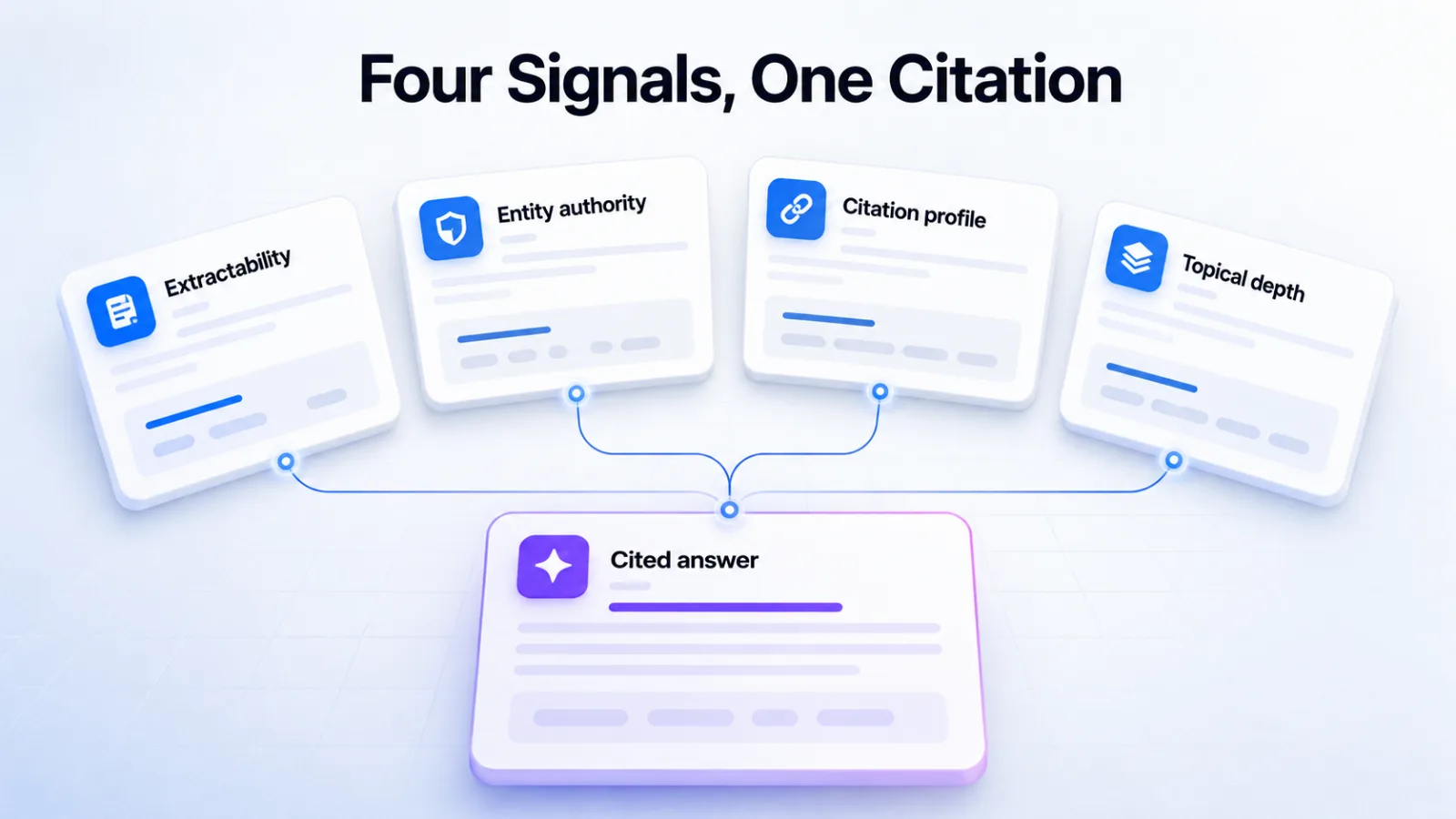
Passage-Level Extractability
The system lifts passages, so each one has to survive being quoted alone.
A quotable paragraph opens with its answer, names its subject instead of saying “it”, and closes its thought in under four sentences. That’s the property being selected for.
Entity Authority
Gemini cites sources it already recognises as entities, which is why brand mentions move AI visibility in a way keyword density never will.
The evidence for mentions driving citation behaviour is laid out in brand mentions and AI visibility.
Citation Profile
Pages that trusted sources link to and cite get retrieved more, the same authority logic as classic search. The twist: co-citation alongside known entities counts even without a link.
The full factor list, ranked by evidence rather than folklore, is in AI citation ranking factors.
Topical Depth
A site that covers a topic’s sub-questions across a connected cluster out-retrieves a site with one long page, because fan-out generates sub-questions and each one retrieves independently.
Depth means the cluster exists and links to itself, not that every page is long.
How to Structure a Page for AI Retrieval
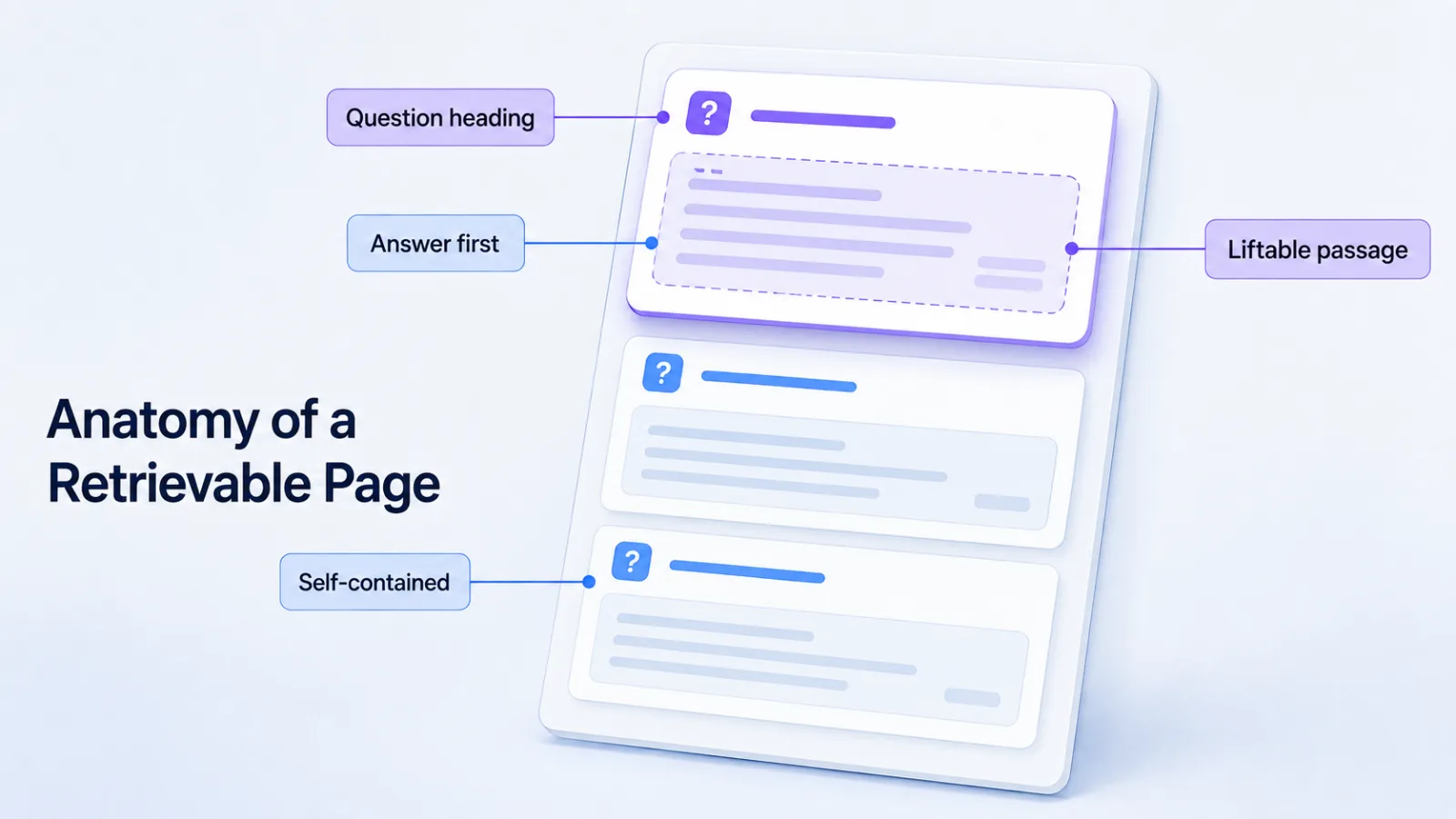
To structure a page for AI retrieval, make every heading a question a machine might ask, and every first sentence under it the answer.
This isn’t a style preference. Of the queries this site received over 90 days, 707 were full natural-language sentences of eight words or more: 6,676 impressions, exactly 1 click.
Machines already phrase the demand as questions. Pages structured as answers are the supply side of that.
Open with the answer
The primary question gets answered in the first 200 words, bolded, before any context or scene-setting.
Everything after it earns its place by deepening the answer, never by delaying it.
One sub-question per heading
Each H2 or H3 owns exactly one question, phrased the way a person asks it.
Headings that name themes (“Our Approach”, “Why It Matters”) give the retrieval step nothing to match against. Headings that ask what the buyer asks match the fan-out’s own sub-queries.
Self-contained passages
Every section stands alone: subject named, claim complete, nothing pointing back up the page.
The passage that gets quoted is the one that makes sense out of context. Write each section as if it will be read without the rest of the page, because in an AI answer it will be.
Schema where it earns its keep
Structured data helps parsers confirm what a page is. It doesn’t rescue a page whose prose can’t be quoted.
FAQPage on genuine questions and Organization on the brand are the two that pay. Stacking schema types on thin content is effort the retrieval step never sees.
What Our Own Logs Show
We log every AI crawler request to this site, and the split tells you where AI Mode-era visibility gets decided.
Over 74 days: 13,977 page requests from AI agents. 3,914 came from training crawlers stocking model corpora.
3,252 came from retrieval agents fetching pages mid-answer. The rest declared no purpose.
Two URLs, the homepage and the sitemap, absorbed a quarter of all of it, and 69% of the URLs reached were fetched exactly once. Discovery is wide and shallow, which makes internal linking the cheapest AI visibility work there is: a page nothing links to doesn’t get a second fetch.
The full breakdown, and how to read your own access log, is in server logs for AI search.
The Off-Site Half Decides Ties
When two pages answer a sub-question equally well, the entity with more independent mentions and citations gets quoted.
On-page structure gets you into the comparison. Off-site authority wins it. That’s earned coverage, brand mentions in trusted publications, and the citation network those mentions build, which is the work our citation network programme does for brands.
Frequently Asked Questions
Is AI Mode optimization different from normal SEO
The eligibility layer is identical: crawlable, indexable, rankable. The competition layer is different: passages against passages inside generated answers, instead of pages against pages on a results screen.
Teams that treat it as a replacement for SEO skip the entry ticket. Teams that treat it as identical to SEO stop at the entry ticket.
Do I need to rank on page one to get cited
No. Retrieval reaches deeper than the first page, and a clean passage from a mid-ranking page beats a buried answer from position one.
You do need to be indexed and retrievable for the sub-question, which is a lower bar than a page-one rank and a different one.
Does adding schema get me into AI Mode answers
Schema alone, no. It confirms structure for parsers; it doesn’t create quotable prose.
Write passages that survive being lifted, then add FAQPage and Organization markup so machines can confirm what they’re lifting.
How do I measure AI Mode visibility
You measure it by asking the systems your buyers’ questions, five phrasings each, and recording which brands get named. Rank trackers can’t see inside generated answers.
The repeatable method is in tracking brand mentions in AI search.
Should I restructure every page on the site
No. Restructure the pages that answer buying questions, and leave pages that already earn their traffic alone.
A quarter’s worth of restructuring usually comes down to ten pages that matter and a cluster linking them.
Run the Passage Test on One Page
Take your highest-value page and read each section alone, out of context.
Any section that needs the page around it to make sense is a passage AI Mode can’t quote. Rewrite those first, wire the page into its cluster, and re-run the buying questions a month later.
The brands getting quoted next year are structuring for retrieval now, while their competitors are still watching rank positions.