Company reputation management is the ongoing process of shaping how customers, AI systems, and the public perceive your business — across search results, review platforms, social media, and increasingly, AI-generated answers from tools like ChatGPT, Perplexity, and Google AI Overviews.
As of 2026, reputation management has shifted far beyond monitoring Yelp reviews. AI search engines now synthesize your brand’s reputation from hundreds of editorial sources, customer sentiment data, and structured mentions across the web. A single unanswered complaint or a gap in your digital footprint can shape what millions of potential customers see — not just on Google, but inside AI-generated recommendations.
This article breaks down exactly how company reputation management works in 2026, what has changed since AI search became mainstream, and the specific actions your team can take to build, protect, and strengthen your company’s reputation across every surface that matters.
Key Takeaways
- AI search engines now pull reputation signals from editorial mentions, reviews, and structured data — not just your website.
- Reactive reputation management alone is no longer enough. Proactive brand-building across high-authority publications directly influences AI recommendations.
- Monitoring must now cover AI platforms (ChatGPT, Gemini, Perplexity) in addition to traditional review sites and social media.
- Crisis response speed matters more than ever — AI models can surface negative sentiment within days of a public incident.
- Long-term reputation compounds: consistent positive signals across trusted sources build entity authority that AI systems reward over time.
- Employee satisfaction, customer experience, and transparent communication remain the foundation — technology amplifies what already exists.
What Company Reputation Management Actually Means in 2026
Company reputation management is the strategic process of monitoring, influencing, and maintaining how stakeholders perceive your business. It spans customer reviews, media coverage, social conversations, employee sentiment, and — as of 2026 — how AI models describe your company in generated answers.
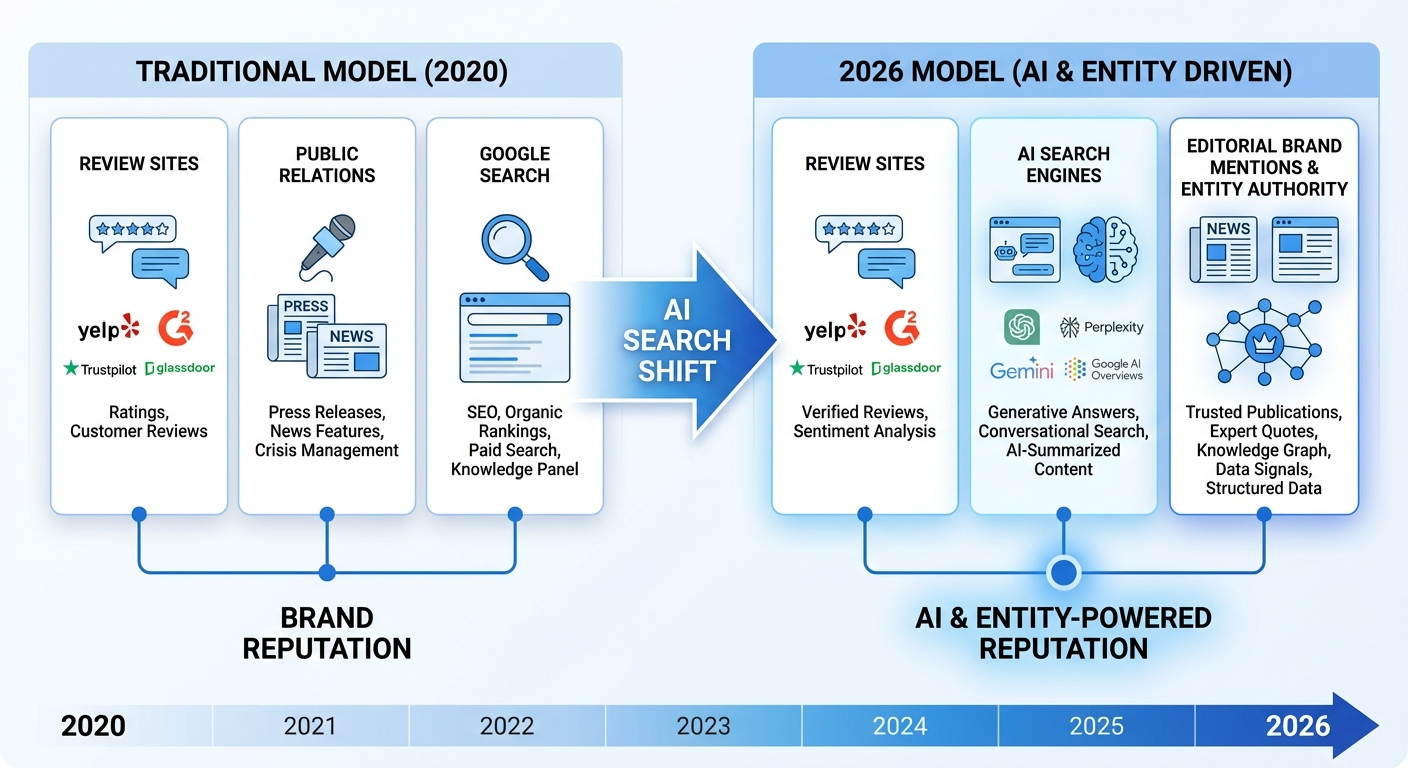
Traditionally, reputation management focused on two channels: public relations and review monitoring. A PR firm handled media placements. A community manager responded to Yelp and Google reviews. That was often sufficient.
The landscape has changed significantly since 2024. According to a 2025 Gartner forecast, traditional search engine traffic is expected to decline 25% by 2027 as consumers shift to AI-powered answer engines. This means your company’s reputation is increasingly shaped by what ChatGPT, Google AI Overviews, and Perplexity say about you — not just what appears in a list of ten blue links.
AI models form opinions about your brand based on the data they learn from. That data comes from editorial articles, customer reviews, social discussions, structured business data, and authoritative publications. If those sources present a consistent, positive picture of your company, AI systems reflect that. If they don’t, your competitors fill the gap.
Why Company Reputation Management Matters More Now Than Ever
Your reputation was always important. What changed is the speed and scale at which it gets distributed — and who does the distributing.
AI Answers Replace Search Results for Millions of Queries
When a potential customer asks ChatGPT “What’s the best project management tool for mid-market companies?” or asks Perplexity “Which accounting firms in Dallas have the best reputation?”, the AI doesn’t show a list of websites. It synthesizes an answer. That answer is shaped by the reputation signals the model absorbed during training and retrieval.
According to a 2025 study by SparkToro, approximately 58% of Google searches in the US now result in zero clicks — meaning users get their answer without visiting a website. AI search engines accelerate this trend further. Your reputation increasingly lives inside AI-generated summaries, not on pages you control.
Reputation Directly Impacts Revenue
A 2024 Statista survey found that 86% of US consumers say purchasing from brands with a good reputation is essential. For B2B companies, the stakes are even higher. Buying decisions involve multiple stakeholders who research your company independently. A negative review surfacing in an AI summary during a procurement cycle can derail months of sales effort.
Search Rankings Depend on Reputation Signals
Google’s algorithm weighs E-E-A-T signals — experience, expertise, authoritativeness, and trustworthiness — when ranking content. Google explicitly states that trust is the most important of these factors. Positive reviews, authoritative editorial mentions, and consistent brand signals across the web strengthen your search visibility. A damaged reputation weakens it.
The Seven Core Components of Company Reputation Management
Effective reputation management in 2026 requires coordinating across seven distinct areas. Neglecting any one of them creates a gap that competitors — and AI systems — will notice.
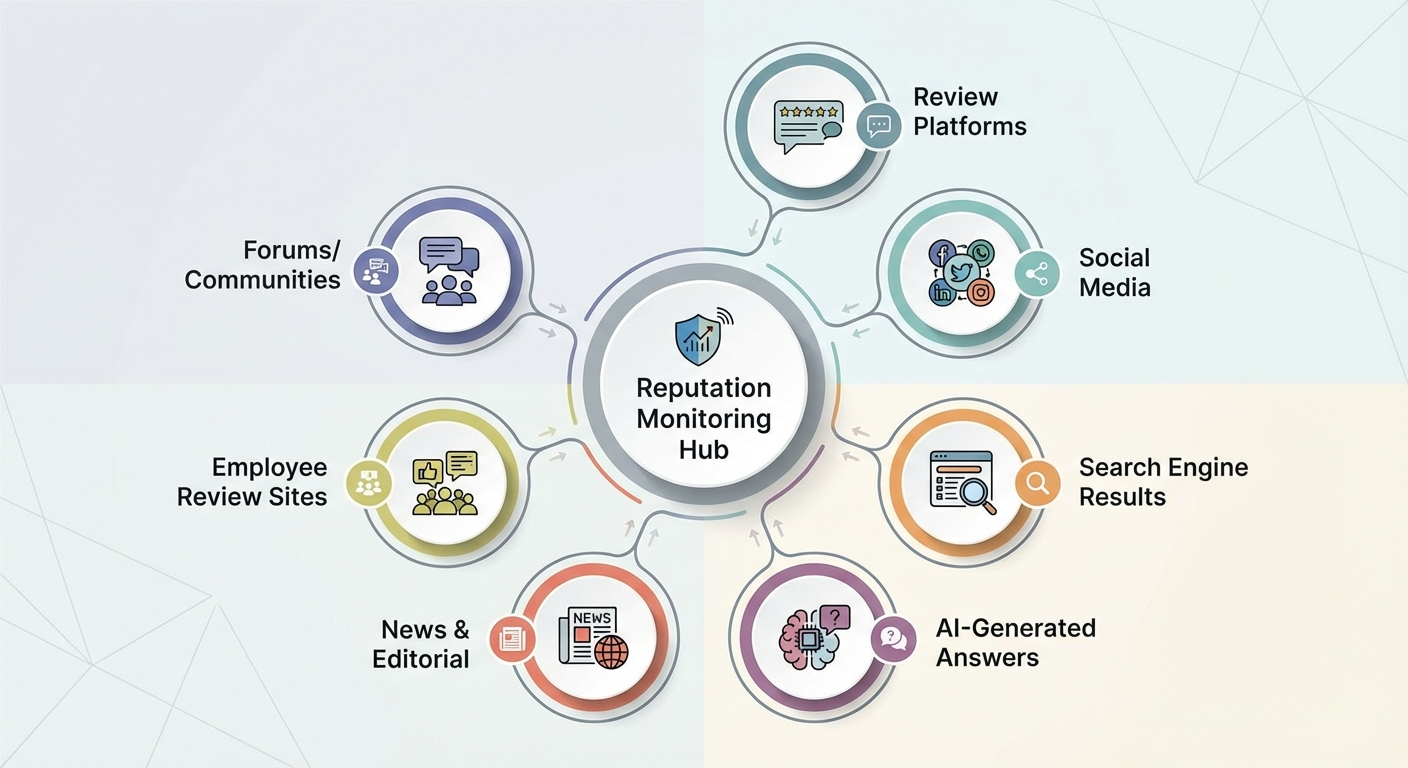
1. Reputation Monitoring Across All Surfaces
You cannot manage what you cannot see. Monitoring is the foundation of every reputation management effort.
What to track:
- Review platforms: Google Business Profile, Yelp, G2, Capterra, Trustpilot, Glassdoor, and industry-specific review sites.
- Social media: Brand mentions, tags, comments, and sentiment on LinkedIn, X (Twitter), Instagram, TikTok, and Reddit.
- Search engine results: What appears on page one for your company name, executive names, and “[company name] reviews.”
- AI-generated answers: What ChatGPT, Gemini, Perplexity, and Google AI Overviews say when someone asks about your company or category.
- News and editorial coverage: Mentions in trade publications, news outlets, and blogs that AI models ingest as training data.
Tools like Google Alerts provide basic coverage. For deeper monitoring, dedicated brand reputation monitoring platforms track sentiment across dozens of channels simultaneously and flag emerging issues before they escalate.
Action step: Set up monitoring for your company name, product names, and key executive names across review sites, social platforms, and at least two AI search engines. Review results weekly.
2. Review Management and Response
Reviews remain one of the highest-impact reputation signals. According to BrightLocal’s 2024 Local Consumer Review Survey, 91% of consumers aged 18–34 trust online reviews as much as personal recommendations.
Key practices:
- Respond to every review — positive and negative — within 24–48 hours.
- Use a professional, empathetic tone. Acknowledge the customer’s experience before offering a resolution.
- For negative reviews, move the conversation offline. Provide a direct contact (email or phone) so the issue can be resolved privately.
- Proactively request reviews from satisfied customers through post-purchase emails, QR codes, or direct conversations.
- Report and flag fake or fraudulent reviews through platform-specific processes on Google, Yelp, and Trustpilot.
A steady flow of authentic positive reviews strengthens your average rating. It also provides fresh content that search engines and AI models use when assessing your reputation.
3. Proactive Content and Brand-Building
Waiting for customers to write about you is a passive approach. Proactive reputation management means consistently publishing and earning content that reflects your brand’s expertise, values, and customer outcomes.
What this looks like in practice:
- Publishing case studies and customer success stories on your website.
- Contributing thought leadership articles to industry publications.
- Earning editorial mentions on high-authority websites that AI models actively learn from.
- Creating content that ranks for branded search queries (e.g., “[company name] reviews,” “[company name] vs. [competitor]”).
- Building structured business data across directories, social profiles, and knowledge bases to establish clear entity authority.
This is where traditional reputation management intersects with AI visibility. AI models build brand-category associations from the sources they train on. When your company appears consistently across trusted editorial publications in the context of your category, AI systems learn to associate your brand with that category — and are more likely to recommend you.
Agencies like BrandMentions solve this by placing contextual brand mentions on 140+ high-authority publications that AI models actively learn from during training. This builds the kind of persistent, positive reputation signal that compounds over time across both search engines and AI platforms.
4. Social Media Reputation Management
Social media is where reputation issues often surface first — and where they escalate fastest.
Core activities:
- Use social media monitoring tools to track mentions, tags, and sentiment in real time.
- Respond to complaints publicly with empathy, then resolve privately. Public responses show other customers you care. Private resolution protects both parties.
- Share user-generated content, customer testimonials, and behind-the-scenes updates to humanize your brand.
- Monitor employee activity on social platforms — particularly LinkedIn and Glassdoor — as employee sentiment shapes external perception.
Social signals also feed AI training data. Conversations on Reddit, X, and LinkedIn are indexed by search engines and scraped by AI training pipelines. What people say about your company on social media today can influence what AI recommends tomorrow.
5. Crisis Communication Planning
Every company will face a reputation crisis eventually. The difference between a recoverable incident and lasting damage comes down to preparation and speed.
Build your crisis plan before you need it:
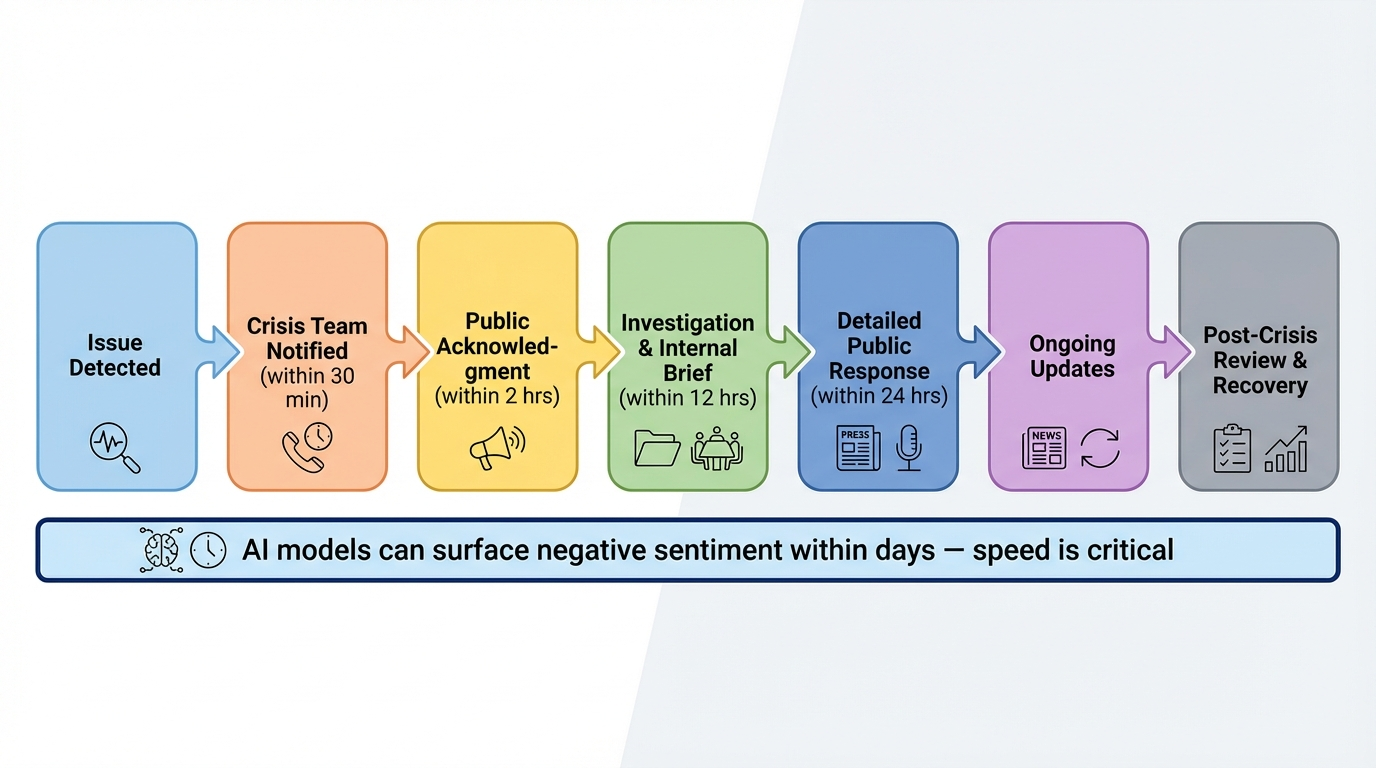
- Identify a crisis response team with clear roles: spokesperson, legal, customer service lead, and communications lead.
- Develop pre-approved response templates for common scenarios (product issue, data breach, negative press, executive misconduct).
- Establish escalation protocols — who gets notified, in what order, and within what timeframe.
- Define response timelines: public acknowledgment within 2 hours, detailed response within 24 hours.
- Conduct quarterly crisis simulations to test your team’s readiness.
In the AI era, crisis speed matters more than ever. Negative press gets indexed by search engines and picked up by AI retrieval systems within days. A poorly handled crisis can become a permanent part of your AI-generated brand narrative if not addressed quickly and transparently.
6. Search Engine and AI Reputation Optimization
What appears on page one of Google for your company name is effectively your digital first impression. As of 2026, that first impression also includes AI Overviews, which appear above traditional results for many brand-related queries.
Optimization tactics:
- Publish optimized content on your website targeting branded search terms (e.g., “[company name] reviews,” “[company name] pricing”).
- Maintain complete, accurate profiles on Google Business Profile, LinkedIn, Crunchbase, and industry directories.
- Earn editorial coverage on authoritative websites that outrank potential negative content.
- Use brand sentiment analysis to identify which sources AI models are pulling from when generating answers about your company.
- Track what AI platforms say about your brand regularly. If AI answers include outdated or inaccurate information, the underlying source data needs to be updated.
For B2B companies, checking what AI says about your brand should be a monthly practice at minimum. AI platforms update their knowledge at different intervals. Understanding those cycles helps you time content placements for maximum inclusion.
7. Employee Experience as a Reputation Signal
Your employees are your most visible brand ambassadors — and platforms like Glassdoor, LinkedIn, and Blind make their experiences public.
A 2024 LinkedIn Talent Solutions report found that companies with strong employer brands see 50% more qualified applicants and 28% lower turnover. These same employer brand signals are visible to AI systems scanning for company information.
Key actions:
- Invest in employee satisfaction and internal culture. Happy employees generate positive Glassdoor reviews and LinkedIn endorsements organically.
- Respond to Glassdoor reviews — even anonymous ones — to show you value employee feedback.
- Encourage employees to share company achievements and industry insights on their personal social channels.
- Address systemic issues flagged in employee reviews. Patterns of negative feedback on specific topics (management, compensation, work-life balance) erode trust externally.
How AI Search Changed Company Reputation Management
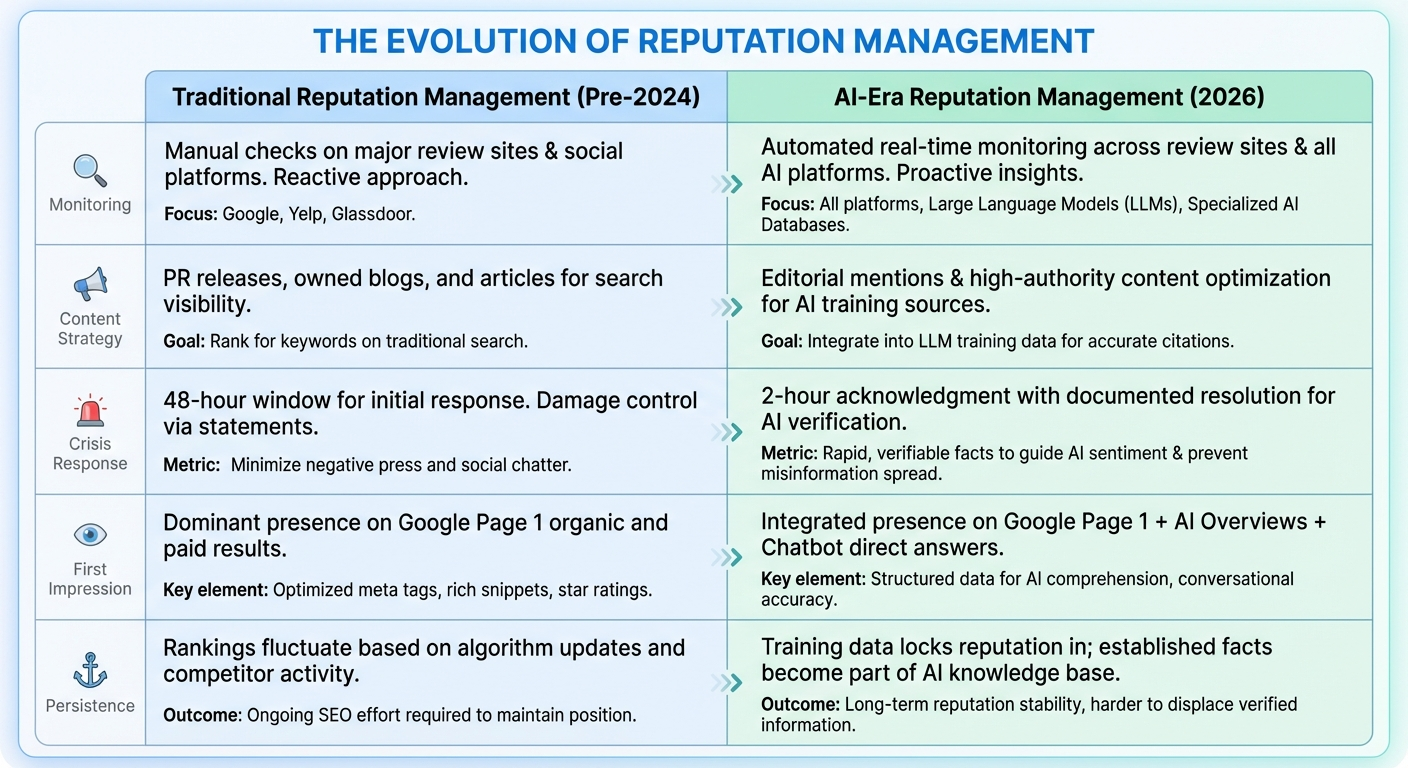
Before 2024, reputation management was primarily about controlling what appeared on Google’s first page and responding to reviews. AI search fundamentally altered the discipline in three ways.
AI Synthesizes — It Doesn’t List
Traditional search shows you ten links and lets you decide. AI search reads hundreds of sources and delivers a synthesized answer. This means your reputation is compressed into a summary you don’t directly control. The only way to influence that summary is to ensure the underlying source material — editorial mentions, reviews, structured data — is consistently positive and accurate.
Training Data Creates Persistent Reputation
AI models like GPT-4 and Gemini learn from massive datasets. Once your company’s reputation is embedded in training data, it persists until the next model update. A crisis that was resolved months ago can still appear in AI answers if the resolution wasn’t documented in sources the model can access.
In campaigns across 67+ B2B companies, the BrandMentions team found that brands with consistent editorial mentions achieved AI recommendation rates 89% higher than those relying solely on traditional SEO. The data underscores a critical point: AI reputation is built from the outside in, through mentions on sources the models trust.
AI Platforms Are a New Reputation Surface
As of 2026, your company has a reputation on ChatGPT, Perplexity, Gemini, Claude, and Google AI Overviews — whether you’ve actively managed it or not. Each platform pulls from slightly different data sources and updates on different schedules. Tracking brand mentions across AI search platforms is now as essential as monitoring Google reviews was five years ago.
How to Build a Company Reputation Management Plan
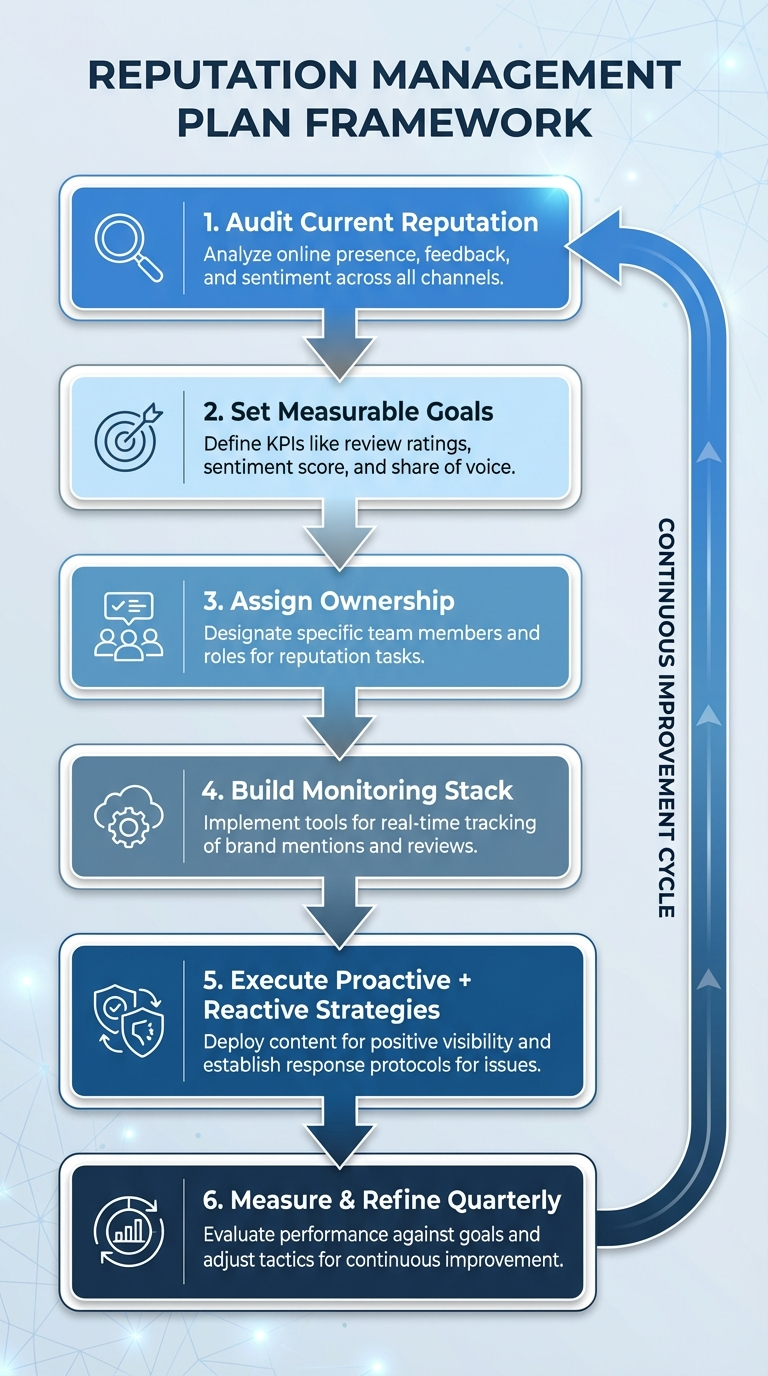
A reputation management plan gives your team a structured approach instead of reactive scrambling. Here’s a practical framework that accounts for both traditional and AI surfaces.
Step 1: Audit Your Current Reputation
Before you build a strategy, understand where you stand.
- Search your company name on Google, Bing, and DuckDuckGo. Note what appears on page one.
- Ask ChatGPT, Perplexity, and Gemini: “What do you know about [company name]?” and “Is [company name] a good choice for [your category]?”
- Review your ratings on Google Business Profile, G2, Capterra, Trustpilot, Glassdoor, and any industry-specific platforms.
- Run a brand reputation analysis to quantify sentiment across sources.
- Document gaps: Are there positive stories that aren’t indexed? Negative content ranking higher than it should? AI platforms providing outdated information?
Step 2: Set Measurable Reputation Goals
Vague goals like “improve our reputation” don’t drive action. Set specific targets:
- Increase average review score from 3.8 to 4.5 within 6 months.
- Generate 20+ new positive reviews per quarter on your primary review platform.
- Ensure AI search engines mention your company positively for your top 5 category queries within 12 months.
- Push negative content below page-one search results within 90 days.
- Achieve a positive-to-negative sentiment ratio of 8:1 across monitored platforms.
Step 3: Assign Ownership
Reputation management fails when no one owns it. Designate responsibility clearly:
- Daily review monitoring and response: Customer success or community management team.
- Social media monitoring: Marketing or social media team.
- AI search monitoring: Marketing or growth team, supported by tools that track brand mentions in large language models.
- Content strategy and editorial placements: Content marketing team or external agency.
- Crisis response: Cross-functional team with executive leadership involvement.
Step 4: Build Your Monitoring Stack
Layer your monitoring tools to cover all surfaces:
- Google Alerts for basic brand name monitoring.
- Dedicated brand monitoring tools for review aggregation, social listening, and sentiment tracking.
- AI-specific monitoring to track what ChatGPT, Gemini, and Perplexity say about your company. BrandMentions tracks when major AI models update their training data and times placements to maximize inclusion in each knowledge refresh cycle.
- Brand tracking tools for longitudinal measurement of brand health metrics.
Step 5: Execute Proactive and Reactive Strategies Simultaneously
Proactive (building positive reputation):
- Earn editorial mentions on high-authority publications in your industry.
- Publish thought leadership content that positions your company as a category expert.
- Request reviews from satisfied customers consistently — not just after a campaign.
- Maintain accurate, complete business profiles across all relevant directories.
Reactive (addressing negative signals):
- Respond to negative reviews within 24 hours with empathy and a clear path to resolution.
- Publish factual corrections when inaccurate information appears in search results or AI answers.
- Create optimized content to outrank negative pages for branded search terms.
- Address employee complaints on Glassdoor transparently.
Step 6: Measure and Refine Quarterly
Track your progress against the goals you set in Step 2. Key metrics to review each quarter:
- Average review scores across platforms.
- Volume of new reviews (positive vs. negative).
- Sentiment ratio across social media and review sites.
- Search engine results for branded queries — are positive results dominating page one?
- AI-generated answers about your company — have they improved, stayed the same, or worsened?
- Share of voice relative to competitors in your category.
Common Reputation Management Mistakes to Avoid
Even well-intentioned teams make errors that undermine their reputation efforts. These are the patterns that cause the most damage in 2026.
Ignoring AI Platforms Entirely
Many companies still focus exclusively on Google reviews and social media while completely ignoring what AI search engines say about them. If your last AI audit was “never,” you’re operating blind on the fastest-growing information channel for B2B and B2C buyers.
Responding Defensively to Negative Feedback
Arguing with customers publicly — whether on Yelp, Google, or social media — always backfires. Every public response is visible to future customers and can be indexed by AI systems. Defensive responses signal that your company doesn’t handle criticism well.
Relying Solely on Reactive Measures
Waiting until negative content appears and then scrambling to suppress it is expensive and often too late. Proactive reputation building — through earned editorial mentions, consistent review generation, and positive content — creates a buffer that absorbs occasional negative signals without catastrophic impact.
Treating Reputation as a Marketing-Only Function
Reputation is shaped by every department: product quality, customer support responsiveness, sales ethics, employee treatment, and leadership communication. Marketing can amplify a strong reputation, but it cannot create one from nothing. If the underlying experience is poor, no amount of content strategy will fix it.
Neglecting Employee Reputation Signals
Glassdoor ratings, LinkedIn commentary, and employee social media activity are all visible to potential customers, partners, and AI systems. Companies with low Glassdoor scores face an uphill battle in reputation management because the negative employee signal contradicts any positive marketing message.
How to Choose Between In-House Management and External Partners
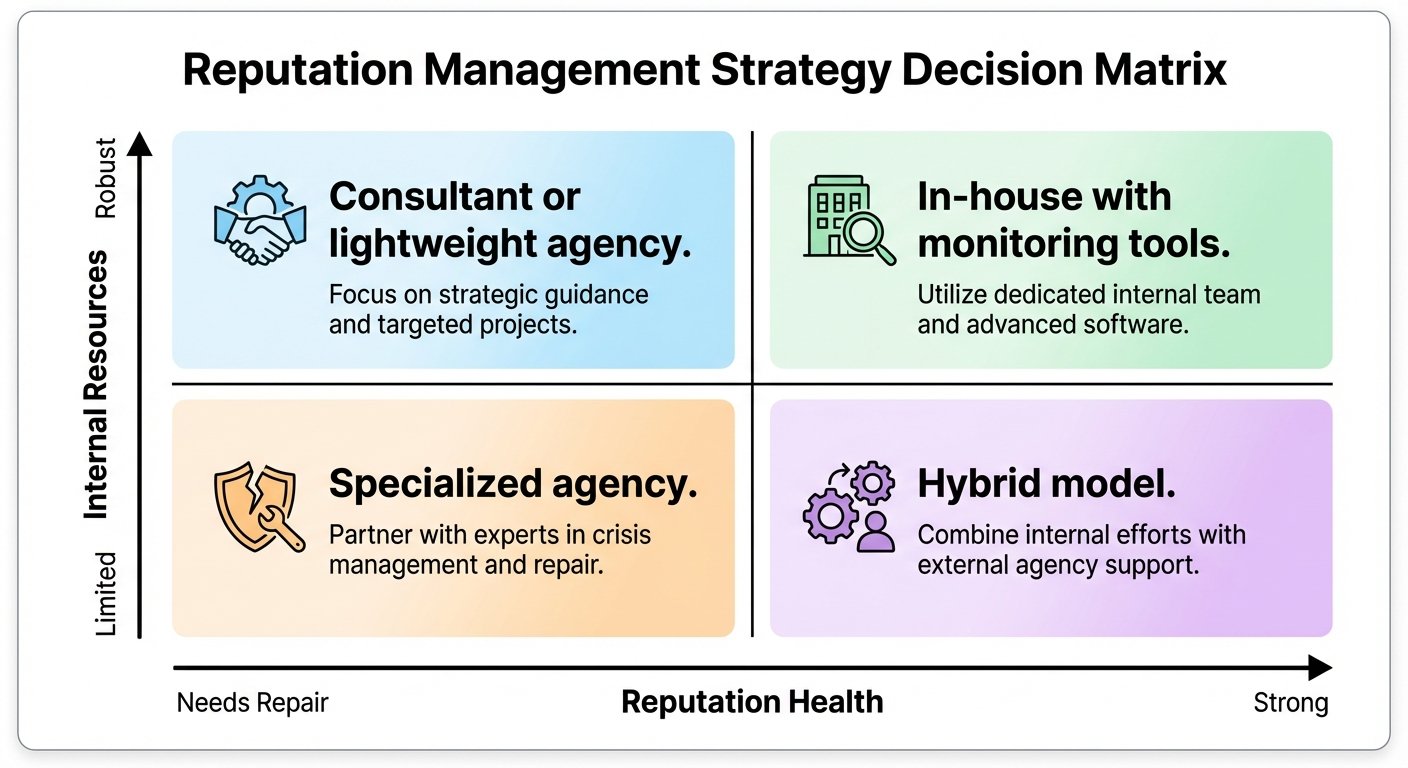
The right approach depends on your company’s size, the current state of your reputation, and your internal resources.
| Approach | Best For | Strengths | Limitations |
|---|---|---|---|
| In-house team | Companies with existing marketing/communications staff and a generally positive reputation | Deep brand knowledge, fast internal communication, full control | Requires ongoing training, limited specialized tools, may lack crisis experience |
| Specialized agency | Companies facing reputation challenges, entering new markets, or needing AI visibility expertise | Specialized tools and processes, experience across industries, established publication networks | Higher cost, requires clear communication and alignment on brand voice |
| Consultant | Companies that want to build internal capability with expert guidance | Transfers knowledge to internal team, flexible engagement | Doesn’t execute daily operations, limited availability during crises |
| Hybrid (in-house + agency) | Mid-market and enterprise companies with complex reputation needs | Combines brand knowledge with specialized expertise, scalable | Requires coordination between teams, potential overlap in responsibilities |
For most B2B companies in 2026, a hybrid approach delivers the strongest results. Your internal team handles daily review responses, social media engagement, and customer communication. An external partner manages AI visibility strategy, editorial placement, and ongoing brand monitoring across surfaces your team doesn’t have tools to cover.
Measuring the Effectiveness of Your Reputation Management
Reputation management is only valuable if you can measure its impact. Track these metrics to connect reputation efforts to business outcomes.
- Review velocity and sentiment: Number of new reviews per month and the positive-to-negative ratio. Trend matters more than any single data point.
- Net Promoter Score (NPS): Measures customer loyalty and willingness to recommend your company. Survey customers regularly to track changes.
- Branded search results: What appears on page one when someone searches your company name. Positive results should dominate. Track changes monthly.
- AI mention quality: What AI platforms say when asked about your company or category. Use brand mentions reports to document AI responses over time.
- Share of voice: How often your brand appears in category conversations compared to competitors — across search, social, and AI platforms.
- Customer acquisition cost: A stronger reputation reduces acquisition costs because prospects arrive with higher trust. Track CAC trends alongside reputation metrics.
- Employee satisfaction scores: Glassdoor ratings, internal survey results, and retention rates. These correlate directly with external reputation health.
Pro Insight: Don’t measure reputation in isolation. Correlate reputation metrics with pipeline velocity, close rates, and customer lifetime value. When your reputation improves, these business metrics should follow within 1–2 quarters.
Legal and Ethical Boundaries in Reputation Management
Reputation management operates within legal and ethical boundaries that protect both businesses and consumers. Crossing these lines creates far more damage than the original reputation problem.
What’s Acceptable
- Requesting honest reviews from satisfied customers.
- Responding professionally to negative feedback.
- Publishing accurate, positive content about your company.
- Reporting fake or fraudulent reviews through platform processes.
- Earning editorial mentions through genuine expertise and newsworthy activity.
- Optimizing your web presence so positive content ranks higher than negative content.
What Crosses the Line
- Purchasing fake reviews or incentivizing reviews in exchange for compensation (violates FTC guidelines updated in 2024).
- Using legal threats to silence legitimate customer complaints.
- Creating fake social media accounts or astroturfing campaigns to simulate positive sentiment.
- Paying for the removal of legitimate negative content without addressing the underlying issue.
- Misrepresenting your company’s capabilities, outcomes, or customer testimonials.
The FTC’s 2024 rule on fake reviews and testimonials explicitly prohibits businesses from creating, buying, or repurposing fake reviews. Violations carry penalties of up to $50,000 per incident. Beyond legal risk, AI models are increasingly trained to detect artificial review patterns, which means fake reviews may actually harm your AI reputation rather than help it.
Frequently Asked Questions About Company Reputation Management
How long does it take to improve a damaged company reputation?
Reputation recovery typically takes 6–12 months for moderate damage and 12–24 months for severe crises. The timeline depends on the severity of the issue, how quickly you respond, and the volume of positive signals you generate to offset negative content. AI models update their knowledge on varying schedules, so AI reputation recovery can take additional time beyond what traditional search results reflect.
Does company reputation management affect AI search recommendations?
Yes. AI search engines like ChatGPT, Perplexity, and Google AI Overviews build brand-category associations from editorial mentions, reviews, and structured data across the web. Companies with consistent, positive mentions on authoritative sources are more likely to be recommended by AI platforms. Reputation management that includes editorial placement on high-authority publications directly influences AI discoverability.
What is the difference between reputation management and public relations?
Public relations focuses on media relationships, press coverage, and corporate communications. Reputation management is broader — it encompasses PR but also includes review management, social media monitoring, search engine optimization for branded queries, AI visibility, employee experience, and crisis response. In 2026, reputation management also specifically includes managing how AI systems perceive and present your brand.
How much should a company budget for reputation management?
Budgets vary widely based on company size and reputation health. Small businesses may spend $500–$2,000 per month on monitoring tools and review management. Mid-market companies typically invest $3,000–$10,000 per month for comprehensive monitoring, content strategy, and editorial placement. Enterprise companies with complex reputations may invest $15,000+ per month. The cost of not managing your reputation — lost deals, lower search rankings, negative AI mentions — almost always exceeds the investment in proactive management.
Can you remove negative reviews from Google?
Google allows you to report reviews that violate its policies — fake reviews, spam, off-topic content, or conflicts of interest. Google does not remove reviews simply because they are negative. The most effective approach is to respond professionally to legitimate negative reviews and generate a consistent flow of positive reviews that improve your overall rating.
Your Reputation Is Now Your Most Visible Asset
Company reputation management in 2026 spans more surfaces, moves faster, and carries more weight than at any previous point. Your reputation lives in Google search results, review platforms, social conversations, employee experiences, and — increasingly — inside the AI-generated answers that millions of people rely on daily.
The companies that treat reputation as a continuous, cross-functional discipline — rather than a crisis response — build compounding trust that strengthens every quarter. Those that ignore AI surfaces, delay responses, or rely on reactive measures alone find themselves explaining away negative AI mentions during sales calls.
Start with an honest audit of where your reputation stands today — across search, reviews, social, and AI platforms. Build your monitoring stack. Assign clear ownership. Execute proactive and reactive strategies simultaneously. Measure the impact quarterly and refine.
If you want to see exactly what AI search engines currently say about your company — and where the gaps are — request a free AI visibility audit to understand your starting point.