Brand tracking tools measure how your audience perceives your company — across traditional search, social media, and increasingly, AI-powered search engines like ChatGPT, Perplexity, and Gemini. Choosing the right tool in 2026 means looking beyond basic social listening and asking a harder question: where does your brand actually show up when people ask AI for recommendations?
This article breaks down the brand tracking tools landscape as it exists right now — survey platforms, social monitoring software, SEO-based trackers, and the emerging category of AI visibility tools. You’ll find practical guidance on which type fits your goals, what each category actually measures, and where the gaps are that most comparison lists ignore.
- The four distinct categories of brand tracking tools and what each one actually measures
- Why AI search visibility tracking is now a separate — and critical — category in 2026
- How to match tool type to your specific brand tracking goals
- Which metrics matter for traditional brand health vs. AI discoverability
- Where survey-based trackers, social listeners, and AI monitoring tools overlap — and where they don’t
- A practical decision framework for selecting the right tool combination
Why Brand Tracking Has Split Into Four Distinct Categories
As recently as 2024, “brand tracking” meant one of two things: running consumer surveys or monitoring social media mentions. Both still matter. But the rise of AI-powered search has created two additional categories that most brands haven’t accounted for yet.
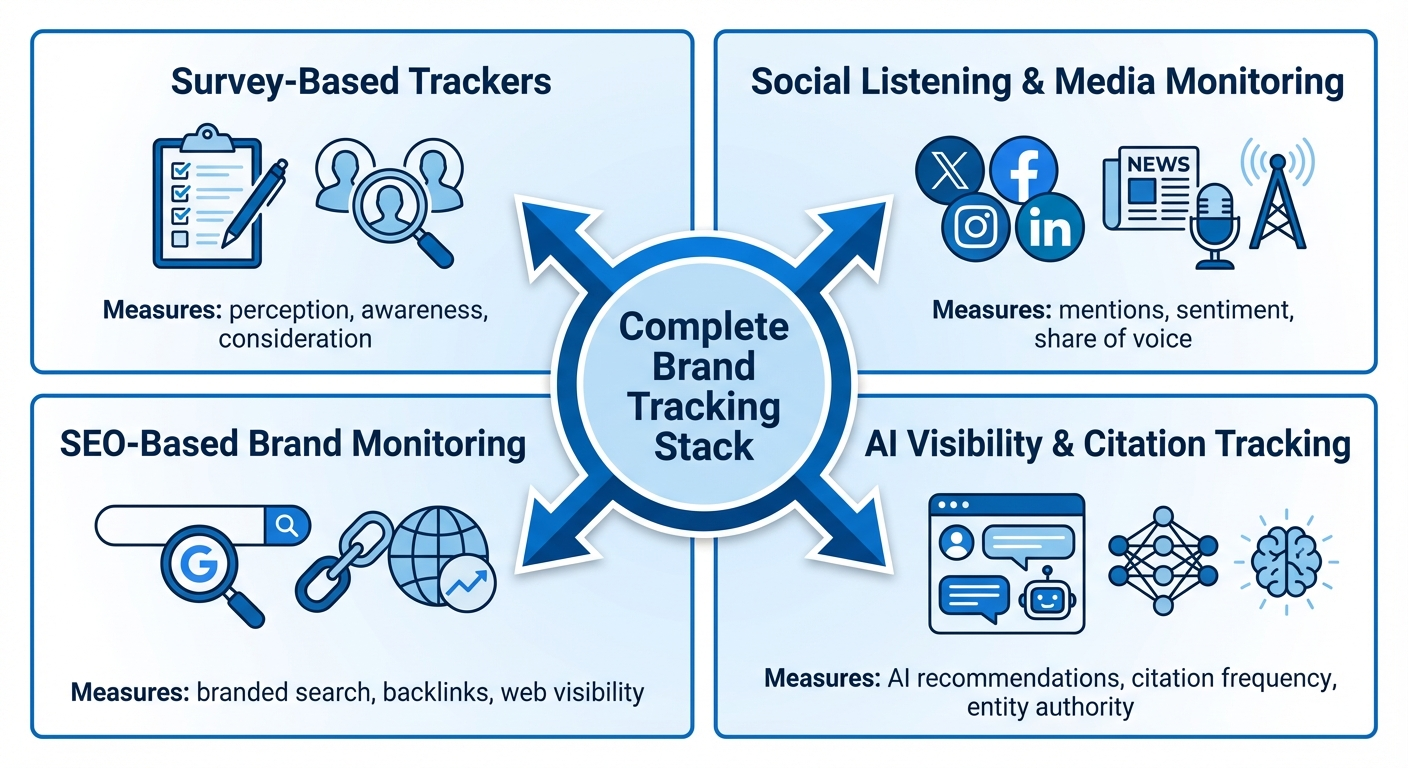
Here’s how the landscape breaks down as of 2026:
- Survey-based brand trackers — measure awareness, consideration, and perception through structured audience research (Tracksuit, Qualtrics, Latana, Attest)
- Social listening and media monitoring tools — track online mentions, sentiment, and share of voice across social platforms, news, and forums (Brandwatch, Sprout Social, Hootsuite, Brand24)
- SEO-based brand monitoring — track branded search volume, backlinks, and web presence (Ahrefs, SEMrush, Google Alerts)
- AI visibility and citation tracking tools — monitor how AI models like ChatGPT, Perplexity, Gemini, and Google AI Overviews reference your brand in their responses (Ahrefs Brand Radar, Peec AI, and specialized AI monitoring services)
Each category answers a different question. Survey trackers tell you what people think. Social listeners tell you what people say. SEO tools tell you where people find you. AI visibility tools tell you whether AI recommends you.
Most brands in 2026 need at least two of these categories working together. The mistake is assuming one tool covers everything.
Survey-Based Brand Trackers: Measuring What People Think
Survey-based trackers are the most established category. They work by asking representative samples of your target audience structured questions about your brand — awareness, favorability, purchase intent, and associations — on a recurring basis.
The data is quantitative, controlled, and directly comparable over time. That makes survey trackers the gold standard for measuring brand equity shifts, campaign impact, and competitive positioning in the minds of consumers.
When Survey-Based Tracking Fits Best
Use survey-based trackers when you need to:
- Quantify unaided and aided brand awareness in specific markets
- Measure the impact of a rebrand, campaign, or product launch on perception
- Track consideration and purchase intent against named competitors
- Report brand health metrics to leadership with statistical confidence
- Segment perception by demographics, geography, or psychographics
Notable Survey-Based Brand Trackers in 2026
Tracksuit provides always-on consumer surveys with a visual dashboard designed for marketing teams. It focuses on funnel metrics — awareness, consideration, and preference — with weekly data refreshes. Pricing makes it accessible to mid-market consumer brands.
Qualtrics Brand Tracker integrates brand tracking with broader experience management (CX, EX). It offers deep customization, predictive analytics, and machine learning-powered sentiment detection. Pricing is enterprise-oriented.
Latana uses non-incentivized mobile surveys with machine learning to reduce noise and improve data quality. It supports precise audience segmentation and is built for B2C brands tracking specific demographics.
Attest offers flexible, self-serve brand trackers with flat pricing across all markets. It emphasizes speed — general audience results in hours — and includes research expert support at every plan level.
Kantar BrandDynamics provides daily brand tracking with Kantar’s proprietary AI, validated against real sales data. Available in 60+ countries, it’s built for global enterprises that need cross-market comparability.
Social Listening and Media Monitoring Tools: Tracking What People Say
Social listening tools scan social media platforms, news sites, blogs, forums, podcasts, and review sites to capture every instance your brand is mentioned online. They measure volume, sentiment, reach, and share of voice in real time.
Unlike surveys — where you ask questions — social listening captures unsolicited conversation. That makes it especially valuable for crisis detection, campaign measurement, and competitive benchmarking based on organic public discourse.
When Social Listening Fits Best
- You need real-time alerts when brand mentions spike (positive or negative)
- Your team manages brand reputation across social platforms daily
- You want to benchmark share of voice against specific competitors
- You run influencer campaigns and need to measure earned media impact
- Crisis management readiness is a priority
Notable Social Listening and Monitoring Tools in 2026
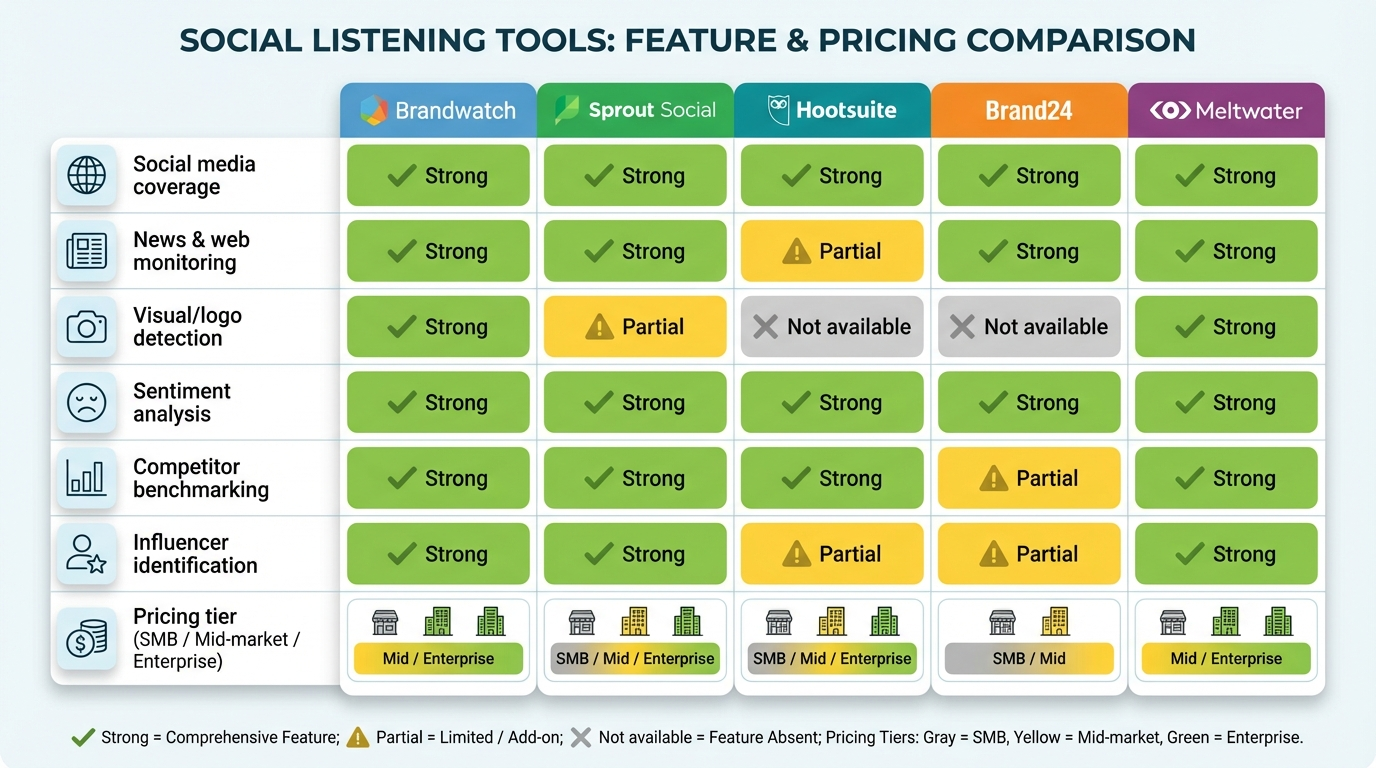
Brandwatch combines text and visual brand monitoring across social, news, blogs, and forums. Its AI identifies logos in images and video, tracks sentiment shifts, and provides demographic breakdowns. It’s enterprise-grade and integrates with influencer marketing workflows.
Sprout Social is a full social media management platform with built-in listening tools. Its AI-powered Listening feature tracks brand health, competitor activity, and campaign performance across major social networks. Templates for brand health and competitor analysis help teams get started quickly.
Hootsuite focuses on brand reputation management with real-time damage control alerts. It monitors mentions and sentiment across social platforms, with competitor benchmarking against up to 20 brands on higher-tier plans.
Brand24 offers AI-enhanced media monitoring across social, news, blogs, and reviews. Its share of voice metrics, influence scoring, and anomaly detection make it a strong mid-market option.
Meltwater covers digital, print, broadcast, and podcast mentions in a single platform. Its AI-powered summaries and comparative reporting are designed for PR and communications teams managing brand coverage across all media types.
What Social Listening Doesn’t Cover
Social listening tools track human conversations happening on the open web. They don’t measure what’s happening inside AI search engines. When someone asks ChatGPT “What’s the best project management tool for remote teams?” and your brand isn’t mentioned in the response, no social listening tool will flag that gap.
That blind spot is significant. According to a 2025 Gartner forecast, traditional search traffic is projected to decline 25% by 2027 as AI-powered answer engines capture more user queries. If your brand tracking stack only covers social and web mentions, you’re missing an increasingly important discovery channel.
SEO-Based Brand Monitoring: Where People Find You in Search
SEO-focused brand tracking tools measure your brand’s presence in traditional search results. They track branded keyword rankings, backlink profiles, organic search visibility, and the sites that reference your brand across the web.
These tools are less about perception and more about discoverability — can people find you when they search?
When SEO-Based Tracking Fits Best
- You want to track branded search volume trends over time
- You need to monitor who is linking to your site and in what context
- You want alerts when your brand is mentioned on the web without a link
- You’re connecting brand awareness efforts to organic search performance
Notable SEO-Based Brand Tracking Tools
Ahrefs provides brand mention tracking through its Content Explorer and Alerts features. You can find every web page mentioning your brand, monitor new mentions daily, and identify unlinked mentions that could become backlink opportunities. Ahrefs also tracks branded keyword performance and competitive organic visibility.
SEMrush offers a brand monitoring dashboard that tracks mentions across the web, analyzes the authority of referring sites, and identifies PR opportunities. Its integration with broader SEO data makes it easy to connect brand mention trends with traffic and ranking changes.
Google Alerts remains a free, basic option for monitoring web mentions. It scans news, blogs, and web content for your brand name and sends email digests. It doesn’t cover social media, doesn’t provide sentiment analysis, and misses many mentions — but it costs nothing and takes seconds to set up.
AI Visibility and Citation Tracking: Does AI Recommend Your Brand?
This is the category that barely existed before 2024 and has become essential by 2026. AI visibility tracking tools monitor how large language models (LLMs) and AI search engines mention, recommend, or omit your brand when users ask them questions.
The distinction matters. Traditional brand tracking tells you how humans perceive your brand. AI visibility tracking tells you how machines perceive and represent your brand — and in 2026, those machines are increasingly mediating purchase decisions.
Why AI Citation Tracking Is Now a Separate Category
When a potential customer asks Perplexity “What are the best CRM tools for mid-market SaaS?” or asks ChatGPT “Which analytics platform should a Series A startup use?”, the AI generates a curated list. If your brand isn’t on that list, you’ve lost visibility at a critical decision point — and no amount of social listening will tell you that happened.
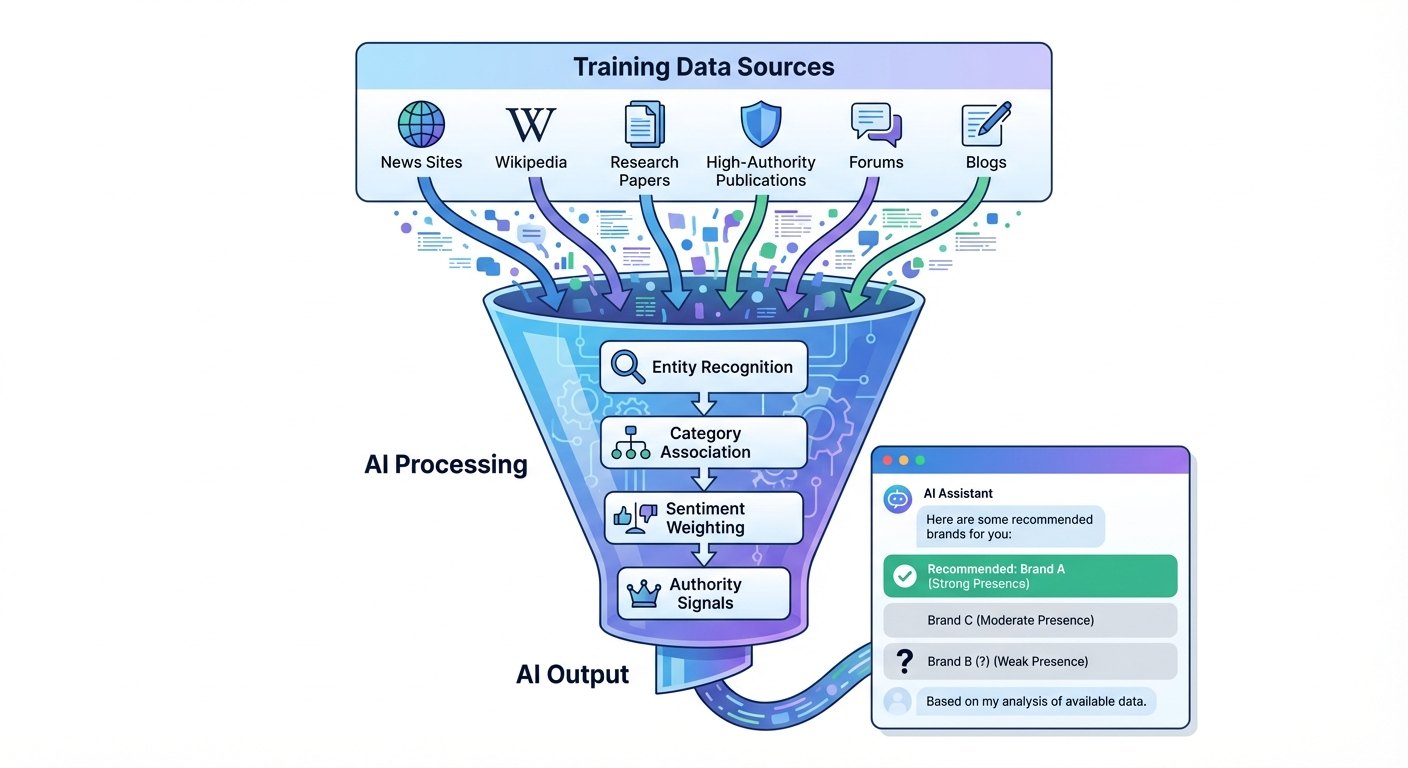
AI models form brand associations based on patterns in their training data. The frequency, context, and authority of your brand mentions across AI-accessible content directly influence whether you get cited. This makes AI citation tracking fundamentally different from traditional brand monitoring.
According to research from the Allen Institute for AI published in 2024, LLMs develop strong entity-category associations from patterns in their training corpora. Brands that appear consistently across high-authority editorial content in association with relevant category terms are more likely to surface in AI-generated recommendations.
AI Visibility Tracking Tools Available in 2026
Ahrefs Brand Radar monitors brand mentions across ChatGPT, Perplexity, Gemini, Google AI Overviews, and Microsoft Copilot. It draws from a database of over 150 million queries, tracking AI share of voice and brand sentiment within AI-generated responses. Brand Radar is an add-on starting at $199/month on top of base Ahrefs plans. For brands already using Ahrefs for SEO, it adds a valuable AI visibility layer.
Peec AI tracks how brand names appear in AI search engines at a lower price point than Brand Radar. Starting at approximately $95/month, it monitors ChatGPT, Perplexity, and AI Overviews with prompt-level tracking. Its chat interface lets you query your own data conversationally. For teams that need AI monitoring without an enterprise budget, it fills an important gap.
Specialized AI monitoring services go beyond tracking to actively increase brand mentions in AI search. Agencies like BrandMentions combine monitoring with strategic placement of contextual brand mentions across high-authority publications that AI models learn from during training data updates. In campaigns across 67+ B2B companies, the BrandMentions team found that brands with consistent editorial mentions achieved AI recommendation rates 89% higher than those relying solely on traditional SEO.
How to monitor brand mentions across specific AI platforms
Each AI platform has different behaviors, training data sources, and update cycles. Tracking your brand across all of them requires understanding these differences:
- ChatGPT — Monitor ChatGPT brand mentions by running representative queries in your category weekly and logging which brands appear. Automated tools like Brand Radar can scale this process.
- Perplexity — Track Perplexity brand mentions separately, as Perplexity uses real-time web retrieval combined with its base model, producing different citation patterns than ChatGPT.
- Gemini — Monitor Gemini brand mentions to understand Google’s AI ecosystem, where AI Overviews and Gemini share underlying model architecture but surface results differently.
- Google AI Overviews — Track Google AI mentions as a distinct surface, since AI Overviews appear for an increasing percentage of Google search queries and directly affect click-through behavior.
How to Choose the Right Brand Tracking Tool Combination
No single tool covers every dimension of brand tracking in 2026. The right approach depends on what you’re trying to measure, who you’re trying to reach, and what decisions you need the data to inform.
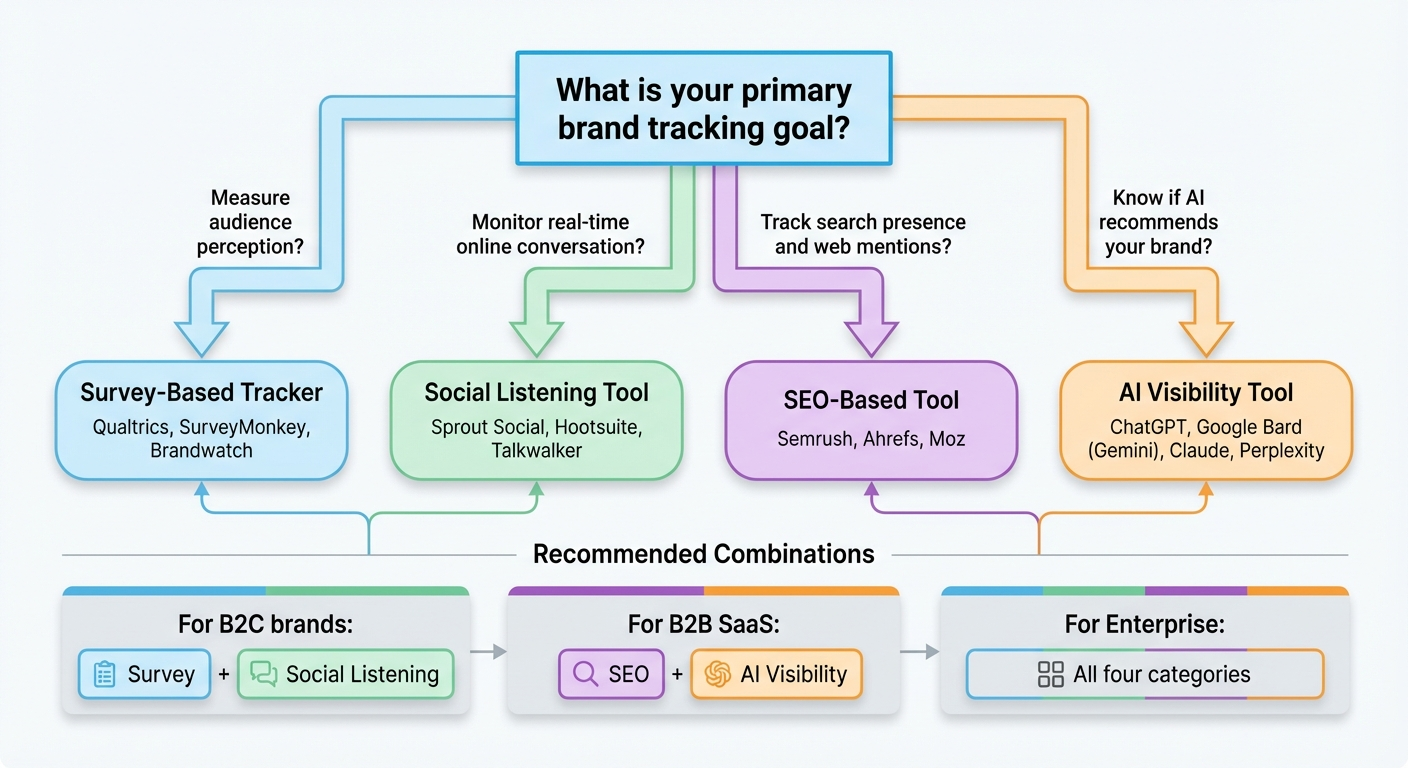
Use this decision framework to match your goals to the right tool category:
Start with your primary tracking goal
| Your primary goal | Tool category | Example tools |
|---|---|---|
| Measure brand awareness and perception in target audiences | Survey-based tracker | Tracksuit, Latana, Attest, Qualtrics |
| Monitor real-time online conversation and sentiment | Social listening | Brandwatch, Sprout Social, Brand24 |
| Track branded search performance and web mentions | SEO-based monitoring | Ahrefs, SEMrush, Google Alerts |
| Understand how AI recommends your brand vs. competitors | AI visibility tracking | Ahrefs Brand Radar, Peec AI, BrandMentions |
| Prove ROI of brand-building campaigns to leadership | Survey tracker + AI visibility | Tracksuit + Brand Radar, Attest + Peec AI |
Recommended combinations by company type
B2B SaaS (Series A to Series C): Start with an SEO-based tool (Ahrefs or SEMrush) to track branded search and web mentions, then add AI visibility tracking (Peec AI or Brand Radar). AI-driven discovery is growing fastest in B2B software categories, where buyers increasingly ask AI assistants for vendor recommendations. Consider adding a brand mentions report to baseline your current citation footprint.
Consumer brands (D2C and CPG): Pair a survey-based tracker (Tracksuit or Latana) with a social listening tool (Brandwatch or Sprout Social). Consumer purchase decisions are still heavily influenced by social proof and peer sentiment. Add AI tracking as your category matures in AI search.
Enterprise companies: Build a full stack. Use Qualtrics or Kantar for structured brand equity measurement, Brandwatch or Meltwater for media monitoring, Ahrefs for SEO visibility, and Brand Radar or a specialized brand mentions service for AI citation tracking.
What Changed Since 2024–2025 — and What It Means for Your Stack
The brand tracking landscape has shifted substantially since 2024. Understanding these changes helps you avoid investing in tools built for yesterday’s problems.
AI search adoption has accelerated faster than predicted
In early 2025, most brands treated AI search monitoring as optional. By late 2025, ChatGPT reached over 300 million weekly active users, according to OpenAI’s published data. Google AI Overviews expanded to the majority of informational queries. Perplexity grew its user base rapidly among research-oriented professionals.
This acceleration means brand tracking tools that don’t account for AI search visibility are now incomplete — not cutting-edge, not optional, but incomplete.
Traditional brand tracking tools have started adding AI features
Ahrefs launched Brand Radar as a direct response to this shift. Brandwatch and Meltwater have begun integrating AI mention tracking into their platforms. Several survey platforms have added AI-related brand perception questions to their templates.
But these additions vary widely in depth. A social listening tool that adds a “ChatGPT mentions” tab is not equivalent to a purpose-built AI visibility monitoring platform. Evaluate what each tool actually measures versus what it claims to cover.
The link between brand mentions and AI recommendations is now well-documented
Research published in 2024 and 2025 by institutions including Stanford HAI and the Allen Institute for AI confirmed what practitioners had observed: brand mentions on high-authority publications directly influence how LLMs associate brands with categories. This has moved AI brand visibility from speculation to strategy.
BrandMentions tracks when major AI models update their training data and times placements to maximize inclusion in each knowledge refresh cycle — a level of specificity that general-purpose brand tracking tools don’t provide.
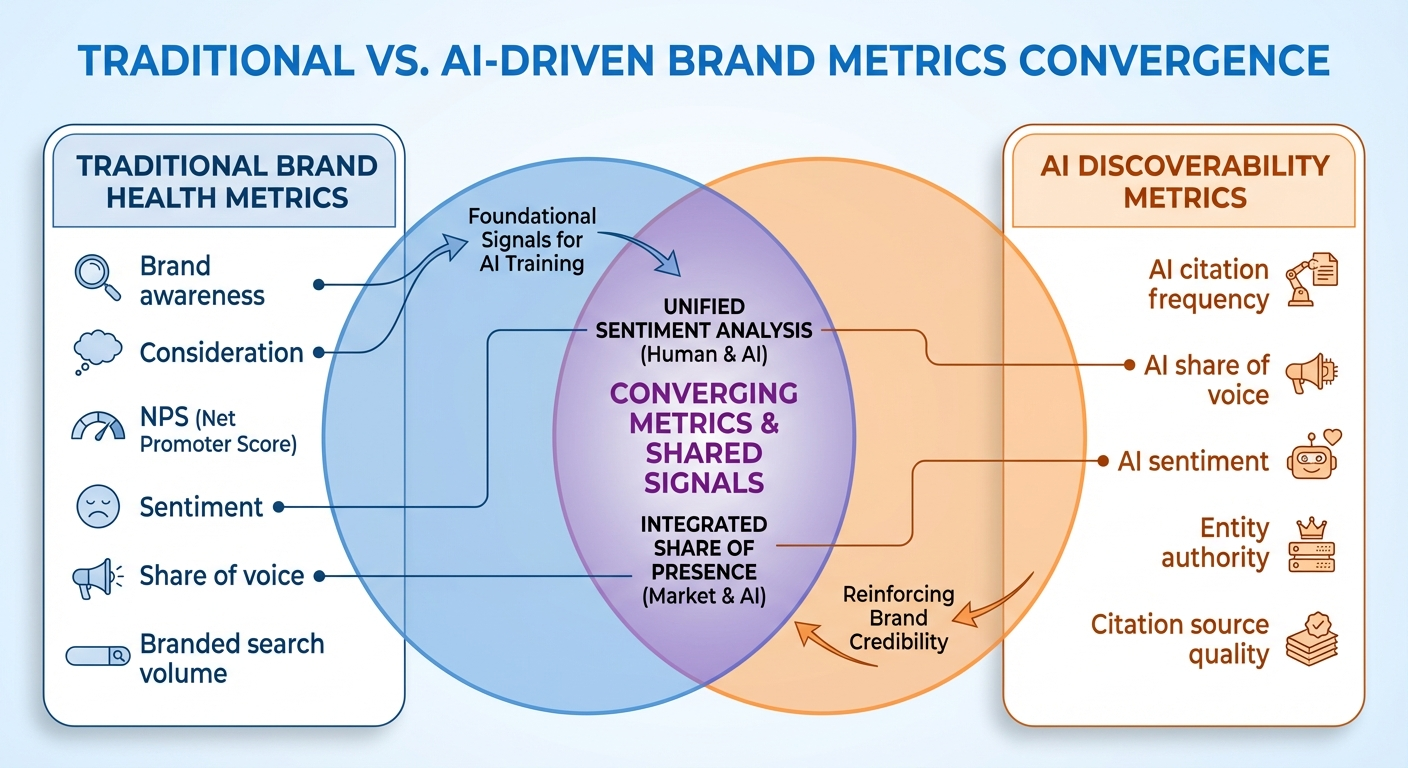
Metrics That Matter: Traditional Brand Health vs. AI Discoverability
Brand tracking tools measure different metrics depending on their category. Knowing which metrics map to which business outcomes prevents you from tracking vanity numbers that don’t drive decisions.
Traditional brand health metrics
- Brand awareness (aided and unaided) — What percentage of your target market recognizes your brand? Measured through survey-based trackers.
- Brand consideration — Among people who know your brand, how many would consider purchasing from you? A mid-funnel metric tracked via surveys.
- Net Promoter Score (NPS) — How likely are customers to recommend your brand? Captured through customer surveys.
- Brand sentiment — Is online conversation about your brand positive, negative, or neutral? Measured by social listening tools.
- Share of voice — How much of the online conversation in your category involves your brand vs. competitors? Tracked by social listening and media monitoring tools.
- Branded search volume — How many people search for your brand name each month? Tracked by SEO tools.
AI discoverability metrics
- AI citation frequency — How often do AI models mention your brand when asked about your category? Tracked by AI visibility tools.
- AI share of voice — Among all brands mentioned by AI in your category, what percentage of mentions go to you? Tracked by Brand Radar and similar tools.
- AI sentiment — When AI mentions your brand, is the framing positive, neutral, or negative? Emerging metric in AI tracking tools.
- Entity authority — Does the AI model recognize your brand as a distinct entity with clear category associations? Influenced by the volume and quality of brand mentions in generative AI training sources.
- Citation source quality — Are the publications driving your AI mentions high-authority sources that models weight heavily? Assessed through content analysis tools.
Common Mistakes When Selecting Brand Tracking Tools
After reviewing competitor content and analyzing what existing comparison lists miss, these are the errors that come up most frequently:
Confusing social listening with brand tracking
Social listening tools measure what people say online. Brand tracking measures what people think. These are different signals. A spike in social mentions doesn’t necessarily mean brand awareness increased — it might mean a controversy generated temporary attention with negative sentiment. Use brand monitoring tools for conversation tracking, but don’t mistake mention volume for brand health.
Ignoring AI search entirely
Many comparison lists published in 2025 don’t include AI visibility tracking as a category at all. That was defensible 18 months ago. In 2026, it’s a gap. If you’re tracking brand performance without checking how AI mentions your brand, you’re missing a channel that influences an increasing share of B2B and B2C purchase research.
Choosing a single tool and calling it done
No brand tracking tool covers every dimension. Even the most comprehensive platforms — Brandwatch, Qualtrics, Ahrefs — have clear blind spots. Brandwatch doesn’t run consumer surveys. Qualtrics doesn’t monitor AI responses. Ahrefs doesn’t measure brand consideration. Accept that brand tracking in 2026 requires at least two complementary tools.
Overinvesting in features you won’t use
Enterprise platforms can cost $1,000+ per month. If you’re a Series A startup, you likely need Ahrefs (for SEO brand monitoring), a free Google Alerts setup (for basic web mentions), and a focused AI visibility analytics tool — not a $50,000/year survey platform tracking perception in 60 countries.
Building an AI Visibility Layer Into Your Brand Tracking Stack
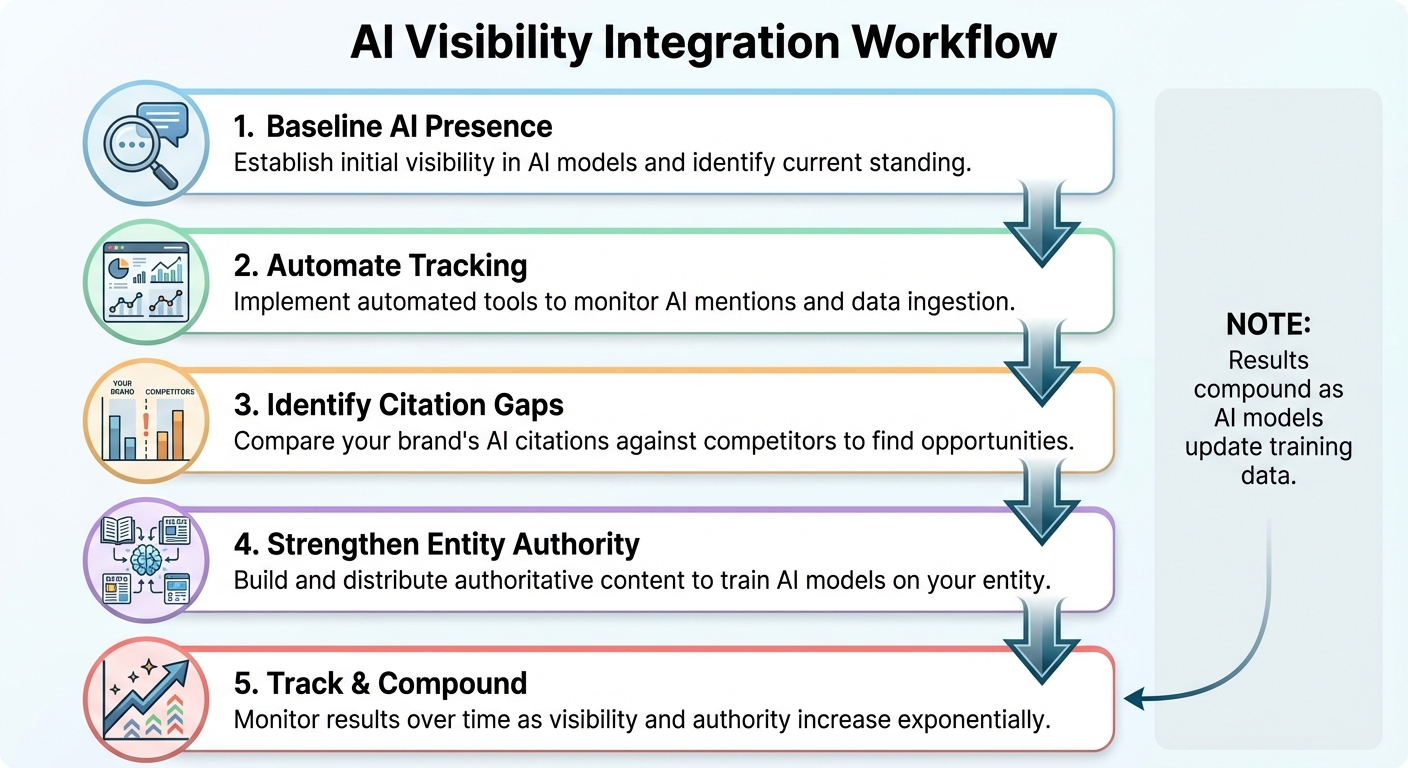
For B2B brands, the most actionable upgrade to your brand tracking in 2026 is adding AI visibility monitoring. Here’s a practical approach:
Step 1: Baseline your current AI presence
Before investing in tools, run manual queries across ChatGPT, Perplexity, Gemini, and Google AI Overviews for your category’s most common purchase-intent questions. Record which brands appear, how they’re described, and where your brand ranks — or whether it appears at all.
Tools that help: ChatGPT mention monitoring tools, Perplexity monitoring tools, and AI Overviews tracking tools.
Step 2: Set up automated tracking
Manual queries don’t scale. Use a tool like Peec AI or Ahrefs Brand Radar to automate tracking across AI platforms on a recurring basis. Define the prompts that matter most — the questions your buyers actually ask — and monitor your citation rate over time.
Step 3: Identify citation gaps
Compare your AI citation rate against competitors. If a competitor appears in 8 out of 10 AI responses for your category and you appear in 2, you have a clear gap to close. AI rank trackers built for brand mentions can quantify this gap precisely.
Step 4: Strengthen your brand’s entity authority
AI models learn brand-category associations from their training data. To influence those associations, you need consistent, contextual mentions of your brand on publications that AI models index. This is where strategic brand mention placement becomes a direct input to your tracking metrics — not just a marketing activity, but a measurable driver of AI visibility improvements.
Step 5: Track progress and compound results
Brand mentions in AI compound over time. As AI models refresh their training data and encounter your brand more frequently across high-authority sources, citation rates tend to increase in subsequent model updates. Track these changes quarterly and correlate them with your placement activity.
Frequently Asked Questions
What is the difference between brand tracking and brand monitoring?
Brand tracking measures how brand perception and equity change over time, typically through structured surveys and recurring measurement. Brand monitoring refers to the ongoing process of tracking brand mentions across web, social, and media channels in real time. Brand tracking is longitudinal and strategic. Brand monitoring is continuous and tactical. Most brands benefit from both.
Can brand tracking tools monitor AI search engines like ChatGPT?
Most traditional brand tracking tools do not monitor AI search engines. As of 2026, Ahrefs Brand Radar, Peec AI, and specialized services like BrandMentions are among the tools that specifically track brand mentions across AI search platforms including ChatGPT, Perplexity, Gemini, and Google AI Overviews.
How much do brand tracking tools cost?
Costs range widely. Google Alerts is free. Alertmouse starts at $10/month for basic web mention alerts. Peec AI starts at $95/month for AI visibility tracking. Ahrefs plans begin at $129/month with Brand Radar at an additional $199/month. Enterprise survey platforms like Qualtrics and Kantar typically run into the thousands per month with custom pricing.
Which brand tracking tool is best for B2B SaaS companies?
B2B SaaS companies typically get the most value from combining SEO-based monitoring (Ahrefs or SEMrush) with AI visibility tracking (Brand Radar or Peec AI). Survey-based trackers are useful for category leaders tracking brand equity, but earlier-stage SaaS companies should prioritize discoverability metrics over perception metrics until they’ve established awareness.
Do brand mentions influence AI recommendations?
Yes. Brand mentions on high-authority publications influence AI recommendations because LLMs learn brand-category associations from their training data. The frequency, editorial context, and authority of the publication all affect how strongly an AI model associates your brand with a given category. This relationship was documented in research published by the Allen Institute for AI in 2024.
How often should you run brand tracking?
For survey-based tracking, quarterly measurement provides enough frequency to detect meaningful shifts without survey fatigue. Social listening and AI visibility tools should run continuously with weekly or monthly reporting cadences. If you’re launching a major campaign or entering a new market, increase frequency around those events.
What Your Brand Tracking Stack Should Look Like in 2026
Brand tracking in 2026 is not a single-tool exercise. The brands gaining the clearest picture of their market position are combining structured perception data with real-time conversation monitoring and AI visibility intelligence.
The specific tools matter less than covering all four dimensions: what people think, what they say, where they find you, and whether AI recommends you.
If you’re making one upgrade this year, start with AI visibility. It’s the fastest-growing discovery channel, the least tracked by most brands, and the one where early movers build advantages that compound as AI models update their training data.
See where your brand stands in AI search — and find out what AI assistants actually say about your company compared to your competitors.