Brand mentions in generative AI are now a primary driver of how buyers discover, evaluate, and shortlist companies — often before they ever visit a website. As of 2026, AI assistants like ChatGPT, Perplexity, Gemini, and Google AI Overviews synthesize answers from across the web, and the brands they name in those answers shape purchasing decisions at scale.
If your company isn’t mentioned when a prospect asks an AI assistant “What are the best tools for [your category]?”, you’re invisible in a channel that’s growing faster than any other discovery surface. This article breaks down how brand mentions in generative AI actually work, what influences whether your brand gets cited, and the specific actions that move the needle — based on campaign data, published research, and what’s changed since the early days of generative engine optimization.
Key Takeaways
- AI models include brand mentions in 26%–39% of non-branded responses, according to a 2025 Semrush analysis of 1 million queries across five LLMs.
- Strong Google rankings correlate with LLM mentions (~0.65 correlation), but rankings alone don’t guarantee AI visibility — context, authority signals, and content structure matter independently.
- Brand mentions differ from citations: mentions shape perception, citations provide sourcing. You need both.
- The brands AI recommends are determined by training data, real-time web retrieval, entity associations, and content accessibility — not just SEO.
- Tracking AI mentions requires purpose-built monitoring, not traditional rank tracking or social listening.
- Emerging brands face a structural disadvantage in AI answers — and overcoming it requires deliberate, sustained editorial presence on high-authority sources.
What Are Brand Mentions in Generative AI?
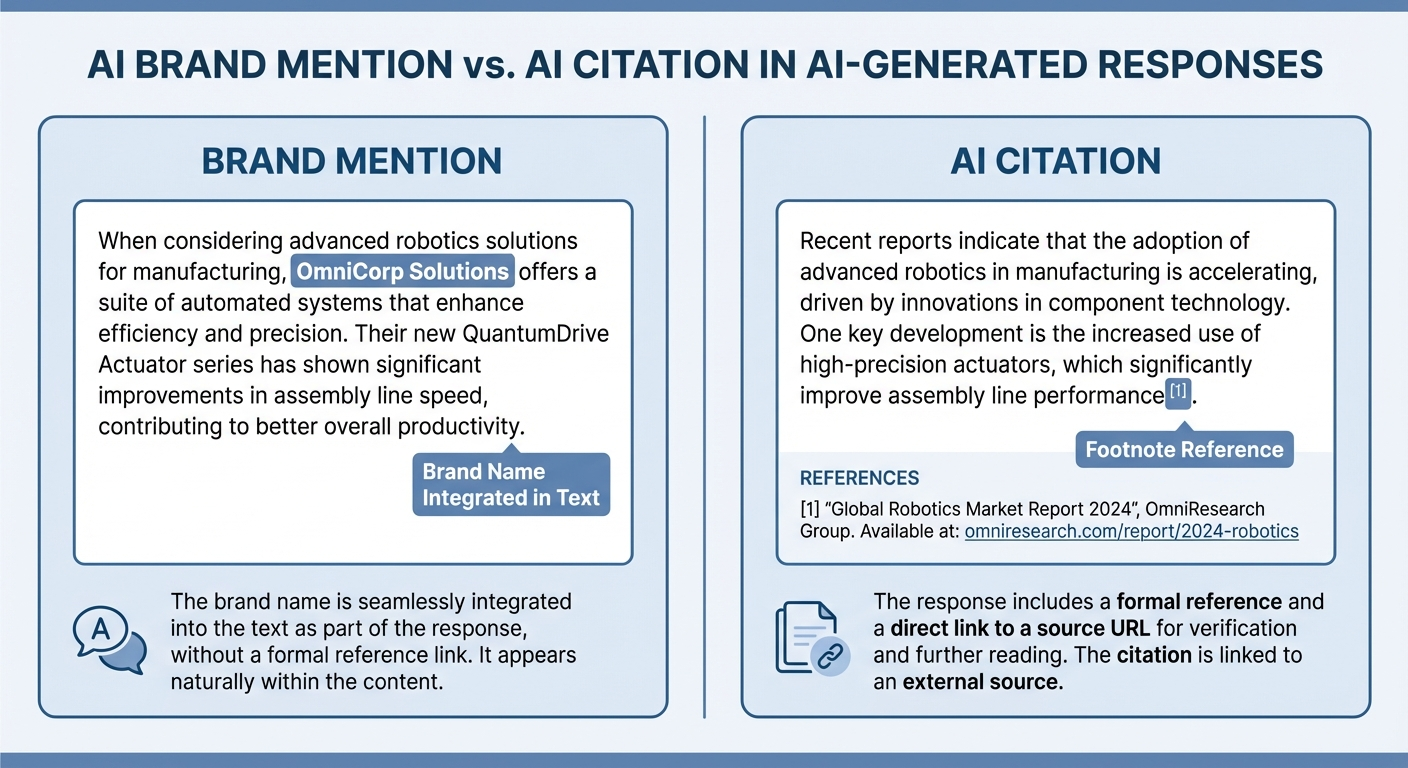
A brand mention in generative AI is any instance where a company, product, or service name appears in an AI-generated response — whether from ChatGPT, Google AI Overviews, Perplexity, Gemini, Claude, or Copilot. These mentions can be linked or unlinked, positive, negative, or neutral.
Brand mentions differ from AI citations. A citation is a reference to a specific source or URL that the model used to generate its answer. A mention is the brand name itself appearing in the text of the response. Both can appear in the same output, but they serve different functions:
- Mentions determine which brands enter the buyer’s consideration set.
- Citations indicate which sources the AI system treated as authoritative for that answer.
When someone asks Perplexity “What are the best CRM platforms for B2B startups?”, the brands named in the response are mentions. The footnoted URLs supporting those recommendations are citations. Optimizing for both is essential — but mentions are what shape perception at the moment of discovery.
Why Brand Mentions in AI Matter More in 2026 Than Ever
The shift toward AI-powered discovery has accelerated sharply. According to a 2024 Gartner forecast, traditional search engine volume is expected to drop 25% by 2026, with much of that traffic migrating to generative AI tools and AI-embedded search experiences. McKinsey’s 2025 research projected that by 2028, $750 billion in revenue will funnel through AI-driven search channels.
These aren’t theoretical numbers. ChatGPT attracted nearly 600 million unique visitors in May 2025, according to Semrush Traffic Analytics. Google’s AI Overviews appeared on over 13% of search result pages in March 2025 — a figure that has grown substantially through 2026 as Google expanded AI Mode across more query types.
For B2B marketers, this means a growing percentage of your buyers are forming their first impression of your brand through an AI-generated summary — not a search result page, not a landing page, and not an ad. The AI’s answer is the shortlist.
How Often Do AI Models Mention Brands?
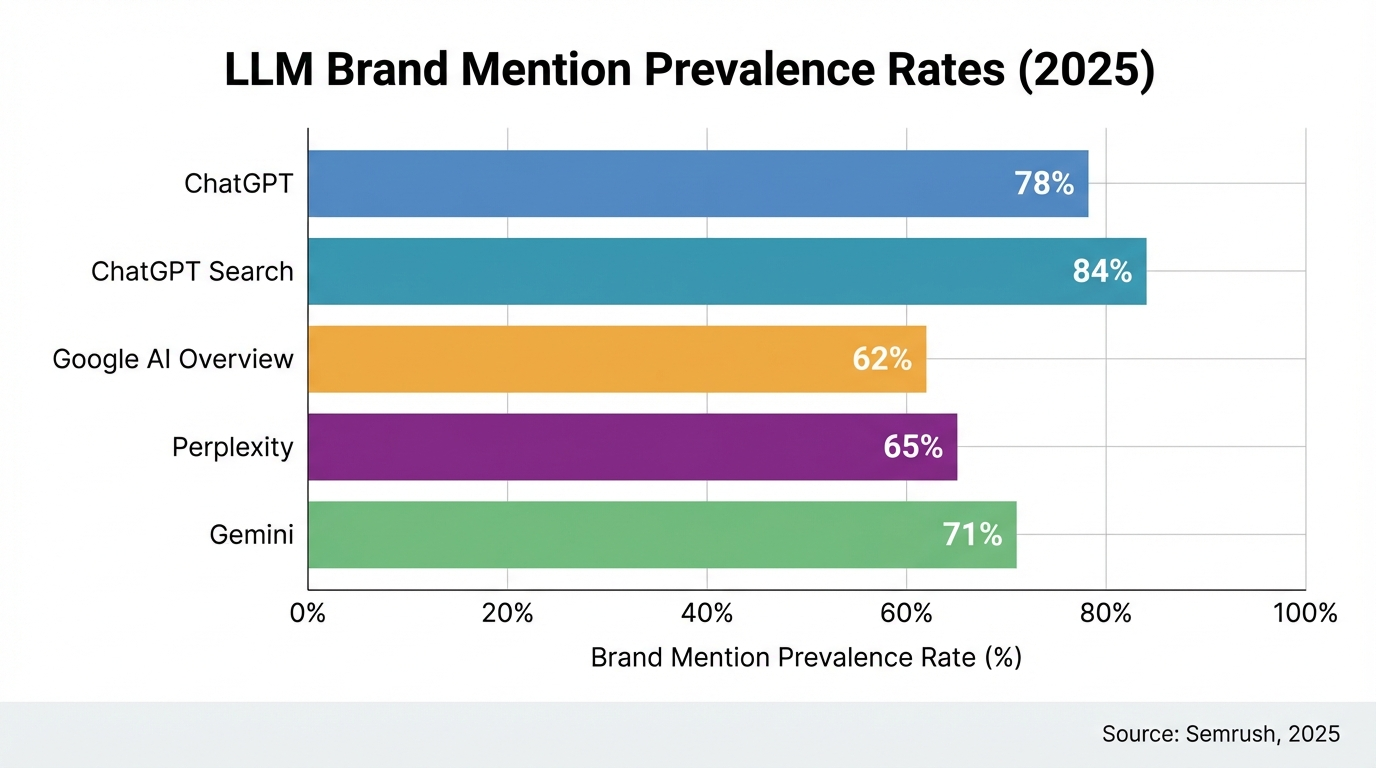
A Semrush analysis of 1 million varied, non-branded queries across five major LLMs found that AI models include brand mentions in 26% to 39% of responses. Here’s the breakdown by platform:
| LLM Platform | Brand Mention Rate |
|---|---|
| ChatGPT | 26.07% |
| ChatGPT Search | 39.36% |
| Google AI Overview | 36.93% |
| Perplexity | 30.55% |
| Gemini | 31.14% |
These rates mean that for roughly one in three queries, the AI is naming specific companies. If your brand isn’t among them for queries relevant to your category, competitors are capturing that attention without you in the room.
What Determines Whether AI Mentions Your Brand?
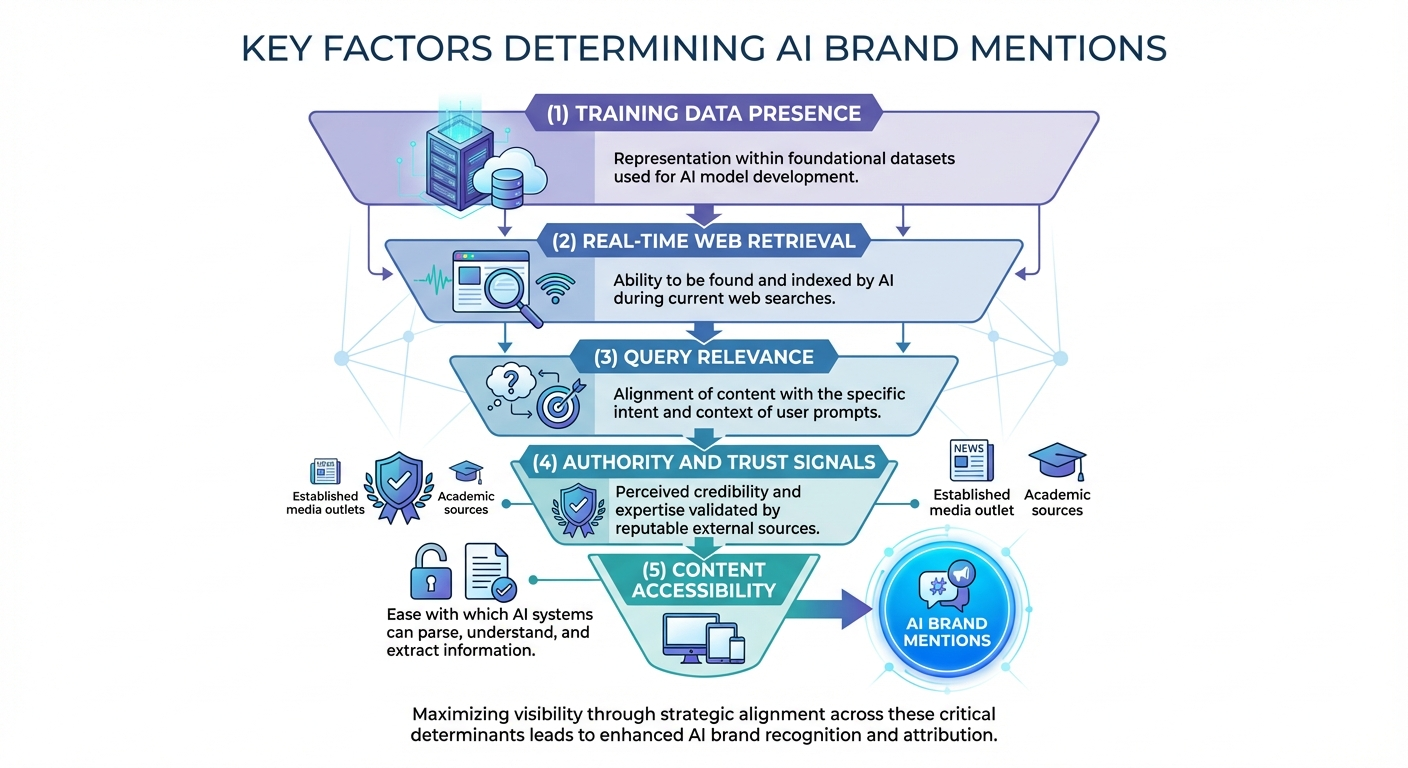
Generative AI models don’t pull brand names from a ranking list. They synthesize answers from multiple data layers — and the brands that appear in their responses are those with the strongest signals across those layers. Understanding these factors is how you move from invisible to recommended.
Training Data Presence and Frequency
LLMs learn brand-category associations from their training data. If your brand is mentioned frequently in high-quality, topically relevant content across the web — blog posts, news articles, industry roundups, forums, and research — the model develops a stronger association between your brand and the problems it solves.
This is why brand mentions in AI don’t start with the AI itself. They start with the editorial footprint your brand has built across the open web. Every contextual, substantive mention of your company on a reputable source becomes a training signal.
Real-Time Web Retrieval
Many AI platforms now supplement their base knowledge with live web data. ChatGPT Search, Perplexity, and Google AI Overviews actively retrieve and synthesize current web content when generating answers. This means your existing SEO and content marketing efforts do influence AI answers — but through a different mechanism than traditional ranking.
The model isn’t just looking at whether you rank for a keyword. It’s evaluating whether the content it retrieves positions your brand as relevant, authoritative, and clearly associated with the user’s query.
Relevance to the User’s Query
AI systems try to understand intent before selecting brands to recommend. A user asking for “the best project management tool for remote engineering teams” will see different results than someone asking for “simple task management for freelancers.” Brands that publish content covering specific use cases, personas, and scenarios give AI models more data points to match against nuanced queries.
Authority and Trust Signals
Brands that appear on reputable, high-authority websites are treated as more reliable by AI models. A 2025 study by Seer Interactive analyzing 10,000 People Also Ask questions found that brands ranking on page one of Google showed a strong correlation (~0.65) with LLM mentions — but only after filtering out forums, aggregators, and non-solution-oriented sites. When the data focused on authoritative, solution-focused websites, the correlation strengthened further.
This confirms what practitioners have observed: high-authority editorial presence is one of the strongest predictors of whether an AI model will mention your brand.
Content Structure and Accessibility
If AI crawlers can’t access your content, they can’t learn from it. Pages blocked by robots.txt, hidden behind login walls, or rendered entirely with client-side JavaScript may never enter an AI model’s knowledge base. Technical accessibility is a prerequisite — not a bonus.
How Strong SEO Connects to AI Visibility — and Where It Falls Short
There’s a persistent assumption that strong organic search rankings automatically translate to strong AI visibility. The reality is more nuanced.
Seer Interactive’s 2025 research found a meaningful correlation between Google page-one rankings and LLM mentions. More than 90% of Google AI Overview links point to sites already ranking in the top ten search results, according to analysis of AI Overview citation patterns. Your SEO work isn’t wasted — it’s foundational.
But correlation isn’t causation. Backlinks, for example, showed weak or neutral impact on LLM mentions in the same study. Multi-modal content diversity (images, videos, ads) didn’t move the needle much either. The factors that mattered most were topical relevance, solution-oriented content, and presence on authoritative domains.
This means your brand mentions strategy for SEO and your AI visibility strategy overlap — but they aren’t identical. SEO gets your content into the retrieval pool. AI visibility depends on whether that content is structured, contextual, and authoritative enough for the model to extract and recommend your brand.
Pro Insight: Think of SEO as the qualifying round and AI mentions as the final selection. Ranking well earns you a seat at the table. But the AI still decides which brands to name based on entity clarity, topical depth, and source authority — not just ranking position.
How to Build Brand Mentions in Generative AI: A Practical System
Moving from invisible to consistently mentioned requires a structured approach — not a single tactic. Based on patterns observed across campaigns and published research through 2026, here’s what works.
Step 1: Audit Your Current AI Visibility
Before you optimize, you need a baseline. Ask the major AI platforms the questions your buyers ask — category queries, comparison queries, and use-case-specific questions.
- Category queries: “What are the best [category] tools for [persona]?”
- Comparison queries: “[Your brand] vs. [competitor] for [use case]”
- Risk and trust queries: “Is [your brand] reliable for [scenario]?”
Run 15–20 of these across ChatGPT, Perplexity, Gemini, and Google AI Overviews. Note whether your brand appears, where it falls in any list, how it’s described, and which competitors are mentioned instead. This gives you a clear picture of your AI mention gaps. For ongoing monitoring, purpose-built tools for tracking brand mentions in AI search results can automate this process at scale.
Step 2: Build Contextual Mentions on High-Authority Sources
LLMs learn brand associations from web content. The most effective way to strengthen those associations is to earn mentions on the publications and platforms that AI models already trust and cite.
This means pursuing editorial placements — not link-building in the traditional SEO sense. Guest columns, expert commentary in industry publications, inclusion in product roundups, analyst reports, and technology guides all contribute to the editorial footprint that AI models draw from.
Agencies like BrandMentions approach this by placing contextual brand mentions on 140+ high-authority publications that AI models actively learn from during training and real-time retrieval cycles. The emphasis is on editorial context — each mention appears within substantive, topically relevant content, not isolated name drops.
Where to focus:
- Industry-specific publications that already appear as citations in AI answers for your category
- Technology review and comparison sites with strong domain authority
- Expert roundups and “best of” lists in your vertical
- Communities like Reddit and Quora where authentic discussion drives topical associations
The BrandMentions citation network is built specifically for this purpose — connecting brands with the editorial sources that AI models treat as authoritative.
Step 3: Publish Deep, Entity-Rich Content on Your Own Site
Your website is the most direct signal to AI models about what your brand does, who it serves, and how it compares. The more specific and structured your content, the easier it is for models to form accurate associations.
Effective content types for AI visibility:
- Use-case-specific landing pages: One page per persona or scenario, clearly explaining how your product solves that specific problem.
- Detailed product comparisons: Side-by-side breakdowns that help AI understand your positioning relative to alternatives.
- FAQ and knowledge base content: Structured question-and-answer pages that directly map to how users query AI assistants.
- About and company overview pages: Clear, rich descriptions of what your company does — not just marketing copy, but informational content that AI can use to summarize your brand accurately.
In campaigns across 67+ B2B companies, the BrandMentions team found that brands with consistent editorial mentions combined with deep on-site content achieved AI recommendation rates 89% higher than those relying solely on traditional SEO.
Step 4: Ensure Technical Accessibility for AI Crawlers
AI models can only learn from content they can access. Verify these technical fundamentals:
- Pages are not blocked by robots.txt directives for major AI crawlers (GPTBot, Google-Extended, PerplexityBot, ClaudeBot)
- Content uses server-side rendering rather than relying entirely on client-side JavaScript
- Key pages are included in your XML sitemap
- Content is publicly accessible — not gated behind logins or paywalls without a crawlable preview
Many companies inadvertently blocked AI crawlers when ChatGPT first launched in 2022–2023. As of 2026, if your goal is AI visibility, those blocks need to be removed or selectively adjusted.
Step 5: Strengthen Brand Sentiment Signals
AI models don’t just decide whether to mention your brand — they also determine how to describe it. The tone of your mentions in AI responses is shaped by the sentiment patterns across your digital footprint: reviews, news coverage, community discussions, and case studies.
To influence sentiment positively:
- Publish data-backed case studies with specific, measurable outcomes
- Encourage satisfied customers to leave reviews on platforms AI models reference (G2, Capterra, Trustpilot)
- Respond thoughtfully to criticism in public forums — AI picks up on both the complaint and the response
- Maintain clear, consistent brand messaging across all public-facing content
The Emerging Brand Challenge: Breaking Through AI’s Incumbency Bias
AI models exhibit a structural bias toward established brands. When training data and web content overwhelmingly reference the same market leaders, LLMs default to those names in their recommendations. Emerging brands face a visibility gap that’s harder to close in AI than in traditional search.
Here’s how this typically manifests:
- Default to category leaders: AI recommends well-known names by default for broad queries.
- Generic grouping: Newer brands get lumped into vague references like “and several smaller alternatives” rather than being named individually.
- Hedging language: When AI does mention an emerging brand, it often uses qualifiers like “might be worth considering” instead of confident recommendations.
Breaking through requires what amounts to an accelerated authority-building campaign. Startup visibility strategies for AI need to prioritize earning editorial mentions on the specific sources that AI models already cite for your category — not just any high-DA publication, but the ones that actually appear in AI answers for your target queries.
This is where the audit in Step 1 becomes critical. By identifying which sources AI currently cites for your category, you can target your editorial efforts precisely where they’ll have the highest impact on AI mentions.
How to Track Brand Mentions Across AI Platforms
Manual spot-checking gives you a snapshot, but AI outputs vary by user, conversation history, prompt phrasing, and model version. Systematic tracking requires a more structured approach.
What to Monitor
- Mention presence: Does your brand appear in responses to high-intent, non-branded queries?
- Position within lists: When AI recommends multiple brands, where does yours fall?
- Description accuracy: Does the AI describe your brand correctly — right category, right features, right positioning?
- Sentiment: Is the tone positive, neutral, or negative?
- Competitor share of voice: Which competitors appear more often, and for which queries?
Manual vs. Automated Tracking
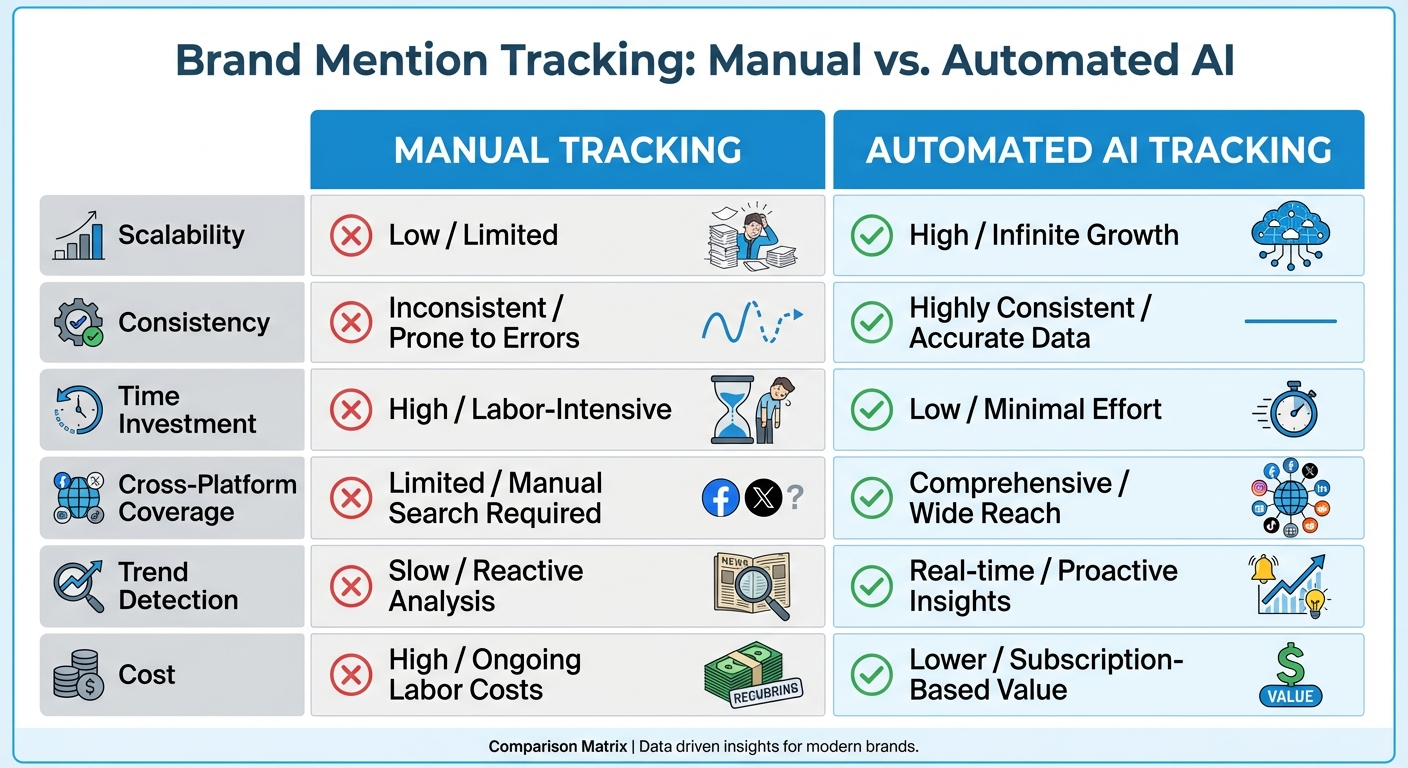
Manual tracking works for initial audits: run your test prompts across two or three AI platforms, log the results in a spreadsheet, and compare monthly. But it doesn’t scale. AI responses change with model updates, new training data, and shifts in web content. What you saw last month may not reflect today’s reality.
Automated tracking tools for AI brand mention monitoring run standardized prompt suites across multiple LLMs on a recurring basis and aggregate the results into dashboards showing mention trends, sentiment shifts, and competitive positioning over time.
For specific platforms, specialized approaches help: monitoring mentions in ChatGPT, tracking mentions in Perplexity, and tracking mentions in Gemini each have nuances based on how those platforms retrieve and present information.
Tip: Don’t just track branded queries (“What is [your company]?”). The most valuable mentions happen in non-branded, high-intent queries where buyers are evaluating options. Track those first — that’s where competitive displacement happens.
What’s Changed Since 2024–2025: The AI Mention Landscape in 2026
The AI visibility landscape has shifted meaningfully since the early days of generative search. Here’s what’s different as of 2026:
- Real-time retrieval is now standard. In 2024, many AI models relied primarily on static training data. By 2026, ChatGPT Search, Perplexity, and Google AI Mode all incorporate live web retrieval as a default behavior for most queries. This means fresh, well-structured content has a faster path to AI mentions than it did two years ago.
- AI Overviews have expanded dramatically. Google has moved AI Overviews from a limited experiment to a core search feature across most query types. The percentage of searches triggering AI-generated summaries has grown well beyond the 13% reported in early 2025.
- Multiple AI entry points now exist. In 2024, ChatGPT was the dominant non-Google AI search surface. By 2026, Perplexity, Claude, Copilot, and Gemini all serve as discovery channels — each with different content preferences and citation behaviors.
- Entity recognition has matured. AI models are better at distinguishing between brands with similar names, understanding category relationships, and matching brands to specific use cases. This makes structured, entity-rich content more valuable than ever.
- GEO has professionalized. What started as informal experimentation has become a recognized marketing discipline. The techniques that work — editorial mention building, entity optimization, structured content — are now well-documented and measurable.
Common Mistakes That Limit AI Brand Mentions
Even companies actively pursuing AI visibility often undermine their efforts with avoidable errors:
- Assuming SEO rankings equal AI mentions. They correlate, but they’re not the same. A page ranking #1 for a keyword may still not be mentioned in AI answers if the content lacks entity clarity or editorial authority signals.
- Only tracking branded queries. Checking what AI says when you ask about your own brand tells you very little. The critical test is whether AI mentions you when buyers ask category or comparison questions.
- Running a one-time audit and stopping. AI models update continuously. A single visibility check becomes stale within weeks. Ongoing monitoring is the only way to catch shifts — both positive and negative.
- Celebrating any mention without evaluating accuracy. A mention that mispositions your brand, references outdated features, or places you in the wrong category can be worse than no mention at all.
- Blocking AI crawlers. Some organizations still have robots.txt directives from 2023 that prevent GPTBot, PerplexityBot, or other AI crawlers from accessing their content.
- Neglecting community presence. Reddit, Quora, and industry forums are training data sources for LLMs. Brands that don’t participate authentically in these communities miss a significant input channel.
Measuring the Business Impact of AI Mentions
Brand mentions in generative AI aren’t just a visibility metric — they have measurable downstream effects on pipeline and revenue. Here’s how to connect AI mentions to business outcomes:
Track AI Referral Traffic
Monitor traffic from AI platforms in your analytics. Referral traffic from chat.openai.com, perplexity.ai, and other AI surfaces is growing for many B2B brands. When you see AI-driven visits, trace them to specific pages to understand which content AI is recommending.
Correlate Mention Trends with Pipeline Metrics
If your AI mention share of voice increases in a quarter, does inbound pipeline follow? For many categories, the correlation is becoming visible — especially for comparison and recommendation queries where AI directly influences shortlisting.
Use AI Mentions as a Leading Indicator
Brand mentions in AI responses often precede shifts in branded search volume, direct traffic, and demo requests. Tracking them gives you an early signal of whether your market positioning is strengthening or weakening in the discovery layer that sits upstream of your website.
Frequently Asked Questions
How do AI models decide which brands to mention?
AI models select brands based on a combination of training data associations, real-time web content retrieval, relevance to the specific user query, and authority signals from the sources where the brand appears. Brands with consistent, contextual editorial mentions on high-authority publications have the strongest mention rates across major AI platforms.
Can you pay to get your brand mentioned by AI?
You cannot directly pay AI platforms to mention your brand in organic responses. However, you can invest in building the editorial footprint — high-authority content, strategic placements, and structured on-site information — that AI models draw from when generating answers. This is the core of generative engine optimization.
Does traditional SEO still matter for AI visibility?
Yes. Over 90% of Google AI Overview citations link to sites already ranking in the top ten search results. Strong SEO gets your content into the retrieval pool that AI models draw from. But SEO alone isn’t sufficient — AI models also weigh entity clarity, editorial context, and source authority beyond ranking position.
How long does it take to start appearing in AI responses?
Timelines vary based on your starting position, category competitiveness, and the AI platforms you’re targeting. Models with real-time web retrieval (like Perplexity and ChatGPT Search) can reflect new editorial mentions within days or weeks. Models relying on periodic training data updates may take longer. Consistent editorial mention building typically shows measurable results within 60–90 days.
Should I block or allow AI crawlers on my website?
If your goal is AI visibility, allow AI crawlers to access your key content pages. Blocking GPTBot, PerplexityBot, ClaudeBot, or Google-Extended prevents those systems from learning about your brand from your own authoritative content. Review your robots.txt and remove outdated blocks from 2023 or 2024.
How is tracking AI brand mentions different from social listening?
Social listening monitors conversations about your brand on social platforms. AI mention tracking monitors how AI systems represent your brand in their responses to user queries. These are fundamentally different surfaces — social listening tools don’t capture AI outputs, and AI outputs aren’t driven by the same signals as social conversations. Both matter, but they require separate monitoring approaches.
Your brand’s visibility in AI is not a future concern — it’s a present-day competitive factor. Every week that passes without a deliberate AI mention strategy is a week where buyers are asking AI assistants about your category and hearing competitor names instead of yours.
The system that drives AI mentions is straightforward: build a strong editorial footprint on the sources AI trusts, publish deep and structured content on your own site, ensure technical accessibility, and monitor your mention presence continuously.
See where your brand stands in AI search — and find out exactly what AI says about you and your competitors.