Ahrefs Brand Radar data confirms what many marketers suspected: brand mentions are the strongest correlated factor with AI search visibility, outperforming backlinks and domain authority. If you want AI assistants to recommend your brand, you need to understand how Ahrefs tracks brand mentions — and what those findings mean for your visibility strategy in 2026.
This article breaks down the Ahrefs brand mentions data, explains how their Brand Radar tool works, and shows you how to use these insights to strengthen your own AI visibility — whether you use Ahrefs or not.
You will also learn what Ahrefs’ research gets right, where the data has limits, and what practical steps to take beyond what any single tool can measure.
Key Takeaways
- Ahrefs’ 75,000-brand study found branded web mentions correlate most strongly (0.664) with AI Overview visibility — more than backlinks, domain rating, or content volume.
- Their updated December 2025 research found YouTube mentions show even stronger correlations (~0.737) across ChatGPT, AI Mode, and AI Overviews.
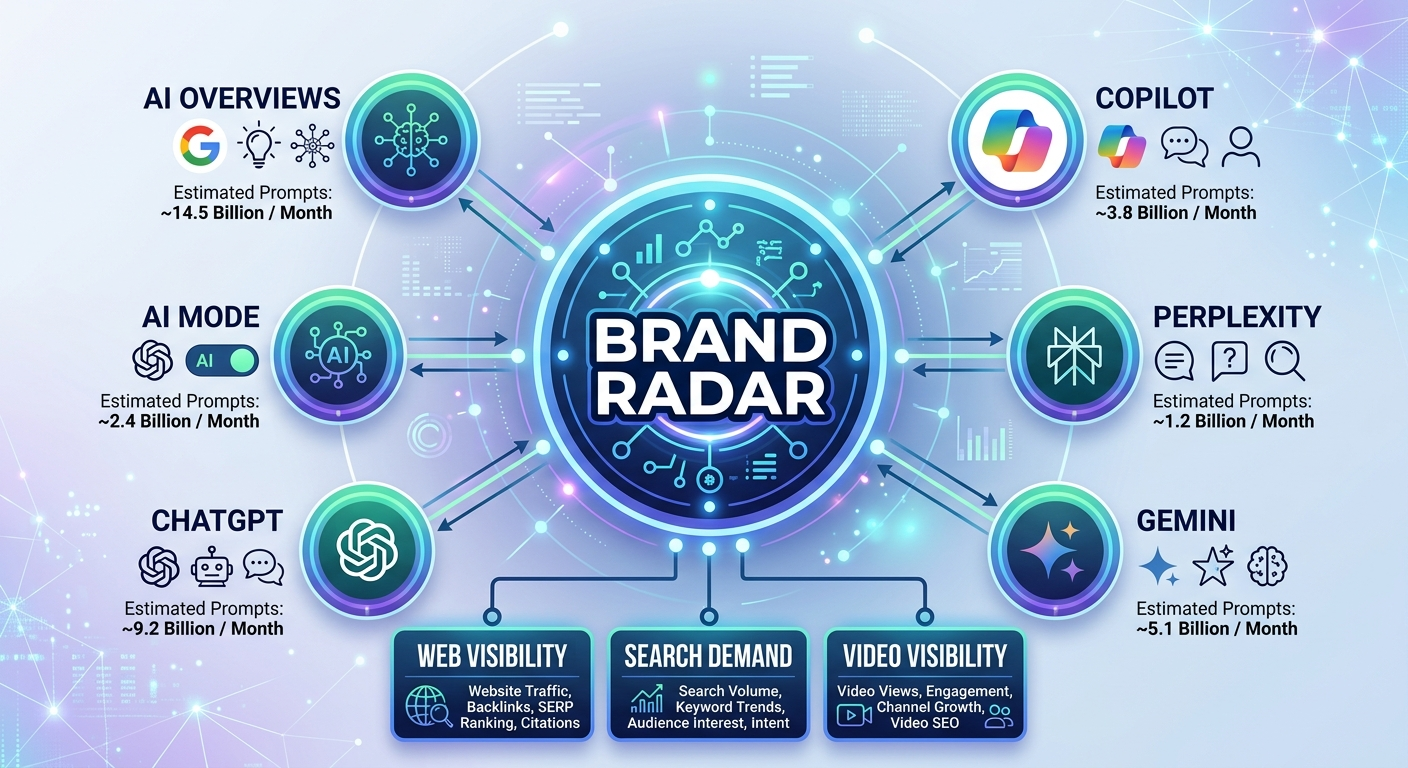
- Brand Radar tracks over 356 million monthly prompts across six AI indexes: AI Overviews, AI Mode, ChatGPT, Perplexity, Copilot, and Gemini.
- Ahrefs’ findings align with a broader shift: off-page SEO in the AI era is about earning mentions, not just links.
- Correlation is not causation — but the directional signal is clear enough to act on.
- Smaller brands may find ChatGPT the most accessible entry point, since it correlates less strongly with traditional authority metrics.
What Ahrefs’ Brand Mention Data Actually Shows
Ahrefs published two major studies on brand mentions and AI visibility in 2025. Both analyzed which factors correlate with brands appearing in AI-generated search responses.
The first study, published in mid-2025, examined brand inclusion in Google’s AI Overviews. The second — released in December 2025 — expanded the analysis to 75,000 brands across ChatGPT, AI Mode, and AI Overviews.
Here is what the data showed, ranked by correlation strength:
| Factor | Correlation with AI Visibility | Interpretation |
|---|---|---|
| YouTube mentions | ~0.737 | Strongest factor across all three platforms |
| YouTube mention impressions | ~0.717 | Weighted by video views; slightly weaker than raw mention count |
| Branded web mentions | 0.66–0.71 | Strong correlation; consistently high across platforms |
| Branded anchors | 0.51–0.63 | Moderate-to-strong; highest in AI Mode (0.628) |
| Branded search volume | 0.35–0.47 | Moderate; strongest in AI Mode (0.466) |
| Domain Rating (DR) | ~0.33 | Mid-tier; AI Overviews value DR slightly more |
| Number of referring domains | ~0.30 | Weak-to-moderate correlation |
| Number of site pages | ~0.19 | Almost no relationship with AI visibility |
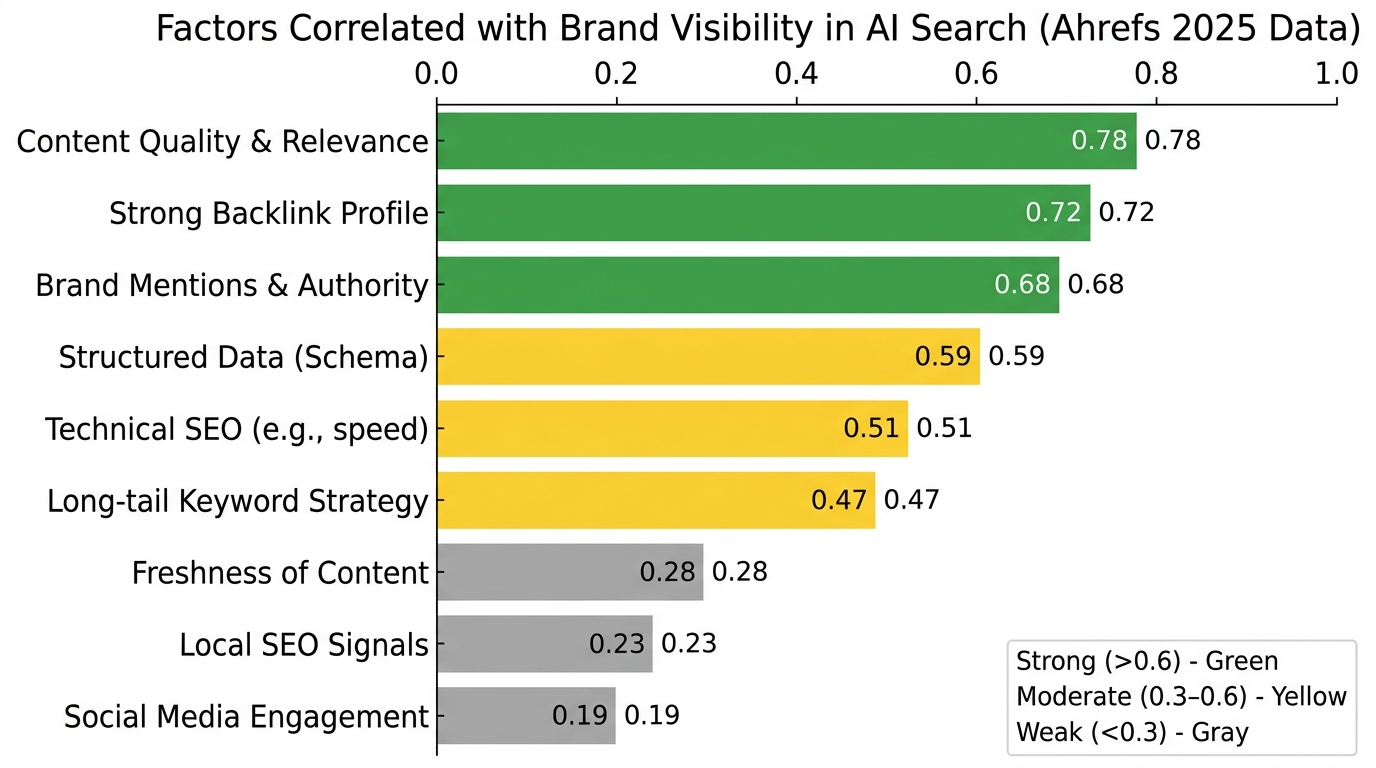
The takeaway is direct: brands that get mentioned frequently across the web — especially on YouTube and in editorial content — are far more likely to show up in AI-generated answers than brands with high domain authority or large backlink profiles alone.
As Ryan Law, Ahrefs’ Director of Content Marketing, put it during their podcast: “The content on your own site is not as valuable as the content about you on other pages on the web.”
Why YouTube mentions ranked highest
The December 2025 study introduced two new factors — YouTube mentions and YouTube mention impressions — and both outperformed every other signal.
This makes structural sense for three reasons:
- Training data: Both OpenAI and Google have trained their large language models on YouTube transcripts. The New York Times reported that OpenAI’s GPT-4 model was trained on over one million hours of YouTube transcriptions.
- Retrieval sources: YouTube is among the top-cited domains across every major AI assistant. It ranks as the most-cited domain for AI Mode and AI Overviews, and sixth-most-cited for ChatGPT.
- Frequency over reach: Ahrefs found that the raw number of YouTube mentions correlated slightly more strongly than impression-weighted mentions. Being mentioned across many videos matters more than being mentioned in a few viral ones.
For marketing teams, this signals that YouTube visibility — even in smaller channels — contributes to how AI systems understand and recommend brands.
How Ahrefs Brand Radar Tracks Mentions
A brand mention is any reference to a company, product, or representative in online content — whether or not it includes a hyperlink. Ahrefs’ Brand Radar tool is designed to track these mentions across both traditional web sources and AI-generated responses.
As of 2026, Brand Radar monitors over 356 million monthly prompts across six AI indexes:
- AI Overviews (~256M prompts)
- AI Mode (~45M prompts)
- ChatGPT (~14M prompts)
- Copilot (~14M prompts)
- Gemini (~14M prompts)
- Perplexity (~14M prompts)
Brand Radar also tracks web visibility (pages mentioning your brand across the web), search demand (branded keyword volume), and video visibility on YouTube.
What Brand Radar measures
The tool provides several reporting dimensions:
- AI Share of Voice: The percentage of AI responses mentioning your brand versus competitors within your industry.
- Topic associations: Which topics AI systems connect to your brand most frequently.
- Cited pages: The specific web pages AI models cite when mentioning your brand.
- Competitive gaps: Questions and topics where competitors get mentioned but you do not.
- Custom prompts: The ability to track specific questions that drive purchase decisions.
This data is particularly useful for identifying where your brand is absent from AI conversations — and where competitors have built mention advantage you can close.
How it differs from traditional mention monitoring
Traditional brand monitoring tools like Mention, Brand24, or Google Alerts track real-time social and web mentions for community management and reputation monitoring. AI brand mention monitoring serves a different function.
| Dimension | Traditional Monitoring | AI Mention Monitoring (Brand Radar) |
|---|---|---|
| Primary owner | Social media / community team | Content, SEO, or brand marketing team |
| Monitoring cadence | 24/7, real-time alerts | Weekly checks, monthly strategic reviews |
| Response type | Direct replies, crisis management | Content creation, PR strategy, outreach |
| Mindset | Reactive | Proactive, strategic |
If your goal is to influence how AI assistants describe and recommend your brand, traditional monitoring tools alone are not sufficient. You need tools — like Brand Radar or manual AI audits — that show what AI models actually say when users ask about your category.
What These Findings Mean for Your AI Visibility Strategy
The Ahrefs data provides a clear directional signal: earning brand mentions on authoritative, relevant third-party sites is the single highest-leverage activity for AI visibility in 2026.
This does not mean links stopped mattering for traditional SEO. Backlinks remain foundational for Google organic rankings. But for the specific question of “which brands do AI assistants recommend?” — mentions matter more than links.
Here is how to translate this data into action.
1. Audit where your brand is (and is not) mentioned
Before building new mentions, assess your baseline. Use Brand Radar, brand mention monitoring tools, or manual AI queries to understand:
- How many unique web pages mention your brand?
- Which topics do AI models associate with your brand?
- Where do competitors get mentioned that you do not?
- What do AI assistants actually say when users ask about your category?
The competitive gap analysis is especially valuable. If a competitor appears in AI responses for “best project management tools for remote teams” and you do not — despite offering that functionality — you have a specific, actionable problem to solve.
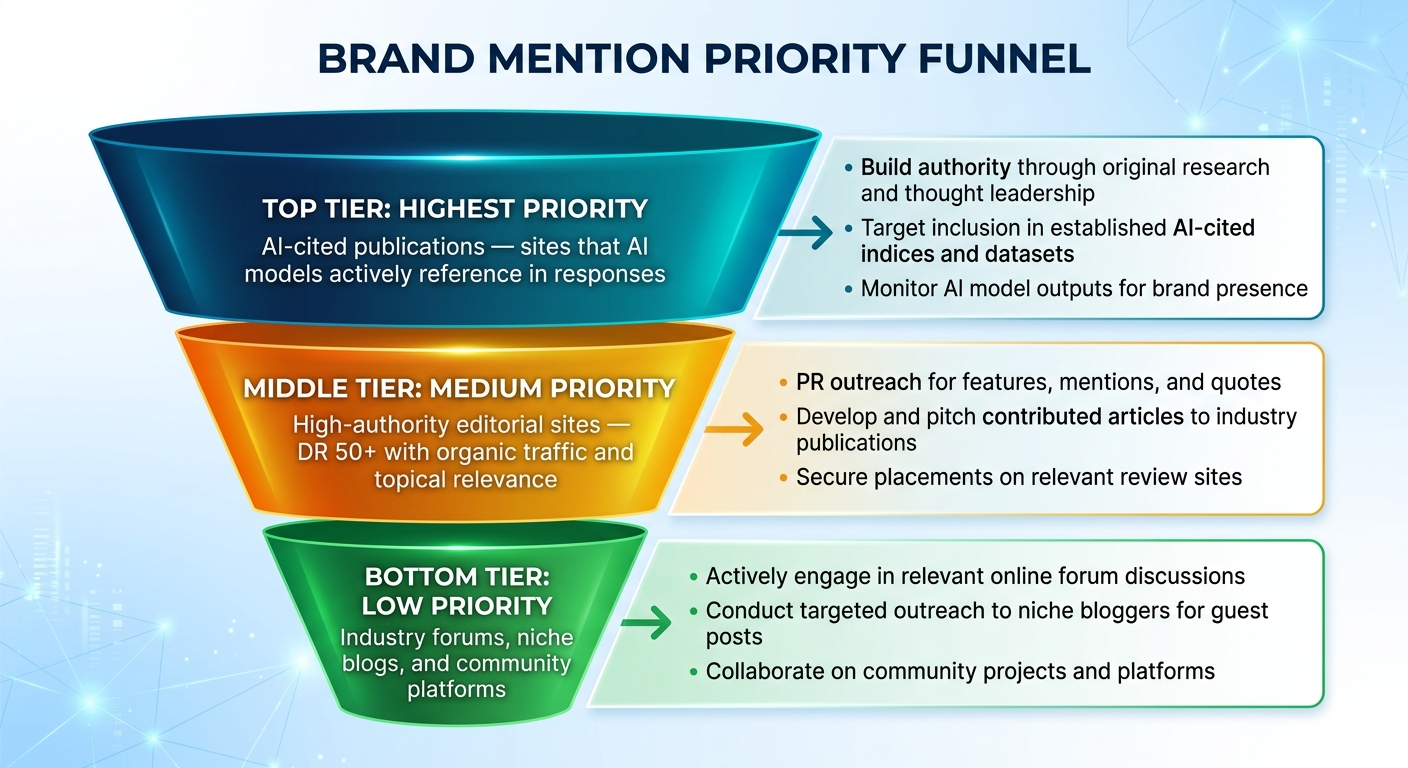
2. Prioritize editorial mentions on AI-cited publications
Not all mentions carry equal weight. Ahrefs’ data shows that AI models ground their responses in specific source pages. If you can identify which domains and pages AI assistants cite most frequently in your category, those become your highest-priority outreach targets.
Brand Radar’s “Cited pages” report shows this directly. Without the tool, you can approximate the data by running category queries across ChatGPT, Perplexity, and Gemini, then noting which sources they cite in their answers.
Focus your outreach, PR, and content placement efforts on publications that AI models already trust. Strategic brand mentions on these high-authority sites compound over time — they influence both traditional search rankings and AI recommendations simultaneously.
3. Build YouTube presence deliberately
Given that YouTube mentions showed the strongest correlation with AI visibility across all platforms studied, your video strategy directly impacts whether AI assistants recommend your brand.
This does not require a massive production budget. Ahrefs’ data showed that mention frequency mattered more than individual video view counts. Practical approaches include:
- Create product tutorials and how-to content that naturally features your brand name
- Appear as a guest on industry YouTube channels
- Sponsor or collaborate with niche creators who produce comparison and review content
- Publish webinar recordings and conference talks
The goal is breadth of mention — your brand name appearing in video titles, descriptions, and transcripts across many relevant videos — rather than a single viral hit.
4. Earn mentions on Reddit, Quora, and UGC platforms
Ahrefs’ Brand Radar data shows YouTube, Reddit, and Quora among the top five most-cited domains across AI indexes. Reddit and Quora are especially prominent in Google’s AI Overviews.
These platforms present a different challenge than editorial outreach. You cannot directly pitch a Reddit thread. But you can:
- Build a genuine presence by providing helpful answers in relevant subreddits
- Monitor competitor mentions to identify threads where your solution is relevant but absent
- Create content worth referencing — users organically share tools and resources that solve real problems
The key is authenticity. AI models can detect — and users quickly flag — promotional content that does not add value to the conversation.
5. Fix misinformation before it compounds
AI models learn from patterns across the web. If incorrect information about your brand — wrong pricing, outdated product descriptions, inaccurate founding details — appears on multiple sites, AI assistants may repeat those errors in their responses.
Ahrefs’ team documented this directly: they noticed AI responses hallucinating about an “Ahrefs Multilingual SEO Matrix” and had to create corrective content to fix the AI’s output.
Regularly check what AI says about your brand. When you find inaccuracies, address them at the source — update your own pages, reach out to publishers hosting incorrect information, and create clear, definitive content that establishes the correct facts.
Where Ahrefs’ Data Has Limits
Ahrefs has produced the most comprehensive public research on brand mention correlation with AI visibility. But responsible interpretation requires acknowledging what the data does and does not prove.
Correlation is not causation
Ahrefs explicitly states this caveat in their own research. A 0.664 correlation between branded web mentions and AI Overview visibility means these two variables move together — but it does not prove that increasing mentions will directly cause increased AI visibility.
Large, well-known brands naturally have both more mentions and more AI visibility. The underlying cause could be brand strength itself, not the mentions specifically.
That said, the directional signal is strong enough to inform strategy. Brands that invest in earning editorial mentions across the web are positioning themselves correctly for both scenarios — whether mentions directly influence AI or whether they are a strong proxy for the brand signals that do.
The tool measures correlation, not all the mechanisms
Brand Radar tracks where your brand appears in AI responses and on the web. It does not reveal the internal mechanisms by which each AI model selects brands to recommend.
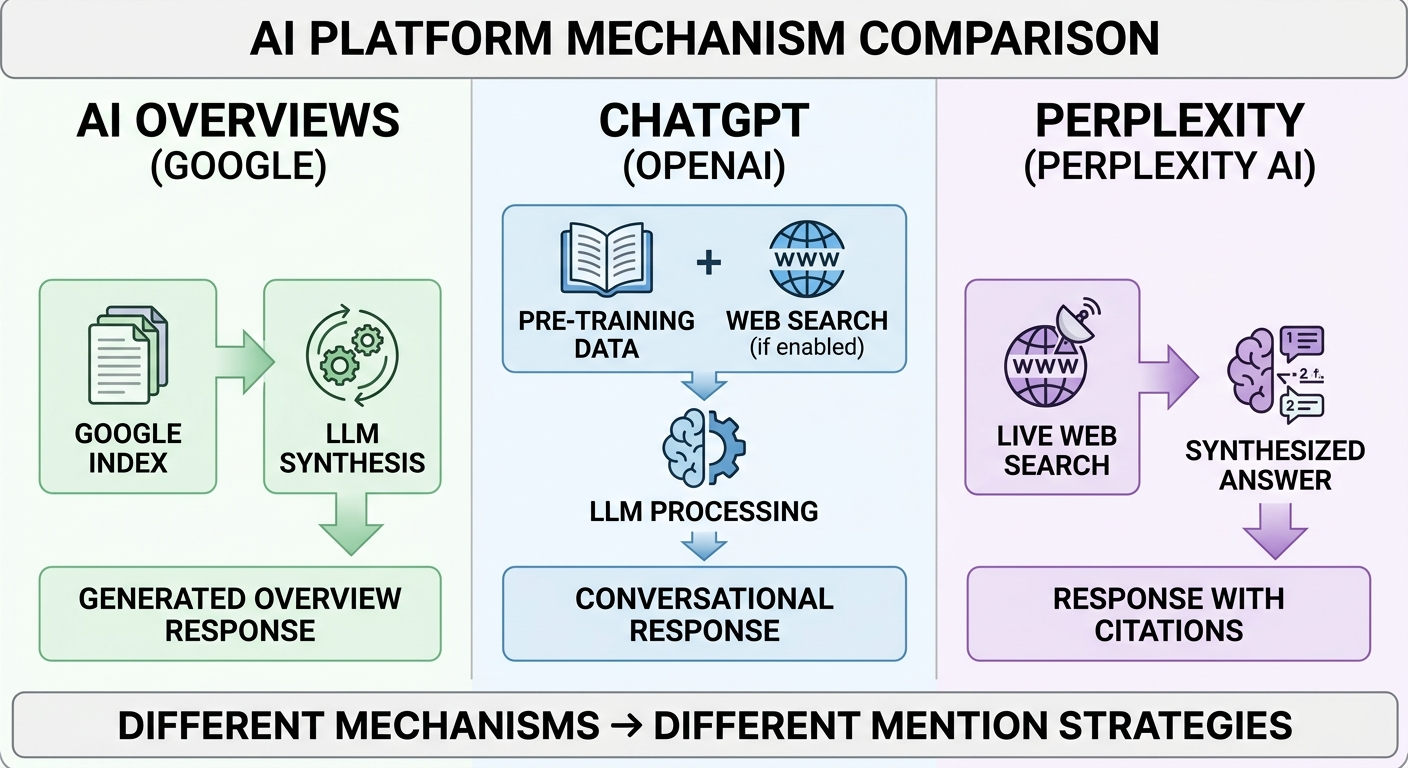
Each AI platform uses different approaches:
- AI Overviews and AI Mode ground results from Google’s search index, then apply an LLM layer.
- ChatGPT uses retrieval-augmented generation (RAG) — pulling real-time web data to supplement its training knowledge.
- Perplexity conducts live web searches and synthesizes answers with inline citations.
The mentions that influence AI Overviews may differ from those that influence ChatGPT’s recommendations. A comprehensive AI visibility strategy accounts for these differences rather than treating all AI platforms identically.
Smaller brands face a different playbook
Ahrefs’ study filtered for domains with DR above 40 and keywords with monthly search volume of at least 800. This means the 75,000 brands analyzed skew toward established companies.
If your brand is newer or operates in a niche market, the correlation data may not apply directly to your situation. The good news: Ahrefs’ December 2025 findings suggest ChatGPT shows the weakest correlations with traditional authority metrics, making it potentially the most accessible AI platform for emerging brands.
For smaller brands, focused mention-building in a specific category niche — rather than competing for broad visibility — often produces faster results. A B2B SaaS startup does not need mentions everywhere. It needs consistent mentions in the specific publications, communities, and content that AI models reference for its category.
Going Beyond What Ahrefs Tracks: Building Mentions That Compound
Ahrefs provides the measurement layer. But the actual work of building AI visibility happens through consistent, strategic brand mention acquisition across the web.
This is where the Ahrefs research intersects with the practical execution of AI brand mention building.
The mention-visibility feedback loop
Brand mentions in AI search create a compounding effect:
- Your brand gets mentioned on authoritative editorial sites
- AI models encounter these mentions during training data updates and live web retrieval
- AI assistants begin including your brand in relevant responses
- Users discover your brand through AI recommendations, increasing search demand
- Increased search demand reinforces your brand’s entity signal to AI models
- The cycle repeats with stronger signals each time
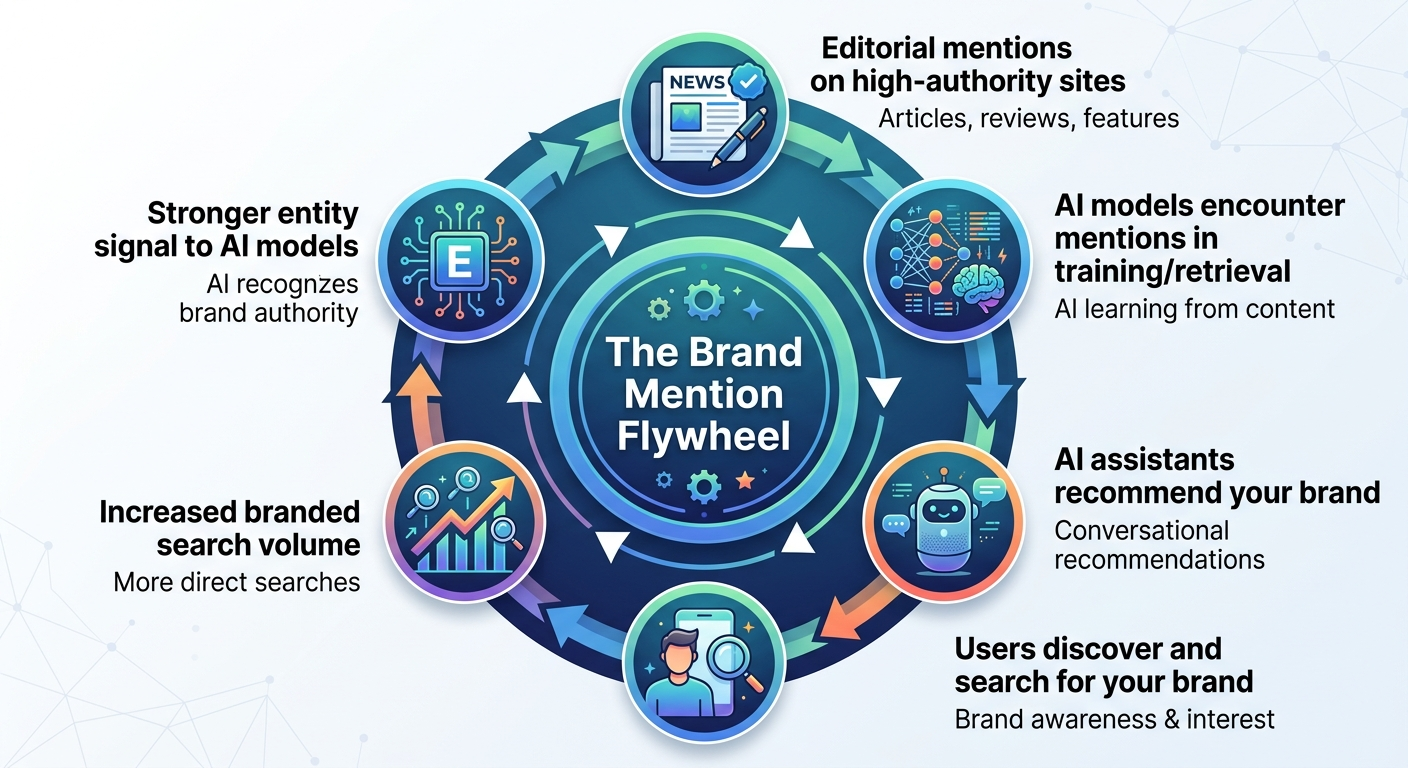
The earlier you begin building this flywheel, the more difficult it becomes for competitors to catch up. Agencies like BrandMentions accelerate this process by placing contextual brand mentions across 140+ high-authority publications that AI models actively reference — building the editorial footprint that feeds this compounding cycle.
Topicality matters as much as frequency
Ahrefs’ team emphasized that the context of brand mentions shapes how AI models understand your brand. It is not enough to be mentioned frequently — you need to be mentioned alongside the right topics, categories, and use cases.
Tim Soulo, Ahrefs’ CMO, explained: “You just need to see where your competitors are mentioned, where you are mentioned, where your industry is mentioned. And you have to get mentions there.”
If your brand builds project management software, mentions in articles about “best tools for remote team collaboration” strengthen your association with that category. Mentions in unrelated contexts add volume but limited strategic value.
When planning where to build mentions across AI search platforms, map your priority topics first. Then identify which publications and pages AI models cite for those specific topics.
Unlinked mentions carry real weight in AI search
One of the most significant implications of the Ahrefs data: unlinked brand mentions — references to your brand without a hyperlink — influence AI visibility independently of backlinks.
Ryan Law stated this directly: “These off-page mentions don’t have to be in the form of links in order to be useful for ranking in AI search.”
This expands the opportunity set considerably. Every editorial mention, forum discussion, review site listing, and YouTube transcript where your brand name appears contributes to your AI visibility — whether or not it includes a clickable link.
For teams already tracking unlinked brand mentions, this reframes their value. What was previously a link reclamation opportunity is now also an AI visibility signal in its own right.
How to Run Your Own Brand Mention Audit Using Ahrefs Data
Whether you use Brand Radar or combine Ahrefs’ other tools, here is a practical process for auditing your brand’s mention landscape.
Step 1: Baseline your current web mentions
In Ahrefs Content Explorer, search for your brand name (excluding your own domain). Apply filters for language, minimum Domain Rating, and minimum organic traffic to focus on quality mentions.
Record the total number of unique pages, estimated organic traffic to those pages, and the referring domains linking to those pages. This is your mention baseline.
Step 2: Identify competitive mention gaps
Run the same Content Explorer search for each competitor. Export the results and compare which publications mention competitors but not your brand.
In Brand Radar, the “Others only” filter in the mention graph directly surfaces questions where competitors get cited and you do not. These gaps represent your highest-priority outreach opportunities.
Step 3: Check what AI actually says about your brand
Query ChatGPT, Perplexity, Gemini, and Google AI Mode with questions your buyers ask:
- “What are the best [your category] tools?”
- “How does [your brand] compare to [competitor]?”
- “What should I consider when choosing a [your category] solution?”
Document the responses. Note which brands appear, which sources get cited, and whether your brand is described accurately. Monitoring these AI mentions consistently helps you track progress over time.
Step 4: Map your YouTube mention landscape
Given the strength of the YouTube correlation, assess how many videos mention your brand in titles, descriptions, and transcripts. Brand Radar’s YouTube index shows this directly. Without the tool, search YouTube for your brand name and note the breadth and recency of mentions.
Step 5: Set up ongoing monitoring
Brand mentions fluctuate as content gets published, updated, or removed. Set up Ahrefs Alerts for your brand name and key product names to catch new mentions automatically. Combine this with AI search mention tracking on a monthly cadence to identify trends and act on gaps.
Ahrefs Brand Mentions vs. Broader AI Visibility Approaches
Ahrefs provides the strongest publicly available data on brand mention correlation with AI search. But building AI visibility requires more than measurement.
Here is how the Ahrefs approach fits within the broader landscape:
| Capability | Ahrefs Brand Radar | Dedicated AI Visibility Agency |
|---|---|---|
| AI mention tracking | Yes — 356M+ prompts across 6 indexes | Varies by provider |
| Competitive gap analysis | Yes — share of voice, topic gaps | Yes, often with action plans |
| Web mention monitoring | Yes — via Content Explorer and Alerts | Varies |
| Mention acquisition / placement | No — measurement only | Yes — editorial placements on high-authority sites |
| Outreach and PR execution | No | Yes |
| YouTube strategy execution | No | Varies |
Ahrefs excels at showing you where you stand and where the gaps are. The actual work of closing those gaps — earning editorial placements, building YouTube presence, getting mentioned on AI-cited publications — requires either an in-house team or a specialized partner.
In campaigns across 67+ B2B companies, the BrandMentions team found that brands with consistent editorial mentions across high-authority publications achieved measurably higher AI recommendation rates than those relying solely on traditional SEO. The measurement data from Ahrefs confirms the strategy; the execution is what produces the results.
What Has Changed Since 2024–2025
The AI search landscape has evolved rapidly. Understanding what shifted helps you calibrate your strategy for 2026.
- AI Overviews expanded significantly. As of 2026, AI Overviews appear for a much broader range of queries than when they launched in 2024. More queries means more opportunities — and more competition — for brand visibility in AI responses.
- Google AI Mode launched. Introduced in 2025, AI Mode represents a conversational, multi-step AI search experience that Ahrefs found rewards established brands most strongly — correlating more heavily with branded web mentions (0.709) and branded anchors (0.628) than either ChatGPT or AI Overviews.
- ChatGPT search became mainstream. With over 700 million weekly users (as of mid-2025, per OpenAI’s usage report), ChatGPT is no longer an experimental curiosity. It is a primary discovery channel that increasingly shapes purchase decisions.
- YouTube emerged as a top citation source. Ahrefs’ December 2025 study was among the first to quantify how YouTube mention frequency correlates with AI visibility — a signal that was largely unmeasured in earlier research.
- Brand mentions overtook backlinks as the dominant off-page signal for AI. Patrick Stox of Ahrefs described this as “the era of off-page SEO” — where the focus shifts from link acquisition to mention acquisition.
According to a 2025 Gartner forecast, traditional search engine traffic was expected to decline 25% by 2026 as AI-powered alternatives absorbed more user queries. As of 2026, this trend is playing out — making the visibility signals that Ahrefs measures increasingly important for brand discoverability.
Frequently Asked Questions
Does Ahrefs track brand mentions in ChatGPT?
Yes. Ahrefs Brand Radar tracks brand mentions across approximately 14 million monthly ChatGPT prompts. It shows which brands appear in ChatGPT responses, which topics trigger those mentions, and which source pages ChatGPT cites. This data updates on a monthly cadence.
Are brand mentions more important than backlinks for AI search?
According to Ahrefs’ 75,000-brand study, branded web mentions show a stronger correlation with AI visibility (0.664) than backlink counts (approximately 0.295 for referring domains) or domain authority (approximately 0.326 for DR). Backlinks remain important for traditional Google organic rankings, but for AI-generated responses specifically, mention frequency appears to carry more weight.
Can small brands improve their AI visibility using this data?
Yes, but with a focused approach. Ahrefs’ data suggests ChatGPT shows weaker correlations with traditional authority metrics, making it potentially the most accessible platform for emerging brands. Concentrate on earning mentions within your specific category niche rather than competing broadly. Even a small number of mentions on relevant, AI-cited publications can begin building your brand’s association with the topics that matter to your buyers.
How often should I monitor brand mentions in AI search?
For most B2B brands, a monthly strategic review is sufficient — aligned with how frequently AI models update their data. Supplement this with weekly spot-checks on key queries and automated web mention alerts through Ahrefs or predictive AI alert tools to catch new developments between reviews.
Do unlinked brand mentions help with AI visibility?
Yes. Ahrefs’ research team confirmed that brand mentions influence AI responses whether or not they include a hyperlink. AI models analyze the context and frequency of your brand name across the web — not just linked references. This means every editorial mention, forum discussion, and video transcript contributes to how AI systems understand and recommend your brand.
Where to Go From Here
Ahrefs’ brand mention research provides the clearest public evidence that earning editorial mentions is the highest-leverage off-page strategy for AI search visibility in 2026. The data does not guarantee outcomes — no honest analysis does — but the direction is unambiguous.
Your next steps depend on where you are today:
- If you have not audited your AI mentions yet, start with manual queries across ChatGPT, Perplexity, and Google AI Mode for your top five category terms. Document which brands appear and which sources get cited.
- If you already track mentions but are not building new ones, use the competitive gap data to identify specific publications and topics where you are absent. Build an outreach plan targeting those gaps.
- If you are actively building mentions, layer in YouTube presence and LLM-specific tracking to ensure your efforts translate into AI visibility across all major platforms.
The brands that start building this mention flywheel now will compound their advantage over the next 12–24 months — as AI search continues absorbing a larger share of how buyers discover and evaluate solutions.
Want to see where your brand stands in AI search right now? Get your free AI visibility audit and find out which AI assistants mention your competitors — but not you.