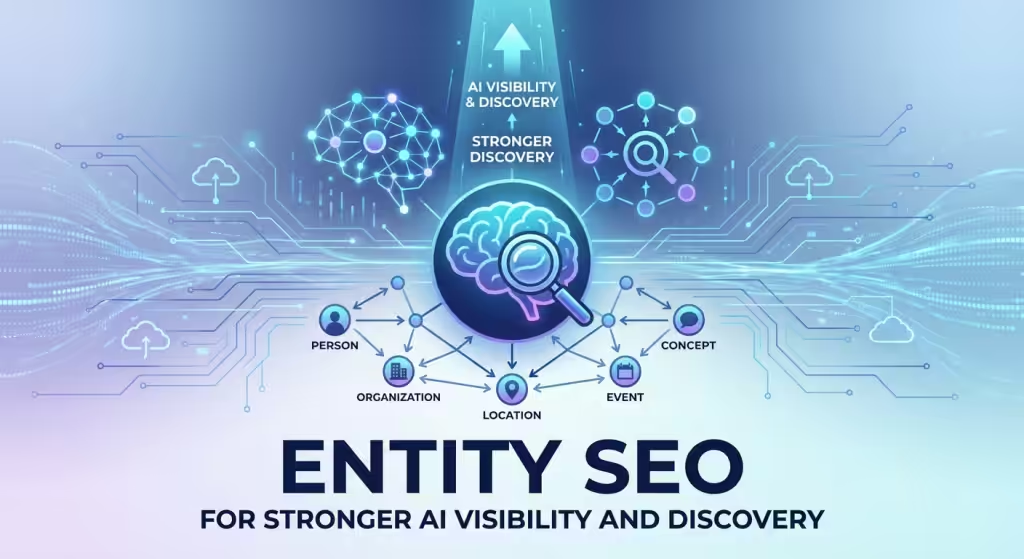

Entity SEO is the practice of optimizing your content around clearly defined concepts, people, brands, products, places, and the relationships between them, rather than targeting isolated keyword strings. As of 2026, this approach determines how Google’s Knowledge Graph, AI Overviews, and large language models like ChatGPT and Gemini interpret, rank, and cite your content across every search surface.
If your pages still rely on keyword density and exact-match phrasing, you’re optimizing for a search engine that no longer exists. Google’s systems, from BERT and MUM to the entity-aware infrastructure powering AI Mode, now evaluate meaning, context, and the strength of connections between concepts. The same shift drives how AI assistants select which brands to recommend and which sources to cite.
This article breaks down how entity SEO works in practice, what has changed since 2024, and how to build entity authority that compounds across both traditional and AI-powered search. You’ll walk away with a specific, repeatable process, not abstract theory.
What You’ll Learn
- How entities differ from keywords, and why the distinction reshapes your entire content strategy
- What Google’s Knowledge Graph actually does with entity data in 2026
- How AI search engines like ChatGPT, Perplexity, and Gemini use entity recognition to choose which brands to cite
- A step-by-step process for identifying, mapping, and optimizing entities on your site
- How structured data and schema markup reinforce entity signals for both search engines and LLMs
- The internal linking architecture that builds entity authority across topic clusters
- Common entity SEO mistakes that silently erode your visibility
What Is Entity SEO?
Entity SEO is an optimization approach that focuses on clearly defined concepts, not just the words used to describe them, so search engines and AI systems understand what your content is about, who created it, and how it relates to broader topics.
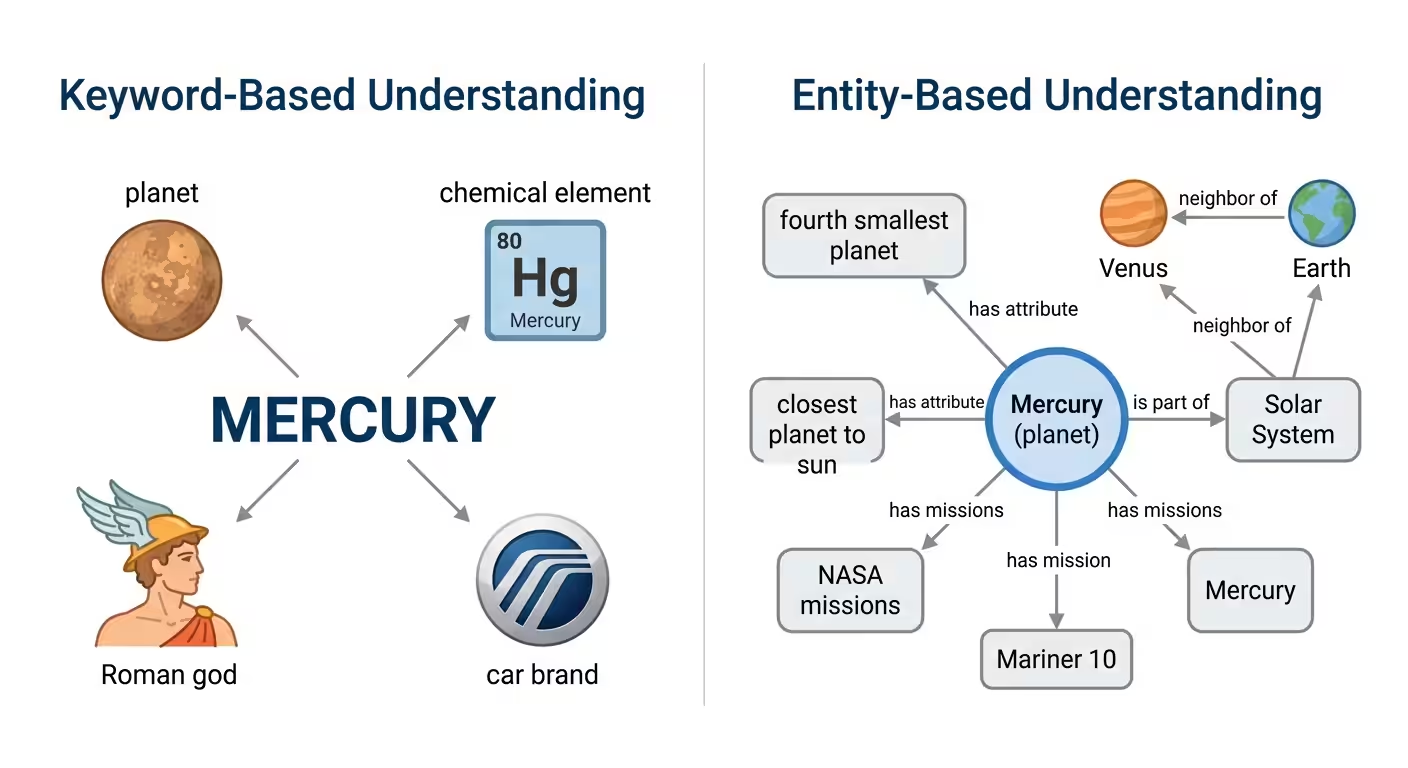
An entity is a thing or concept that’s singular, unique, well-defined, and distinguishable. Google uses this exact definition in its documentation. Entities can be people, organizations, products, places, events, or abstract concepts like “machine learning” or “content marketing.”
The critical difference: entities carry identity. The keyword “apple” is ambiguous. The entity Apple Inc. (KGMID: /m/0k8z) is a specific technology company linked to attributes like CEO, products, headquarters, and competitors inside Google’s Knowledge Graph. Entity SEO is the practice of making those identity signals unmistakable across your content.
How entities differ from keywords
Keywords are the language people type into search bars. Entities are the concepts those words refer to. This distinction determines how modern search works.
| Aspect | Keywords | Entities |
|---|---|---|
| Nature | Text strings, words and phrases | Uniquely identifiable concepts with attributes and relationships |
| Identifier | The characters themselves | A machine ID (e.g., KGMID or Wikidata QID) |
| Language | Tied to a specific language | Language-agnostic, the same entity exists in every language |
| Ambiguity | High, “jaguar” could mean anything | Low, the entity Jaguar Cars is distinct from Panthera onca |
| SEO role | Demand signals showing how users phrase intent | Semantic anchors that help search engines interpret meaning |
| Ranking effect | Targets specific query phrasing | Enables ranking across clusters of related queries |
Frequently Asked Questions
What is entity authority in SEO and how does it work?
Entity authority is how well Google and AI models recognize your brand as a credible entity in your category. It’s measured indirectly through Knowledge Graph presence, consistent NAP (name, address, phone) data across the web, structured Organization schema, and citation density on trusted third-party sites. Entity authority compounds: once Google trusts your brand as the canonical entity for a topic, that trust transfers to every page on your site. Building it requires structured data, consistent brand naming, and editorial citations on sites Google already trusts.
Keywords still matter, they reveal how your audience frames their intent. But entities determine whether search engines understand the meaning behind those keywords and connect your content to the right context.
Why Entity SEO Matters More in 2026 Than Ever Before
Three converging forces have made entity SEO the foundation of modern search visibility. Each one accelerated between 2024 and 2026.
Google’s entity infrastructure has expanded dramatically
Google’s Knowledge Graph contained roughly 500 billion facts about 5 billion entities when it was last publicly referenced in detail. By 2024, independent analyses estimated the graph had grown to over 8 billion entities. As of 2026, Google’s AI Mode and AI Overviews rely on this entity graph as the primary mechanism for generating synthesized answers.
This means Google increasingly ranks and recommends content based on how well it can map your pages to known entities and their relationships, not on how many times a keyword appears.
AI search engines depend on entity recognition to choose sources
ChatGPT, Perplexity, Gemini, and Copilot don’t crawl the web the way Google’s traditional index does. They query search indexes, retrieve candidate sources, and then synthesize answers. The selection process heavily favors content where entities are clearly defined, relationships are explicit, and claims are specific and sourced.
Content that defines entities in self-contained sentences with supporting evidence is easier for large language models to extract and reuse, and that’s the pattern entity SEO produces.
If an LLM can’t identify what entity your page is about and how it relates to the user’s question, your content is unlikely to be cited. This is why brand mentions in AI correlate so strongly with clear entity signals.
Zero-click search demands entity authority
According to a 2025 Rand Fishkin analysis via SparkToro, over 60% of Google searches now end without a click. AI Overviews, Knowledge Panels, and featured snippets answer queries directly in the SERP. To appear in these features, your content must be structured so Google can extract entities, relationships, and definitive statements without requiring a full page visit.
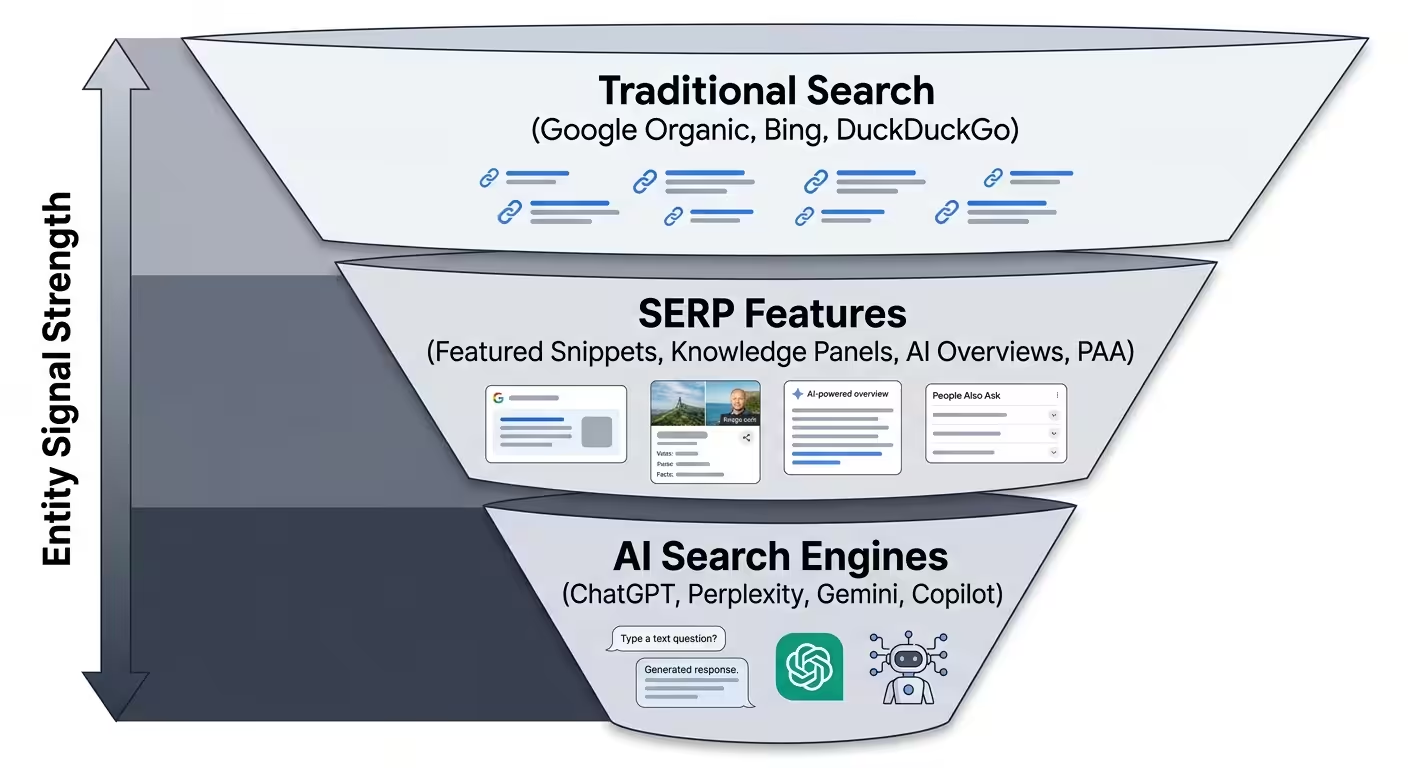
Entity SEO is the structural foundation that makes your content extractable across all these surfaces.
How Google Uses Entities to Interpret and Rank Content
Google’s entity system works across three layers: identification, disambiguation, and relationship mapping. Understanding each one gives you a concrete framework for optimization.
Entity identification
Google’s Natural Language Processing (NLP) algorithms scan your content and extract mentions of known entities. This process, called Named Entity Recognition (NER), identifies people, organizations, locations, products, events, and concepts within your text.
Each identified entity receives a salience score from 0 to 1, indicating how central that entity is to the page’s meaning. A page about “CRM software for B2B startups” might assign high salience to the entities Customer Relationship Management, B2B, and Startup, while a passing mention of Salesforce receives a lower score.
Pro Insight: You can test how Google interprets your content using Google Cloud’s Natural Language API. Paste a paragraph, and the tool returns the entities it detects along with their salience scores, types, and Wikipedia links. This is the same NLP engine that feeds into Google’s ranking systems.
Entity disambiguation
Entity disambiguation is the process by which Google determines which specific entity a word or phrase refers to. When your page mentions “Python,” Google must decide whether you mean the programming language, the snake, or the comedy group.
Google resolves ambiguity using surrounding context, structured data, and links to knowledge bases like Wikidata. Your job in entity SEO is to make disambiguation effortless, so Google never has to guess what your content is about.
Entity relationship mapping
Once entities are identified and disambiguated, Google maps the relationships between them. This is where the Knowledge Graph’s structure becomes a ranking factor in practice.
If your page about “email marketing automation” references related entities like lead scoring, segmentation, A/B testing, and CRM integration in ways that reflect their actual relationships, Google recognizes your content as comprehensive. Pages that cover isolated keywords without mapping entity connections appear thin by comparison.
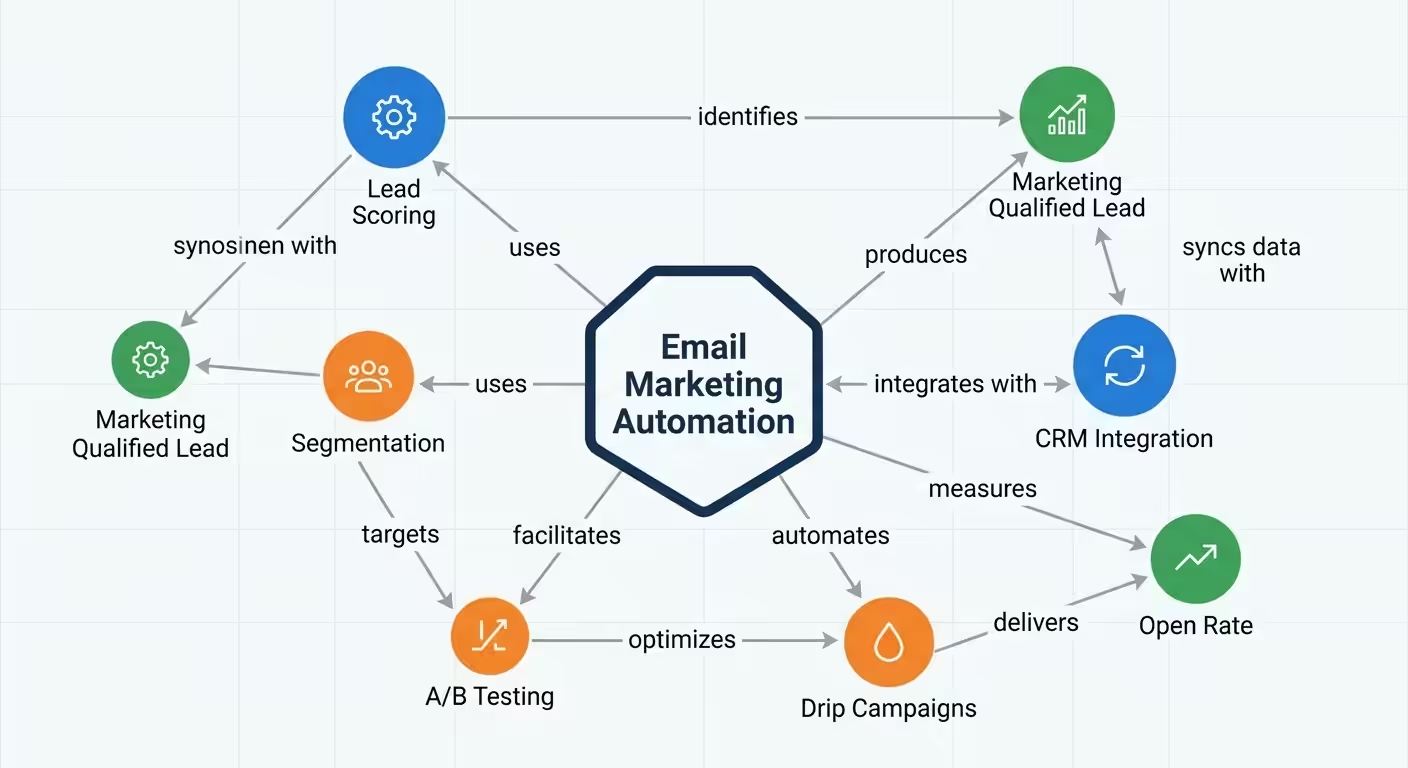
This relationship mapping is also how Google’s AI Overviews assemble synthesized answers from multiple sources, each source contributing entity-level knowledge that fills a different part of the answer.
Entity SEO and AI Visibility: The Direct Connection
For the per-platform walkthroughs behind the AI side of this connection, see ChatGPT brand visibility audit steps and auditing Perplexity for your brand, and brand mention tracking inside language models covers the cross-platform cadence that pairs with the entity work described below.
Entity authority doesn’t just improve your Google rankings. It directly determines whether AI assistants mention your brand when users ask for recommendations.
Large language models build their understanding of brands, products, and topics from patterns in their training data, which includes web content indexed from high-authority publications. When your brand entity appears consistently in editorial contexts alongside relevant category entities, LLMs learn that association.
For example: if a B2B project management tool is mentioned across dozens of high-authority articles alongside entities like remote team collaboration, agile methodology, and enterprise workflow, an LLM will associate that brand with those concepts. When a user asks ChatGPT or Perplexity for project management recommendations, the tool with stronger entity associations across training data is more likely to be cited.
A specialist handles this by placing contextual brand mentions on category-relevant publications AI retrievers frequently surface for your space, which creates the entity-to-category associations that LLMs draw on when they formulate recommendations.
This is why entity SEO and increasing brand mentions in AI search are two sides of the same strategy. Strong entity signals on your site make you recognizable. Consistent entity associations across external sources make you recommendable.
How to Implement Entity SEO: A Practical Process
Theory is useful only if it changes how you work. Here’s a step-by-step process for building entity authority into your content operations.
Step 1: Identify your core entities
Start by defining the small, intentional set of entities you want search engines and AI systems to associate with your brand. These typically fall into three categories:
- Brand entity: Your company, its founders, its key products
- Offering entities: The specific services or products you provide
- Category entities: The broader topics and industries your offerings belong to
For a B2B SaaS company selling marketing automation software, the core entities might include the company name, the product name, “marketing automation,” “email marketing,” “lead nurturing,” and “CRM integration.”
Keep this list focused. Trying to associate your brand with too many unrelated entities dilutes your semantic profile.
Step 2: Map entity relationships using knowledge bases
Wikipedia and Wikidata are the most reliable sources for understanding how Google’s Knowledge Graph connects entities. Search Wikipedia for your primary topic entity and examine:
- The opening paragraph: The blue links here represent the strongest entity connections Google trusts
- The table of contents: Each major heading maps to a subtopic entity that Google expects comprehensive coverage to address
- The “See also” section: These are semantically adjacent entities
- The Wikidata entry: This shows the entity’s unique QID, its type classification, and its formal properties
This process gives you a map of the entities your content needs to reference, and the relationships it needs to establish, to demonstrate genuine topical depth.
Key Definition: A knowledge graph is a structured database of entities and the relationships between them. Google’s Knowledge Graph is the specific knowledge graph that powers Google Search features like Knowledge Panels, entity-based disambiguation, and AI Overviews.
Step 3: Audit your existing content for entity coverage
Before creating new content, evaluate what you already have. Use Google Cloud’s Natural Language API to analyze your most important pages. For each page, document:
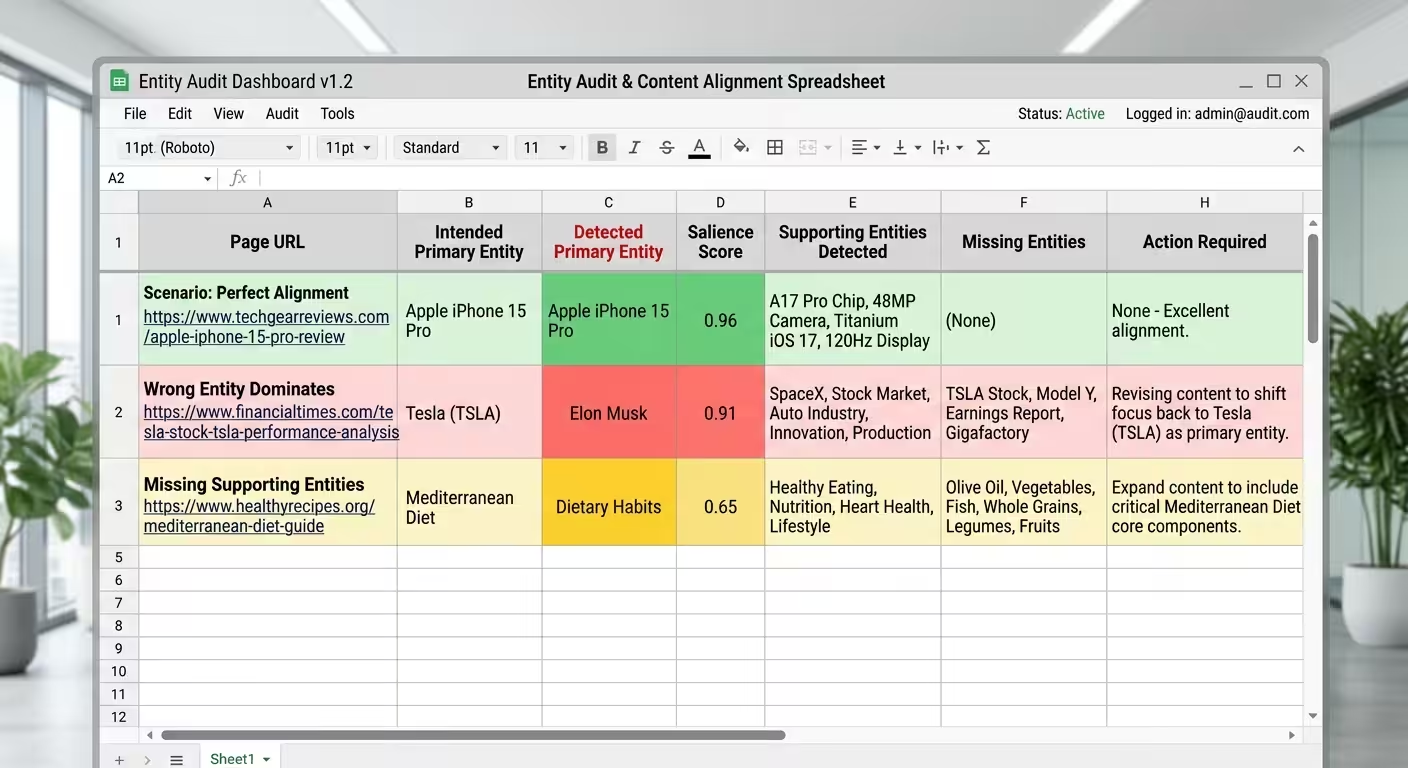
- Which entities Google detects
- The salience score of each entity
- Whether the primary entity matches your intended topic
- Whether supporting entities align with the relationship map you built in Step 2
Pages where Google assigns high salience to the wrong entity, or fails to detect your primary entity at all, are immediate optimization opportunities. Tools like SEO tools for brand mentions and content analysis can help surface these gaps at scale.
Step 4: Optimize content for entity clarity
With your audit complete, apply these on-page principles to each page:
Define the primary entity in the first paragraph. Search engines assign extra weight to entities that appear early. State what the page is about in a clear, self-contained sentence that includes the entity name, its type, and a defining attribute.
Use entity names, not vague pronouns, in key statements. Instead of writing “It helps marketers automate campaigns,” write “Marketing automation software helps marketers automate campaigns.” AI extraction systems can’t resolve ambiguous pronoun references.
Cover the entity’s expected attributes and relationships. If your page is about “email marketing,” Google expects coverage of deliverability, open rates, segmentation, compliance (CAN-SPAM, GDPR), and automation. Missing these supporting entities signals incomplete coverage.
Place entity mentions in structural positions. Research from a 2014 Google-affiliated paper by Dunietz and Gillick found that entity salience increases when entities appear in headings, the first sentence, and at higher frequency within the document. These findings remain consistent with observed NLP behavior in 2026.
Step 5: Build topic clusters that reinforce entity relationships
Individual pages establish entity relevance. Clusters establish entity authority.
A topic cluster starts with a pillar page covering a broad entity (e.g., “content marketing”) and connects to supporting pages that cover specific subtopic entities (e.g., “editorial calendar,” “content distribution,” “content audit framework”). Each supporting page links back to the pillar and cross-links to related supporting pages.
This internal structure mirrors the relationship patterns in knowledge graphs. When Google crawls your site and finds this semantic network, it recognizes your domain as a comprehensive source on the topic, not just a collection of loosely related articles.
Your competitive research process should evaluate not just which keywords competitors rank for, but which entity clusters they’ve built, and where gaps exist for you to establish stronger authority.
Step 6: Strengthen entities with structured data
Schema markup is structured code added to your pages that explicitly tells search engines what entities your content covers and how they relate to each other. It acts as a disambiguation layer, removing any ambiguity about what your page is about.
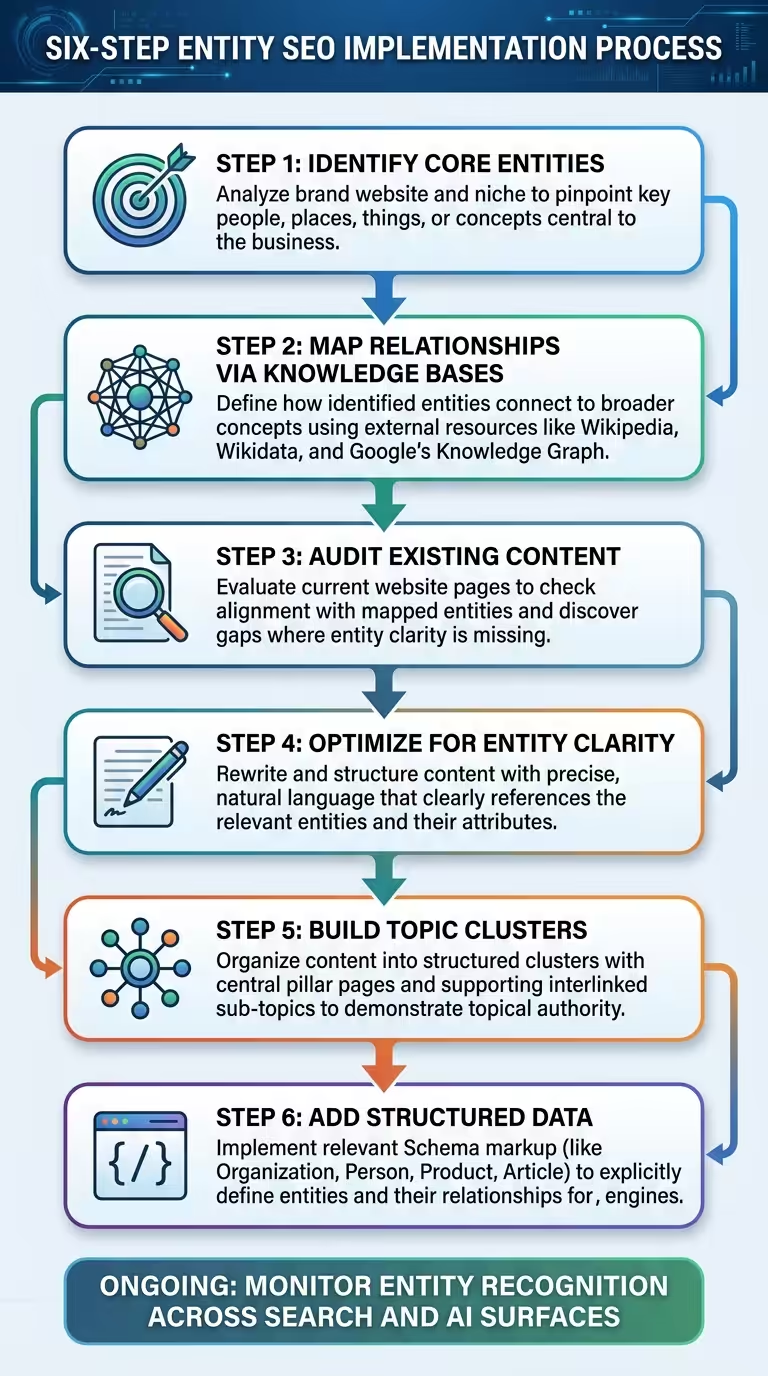
The most impactful schema types for entity SEO include:
- Organization schema: Defines your brand entity with official name, logo, founders, and social profiles
- Person schema: Establishes authorship entities with credentials and affiliations
- Article schema with
aboutandmentionsproperties: Explicitly declares the primary and secondary entities a page covers sameAslinks: Connect your entities to their entries in authoritative knowledge bases like Wikidata, Wikipedia, or LinkedIn
Here’s a simplified example for a page about entity SEO:
Internal Linking as an Entity Authority Signal
Internal links are how you “wire” your entity relationships for search engines. Every link between pages on your site carries semantic meaning about how those topics connect.
Effective entity-based internal linking follows three principles:
Link conceptually related pages, not convenient ones. A page about “lead scoring” should link to pages about “marketing qualified leads” and “CRM pipeline management”, not to an unrelated product announcement just because it’s new.
Use descriptive anchor text that names the entity. Instead of “learn more,” use “how lead scoring models improve pipeline conversion.” This tells Google exactly which entity the destination page covers. Vary your anchor text naturally across articles, mix exact entity names, partial matches, and descriptive phrases.
Build bidirectional connections. Your pillar page should link down to supporting content. Supporting content should link up to the pillar. And closely related supporting pages should link laterally to each other. This creates the same interconnected pattern that knowledge graphs use to map entity relationships.
If you’re building brand mentions as backlinks from external sources, those external links create the same type of entity relationship signal, but across domains instead of within your own site.
Entity SEO Mistakes That Quietly Erode Your Visibility
The entity mistake we see most often in audits is a brand with strong topical content and no unambiguous entity anchor: no Organization schema with sameAs links, no consistent NAP across Crunchbase and LinkedIn, no canonical About page the rest of the web can point to. The topical signals are fine. The retrievers just can’t tell which of four similarly-named companies the content belongs to, and the citations fragment.
Most entity SEO failures don’t look like obvious errors. They look like content that seems fine but never reaches its potential. Here are the patterns to avoid:
Publishing thin entity pages. A 200-word page “about” a concept doesn’t establish entity authority. Google evaluates whether your coverage addresses the attributes, relationships, and context that the Knowledge Graph associates with that entity. If competitors cover twelve supporting entities and you cover three, your page appears superficial.
Chasing unrelated entities. Every entity you associate with your brand either strengthens or dilutes your semantic profile. A cybersecurity SaaS company publishing content about office design trends confuses Google about what the brand entity actually represents.
Using inconsistent entity names. If your product is called “DataSync Pro” on your homepage, “Datasync” on your pricing page, and “our data synchronization tool” on your blog, you’re creating three separate entity signals instead of reinforcing one. Consistency is how entities gain recognition.
Ignoring authorship entities. Google’s E-E-A-T framework evaluates who created content, not just what it says. Pages without clear author entities, name, credentials, expertise areas, miss an entire dimension of entity authority. This matters even more for SEO reputation management, where the author’s entity profile directly affects perceived trustworthiness.
Treating schema as a substitute for content depth. Structured data labels what’s on the page. It doesn’t create expertise. Schema markup on a thin, keyword-stuffed page just helps Google identify that page as thin and keyword-stuffed, faster.
How Entity SEO Has Changed Since 2024
The fundamentals of entity SEO have remained stable since Google launched its Knowledge Graph in 2012. But several developments between 2024 and 2026 have amplified its importance:
- Google AI Mode (launched 2025): Google’s conversational search experience uses entity relationships as the primary mechanism for selecting and synthesizing multi-source answers. Pages with strong entity signals are disproportionately represented in AI Mode citations.
- LLM training data refreshes: Both OpenAI and Anthropic moved to more frequent training data updates in 2026, meaning new editorial brand mentions reach LLMs faster. BrandMentions tracks when major AI models update their training data and times placements to maximize inclusion in each knowledge refresh cycle.
- Structured data expansion: Google expanded its support for
aboutandmentionsschema properties in 2026, giving publishers more explicit ways to declare entity relationships. Early adopters report measurable improvements in featured snippet and AI Overview inclusion. - Cross-platform entity recognition: As of 2026, strong entity signals on your website improve discoverability not only in Google but across ChatGPT web search, Perplexity source selection, and Bing’s Copilot citations. Entity authority has become platform-agnostic.
Measuring Entity SEO Performance
Entity SEO results appear differently than keyword-level metrics. Here’s what to track:
Cluster-level visibility in Google Search Console. Instead of monitoring individual keyword rankings, group impressions and clicks by topic cluster. Rising visibility across a cluster of related pages indicates growing entity authority. A single page might fluctuate, a cluster trending upward shows Google recognizing your topical depth.
SERP feature appearances. Track how often your pages appear in Knowledge Panels, featured snippets, People Also Ask boxes, and AI Overviews. These features all rely on entity recognition. Increasing presence in them signals that Google can confidently extract and attribute entities from your content.
AI citation frequency. Monitor whether AI assistants mention your brand when users ask about topics in your category. Tools that track brand mentions across AI search platforms provide direct visibility into whether your entity authority translates to LLM recommendations.
Entity salience scores over time. Run your key pages through Google’s Natural Language API quarterly. Track whether your intended primary entities are gaining salience and whether supporting entities are becoming more consistently recognized.
Frequently Asked Questions About Entity SEO
Does entity SEO replace keyword research?
No. Entity SEO builds on keyword research, not in place of it. Keywords reveal how your audience phrases their intent. Entities provide the semantic structure that helps search engines interpret that intent. The most effective strategies use keywords to identify demand, then organize content around the entities those keywords point to.
Do I need a Wikipedia page for entity SEO to work?
A Wikipedia entry strengthens entity recognition, but it’s not required. Google’s Knowledge Graph draws from many sources, Wikidata, CrunchBase, LinkedIn, Google Business Profiles, and structured data on your own site. Consistent, clear entity signals across multiple authoritative sources can establish entity recognition without Wikipedia.
How long does entity authority take to build?
Entity authority compounds over time. Initial improvements in entity detection and SERP feature eligibility can appear within weeks of implementing structured data and on-page optimization. Broader entity authority, the kind that influences AI recommendations and cross-platform visibility, typically develops over three to six months of consistent content publication and external mention activity. The pattern we see in audits is that brands with sustained editorial coverage on category-relevant publications achieve measurably stronger entity recognition within one to two AI training data refresh cycles.
Can small businesses benefit from entity SEO?
Absolutely. Entity SEO is especially valuable for smaller brands because it shifts the competitive advantage from domain authority alone to topical depth and entity clarity. A focused B2B company that thoroughly covers its niche entities can outperform larger competitors who spread their content across too many unrelated topics.
Is entity SEO the same as semantic SEO?
They overlap heavily but aren’t identical. Semantic SEO is the broader practice of optimizing for meaning and context. Entity SEO is the specific discipline within semantic SEO that focuses on identifying, defining, and connecting entities. Think of entity SEO as the structural framework that makes semantic SEO operational.
A 60-Day Entity SEO Sequence to Run First
Entity SEO is no longer a theoretical concept for advanced practitioners. It’s the operating system for how search works in 2026, across Google, Bing, ChatGPT, Perplexity, Gemini, and every AI surface that follows.
The brands that invest in clear entity definitions, comprehensive topic clusters, consistent naming, structured data, and deliberate entity-to-category associations will compound their visibility over time. Those that continue optimizing for isolated keywords will find their content increasingly invisible to the systems that now mediate how people discover information.
Start with your core entities. Map the relationships. Audit what you’ve. Fill the gaps. Reinforce with structure. Then measure, not at the keyword level, but at the entity level, across every surface where your audience looks for answers.
If you want a baseline before committing to a tool or process, book a short strategy call. We’ll run 25 category-relevant prompts across ChatGPT, Perplexity, Gemini, and Google AI Overviews so you can see exactly which sources each platform trusts for your category, and which competitors are capturing citations you’re not.