
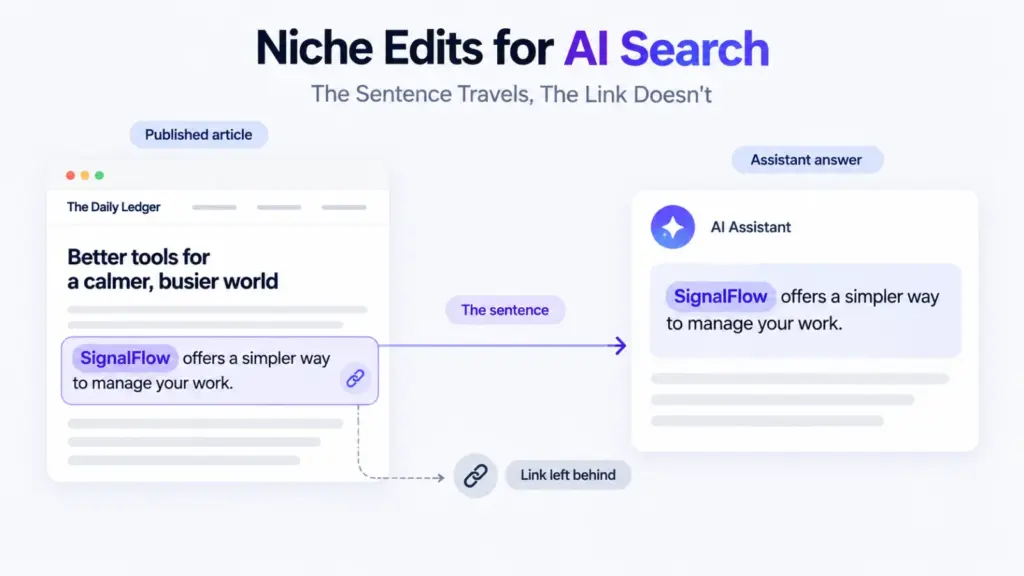

You buy a niche edit. The link goes live inside a three-year-old post, the anchor reads the way you wanted, and a month later the assistant your buyers use still doesn’t name you.
The link isn’t what the model read. Niche edits for AI search work through the sentence wrapped around the link, not the link itself.
That single distinction changes which placements are worth paying for, and it explains why the cheap ones keep failing.
What You’ll Learn
- An assistant retrieves passages of text, so it sees your brand name and never sees link equity.
- A link with no sentence around it gives a model nothing to repeat.
- Placement pages that no assistant retrieves cannot pass on anything, links included.
- The cheapest niche edits fail hardest, because thin context is what makes them cheap.
What a Niche Edit Buys
A niche edit is a link inserted into a page that already exists and already has age, traffic and its own links. You pay for the insertion, and the page does the rest.
For classic search that logic holds. A crawler follows the link, attributes some authority to your domain, and the anchor tells it what the destination is about.
An assistant does none of that at answer time. It pulls passages of text that match the question, then writes a reply from what those passages say.
So the useful question about a placement changes. Not “how strong is this page”, but “if a model retrieves this passage, what does it learn about me”.
Why the Mention Carries More Than the Link
It carries more because a retrieved passage is text, and a link is markup the model has no reason to repeat.
Picture the passage that gets pulled into an answer. It contains your brand name, whatever claim sits next to it, and the surrounding sentences that give it meaning.
An assistant summarising that passage repeats the claim. It doesn’t repeat an anchor tag.
This is why what an AI mention is worth depends on wording rather than on link metrics. Two placements on the same domain can be worth wildly different amounts.
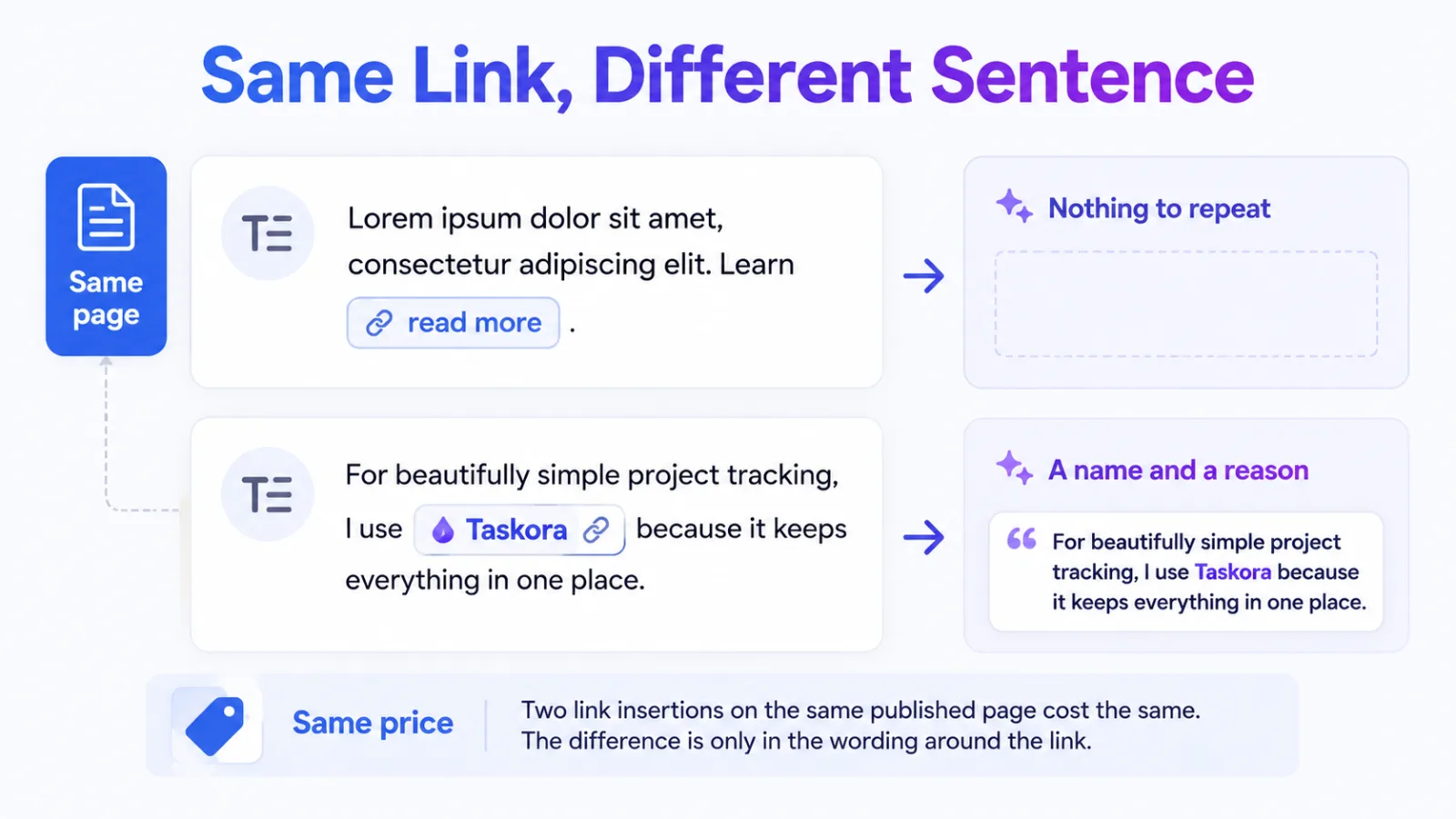
Compare two versions of the same insertion, with the linked words in italics:
| What the page says | What a model can take from it |
|---|---|
| “…a few tools can help with this.” | Nothing. No brand, no claim, no category. |
| “…teams tracking this usually start with Brandname, which handles the reporting side.” | A name, a category and a reason, all repeatable. |
Same link, same page, same price. Only the second one can appear in an answer.
The Link Still Matters
Links haven’t stopped working, and treating this as links-versus-mentions gets it wrong.
A link still moves classic rankings, and classic rankings still feed retrieval. Assistants lean on pages that rank, so a placement that lifts your position also raises the odds your own page gets pulled into an answer.
The link also does something the mention can’t: it sends a person who reads the answer, clicks through to the source, and lands on you.
So the honest position is that a niche edit does two jobs, and buyers are usually only told about one. If you want the full comparison of the tactic against its alternative, guest posting vs niche edits covers that ground.
Which Placements Are Worth Buying
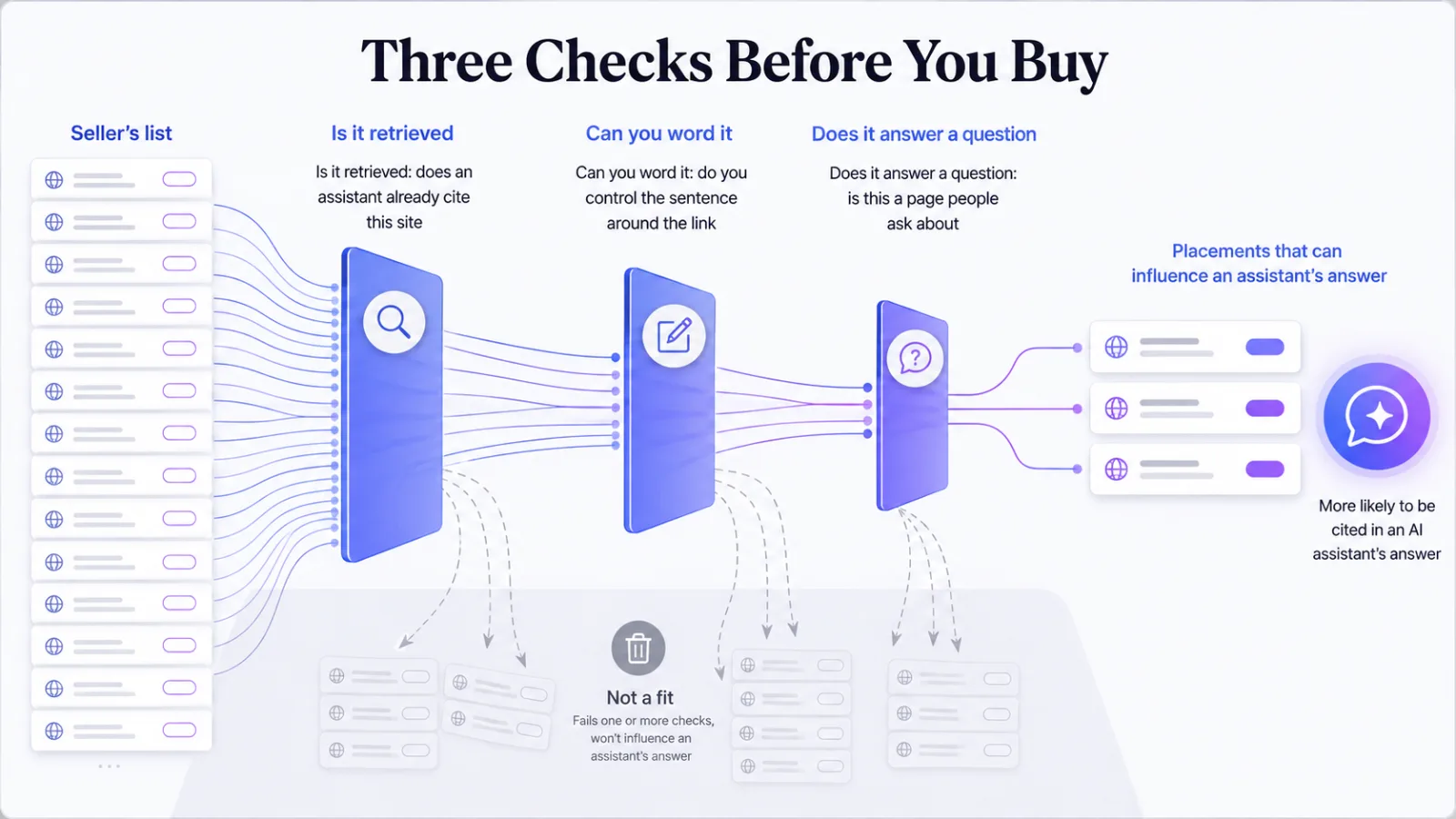
Three tests separate a placement that can move an answer from one that only moves a metric.
Does Anything Retrieve the Page
A page nobody’s assistant surfaces can’t hand on a mention or a link. Age and domain rating say nothing about this, and it’s the first thing to check rather than the last.
Run the question your buyers ask and see which sources the answer leans on. Those publications are your shortlist.
Can You Control the Sentence
Ask what the inserted text will say before you agree to anything. A seller who will place a link but won’t discuss the wording is selling you the half that doesn’t work here.
The sentence needs your name, your category and one specific claim. That’s the whole requirement.
Does the Page Answer a Real Question
Insertions into listicles and how-to pages get retrieved because those pages answer questions people ask. Insertions into thin roundups sit in text nothing ever pulls.
How to Judge a Niche Edit Offer
You judge it on the sentence and the source, then on the metrics, in that order.
Most offers arrive as a spreadsheet of domains with authority scores and prices. That spreadsheet answers the wrong question first, so read it backwards.
Start by asking which of those domains showed up when you ran your buyers’ questions through an assistant. Cut the rest, whatever their scores say.
Then ask for the draft sentence on the ones that survive. A placement you can’t word is a placement you can’t aim.
What’s left is a shorter and more expensive list than the one you were sent. It’s also the part of the spend that can show up in an answer. Our niche edit link insertion services breakdown covers who does this properly.
Frequently Asked Questions
Do niche edits help with AI search at all?
Yes, through two routes. The mention gives an assistant something to repeat, and the link can lift the classic ranking that makes your own page retrievable. Neither route works if the insertion is a bare anchor in a sentence that says nothing.
Are expensive niche edits worth more for AI visibility?
Only when the price buys retrieval and wording. Paying more for a higher domain rating on a page no assistant reads buys you nothing here, and a cheaper placement on a genuinely cited publication beats it.
Should I ask for a specific anchor text?
Ask for the sentence first and the anchor second. Anchor text still helps classic ranking, but the words on either side of it are what an assistant can quote, and sellers rarely offer them unless you ask.
How long before a niche edit shows up in an answer?
It depends on when the page gets recrawled and whether the assistant refreshes what it retrieves, so the honest range is weeks rather than days. Treat anyone promising a timeline as guessing.
Can one placement move an answer on its own?
Rarely. Assistants tend to name brands that appear across more than one retrieved source, so a single insertion is a contribution rather than a result. Plan placements as a set aimed at one question family.
Run Your Buyers’ Question First
Before you approve another placement list, take the question your buyers ask and run it in the assistant they use. Write down every source the answer leans on.
That list is your buying shortlist, and it usually looks nothing like the spreadsheet you were sent. Working out how to increase brand mentions in AI search starts there rather than with domain metrics.