
If you’re replacing Ahrefs Brand Radar, the right alternative comes down to three things: how many AI engines a tool covers, what it actually costs once add-ons and seats are counted, and whether your team needs monitoring alone or monitoring plus the ability to act.
The best replacement depends on your budget, the engines you care about, your reporting needs, and your workflow, and for most teams the shortlist narrows to two or three tools fast. This guide compares eight strong alternatives against Brand Radar so you can eliminate the wrong fits and pick with confidence.
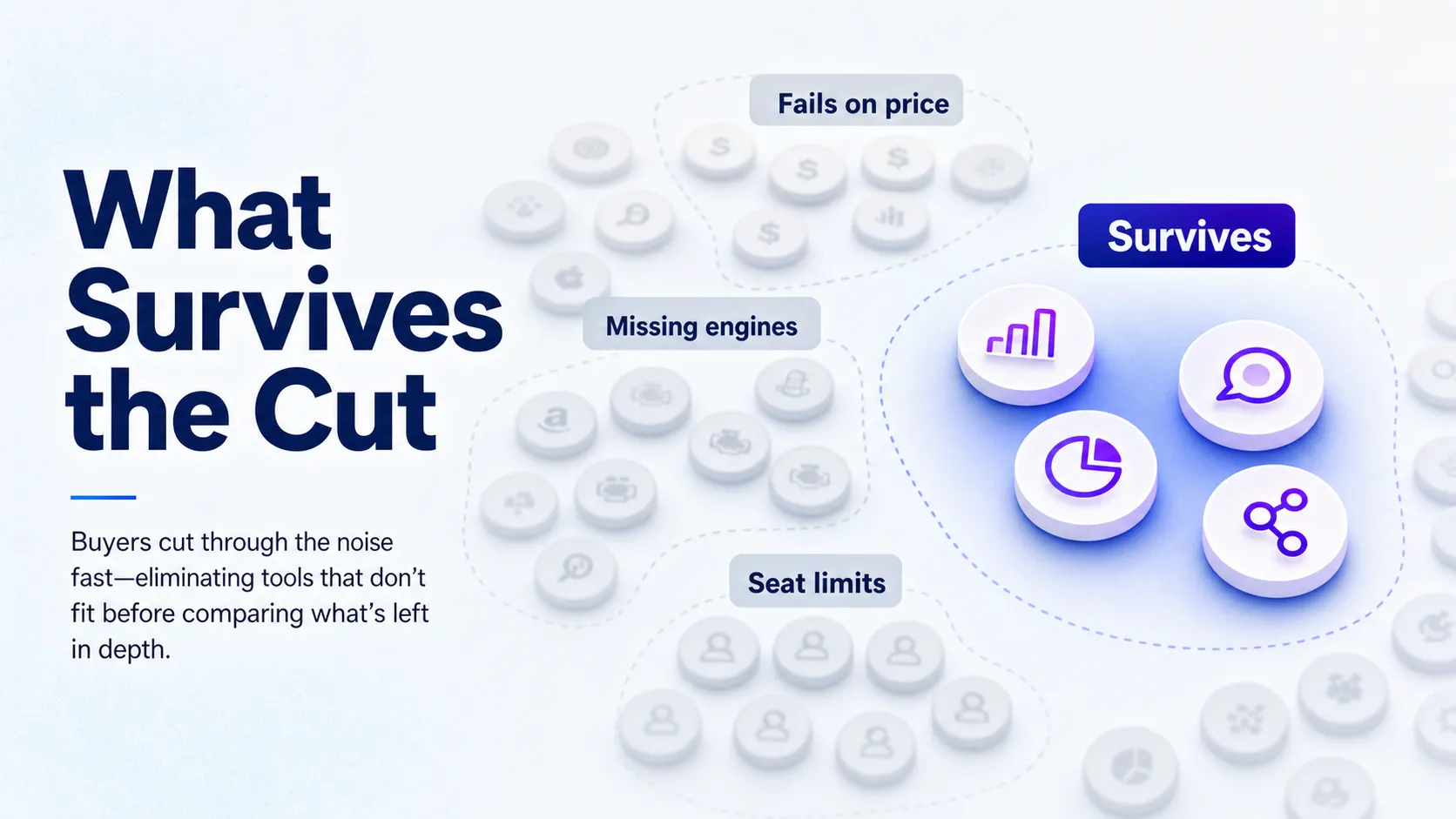
You’re reading this because something about Brand Radar doesn’t fit. Maybe the add-on pricing stacks past your budget, maybe it misses Claude and Grok, or maybe you want a tool that helps you fix what it finds.
Each of those problems points to a different winner, so the comparison below is built to match a tool to your specific reason for leaving.
Ahrefs Brand Radar Alternatives at a Glance
Here is the fast shortlist. The table puts Brand Radar in the top row as your baseline, then lines up the eight alternatives so you can spot the two or three worth a deeper look in under a minute.
Prices reflect each tool’s published entry point, not the full cost once you add seats, domains, or prompt packs.
| Tool | Best for | Starting price | Main limitation |
|---|---|---|---|
| Ahrefs Brand Radar (baseline) | Existing Ahrefs power users | $199/mo per AI index, on top of a $129/mo base plan | No Claude or Grok, costs climb fast |
| Semrush AI Visibility Toolkit | Teams wanting one full SEO suite | $99/mo per domain | Add-ons stack, tracks fewer engines |
| Authoritas AI Tracker | Citation-focused AI search teams | Demo-led, public pricing limited | Thin public feature detail |
| SE Ranking AI Visibility Tracker | Mid-market agencies | $89/mo for the AI module | AI module is part of a wider suite |
| Rankability | Agencies wanting monitoring plus fixes | $166/mo | Narrower than a full SEO platform |
| Peec AI | Teams wanting clean dashboards | €89/mo | Lighter on optimization depth |
| LLMrefs | Solo marketers and SMBs | $79/mo, freemium available | Simpler analytics |
| Cairrot | Budget and API-first buyers | $39 to $99/mo | Smaller toolset than enterprise tools |
| Scrunch AI | Enterprise governance and scale | $300/mo | Priced out of SMB range |
| Profound | Large brands and agency networks | $499/mo | Highest entry cost here |
Three quick shortlists fall out of this. For breadth inside one suite, look at Semrush and SE Ranking.
For monitoring plus the power to act, look at Rankability and Scrunch AI. For lowest entry cost, look at Cairrot and LLMrefs.
The rest of this guide explains why.
What We Are Comparing and Why These Tools Make the Shortlist
This is a replacement comparison, not a category explainer. Every tool here does some mix of AI visibility tracking, brand mention monitoring, citation analysis, and the adjacent search workflows that sit next to them.
The question isn’t what AI visibility means. The question is which tool reads how AI engines surface your brand, and does it in a way that fits your budget and your team.
Buyers are looking at alternatives now for four reasons. Price pressure is the loudest one, because Brand Radar’s per-index add-on model can push real monthly cost well past the headline figure.
Coverage gaps come second, since Brand Radar doesn’t track Claude or Grok, and some teams care about those. Workflow fit comes third, because monitoring alone doesn’t fix anything.
And the enterprise-versus-SMB split matters, since a solo marketer and a global brand need very different tools.
Brand Radar sits in this market as a capable baseline, not the default winner. It carries a large search-backed prompt database and broad multi-channel tracking that reaches into YouTube and Reddit, which is genuinely useful. But a baseline is a starting point you measure others against, so that’s how it appears here.
One distinction shapes the whole list. Some tools are dedicated AI visibility trackers, built only to monitor and improve how models name your brand.
Others are broad SEO suites that bolted an AI visibility module onto an existing platform. The first group goes deeper on AI search.
The second group wins when you want AI visibility data sitting next to your rank tracking and backlinks. Neither is better in the abstract.
The right one depends on whether you want a specialist or a suite, which is the first question to answer before you read another review.
How We Scored Each Ahrefs Brand Radar Alternative
Set the framework before the winners, because a tool that wins on price can lose on coverage, and a tool with the best dashboard can leave you with nothing to do about what it shows. These are the criteria that separate the eight options.
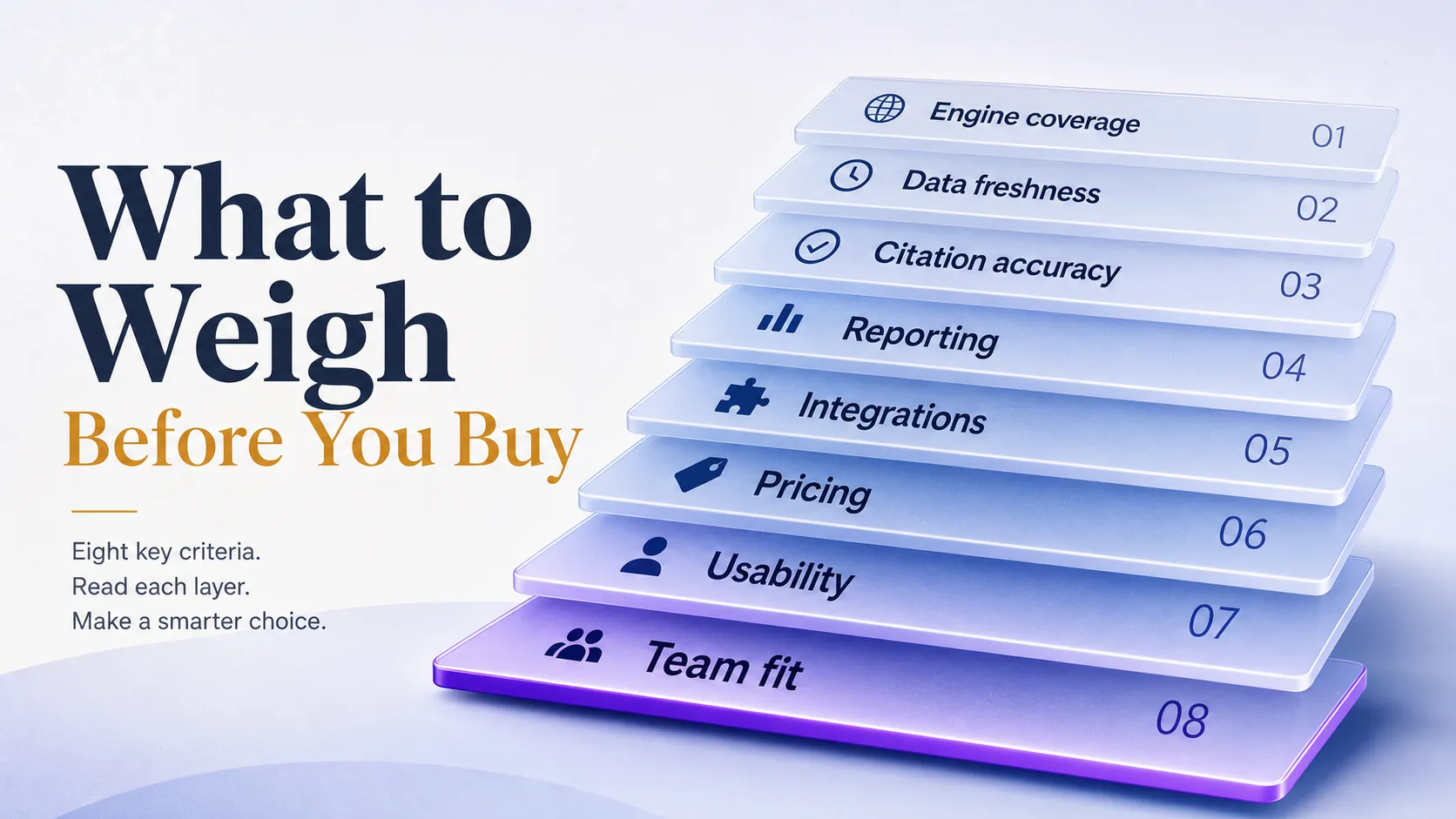
The core criteria are AI engine coverage, data freshness, citation and mention accuracy, exports and reporting, integrations, pricing and value, usability, and fit for agencies versus in-house teams. Each one decides a different kind of buyer, so weigh them against your own constraints rather than chasing a single overall score.
Prompt Methodology Decides Trust
How a tool samples prompts changes whether you trust the output. Brand Radar uses search-backed prompts drawn from real query data, which grounds its tracking in what people actually ask.
Other tools lean on synthetic or simulated queries the vendor generates. Search-backed sampling usually reads as more representative, but simulated queries let a tool track topics with low search volume.
Ask any vendor where their prompts come from before you trust the share-of-voice number on the dashboard.
Watch the Hidden Scaling Costs
The headline price is rarely what you pay. Extra seats, prompt caps, domain limits, and add-on modules all push the real monthly figure up.
Brand Radar is the clearest example, where a $199 per-index add-on sits on top of a base plan, and tracking more engines multiplies that. Semrush charges per domain and per user with separate prompt packs.
The total cost, not the entry price, is the number that belongs on your shortlist.
Monitoring Only Versus Monitoring Plus Action
A tool that only reports your visibility leaves the hard part to you. Monitoring-only tools tell you where you stand.
Monitoring-plus-optimization tools tell you where you stand and then help you write, fix, or restructure the pages that earn citations. If your team is small and stretched, a tool that hands you the next step is worth more than one with a prettier chart.
This single split explains most of the price differences below.
Coverage, Accuracy, Reporting, and Pricing Side by Side
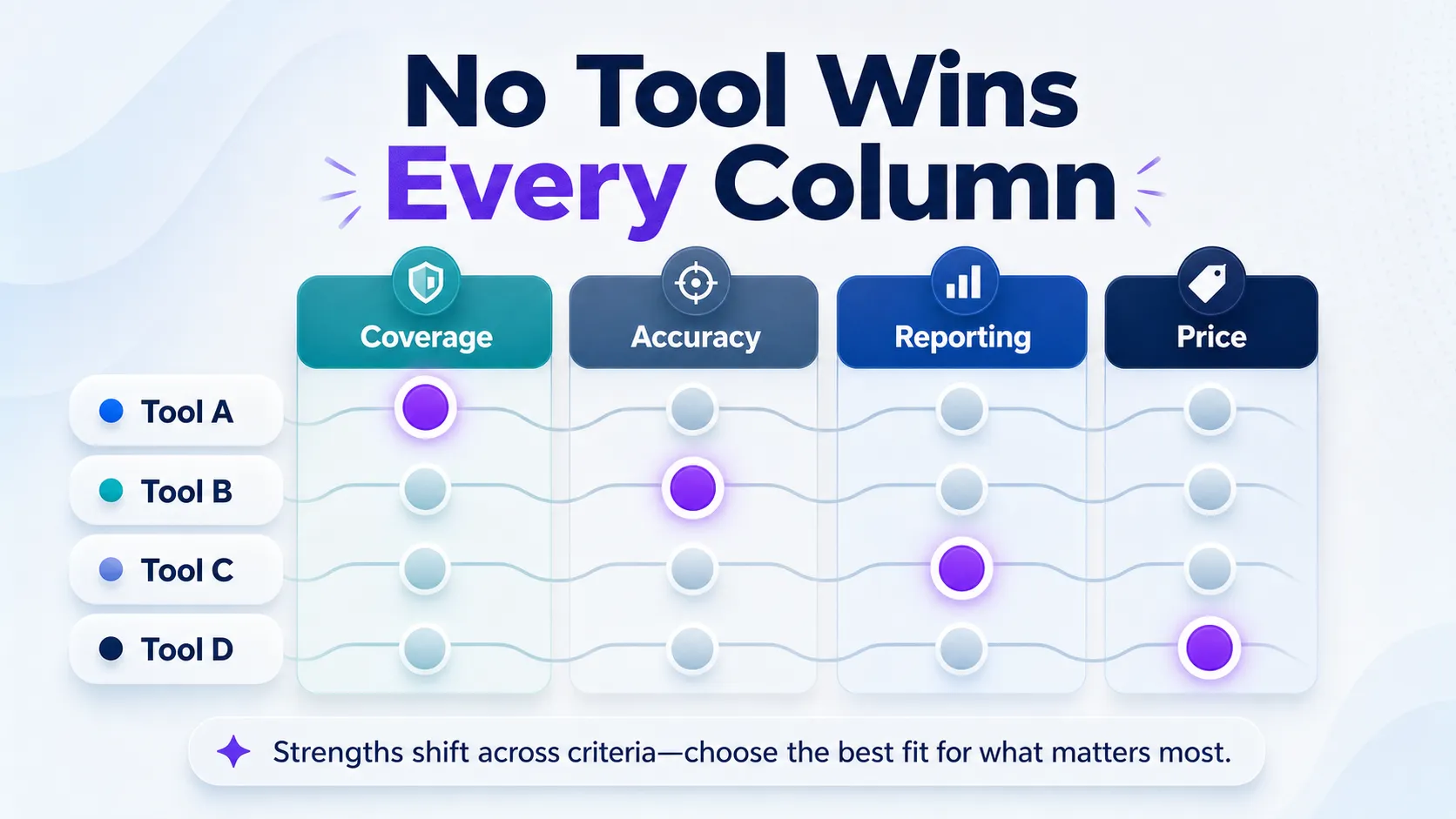
Before the tool-by-tool reviews, compare the criteria directly. The tradeoffs are clearer when you see them lined up, because no single tool wins every column.
Coverage and Engine Support
Coverage is where Brand Radar both leads and lags. It tracks six AI surfaces, including AI Overviews, AI Mode, ChatGPT, Copilot, Gemini, Perplexity, and Grok, and it pulls in YouTube and Reddit signals on top.
That breadth across discovery channels is rare. The gap is Claude, which Brand Radar doesn’t cover, and which matters for teams whose buyers lean on Anthropic’s model.
Cairrot covers five models including Claude and DeepSeek, and tools like Rankability and Peec AI reach across ChatGPT, Gemini, Claude, Perplexity, and Google’s AI surfaces. If Claude or Grok coverage is non-negotiable, your shortlist shrinks immediately.
Accuracy and Prompt Methodology
Accuracy is the quiet weakness across the category. Independent reviews of Brand Radar flag underreporting of mentions in ChatGPT and Perplexity, plus ambiguity between a plain mention and a linked citation, which creates manual verification work.
That ambiguity isn’t unique to Ahrefs. Most tools blur the line between “your brand appeared” and “your brand was cited with a link,” so check how each one defines the metric.
A tool that separates mentions from citations saves you from chasing numbers that don’t mean what you think.
Reporting, Exports, and Integrations
Reporting separates the suites from the specialists. Semrush is built for executive dashboards, with clean share-of-voice, sentiment, and perception views that read well in a board deck.
Brand Radar integrates with Ahrefs API v3, Ahrefs Connect, and Whatagraph, and ties citation data back to Site Explorer so you see AI mentions next to backlink profiles. Peec AI focuses on clean multi-engine dashboards with easy exports and unlimited seats.
If your week revolves around stakeholder reporting, weight this column heavily, because raw data you can’t present is data you can’t use.
Pricing and Value
Pricing is where the field spreads widest. Brand Radar’s realistic full cost runs from roughly $828 to $1,148 a month once you stack the base plan and the engine indexes.
Profound starts at $499 and climbs into custom enterprise territory. Scrunch AI sits around $300.
At the affordable end, Cairrot runs $39 to $99, LLMrefs runs $79 with a freemium tier, and SE Ranking’s AI module starts near $89. The spread between the cheapest and most expensive option here is more than tenfold, so define your ceiling before you fall for a feature list.
Best Workflow Fit
Workflow fit is the deciding column for most teams. Passive monitoring tools like Brand Radar and Peec AI tell you what’s happening.
Monitoring-plus-optimization tools like Rankability and Scrunch AI add prompt-level testing, gap analysis, and handoffs to writers, so the insight turns into a task. Suite-based tools like Semrush and SE Ranking fold AI visibility into a wider SEO workflow you already run.
Match the tool to how your team actually works, not to the longest feature page.
The Best Ahrefs Brand Radar Alternatives, Reviewed
Each tool below follows the same structure: what it is, why it matters, its best features, where it falls short against Brand Radar, and who it suits. The data block under each item carries the fields you need to choose.
1. Semrush AI Visibility Toolkit: Best All-in-One Suite
Semrush is an AI visibility add-on inside one of the largest SEO and marketing platforms, built for teams that want AI search data living next to their keyword, content, and backlink work.
It matters because most marketing teams already run a suite, and adding AI visibility to a stack you know beats learning a separate tool.
The Brand Performance view gives clean share of voice, sentiment, and perception drivers, and Prompt Research treats prompts like keywords with difficulty and volume estimates. The catch against Brand Radar is engine count, since Semrush tracks fewer AI platforms, and the per-domain, per-user, per-prompt-pack pricing stacks quickly.
It also leans on simulated queries rather than search-backed ones.
- Best for: Teams that want SEO, content, and AI visibility in one ecosystem
- Starting price: $99/mo per domain for the AI Visibility Toolkit
- Standout feature: Keyword-style prompt research with topic difficulty and competing brands
- Rating: 4.5/5 on G2, 4.6/5 on Capterra
2. Authoritas AI Tracker: Best for Citation-Focused Search Teams
Authoritas AI Tracker is a dedicated AI search platform for teams that care most about citations and how AI assistants position their brand. It matters because it positions itself as a specialist rather than a suite bolt-on, with a focus on AI search and LLM coverage, sentiment analysis, and source and citation tracking.
The standout is its citation and source focus, including share-of-voice and estimated impressions metrics drawn from a large keyword behavior model. The honest limitation is transparency, because public detail on features and pricing is thin and the product is largely demo-led, so you’ll need a sales conversation to learn the real shape of it.
- Best for: SEO and AI search teams focused on citations and source tracking
- Pricing: No public rate card, AI Tracker quoted per plan with model add-ons
- Standout feature: LLM source and citation tracking with sentiment analysis
3. SE Ranking AI Visibility Tracker: Best for Mid-Market Agencies
SE Ranking brings AI Overviews, AI Mode, and ChatGPT tracking into the same place as classic rank tracking, which suits agencies and mid-market teams that want connected visibility rather than a standalone tracker.
It matters because it folds AI visibility into GA4 traffic context and social analytics, so you see the AI picture alongside organic performance in one ecosystem.
The standout is its “no-cited” gap finder, which surfaces queries where you should appear but don’t. Against Brand Radar, the AI piece is a module inside a broader suite rather than a deep dedicated tracker, so heavy AI-only teams may want more depth than it offers.
- Best for: Established agencies and mid-market teams wanting connected visibility
- Starting price: $89/mo for the AI Visibility Tracker module
- Standout feature: No-cited gap finder that flags missed citation chances
- Rating: 4.8/5 on G2, 4.7/5 on Capterra
4. Rankability: Best for Monitoring Plus Optimization
Rankability combines monitoring and optimization in one stack, which is why agencies reach for it when reporting a problem isn’t enough and they need to fix it. It matters because most trackers stop at the dashboard, while Rankability connects prompt-level testing and citation mapping to a workflow that hands tasks to writers.
The standout features are prompt-level testing, citation and source mapping, competitor diffs, and those writer handoffs. The tradeoff against Brand Radar is scope, since Rankability is narrower than a full SEO platform and doesn’t carry Brand Radar’s YouTube and Reddit discovery breadth. For agencies, that focus is usually the point.
- Best for: Agencies that want monitoring and optimization in one workflow
- Starting price: $166/mo
- Standout feature: Prompt-level testing with citation mapping and writer handoffs
5. Peec AI: Best for Clean Dashboards and Exports
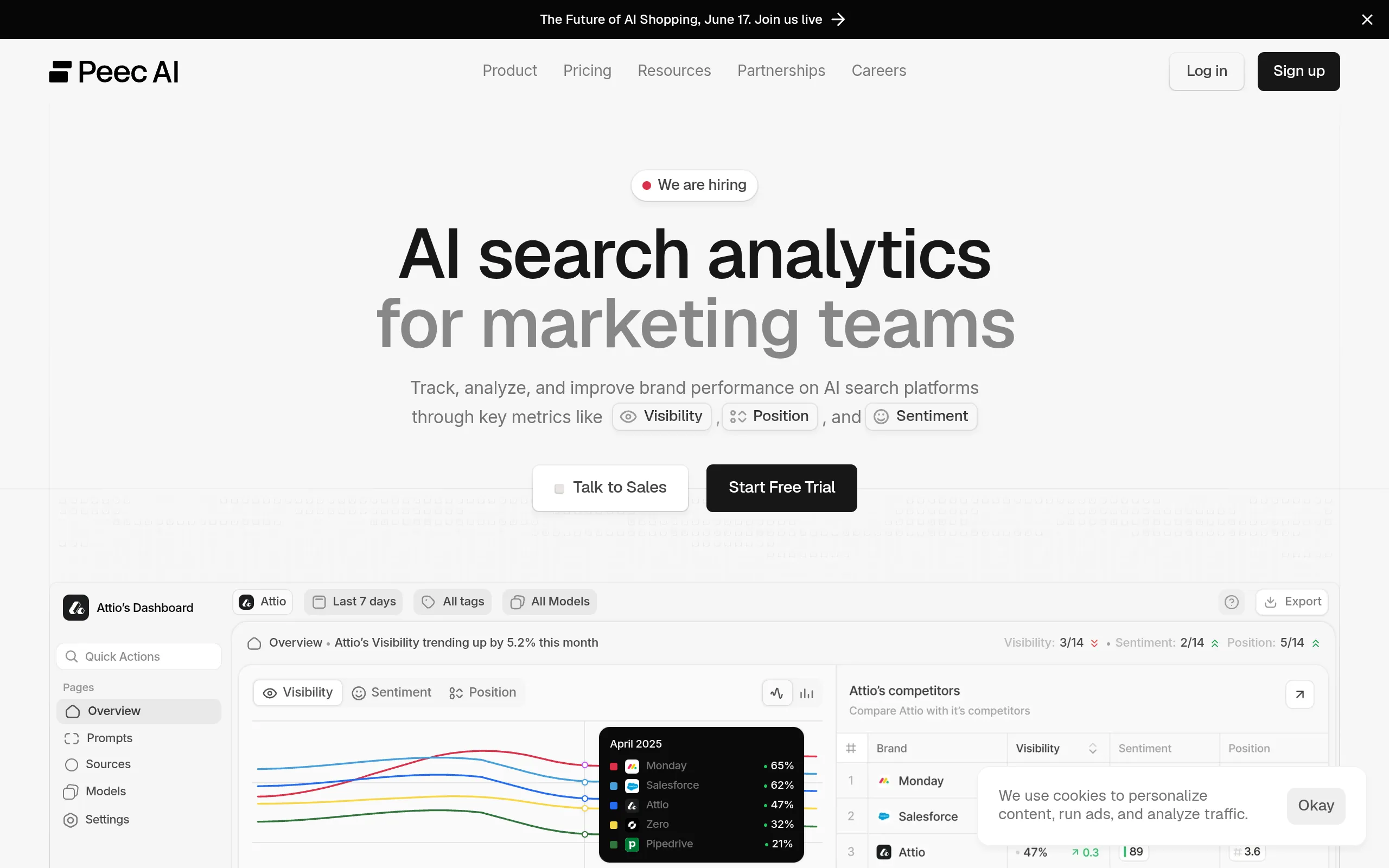
Peec AI delivers clean multi-engine dashboards and exports on a daily cadence, built for teams that want readable visibility data without heavy operational overhead. It matters because adoption is easy, and a tool the whole team actually opens beats a powerful one nobody logs into.
The standout is unlimited seats and multi-country support even on the Starter plan, so you can roll it out widely without per-user math. Against Brand Radar, Peec AI is lighter on optimization depth and doesn’t match the search-backed prompt database, so it sits firmly in the monitoring camp rather than the act-on-it camp.
- Best for: Teams wanting multi-engine dashboards plus easy exports
- Starting price: €89/mo
- Standout feature: Unlimited seats and multi-country support on the Starter plan
6. LLMrefs: Best Entry Point for Solo Marketers
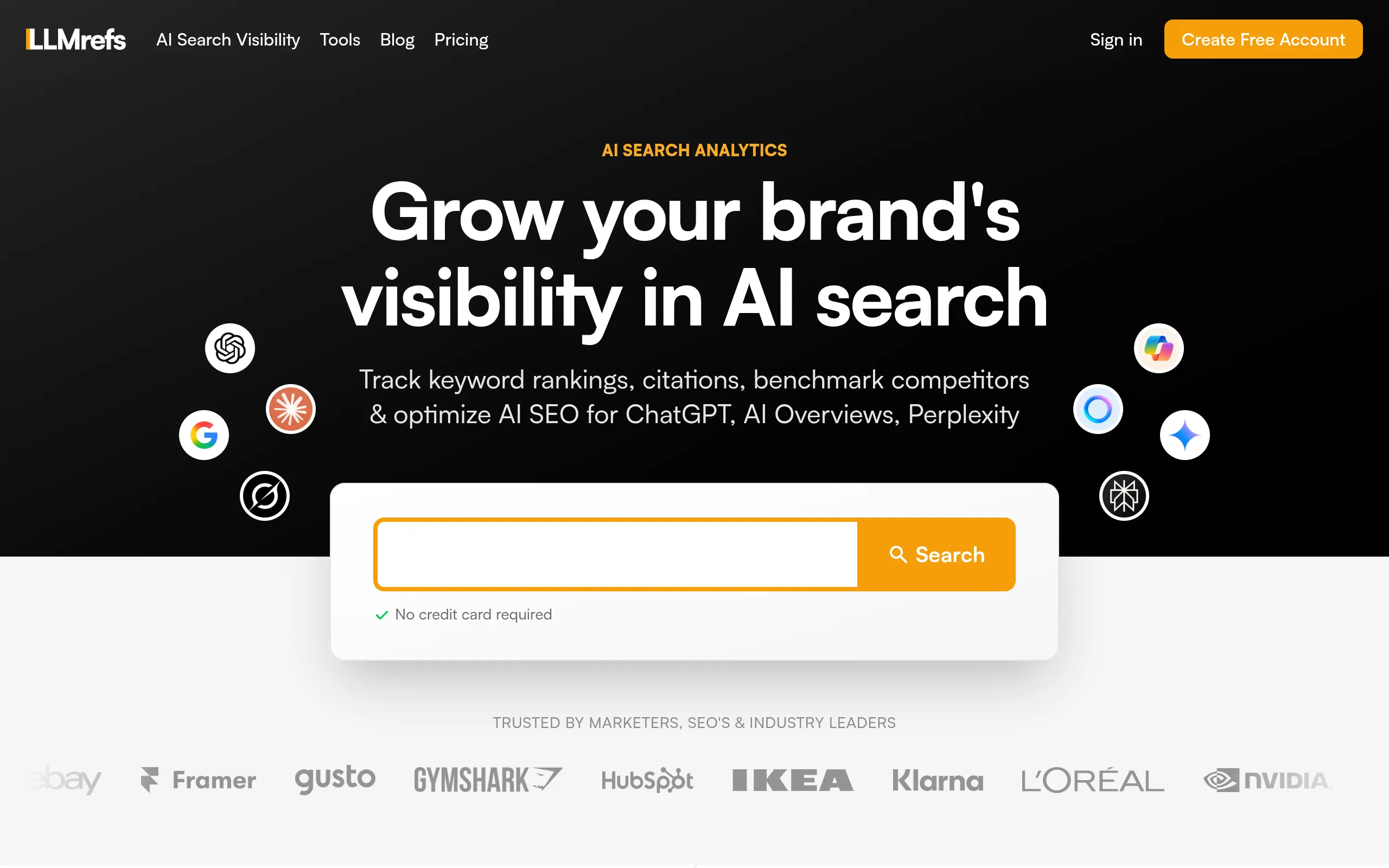
LLMrefs is the affordable way to start measuring AI visibility, aimed at solo marketers and SMBs testing the waters before they commit to a heavier tool. It matters because the entry cost is low and a freemium tier lets you see your standing before paying anything.
The standout is the LLMrefs Score, a single number that helps you prioritize where to act first. Against Brand Radar, the analytics are simpler and the coverage and prompt depth are lighter, which is the expected tradeoff at this price.
For a one-person marketing team, that simplicity is a feature, not a flaw.
- Best for: Solo marketers and SMBs testing AI visibility
- Starting price: $79/mo, freemium available
- Standout feature: LLMrefs Score for fast prioritization
7. Cairrot: Best for Budget and API-First Buyers
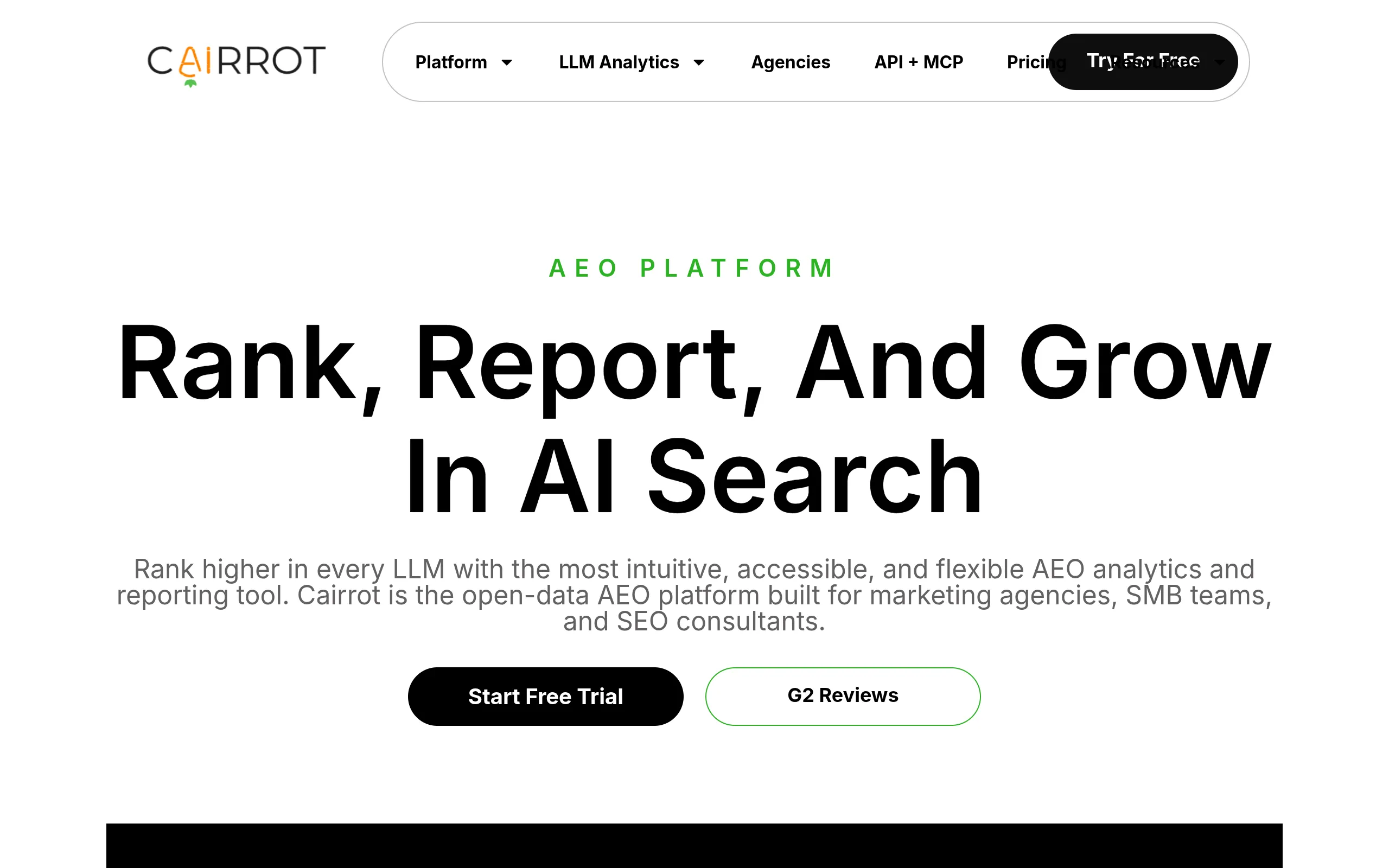
Cairrot is an answer-engine optimization tool that tracks LLM visibility across multiple models and ships a free API on every plan, which makes it the natural pick for budget-conscious and technically minded buyers.
It matters because it covers ground Brand Radar misses, tracking five models including Claude and DeepSeek, plus an llms.txt generator for teams shaping how crawlers read their site. The standout is that free API paired with agency-friendly pricing.
Against Brand Radar, the overall toolset is smaller and it lacks the enterprise reporting and discovery-channel breadth, but for the price the model coverage is hard to beat.
- Best for: Agencies and SMBs needing affordable, API-first AEO tracking
- Starting price: $39 to $99/mo
- Standout feature: Free API on all plans plus Claude, Grok, and DeepSeek coverage
8. Scrunch AI: Best for Enterprise Governance and Scale
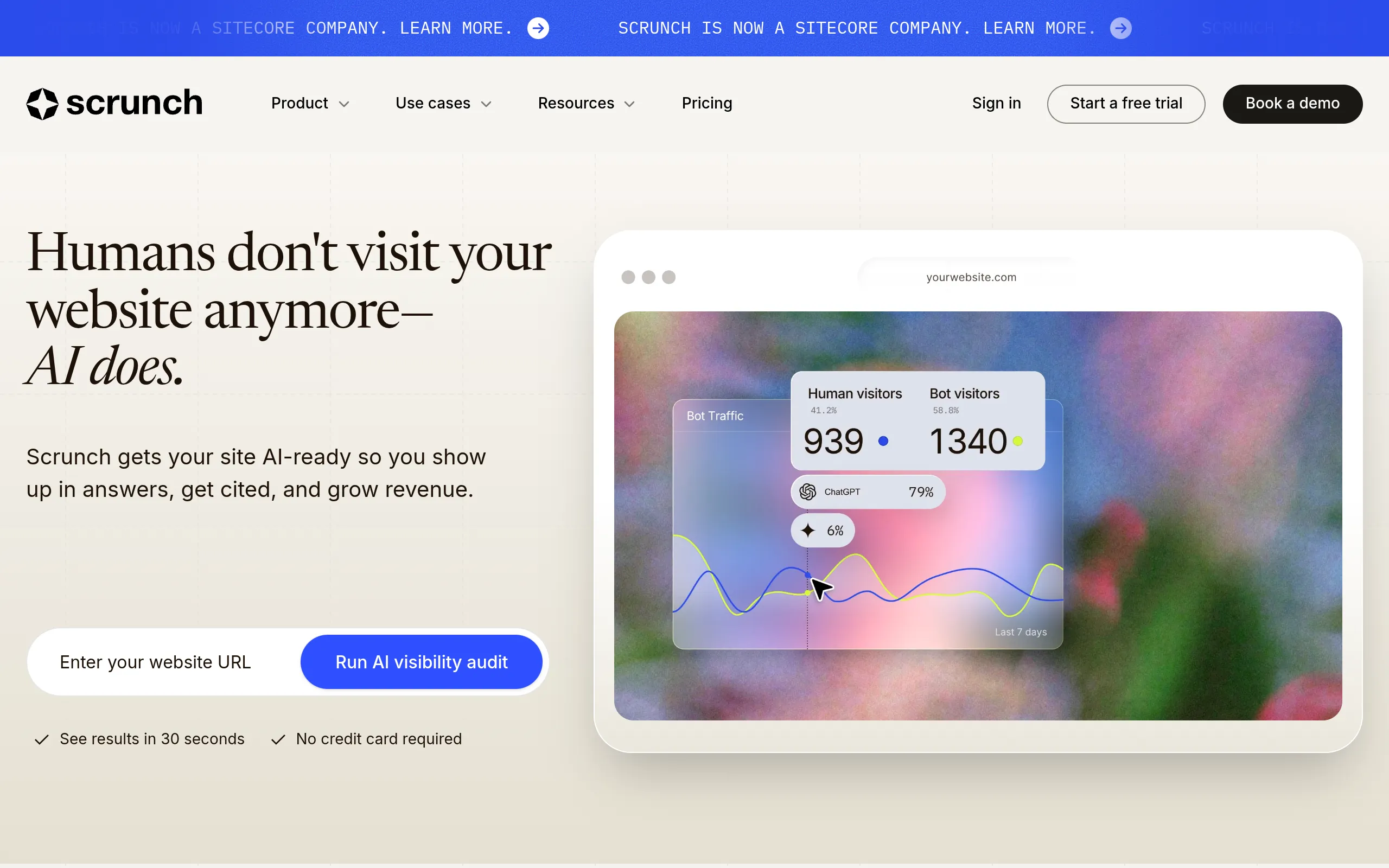
Scrunch AI is monitoring and optimization infrastructure built for enterprise teams that need governance, collaboration, and measurable impact at scale. It matters because large organizations need controls and accountability that SMB tools don’t carry, and Scrunch is built around that.
The standout features are misinformation detection, journey mapping, machine-readable content layers, and share-of-voice across AI assistants.
Against Brand Radar, the price puts it out of SMB reach, but for an enterprise weighing governance against raw database size, Scrunch’s combination of monitoring plus optimization at scale is the stronger fit. Its GA4 integration also ties visibility back to traffic, which Brand Radar doesn’t do natively.
- Best for: Enterprise teams needing governance and optimization at scale
- Starting price: $300/mo
- Standout feature: Misinformation detection plus machine-readable content layers
If you only read three of these, read them by job. Semrush is the strongest fit for suite users who want everything in one place.
Cairrot is the budget pick that still covers the models Brand Radar skips. Scrunch AI is the enterprise choice when governance and scale outweigh a bigger prompt database.
For a wider view of the category, our roundup of generative engine optimization tools tests adjacent options worth a look.
| Tool | Best for | Starting price |
|---|---|---|
| Semrush AI Visibility Toolkit | All-in-one suite users | $99/mo per domain |
| Authoritas AI Tracker | Citation-focused teams | Demo-led |
| SE Ranking AI Visibility Tracker | Mid-market agencies | $89/mo |
| Rankability | Monitoring plus optimization | $166/mo |
| Peec AI | Clean dashboards | €89/mo |
| LLMrefs | Solo marketers | $79/mo |
| Cairrot | Budget and API-first | $39 to $99/mo |
| Scrunch AI | Enterprise scale | $300/mo |
We picked these eight by matching the SERP’s most-cited alternatives against four criteria that decide real buying choices: AI engine coverage, total cost including add-ons, citation accuracy, and whether the tool helps you act on what it finds.
Pricing and feature details come from each vendor’s published information, and every tool here serves a distinct buyer rather than padding a round number.
Which Alternative Fits Your Team and Budget
The comparison turns into a decision once you match a tool to your constraint. This table reads down to your situation, then across to the pick that fits it and the reason behind the choice.
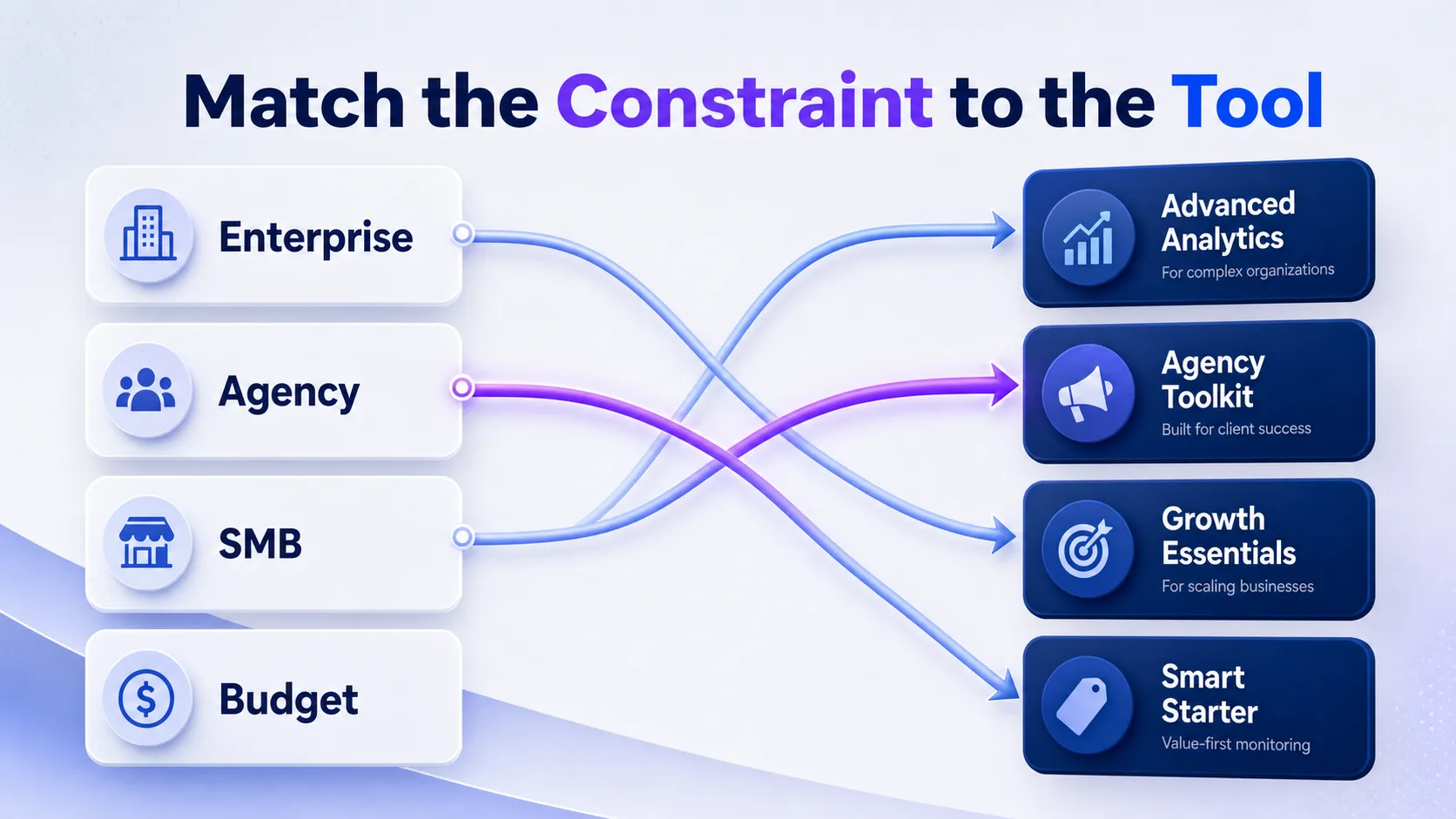
| Your situation | Best pick | Why |
|---|---|---|
| Enterprise team | Profound or Scrunch AI | Governance, APIs, and scale, with Scrunch adding optimization depth |
| Agency | Rankability or SE Ranking | Rankability for workflow action, SE Ranking for suite breadth |
| SMB or solo marketer | LLMrefs or Peec AI | Lower overhead and simpler dashboards |
| Budget buyer | Cairrot or LLMrefs | Lowest entry price with controllable scaling |
| Wants monitoring plus optimization | Rankability or Scrunch AI | Both connect insight to action, not just reporting |
| Already on a broad SEO suite | Semrush or SE Ranking | AI visibility lives next to your existing workflow |
Tie each pick to what actually limits you. If analyst time is scarce, a tool that hands you the next step beats one with deeper raw data.
If your week ends in an executive report, dashboard quality outweighs database size. And if you hand work to a content team, the tool that produces a task list, not just a chart, saves the most hours.
For a clear view of what to measure once you choose, our breakdown of AI visibility versus SEO metrics sorts the signals worth tracking.
Picking the Right Replacement
The best overall pick for broad SEO teams is Semrush, because AI visibility sitting inside the suite you already run beats a separate login, even though it tracks fewer engines than Brand Radar.
The best pick for specialist AI visibility teams is Rankability, because it closes the loop from monitoring to fixing, which is where most trackers leave you stranded. The core tradeoff never disappears: breadth and convenience on one side, specialization and lower cost on the other.
Brand Radar itself is still worth keeping as a supplement when you already live in Ahrefs and value its search-backed prompts and discovery-channel reach, just not as your only tool if Claude coverage or actionability matters. The rule is simple.
Pick on coverage, cost, and whether you need to act after you monitor, and the field narrows to one. Book a strategy call to see exactly where your brand stands across AI engines before you commit to any tool.
Frequently Asked Questions
Is there a cheaper alternative to Ahrefs Brand Radar?
Yes, several. Cairrot starts at $39 to $99 a month with a free API, and LLMrefs starts at $79 with a freemium tier.
Both cost a fraction of Brand Radar’s realistic full price, which runs from roughly $828 to $1,148 a month once you stack the base Ahrefs plan and per-engine indexes. The cheaper tools carry lighter analytics, but for solo marketers and SMBs that tradeoff is usually worth it.
Which Ahrefs Brand Radar alternative is best for agencies?
Rankability suits agencies that want monitoring plus optimization in one workflow, since it pairs prompt-level testing and citation mapping with handoffs to writers. SE Ranking fits agencies that prefer connected visibility, folding AI tracking into rank tracking and GA4 context.
Choose Rankability if you act on findings directly, and SE Ranking if you want AI visibility alongside a broader suite your team already uses.
Does Semrush have an AI visibility tracker?
Yes. The Semrush AI Visibility Toolkit tracks brand presence in AI answers with share of voice, sentiment, prompt tracking, and keyword-style prompt research.
It starts at $99 per domain per month as an add-on, with separate charges for extra users, domains, and prompt packs. It tracks fewer AI platforms than Brand Radar but presents the data more cleanly for executive reporting.
Which tool tracks ChatGPT, Gemini, Perplexity, and Claude?
Cairrot tracks five models including Claude and DeepSeek alongside the major engines, and Rankability and Peec AI reach across ChatGPT, Gemini, Claude, Perplexity, and Google’s AI surfaces.
This matters because Brand Radar doesn’t track Claude, so if Anthropic’s model is part of your buyers’ habits, one of these specialist trackers fits better than the Ahrefs add-on.
Is Ahrefs Brand Radar worth it compared with specialist tools?
Brand Radar is worth it for teams already deep in the Ahrefs ecosystem who value its search-backed prompt database and its reach into YouTube and Reddit. It’s not the best value for teams that need Claude coverage, want optimization built in, or work on a tight budget.
The honest read is that Brand Radar is a strong baseline rather than a default winner, and a specialist tool often serves a focused AI visibility team better for less money.
Shortlist two of these alternatives, then choose the one that matches your coverage, reporting, and budget needs. The right tool is the one that fits how your team works, not the one with the longest feature page, so start by naming your single biggest reason for leaving Brand Radar and let that decide.