
If AI answer engines cannot find the answer in the first screen of your page, they usually skip it. That single behavior decides whether ChatGPT, Perplexity, or Google AI Overviews lift your content or someone else’s.
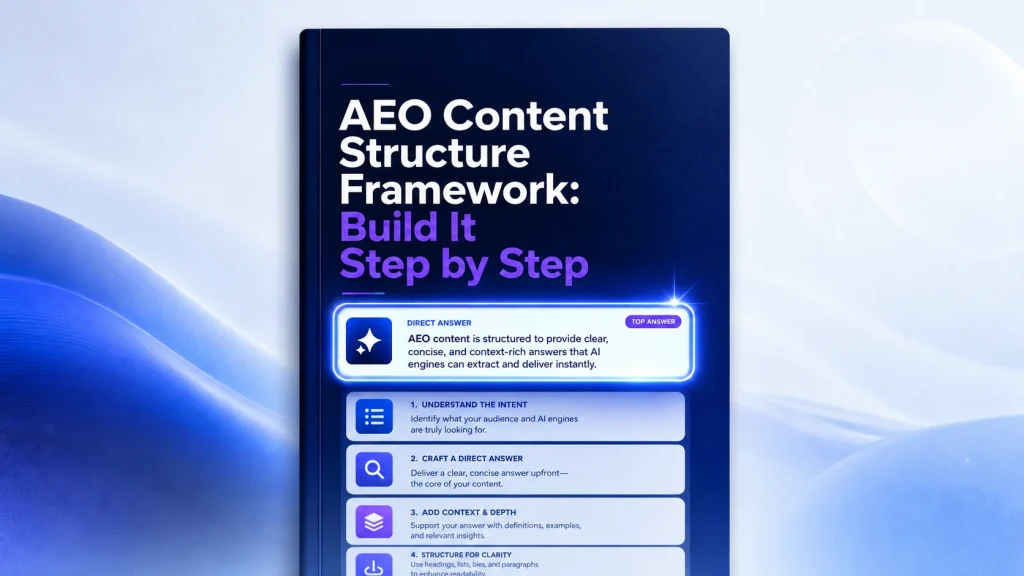
The framework runs in five steps: lock the query and answer objective, build an answer-first skeleton, add extraction-friendly blocks, strengthen authority signals, then validate and refresh. The steps below turn that into a repeatable build you can run on one page this week and scale across your library after.
It’s the exact sequence we use to make a page easy to skim for a human and easy to cite for a model.
Key Takeaways
- A page earns AI citations by putting the direct answer in the first screen, not three scrolls down.
- Five steps build the framework: lock the query, build an answer-first skeleton, add extraction-friendly blocks, strengthen authority, then validate and refresh.
- Models often lift one self-contained passage, so every block should make sense on its own.
- Internal links and entity coverage tell an engine the page belongs to a trusted, connected cluster.
- Schema should match what’s actually on the page, never forced onto the wrong content type.
- Pages engines actually cite average 1,064 days old versus 1,432 for standard results, so refresh on a real cadence.
Prerequisites: What You Need Before Building the Framework
Before you draft a single line, lock five inputs. The framework works when the page has one job, not three competing ones.
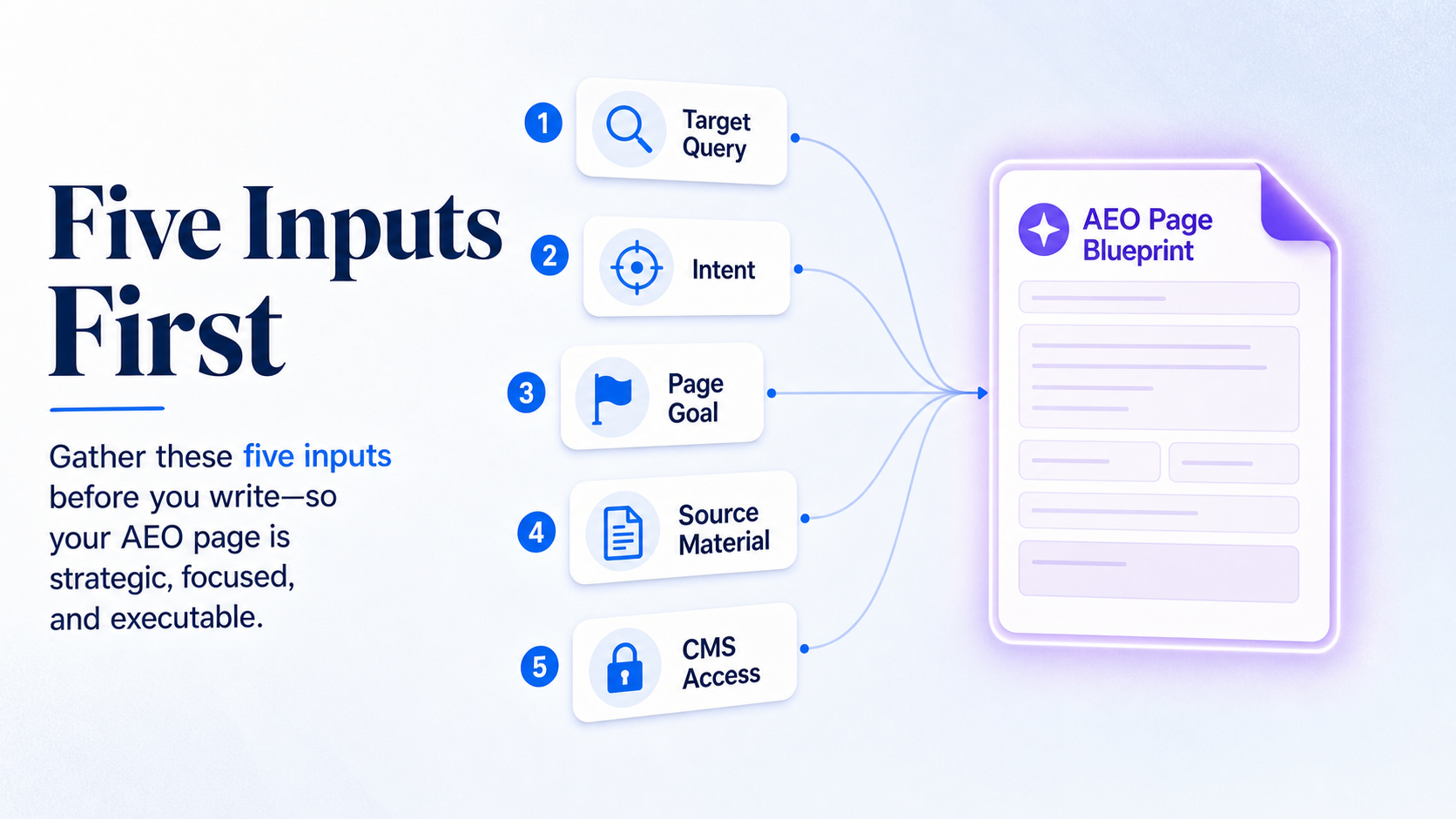
Here is the short list that keeps the build executable rather than theoretical:
- One target query the page is meant to win.
- One primary search intent behind that query.
- One page goal, such as earning a citation or driving a defined next action.
- Source material from someone who knows the subject, with real facts, examples, or product details.
- CMS access to publish, add headings, and apply structured data.
Schema capability matters even if you are not the one writing the JSON-LD. Structured data is the machine-readable label that tells an engine what a block of content is. You need to know whether your CMS can add it before you design blocks that depend on it.
Your source material also has to carry weight. A page that summarizes general knowledge gives a model nothing to cite. Bring evidence, named examples, or product facts that can stand on their own.
One more input that teams skip: the page should already belong to a topical cluster or internal linking plan. A page floating alone with no connected coverage is harder for an engine to trust. If you want the broader view of how this fits a citation strategy, our AI visibility frameworks and guides sit one level up from this tutorial.
A common failure pattern is starting the outline before the query intent is locked. You end up with a page that’s structurally clean and commercially useless.
Step 1: Choose the Right Query and Answer Objective
Pick a query by intent first, not search volume. The best AEO targets are questions with an obvious answer shape, because a model can lift a clean answer and attribute it to you.
Prioritize queries that signal a direct answer expectation: “how to,” “what is,” “best,” “vs,” “checklist,” or “steps.” These map to the formats answer engines surface most often.
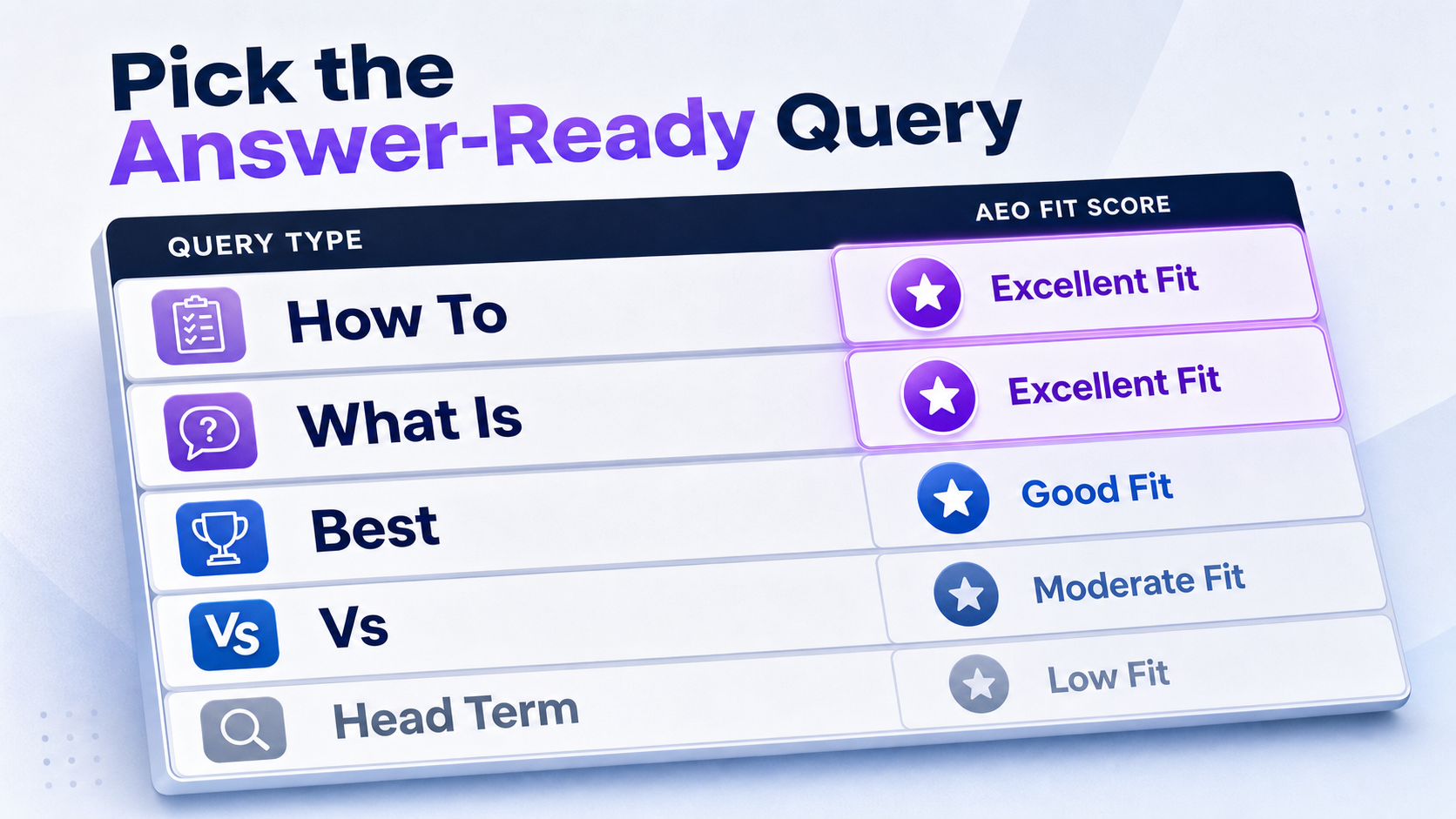
Next, decide what kind of answer the page owes. Is it a definition, a process, a comparison, or a troubleshooting fix? Naming this early stops you from writing a definition page when the reader wanted steps.
Score each candidate query with a simple lens before you commit.
| Factor | What you check | Strong signal |
|---|---|---|
| Intent clarity | Does the query have one obvious answer shape? | A single, nameable answer the page can win |
| AI surface likelihood | Do answer engines already generate responses for this? | The query triggers AI Overviews or chat answers |
| Business value | Does winning the answer move a real goal? | The query sits near a buying or trust decision |
| Available proof | Can you back the answer with facts or examples? | You hold evidence the page can cite |
Before you write anything else, define one primary answer statement in a single sentence. If you can’t, the query is too broad or the intent is unclear, and the page will drift.
Pages usually underperform when teams chase broad head terms instead of answer-ready queries with explicit user intent. A head term feels valuable on a volume chart and disappoints on an answer surface.
Step 2: Build the Answer-First Page Skeleton
The skeleton is where the framework becomes visible. Build the page so the answer is the first thing a human and a model reach.

Follow these steps in order.
- Write the H1 to mirror the target query or a close variant, without making it read awkwardly.
- Put a direct answer in the first two sentences, with no narrative warm-up before it.
- Add a short TL;DR or quick-answer block near the top, above any long explanation.
- Use H2s to separate major logic sections and H3s for question-based subpoints or sub-steps.
- Keep the intro short enough that the page reaches the answer on the first screen, not the third scroll.
The TL;DR block deserves attention. It gives a model a clean, self-contained summary to lift, and it gives a skimming reader the payoff fast. Keep it to a few short claims, each a single point.
Order the body the way the reader’s logic moves. A process page runs in sequence.
A comparison page runs criterion by criterion. A definition page runs from the core meaning outward to context and examples.
In practice, pages that front-load the answer in the first 80 to 120 words are far easier to repurpose into snippets and AI answers. The answer block becomes the thing engines quote, so it earns the prime position.
Step 3: Add Extraction-Friendly Content Blocks
Once the skeleton holds, build the body from blocks a model can chunk and lift cleanly. Models often pull a single passage rather than a whole page, so each block should make sense on its own.
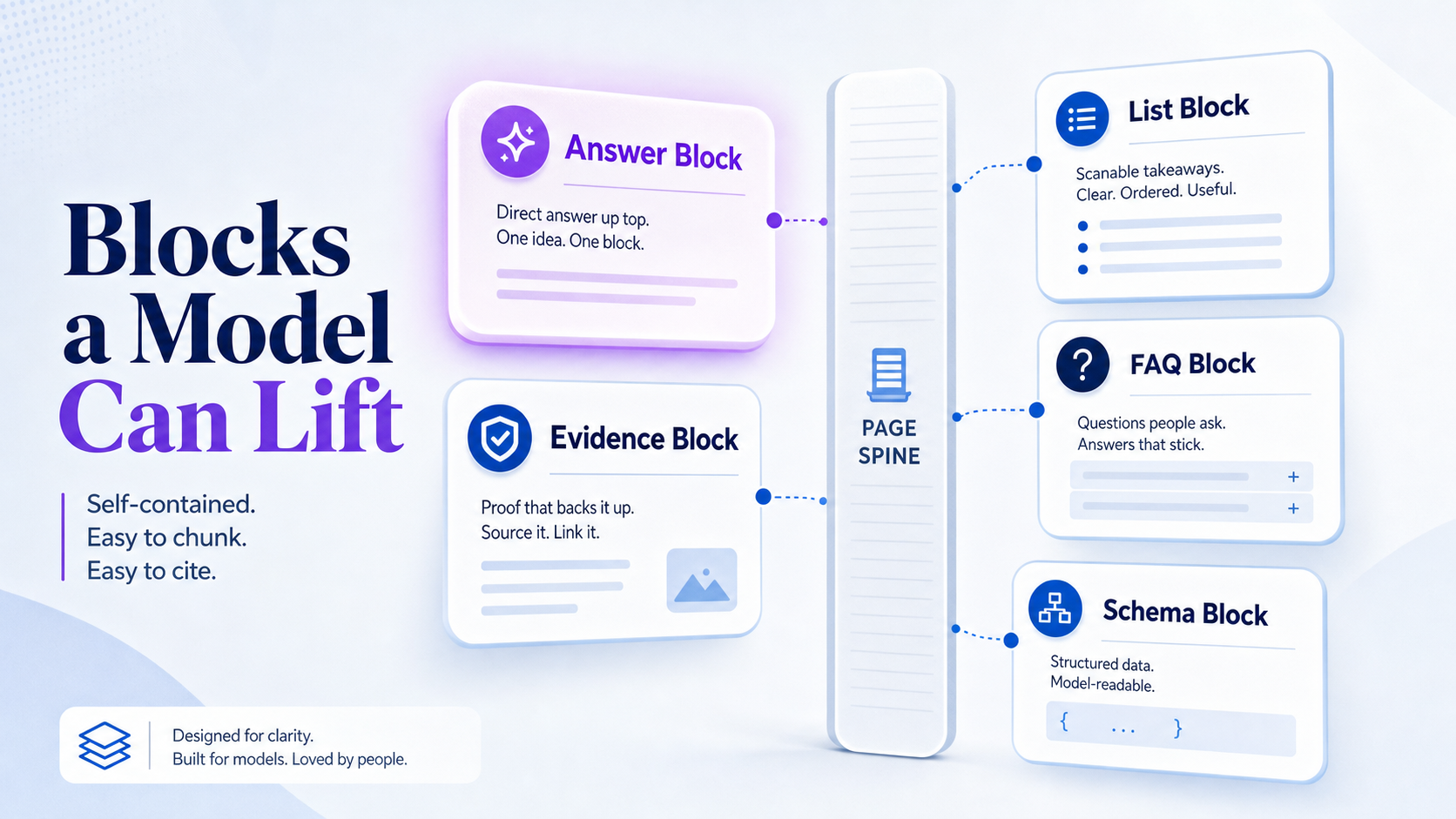
The table below pairs each block type with the situation it serves.
| Block type | Use it when |
|---|---|
| Short paragraph (2 to 4 lines) | You are explaining a single idea in prose |
| List or checklist | You have parallel, same-level items none needing a long explanation |
| Table | You compare items across shared attributes or conditions |
| Question-based subhead | The reader naturally wants a direct answer at that point |
| Definition block | A term may be quoted or extracted on its own |
| FAQ block | Real follow-up questions support the main page goal |
A few rules keep these blocks clean:
- Keep paragraphs short, ideally two to four lines, never a wall of text.
- Use question-based subheads only where a direct answer follows in sentence one.
- Place evidence, examples, and named entities in self-contained blocks so they do not get buried in narrative.
- Add FAQ items only for genuine follow-up questions, not padding.
Schema fits here too. Add FAQPage, Article, or HowTo markup where the content actually matches that type.
Don’t force HowTo onto a definition page or FAQPage onto a section that isn’t really a question and answer set. To see how engines weigh these signals against everything else on the page, our breakdown of how AI crawlers pick sources covers the wider selection logic.
A recurring pattern in AEO-ready pages is that models prefer self-contained passages that stand alone without surrounding context. Write each block as if it might be the only part a model reads.
Step 4: Strengthen Context and Authority Signals
A well-built page still needs context around it. Answer engines weigh how trustworthy and connected a page looks, not just how clean its formatting is.
Start with internal links. Connect the page to related cluster pages so it’s not isolated, and link up to the pillar it supports at least once.
Each link should sit on a natural anchor and point to a destination that expands the exact claim at that point. Our AI Overview optimization checklist is a useful sibling to link when a section touches Overview eligibility, since it covers the on-page checks this framework assumes.
Then reinforce topical coverage. Use related entities naturally in the copy, the tools, platforms, and concepts a reader would expect on a thorough page. If you want the deeper mechanics behind why entities matter, our guide to building entity authority for search owns that explanation.
Back your claims. Include citations or references for facts, standards, or technical claims, and add examples that show the framework in action rather than abstract advice. Where your CMS supports it, surface author or subject-matter credibility, especially for technical or specialized topics.
Topical clustering does quiet work. It tells an engine what role the page plays inside the larger site, which raises confidence that the page is a real authority rather than a one-off. Pages with linked supporting assets and explicit entity coverage tend to hold citations more reliably than standalone articles with no topical context.
Step 5: Validate and Refine the Page
Validation is a repeatable review, not a one-time gut check. Run the page through the same pass every time so the structure holds and improves.
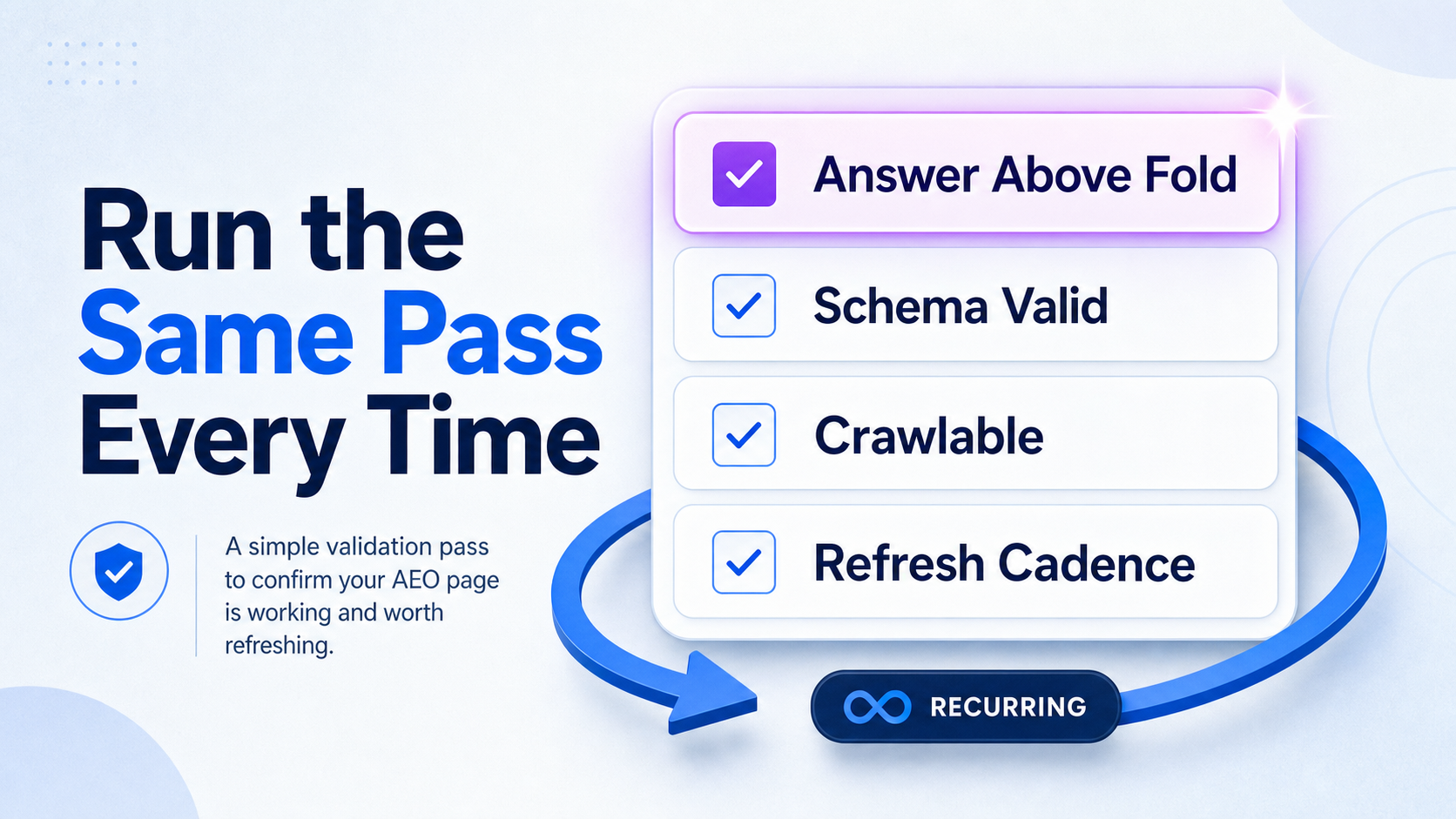
- Confirm the main answer appears above the fold and reads clearly without scrolling.
- Review every heading for clarity, specificity, and logical order.
- Check schema implementation, then test technical accessibility, including crawlability and mobile rendering.
- Make a cleanup pass to remove fluff, tighten vague sentences, and cut redundancy.
- Track how the page performs on AI surfaces over time.
- Refresh on a regular cadence, roughly every 60 to 90 days, updating examples, FAQs, and evidence blocks before they go stale.
The technical accessibility check matters more than teams expect. A perfectly structured page that a crawler cannot reach, or that renders poorly on mobile, never gets the chance to be cited. If you want to confirm engines are actually reaching your content, our walkthrough on tracking which AI bots crawl your site shows how to verify access.
Refresh cadence is the lever most teams ignore. Teams that routinely refresh the answer block and FAQs tend to preserve visibility better than teams that publish once and never revisit the structure. Treat the page as a living asset.
Tips, Common Pitfalls, and What Good Looks Like
Most AEO pages fail on architecture, not markup. The answer is buried, the headings are vague, or the proof is missing. Here is what goes wrong and how to fix it.
Burying the answer under a clever intro
If your introduction sounds smart but delays the point, a model reads warm-up instead of an answer and moves on. Open with the answer, then earn the reader’s attention with depth below it.
Vague headings that promise nothing specific
A heading like “Why this matters” tells a reader and an engine nothing. Name the concrete thing the section delivers, so the heading itself reads like an answer to a question.
Fluff, repetition, and inflated intros
Padding weakens extractability. Every redundant sentence dilutes the signal a model uses to decide what your page is about. Cut anything that doesn’t move the answer forward.
Forcing schema onto a weak page
Schema supports good content, it doesn’t rescue thin content. Add markup that matches what’s actually on the page, and fix the content first if the page is weak.
FAQs that repeat one answer in different words
Three FAQ items that all say the same thing add nothing. Each question should open a genuinely different answer the body hasn’t already given.
Letting the page go stale
AI engines weight recency more heavily than traditional search does. Ahrefs’ analysis of 17 million AI citations found the pages engines actually surfaced averaged 1,064 days old, versus 1,432 days for standard organic results, a real freshness gap. A framework page like this one earns its citations back by getting revisited on a real cadence, not by getting published once and left alone.
What good looks like
A strong AEO page is skimmable, answer-first, evidence-backed, logically ordered, and easy to cite. It reads naturally for a human while staying modular enough for a model to lift one block.
The most common failure point is not technical markup. It’s vague page architecture that hides the answer and the proof.
Frequently Asked Questions
Are there any actual frameworks for AEO?
Yes: this page names one, in five concrete steps. Lock the query and answer objective, build an answer-first skeleton, add extraction-friendly blocks, strengthen authority signals, then validate and refresh. The reason most “frameworks” feel empty is they stop at “structure your content better” without naming the build order. A real framework tells you what to do first, what to do next, and how to check it.
How do you structure content for AEO?
Structure it answer-first. The H1 mirrors the query, a direct answer sits in the first two sentences, and a short summary block follows. The body then runs in logical sections that each answer one question. Use short paragraphs, lists, tables, and question-based subheads so a model can lift a clean passage.
Where should the TL;DR go on the page?
Put the TL;DR near the top, directly after your direct answer and before any long explanation. That placement gives a skimming reader the payoff fast and gives an answer engine a clean, self-contained summary to quote. Keep it to a few short claims, each making one point.
Do you need FAQ schema for AEO content?
No, FAQ schema isn’t required, but it helps when your page genuinely contains a set of questions and answers. The rule is parity: only mark up content that exists on the page, and only when the section is really a question and answer block. Forcing FAQPage schema onto content that isn’t structured as questions adds risk, not visibility.
What schema types should I start with for answer engines?
Start with Article for the page itself, add FAQPage when you have a real FAQ section, and use HowTo only for genuine step-by-step instructions. Pick the type that matches the content, since matching is what makes the markup trustworthy. Our guide on writing llms.txt for AI search covers a related technical signal once your schema is in place.
Build One Page, Then Scale the Pattern
The framework only proves itself when you run it. Pick one page this week, rebuild it answer-first, then ask ChatGPT or Perplexity your target query and see whether your content is the part it quotes. If it isn’t, your answer is buried, your proof is thin, or your structure is hiding the point.
Fix that one page and confirm the answer is extractable. Then run the same five steps across the rest of your library until the pattern is the default, not the exception. If you’d rather have a team run this playbook across your library, see where your brand’s AI visibility stands with a short strategy call.