
Traditional brand monitoring stops at web and social, but AI search now decides whether your brand gets mentioned, cited, or ignored in the answer a buyer reads first. The problem is that you cannot manage what you never measure, and most teams have no idea whether ChatGPT names them, whether Perplexity cites a competitor instead, or whether they vanish from Gemini entirely.
To track brand mentions across AI search platforms, you define what counts as a mention, build a stable prompt set, check each platform manually to validate, automate recurring checks, and measure the metrics that show real visibility change. This guide walks the full workflow, from baseline to optimization, with the mechanics each step needs.
What You Need Before You Start
Set your baseline before you run a single check, because tracking only works when every result is comparable to the last one. AI answers shift with prompt wording, model version, location, and date, so loose setup produces noisy data that nobody trusts by week three.
Gather six inputs first: your brand and entity names, your product names, executive or founder names, your competitor set, the markets you serve, and the AI platforms you want to track. Then lock a baseline date. That date is your “before” snapshot, and without it you can describe today but never prove movement.
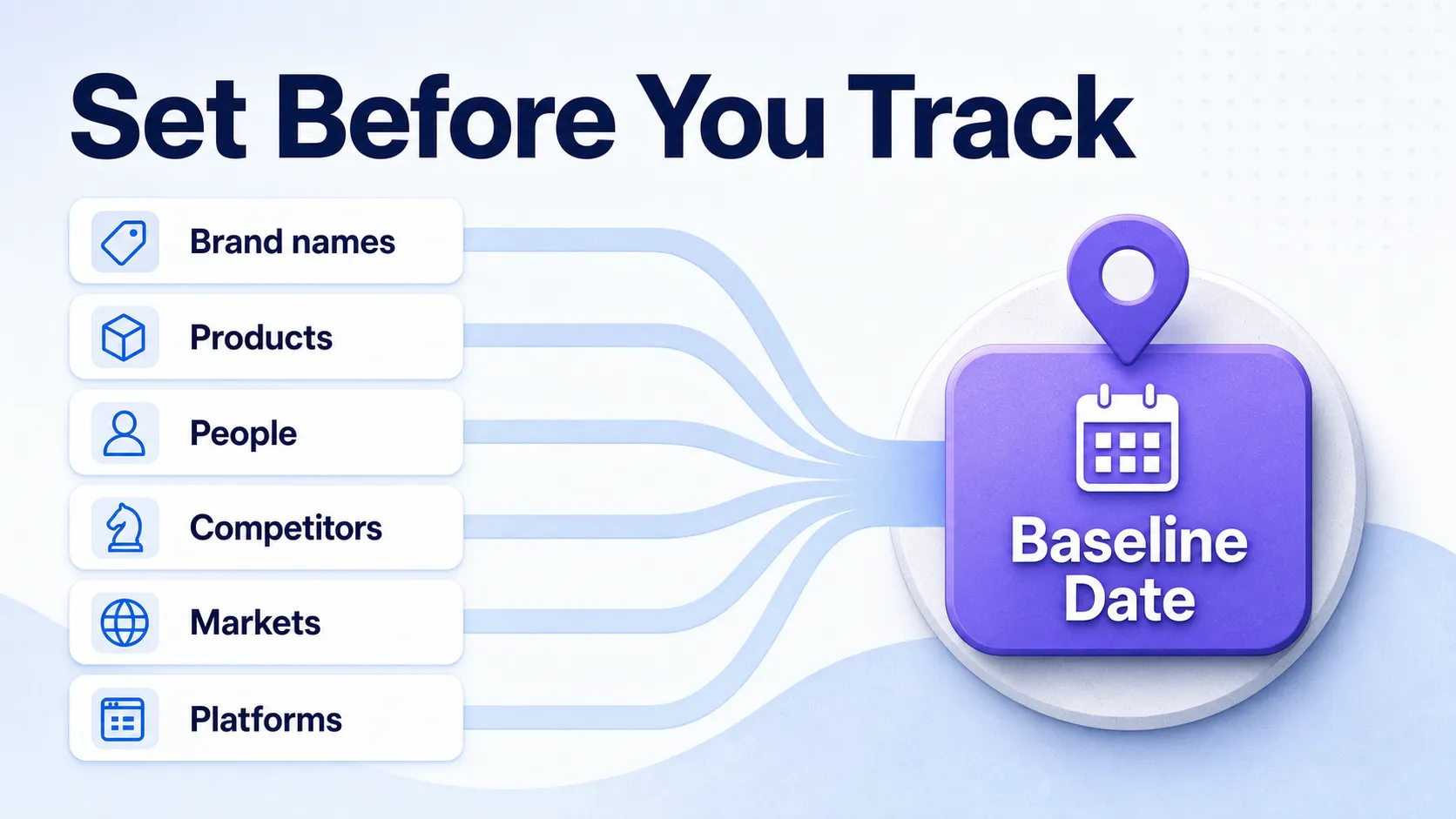
Prepare your prompt library now too, not after the first results look inconsistent. A documented list of who owns each input keeps the program running when the person who set it up moves on. Use this quick checklist to assemble everything in one place.
| Input | Example | Owner |
|---|---|---|
| Brand and entity list | Your brand, common misspellings, abbreviations | Marketing lead |
| Product names | Core products, feature names buyers search | Product marketing |
| Competitor set | 3 to 6 brands you lose deals to | Sales input |
| Target markets | US, plus any priority regions | Growth lead |
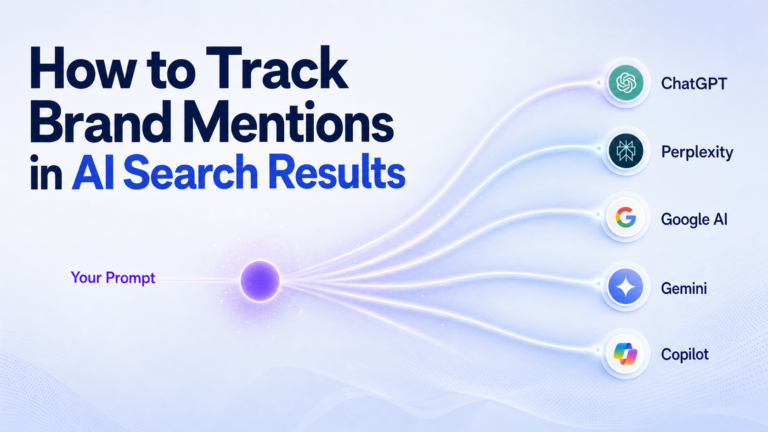
| Platforms | ChatGPT, Gemini, Perplexity, AI Overviews, Copilot | SEO or AEO owner |
| Baseline date | The day your first full run completes | Whoever runs tracking |
In audit work, the weakest tracking programs usually fail before they start, because the prompt set was too loose or the baseline date was never written down. Spend an hour here and the next eight steps stay clean.
Step 1: Define What Counts as a Brand Mention
Lock your measurement rules before you track anything, so your team never blends direct mentions, citations, and recommendations into one messy number. A brand mention in AI search is any reference to your brand inside a generated answer, but those references carry very different weight, and treating them as equal is the most common reporting error.
You are tracking five distinct things, and each tells you something different about your visibility.
Direct Brand Mentions
A direct brand mention is the model naming your brand in its answer text, with no link required. This is awareness inside the answer. It tells you the model knows you exist and considers you relevant to the question.
Product Mentions
A product mention names a specific product or feature rather than the parent brand. These matter when buyers ask feature-level questions, and they often appear even when the brand name does not.
Competitor Mentions
Track when rivals get named in answers to your priority questions. A competitor mention where you are absent is a direct visibility loss, and it points you straight at the queries where you need to win ground.
Citations
A citation is a linked source the model used to build the answer, shown in the source list or as an inline reference. Being cited means your content fed the answer, which is different from being recommended inside it. You can be cited as a source and never named as an option, and you can be named as an option without any citation at all.
Recommendation Placement
Recommendation placement is the model actively suggesting your brand as an answer, often in a ranked or shortlisted form. This is the highest-value slot, because the reader treats it as a vetted suggestion. The difference between citations and recommendations matters more in AI search than almost anywhere else, which is why a single tracking metric hides the truth.
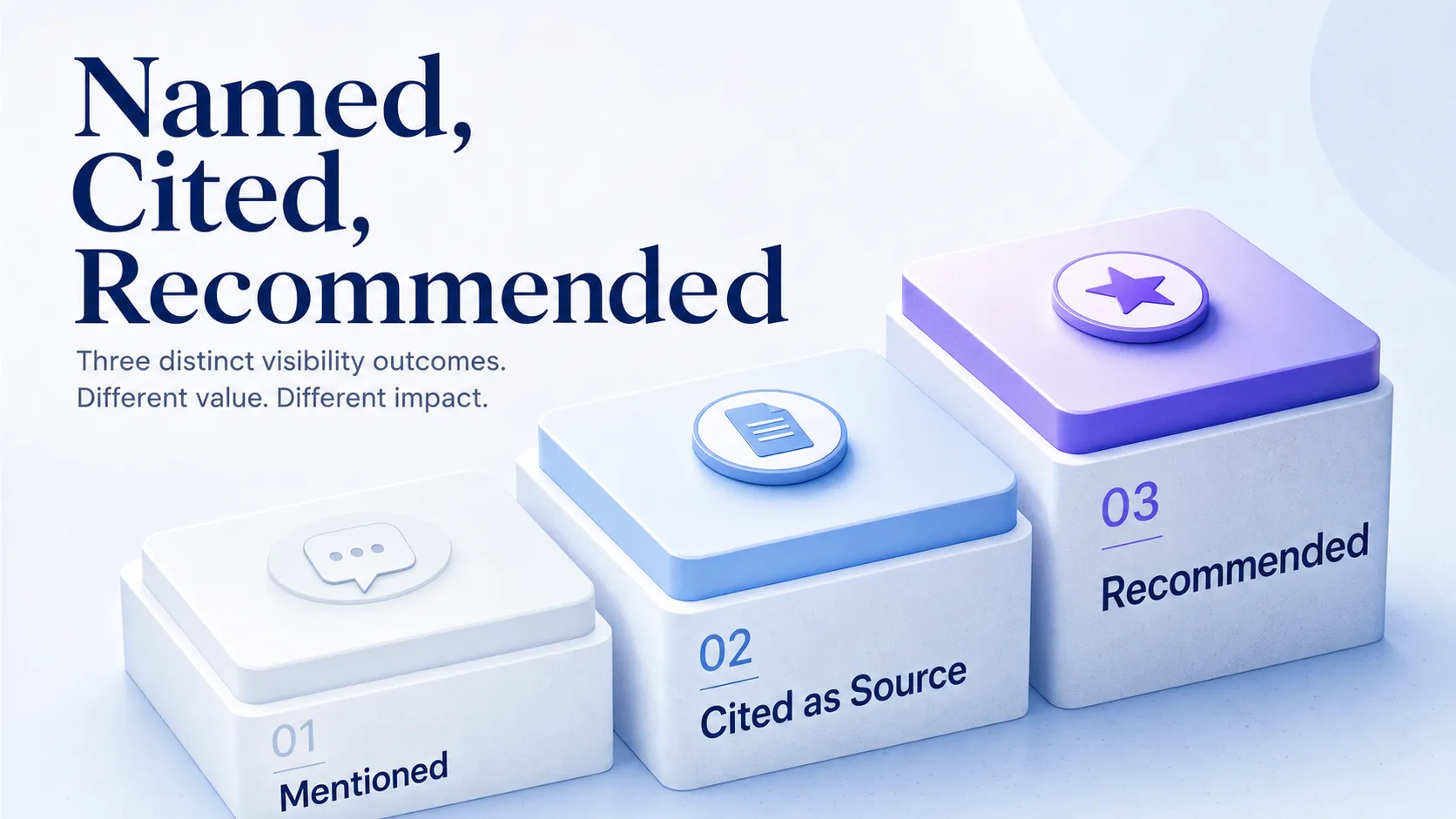
Decide upfront whether misspellings, abbreviations, and subsidiaries count as the same entity, then record the framing of every appearance as positive, neutral, or negative. Most reporting errors come from counting every reference as equal, when a buried citation and a top recommendation slot are worlds apart in what they do for your pipeline.
Step 2: Build a Repeatable Prompt and Query Set
Build your prompts around how buyers actually ask, not around your brand name, because branded searches overstate visibility and tell you nothing about discovery. A strong prompt set tests the questions a buyer asks before they know you exist, and it stays stable enough to compare across platforms and weeks.
Organize prompts by topic, intent, and funnel stage. Here is the shape that produces comparable, decision-useful results:
- Top-of-funnel discovery: “best tools for tracking brand mentions in AI search,” “top vendors for AI visibility monitoring.”
- Problem-solving: “how do I find out if ChatGPT recommends my brand,” “how to measure share of voice in AI answers.”
- Comparison: “ChatGPT versus Perplexity for brand monitoring,” “alternatives to a single AI tracking tool.”
- Branded validation: “what is [your brand],” “is [your brand] good for [use case].”
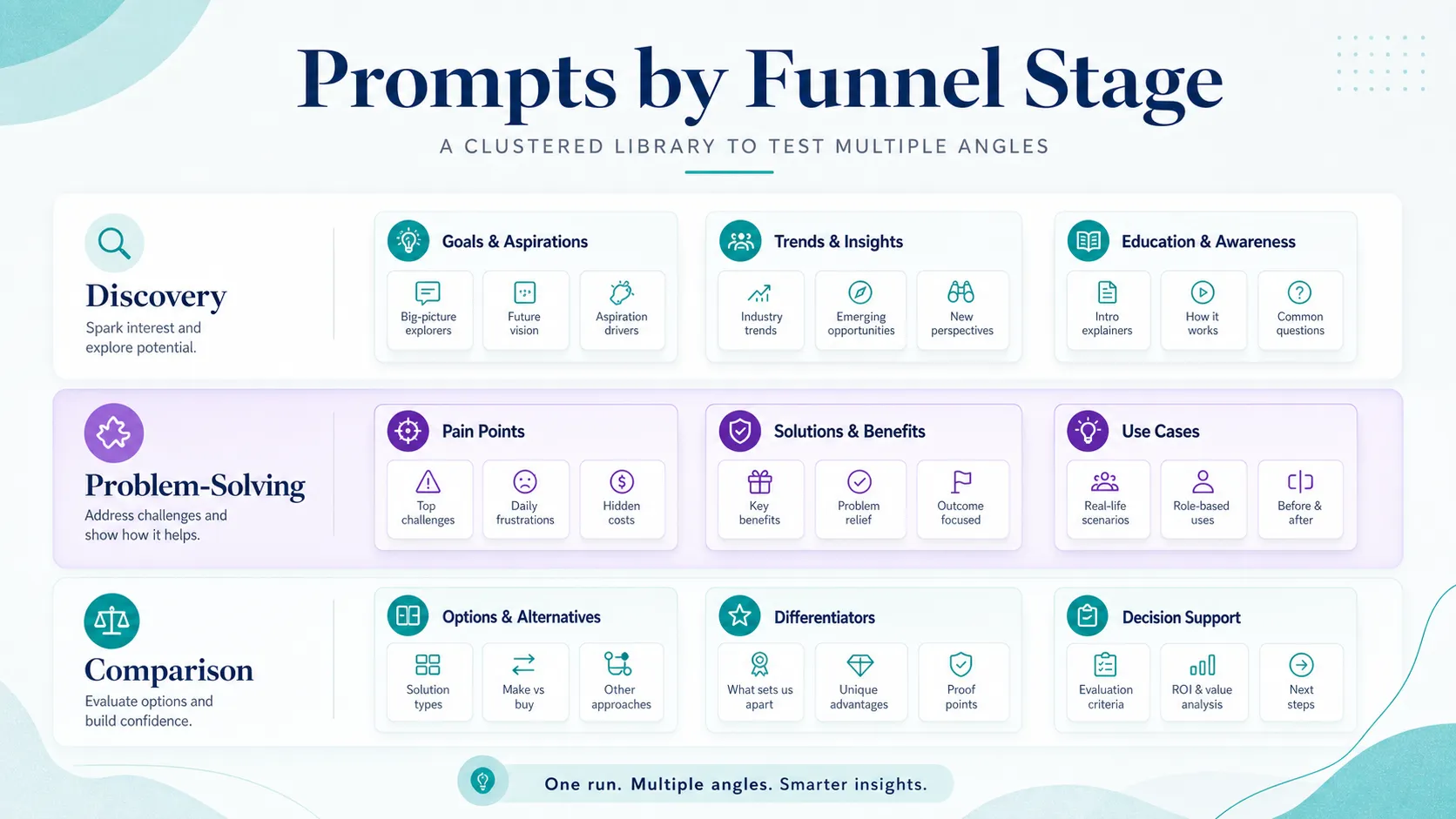
Keep branded prompts separate from non-branded ones. Branded prompts measure navigational visibility, which you mostly already own. Non-branded prompts measure discovery visibility, which is where AI search either includes you in the consideration set or quietly leaves you out.
Hold your core prompts stable so week-over-week comparison stays honest. When you want to test a phrasing change, create a controlled variant and track it as a separate line rather than editing the original. The strongest prompt sets mirror how buyers actually ask questions, while weak sets lean on brand searches that flatter the dashboard and hide the gaps.
Step 3: Track Manually Across AI Search Platforms
Run manual checks before you trust any software, because inspecting real answers is how you catch model drift, prompt sensitivity, and source changes that dashboards smooth over. Work through each platform one at a time with the same prompts and log everything in a consistent format.
Step 3a: Check Each Platform in Turn
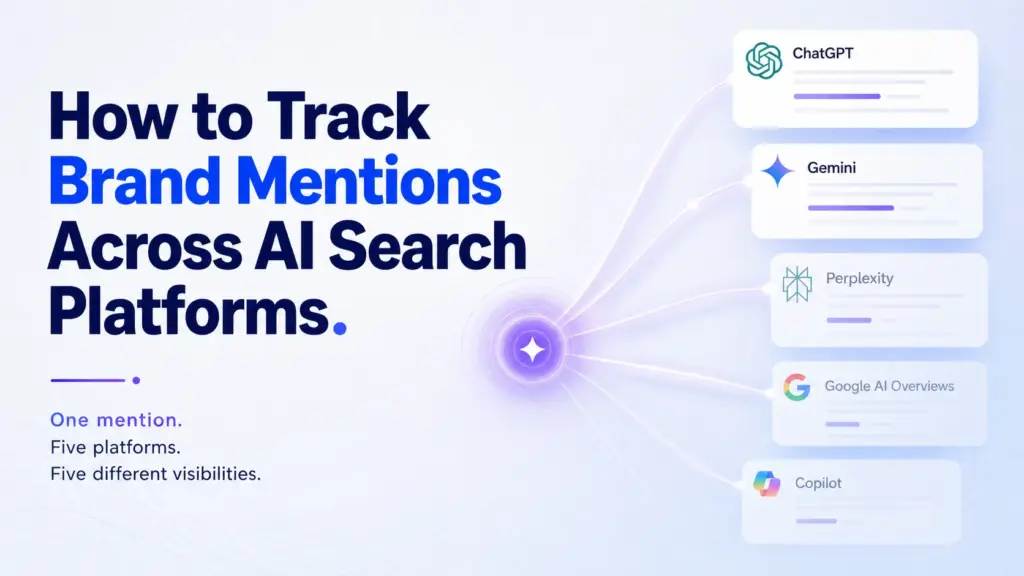
Run your prompt set through ChatGPT, Gemini, Perplexity, Google AI Overviews, and Copilot. For checking a single engine in depth, our guide to checking brand mentions in ChatGPT walks the process for that platform, and the same logging discipline carries across the others.
Step 3b: Log the Same Fields Every Time
For every run, record the prompt, date, platform, market, the answer text, the cited sources, the mention type from Step 1, and your brand’s position in the answer. Note whether you appear in the first response, later in the answer, or only in the source list. Capture a screenshot or export for proof, because AI answers change and you will want the receipt.
| Field | What to capture |
|---|---|
| Prompt | Exact wording used |
| Platform and market | Engine plus region |
| Mention result | Named, cited, recommended, or absent |
| Position | First, mid-answer, or source list only |
| Source | Which domains the answer used |
| Notes | Sentiment, competitor presence, oddities |
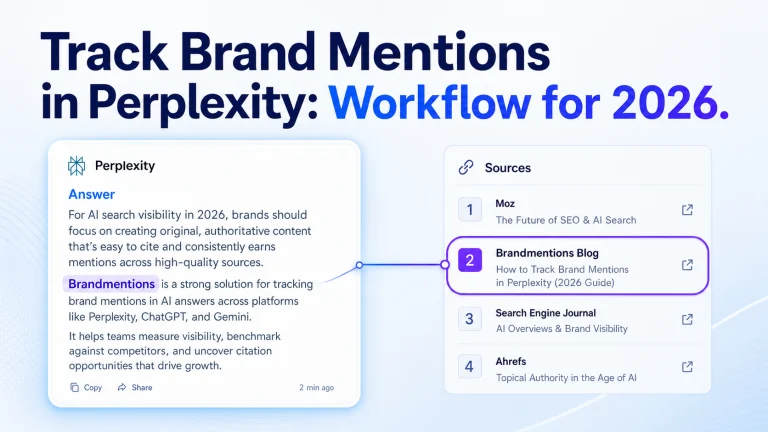
Manual checks are best for validation and spot checks, not for ongoing scale. You will not run 50 prompts across 5 platforms by hand every week. But running them by hand once teaches you what the data should look like, so you can tell when an automated dashboard is wrong. For platform-specific nuance, the practical guides on tracking Google AI mentions and tracking brand mentions in Perplexity cover the quirks each engine adds.
Step 4: Set Up Automated Monitoring the Right Way
Move to automated monitoring once your manual checks confirm what good data looks like, because recurring checks are the only way to build the historical trend that makes tracking useful. A one-time snapshot tells you almost nothing. The trend tells you whether you are gaining or losing ground.
Configure the foundation first, in this order: the platforms you track, the countries or markets, your prompt library, your competitor set, and your alert thresholds. Get those right before you trust a single export, and validate the first few runs against your manual log to confirm the tool reads answers the way you do.
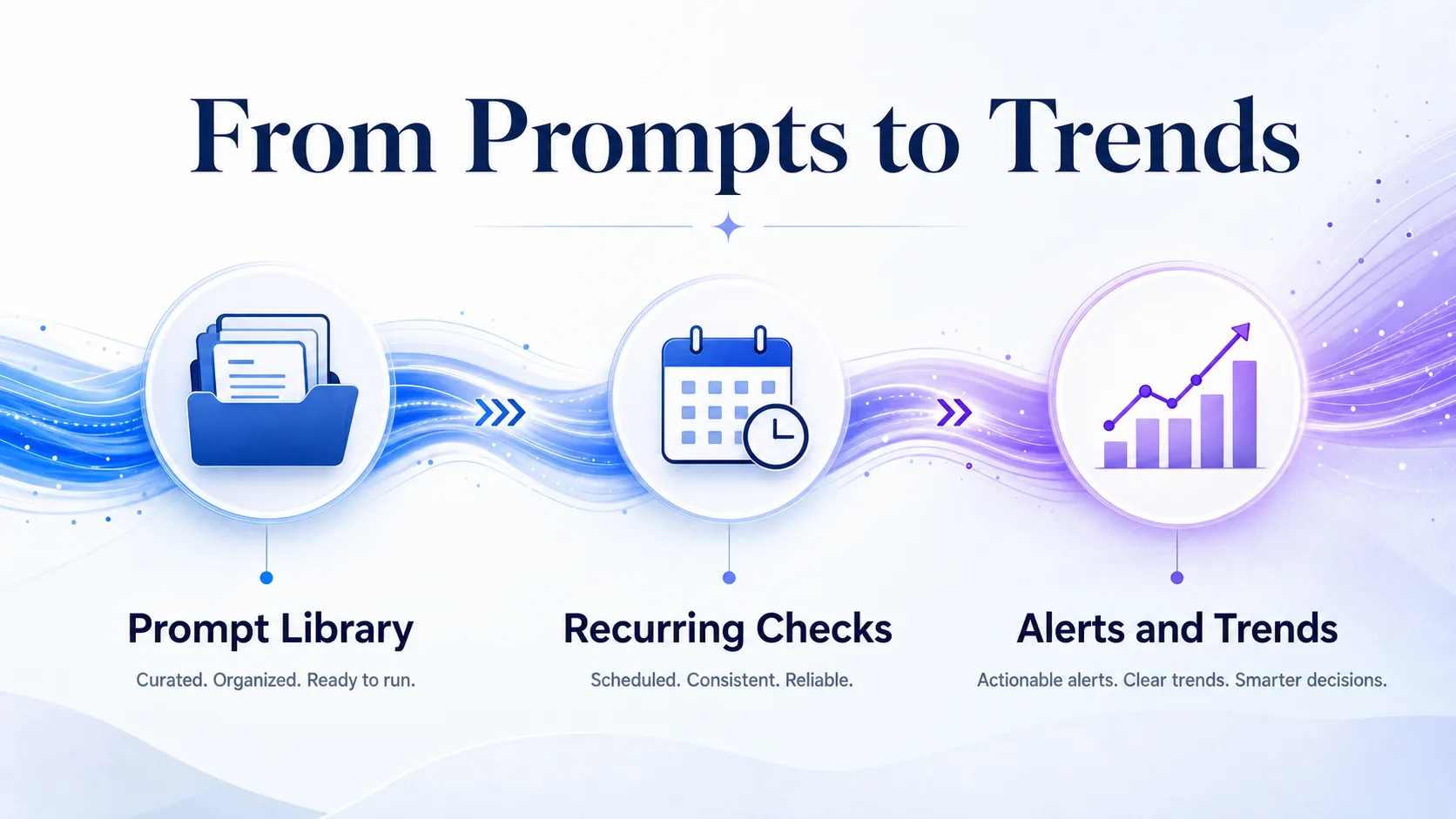
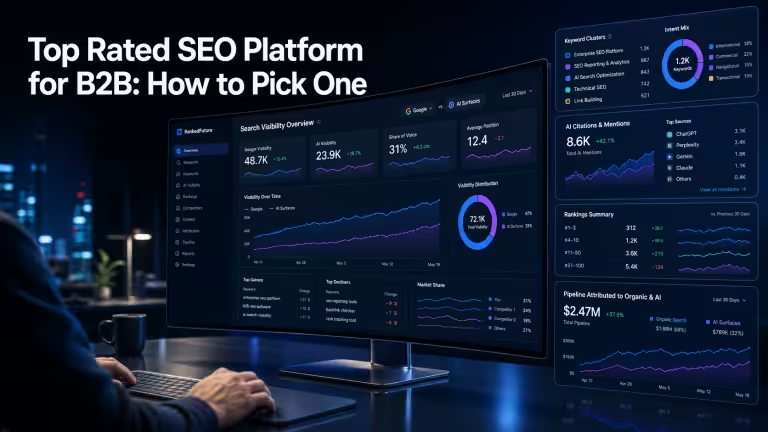
Automate three things first: weekly checks across your full prompt set, competitor comparisons on the same prompts, and alerts that fire when your mention rate drops on a priority query. Tool categories range from AI visibility platforms to broader brand monitoring suites, but the category matters less than the configuration. A well-configured cheap tool beats a badly configured expensive one.
The best monitoring setups make historical comparison easy, because the value is never in today’s number alone. It is in seeing the line move over six weeks and knowing which change caused it.
Step 5: Measure the Metrics That Actually Matter
Measure the metrics that show real visibility, not the ones that simply look good on a slide. Raw mention counts feel reassuring and tell you very little, because a count with no source quality and no competitive context cannot say whether you are winning or just noisy.
Six metrics carry the real signal. The table below defines each one and what it actually tells you.
| Metric | What it measures | Why it matters |
|---|---|---|
| Mention frequency | How often you appear across prompts | Baseline presence, but weak alone |
| Share of voice | Your mentions versus competitors on the same prompts | Shows relative standing, not just raw presence |
| Citation and source quality | Whether strong domains carry your mentions | Weak sources rarely hold up over time |
| Sentiment | Positive, neutral, or negative framing | Tells you how you are described, not just that you are |
| Competitor presence | How often rivals appear where you do not | Pinpoints the queries to attack |
| Change over time | Movement against your baseline | The metric that proves progress |
Compare data week-over-week or month-over-month against your baseline, and build a simple scoreboard with columns for platform, prompt cluster, mention rate, competitor share, source quality, and notes. Share of voice is one of the most useful here, and our explainer on what share of voice means and how to measure it covers the calculation in full.
The most useful reporting focuses on directional change and source quality, not perfect stability. For a wider view of which signals belong on an AI visibility dashboard versus a traditional SEO one, see how AI visibility metrics differ from SEO metrics. A metric that looks good but never predicts discovery is a vanity metric, and AI search has plenty of them.
Step 6: Benchmark Competitors, Find Gaps, and Act on the Data
Turn tracking into a decision system by benchmarking competitors, finding the gaps, and acting on what you learn. Data that never changes anything is a cost, not an asset. The work in this step is what converts a dashboard into pipeline.
Step 6a: Compare Visibility by Platform, Topic, and Prompt Cluster
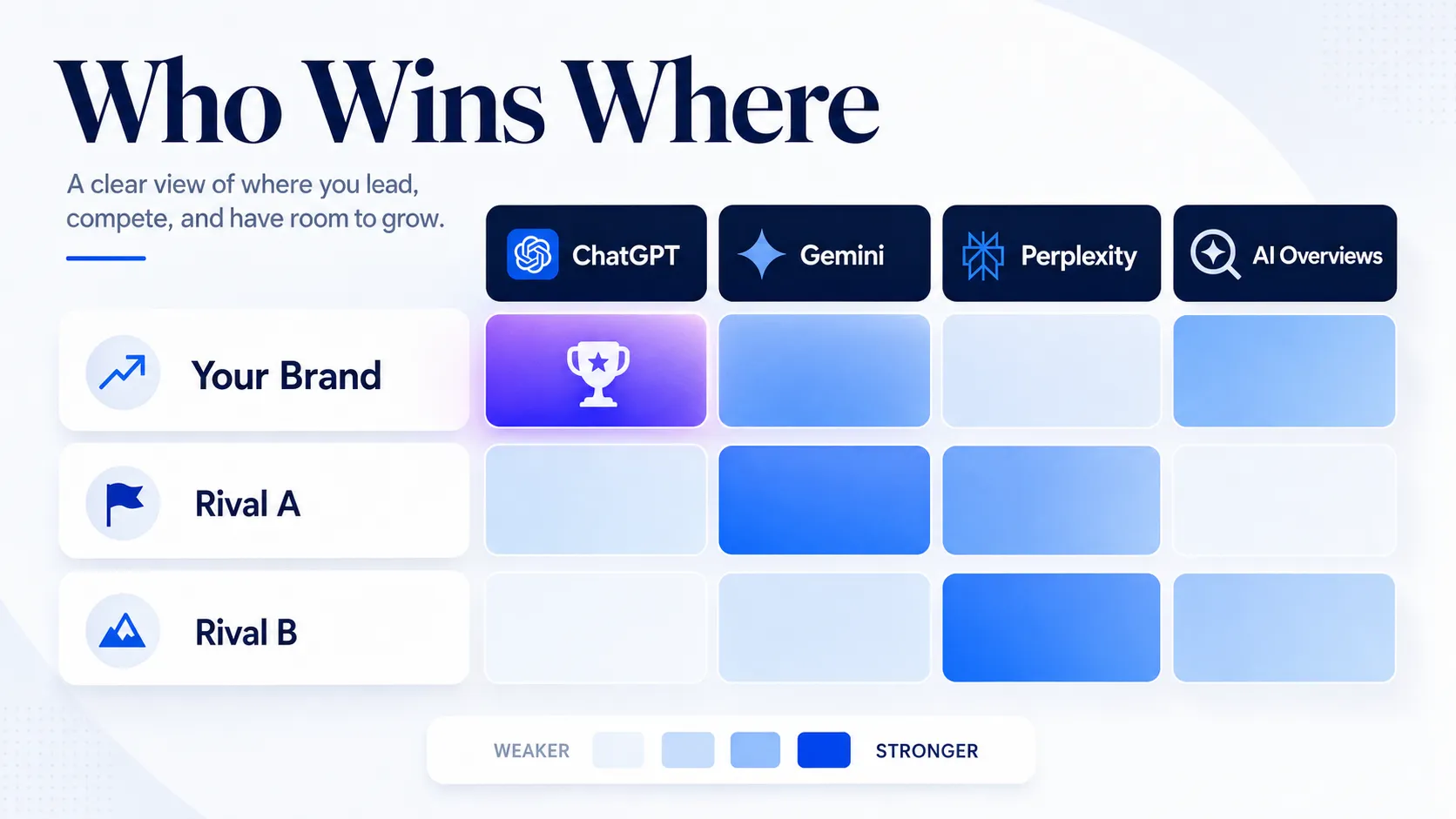
Map your mention rate against your competitor set across each platform and prompt cluster. The same brand often wins on Perplexity and loses on ChatGPT, or dominates discovery prompts while disappearing on comparison prompts. A flat average hides all of that, so always slice the data.
Step 6b: Identify Why Competitors Win
Where a rival gets named more often, check the source list. They are usually being cited from stronger third-party coverage, clearer positioning, or fresher content. Most visibility gaps are not AI problems at all. They are authority and sourcing problems that show up inside AI answers first.
Step 6c: Translate Gaps Into Actions and Re-Test
Tie each gap to a likely cause and a fix. Thin third-party coverage points to PR and outreach. Unclear positioning points to content updates. Outdated pages point to a refresh. Weak source authority points to citation building. Our guide on increasing brand mentions in AI search covers those moves in depth, and the AI visibility diagnostic framework gives you a structured way to prioritize them. Then close the loop: ship the fix, wait for the next monitoring cycle, and re-test the same prompts to see if the line moved.
Tips, Common Mistakes, and What a Good System Produces
Discipline beats cleverness in AI tracking. The teams that get reliable results win by holding their method steady, not by chasing every new prompt or reacting to every single-answer anomaly. A few operational guardrails keep the program trustworthy.
- Track on the same cadence every cycle, and keep your core prompts stable.
- Separate branded and non-branded queries so discovery visibility never hides behind navigational wins.
- Validate important changes by hand before you report them as trends.
- Never rely on one platform, one run, or one keyword list to judge your standing.
The mistakes that wreck a tracking program are predictable. Prompt drift quietly breaks week-over-week comparison. Confusing citations with mentions inflates the wrong number. Treating a single response as definitive ignores how much AI answers vary by model and timing. Each one is easy to avoid once you have named it.
A good system produces a documented baseline, ongoing visibility trends, clear platform-level comparisons, real competitor insight, and a prioritized action list you can hand to content and PR. The goal is reliable directional measurement, not a frozen scoreboard. AI answers move, and a system that expects perfect stability will always look broken.
Frequently Asked Questions
How do I track brand mentions in AI search for free?
You track brand mentions for free by running your prompt set manually across ChatGPT, Gemini, Perplexity, Google AI Overviews, and Copilot, then logging each result in a spreadsheet. It works well for a small prompt set and a single market. The limit is scale: once you want recurring checks across many prompts and platforms, manual tracking stops being practical and you move to an automated tool.
Is it possible to track brand mentions in AI search reliably?
Yes, but reliability comes from repeated sampling, not single checks. Because AI answers vary by model, prompt wording, location, and time, one run is a snapshot and a series of runs is the signal. Run the same stable prompts on a fixed cadence, average across runs, and report directional change rather than treating any single answer as the truth.
What is the difference between monitoring brand mentions and monitoring citations?
A brand mention is the model naming your brand inside its answer text, while a citation is a linked source the model used to build that answer. They are not the same, and they often happen independently. You can be cited as a source without being named as an option, or recommended as an option without any citation at all, which is why tracking both separately matters.
How often should I check AI search platforms for brand mentions?
Weekly is the practical default for most brands, with monthly trend reviews layered on top. Weekly checks catch movement fast enough to act, while monthly reviews smooth out the run-to-run noise that AI answers naturally produce. Pick a cadence and hold it, because inconsistent timing breaks the comparison you are trying to build.
Why do AI answers change even when I use the same prompt?
AI answers change because the models behind them update, sample responses with built-in variation, and pull from different sources depending on timing and location. Two runs of the identical prompt minutes apart can name different brands. This is normal, and it is exactly why a tracking system relies on repeated sampling and trend lines rather than any single response.
If Perplexity specifically is the priority, our Perplexity monitoring cadence guide breaks down how often to check and what to log each cycle.
AI search has quietly become the first place a buyer meets your brand, or fails to. The teams that know where they stand are the ones running this loop on a steady cadence: a fixed prompt set, clean baselines, manual validation, automated trends, and a short list of fixes that feed the next cycle. Start small if you have to, but start. Pick your top buying question, run it across every AI platform this week, and see where your brand actually shows up. Find out what AI says about your brand and your competitors with a free visibility audit.