
Brand mentions in AI search are harder to track than Google rankings because the answer can change with the model, the prompt, and the source set. Ask ChatGPT the same buying question twice and your brand might appear once and vanish the next time. So a single check tells you almost nothing.
The best setup for most teams is one lightweight manual method paired with one dedicated AI visibility platform: the manual layer catches volatility week to week, and the platform catches scale, citations, and competitor movement across ChatGPT, Perplexity, Gemini, Microsoft Copilot, and Google AI Overviews.
This guide ranks seven ways to do it, scores them on the criteria that actually matter, and shows which combination fits your team size and budget.
Why Brand Mentions in AI Search Aren’t the Same as Social Mentions
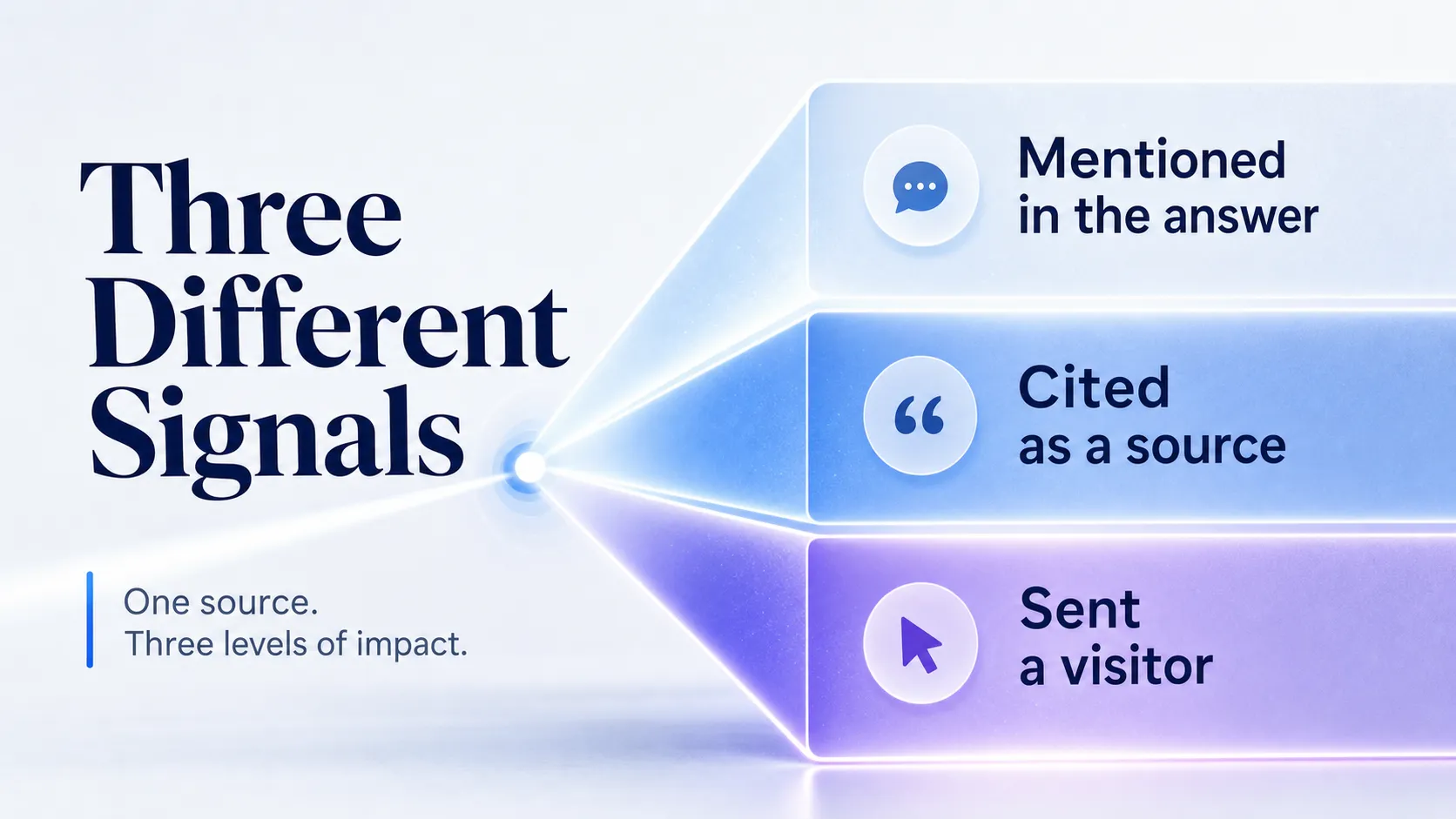
Before you compare methods, separate four things people lump together. They carry different value, and a tool that nails one often misses the others.
An AI mention is your brand name appearing inside an AI-generated answer, with or without a link. If someone asks Perplexity for the best brand monitoring tools and your name shows up in the prose, that’s a mention.
An AI citation is the source the answer links to or attributes. The engine pulled a claim from a page and pointed at it. You can be mentioned without being cited, and cited without being mentioned, because the engine may name you while linking to a third-party roundup that ranked you.
An AI referral is a session that lands on your site from an AI surface, the kind you see in analytics. That’s the business-impact layer. Being named in an answer feels good, but the click is what shows up in pipeline.
Social mentions are different again. Posts on Reddit, X, LinkedIn, and forums can feed AI answers, since models lean on community discussion, but a Reddit thread about your brand isn’t AI search visibility on its own. It’s an input, not the output.
AI visibility is volatile by design. Prompt wording shifts the answer.
Model versions update. Geography changes the source set.
Citation policies differ between engines. The pattern most teams hit first: a “visible” AI mention sends no traffic, while the cited source gets the click instead, and that’s the moment they realize mentions and referrals need separate tracking.
If you want the full breakdown of how citations actually drive visibility, how brand mentions work in AI search covers the mechanics.
How We Ranked the Best Ways to Track Brand Mentions in AI Search
This ranking is evaluated, not random. Each method scored against six criteria, and coverage and accuracy weighed heavier than price for teams that need reporting they can defend.
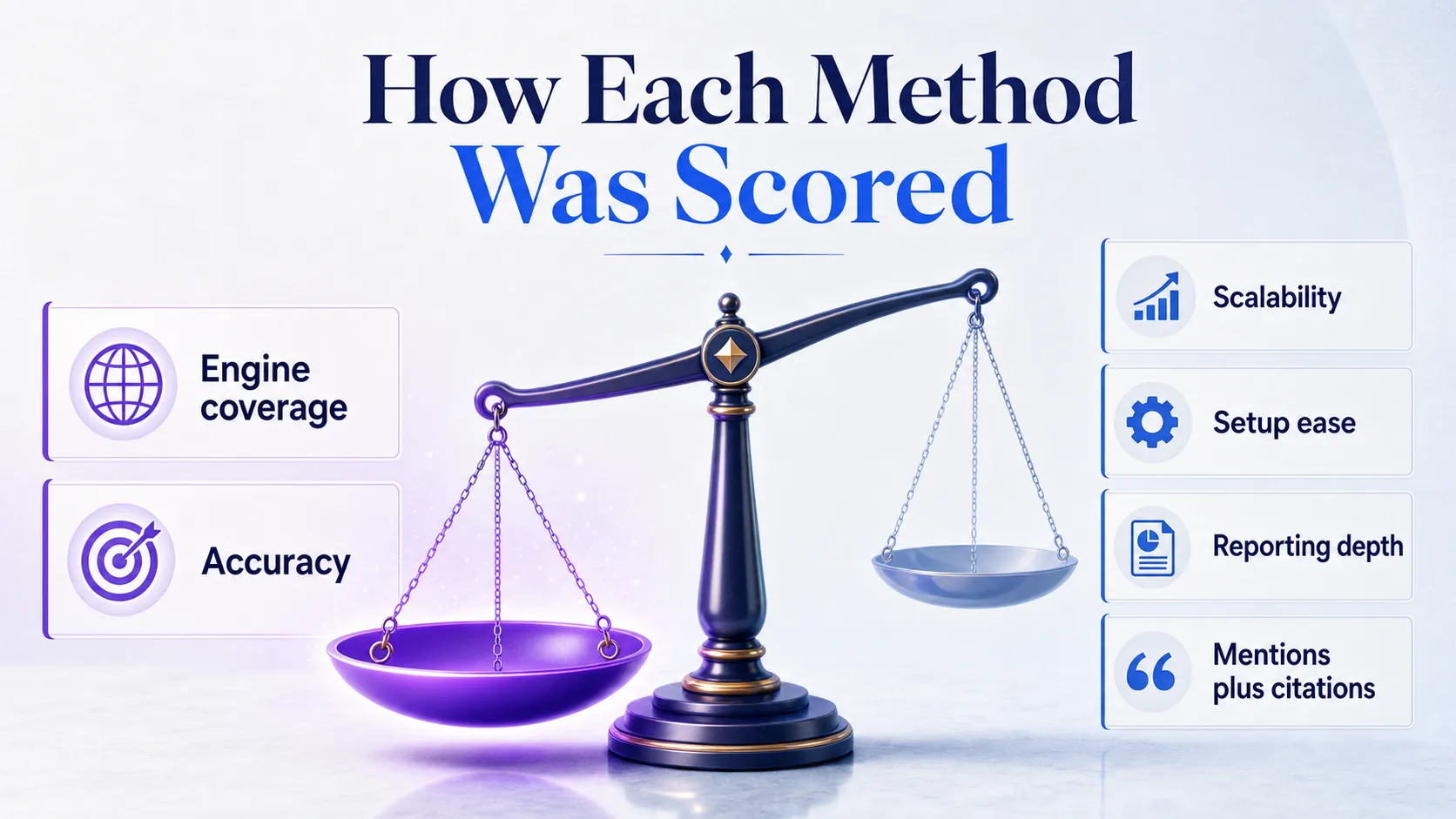
The six criteria: coverage across AI engines, accuracy and false-positive resistance, scalability, ease of setup, reporting depth, and whether the approach tracks both mentions and citations. A method that looks broad but can’t handle repeated prompt sampling or false-positive cleanup wastes more time than it saves.
The biggest disqualifier is repeatability. If you can’t run the method on a schedule and export the result into a report, it falls down the ranking no matter how clever it looks in a one-off check.
The strongest methods also separate your brand from competitor mentions and from homonyms, so a tool that flags every “Apple” as your fintech app scores poorly on accuracy.
The 7 Best Ways to Track Brand Mentions in AI Search
Seven methods, ranked for practical usefulness. The list blends software platforms with manual approaches, because the strongest real-world setup combines both. Each entry tells you what it is, why it earns its place, and who it fits, plus one sentence on what it misses so you don’t confuse it with the others.
1. Dedicated AI Visibility Platform: Best for Multi-Engine Tracking
A dedicated AI visibility platform is purpose-built software that runs prompt sets across multiple AI engines and reports mentions, citations, sentiment, and competitors in one dashboard. This is the strongest choice when you need dependable, repeatable coverage across ChatGPT, Perplexity, Gemini, Copilot, and AI Overviews rather than checking each one by hand.
It earns the top spot because it solves the two hardest problems at once: scale and separation. Running the same prompts every week across five engines is tedious manually and nearly impossible to keep consistent, and a good platform also handles entity disambiguation so competitor mentions and homonyms don’t inflate your numbers.
The honest limitation is cost and the learning curve. You still have to choose prompts well, since a broad tool fed weak prompts produces a confident but useless dashboard.
- Best for: in-house SEO teams, agencies, and enterprise brands
- Effort: medium setup, low ongoing
- Time to results: days to a first baseline
- Cost: mid to high
2. Structured Prompt Monitoring: Best for Lean Teams on a Budget
Structured prompt monitoring is a fixed set of buying questions you run on a schedule, logging which engines name your brand in a spreadsheet. It’s the cheapest reliable way to spot model drift, and any solo marketer can start it this afternoon with nothing but a list of prompts and a sheet.
It earns its place because discipline beats tooling at the bottom of the budget. Run the same ten prompts every Monday across ChatGPT and Perplexity, mark a yes or no for each, and within a month you have a trend line nobody handed you.
What it misses is scale and citation depth: it tells you whether you appear, not which sources the engine pulled from, and it falls apart once you need dozens of prompts across five engines.
- Best for: beginners, solo marketers, and lean teams
- Effort: low setup, high ongoing
- Time to results: first signal in one week
- Cost: free
3. Google AI Overviews and AI Mode Tracking: Best for Google-Dependent Brands
AI Overviews tracking watches how Google’s AI surfaces mention and cite brands inside search results. This is search-layer visibility, not social buzz, and it matters most for brands whose discovery still runs through Google even as the answer format changes.
It earns a spot because Google AI Overviews and AI Mode reach an audience the standalone chat tools don’t, and the citation pattern there often differs from ChatGPT or Perplexity. Watch it on its own and you catch shifts that a chat-only tool would never surface.
The catch: it’s one engine, so treating Overviews coverage as your whole AI visibility picture leaves the chat assistants invisible. The AI Overviews mentions tools worth testing handle this layer specifically.
- Best for: brands that depend on Google discovery
- Effort: low to medium setup, low ongoing
- Time to results: days
- Cost: free to mid
4. AI Referral Analytics in GA4 and Server Logs: Best for Attribution
AI referral analytics measures the traffic arriving on your site from AI surfaces, tracked through GA4 referral sources and server logs. This is the business-impact layer, the one that turns “we got mentioned” into “we got visitors.”
It earns its rank because everything else measures presence while this measures outcome. When a finance lead asks what AI search is actually worth, referral sessions and their conversion rate are the answer.
The limitation is real, though: it tells you who clicked, not how often you were named, so a brand cited constantly but rarely clicked will look invisible here while being highly visible inside the answers themselves.
- Best for: teams that need attribution to revenue
- Effort: medium setup, low ongoing
- Time to results: weeks, as referral volume builds
- Cost: free
5. Social Listening and Web Monitoring: Best for Reputation and PR
Social listening monitors Reddit, X, LinkedIn, forums, reviews, and news for brand mentions. It’s a supporting layer, not AI search tracking itself, but it matters because those sources feed the AI answers you care about.
It earns a place because models lean heavily on community discussion and review sites, so a sentiment shift on Reddit today can change how Perplexity describes you next month. Watching the inputs gives you early warning the answer-engine tools can’t.
The distinction to keep clear: a spike in social mentions isn’t the same as a spike in AI citations, and treating them as one is the fastest way to misread your own data.
- Best for: reputation, brand, and PR teams
- Effort: medium setup, medium ongoing
- Time to results: days
- Cost: free to high
6. Competitor Benchmarking Inside AI Answers: Best for Category Leaders
Competitor benchmarking tracks whether rivals get named or cited instead of you in the same category prompts. It reveals share-of-answer gaps and shows exactly which questions to prioritize, since a prompt where three competitors appear and you don’t is a clear target.
It earns its rank because absolute presence means little without context. Appearing in four of ten answers sounds fine until you learn a rival appears in nine.
The one thing it misses is the why: benchmarking shows the gap, not the reason behind it, so you still need citation analysis to learn which sources are carrying your competitors into the answer.
- Best for: agencies and category leaders
- Effort: medium setup, low ongoing
- Time to results: days to a first benchmark
- Cost: mid
7. Dashboarding and Scheduled AI Search Audits: Best for Executive Reporting
Dashboarding combines the other methods into a single view that tracks prompts, mentions, citations, referrals, and trends over time. It’s how you turn scattered signals into a report a leadership team can read in two minutes without buying another platform.
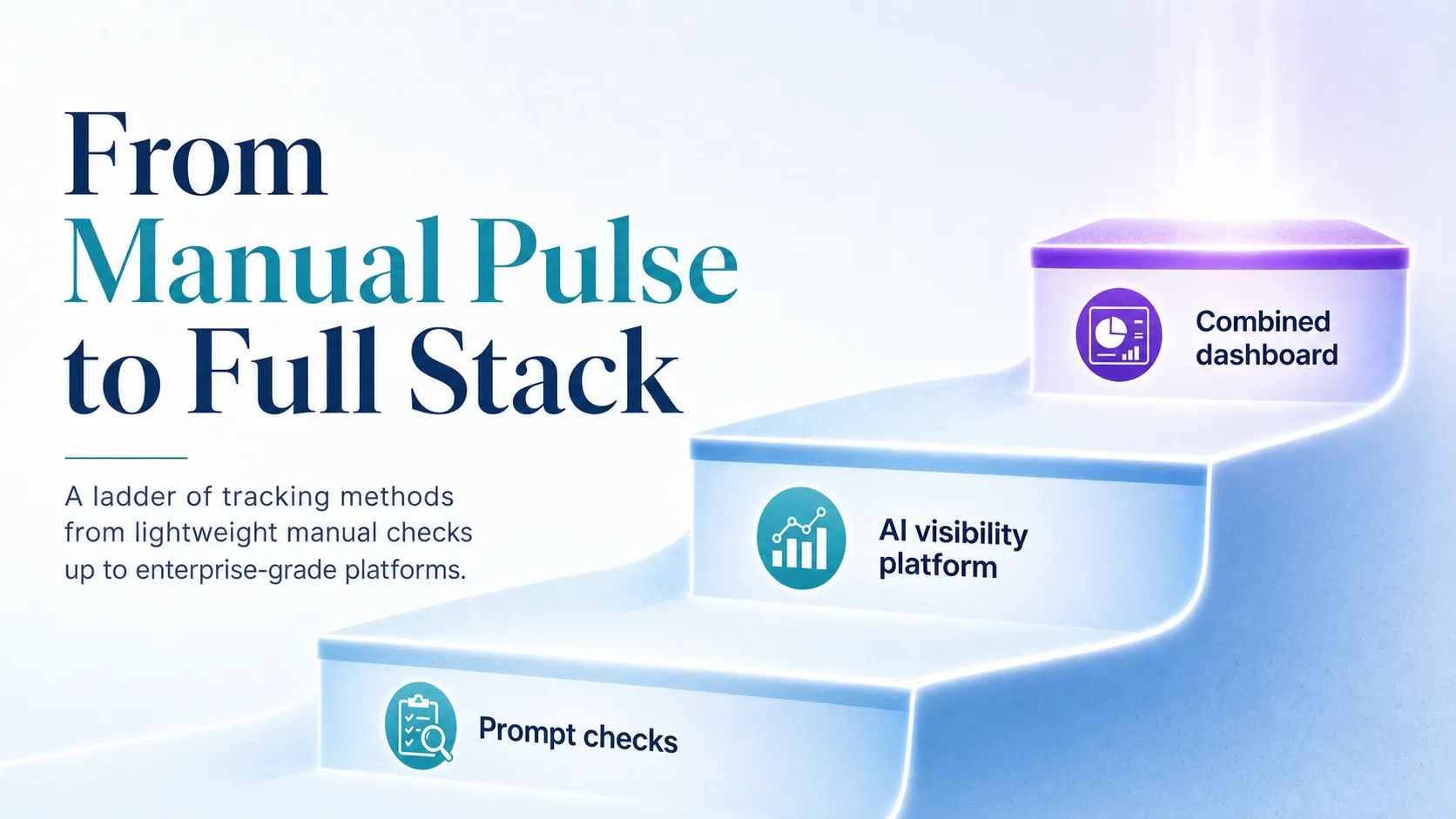
It earns the final spot because the value of every method above compounds when you can see them side by side and watch the trend line move. A scheduled monthly audit catches drift that a one-time snapshot hides.
The limitation is that a dashboard only reflects the quality of its inputs, so a clean chart built on weak prompts or noisy mention data is a confident lie.
- Best for: teams that need executive reporting without a new suite
- Effort: high setup, low ongoing
- Time to results: first report in a week or two
- Cost: free to mid
Comparison Table: Setup, Cost, Coverage, and Reporting
Use this to move from scanning the list to choosing a method. The labels keep it fast: Low, Medium, or High for difficulty and coverage, Free through High for cost.
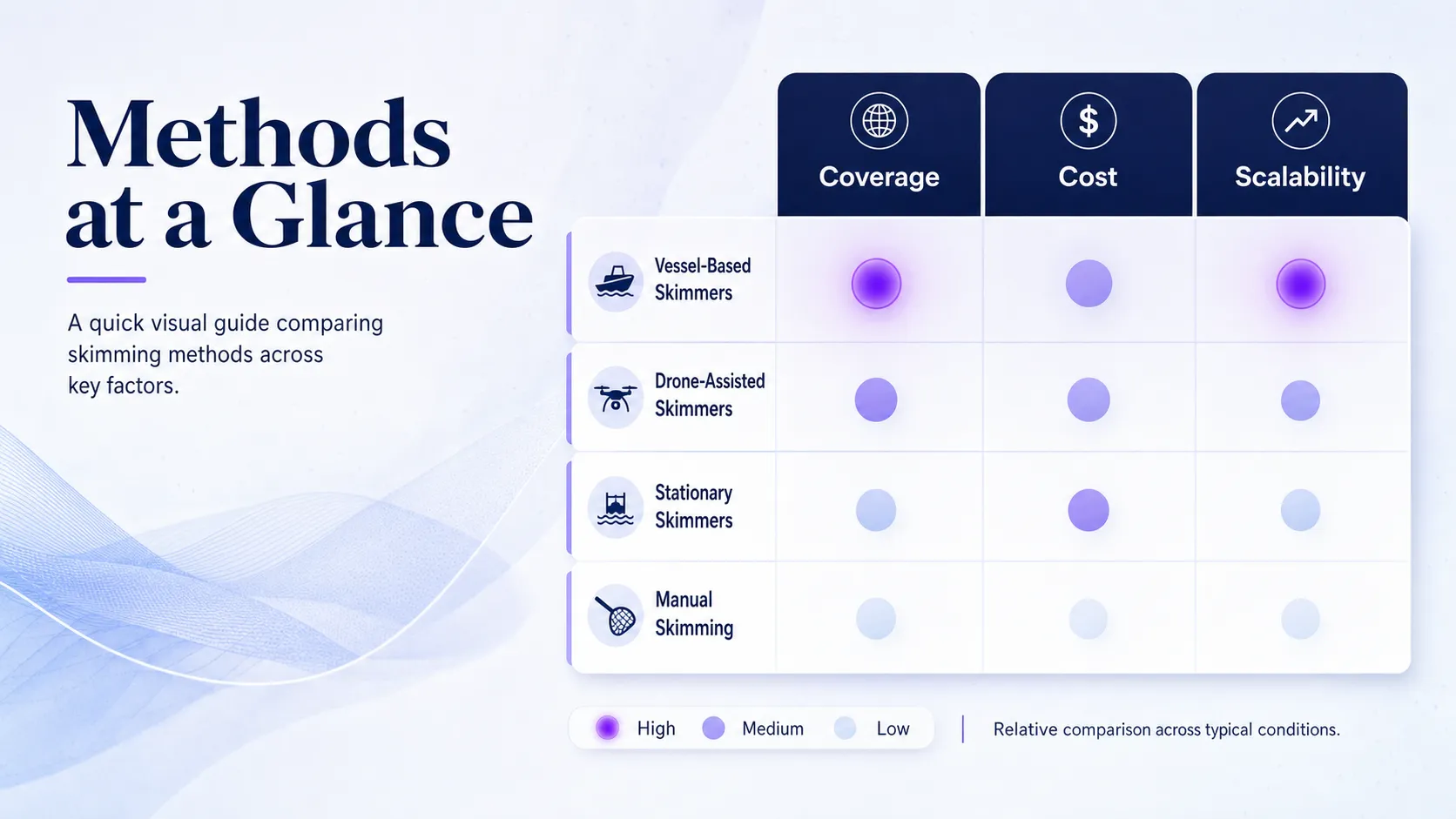
| Method | Setup Difficulty | Cost | AI Engine Coverage | Scalability | Reporting Strength |
|---|---|---|---|---|---|
| 1. AI visibility platform | Medium | Mid to High | High | High | High |
| 2. Structured prompt monitoring | Low | Free | Medium | Low | Low |
| 3. AI Overviews and AI Mode tracking | Low to Medium | Free to Mid | Low | Medium | Medium |
| 4. AI referral analytics | Medium | Free | Medium | High | Medium |
| 5. Social listening | Medium | Free to High | Low | High | Medium |
| 6. Competitor benchmarking | Medium | Mid | High | Medium | High |
| 7. Dashboarding and audits | High | Free to Mid | High | High | High |
Read the table knowing mentions, citations, and referrals are separate columns of value, so a method rated high on coverage may still tell you nothing about who clicked. Compare a few of these head to head in the brand mention monitoring tools comparison before you commit budget.
See where AI answers put your brand
Twenty minutes with a senior strategist: where the major engines point buyers in your category, who gets named instead of you, and a straight read on what a programme would change.
Book a strategy callHow to Choose the Right Tracking Stack by Team Type
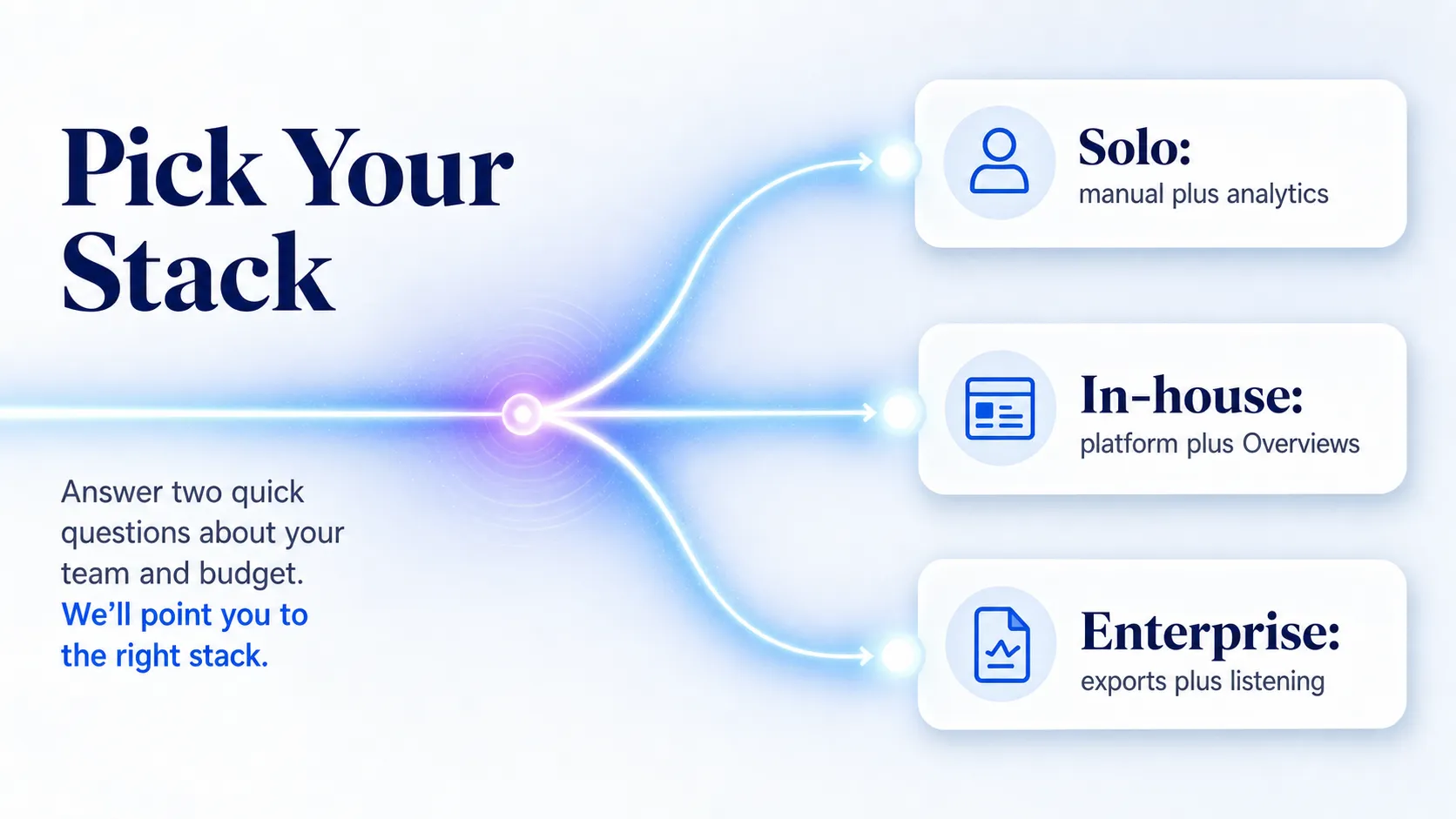
The right combination depends on your team size, budget, and how mature your AI visibility work already is. A two-layer stack, one manual method plus one platform, is the minimum viable setup for serious monitoring. Here’s how that shapes up by team.
Beginners and Solo Marketers
Start with structured prompt monitoring plus broad web monitoring or a Google Alert, then add a GA4 referral check to see whether any AI traffic exists at all. This costs nothing and answers the first real question: are you anywhere in AI answers yet?
Don’t buy a platform until the manual checks show a pattern worth scaling.
In-House SEO and Content Teams
Run a dedicated AI visibility platform alongside AI Overviews tracking so you see mentions, citations, and competitor gaps in one workflow. The citation layer earns its cost here, because content teams need to know which sources carry brands into answers so they can target placements.
Agencies
Prioritize competitor benchmarking and dashboarding, because clients want side-by-side reporting and you need repeatable prompts running across many accounts. A dashboard that produces the same report shape for every client saves more hours than any single tracking feature. Standardize the prompt set once, then reuse it across the book of business.
Enterprise and Regulated Brands
Prioritize tools with exports, permission controls, APIs, and broad monitoring coverage, then pair them with social listening for risk and reputation. Regulated brands can’t treat AI answers as a marketing curiosity, since a hallucinated claim about a financial or health product is a compliance problem, not just a visibility gap.
Coverage breadth matters here: tracking your brand across ten AI engines stops a blind spot from becoming a liability.
Budget-Limited Teams
Choose the method with the best repeatability and false-positive control, not the one with the longest feature list. A free spreadsheet you actually run every week beats an expensive platform you check once a quarter. The discipline is the asset; the tool is secondary until the reporting load forces an upgrade.
2026 Correlation Data Behind These Tracking Methods
The 75,000-brand Ahrefs study gives the clearest evidence yet for prioritizing among these seven methods. YouTube mentions correlate with AI visibility at 0.737, the single strongest signal measured, ahead of every tracking method above except direct AI Overview monitoring.
Branded web mentions follow at 0.66-0.71. Brands in the top 25% for web mentions receive 10x more AI visibility than the bottom 75%.
Practically: teams using only method 5 (social listening) are tracking a weaker-correlated signal than they think; pairing it with structured prompt monitoring (method 2) closes the gap without adding tool cost.
Trackers, Chatbots, and Continuous Coverage
A quick vocabulary note, because buyers search for this in several ways. An AI mention tracker, sometimes called an AI rank tracker, is any platform from method one that logs whether your company gets named in AI-generated answers.
The same tooling covers chatbots such as ChatGPT and Gemini and retrieval engines such as Perplexity, so you rarely need separate products per surface. The same trackers handle brand mentions in LLMs generally, whatever the interface wrapped around the model.
Tracking continuously matters more here than in classic SEO. Generative AI responses shift with model updates and fresh retrieval, so a one-off audit goes stale within weeks.
A weekly or biweekly cadence on a fixed prompt set is the practical definition of continuous coverage, and the same runs capture competitor mentions at no extra cost, so you also see who wins the answers you lose.
Frequently Asked Questions
What are the best ways to track brand mentions in AI search?
The best ways are a dedicated AI visibility platform, structured prompt monitoring, AI Overviews tracking, AI referral analytics, social listening, competitor benchmarking, and a combined dashboard. Most teams get the strongest result from a two-layer stack: one repeatable manual method plus one platform that runs the same prompts across ChatGPT, Perplexity, and Gemini every week.
Is it possible to track brand mentions in AI search?
Yes, brand mentions in AI search are trackable, but the answer is volatile, so reliable tracking needs repeated sampling rather than a single check.
Because the same prompt can name your brand once and skip it the next time, you run a fixed prompt set on a schedule and watch the trend across runs instead of trusting any one response. Platforms automate that sampling across engines; a spreadsheet does it manually.
How do I track brand mentions in ChatGPT?
Track brand mentions in ChatGPT by running a fixed set of buying questions on a schedule and logging whether your brand appears in each answer. Start with the prompts a real buyer would ask, run them weekly, and record yes or no per prompt so you can see drift over time.
A dedicated tool scales this and adds citation and competitor data, which the tools for monitoring ChatGPT mentions handle automatically.
How can I monitor Perplexity brand mentions?
Monitor Perplexity brand mentions by tracking both whether your brand is named in the answer and whether your site is cited as a source, since Perplexity shows its sources openly.
Because Perplexity surfaces citations directly, you can see which pages carry brands into its answers, which makes it a useful place to spot the source gaps you need to close. The guide to monitoring Perplexity brand mentions walks through the setup.
What’s the difference between an AI mention and an AI citation?
An AI mention is your brand name appearing in the generated answer, while an AI citation is the source the engine links to or attributes.
You can be mentioned without being cited, since the engine may name you while linking to a third-party roundup, and you can be cited without being named when your page supplies a fact the answer states in its own words.
Tracking both matters because they tell you different things: one shows visibility, the other shows which sources earn it.
Building Your Two-Layer Tracking Setup
The strongest setup for almost any team is one lightweight manual method plus one dedicated AI visibility tool. Prompt monitoring catches the week-to-week volatility, and the platform catches scale, citations, and competitor movement you can’t watch by hand.
Whether you need more than that depends on one question: are you doing simple mention tracking, or building broader AI search intelligence?
Start small, run the same prompts on a schedule, and expand only when the reporting load or the false-positive rate makes the upgrade worth it. The cleanest operating rhythm most teams settle into is a manual pulse check weekly, a platform dashboard monthly, and a referral review each quarter.
See where your brand stands in AI search by running your top buying question through ChatGPT and Perplexity today, then build the tracking layer around what you find.