
SEO reputation management is the practice of controlling what search engines — and now AI platforms — display when someone looks up your brand. It combines search engine optimization with strategic content development to ensure positive, accurate information occupies the most visible positions across Google, Bing, AI Overviews, ChatGPT, Perplexity, and other discovery surfaces.
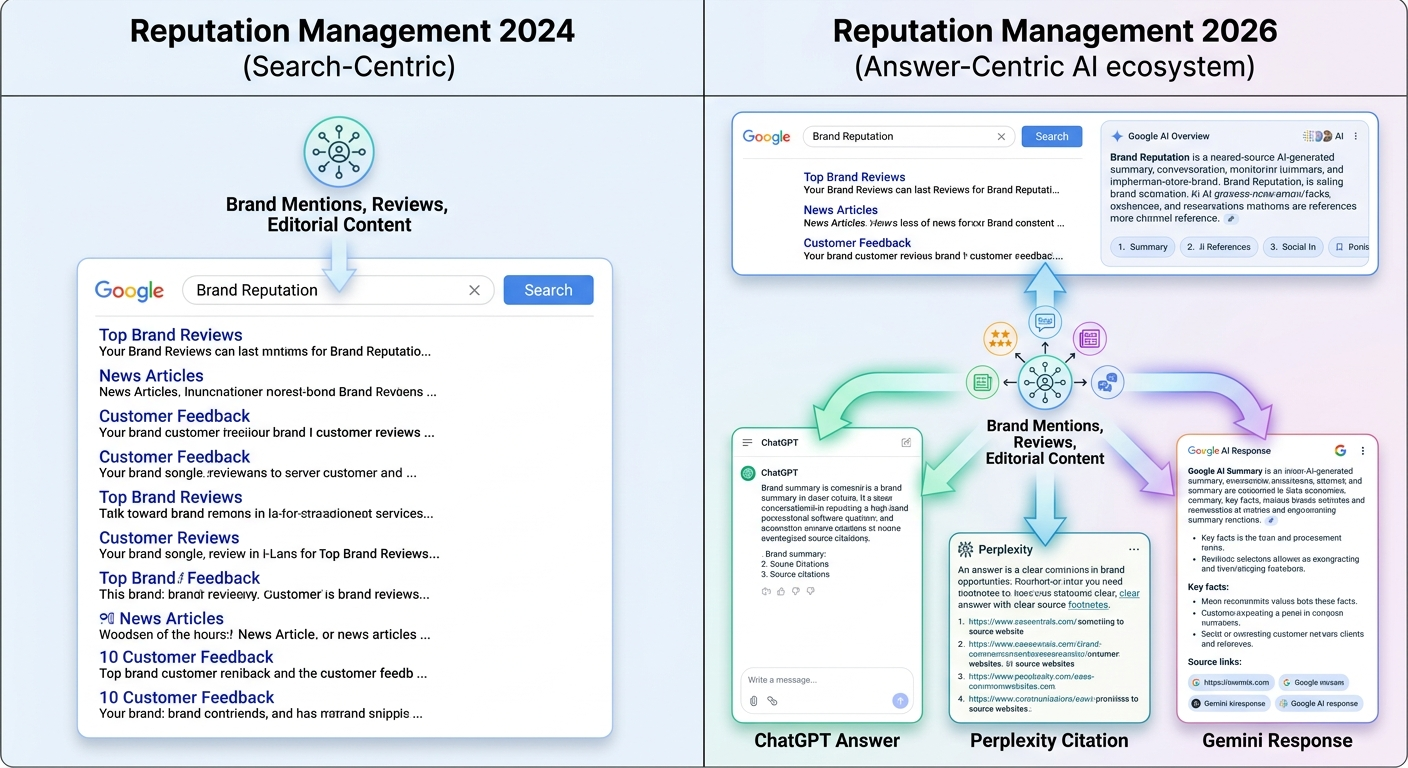
As of 2026, reputation management has changed substantially. AI-generated answers now summarize brand sentiment from dozens of sources in seconds. A single negative article no longer just sits on page one of Google — it gets cited by ChatGPT, surfaced in Perplexity responses, and referenced in Gemini recommendations. The stakes are higher, the surfaces are broader, and reactive strategies no longer work.
This article breaks down how SEO reputation management works in practice — across both traditional search and AI search — with specific steps, real examples, and a framework for prioritizing what matters most for your brand right now.
What You’ll Learn
- Why AI search has fundamentally changed reputation management since 2024
- How to audit your brand’s reputation across Google, AI Overviews, ChatGPT, and Perplexity
- The specific content types that push negative results down — and earn AI citations
- How review signals, entity authority, and editorial mentions interact to shape brand perception
- A prioritization system for deciding where to invest reputation-building effort first
- Common mistakes that make reputation problems worse in AI search
What Has Changed About SEO Reputation Management in 2026?
Traditional SEO reputation management focused on one goal: control page one of Google for your brand name. You optimized your website, claimed social profiles, published positive content, and pushed negative results to page two.
That approach still matters. But it is no longer sufficient.
Three shifts since 2024 have expanded the playing field:
AI Search Summarizes Your Reputation Instantly
Google AI Overviews, ChatGPT, Perplexity, and Gemini do not show ten blue links. They synthesize information from multiple sources and present a single narrative about your brand. If negative content appears in training data or retrieval-augmented generation (RAG) sources, AI platforms will reference it — sometimes without linking to the original page.
According to a 2024 Gartner forecast, traditional search engine volume was projected to drop 25% by 2026 as AI-powered search alternatives gained adoption. That shift means your brand’s reputation is increasingly shaped by AI answers, not just SERP rankings.
User-Generated Content Ranks Higher Than Ever
Google’s increased emphasis on Reddit, Quora, and forum content — visible since the 2024 core updates — means uncontrolled discussions about your brand now regularly appear on page one. AI platforms also draw heavily from these sources when answering brand-related queries.
Entity Authority Determines AI Visibility
Entity authority is the degree to which AI models and search engines recognize your brand as a distinct, credible entity associated with specific topics, products, or categories. Brands with strong entity authority receive more favorable AI citations and higher SERP positions for branded searches.
Building entity authority requires consistent, positive mentions across high-authority editorial sources — not just on your own website. This is where traditional SEO reputation management and brand mentions for SEO converge.
How to Audit Your Brand’s Reputation Across Search and AI
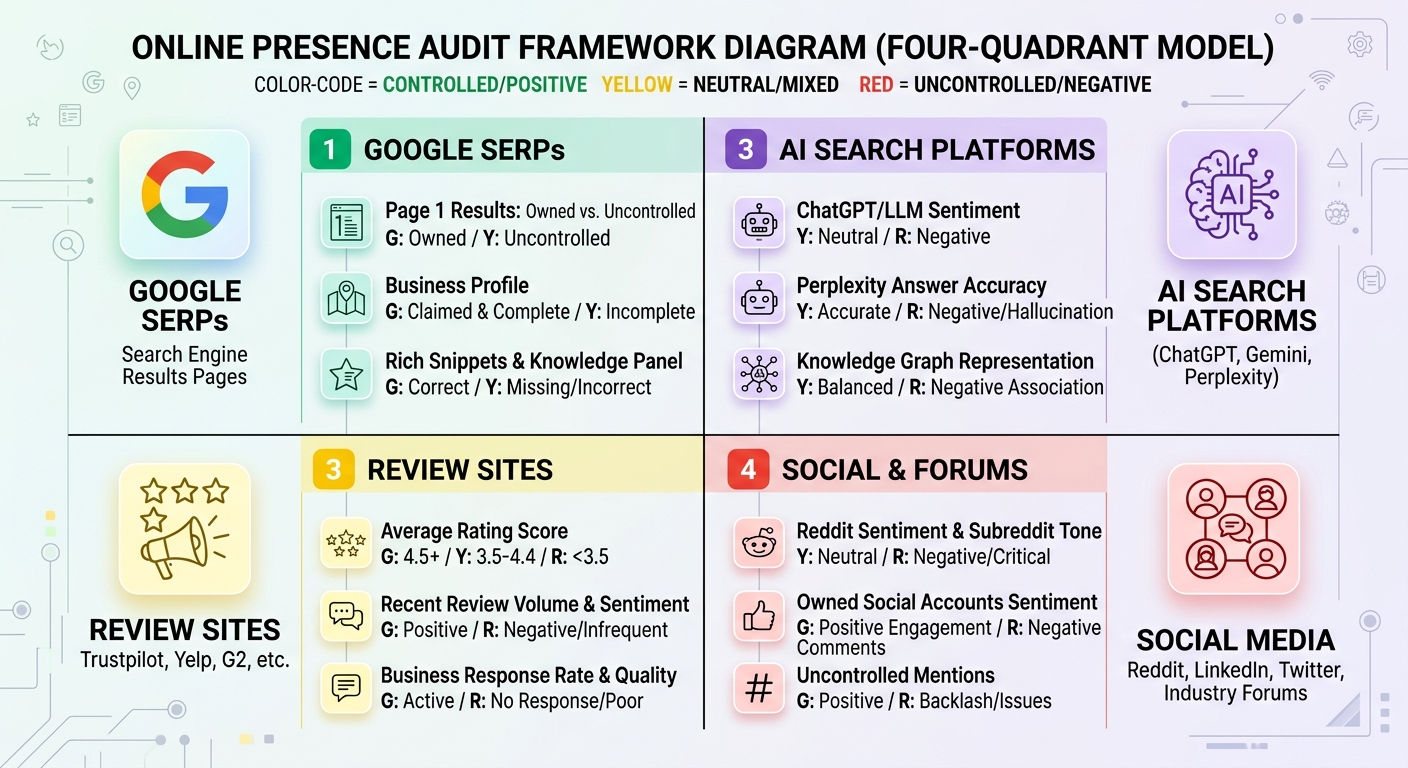
Before building any strategy, you need an accurate picture of what people — and AI — see when they search for your brand. A thorough reputation audit covers four surfaces.
Step 1: Audit Google SERPs for Branded Queries
Search for your brand name on Google in an incognito window. Then search for variations:
- [Brand] reviews
- [Brand] complaints
- [Brand] vs [competitor]
- Is [Brand] legit
- [Brand] pricing
For each query, document every result on page one. Categorize each as owned (your website, social profiles), earned (positive press, favorable reviews), or uncontrolled (negative reviews, forum threads, competitor content). Note which results appear in the People Also Ask section — these indicate the follow-up questions searchers have about your brand.
Step 2: Audit AI Search Responses
Ask ChatGPT, Perplexity, Gemini, and Copilot direct questions about your brand:
- “What do people think about [Brand]?”
- “Is [Brand] a good choice for [your category]?”
- “What are the pros and cons of [Brand]?”
- “Compare [Brand] to [competitor].”
Record each AI response verbatim. Note which sources each platform cites. If an AI platform mentions negative sentiment, trace it back to the source content. This tells you exactly which pages, reviews, or discussions are shaping your AI reputation.
Tools designed to check if AI mentions your brand can automate this process across multiple platforms and prompts.
Step 3: Audit Review Platforms
Check your ratings and recent review trends on Google Business Profile, G2, Capterra, Trustpilot, Yelp, and any industry-specific review platforms. Pay attention to:
- Average star rating and whether it trends upward or downward
- Recency of reviews — stale profiles with old reviews signal inactivity
- Common themes in negative feedback
- Whether you are responding to reviews consistently
Step 4: Audit Social and Forum Mentions
Reddit threads, X (Twitter) discussions, LinkedIn posts, and niche forums increasingly appear in both Google results and AI responses. Use brand monitoring tools to identify where your brand is being discussed and what sentiment those discussions carry.
Document everything in a single audit spreadsheet. The goal is a clear map of your reputation landscape — where you are strong, where you are vulnerable, and which surfaces carry the most risk.
Which Content Types Strengthen Your Reputation in Both Search and AI?
After an audit, most brands discover gaps — queries where they do not control the narrative. The fix is strategic content creation, targeted at the specific keywords and questions where your reputation is weakest.
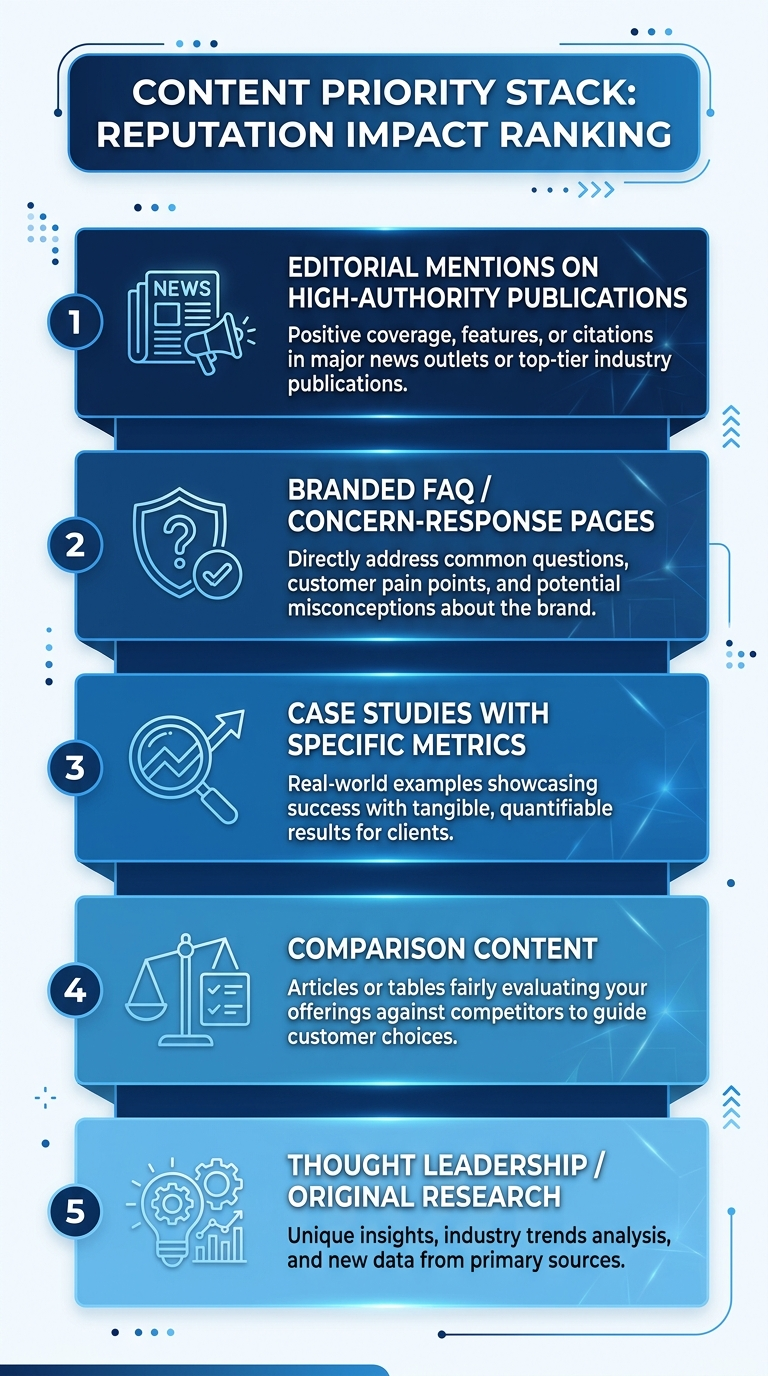
Not all content types carry equal weight. Here are the ones that matter most for SEO reputation management in 2026, ranked by impact.
Branded FAQ and Concern-Response Pages
Create dedicated pages on your website that address the exact questions people ask about your brand — including uncomfortable ones. If “Is [Brand] legit?” appears in People Also Ask or AI responses, publish a transparent page that answers it with evidence: customer counts, case studies, certifications, and third-party validation.
These pages serve dual purposes. They rank for branded queries in Google, and they give AI platforms a credible, first-party source to cite when answering questions about your brand.
Editorial Mentions on High-Authority Publications
AI models learn brand-category associations from their training data. When your brand is mentioned positively in editorial content on publications like Forbes, TechCrunch, industry journals, and respected niche sites, those associations become embedded in how AI platforms talk about you.
This is where strategic brand mentions produce compounding returns. A single editorial mention on one publication may not move the needle. Consistent mentions across dozens of high-authority sources build the kind of entity authority that shapes AI recommendations over time.
In campaigns across 67+ B2B companies, the BrandMentions team found that brands with consistent editorial mentions across high-authority publications achieved AI recommendation rates 89% higher than those relying solely on traditional SEO.
Case Studies and Customer Success Stories
Detailed case studies with specific metrics serve multiple reputation functions. They rank well for “[Brand] results” and “[Brand] case study” queries. They provide AI platforms with concrete, citable evidence of your value. And they build trust with prospects who are evaluating your credibility.
Structure case studies with clear outcome data — percentages, timelines, and named results. AI platforms prefer citing specific, measurable claims over vague success language.
Comparison and “Vs.” Content
If competitors are creating “[Competitor] vs. [Your Brand]” content, they control the narrative for that query. Publish your own honest, balanced comparison content. Acknowledge where competitors have strengths. Highlight where your solution differs. This approach builds trust and ranks for high-intent comparison queries.
Thought Leadership and Original Research
Publishing original data, industry surveys, or proprietary analysis positions your brand as an authority worth citing. According to a 2024 Edelman Trust Barometer report, 64% of B2B decision-makers said thought leadership content directly influenced their purchase decisions. Original research also earns natural backlinks, strengthening your domain authority for all branded queries.
How Do Reviews Affect SEO Reputation Management?
Reviews are one of the strongest reputation signals in both traditional search and AI. They influence Google’s local pack rankings, appear prominently in branded SERPs, and get cited directly by AI platforms when answering questions about your brand.
According to the 2025 BrightLocal Consumer Review Survey, 96% of consumers read online reviews when researching local businesses, and 38% require at least a 4-star rating before considering a purchase.
Generate Reviews Consistently, Not in Bursts
A sudden spike of reviews looks artificial to both Google and AI models. A steady flow of authentic reviews — collected after positive customer interactions — signals ongoing satisfaction. Automate review requests through post-purchase email sequences, but always ask for honest feedback rather than specifically positive reviews.
Respond to Every Review — Especially Negative Ones
Research from ReviewTrackers found that 45% of consumers are more likely to visit a business that responds to negative reviews. Your response is visible not just to the reviewer but to every future prospect who reads that review — and to AI models that analyze review sentiment.
When responding to negative reviews:
- Acknowledge the issue without being defensive
- Explain what you have done or will do to address it
- Move the conversation to a private channel for resolution details
- Never use templated language that sounds automated
Diversify Review Platforms
Google Business Profile reviews matter most for local SEO. But AI platforms pull from a wider set of sources — G2, Capterra, Trustpilot, industry-specific directories. Ensure you have an active review presence across all platforms relevant to your audience. Each platform where you maintain a strong rating creates another positive signal that AI models can reference.
For a deeper look at tracking brand perception across platforms, see our guide to brand reputation monitoring.
How to Push Negative Content Down in Search Results
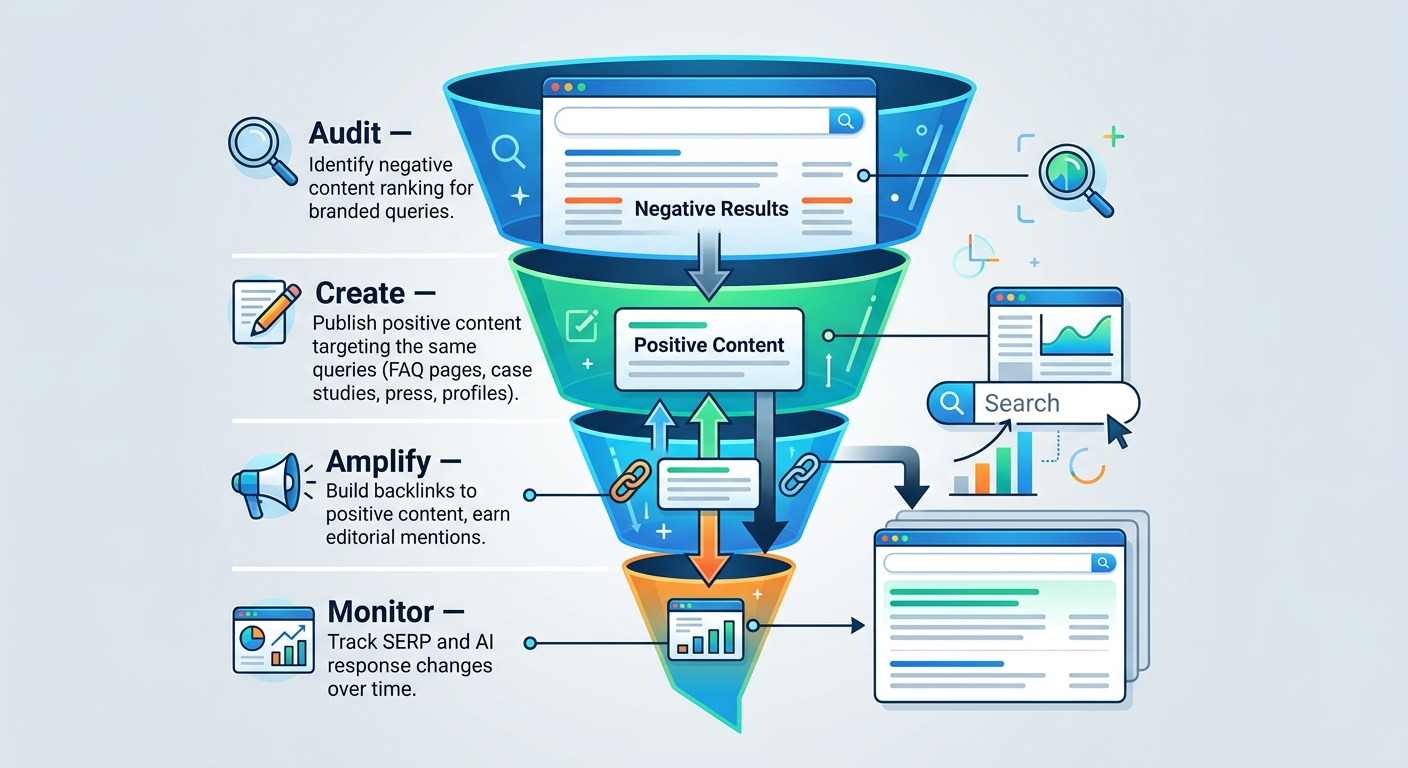
Removing negative content from the internet is rarely possible. But you can reduce its visibility by outranking it with stronger, more authoritative content. This is the core mechanic of SEO reputation management — and it works in 2026 the same way it worked in 2015, with one important addition: you now need to outrank negative content in AI responses too.
Claim and Optimize Every Property You Control
Each digital property you own represents a potential page-one position for your brand name:
- Your website — should absolutely dominate position one for your brand name
- Google Business Profile — fully completed with photos, posts, and regular updates
- LinkedIn company page and executive profiles — high domain authority, ranks well for branded searches
- Facebook, X (Twitter), Instagram — even if lightly used, claimed and branded profiles rank
- YouTube channel — video results appear in blended SERPs and AI citations
- Industry directories and review platforms — claimed profiles with complete information
Each optimized property pushes one more controlled result onto page one and one uncontrolled result off it.
Build Backlinks to Positive Content
Backlinks remain the strongest ranking signal in Google’s algorithm. When positive content about your brand earns links from authoritative sources, it climbs above negative content in search results. Focus link-building efforts on:
- Your “About” and case study pages
- Positive press coverage and earned media
- Guest posts and thought leadership published on high-authority sites
A single negative article with few backlinks is far easier to displace than one with strong link authority. Prioritize displacing the weakest negative results first — quick wins build momentum.
Address Negative Content in AI Training Sources
Pushing negative content to page two of Google does not automatically remove it from AI responses. AI models may have already ingested that content during training. To influence AI responses, you need to create a stronger volume of positive, citable content across the sources AI models learn from.
This means editorial mentions on publications that appear in AI training datasets — major news sites, respected industry publications, and high-authority content platforms. Agencies like BrandMentions solve this by placing contextual brand mentions on 140+ high-authority publications that AI models actively learn from during training.
The Reputation Surface Priority Matrix
Not every reputation surface deserves equal investment. Your audit will reveal where your brand is most vulnerable, but as a general prioritization framework, here is how to allocate effort based on impact and difficulty.
| Surface | Impact on Reputation | Difficulty to Influence | Priority Level |
|---|---|---|---|
| Google page 1 (branded searches) | Very high | Moderate | Start here |
| Google Business Profile reviews | High (especially local) | Low–moderate | Start here |
| AI search responses (ChatGPT, Perplexity, Gemini) | High and growing | High — requires sustained editorial presence | Build consistently |
| Google AI Overviews | High | Moderate — influenced by SERP content and structured data | Build consistently |
| Industry review platforms (G2, Capterra, Trustpilot) | High for B2B | Low–moderate | Start here |
| Reddit and forum discussions | Moderate–high | High — cannot be directly controlled | Monitor and respond |
| Social media profiles and discussions | Moderate | Low | Maintain and engage |
Start with the surfaces where you have the most control and the highest impact. Google page one and review platforms offer the best return on effort. AI search responses require longer-term investment but are increasingly where B2B buyers form their first impressions.
For brands that need to increase brand mentions in AI search, the path runs through consistent editorial presence across publications that AI models reference — not through any single tactic.
Common Mistakes That Make Reputation Problems Worse
Some of the most damaging reputation management errors come from well-intentioned but poorly executed responses. Avoid these.
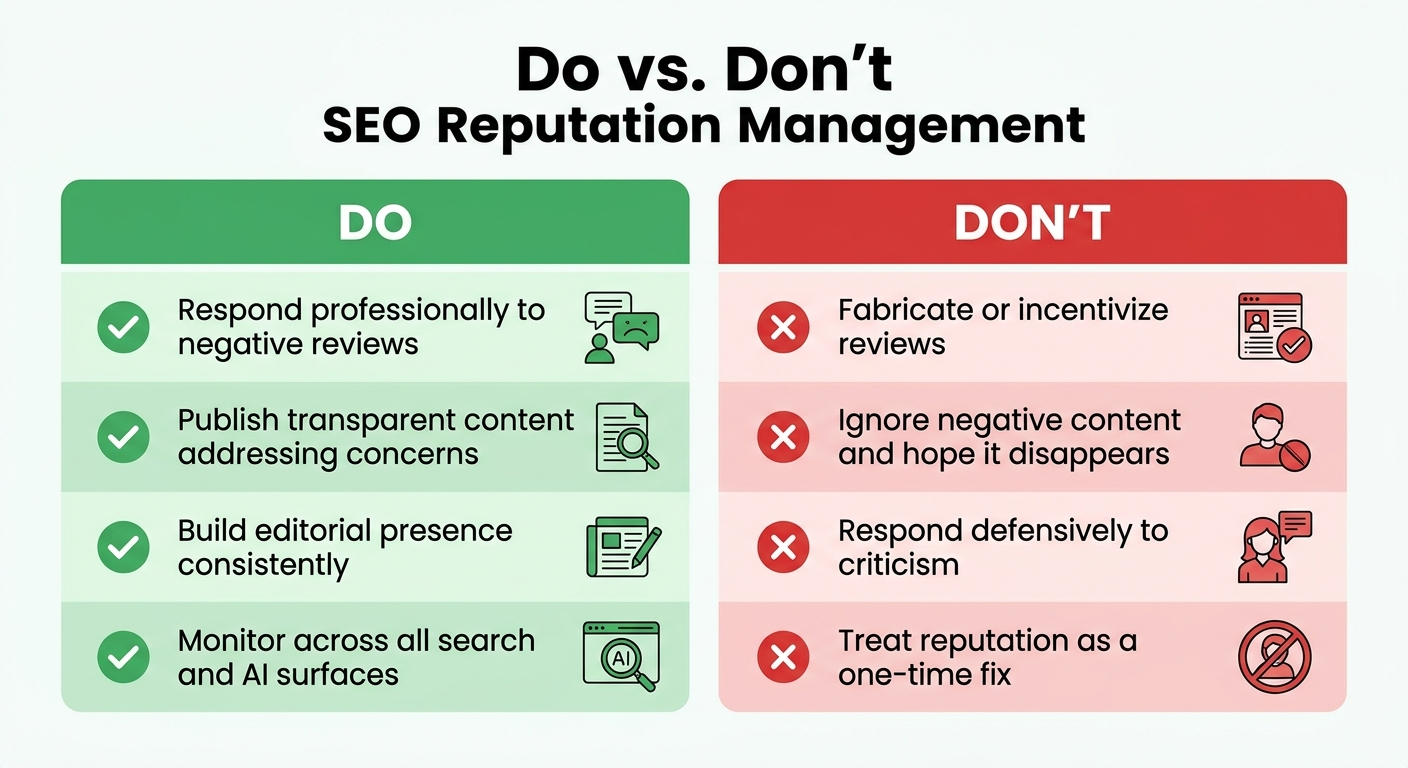
Fabricating or Incentivizing Reviews
The Federal Trade Commission actively prosecutes businesses for fake reviews. In 2023, the FTC proposed strengthened rules specifically targeting fake review practices, with enforcement actions increasing through 2024 and 2025. Beyond legal risk, platforms like Google have become significantly better at detecting review manipulation, and the reputational damage from being caught far exceeds the original problem.
Ignoring Negative Content Entirely
Hoping negative reviews or articles will disappear on their own is not a strategy. Unaddressed negative content accumulates. AI models ingest it. Other publications reference it. The longer you wait, the more difficult and expensive displacement becomes.
Responding Aggressively to Criticism
Defensive, combative, or dismissive responses to negative reviews are visible to every future prospect — and to AI platforms analyzing sentiment. A confrontational response can generate more negative coverage than the original complaint.
Treating Reputation Management as a One-Time Project
Reputation management is continuous. A strong page-one presence today can erode within months if you stop publishing content, earning mentions, and monitoring new discussions. Build reputation management into your ongoing marketing operations, not as a crisis response.
Focusing Only on Google
As of 2026, AI search platforms, Bing, DuckDuckGo, social platforms, and industry-specific sites all shape brand perception. A Google-only strategy leaves your reputation unmanaged on the surfaces where an increasing share of your audience forms their opinions.
How to Measure Whether Your Reputation Strategy Is Working
Effective measurement requires tracking specific metrics across multiple surfaces. Here is what to monitor monthly.
Google SERP Composition for Branded Queries
Track the ratio of owned, earned, and uncontrolled results on page one for your top 5–10 branded queries. The goal is steady improvement — more controlled results, fewer negative or uncontrolled ones. Tools like brand tracking tools can automate this monitoring.
AI Response Sentiment
Regularly prompt ChatGPT, Perplexity, and Gemini with branded queries and track sentiment changes. Are AI responses becoming more positive, neutral, or negative over time? Are your preferred sources being cited? Tools that track brand mentions across AI search platforms can standardize this process.
Review Volume and Rating Trends
Track average star rating, review volume per month, and response rate across all platforms. A rising review volume with a stable or improving average rating indicates a healthy reputation trajectory.
Branded Search Volume
Google Search Console shows how many people search for your brand name. Increasing branded search volume correlates with growing brand awareness and trust. Declining branded search volume — especially combined with worsening sentiment — signals a reputation problem that needs attention.
Referral Traffic from AI Platforms
Monitor referral traffic from ChatGPT, Perplexity, and other AI sources in your analytics platform. Growing AI referral traffic indicates that your brand is being cited and recommended in AI responses — a direct measure of AI reputation health.
Frequently Asked Questions
How long does SEO reputation management take to show results?
For Google SERP improvements, expect to see measurable progress within 8–16 weeks for lower-competition branded queries. High-authority negative content on page one can take 4–6 months to displace. AI search responses change more slowly because they depend on training data refreshes and source authority accumulation — plan for 3–6 months of consistent effort before AI responses shift meaningfully.
Can you completely remove negative search results?
In most cases, no. You can request removal from Google if content violates their policies — for example, if it contains personal information or is defamatory. But for legitimate negative reviews or factual press coverage, the strategy is displacement: publishing and promoting stronger content that outranks the negative material in both search results and AI responses.
Does SEO reputation management also affect AI search results?
Yes, but not automatically. Traditional SERP displacement helps with Google AI Overviews, which draw from indexed web content. ChatGPT, Perplexity, and Gemini require a broader approach — your brand needs consistent positive mentions across the editorial sources these platforms reference during retrieval and training. This is where editorial brand mentions on high-authority publications become essential.
How much does SEO reputation management cost?
Costs vary significantly based on severity. Basic monitoring and review management can run $500–$2,000 per month. Active content creation and SERP displacement for moderate issues typically costs $3,000–$10,000 per month. Complex reputation crises involving negative press, legal issues, and AI response remediation can require $10,000–$25,000+ per month in sustained investment. The earlier you act, the lower the cost.
Should I respond to every negative review?
Yes, with rare exceptions. Professional, empathetic responses demonstrate accountability to every future reader of that review — and to AI platforms analyzing your brand sentiment. The only exception is clearly fraudulent or policy-violating reviews, which should be reported directly to the platform for removal.
Where to Focus First
SEO reputation management in 2026 requires action across more surfaces than ever before. But the fundamentals have not changed: control what you can, strengthen what you own, and build a sustained presence across the sources that matter most.
Start with your audit. Know exactly what people and AI platforms see when they search for your brand. Then prioritize: owned properties and review platforms first, editorial presence and AI visibility second, ongoing monitoring and response always.
The brands that treat reputation as a continuous discipline — not a crisis response — are the ones that earn trust from both search engines and the AI platforms that increasingly shape how buyers discover and evaluate companies.
If you want to see where your brand stands in AI search right now, request a free AI visibility audit and find out what ChatGPT, Perplexity, and Gemini say about your brand — and your competitors.