Semrush Brand Monitoring tracks where your brand name appears across the web, news, forums, and social media — but as of 2026, it does not natively monitor how AI platforms like ChatGPT, Perplexity, or Gemini reference your brand. That gap matters more every quarter, because the places where buyers discover and evaluate brands are shifting from traditional search results toward AI-generated answers.
This article breaks down exactly what Semrush’s brand mentions tools can and cannot do in 2026, where the feature set ends, and how to build a monitoring workflow that covers both traditional web mentions and AI citations. If you rely on Semrush for brand intelligence, you need to understand where its coverage stops — and what to layer on top.
Key Takeaways
- Semrush Brand Monitoring tracks web, news, blog, forum, and social mentions — not AI-generated citations in ChatGPT, Perplexity, or Claude responses.
- Semrush One’s AI Visibility Toolkit (released late 2025) adds AI mention tracking, but requires a separate subscription tier from the standard Brand Monitoring app.
- Tracking brand mentions across both traditional web and AI platforms requires combining at least two toolsets in 2026.
- Unlinked web mentions still carry SEO value — but AI mentions now influence purchase decisions before a searcher ever clicks a link.
- Sentiment analysis in Semrush covers web mentions; AI narrative analysis requires different tooling and a distinct workflow.
- A practical monitoring stack pairs Semrush Brand Monitoring for web coverage with dedicated AI visibility tracking for LLM citations.
What Semrush Brand Monitoring Actually Covers in 2026
Semrush Brand Monitoring is an app within the Semrush platform that tracks online references to your brand, products, or competitors across web-based sources. It scans news sites, blogs, forums (including Reddit and Quora), and social platforms, then classifies each mention by sentiment, source authority, and backlink status.
Here is what the tool monitors as of 2026:
- Web mentions — editorial references on news outlets, industry publications, and blogs
- Forum mentions — discussions on Reddit, Quora, and niche community forums
- Social mentions — references across major social platforms when connected
- Backlink status — whether a mention includes a hyperlink to your site or remains unlinked
- Sentiment classification — positive, negative, or neutral tagging for each mention
- Competitor tracking — side-by-side mention volume for brands you define
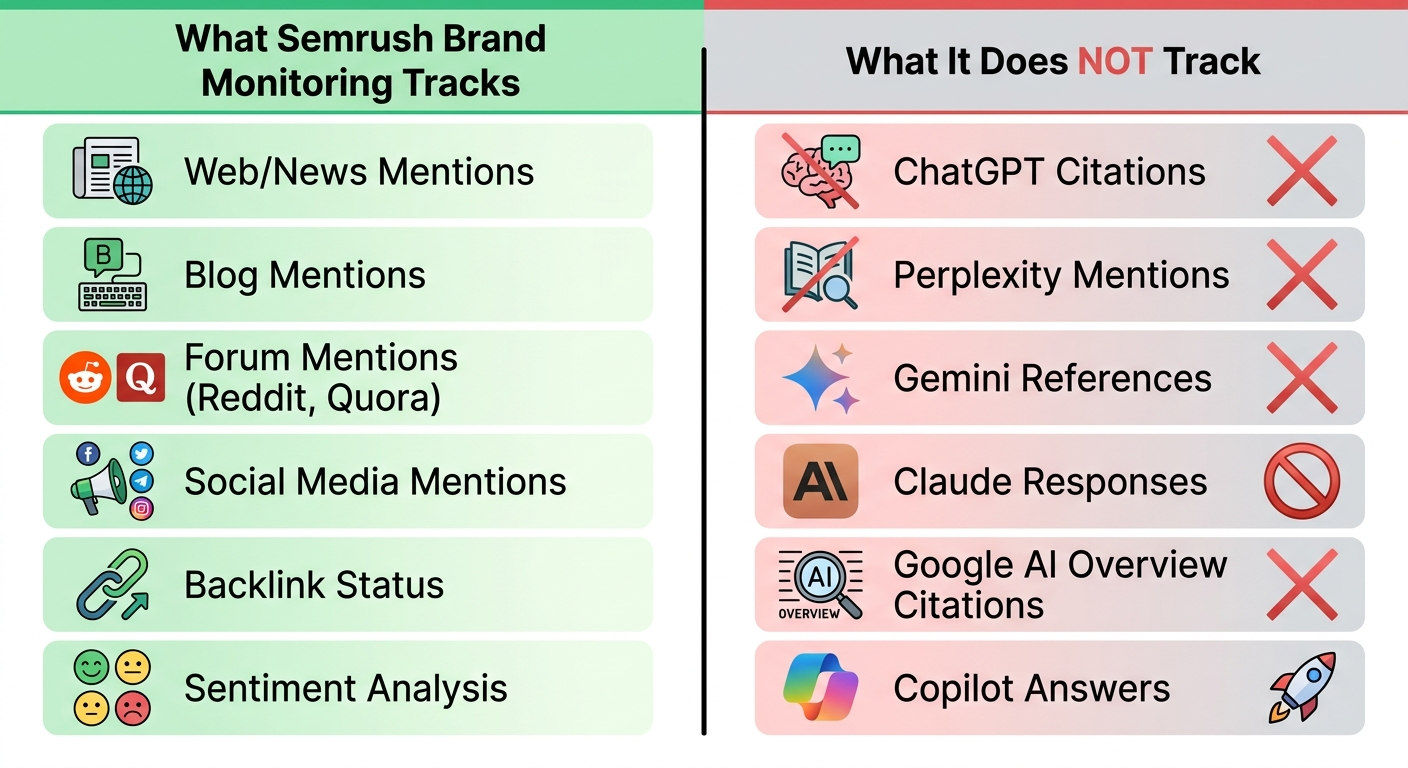
The tool works well for traditional brand monitoring — tracking media coverage, identifying unlinked brand mentions worth converting to backlinks, and spotting reputation shifts across editorial and social sources.
What it does not cover: AI-generated answers. When someone asks ChatGPT “What’s the best project management tool for remote teams?” or Perplexity “Compare CRM platforms for mid-market SaaS,” the brands named in those responses are invisible to Semrush Brand Monitoring.
Where Semrush’s AI Visibility Toolkit Fits In
Semrush recognized this gap. In late 2025, the company launched the AI Visibility Toolkit as part of Semrush One, a higher-tier subscription that bundles SEO authority tools with AI search tracking.
The AI Visibility Toolkit adds capabilities that Brand Monitoring lacks:
- AI mention tracking — monitors how often your brand appears in Google AI Overviews, ChatGPT responses, and other AI platforms
- Competitor Research report — compares your AI mention volume against competitors across AI answer engines
- Prompt Research — shows which topics and queries trigger AI mentions for specific brands
- Brand Performance — analyzes which attributes (pricing, trust, convenience) AI systems associate with your brand
- AI Visibility Score — a composite metric estimating your brand’s overall presence in AI-generated answers
This is a significant expansion. But it comes with an important caveat: the AI Visibility Toolkit is not included in Semrush’s standard plans. It requires Semrush One or Enterprise-level access, which represents a substantially higher investment than the Brand Monitoring app alone.
Brand Monitoring vs. AI Visibility Toolkit: What Each Solves
| Capability | Brand Monitoring (Standard) | AI Visibility Toolkit (Semrush One) |
|---|---|---|
| Web/news/blog mentions | Yes | No (different focus) |
| Forum tracking (Reddit, Quora) | Yes | No |
| Social media mentions | Yes | No |
| Unlinked mention identification | Yes | No |
| Sentiment analysis (web) | Yes | Limited (AI narrative focus) |
| ChatGPT brand citations | No | Yes |
| Google AI Overview mentions | No | Yes |
| Perplexity/Gemini tracking | No | Partial (expanding in 2026) |
| AI competitor benchmarking | No | Yes |
| Prompt-level analysis | No | Yes |
| Subscription tier | Pro, Guru, or Business | Semrush One / Enterprise |
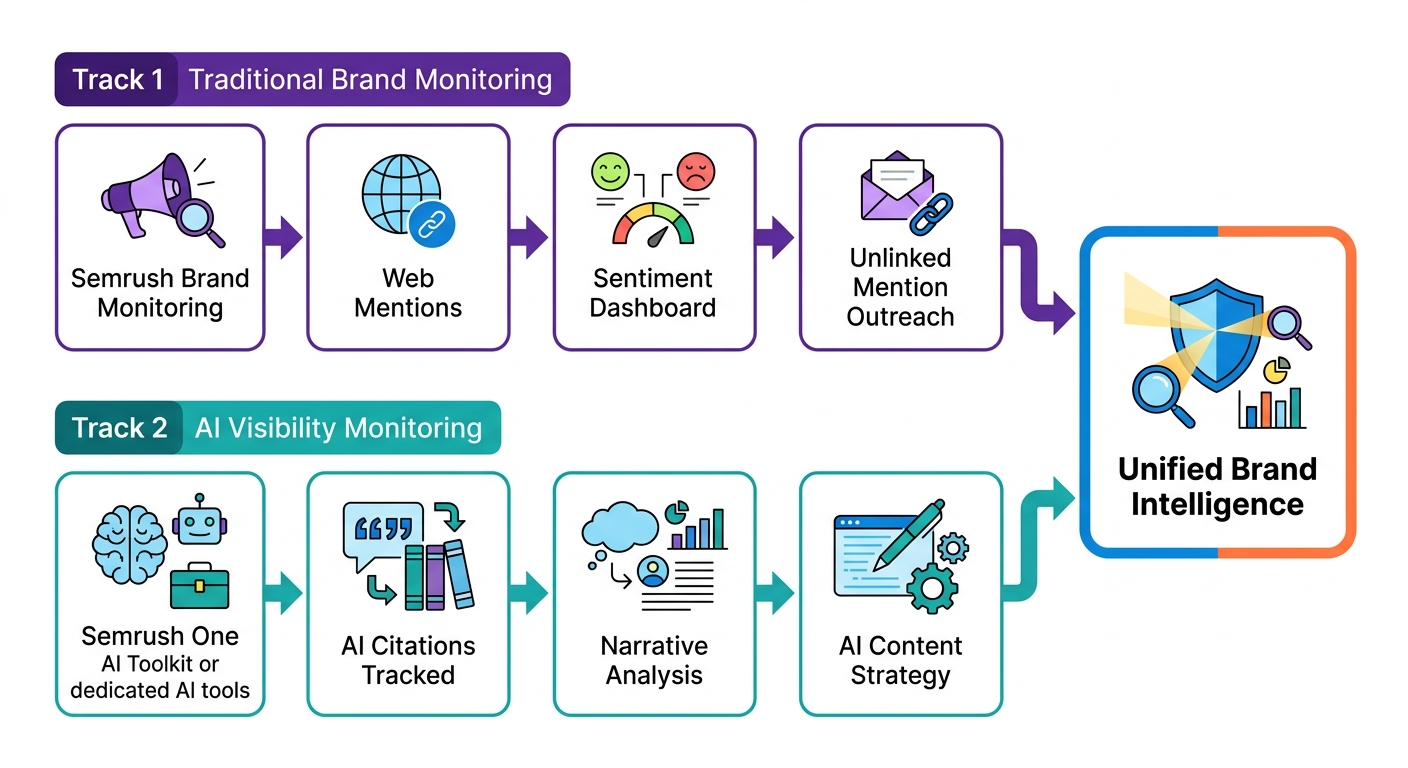
For teams already paying for Semrush Pro or Guru plans, Brand Monitoring handles traditional web mentions effectively. But tracking brand mentions across AI search platforms requires either upgrading to Semrush One or adding a specialized AI monitoring tool to your stack.
Why AI Brand Mentions Demand Separate Tracking
Traditional brand mentions and AI brand mentions operate on fundamentally different mechanics. Understanding why they require separate monitoring helps you allocate budget and attention correctly.
Traditional Mentions Are Indexed; AI Mentions Are Generated
When a journalist writes about your brand on TechCrunch, Semrush Brand Monitoring finds that reference because it crawls published web pages. The mention exists as a static piece of content at a fixed URL.
AI mentions work differently. When ChatGPT recommends your brand in response to a user query, that recommendation is generated dynamically based on patterns in the model’s training data and (in retrieval-augmented systems) recently indexed web content. There is no permanent URL to crawl. The mention may appear for one user’s prompt and not for a slightly different phrasing of the same question.
This is why standard web monitoring tools — including Semrush Brand Monitoring — cannot detect AI citations. The technology required to track AI mentions involves querying AI platforms programmatically, analyzing responses at scale, and mapping which brands appear for which types of prompts.
AI Mentions Shape Purchase Decisions Earlier
According to a 2025 Gartner forecast, traditional search engine volume was projected to decline 25% by 2026 as users shift toward AI-assisted answers. While the exact figures are still being measured, the directional trend is clear: a growing share of brand discovery happens inside AI interfaces before a user ever reaches a traditional search results page.
When a buyer asks an AI assistant “What CRM should a 50-person SaaS company use?” the brands named in that response shape the consideration set immediately. If your brand is absent from that answer, you are excluded from the decision process at its earliest — and increasingly most influential — stage.
This is why AI brand mentions require dedicated monitoring. They represent a distinct influence channel that operates upstream of traditional search and web-based brand mentions.
How to Set Up Semrush Brand Monitoring for Web Mentions
If your primary goal is tracking traditional web mentions — media coverage, forum discussions, social references, and unlinked backlink opportunities — Semrush Brand Monitoring remains a strong tool. Here is how to configure it for maximum usefulness.
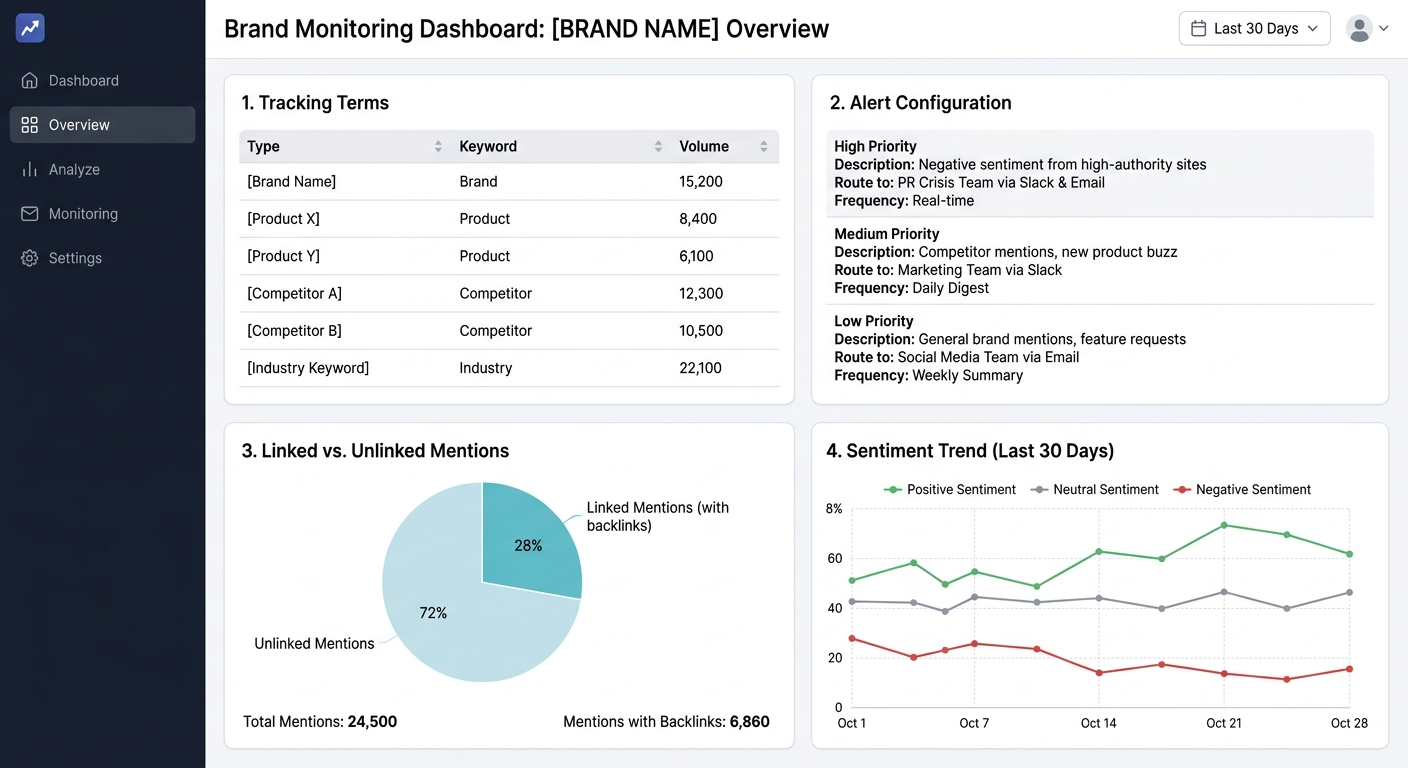
Step 1: Define Your Tracking Terms
Go beyond your brand name. Set up monitoring queries for:
- Your primary brand name and common misspellings
- Product and service names
- Key executive names (CEO, CMO, founders)
- Campaign-specific terms or event names
- Two to three close competitors — for benchmarking share of voice
For brands with shorter or generic names, add context filters to reduce false positives. A company named “Beam” will need tighter filtering than one named “Calendly.”
Step 2: Configure Source Filters and Alerts
Semrush lets you filter by source type (news, blogs, forums, social), language, and geography. Set these based on where your audience actually engages:
- High-priority alerts — major publications, high-follower social accounts, or negative sentiment mentions. Route these to PR or communications immediately.
- Daily digests — moderate-priority mentions from industry blogs, mid-tier publications, and forums. Route to content and SEO teams.
- Weekly summaries — low-priority mentions for trend analysis. Route to marketing leadership.
Step 3: Separate Linked from Unlinked Mentions
Use the backlink filter to isolate unlinked brand mentions — references that name your brand without linking to your site. These represent your most accessible link-building opportunities because the author already knows your brand and chose to reference it.
Export unlinked mentions weekly. Prioritize outreach by the referring domain’s authority score and topical relevance. A mention on an industry-specific publication with moderate authority often delivers more SEO value than one on a high-authority but irrelevant general news site.
Step 4: Track Sentiment Shifts Over Time
Monitor your sentiment ratio (positive vs. negative vs. neutral) on a rolling 30-day basis. Sudden shifts often indicate a PR event, product issue, or competitive attack before those signals surface through other channels.
Semrush’s sentiment classification is automated and imperfect — expect occasional misclassification, especially for sarcasm or nuanced forum posts. Spot-check flagged negative mentions manually before escalating.
Building an AI Mention Tracking Layer on Top of Semrush
Once your web mention monitoring is running, the next challenge is adding AI citation tracking. You have two primary paths depending on your budget and existing tool stack.
Option A: Upgrade to Semrush One
If your team already relies heavily on Semrush for SEO and content workflows, upgrading to Semrush One consolidates your AI visibility data within a platform you already know. The AI Visibility Toolkit gives you:
- AI mention counts across Google AI Overviews and ChatGPT
- Competitor benchmarking on AI citation volume
- Topic-level prompt analysis showing which queries trigger your brand
- Brand attribute mapping — what qualities AI associates with your brand
The trade-off is cost. Semrush One pricing is significantly higher than standard Semrush plans, and as of early 2026, AI visibility coverage across platforms like Perplexity and Claude is still expanding. Check current platform coverage before committing.
Option B: Add a Dedicated AI Monitoring Tool
For teams that want deeper AI citation tracking without a full Semrush One commitment, specialized tools focus exclusively on monitoring brand mentions in LLMs. These tools query AI platforms at scale, track citation frequency across different prompt categories, and measure how your brand’s AI narrative evolves over time.
This approach works well when your team uses Semrush for traditional SEO but needs AI visibility data that goes deeper than what Semrush One currently offers — particularly for tracking citations in Perplexity, Gemini, and ChatGPT simultaneously.
Option C: Manual Spot Checks (Free but Limited)
If budget is a constraint, you can perform manual AI mention audits by querying ChatGPT, Perplexity, Gemini, and Copilot with prompts your buyers would use. Document which brands appear, how they are described, and whether your brand is included.
This works for directional insights but does not scale. You cannot track trends, measure sentiment, or benchmark competitors systematically with manual checks alone.
What Semrush Brand Monitoring Data Tells You About AI Readiness
Here is something most teams miss: your traditional brand mention data from Semrush is a leading indicator of your AI visibility potential.
AI models like GPT-4 and Gemini learn brand-category associations from their training data, which consists largely of web content — the same content Semrush Brand Monitoring tracks. If your brand appears frequently across high-authority publications in connection with specific topics, AI models are more likely to include you in relevant responses.
Signals That Predict Strong AI Citation Potential
- High mention volume on authoritative publications — consistent references on sites that AI training datasets prioritize (major news outlets, established industry publications, Wikipedia)
- Topical consistency — your brand appears in connection with the same category and use cases repeatedly, which strengthens the association AI models draw
- Positive or neutral sentiment dominance — brands with persistently negative sentiment may appear in AI responses but framed unfavorably
- Mention diversity — references across multiple source types (editorial, forums, reviews, comparison content) give AI systems more data points to triangulate relevance
Signals That Suggest Weak AI Visibility
- Low mention volume overall — if Semrush Brand Monitoring shows few mentions per month, AI models likely lack sufficient data to reference your brand confidently
- Mentions concentrated on low-authority or niche sites — AI training data is weighted toward high-authority sources. Mentions on sites with minimal readership carry less influence.
- Inconsistent topical association — if your brand is mentioned in connection with many unrelated topics, AI models may not form a strong category association
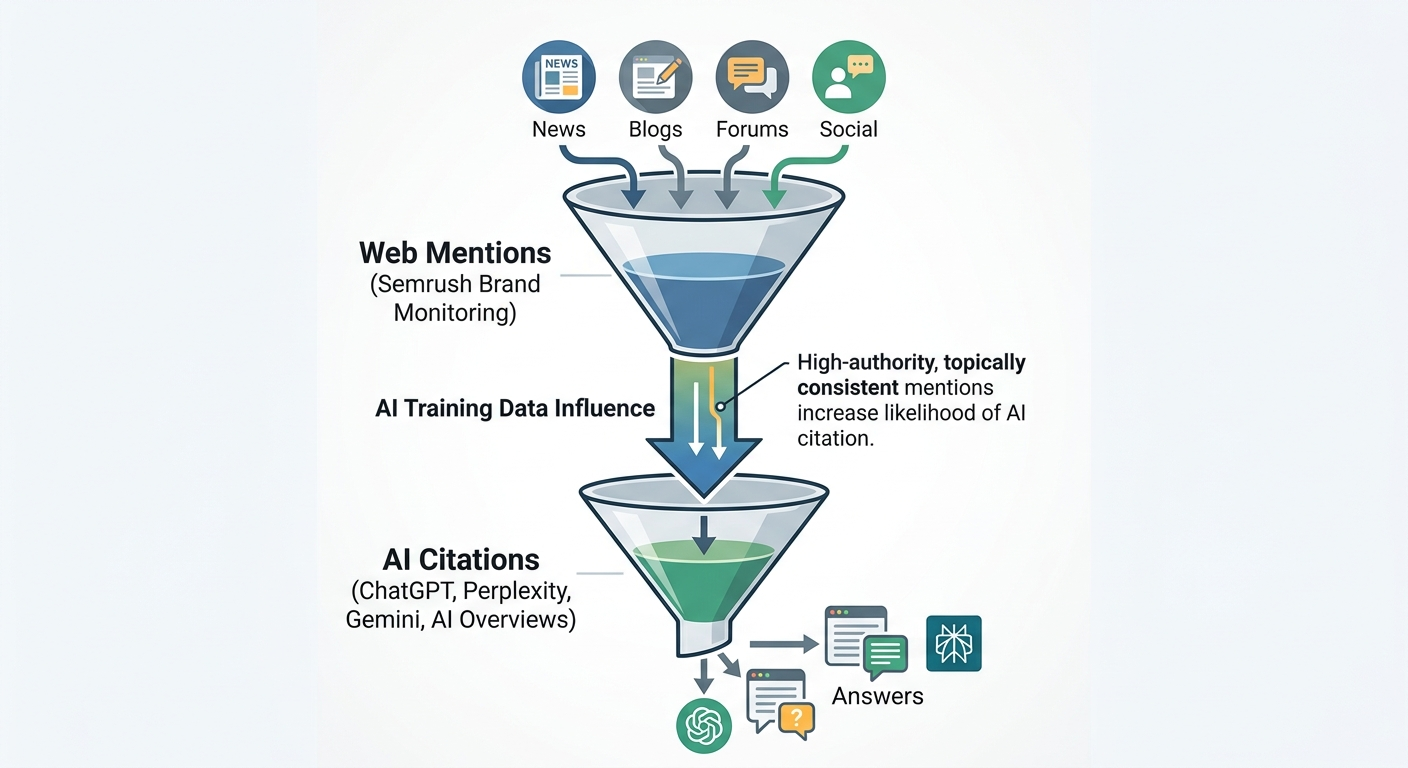
In this way, Semrush Brand Monitoring serves a dual purpose. It monitors your current web presence and provides early signals about whether your brand has enough editorial coverage to influence AI-generated recommendations. Agencies like BrandMentions build on this insight by placing contextual brand mentions on 140+ high-authority publications that AI models actively learn from during training — bridging the gap between web presence and AI discoverability.
Practical Workflow: Combining Web and AI Brand Monitoring
The most effective brand monitoring setup in 2026 runs two parallel systems that feed a unified reporting dashboard. Here is a practical workflow designed for B2B marketing teams with limited bandwidth.
Weekly: Web Mention Review (Semrush Brand Monitoring)
- Review high-priority alerts for PR opportunities or reputation issues
- Export unlinked mentions and prioritize by domain authority for backlink outreach
- Check sentiment trends — flag any shift greater than 10% week-over-week
- Compare your mention volume against tracked competitors
Biweekly: AI Citation Audit
- Review AI mention data from your chosen tool (Semrush One AI Toolkit or dedicated platform)
- Identify which prompts and topics trigger your brand in AI responses
- Note any prompts where competitors appear and you do not — these represent content gaps
- Check AI narrative accuracy — are features, pricing, and positioning described correctly?
Monthly: Unified Brand Intelligence Report
Combine web and AI mention data into a single brand mentions report that tracks:
- Total web mention volume and sentiment trend
- Unlinked mentions converted to backlinks (pipeline and closed)
- AI mention count across platforms
- Share of voice vs. competitors in both web and AI
- Content actions taken based on monitoring insights
This report gives marketing leadership a single view of where the brand stands across both traditional and AI discovery channels — and where investment should shift.
Limitations Worth Knowing Before You Choose a Tool
No brand monitoring tool — including Semrush — covers everything perfectly. Knowing the constraints helps you set realistic expectations and plan around gaps.
Semrush Brand Monitoring Limitations
- No AI citation tracking in the standard Brand Monitoring app
- Sentiment accuracy varies — automated sentiment scoring misclassifies roughly 15–20% of mentions based on common NLP benchmarks, particularly for sarcasm, mixed sentiment, and non-English content
- Social coverage depends on platform API access, which changes frequently. Expect partial coverage on some platforms.
- Forum depth is good for Reddit and Quora but may miss smaller niche forums
Semrush One AI Toolkit Limitations
- Platform coverage is still expanding. As of early 2026, ChatGPT and Google AI Overviews have the deepest tracking. Perplexity, Claude, and Copilot coverage varies.
- Pricing puts it out of reach for many small and mid-size teams
- Historical data is limited — the toolkit is relatively new, so long-term trend analysis is still developing
General AI Monitoring Limitations
- AI responses are non-deterministic — the same prompt can produce different brand recommendations across sessions, making consistent measurement challenging
- AI models update their knowledge at irregular intervals, so visibility can shift without warning
- No tool can guarantee 100% coverage of every AI platform’s responses at all times
Pro Insight: Treat AI mention data as directional, not absolute. A brand appearing in 60% of category-relevant ChatGPT prompts one week and 45% the next does not necessarily indicate a problem — it reflects the inherent variability of generative AI responses. Focus on 30-day and 90-day trends, not daily fluctuations.
From Monitoring to Action: What to Do With the Data
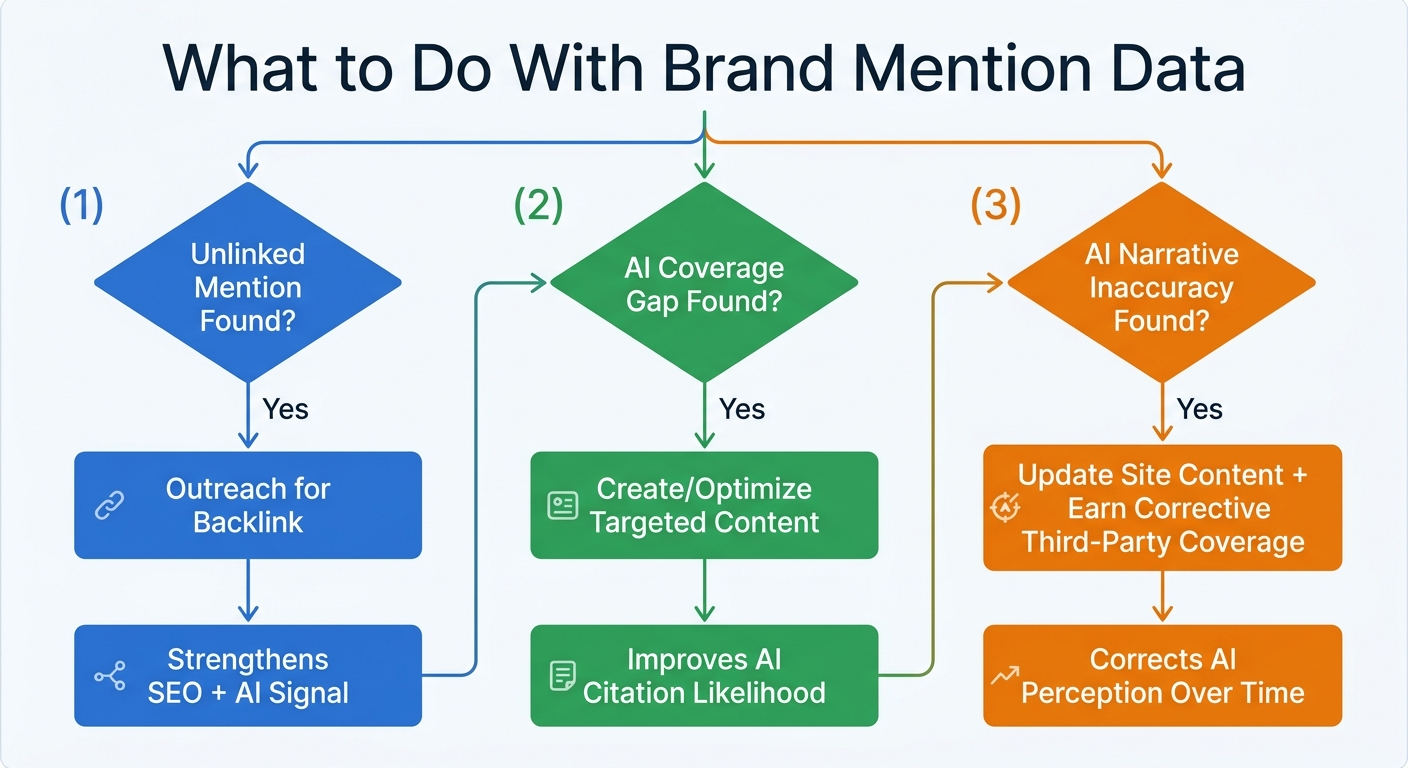
Monitoring is only valuable if it drives decisions. Here is how to translate Semrush brand mention data — both web and AI — into concrete marketing actions.
Turn Unlinked Mentions Into Links (and AI Signals)
Every unlinked mention you convert into a backlink strengthens your domain authority for traditional SEO. But it also reinforces the brand-topic association that AI models use to decide which brands to reference. A linked mention on a high-authority publication sends a stronger signal to both Google’s algorithm and the AI training pipelines that crawl authoritative web content.
Prioritize unlinked mention outreach by publication authority and topical relevance. A detailed walkthrough of this process is available in our guide on brand mentions for SEO.
Fill AI Coverage Gaps With Targeted Content
When AI monitoring reveals prompts where competitors appear and your brand does not, you have a clear content brief. Create or improve content that directly addresses those queries — structured clearly, with specific answers, on pages AI systems can easily parse.
In campaigns across 67+ B2B companies, the BrandMentions team found that brands with consistent editorial mentions across high-authority sources achieved AI recommendation rates 89% higher than those relying solely on traditional SEO — suggesting that building AI-ready brand mentions compounds over time.
Correct AI Narrative Inaccuracies
If AI monitoring reveals that ChatGPT or Perplexity describes your brand inaccurately — wrong pricing, outdated features, incorrect positioning — you can address this by updating your own site content and expanding coverage on third-party sources that AI models reference. AI systems eventually reflect the consensus of authoritative web content, so correcting the source material corrects the AI narrative over time.
Frequently Asked Questions
Does Semrush Brand Monitoring track AI mentions in ChatGPT or Perplexity?
No. Semrush Brand Monitoring tracks mentions across web, news, blog, forum, and social sources. It does not monitor AI-generated responses. To track AI citations, you need Semrush One’s AI Visibility Toolkit or a dedicated AI visibility analytics tool.
Is Semrush’s AI Visibility Toolkit included in standard Semrush plans?
No. The AI Visibility Toolkit is part of Semrush One, a higher-tier subscription separate from Pro, Guru, or Business plans. Enterprise AIO offers additional AI tracking capabilities at the enterprise level.
Can I track competitor brand mentions in AI answers using Semrush?
Yes, but only through the AI Visibility Toolkit in Semrush One. The Competitor Research report compares AI mention volume across your brand and up to four competitors on platforms like ChatGPT and Google AI Overviews.
How do web brand mentions influence AI recommendations?
AI models learn brand-category associations from their training data, which primarily consists of web content. Brands mentioned frequently across high-authority publications in connection with specific topics are more likely to be referenced in AI-generated answers. Consistent, authoritative brand mentions in generative AI source material strengthen that association.
What is the difference between a brand mention and a brand citation in AI?
A brand mention is any reference to your company on a web page, social post, or forum thread. A brand citation in AI is when an AI system like ChatGPT or Gemini names your brand in a generated response to a user query. Both matter, but they require different monitoring tools and different optimization strategies.
How often should I audit my brand’s AI mentions?
Biweekly audits work well for most B2B teams. AI models do not update their knowledge daily, so checking too frequently creates noise without actionable signal. Monthly is the minimum cadence for teams tracking competitive positioning across AI platforms. For a structured approach, explore proven methods for tracking brand mentions in AI search.
What Comes Next for Brand Monitoring
Brand monitoring in 2026 sits at a transition point. Tools like Semrush Brand Monitoring still deliver essential value for tracking web mentions, managing reputation, and fueling link-building workflows. But the discovery layer is expanding beyond traditional search, and monitoring needs to expand with it.
The practical move is not choosing between web monitoring and AI monitoring. It is building a stack that covers both — using Semrush Brand Monitoring for the web layer and adding AI citation tracking through Semrush One, a dedicated platform, or a specialized agency that tracks brand mentions across AI search results.
Start with what you can measure today. Layer AI monitoring as your budget allows. The brands that build visibility across both channels now will compound their discoverability advantage as AI search continues absorbing market share from traditional results.
Want to see where your brand currently stands in AI search — and how it compares to competitors? Get your free AI visibility audit.