Professional crisis management (PCM) is a behaviorally grounded system for preventing, de-escalating, and safely resolving behavioral crises in schools, residential programs, and human service settings. Developed by Board Certified Behavior Analysts, PCM stands apart from other crisis intervention models because it emphasizes prevention first, uses painless physical procedures based on natural body positioning, and relies on Applied Behavior Analysis (ABA) principles throughout every phase.
If you’re evaluating crisis management training for your organization in 2026 — or comparing PCM against alternatives like CPI, Safety Care, or TCI — this article breaks down exactly how the system works, what each certification level covers, who it’s designed for, and what the evidence says about outcomes.
Key Takeaways
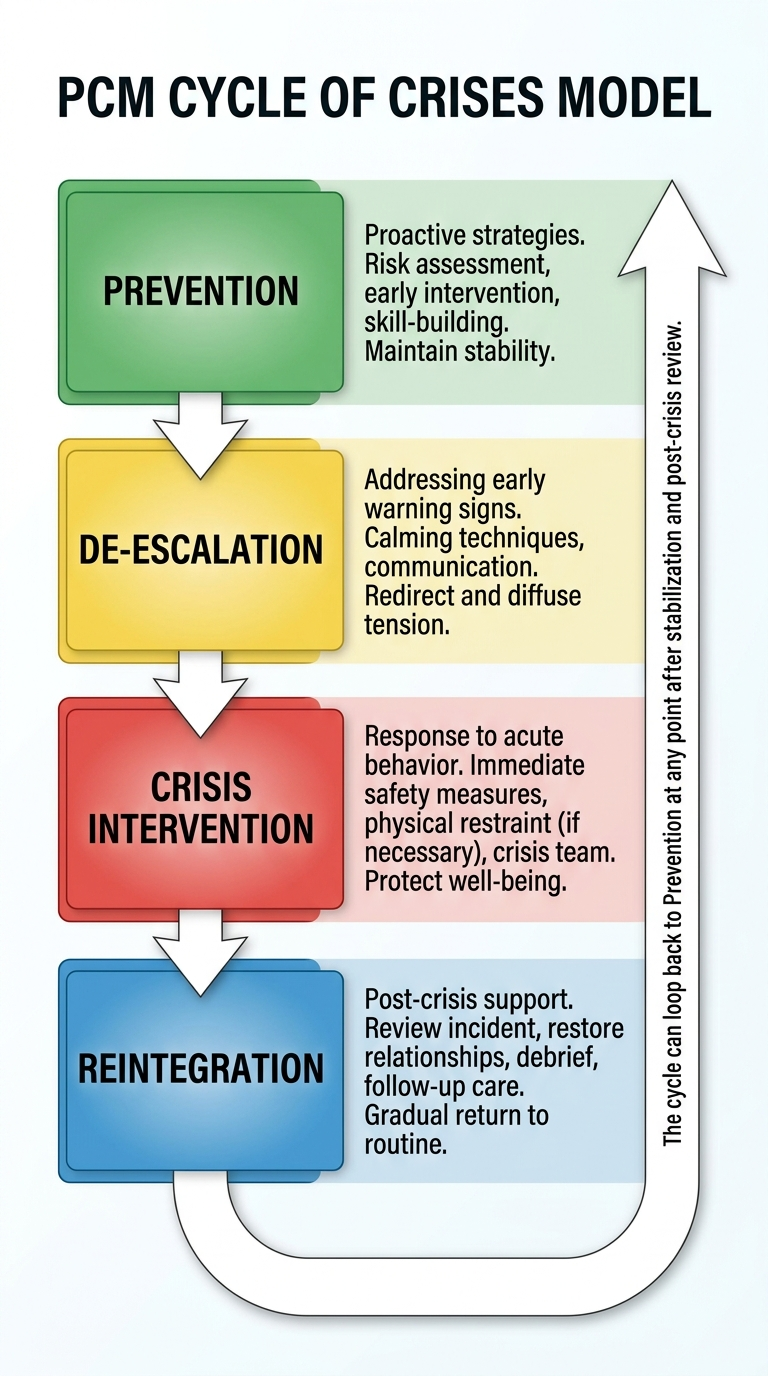
- PCM covers four distinct phases: prevention, de-escalation, crisis intervention, and reintegration — not just physical holds.
- All physical procedures use natural body positioning with zero pain-based techniques, preserving dignity throughout an episode.
- Six certification levels exist, ranging from non-physical strategies only (Basic Practitioner) to full horizontal immobilization (Practitioner 2).
- PCM is the only crisis management system with peer-reviewed publications showing reductions in restraints and injuries.
- Dynamic Holding — PCM’s core intervention method — gives real-time feedback that can shorten restraint episodes to as little as 12 seconds.
- As of 2026, PCMA (now operating under the name Pivot Crisis Intervention) continues expanding certification courses across the U.S. and internationally.
How Professional Crisis Management Differs from Other Systems
Most crisis intervention programs teach staff what to do after someone becomes aggressive. PCM inverts that priority. The system allocates the majority of its training hours to what happens before a crisis — prevention strategies and early de-escalation.
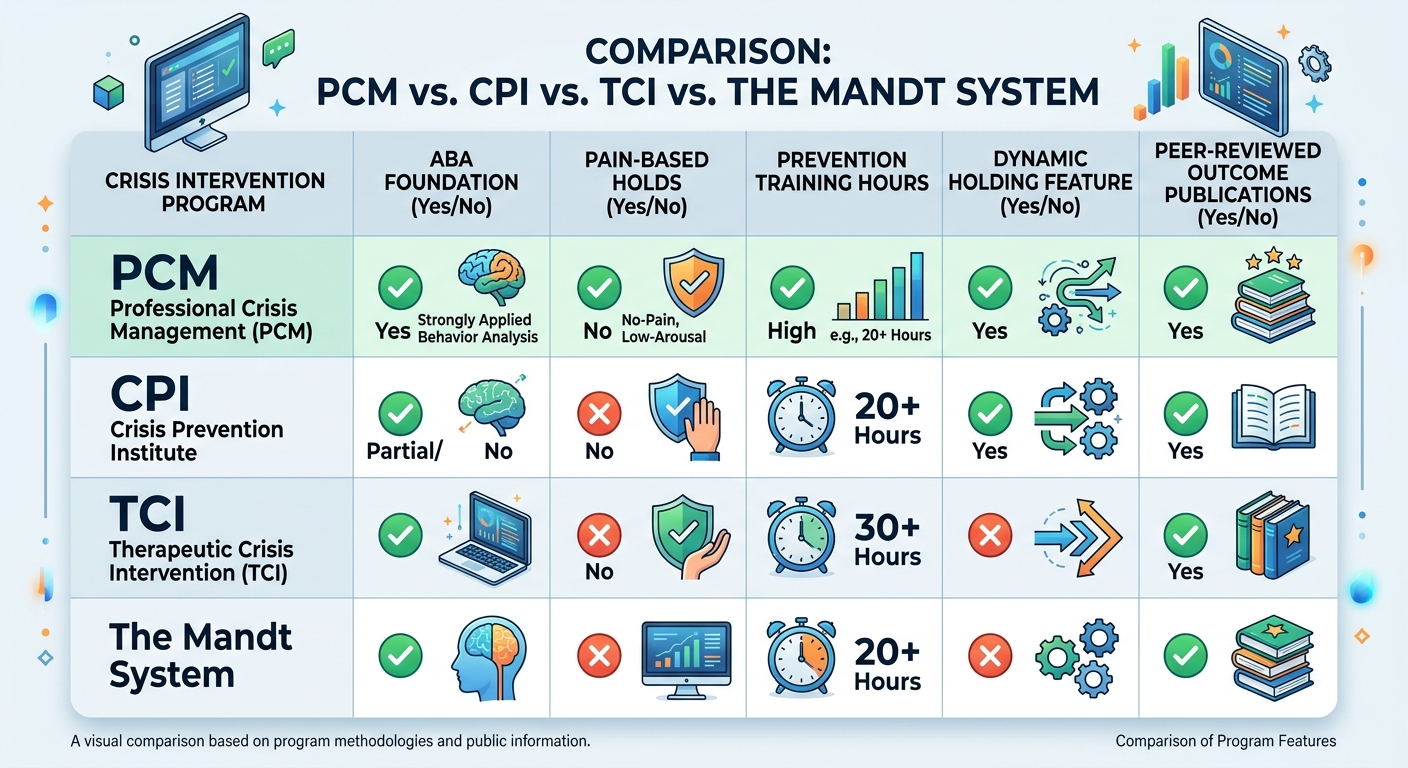
Here’s what structurally separates PCM from alternatives like CPI (Crisis Prevention Institute), TCI (Therapeutic Crisis Intervention), Mandt, and Safety Care:
- ABA foundation: PCM is the only major crisis management system with a curriculum fully grounded in Applied Behavior Analysis. This means every strategy — from prevention to reintegration — connects to behavioral science principles rather than general de-escalation theory.
- No pain-based holds: All physical procedures use the body’s natural range of motion. There are no joint locks, pressure points, or off-balance positions.
- Dynamic Holding methodology: Instead of treating restraint as an all-or-nothing event, PCM teaches staff to adjust holds in real time, providing feedback that reinforces calm behavior and accelerates release.
- Prevention emphasis: PCM teaches 12 categories of prevention strategies (with multiple techniques within each) — far beyond what most systems label as “prevention.”
- Peer-reviewed evidence: PCM has published research demonstrating measurable reductions in restraint frequency, restraint duration, and injury rates for both staff and clients.
Travis Blevins, an Executive Director with 15 years of experience implementing CPI, Safety Care, TCI, Mandt, and PCM, has stated publicly: “Professional Crisis Management is by far the most effective methodology in keeping folks safe, and decreasing crises. It also is the only form of crisis management that has peer-reviewed publications evidencing demonstrated reduction in restraints, injuries (both to staff and consumers), and promotes pro-active procedures.”
The Four Phases of the PCM Cycle of Crises Model
PCM organizes crisis response into four sequential phases. Each phase has its own set of strategies, and staff are trained to operate at the least restrictive level that the situation requires.
Phase 1: Prevention
Prevention is the set of strategies staff use to keep stable individuals stable — before any signs of escalation appear. This is where PCM dedicates the most training time.
PCM’s prevention framework includes 12 categories of proactive strategies. One category alone — maximizing relationships — contains five distinct strategies, each with multiple practical applications. For example, asking a student about their hobbies builds rapport and reduces the likelihood of future conflict. A student who likes their teacher is significantly easier to teach.
Many systems claim to teach prevention but actually begin at de-escalation. PCM draws a clear line between the two. Prevention happens when there are no signs of a problem. It’s proactive environmental design, relationship building, and reinforcement of adaptive behavior.
Phase 2: De-escalation
De-escalation is used when an individual begins showing pre-crisis behavior — the phase between stable functioning and full crisis.
PCM identifies three distinct levels of pre-crisis behavior:
- Pre-crisis Level 1: Off-task or disengaged behavior. Most systems don’t even recognize this as a precursor to crisis. PCM does, and provides specific redirection strategies for it.
- Pre-crisis Level 2: Escalating agitation, verbal defiance, or low-level disruption.
- Pre-crisis Level 3: Immediate precursors to aggression or self-injury.
Each level has a tailored set of de-escalation strategies. The goal is to return the individual to stable functioning before physical intervention becomes necessary.
Phase 3: Crisis Intervention
Crisis intervention is the set of structured physical procedures used when prevention and de-escalation have not been sufficient. PCM defines a “crisis” specifically: continuous aggression, continuous self-injury, or continuous high-magnitude disruption (throwing objects, damaging property, behavior that directly endangers others).
Physical procedures in PCM follow a hierarchy from least to most restrictive:
- Personal safety techniques: Releases from hair pulls, bites, or removal of dangerous objects. Blocking strikes or kicks.
- Transportation procedures (escorts): Assisted walking to move an individual away from danger or toward a safe area. The individual remains upright and participates in the movement — they are never carried.
- Vertical immobilization: Standing holds used when transportation breaks down because the individual is attempting to injure themselves or staff.
- Horizontal immobilization: Prone (face-down) or supine (face-up) procedures on a foam mat. Used only as a last resort when vertical procedures cannot safely contain the level of aggression.
The defining feature of PCM’s crisis intervention is Dynamic Holding. Rather than maintaining a static restraint position until the individual exhausts themselves, staff systematically adjust their hold in real time. This gives the individual feedback — when they relax, the hold loosens. When they escalate, the hold stabilizes.
This feedback loop allows the individual to learn, within the episode, that calm behavior leads to release. In some cases, the release process takes as little as 12 seconds. The individual retains a sense of control over the situation, which reduces the likelihood of retaliation or repeated episodes.
Phase 4: Reintegration
Reintegration is the process of transitioning an individual back to normal activities after a crisis has resolved. This phase is critical — and frequently mishandled by programs without structured post-crisis procedures.
PCM teaches two levels of reintegration strategies:
- Immediate post-crisis: Systematic checks for cooperation. Staff assess whether the individual is genuinely calm or simply fatigued.
- Return to activities: Checking for interest in typical activities, looking for key changes in affect, and starting with simple, familiar tasks before returning to the full routine.
Without structured reintegration, staff often ask individuals to resume the very activity that triggered the crisis — leading to an immediate second episode. PCM’s post-crisis framework is designed to break that cycle.
PCM Certification Levels Explained
Not every organization faces the same type of crisis. A school dealing with occasional non-compliance needs a very different toolkit than a residential facility serving individuals with severe aggression. PCM addresses this by offering six distinct certification levels.
| Certification Level | What It Covers | Minimum Training Hours | Best For |
|---|---|---|---|
| EveryDay BehaviorTools | ABA-based prevention strategies only. No physical procedures. | Varies | Staff with a “hands-off” mandate; higher-functioning individuals with nuisance behaviors |
| Basic Practitioner | All non-physical strategies (prevention, de-escalation, reintegration). No physical intervention. | 6 hours | Support staff working alongside PCM-certified team members |
| Basic Practitioner Plus | Same as Basic Practitioner plus personal safety techniques (hair release, bite release). | 6+ hours | Staff in environments where restrictive procedures are prohibited |
| Practitioner | Non-physical strategies + personal safety + transportation (escorts). | 14 hours | Level 2 Crisis Severity Matrix populations |
| Practitioner 1 | Everything in Practitioner + vertical (standing) immobilization. | 18 hours | Level 3 Crisis Severity Matrix populations |
| Practitioner 2 | Everything in Practitioner 1 + horizontal immobilization (prone and/or supine on a mat). | 22 hours | Levels 3–4 Crisis Severity Matrix; severe aggression or self-injury |
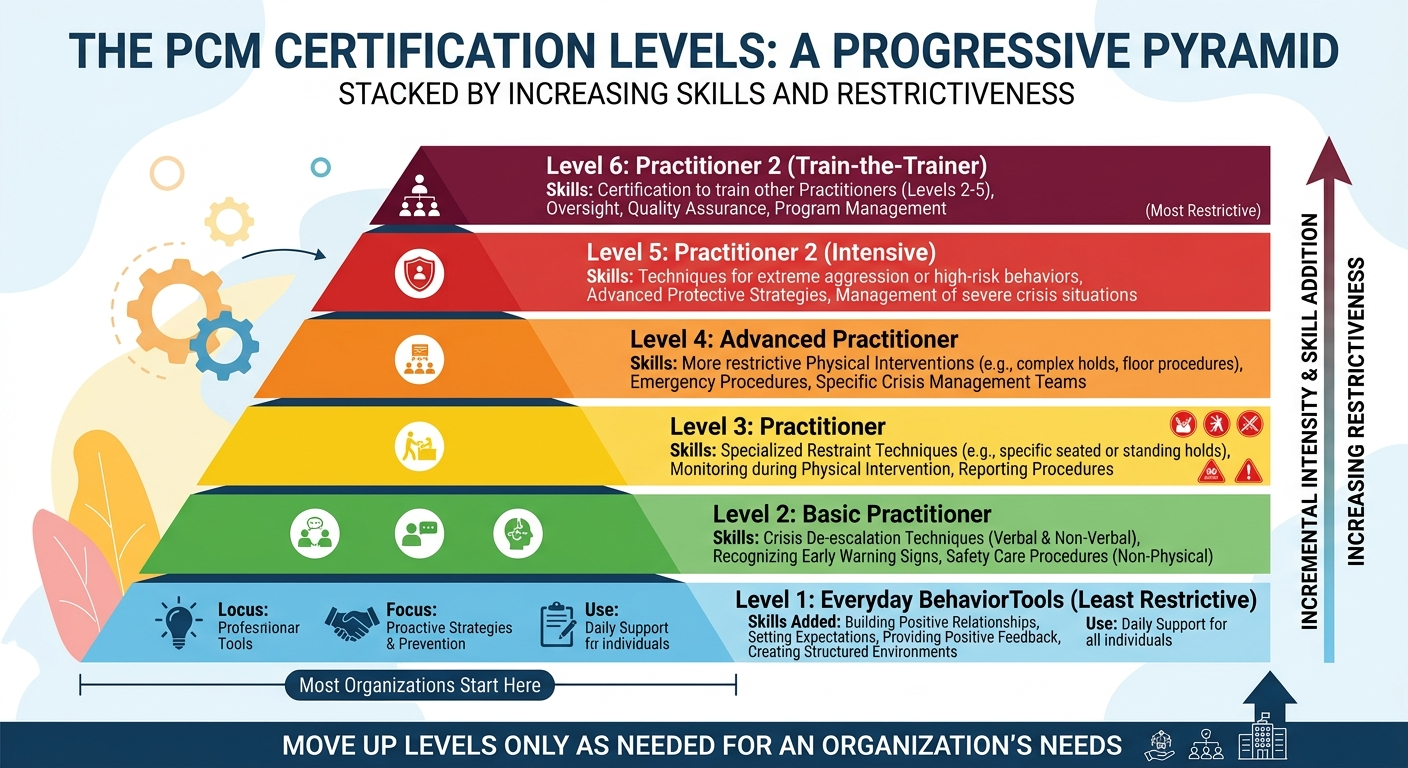
Many organizations never need training beyond Practitioner 1. The system is designed so you certify staff at the level that matches the actual severity of behaviors they encounter — not a one-size-fits-all approach.
How PCM Instructor Certification Works in 2026
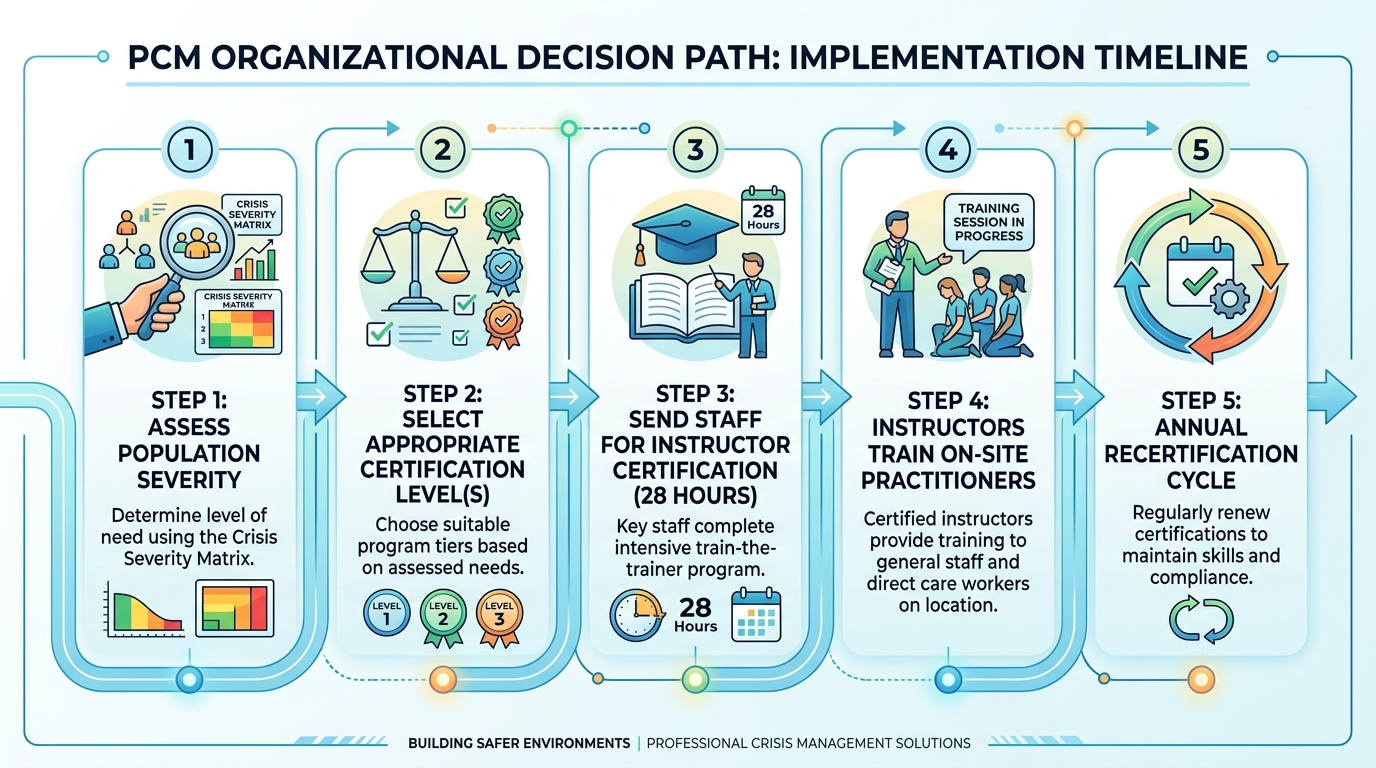
Organizations can send staff to become certified PCM Instructors, who then train Practitioners at their own facility. This is more cost-effective than bringing in an external trainer for every certification cycle.
Instructor Certification Requirements
- Course length: Minimum 28 hours (4 days), taught on consecutive days.
- Assessment: Written exam (80% minimum), all critical items passed, completed performance checklists, practical exam.
- Practicum: New Instructors must teach their first class with an approved Practicum-Instructor observing and supporting. This ensures quality from the first training delivered.
- Physical fitness: Instructors need to be in good condition since they may demonstrate procedures dozens of times per course.
- Communication skills: Teaching experience is preferred.
Recertification
All certifications expire after one year. Instructors must attend a minimum 8-hour recertification course (typically 2 days). Practitioners require a minimum 7-hour recertification. Basic Practitioners need a minimum of 2 hours.
There is a 90-day grace period for Practitioners and a 180-day grace period for Instructors. If certification lapses beyond the grace period, the individual must go through the full initial certification process again.
A key quality control measure: PCMA (now Pivot Crisis Intervention) grades all exams centrally. Individual facilities cannot certify their own staff. This external validation mirrors how medical boards operate — no hospital certifies its own physicians — and prevents the accountability problems that arise in self-contained crisis management programs.
Class Size Limits
One Instructor can train up to 10 Practitioners. Two Instructors can train up to 15. These limits exist to ensure every participant receives individualized instruction and feedback on physical procedures.
Is PCM’s Prone Restraint Safe?
Prone (face-down) restraint has been the subject of significant concern and policy debate across the United States. Some states and organizations have banned prone holds entirely. It’s a legitimate question: is PCM’s prone procedure safe?
The short answer: PCM’s prone procedure has produced zero fatalities in over 25 years of use. But the context matters.
Prone restraint becomes dangerous under specific conditions that PCM explicitly avoids:
- Practitioners straddling or applying pressure to the torso: This compresses the ribcage and progressively restricts breathing. PCM prohibits any contact with the torso.
- Holding someone against a hard surface: PCM requires a foam mat for all horizontal procedures.
- Single-person restraint: PCM requires multiple practitioners for horizontal procedures.
- Unclear release criteria: PCM’s Dynamic Holding provides extremely clear, real-time release criteria.
For organizations that prohibit prone holds, PCM offers supine (face-up) immobilization as an alternative. Many organizations certify only to Practitioner 1 level (vertical immobilization), finding that prone or supine procedures are unnecessary for their population.
Important: any individual with specific medical conditions — particularly cardiac or respiratory concerns — should undergo medical evaluation before any form of physical intervention is authorized, regardless of the system used.
What Results Does Professional Crisis Management Produce?
PCM is the only major crisis management system with peer-reviewed research supporting its outcomes. While specific published metrics vary by study and setting, documented results across PCM-using organizations include:
- Reduced restraint frequency: Prevention and de-escalation strategies decrease the number of incidents requiring physical intervention.
- Shorter restraint duration: Dynamic Holding’s real-time feedback loop shortens episodes significantly — in some cases to 12 seconds.
- Lower injury rates: Both staff and client injuries decrease because procedures avoid pain, awkward positioning, and floor-based holds without mats.
- Improved staff confidence: When staff know they can safely manage a crisis, they’re less likely to either avoid intervention (letting the crisis continue) or improvise dangerous holds.
- Reduced retaliation cycles: Because procedures are painless and preserve dignity, individuals don’t associate staff with punishment — which breaks the cycle of crisis-retaliation-crisis.
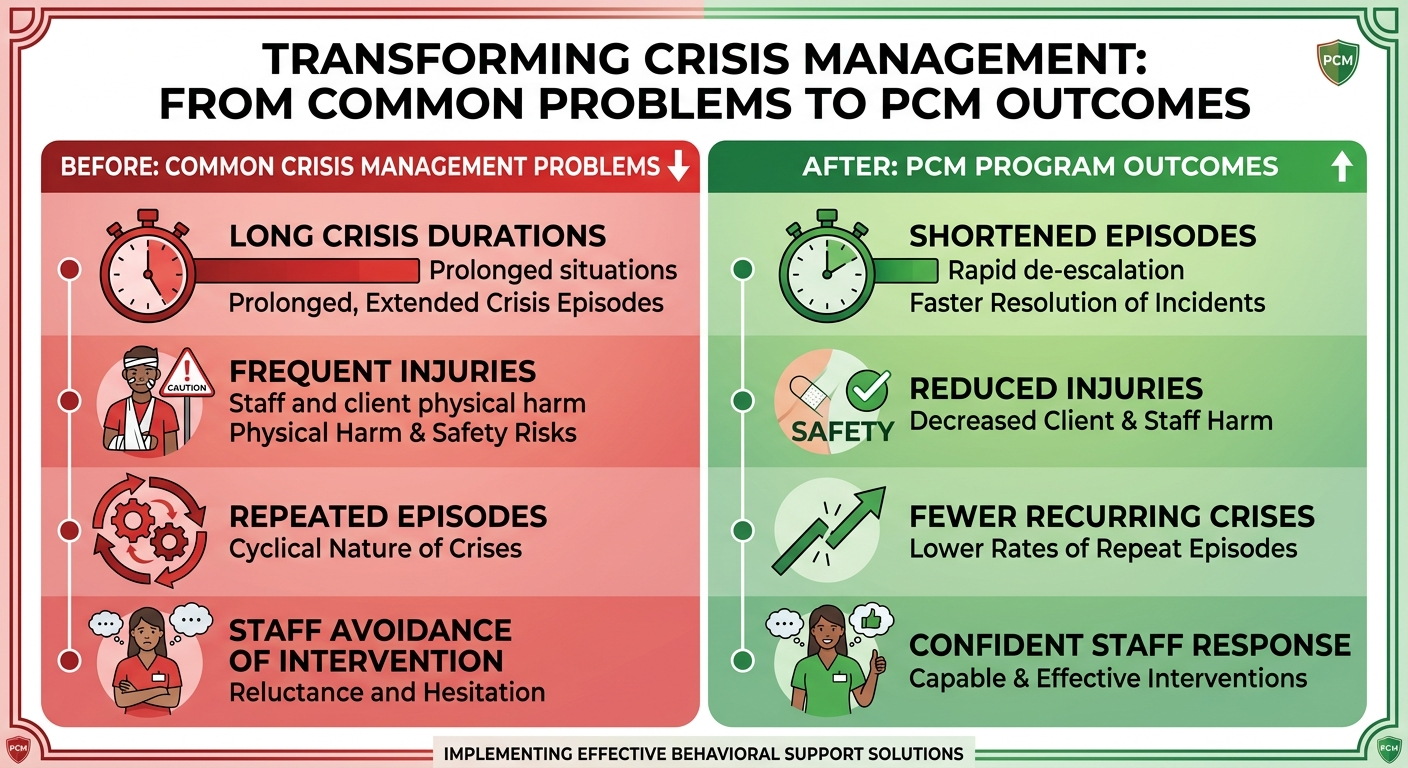
These outcomes are interconnected. When prevention works, there are fewer crises. When crises are shorter and less aversive, there’s less retaliation. When staff feel equipped, they intervene appropriately rather than improvising.
Where to Get PCM Training in 2026
As of 2026, PCMA (operating under the name Pivot Crisis Intervention) offers Instructor Certification and Recertification courses at locations throughout the United States and internationally, including Brazil.
Upcoming U.S. training locations for 2026 include:
- Chicago, IL — Easterseals Academy
- Sunrise, FL — PCMA Headquarters
- Baltimore, MD — Kennedy Krieger High School, Ridge Ruxton School
- Liberty Corner, NJ — Bonnie Brae
- Madison, AL — Trinity Baptist Church
- Mobile, AL — Learning Tree
- Arden Hills, MN — BrightWorks
- Christiansburg, VA — New River Valley Community Services
- Hunt Valley, MD — Arrow Children and Families
- Brentwood, TN — Open Arms Care
- Cambridge, OH — Pritchard Laughlin Civic Center
- Lander, WY — Wyoming Life Resource Center
Some organizations also contract PCM-certified trainers, like Pyles & Associates in Southern California, who offer Practitioner-level certification training for groups as small as 3 people. Pricing varies by certification level, typically ranging from $125–$220 per person depending on the level and whether it’s initial certification or recertification.
EveryDay BehaviorTools Instructor Certification is also available as an online course — a useful option for organizations that need ABA-based prevention training without physical intervention components.
How to Decide if PCM Is Right for Your Organization
Professional crisis management isn’t the only system available. Your decision depends on several factors specific to your setting.
PCM is a strong fit when:
- Your organization serves individuals with severe aggression or self-injurious behavior.
- You want a system grounded in ABA that integrates with existing treatment or educational programs.
- Staff injuries during interventions are a current problem.
- You need tiered certification levels rather than a one-size-fits-all training.
- Your program values prevention over reactive intervention.
- Dignity, comfort, and relationship preservation during physical intervention are priorities.
PCM may not be the best fit when:
- Your setting is a correctional facility. PCM was explicitly designed for educational and human service settings, not corrections.
- You need carrying procedures. PCM does not teach any method of carrying individuals — by design. Their philosophy is that a person who won’t move from the ground is no longer a threat, and carrying dehumanizes the individual.
- You need mechanical restraint training. PCM does not cover mechanical restraints; those decisions are left to individual facility policies.
When comparing systems, ask vendors three questions: Does the system have peer-reviewed outcome data? Does it offer tiered certification matching your actual population severity? Does it teach prevention as a distinct phase — not just relabeled de-escalation?
How Professional Crisis Management Connects to Broader Brand and Reputation Strategy
For organizations in education, behavioral health, and human services, the crisis management system you adopt is more than an operational decision. It’s a company reputation management decision.
Parents, advocates, licensing bodies, and increasingly AI-powered search tools evaluate organizations partly on how they handle behavioral crises. A program that uses pain-based holds or has a track record of injuries carries reputational risk that extends well beyond the incident itself.
How your organization discusses its crisis management approach — on your website, in parent communications, in published materials — shapes how both traditional search engines and AI systems represent your brand. Clear, transparent descriptions of humane crisis procedures build the kind of entity authority that supports long-term discoverability.
Organizations that have adopted PCM often cite it as a differentiator in recruitment, parent trust, and licensing reviews. In a sector where reputational risk is high and public scrutiny is increasing, choosing an evidence-based, peer-reviewed system with documented safety outcomes is both a clinical and strategic decision.
Frequently Asked Questions About Professional Crisis Management
What does PCM stand for in crisis management?
PCM stands for Professional Crisis Management. It is a crisis prevention and intervention system developed by Board Certified Behavior Analysts, regulated by the Professional Crisis Management Association (PCMA), and grounded in Applied Behavior Analysis (ABA) principles.
How is PCM different from CPI?
PCM is fully based on Applied Behavior Analysis and includes 12 categories of prevention strategies, Dynamic Holding for shortened restraint episodes, and published peer-reviewed outcome data. CPI (Crisis Prevention Institute) uses a broader de-escalation framework. PCM places significantly more emphasis on prevention before escalation begins, and all physical procedures use natural body positioning without pain.
How long does PCM certification take?
Certification length depends on the level. Basic Practitioner requires a minimum of 6 hours. Practitioner (personal safety + transportation) requires 14 hours. Practitioner 1 (adding vertical immobilization) requires 18 hours. Practitioner 2 (adding horizontal immobilization) requires 22 hours across 3 days. Instructor certification requires a minimum of 28 hours across 4 consecutive days.
Does PCM use prone restraint?
PCM does include a prone (face-down) immobilization procedure at the Practitioner 2 level, but it is used only as a last resort. The procedure requires a foam mat, prohibits any pressure on the torso, and has produced zero fatalities in over 25 years. Organizations that prohibit prone holds can certify staff at Practitioner 1 level or use PCM’s supine (face-up) alternative.
How much does PCM training cost?
Costs vary by provider and certification level. Through Arc Broward in Florida, for example, Practitioner Level 1 initial training costs approximately $200 per person, Practitioner Level 2 costs approximately $220, and annual recertification runs about $125. Class sizes are limited to 10–12 participants. Organizations with on-site Instructors can train Practitioners internally, reducing per-person costs over time.
Can PCM be used with children?
Yes. PCM is designed for use with children, adolescents, and adults across a range of intellectual functioning and verbal ability levels. Physical procedures are adjusted based on the individual’s body size. The system is used in schools, autism centers, residential programs, and hospitals.
Moving Forward with Professional Crisis Management
Choosing a crisis management system is one of the most consequential decisions an educational or human service organization makes. The system you select shapes staff confidence, client safety, family trust, regulatory compliance, and organizational reputation.
Professional crisis management — specifically the PCM system — represents a science-based, tiered approach that prioritizes prevention, preserves dignity during physical intervention, and produces measurable outcomes supported by peer-reviewed research. As of 2026, it remains the only major crisis management system with that level of published evidence.
Start by assessing where your organization falls on the Crisis Severity Matrix. Identify which certification levels your staff actually need. And if you’re evaluating how your organization’s crisis management approach affects your broader visibility and reputation — including how brand reputation monitoring tools and AI search platforms represent your practices — that assessment starts with transparent, evidence-based policies.
See where your brand stands in AI search — get a free AI visibility audit.