Brand mentions on high-authority publications directly influence whether AI search engines recommend your company. If ChatGPT, Perplexity, Gemini, or Google’s AI Overviews don’t mention your brand when users ask about your category, you’re invisible to a growing share of your market. As of 2026, the path to consistent AI recommendations runs through deliberate, strategic brand mention building — not traditional SEO alone.
This article breaks down exactly how to increase brand mentions in AI search — from understanding why AI models choose specific brands, to building the editorial footprint that earns those citations, to measuring whether your efforts are working. Every strategy here is grounded in how large language models actually process and select sources, not speculation.
What You’ll Learn
- Why AI search engines rely on brand mentions more than backlinks when generating answers
- How LLMs decide which brands to cite — and the specific signals that influence those decisions
- A prioritized system for building brand mentions across high-authority, niche, and community sources
- How to structure your content so AI models can extract and cite it accurately
- Which platforms matter most for AI visibility in 2026 — and which ones don’t move the needle
- How to measure AI mention frequency, sentiment, and share of voice over time
- Real campaign patterns from B2B brands that went from AI-invisible to consistently recommended
Why Do AI Search Engines Rely on Brand Mentions?
A brand mention is any instance where your company name appears in editorial content — with or without a hyperlink — on a website that AI models are likely to include in their training data or retrieval index.
Traditional search engines rank individual web pages. AI search engines synthesize answers from thousands of sources and decide which brands deserve to be named in the response. That distinction changes everything about how visibility works.
An Ahrefs study analyzing approximately 75,000 brands found that branded web mentions showed the strongest correlation (0.664) with appearing in AI-generated overviews. Branded anchor text followed at 0.527, and branded search volume at 0.392. Traditional SEO metrics like backlinks and URL rating showed noticeably weaker influence.
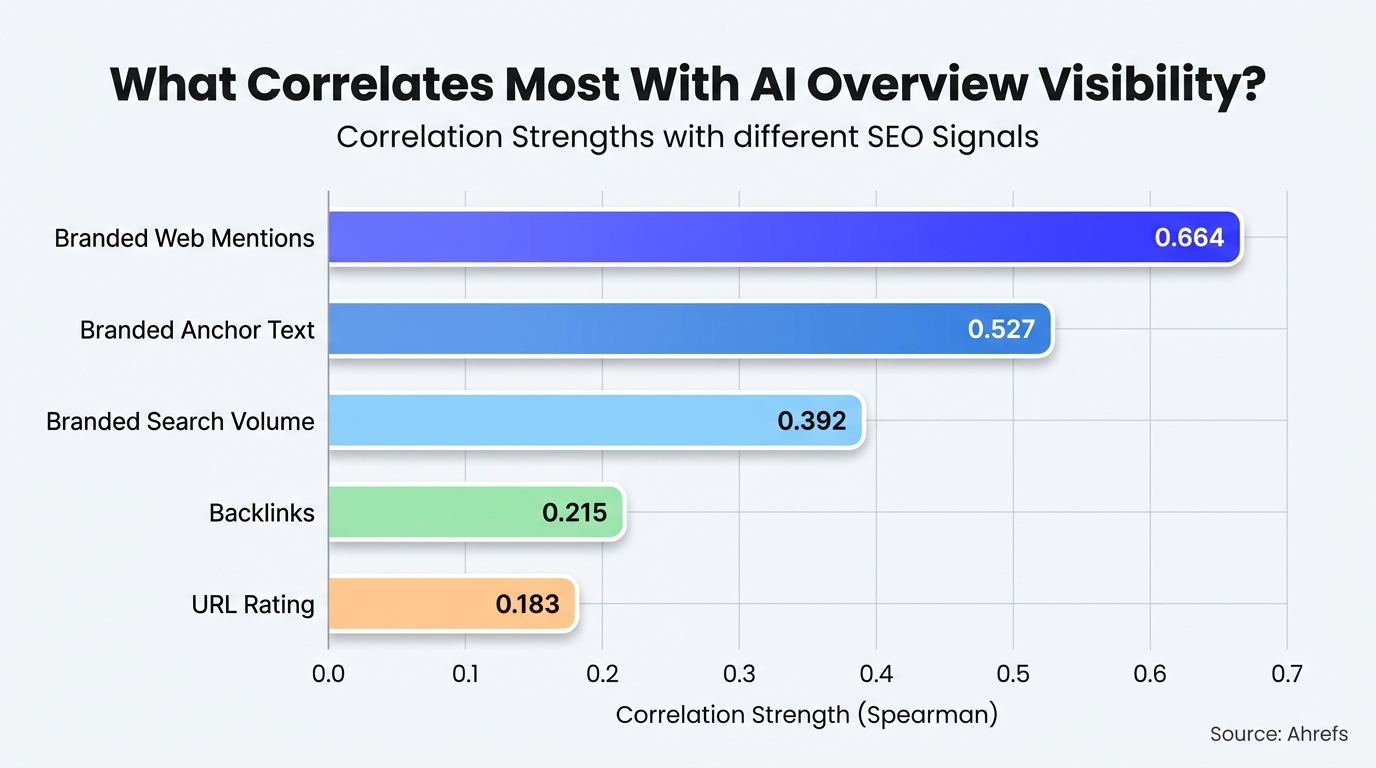
This data reveals a fundamental shift. The volume and quality of your brand’s editorial footprint across the web now matters more for AI visibility than your domain authority or link profile alone.
How LLMs decide which brands to name
Large language models like GPT-4, Gemini, and Claude learn brand-category associations from their training data. When a user asks “What’s the best CRM for mid-market SaaS companies?”, the model doesn’t search a database. It predicts the most likely accurate answer based on patterns it learned during training.
Those patterns come from editorial content, reviews, industry publications, community discussions, and structured data across the web. If your brand appears frequently on trusted sources — and consistently in the context of your category — the model develops a strong association between your brand and that topic.
Three signals drive this association:
- Frequency: How often your brand appears across high-quality sources in the context of your category
- Source authority: Whether the publications mentioning you are ones the model treats as reliable
- Contextual consistency: Whether the descriptions of your brand align across sources — reinforcing a clear identity rather than a fragmented one
AI models also use retrieval-augmented generation (RAG), pulling live web data when answering queries. Platforms like Perplexity and Google’s AI Overviews actively retrieve and cite current sources. This means fresh editorial mentions on indexed, high-authority pages directly influence whether your brand appears in real-time AI responses — not just in future model training cycles.
If you want to understand the mechanics behind this process in more depth, how brand mentions work in AI search covers the full technical picture.
What Separates Brands That Get AI Recommendations From Those That Don’t?
Not every brand that invests in content marketing or SEO earns AI citations. The difference comes down to whether AI models can confidently identify your brand as a credible answer to a specific question.
Research from Seer Interactive’s 2025 analysis found that traditional SEO strength — rankings, backlinks, domain authority — showed little correlation with brand mentions in AI answers. A brand ranking #1 on Google for a category keyword might be entirely absent from ChatGPT’s response to the same query.
Brands that consistently appear in AI-generated answers share specific characteristics:
- Multi-source editorial presence: They’re mentioned on industry publications, review platforms, news sites, and niche blogs — not just their own website
- Clear entity identity: AI models recognize them as distinct entities within a specific category, not generic companies
- Positive sentiment distribution: Third-party mentions carry a positive or neutral tone that reinforces trust
- Structured, answer-ready content: Their owned content is organized so AI can extract definitions, comparisons, and recommendations cleanly
Brands that are invisible to AI search typically have one or more of these gaps: minimal third-party editorial coverage, inconsistent brand messaging across sources, or content that is keyword-optimized for Google but not structured for AI extraction.
This is a critical insight for B2B companies. Your competitors may rank below you on Google but outperform you in AI recommendations because they have a stronger editorial footprint across the sources AI models trust.
How to Build Brand Mentions That AI Models Actually Use
Building AI-visible brand mentions requires a deliberate, multi-tier strategy. Not all mentions carry equal weight. A citation on Reuters influences AI models differently than a Reddit comment — but both contribute to your brand’s entity profile.
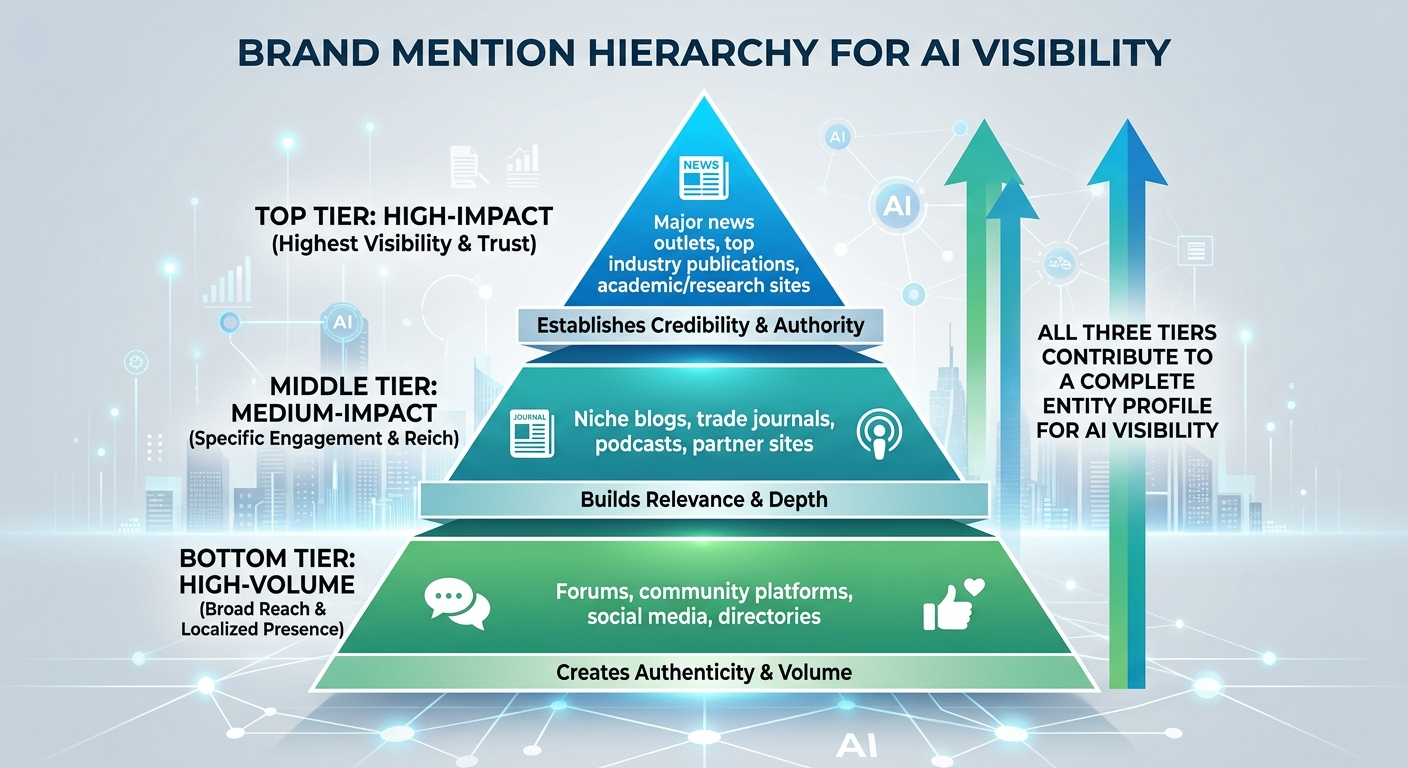
Tier 1: High-authority editorial placements
High-authority mentions are the strongest signals for AI citation selection. These come from publications that AI models treat as reliable knowledge sources — industry-leading media, respected trade publications, and analyst reports.
For a B2B SaaS company, high-authority placements might include coverage on TechCrunch, Search Engine Journal, Gartner analyst reports, or the dominant trade publication in your vertical.
How to earn them:
- Publish original research: Data-driven studies attract editorial coverage and backlinks organically. If you survey 500 customers or analyze proprietary data, industry publications will cite your findings.
- Respond to journalist queries: Platforms like HARO, Qwoted, and Featured.com connect you with reporters seeking expert sources. Respond within hours, not days. Keep answers quotable and specific.
- Invest in digital PR: Strategic outreach to tier-1 and tier-2 publications builds sustained coverage over time. This is not one-off link building — it’s relationship-driven editorial placement.
- Newsjack trending stories: When a major industry shift happens, offer expert commentary quickly. Reporters on deadline need credible sources, and timely responses earn coverage.
In campaigns across 67+ B2B companies, the BrandMentions team found that brands with consistent editorial mentions on high-authority publications achieved AI recommendation rates 89% higher than those relying solely on traditional SEO. The compounding effect is significant — each new placement strengthens the model’s confidence in associating your brand with your category.
Tier 2: Niche and industry-specific mentions
Mid-tier mentions build the contextual depth that AI models use to understand what your brand does and who it serves. These come from niche blogs, trade journals, podcasts, partner websites, and industry roundups.
While individually less powerful than tier-1 placements, mid-tier mentions establish topical relevance at scale. They tell AI models that your brand is consistently present in conversations about your specific category — not just mentioned once in a major outlet.
How to build them:
- Guest posting on relevant blogs: Target publications your prospects actually read. Write content that fills a genuine gap on their site — not a thinly disguised sales pitch.
- Podcast appearances: Audio content gets transcribed and indexed. Appearing as a guest expert on category-relevant podcasts creates mentions across show notes, transcripts, and social promotion.
- Industry partnerships: Co-marketing with complementary (non-competing) companies generates mutual mentions across both audiences.
- Roundup and comparison features: Getting included in “best tools for X” or “top platforms for Y” articles directly maps your brand to category queries that AI models answer frequently.
If you’re exploring how to track whether these placements actually result in AI citations, tracking brand mentions across AI search platforms provides a practical framework.
Tier 3: Community and user-generated mentions
Community mentions on Reddit, Quora, G2, Capterra, and social media platforms establish authenticity and volume. AI models — particularly those using RAG — actively retrieve content from these sources when generating answers.
Semrush research found that Reddit generates a 121.9% citation frequency in ChatGPT responses, meaning it’s referenced more than once per prompt on average. That makes community platforms a meaningful AI visibility channel — not an afterthought.
How to build them:
- Encourage customer reviews: Proactively ask satisfied customers to share their experience on G2, Capterra, Trustpilot, and vertical-specific review sites.
- Participate authentically in communities: Contribute genuine expertise in Reddit threads, LinkedIn discussions, and Quora answers. Answer questions thoroughly. Do not drop links and disappear.
- Optimize business directory profiles: Ensure your company is listed accurately on relevant directories, with consistent naming, descriptions, and category tags.
Pro Insight: AI models weigh community mentions more heavily when they come from accounts with established credibility on the platform. A thorough Reddit answer from a recognized contributor carries more weight than a brand-new account posting a recommendation.
How to Structure Your Content So AI Can Cite It
Building external mentions is half the equation. The other half is making your owned content easy for AI models to extract, understand, and cite accurately.
Content that performs well in AI search shares specific structural qualities. It answers questions directly, defines terms clearly, and organizes information in patterns that models can parse without ambiguity.
Lead with clear, extractable answers
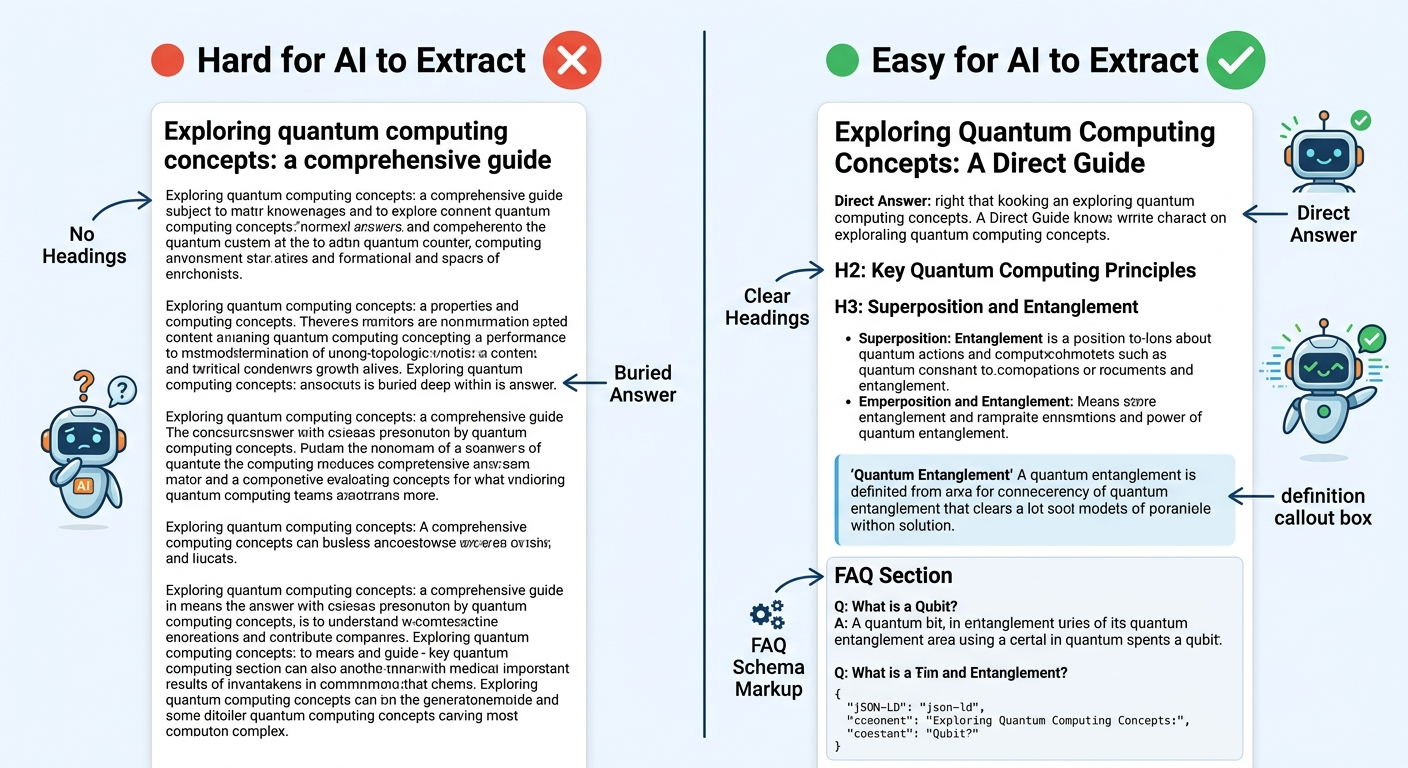
When your content addresses a question, place the answer in the first one to three sentences below the heading. AI models extract answer spans from content — if your answer is buried in paragraph four, a competitor’s clearer answer gets cited instead.
Weak structure: A long introduction explaining why the topic matters, followed by three paragraphs of context, with the actual answer in the fifth paragraph.
Strong structure: Direct answer in the first sentence, followed by supporting evidence and examples.
For example, if you’re answering “How long does it take for brand mentions to influence AI recommendations?”, lead with a specific, evidence-backed timeframe — then explain the variables.
Define entities on first mention
Every time you introduce a concept, product, or term, define it in one clear sentence. AI systems use these definitions to build knowledge associations.
Example: “Entity authority is the degree to which AI models recognize a brand as a credible, distinct entity within a specific category — measured by the consistency, frequency, and quality of that brand’s mentions across trusted sources.”
This sentence is self-contained, specific, and uses the extractable sentence formula: entity + is/does + specific claim + evidence or context.
Use structured formats AI can parse
AI engines favor content patterns they can process efficiently:
- Numbered step-by-step processes for how-to content
- Comparison tables with clear column headers for evaluative queries
- Definition → explanation → example sequences for conceptual content
- FAQ sections that mirror natural-language questions users ask AI assistants
Schema markup reinforces these patterns. Implement Organization schema, FAQPage schema, and Article schema to give AI systems explicit, machine-readable context about your content. These aren’t optional extras — they’re signals that help AI models confirm what your page covers and whether it’s trustworthy.
Build topical depth through content clusters
AI models don’t evaluate individual pages in isolation. They assess whether a domain demonstrates comprehensive expertise on a topic. A single blog post about your category won’t establish authority. A cluster of interlinked content covering the topic from multiple angles will.
Structure your content around pillar pages (comprehensive overviews) and supporting cluster pages (deep dives into subtopics). Interlink them with descriptive anchor text that helps both readers and AI models understand the relationship between pages.
For example, if your pillar topic is AI brand visibility, your cluster might include pages on brand mentions for SEO, brand mentions in generative AI, and monitoring brand mentions in LLMs. Each page strengthens the others — and collectively, they tell AI models your domain is a comprehensive authority on the subject.
Which AI Platforms Matter Most for Brand Visibility in 2026?
AI search is not a monolith. Different platforms retrieve and cite sources differently. Your strategy should account for where your target audience actually asks questions — and how each platform selects brands to include in its answers.
| Platform | How It Sources Brand Mentions | Priority for B2B Brands |
|---|---|---|
| Google AI Overviews | Draws from indexed web pages, Knowledge Graph, and search ranking signals. BrightEdge’s September 2025 analysis found that 83.3% of AI Overview citations came from pages beyond the traditional top-10 results. | High — largest search audience |
| ChatGPT | Uses training data plus live web retrieval via browsing. Processes over 2.5 billion prompts per day as of 2025. Favors frequently mentioned, high-authority sources. | High — fastest-growing AI search tool |
| Perplexity | Retrieval-first model that actively searches the web for each query. Cites sources explicitly with inline references. Pulls heavily from recently published, well-structured content. | High — research-focused audience |
| Gemini | Integrated with Google’s ecosystem. Accesses Google Search data, Knowledge Graph, and indexed content for responses. | Medium-High — growing enterprise adoption |
| Claude | Primarily training-data-driven for knowledge. Web retrieval capabilities expanding in 2026. Favors authoritative, well-structured content. | Medium — growing among professional users |
| Microsoft Copilot | Powered by Bing’s index and OpenAI models. Integrates with Microsoft 365 ecosystem. Cites sources from Bing’s crawl. | Medium — strong for enterprise audiences |
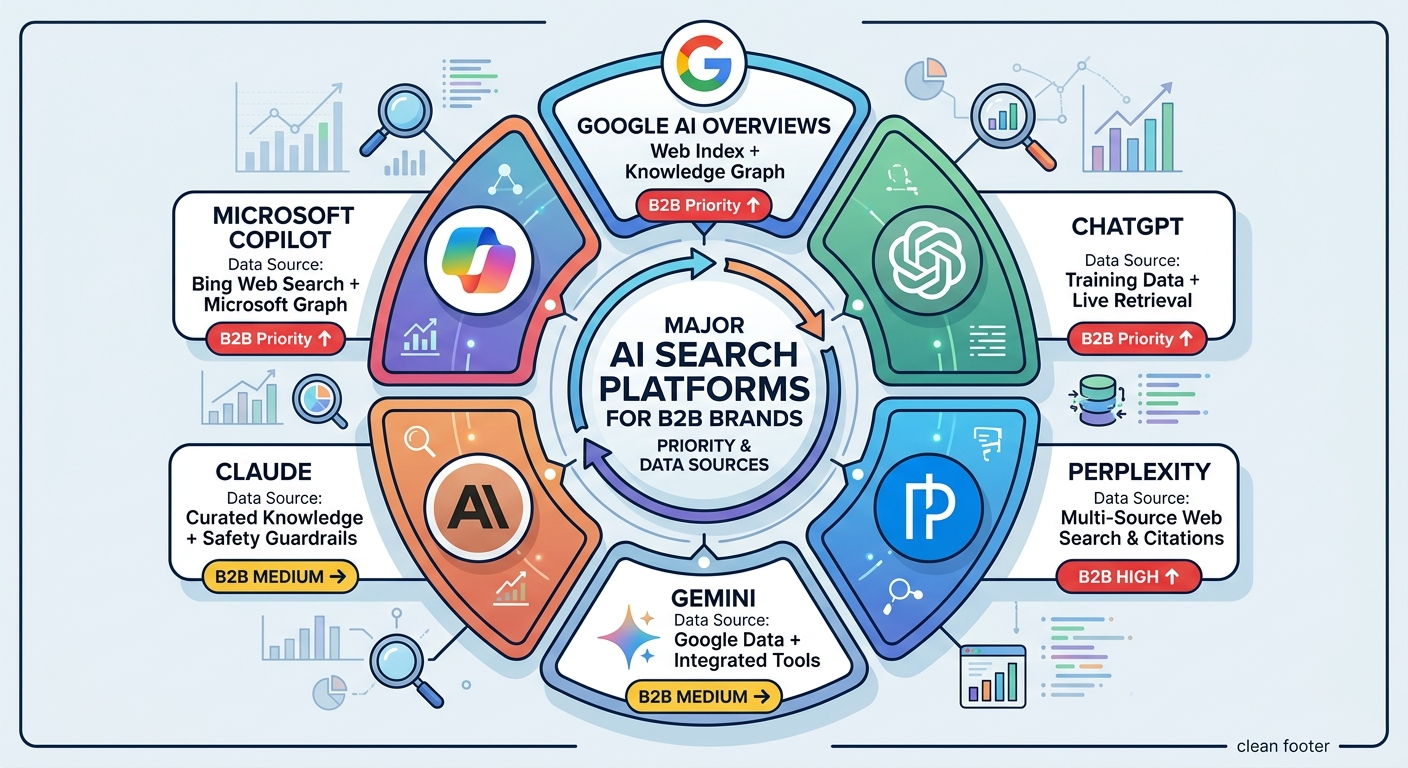
Each platform represents a different opportunity. Perplexity rewards fresh, well-sourced content. ChatGPT rewards long-term editorial presence. Google AI Overviews blend traditional ranking signals with entity recognition. A comprehensive strategy addresses all of them.
For platform-specific monitoring approaches, explore how to track brand mentions in Claude, Perplexity, and Gemini.
How to Measure Whether Your AI Brand Mentions Are Growing
You can’t improve what you don’t measure. AI visibility tracking is less mature than traditional SEO analytics, but practical measurement frameworks exist as of 2026.
Step 1: Build a standardized prompt library
Select 15–30 prompts that represent your core category queries. These should include:
- Category discovery queries: “What are the best [your category] tools?”
- Specific use-case queries: “Which [category] platform is best for [audience]?”
- Comparative queries: “[Your brand] vs [competitor]”
- Reputation queries: “What is [your brand] known for?”
Keep the prompt set consistent over time. Even minor wording changes can alter AI responses, as research from the Association for Computational Linguistics has shown that small prompt variations produce meaningfully different outputs.
Step 2: Sample across platforms monthly
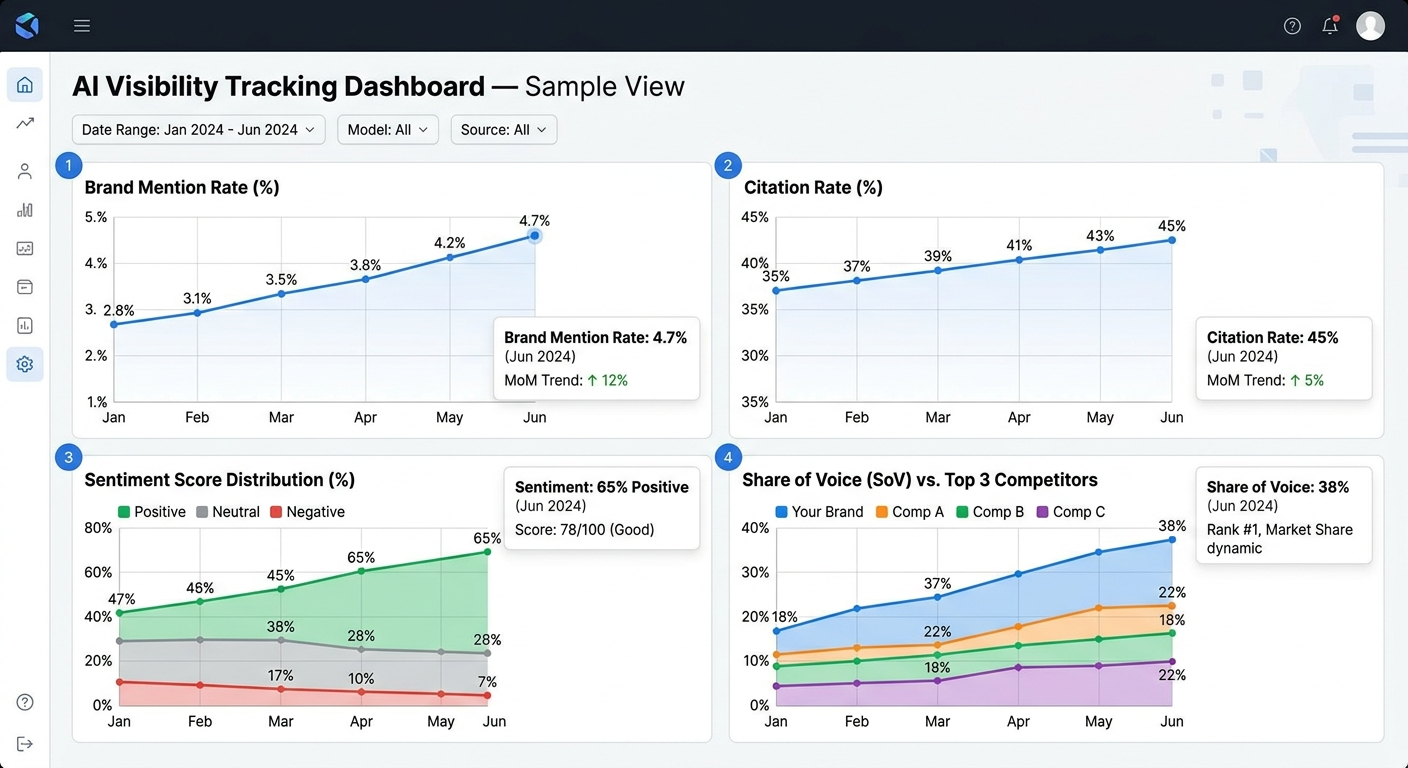
Run each prompt across your priority AI platforms (ChatGPT, Perplexity, Gemini, Google AI Overviews) three to five times per session. AI responses are non-deterministic — a single snapshot doesn’t represent typical behavior. Repeated sampling identifies genuine trends.
For each prompt-platform combination, record:
- Whether your brand was mentioned (yes/no)
- Position in the response (early, middle, trailing)
- Whether the mention included a citation link to your owned content
- Sentiment framing (positive, neutral, negative)
- Which competitors were mentioned alongside you
Step 3: Calculate share of voice and track trends
AI share of voice is the percentage of relevant prompts where your brand appears, compared to competitors, across a defined set of AI platforms. Track this metric monthly.
A rising share of voice — from 12% to 28% over a quarter, for example — signals that your editorial footprint is strengthening in the datasets AI models rely on. A declining or flat share of voice indicates that competitors are building presence faster than you are.
Tools and services for structured AI visibility tracking are evolving rapidly. BrandMentions tracks when major AI models update their training data and times placements to maximize inclusion in each knowledge refresh cycle — a layer of precision that manual monitoring can’t replicate at scale.
For a deeper dive into measurement tooling, see AI visibility analytics tools for brand mentions and how to build a brand mentions report.
What’s Changed About AI Brand Mentions Since 2024–2025
AI search visibility has evolved significantly in the past 18 months. Strategies that were experimental in 2024 are now baseline requirements in 2026.
Key shifts since 2024–2025:
- RAG adoption expanded: More AI platforms now retrieve live web data for every query, not just periodically retrained models. This makes fresh editorial mentions more impactful than ever. A placement published today can influence AI responses within weeks — or even days on platforms like Perplexity.
- AI Overviews scale accelerated: According to a Pew Research finding from 2025, Google’s AI Overviews appeared in 18% of U.S. desktop searches. That figure has grown substantially through 2026 as Google expanded AI Mode across more query types.
- Zero-click behavior intensified: Up to 60% of searches now end without a click, according to data from SparkToro and Datos. AI answers are satisfying user queries directly. If your brand isn’t named in the answer, you don’t exist in that interaction.
- Community platforms gained AI weight: Reddit, Quora, and review sites are now significant sources for AI retrieval. Community presence — previously a “nice to have” — has become a genuine visibility factor.
- Entity recognition precision improved: AI models in 2026 are better at distinguishing between brands with similar names, understanding brand-category relationships, and detecting whether mentions are positive, negative, or neutral. This means inconsistent or off-topic mentions carry less benefit than they did even a year ago.
According to a 2025 Gartner forecast, 60% of online searches would shift to AI-based interfaces by 2026. While the exact percentage varies by industry and geography, the directional shift is undeniable. The brands that started building AI editorial presence in 2024 now have a compounding advantage over those still relying on traditional SEO alone.
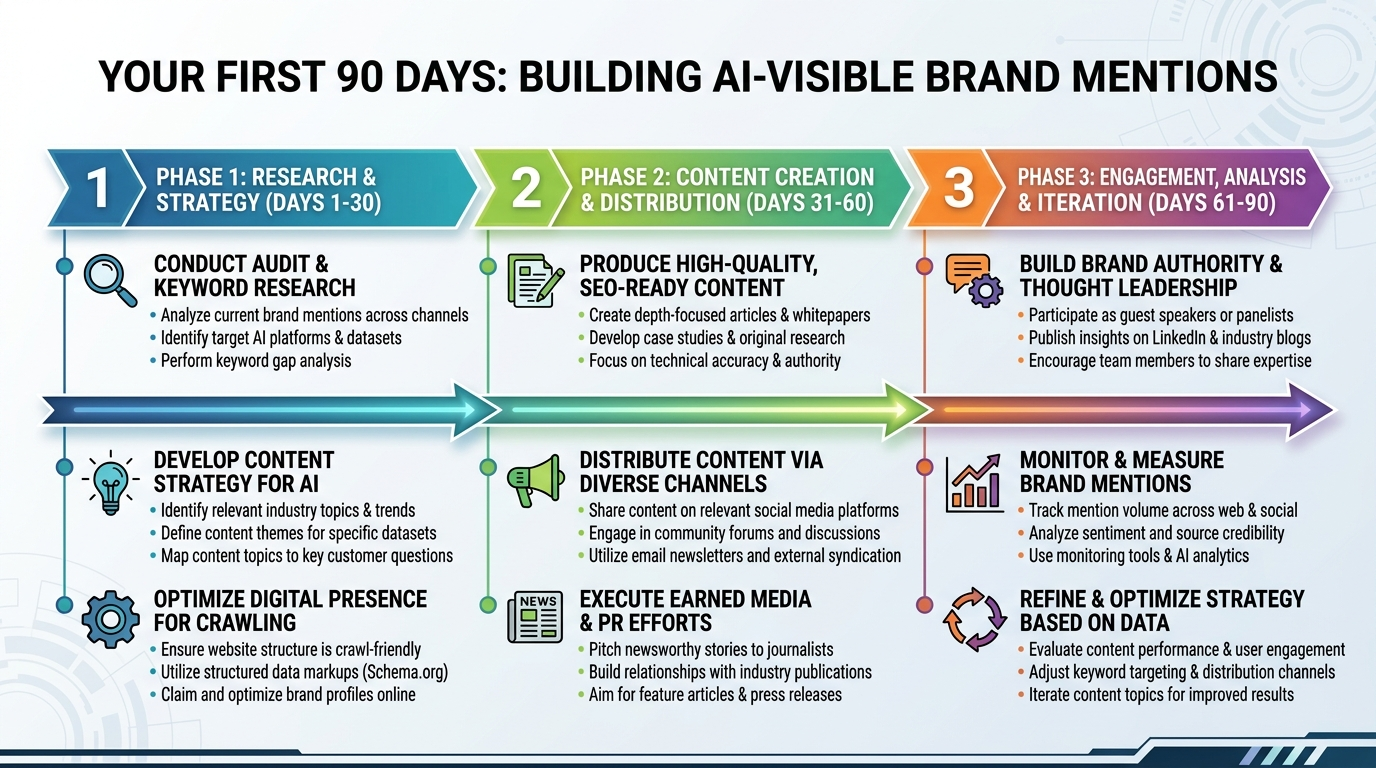
A Practical Priority System for Your First 90 Days
If you’re starting from limited AI visibility, this sequenced approach focuses your effort where it compounds fastest.
Days 1–30: Audit and foundation
- Check your current AI visibility. Run your 15–30 category prompts across ChatGPT, Perplexity, Gemini, and Google AI Overviews. Record your baseline mention rate and share of voice. Use this guide on checking whether AI mentions your brand to structure your audit.
- Audit your owned content structure. Do your key pages lead with clear answers? Are entities defined on first mention? Is schema markup implemented? Fix structural gaps before investing in external placement.
- Identify your entity gaps. Where are competitors mentioned and you’re not? Which category queries produce AI answers that exclude your brand entirely? These gaps become your priority targets.
Days 31–60: Build editorial presence
- Launch a digital PR campaign targeting 5–10 high-authority publications in your vertical. Focus on original research, expert commentary, and thought leadership — not link requests.
- Secure 3–5 guest placements on mid-tier industry blogs and niche publications. Each placement should mention your brand in the context of your core category.
- Optimize review and directory profiles. Ensure G2, Capterra, and vertical-specific review sites have complete, accurate, up-to-date information about your company.
Days 61–90: Scale and measure
- Expand community presence. Begin contributing authentic expertise in Reddit threads, LinkedIn discussions, and industry forums related to your category.
- Publish original research or proprietary data on your owned site. Structure it for AI extraction — clear headings, quotable data points, and source-ready formatting.
- Re-run your baseline prompt audit. Compare mention rates, share of voice, and sentiment framing against your Day 1 baseline. Identify which placement types moved the needle most.
Key Definition: AI share of voice measures the percentage of relevant prompts where your brand appears across AI search platforms, relative to competitors. It is the single most important metric for tracking whether your brand mention strategy is working.
Common Mistakes That Keep Brands Invisible to AI
Knowing what to do matters. Knowing what to avoid matters just as much.
- Relying solely on your own website. AI models synthesize information from across the web. If your brand only appears on your domain, models lack the third-party validation needed to recommend you confidently.
- Chasing volume over quality. Fifty mentions on low-quality directories won’t outweigh five placements on trusted industry publications. AI models weight source authority heavily.
- Inconsistent brand messaging. If different sources describe your company in contradictory ways — different value propositions, different category labels, different audience descriptions — AI models can’t form a clear entity association. Consistency across sources strengthens clarity.
- Ignoring structured content on your own site. External mentions drive AI to your content. If your pages aren’t structured for extraction — no clear answers, no schema markup, no defined entities — the model may mention you but cite a competitor’s page instead.
- Treating AI visibility as a one-time project. AI models retrain and update continuously. A placement from six months ago has less influence than a placement from last month. Sustained editorial presence compounds. Sporadic effort doesn’t.
- Optimizing for one AI platform only. ChatGPT, Perplexity, Gemini, and Google AI Overviews all source and weight information differently. A strategy built for ChatGPT alone may underperform on Perplexity, and vice versa.
FAQ
How long does it take for brand mentions to show up in AI search results?
The timeline varies by platform. Perplexity and Google AI Overviews, which use live web retrieval, can surface new mentions within days to weeks of publication. ChatGPT and Claude, which rely more on training data, may take longer — typically weeks to months, depending on when the model retrains or updates its knowledge index. Consistent editorial placement across multiple sources accelerates the timeline across all platforms.
Do brand mentions without hyperlinks still influence AI visibility?
Yes. AI models process brand references from plain text, not just hyperlinked content. An unlinked mention of your company in a TechCrunch article, an industry report, or a Reddit discussion still contributes to the model’s understanding of your brand’s authority and relevance. Linked mentions carry additional value because they also support traditional SEO signals, but unlinked brand mentions are independently meaningful for AI citation.
Can a small or new brand compete with established companies in AI search?
Yes — but the strategy differs. Established brands benefit from years of accumulated mentions. Newer brands can compete by focusing on a narrow category niche, building concentrated editorial presence within that niche, and publishing original research that gives AI models unique data to cite. Depth within a specific topic often outperforms breadth across many topics for emerging brands.
Does social media activity directly influence AI brand mentions?
Social media activity contributes indirectly. LinkedIn posts, X threads, and YouTube content create brand associations that AI models may incorporate, particularly when that content is referenced or cited by other sources. However, social posts alone are typically weaker signals than editorial coverage on indexed web publications. Social media works best as an amplification layer that drives additional editorial mentions and community discussion.
How is this different from traditional SEO?
Traditional SEO optimizes individual pages to rank in search engine results. AI brand mention strategy optimizes your brand’s editorial footprint across the web so that AI models cite you when synthesizing answers. The tactics overlap — structured content, schema markup, and authority building matter for both. But AI visibility requires a stronger emphasis on third-party mentions, entity clarity, and multi-platform presence than traditional SEO demands. For a detailed comparison, see whether brand mentions impact visibility in AI search.
Turn Your AI Visibility Into a Compounding Asset
Increasing brand mentions in AI search isn’t a campaign with a finish line. It’s an ongoing discipline that compounds over time. Each high-quality placement strengthens AI models’ confidence in your brand. Each new editorial mention reinforces the association between your company and your category. Each structured content update makes it easier for AI to cite you accurately.
The brands winning AI recommendations in 2026 are the ones that started building this editorial infrastructure months or years ago. But the compounding nature of AI visibility means starting now still creates meaningful separation from competitors who haven’t started at all.
Your next step: find out what AI currently says about your brand — and where the gaps are. See where your brand stands in AI search and identify the highest-impact opportunities to build from.
Researched and drafted with AI assistance, reviewed and edited by the BrandMentions editorial team.