To check brand mentions in ChatGPT, you need to run structured prompts across both free and Plus tiers, document responses systematically, and track changes over time — because ChatGPT has no built-in analytics, no brand dashboard, and no way to alert you when your name appears in an answer.
As of 2026, ChatGPT processes over 2.5 billion queries per day, according to Meltwater’s 2026 analysis. With 800 million weekly active users asking for product recommendations, service comparisons, and category advice, the platform shapes purchase decisions before a prospect ever reaches Google. Yet most marketing teams have no idea what ChatGPT says about their brand — or whether it mentions them at all.
This gap exists because ChatGPT operates nothing like a search engine. There are no impressions, no click-through rates, no Search Console equivalent. If your brand appears in a response, you won’t receive a notification. If ChatGPT describes your product inaccurately, you won’t see a flag. The only way to know is to check — deliberately and repeatedly.
This article walks you through three practical methods for checking your brand mentions in ChatGPT: a manual approach you can start in 15 minutes, a prompt library strategy that scales your coverage, and automated tracking platforms that monitor visibility over time. You’ll also learn which metrics actually matter and how to interpret what you find.
- How to manually check if ChatGPT mentions your brand — and why a single query isn’t enough
- A prompt library method that captures 60+ variations from just 6 core keywords
- Why free-tier and Plus-tier ChatGPT produce different brand mentions
- Five metrics that separate meaningful visibility data from noise
- Which automated tools track ChatGPT mentions at scale — and when you actually need one
- How to interpret what ChatGPT says about you and take action on the findings
Why Checking Brand Mentions in ChatGPT Requires a Different Approach
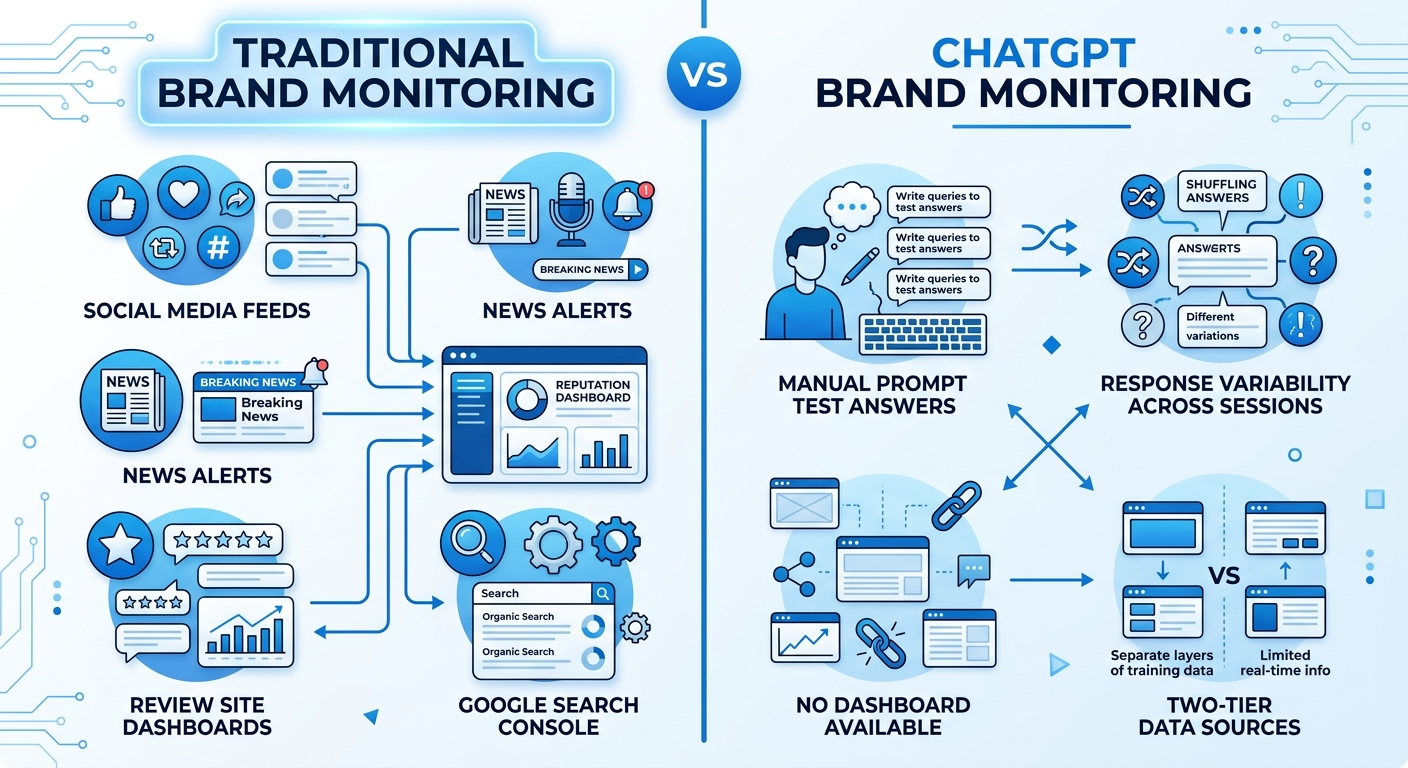
Traditional brand monitoring tools scan social platforms, news sites, and review pages for your company name. ChatGPT doesn’t work like any of those channels.
A brand mention in ChatGPT is any instance where the model names your company, product, or service within a generated response — typically in answer to a recommendation, comparison, or category-level question. These mentions happen conversationally, without source attribution in most cases, and they vary between sessions.
Three characteristics make ChatGPT brand tracking fundamentally different from monitoring Google or social media:
- Response variability: The same prompt can produce different brand recommendations in separate sessions. A single test tells you almost nothing about your actual visibility.
- Two-tier data sources: ChatGPT’s free tier draws from training data with a fixed cutoff date. The Plus tier adds real-time web search. Your brand may appear in one tier but not the other.
- No native analytics: There is no dashboard, no impressions count, no way to see which prompts triggered your brand. You must generate this data yourself.
These differences mean that the standard approach — searching your brand name once and checking the result — produces unreliable data. To get an accurate picture, you need structured prompts, repeated tests, and consistent tracking intervals.
Method 1: Manual Prompt Testing (Start in 15 Minutes)
The fastest way to check your brand mentions in ChatGPT is to ask it directly. Open a new ChatGPT session and type prompts that mirror how your potential customers search for solutions in your category.
This method works for an initial assessment. It costs nothing, requires no tools, and gives you immediate signal. However, it only produces reliable results if you follow a structured process rather than typing a few random questions.
Step 1: Build Your Prompt List
Start with 15–20 prompts written as natural questions — the way a real person would ask ChatGPT for help. Avoid keyword-style queries like “best CRM software.” Instead, use conversational phrasing like “What CRM should a 50-person B2B company use?”
Mix three prompt types:
- Category queries (70%): “What are the best tools for [your category]?” / “Which [product type] do you recommend for [use case]?”
- Comparison queries (15%): “[Your brand] vs [competitor] — which is better for [scenario]?”
- Branded queries (15%): “What do you know about [your brand]?” / “Is [your brand] a good choice for [use case]?”
Source your prompts from real customer language: support tickets, sales call transcripts, Reddit threads in your niche, and Google’s People Also Ask boxes for your primary keywords.
Step 2: Run Each Prompt at Least Twice
Open a fresh ChatGPT session for every test. Do not continue a previous conversation — prior context influences responses. Run each prompt a minimum of two times, ideally three, in separate sessions.
For each test, record:
- Mentioned? Yes, no, or partial (your brand referenced indirectly)
- Position: First recommendation, middle of a list, or brief mention near the end
- Accuracy: Does ChatGPT describe your product correctly? Rate 1–5.
- Competitors named: Which brands appeared alongside or instead of yours?
- Factual errors: Wrong pricing, discontinued features, or confused identity
- Tier tested: Free or Plus — and whether web search was active
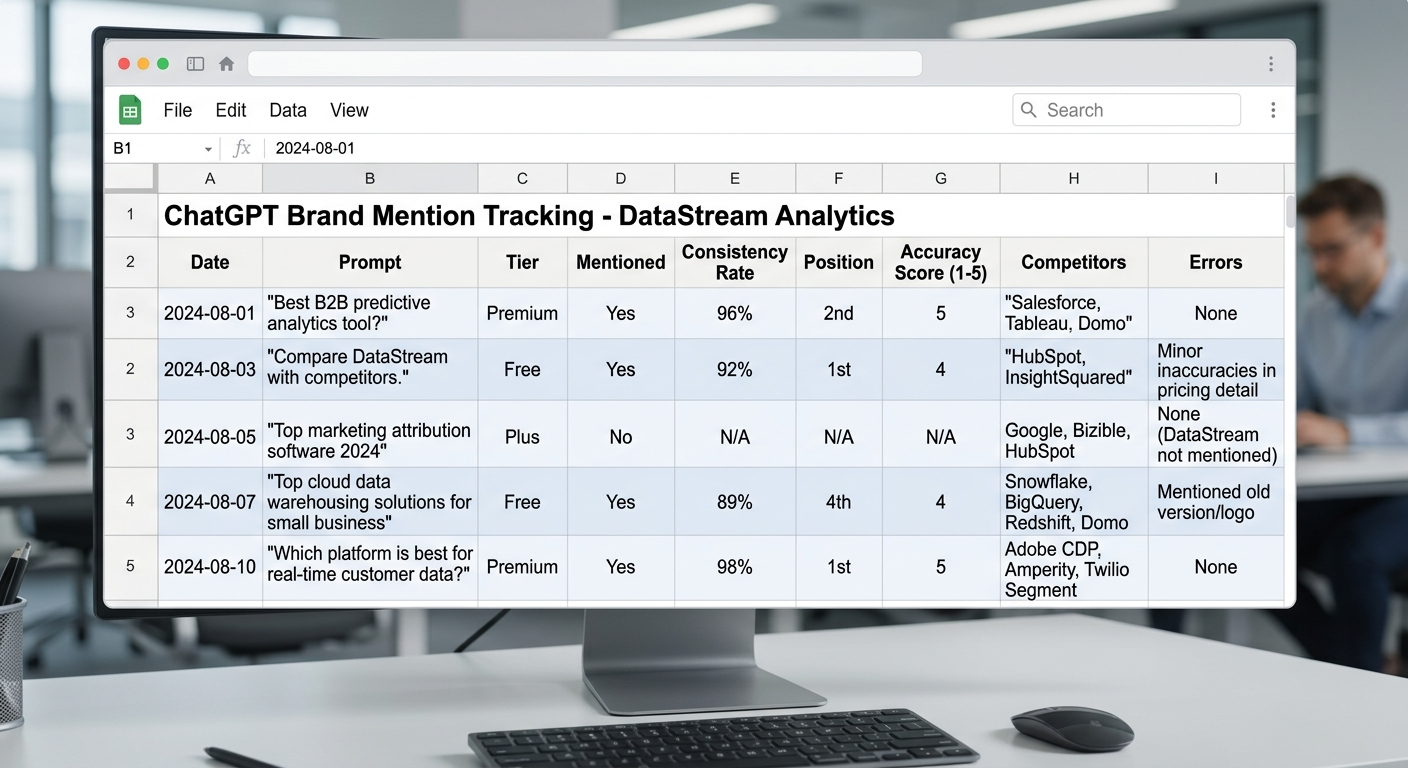
Step 3: Log Results in a Tracking Sheet
Use a simple spreadsheet with these columns: Date, Prompt, Tier (Free/Plus), Mentioned (Y/N), Consistency (e.g., 2/3 tests), Position, Accuracy Score, Competitors Listed, Errors, Notes.
This baseline gives you a clear snapshot of where you stand. Run the same test monthly to track changes — or immediately after a major ChatGPT model update.
Method 2: Scaled Prompt Library for Comprehensive Coverage
Manual testing with 15 prompts gives you an initial signal. But customers ask ChatGPT hundreds of different ways. A prompt library strategy expands your coverage without requiring you to brainstorm every variation yourself.
The concept is straightforward: use ChatGPT itself to generate the prompt variations your customers might use, then test those variations systematically.
How to Generate Prompt Variations
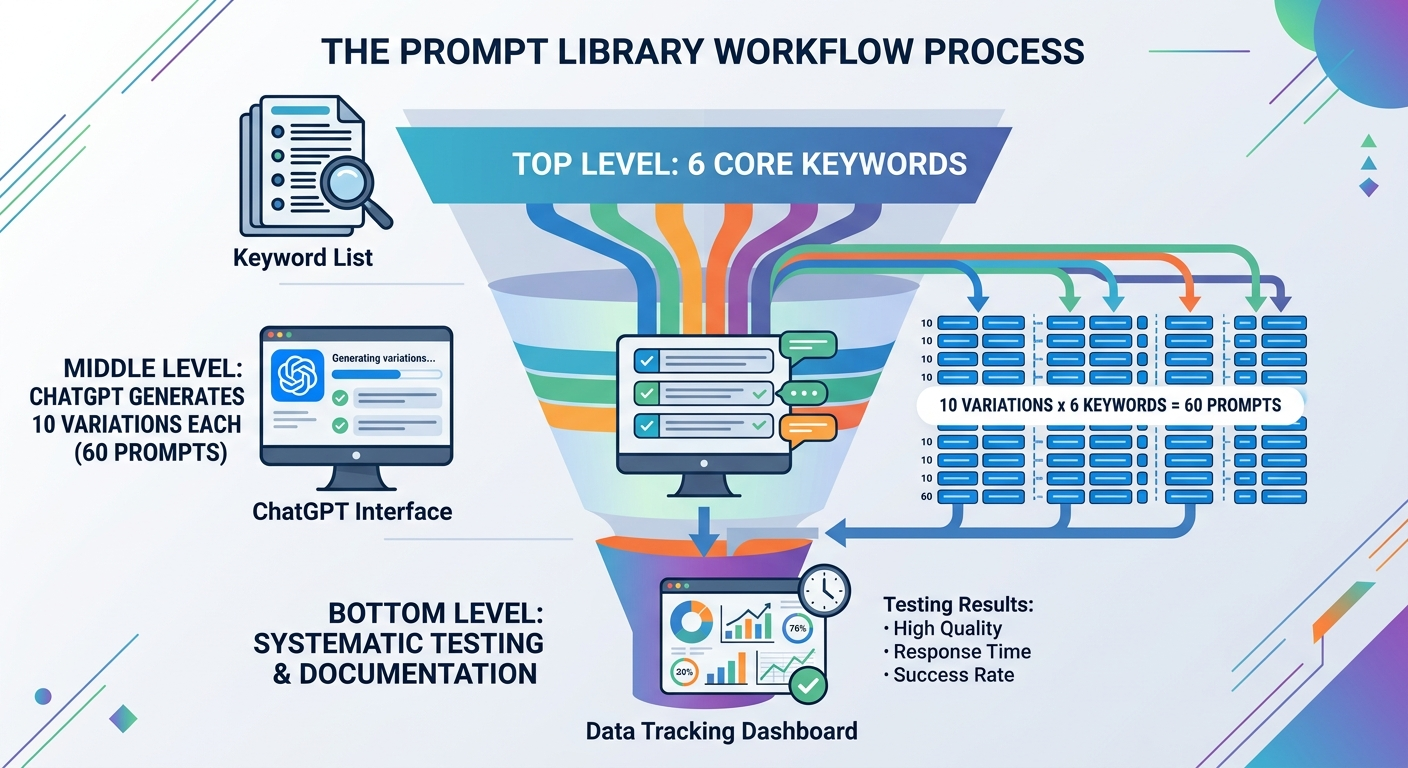
Take each of your 6–10 primary keywords and ask ChatGPT to generate 10 natural-language questions a real buyer would ask when looking for providers in that category. Specify that every question should be phrased to trigger brand recommendations — not definitions or educational content.
For example, if your keyword is “project management software,” your prompt variations might include:
- “Which project management tools work best for remote teams under 100 people?”
- “What’s an affordable project management platform for marketing agencies?”
- “Top-rated project management software for B2B companies in 2026”
- “Best alternative to Asana for enterprise project management”
Starting with just 6 core keywords, this approach typically produces 50–70 unique test prompts. Each one represents a real way someone might discover — or miss — your brand inside ChatGPT.
How to Process the Results
Run each generated prompt in ChatGPT, document the response, and record whether your brand appeared. Track the same data points from Method 1: mention status, position, accuracy, competitors, and errors.
This expanded dataset reveals patterns that a small prompt list cannot:
- Keyword gaps: Categories where ChatGPT never mentions you, even though you compete there
- Competitor dominance: Brands that consistently appear across prompt variations while yours does not
- Framing patterns: How ChatGPT positions your brand — as a leader, a budget option, a niche player, or an alternative
Repeat this process monthly. Compare results across months to measure whether your brand presence in AI is strengthening or declining.
Method 3: Automated Tracking Platforms
Manual testing works for initial assessments and small query sets. But once you need to track 20+ prompts, test multiple times per query, monitor free vs. Plus tier differences, and compare competitors — manual processes break down quickly.
Automated AI rank trackers for brand mentions solve this by running your prompt library on a schedule, storing historical responses, and surfacing trends you would miss with spreadsheet tracking.
What Automated Tools Actually Do
A dedicated ChatGPT tracking platform executes your prompts programmatically, captures the full generated response, extracts brand mentions, and calculates visibility metrics across runs. The best tools also:
- Run each prompt multiple times to calculate mention consistency rates — eliminating the noise caused by ChatGPT’s response variability
- Compare results across free and Plus tiers when applicable
- Store every response historically so you can pinpoint exactly when visibility changed
- Track competitor mentions within the same prompt set for share-of-voice analysis
- Flag factual errors about your brand by comparing responses against verified information
Choosing the Right Tool for Your Needs
The ChatGPT tracking tool landscape has matured significantly since 2024. Several platforms now offer reliable monitoring, each with different strengths:
| Scenario | What to Look For | Example Platforms |
|---|---|---|
| Under 20 queries, ChatGPT only | Free tier, basic prompt tracking | Manual method or free-tier tools |
| 20–100 queries, multi-platform | Multi-test protocols, consistency scoring, competitor SOV | Semrush AI Visibility, Keyword.com |
| 100+ queries, enterprise reporting | API access, historical data, team dashboards | Meltwater GenAI Lens, enterprise-tier platforms |
| SEO team wanting integrated view | AI visibility alongside traditional rank tracking | Semrush, SE Ranking |
Semrush’s AI Visibility Toolkit, for instance, allows you to filter specifically by ChatGPT, view your AI Visibility Score, see which prompts mention your brand, and identify topic gaps where competitors appear but you don’t. According to Semrush’s 2025 documentation, the platform tracks mentions, cited pages, and monthly audience across ChatGPT responses.
For a broader comparison of tools that track brand mentions on ChatGPT, evaluate based on your prompt volume, the number of AI platforms you need to cover, and whether you need sentiment analysis alongside mention tracking.
Five Metrics That Matter When Checking ChatGPT Mentions
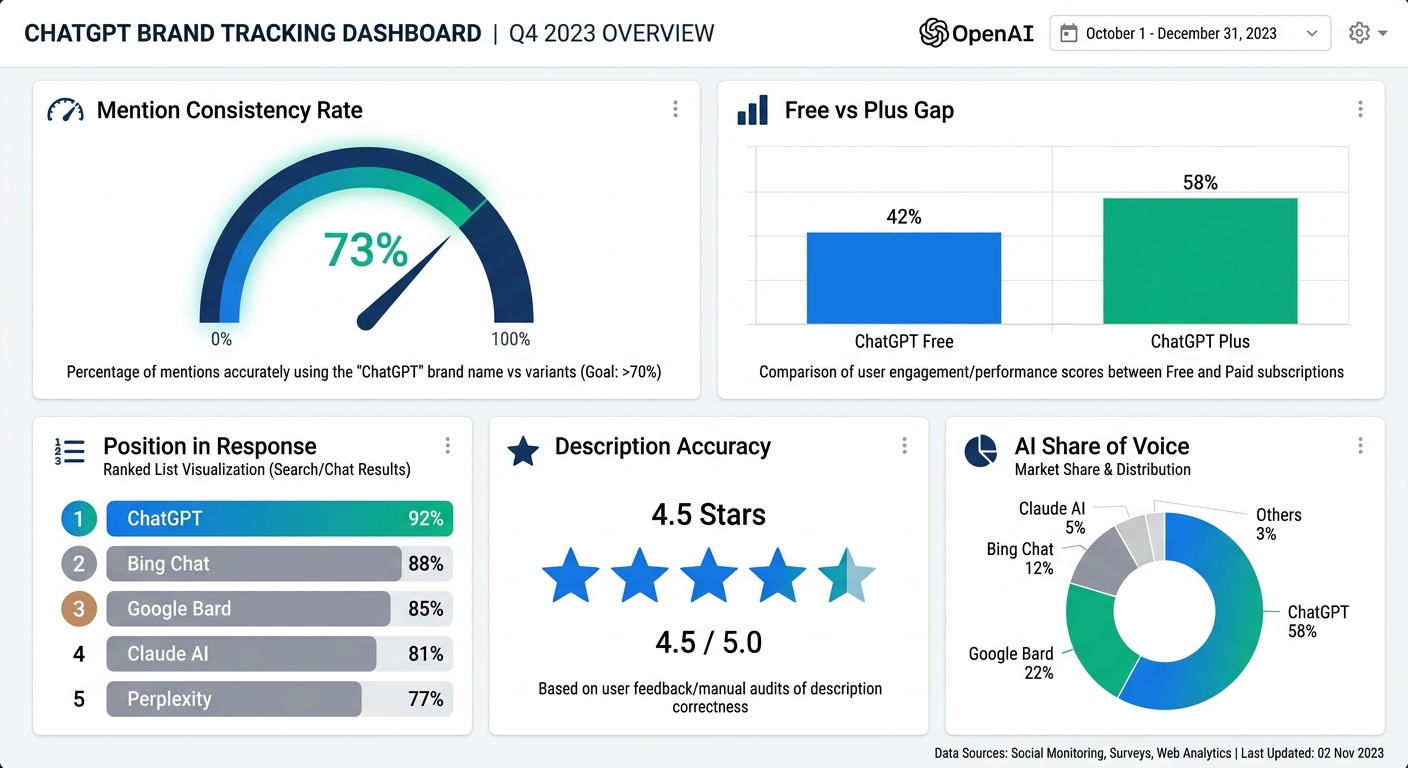
Raw mention counts are a starting point — not a strategy. To turn ChatGPT brand checks into actionable intelligence, track these five metrics:
1. Mention Consistency Rate
Mention consistency rate measures how reliably ChatGPT includes your brand across repeated tests of the same prompt. Calculate it as: (Tests with brand mention ÷ Total tests) × 100.
This metric matters because ChatGPT’s response variability means a single test is unreliable. A brand that appears in 2 out of 3 tests (67% consistency) has a fundamentally different visibility position than one appearing 1 out of 3 times (33%).
- 80%+ consistency: Reliable visibility — ChatGPT strongly associates your brand with this query
- 50–80%: Variable presence — your brand is recognized but not a default recommendation
- Below 50%: Unreliable — ChatGPT does not consistently connect your brand to this topic
2. Free vs. Plus Visibility Gap
Compare your mention rate between ChatGPT’s free tier (training data only) and Plus tier (training data + web search). A gap of 30% or more means your web presence is compensating for absence in the training data. That’s useful intelligence — it tells you your current online authority is working, even though older training data doesn’t include you.
3. Position in Response
Where your brand appears within ChatGPT’s answer affects how many users notice and remember it. Track whether you’re positioned as the first recommendation, one option among several in a list, or a brief mention near the end. First-mentioned brands receive disproportionate attention.
4. Description Accuracy
ChatGPT sometimes describes brands with outdated pricing, discontinued features, or confused identity — especially when a company shares a name with another entity. Rate every mention on a 1–5 accuracy scale. Consistent scores below 4 indicate a problem with how your brand’s information exists across the web.
5. AI Share of Voice
AI Share of Voice measures your brand’s presence relative to competitors across your entire tracked prompt set. Calculate it as: (Your brand mentions ÷ Total brand mentions in the set) × 100. This metric shows whether you’re gaining or losing ground against competitors in the prompts that drive category discovery.
How to Interpret What ChatGPT Says About Your Brand
Finding out whether ChatGPT mentions your brand is step one. Understanding how it describes you is where the real strategic value lives.
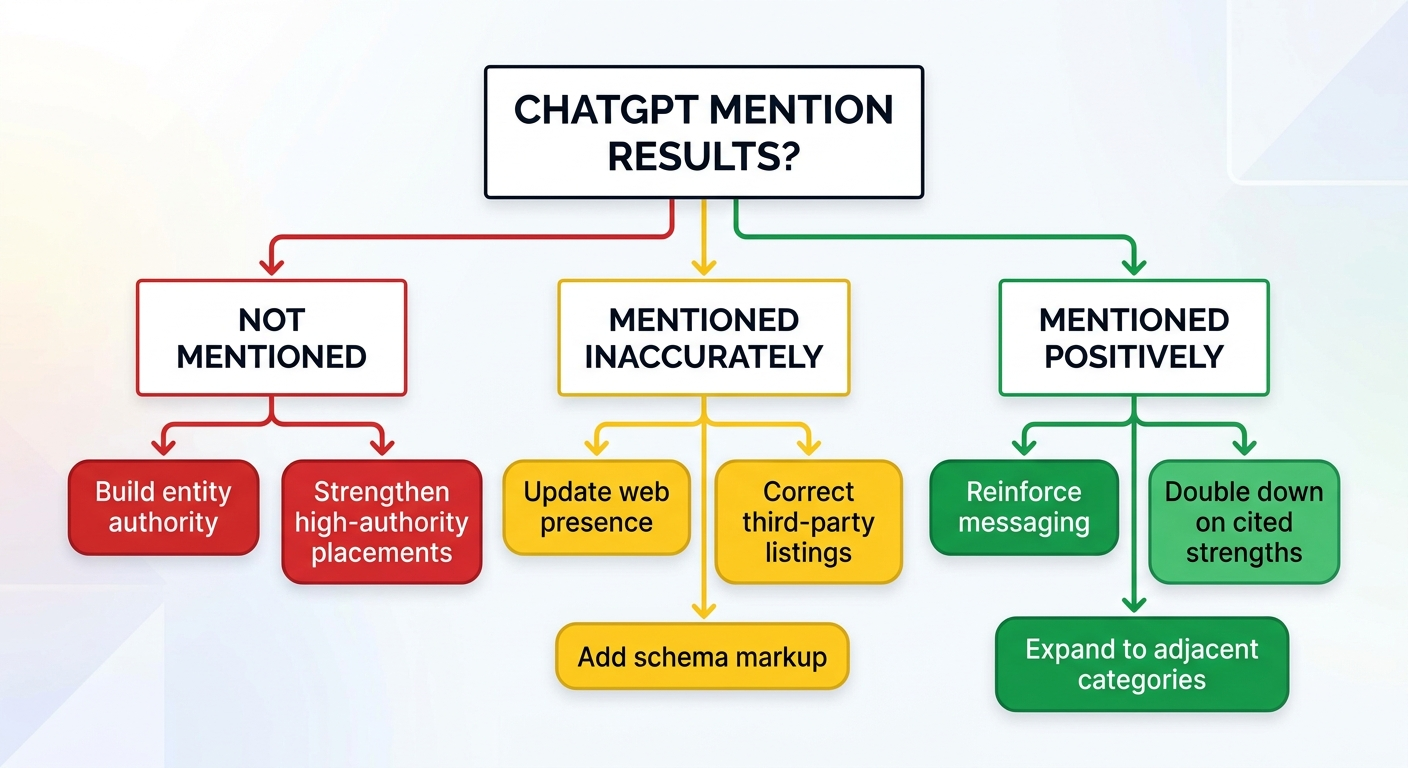
If ChatGPT Doesn’t Mention You at All
Complete absence from ChatGPT responses typically signals one of three issues:
- Weak entity signals: ChatGPT doesn’t have enough structured, authoritative information about your brand to confidently include you. Your company may lack presence on the high-authority platforms that AI models learn from — Wikipedia, major review sites (G2, Trustpilot), Crunchbase, and industry publications.
- Training data cutoff: If your brand launched or pivoted significantly after the model’s training data cutoff, the free tier simply won’t know you exist. Check whether Plus tier (with web search) includes you — that narrows the diagnosis.
- Competitor dominance: Established players with stronger entity authority may fill all available recommendation slots in your category.
The fix requires building the kind of brand mentions that strengthen both SEO and AI visibility: editorial coverage on high-authority publications, consistent entity information across platforms, and structured data on your own site.
If ChatGPT Mentions You Inaccurately
Inaccurate descriptions — wrong pricing, outdated features, confused identity — do more damage than absence. A prospect who reads an incorrect ChatGPT answer about your product may rule you out before ever visiting your site.
You cannot directly edit ChatGPT’s training data. But you can influence the sources it draws from:
- Update your website with clear, current product information — especially your About page, pricing page, and FAQ sections
- Correct outdated information on third-party review sites and directories
- Publish fresh, authoritative content that addresses the specific inaccuracies you’ve found
- Implement Organization, Product, and FAQ schema markup for entity clarity
In campaigns across 67+ B2B companies, the BrandMentions team found that brands with consistent, accurate information across 10+ high-authority publications achieved measurably higher description accuracy scores in ChatGPT within 60–90 days of correcting entity inconsistencies.
If ChatGPT Mentions You Positively
Positive mentions confirm that your brand’s entity signals are working. Identify which strengths ChatGPT consistently highlights — these are the attributes the model most confidently associates with your brand. Reinforce them in your content strategy, sales materials, and broader generative AI visibility efforts.
Why ChatGPT Mentions Differ From Other AI Platforms
If you check your brand in ChatGPT and stop there, you’re seeing only part of the picture. Each major AI platform pulls from different data sources, updates on different timelines, and formats brand mentions differently.
| Platform | Primary Data Source | Citation Style | Update Speed |
|---|---|---|---|
| ChatGPT (Free) | Training data with fixed cutoff | Conversational, no links | Model releases only |
| ChatGPT (Plus) | Training data + web search | Links when browsing is active | Real-time via web |
| Perplexity | Real-time web retrieval | Numbered source citations | Continuous |
| Google Gemini | Google Search index + training data | Links with snippets | Continuous |
| Google AI Overviews | Google Search index | Linked source cards | Near real-time |
A brand might appear consistently in Perplexity (which retrieves fresh web content) but be absent from ChatGPT’s free tier (which relies on older training data). Or it might show up in Gemini’s responses due to strong Google rankings but miss ChatGPT entirely because it draws more heavily from Bing’s index.
According to analysis from Keyword.com published in 2026, approximately 87% of ChatGPT’s citations overlap with Bing’s top search results. This means optimizing for Bing directly improves your ChatGPT Plus visibility — a detail many marketing teams overlook while focusing exclusively on Google.
For comprehensive AI visibility, track your brand mentions across all major AI search platforms, not ChatGPT alone.
What Drives ChatGPT to Mention a Brand
ChatGPT doesn’t rank websites. It synthesizes information from its training data and, when browsing is enabled, from web search results. The brands it mentions are those it has the strongest, most consistent signals about — not necessarily those with the highest domain authority or the most backlinks.
Four signal categories influence whether ChatGPT includes your brand in a response:
- Entity clarity: Does your brand have a clear, consistent identity across the web? Consistent naming, descriptions, and categorization across your website, directories, review platforms, and media coverage help AI models confidently associate your brand with specific topics.
- Source authority: ChatGPT’s training data and real-time browsing prioritize high-authority sources. Brand mentions on trusted publications, industry directories, and recognized review sites carry more weight than mentions on low-authority blogs.
- Content structure: Pages with clear headings, direct Q&A formatting, structured data (schema markup), and concise product descriptions are easier for AI models to parse and extract. ChatGPT is more likely to surface brands from well-structured content.
- Bing ranking signals: For Plus-tier users, ChatGPT’s web search leans heavily on Bing results. Brands ranking well on Bing for category queries have a significant advantage in ChatGPT’s browsing-enabled responses.
Agencies like BrandMentions address this by placing contextual brand mentions on 140+ high-authority publications that AI models actively learn from during training. This approach builds the entity clarity and source authority that drive AI recommendation inclusion — not just for ChatGPT, but across Perplexity, Gemini, and AI Overviews.
A Practical Tracking Schedule for 2026
Checking your ChatGPT brand mentions once reveals a snapshot. Checking them on a schedule reveals trends — which is where the real strategic value emerges.
Monthly Baseline Checks
Run your full prompt library (15–70 prompts, depending on your method) on the same day each month. Keep the prompts, model tier, and testing conditions identical across months. This consistency eliminates noise and lets you attribute changes to actual shifts in visibility rather than session-to-session variability.
Post-Update Checks
OpenAI releases model updates without a public schedule. When a major update is announced — or when you notice different response patterns — run your full prompt set within 48 hours. Model updates can shift which brands ChatGPT recommends, sometimes dramatically.
Post-Campaign Checks
After publishing new content, earning media coverage, or completing a round of editorial placements on high-authority sites, retest your prompts. ChatGPT Plus (with web search) may reflect recent web changes within days. The free tier requires a training data refresh, which happens on OpenAI’s timeline.
For teams using LLM monitoring tools, automated weekly scans provide the most granular trend data. But even monthly manual checks — done consistently — produce useful longitudinal insights.
Common Mistakes When Checking ChatGPT Brand Mentions
Most teams make the same errors when they first start monitoring ChatGPT. Avoid these to get accurate, actionable results:
- Testing once and drawing conclusions. ChatGPT’s response variability means a single query is statistically meaningless. Run each prompt at least 2–3 times across separate sessions.
- Only testing the free tier. Free and Plus tiers pull from different data sources. A brand invisible in the free tier may appear prominently when web search is active. Test both.
- Using keyword-style prompts instead of natural questions. People don’t type “best CRM 2026” into ChatGPT. They ask “What CRM should I use for my growing sales team?” Match your test prompts to real conversational patterns.
- Not tracking competitors. Your ChatGPT visibility is relative. A 70% mention rate means less if your top competitor hits 95% on the same prompts. Always document which brands appear alongside — or instead of — yours.
- Ignoring what ChatGPT says about you. Presence is not enough. If ChatGPT describes your product inaccurately, that inaccuracy shapes perception for every user who encounters it. Accuracy tracking is as important as mention tracking.
Frequently Asked Questions
Can I check my brand mentions in ChatGPT for free?
Yes. Manual prompt testing costs nothing and takes about 15 minutes for an initial check. Open ChatGPT, enter 15–20 category and comparison prompts, and document whether your brand appears, where it’s positioned, and how accurately it’s described. For reliable data, repeat each prompt 2–3 times across fresh sessions. Free manual testing works for initial assessments. Automated tools become necessary when you need to track 20+ prompts consistently over time.
How often does ChatGPT update its knowledge about brands?
ChatGPT’s free tier relies on training data with a fixed cutoff date, which updates only with major model releases — not on a published schedule. ChatGPT Plus supplements training data with real-time web search, meaning your current web presence can influence Plus-tier responses immediately. For the free tier, content you publish today may not appear until the next training data refresh. Plan for both timelines: short-term web optimization for Plus users and long-term authority building for future training data inclusion.
Does ranking well on Google guarantee ChatGPT will mention my brand?
No. Google rankings and ChatGPT mentions are driven by different signals. ChatGPT’s browsing capability relies more heavily on Bing’s index than Google’s, according to 2026 analysis from Keyword.com. Additionally, ChatGPT’s training data draws from a broader set of sources — including Wikipedia, review platforms, and industry publications — that may not correlate with your Google SERP positions. Brands with strong Google rankings but weak presence on Bing, review sites, and authoritative directories often underperform in ChatGPT responses.
What should I do if ChatGPT mentions my brand with incorrect information?
You cannot directly edit ChatGPT’s training data. Focus on correcting the information at its source. Update your website’s product pages, FAQ, and About section with clear, current details. Correct outdated listings on third-party review sites and directories. Publish fresh content that addresses the specific inaccuracies. Implement schema markup (Organization, Product, FAQ) to help AI models parse accurate entity information. For ChatGPT Plus users, these web-level corrections can influence responses within weeks. For the free tier, corrections take effect at the next training data update.
Should I track ChatGPT mentions alongside other AI platforms?
Yes. Each AI platform draws from different sources and produces different brand recommendations. A brand that appears consistently in ChatGPT may be absent from Perplexity or Gemini — and vice versa. Comprehensive AI visibility analytics require tracking across all major platforms where your customers search. Start with ChatGPT (largest user base), then expand to Perplexity, Gemini, and AI Overviews as resources allow.
Your Next Step
The gap between brands that track their ChatGPT presence and those that don’t is widening. As of 2026, AI-driven discovery influences purchase decisions before prospects ever reach a search engine — and the brands that monitor, measure, and strengthen their AI visibility compound that advantage month over month.
Start with Method 1 today: 15 prompts, two sessions each, documented in a spreadsheet. That initial baseline will tell you whether ChatGPT mentions your brand at all, whether the descriptions are accurate, and where competitors appear instead of you. From there, expand to the scaled prompt library method or an automated tracking platform based on what you find.
The content, coverage, and entity clarity you build today prepares your brand for ChatGPT’s next training data refresh — and the one after that. Every authoritative mention you earn is an investment that compounds across every AI model update.
Want to know exactly how AI search engines describe your brand right now? See where your brand stands in AI search.