Free social listening tools let you track brand mentions, monitor competitors, and gauge audience sentiment without paying for enterprise software. As of 2026, the landscape has shifted — many tools that were free a few years ago now sit behind paywalls, while a new generation of lightweight, AI-enhanced options has emerged. This article breaks down which free tools actually deliver value, where each one falls short, and how to build a monitoring stack that covers your blind spots.
If you manage a brand’s online presence — whether you’re a solo founder, a marketing lead at a growing startup, or part of a lean agency team — knowing what people say about you across social platforms, forums, and news sites is no longer optional. The challenge is doing it without a $6,000+ annual contract.
Here’s what separates the free tools worth your time from the ones that waste it.
What You’ll Learn
- Which free social listening tools still work in 2026 — and which have locked features behind paid plans
- The specific platforms each tool covers (social media, forums, news, blogs, Reddit)
- How to combine multiple free tools to approximate paid-level coverage
- Where free tools consistently fall short — and when it makes sense to invest
- How social listening connects to AI visibility and brand discoverability across search engines and AI assistants
- A practical framework for choosing the right tool based on your goals, platforms, and budget
What Does Social Listening Actually Cover?
Social listening is the practice of tracking and analyzing online conversations about your brand, competitors, products, or industry across social media platforms, forums, news sites, and blogs. It goes beyond counting mentions — it examines context, sentiment, and trends to surface actionable insights.
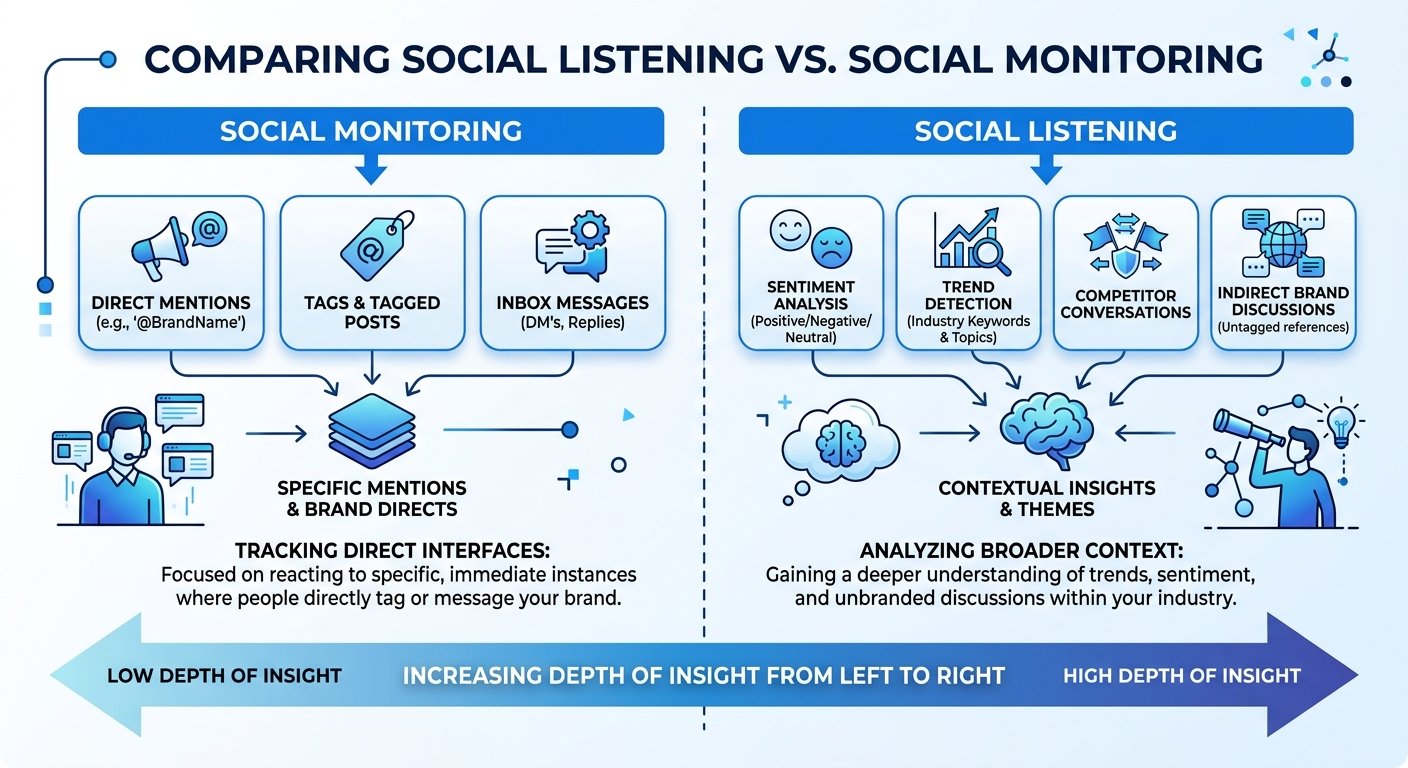
Social listening differs from social monitoring in scope. Monitoring tracks direct mentions, tags, and messages. Listening interprets the broader conversation — including discussions where your brand name never appears but your product category does.
Effective social listening helps you:
- Detect shifts in customer sentiment before they become PR problems
- Identify unmet needs your audience discusses publicly
- Spot competitor weaknesses through their customers’ complaints
- Discover content topics and messaging angles grounded in real conversations
- Find brand advocates and influencers already talking about your space
The challenge with free tools is coverage. Most track only a few platforms well. Understanding which platforms matter for your audience determines which free tools are worth setting up.
9 Free Social Listening Tools That Still Deliver in 2026
The list below includes only tools with a genuinely usable free tier or a free standalone product — not 7-day trials disguised as free plans. For each tool, you’ll find what it covers, what it misses, and who should use it.
1. Google Alerts — Best for Basic Web and News Monitoring
Cost: Free, no limits on alerts.
Platforms covered: News sites, blogs, web pages, some forum content indexed by Google.
What it does not cover: Social media platforms, Reddit, private communities.
Google Alerts sends email notifications when new web content matching your keywords gets indexed. Setup takes under two minutes. You enter a keyword — your brand name, a competitor, or an industry term — and choose how often you want alerts.
It works well for catching news articles, blog posts, and press mentions. For tracking unlinked brand mentions across the web, it remains a solid starting point.
Strengths:
- Unlimited keywords and alerts
- No account required beyond a Google account
- Filters by source type, language, and region
- RSS feed option for integration with other tools
Limitations:
- No sentiment analysis
- Misses social media conversations entirely
- Inconsistent coverage of forums and niche sites
- No dashboard or analytics — just email notifications
Best for: Anyone who needs basic web monitoring for brand mentions and industry news without spending anything. Pair it with a social-specific tool for broader coverage. For a deeper walkthrough, see our guide on how to create and optimize Google Alerts.
2. Talkwalker Alerts by Hootsuite — Best Free Google Alerts Alternative
Cost: Free.
Platforms covered: News sites, blogs, web pages, X (Twitter).
What it does not cover: Instagram, Facebook, LinkedIn, TikTok, Reddit.
Talkwalker Alerts functions similarly to Google Alerts but adds X (Twitter) monitoring, which Google does not cover. After Hootsuite acquired Talkwalker in 2024, the free alerts tool has remained available as a standalone product even as the broader Talkwalker platform moved entirely behind a paid subscription.
You set up keyword alerts, choose your frequency (daily or weekly), and receive email notifications. The tool claims broader web coverage than Google Alerts, particularly for international news sources.
Strengths:
- Includes X (Twitter) monitoring — a meaningful edge over Google Alerts
- No signup required for basic use
- Supports RSS feeds
- Broader international news coverage
Limitations:
- No sentiment analysis or analytics dashboard
- No historical data access
- The formerly free Social Search tool now requires a paid Hootsuite subscription as of 2025
- Cannot save queries or export data
Best for: Supplementing Google Alerts with X coverage. Use both in parallel for wider web monitoring at zero cost.
3. F5Bot — Best for Reddit and Tech Community Monitoring
Cost: Free tier monitors up to 200 keywords.
Platforms covered: Reddit, Hacker News, Lobsters.
What it does not cover: All other social platforms, news, blogs.
F5Bot is a lightweight tool focused on three platforms that matter disproportionately for tech brands, SaaS companies, and developer-facing products. Enter your keywords, and F5Bot emails you when they appear in posts or comments on Reddit, Hacker News, or Lobsters.
Reddit monitoring has grown significantly more valuable since 2024. Reddit content now surfaces prominently in Google search results, and Reddit discussions influence AI model responses — according to a 2023 Washington Post analysis, Reddit is one of the largest text sources in common AI training datasets.
Strengths:
- 200 free keywords — more than most free tools
- Fast email notifications (often within minutes)
- Simple setup, no learning curve
- Active and maintained since 2017
Limitations:
- Covers only three platforms
- No sentiment analysis
- No dashboard or analytics
- Free tier includes ads in notification emails
Best for: SaaS companies, developer tools, and any brand whose audience is active on Reddit or Hacker News. Essential for tracking buying-intent threads like “looking for alternatives to [competitor].”
4. Metricool — Best Free All-in-One Dashboard
Cost: Free plan available. Paid plans start at $22/month.
Platforms covered: TikTok, Instagram, Facebook, X, LinkedIn.
What it does not cover: Reddit, forums, news sites, blogs.
Metricool is primarily a social media scheduling and analytics platform, but its free tier includes basic listening features — hashtag tracking, mention monitoring, and competitor benchmarking. It provides a unified inbox for managing comments, messages, and tags across connected accounts.
The free plan is more generous than most competitors, making it a practical choice for small teams that need scheduling and basic monitoring in one place.
Strengths:
- Combines scheduling, analytics, and monitoring in a single free dashboard
- Clean interface, minimal learning curve
- Competitor tracking even on the free plan
- Covers the platforms where most consumer brand conversations happen
Limitations:
- Monitoring limits on the free plan
- No deep sentiment analysis
- Doesn’t cover Reddit, forums, or broader web mentions
- Instagram data is limited due to Meta’s API restrictions
Best for: Small businesses and creators who want one dashboard for social media management and basic monitoring. For deeper social media monitoring, you’ll need to supplement with other tools.
5. Kwatch.io — Best Free Tool for Real-Time Keyword Alerts
Cost: Free plan available. Paid plans start at $19/month.
Platforms covered (free tier): Reddit, Hacker News.
Paid plans add: X, YouTube, Facebook, LinkedIn.
Kwatch.io sends real-time alerts when your keywords appear on monitored platforms. The free tier covers Reddit and Hacker News — similar to F5Bot — but the paid tiers expand to six social platforms with AI-powered sentiment analysis starting at $19/month.
Setup takes under a minute. Alerts arrive via email, and you can route them to Slack or other tools in your workflow.
Strengths:
- Extremely fast setup
- Real-time notifications
- Low-cost paid upgrade path if you outgrow the free tier
Limitations:
- Free plan is limited to Reddit and Hacker News only
- No analytics or reporting on the free tier
- No historical data
Best for: Founders and solopreneurs who need instant alerts when their brand or product is discussed on Reddit. Useful for spotting sales leads in recommendation threads.
6. Social Searcher — Best Free Tool for Multi-Platform Real-Time Search
Cost: Free tier with limited daily searches. Paid plans start at €3.49/month.
Platforms covered: X, Facebook, YouTube, Reddit, Tumblr, Flickr, blogs, forums.
What it does not cover: Instagram, TikTok, LinkedIn.
Social Searcher provides real-time search across multiple social platforms and includes basic sentiment analysis — a feature most free tools omit entirely. You search for a keyword and instantly see recent mentions with positive, negative, or neutral tags.
The free tier restricts daily search volume, but for quick checks on brand sentiment or competitor activity, it delivers more insight per search than Google Alerts or Talkwalker Alerts.
Strengths:
- Sentiment analysis included on free tier
- Multi-platform coverage in a single search
- Shows mention volume trends and top users
- Basic export available
Limitations:
- Daily search limits on the free plan
- No saved queries or ongoing monitoring on free tier
- Missing Instagram, TikTok, and LinkedIn
- Historical data access is limited
Best for: Quick, on-demand sentiment checks across multiple platforms. Useful for pre-meeting research, campaign pulse checks, or investigating a sudden spike in brand chatter.
7. Answer the Public — Best Free Tool for Search-Based Audience Insights
Cost: Free with limited daily searches. Paid plans start at $11/month.
Coverage: Google and Bing search data.
What it does not cover: Social media platforms, forums, or real-time mentions.
Answer the Public isn’t a traditional social listening tool. It analyzes search query data to show you the questions, comparisons, and prepositions people use around any topic. This makes it a powerful complement to direct social monitoring — it reveals what your audience wonders about, even when they don’t post about it publicly.
Enter a keyword, and the tool visualizes dozens of related questions organized by type: “what,” “how,” “why,” “can,” “is,” and comparison queries (“vs.,” “or,” “versus”).
Strengths:
- Surfaces audience intent and pain points from search behavior
- Excellent for content planning and FAQ development
- Visual output makes it easy to identify patterns
Limitations:
- Limited to search data — does not track social conversations
- Free tier restricts daily searches (typically 3 per day)
- No real-time alerts or ongoing monitoring
Best for: Content marketers and SEO teams who want to understand what questions their audience is asking. Pair with direct social monitoring tools for a complete picture.
8. Hootsuite Free Social Listening Tools — Best for Quick Boolean Searches and Sentiment Snapshots
Cost: Free standalone tools. Full platform starts at $99/month.
Coverage: Varies by tool — social media mentions, sentiment, and keyword trends.
Hootsuite offers a small collection of free standalone tools separate from its paid platform. These include a Boolean search generator for building precise social queries, a sentiment analyzer for gauging public opinion on a topic, and social listening search and alerts for tracking brand mentions.
These tools are lightweight — more like individual instruments than a full dashboard. But they’re genuinely free and useful for specific tasks.
Strengths:
- Boolean generator simplifies complex search queries
- Sentiment analyzer provides quick positive/negative/neutral breakdowns
- Social listening alerts deliver mentions to your inbox
Limitations:
- Each tool operates independently — no unified dashboard
- Limited depth compared to Hootsuite’s paid listening features
- Data coverage and historical access are restricted
Best for: Quick research tasks — checking sentiment before a campaign launch, building Boolean queries for use in other tools, or setting up basic mention alerts.
9. Buffer (Free Plan) — Best for Basic Post Performance Monitoring
Cost: Free plan for up to 3 social channels. Paid plans start at $6/month.
Platforms covered: Facebook, Instagram, X, LinkedIn, Pinterest, TikTok.
What it does not cover: Web mentions, forums, Reddit, news sites.
Buffer’s free plan is primarily a scheduling tool, but it includes basic engagement tracking — likes, comments, shares, and post performance across connected accounts. It’s not a social listening tool in the traditional sense, but it does surface how your own content performs and which posts generate the most conversation.
Strengths:
- Clean, intuitive interface
- Covers six major social platforms
- Useful engagement metrics on the free tier
Limitations:
- No keyword monitoring or mention tracking
- No sentiment analysis
- Only tracks your own accounts, not broader conversations
Best for: Small teams that need a scheduling tool with basic analytics. Not a replacement for social listening, but a useful complement when combined with other tools on this list.
How to Build a Free Social Listening Stack That Actually Works
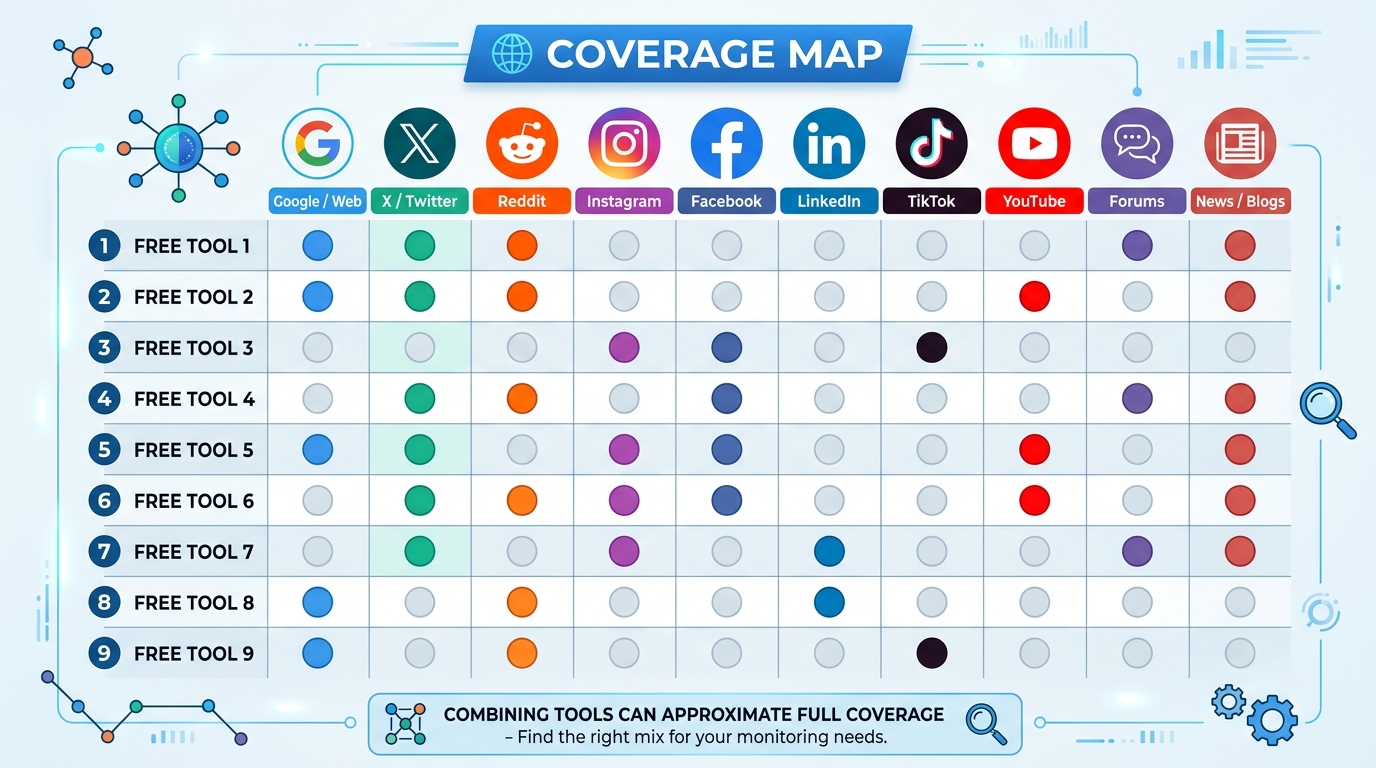
No single free tool covers everything. The practical solution is combining two or three tools that cover different platforms and capabilities. Here’s how to approach it based on what you need to track.
Coverage-First Approach: Maximize Platform Reach
Combine these three tools for the widest free coverage:
- Google Alerts + Talkwalker Alerts — Web, news, blogs, and X mentions
- Metricool (free plan) — Instagram, Facebook, TikTok, LinkedIn, X scheduling and monitoring
- F5Bot — Reddit, Hacker News, Lobsters
This combination covers the web, all major social platforms, and Reddit — the three areas where most brand conversations happen. The gap: no unified dashboard, and no cross-platform sentiment analysis.
Sentiment-First Approach: Understand How People Feel
If understanding brand sentiment matters more than platform breadth:
- Social Searcher — Multi-platform search with sentiment scoring
- Hootsuite Sentiment Analyzer — Quick sentiment checks on specific topics
- Google Alerts — Catch web mentions that sentiment tools might miss
Competitor-First Approach: Track What Others Are Doing
For teams focused on competitive analysis:
- Metricool (free plan) — Competitor benchmarking on social platforms
- Answer the Public — See what questions people ask about competitor brands
- F5Bot — Track competitor names on Reddit recommendation threads
Pro Insight: Set up F5Bot alerts for phrases like “alternative to [competitor name]” and “looking for something like [competitor product].” These threads are where buying intent lives — and where your brand can show up at the right moment.
Where Free Social Listening Tools Consistently Fall Short
Free tools solve real problems, but they leave significant gaps. Understanding these limitations helps you decide when to invest — and prevents you from drawing conclusions from incomplete data.
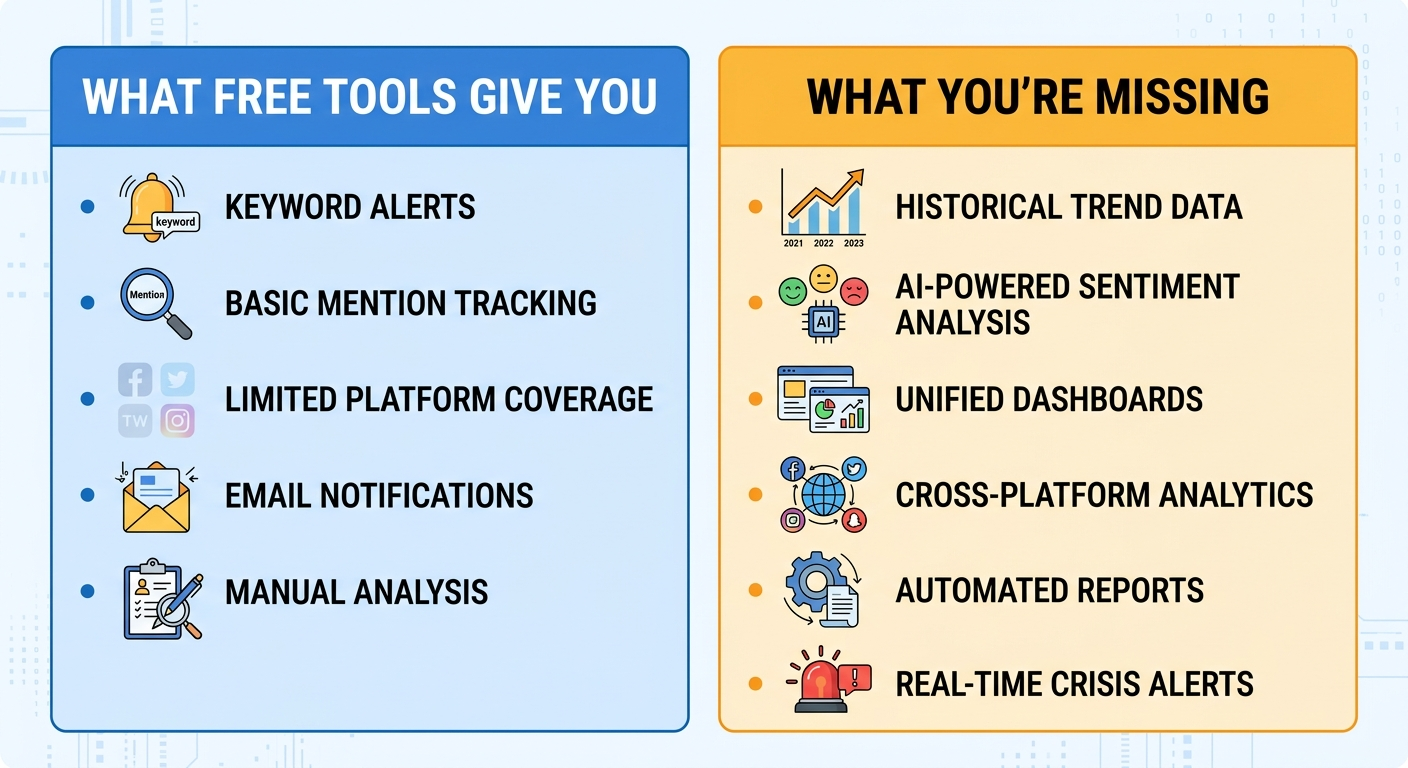
No Historical Data
Most free tools show only recent mentions — typically the last 7 days. You cannot analyze trends over months, compare campaign performance across quarters, or identify seasonal patterns. Paid tools like Brand24, Awario, and Brandwatch offer 30 days to 5 years of historical data.
Limited or Missing Sentiment Analysis
Social Searcher provides basic sentiment tagging. Most other free tools offer none. Without sentiment analysis, you know that people are talking about your brand — but not how they feel. For brand reputation monitoring, this is a critical gap.
No AI-Powered Filtering
Free tools send you everything that matches a keyword — including irrelevant noise. Paid tools use AI to prioritize mentions by relevance, intent, and potential impact. If you track a common word (like a brand name that’s also a dictionary word), free tools can overwhelm you with false positives.
No Unified Dashboard
Running three or four free tools means checking three or four separate interfaces or email streams. There’s no way to compare data across tools, generate unified reports, or share a single dashboard with your team.
Platform API Restrictions
Instagram, Facebook, and LinkedIn have progressively restricted third-party data access since 2023. Even paid tools face limitations. Free tools get the most restricted access, which means your monitoring of these platforms will have significant blind spots — especially for conversations that don’t directly tag your account.
When Free Tools Aren’t Enough — and What to Do About It
Free social listening tools work well for three scenarios:
- Early-stage brands monitoring one brand name and a few keywords
- Solo marketers who need basic awareness of brand mentions
- Teams evaluating whether social listening matters before committing budget
You’ve outgrown free tools when:
- You manage multiple brands or product lines
- You need sentiment tracking to inform executive-level decisions
- Competitor monitoring requires depth beyond keyword matching
- You’re responding to customer conversations at scale and need a unified inbox
- Crisis detection speed matters — hours of delay could mean reputational damage
Mid-tier paid tools like Awario ($49/month), Brand24 ($149/month), and Mentionlytics ($49/month) bridge the gap between free tools and enterprise platforms. They add sentiment analysis, broader coverage, historical data, and exportable reports.
For a detailed breakdown of brand monitoring tools across free and paid tiers, we maintain an updated comparison.
How Social Listening Connects to AI Visibility
Social listening and AI brand visibility are converging in 2026. The conversations that social listening tools track — on Reddit, forums, news sites, and editorial publications — directly influence what AI assistants like ChatGPT, Perplexity, Gemini, and Claude recommend to users.
Here’s why this matters for your monitoring strategy:
AI models learn brand-category associations from the same sources you’re monitoring. When your brand appears consistently in high-authority editorial content alongside your product category, AI assistants are more likely to include it in recommendations. A 2024 study from the Allen Institute for AI confirmed that large language models develop entity associations based on frequency and context of mentions in their training data.
Social listening tools help you see whether those mentions are happening — and whether the sentiment is positive or negative. If your brand consistently appears in complaint threads on Reddit, that context gets absorbed by AI models too.
For brands actively working on increasing brand mentions in AI search, social listening provides the feedback loop. You can track whether editorial placements are generating the conversations that strengthen your brand’s position in AI training data.
Agencies like BrandMentions solve the visibility side of this equation by placing contextual brand mentions on 140+ high-authority publications that AI models actively learn from during training. Social listening tools help you verify the downstream effect — are people discussing your brand in the right contexts?
For teams monitoring what AI assistants currently say about their brand, we’ve built guides on checking AI brand mentions and tracking mentions across AI search platforms.
How to Choose the Right Free Tool for Your Situation
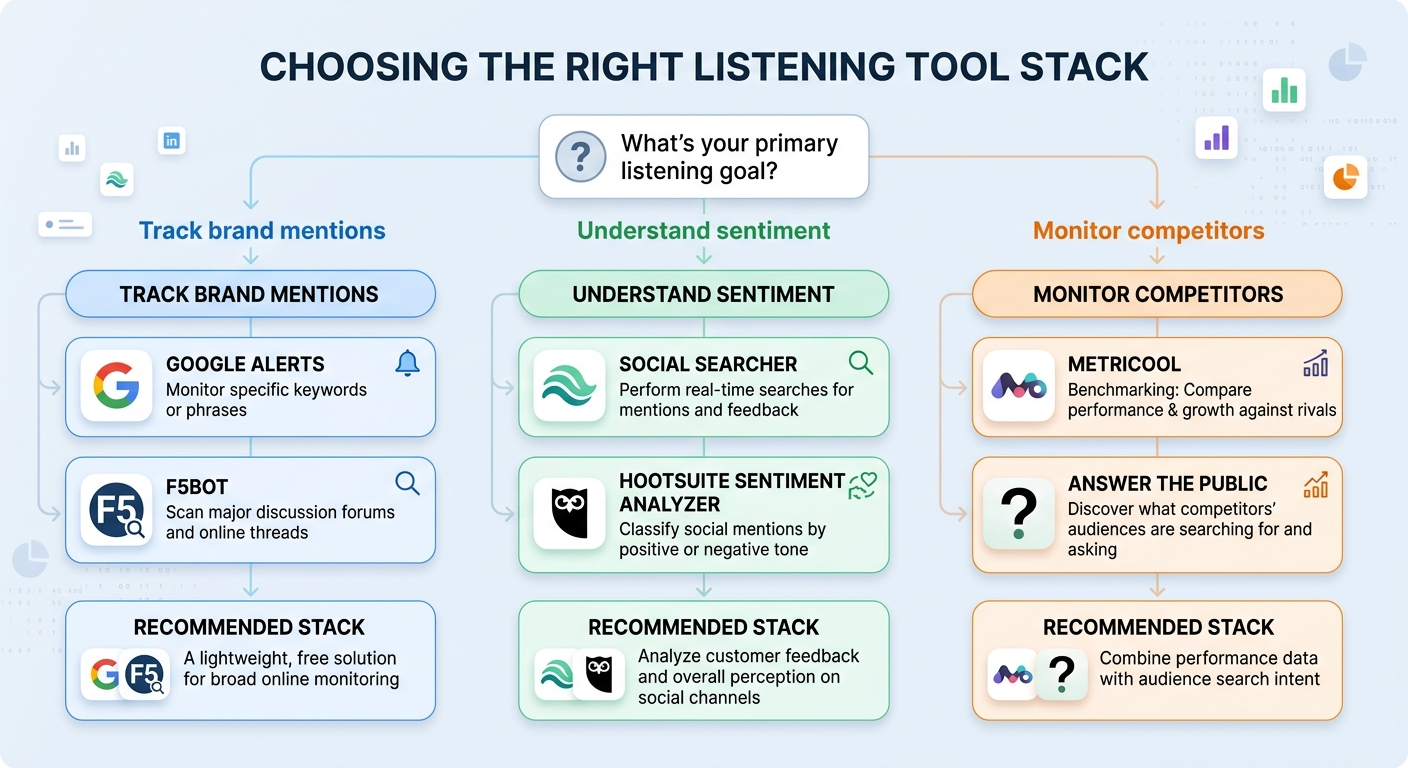
The right tool depends on three things: which platforms your audience uses, what you’re trying to learn, and how much time you have for manual review.
Match the Tool to Your Audience’s Platform
- B2B SaaS or developer tools: F5Bot (Reddit, Hacker News) + Google Alerts (web mentions)
- Consumer brands or ecommerce: Metricool (Instagram, Facebook, TikTok) + Social Searcher (sentiment)
- Professional services or B2B: Talkwalker Alerts (X and web) + Google Alerts (news and blogs)
- Content creators: Buffer (own post analytics) + Answer the Public (audience questions)
Match the Tool to What You Need to Learn
- “Are people talking about us?” → Google Alerts + F5Bot
- “How do people feel about us?” → Social Searcher + Hootsuite Sentiment Analyzer
- “What are competitors doing?” → Metricool + Answer the Public
- “Where are sales opportunities?” → F5Bot + Kwatch.io (Reddit buying-intent threads)
Match the Tool to Your Available Time
Free tools require more manual work than paid platforms. If you have 15 minutes per day for monitoring, Google Alerts and F5Bot email notifications work well — everything comes to your inbox. If you have 30–60 minutes, adding Metricool’s dashboard and Social Searcher spot-checks gives you deeper insight.
Frequently Asked Questions
Is there a completely free social listening tool that covers all platforms?
No single free tool covers all social platforms, forums, news sites, and blogs in 2026. The closest approach is combining multiple free tools — such as Google Alerts for web mentions, Metricool for social platforms, and F5Bot for Reddit. Each covers different sources, and together they approximate broader paid-tool coverage.
Can free social listening tools detect brand crises early?
Free tools can alert you to mention spikes, but they lack real-time sentiment scoring and automated escalation. You’ll notice a crisis through a sudden increase in email alerts — but by the time you piece together the context manually, paid tools would have already flagged the sentiment shift and notified your team. For brands where crisis response speed matters, a paid tool with real-time negative sentiment alerts is worth the investment.
How does social listening differ from social media analytics?
Social media analytics measures the performance of your own content — reach, engagement, follower growth, click-through rates. Social listening tracks what other people say about your brand, competitors, and industry across platforms you don’t control. Analytics tells you how your posts perform. Listening tells you what your audience thinks and talks about when they’re not on your page.
Do free social listening tools work for monitoring AI search mentions?
Traditional social listening tools do not monitor AI search platforms like ChatGPT, Perplexity, or Gemini. These require specialized AI visibility analytics tools. However, social listening can track the editorial and social conversations that influence what AI models learn about your brand — making it a complementary part of an AI visibility strategy.
How many keywords should I track with free tools?
Start with 3–5 keywords: your brand name, your primary product or service name, one or two competitors, and one industry pain point. Free tools impose keyword limits (F5Bot allows 200, Kwatch.io’s free tier allows fewer), so prioritize the terms most likely to surface actionable conversations.
What changed about free social listening tools since 2024?
Several tools that offered free plans through 2024 have since moved behind paywalls. Talkwalker’s Free Social Search is no longer available as a standalone free product — it now requires a Hootsuite subscription. BuzzSumo removed its free plan entirely. Meanwhile, Reddit and forum monitoring tools like F5Bot and Kwatch.io have become more valuable as Reddit’s influence on both Google search results and AI training data has grown significantly.
Researched and drafted with AI assistance, reviewed and edited by the BrandMentions editorial team.
Tracking what people say about your brand is the first step. The next step is making sure your brand shows up when people — and AI assistants — look for solutions in your category. If you want to see how AI search currently describes your brand, get a free AI visibility audit and find out where you stand.