Brand tracking measures how your audience perceives your brand over time — and in 2026, it needs to account for AI search surfaces, not just traditional surveys and social listening. If you only track awareness and sentiment through quarterly surveys, you’re missing how AI assistants like ChatGPT, Perplexity, and Gemini describe your brand to millions of potential buyers every day.
This article breaks down how brand tracking works in practice, which metrics actually matter for growth-stage and enterprise B2B companies, and how to extend your tracking program to cover AI-generated recommendations — a surface most brand teams still ignore.
What You’ll Learn
- How brand tracking differs from brand monitoring — and why you need both
- The core metrics that connect brand perception to revenue outcomes
- How to set up a tracking cadence that matches your market velocity
- Why AI search visibility is now a critical brand tracking metric for 2026
- How to measure what AI models say about your brand — and your competitors
- A practical framework for integrating AI visibility data into your existing tracking program
How Brand Tracking Differs From Brand Monitoring
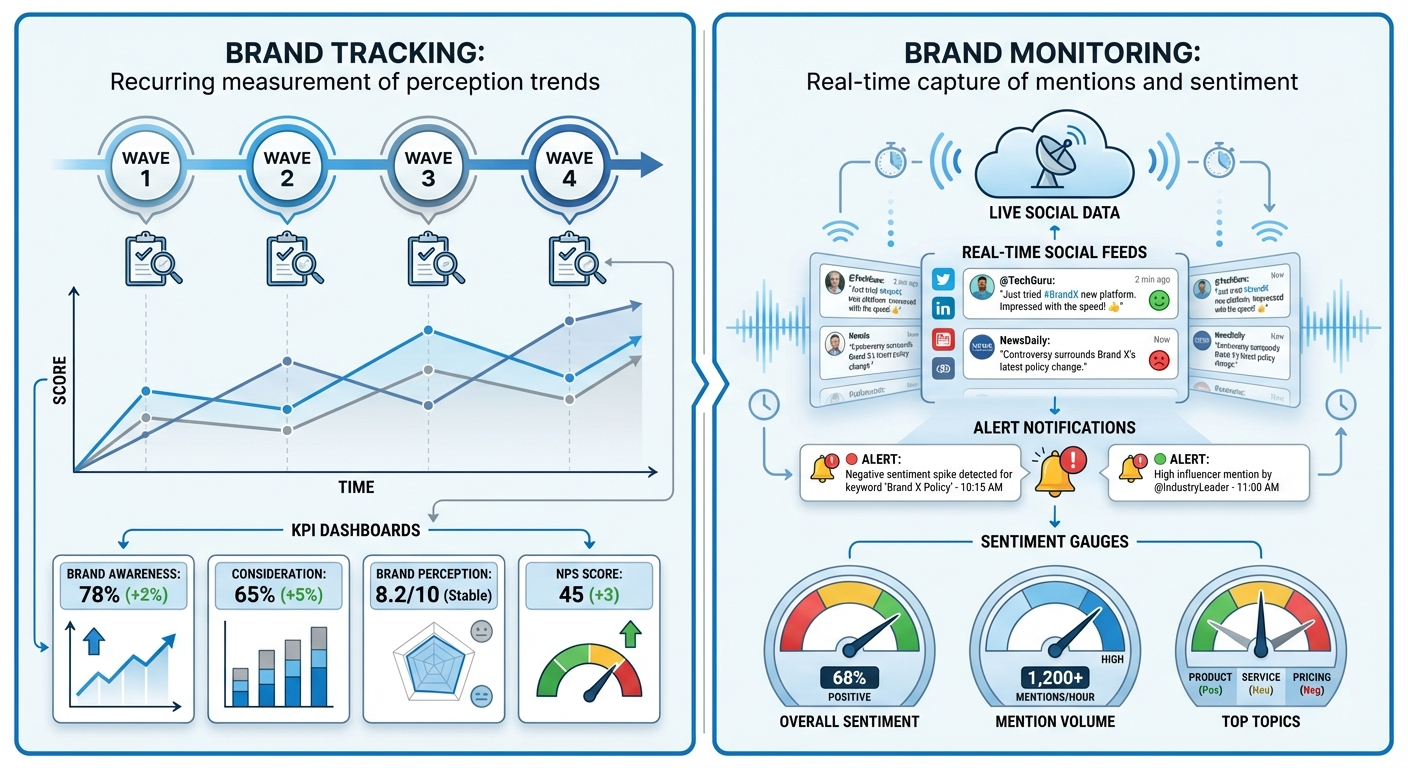
Brand tracking is the systematic, recurring measurement of how your target audience perceives your brand across key metrics — awareness, consideration, preference, loyalty, and equity — over defined time periods. It reveals directional trends, not just snapshots.
Brand monitoring captures real-time mentions, sentiment, and conversations about your brand across social media, news outlets, review sites, and forums. It tells you what people are saying right now.
Here’s where the distinction matters for your strategy:
- Brand tracking answers: “Is our brand getting stronger or weaker with our target buyers over the last six months?”
- Brand monitoring answers: “What did people say about us after yesterday’s product launch?”
Most B2B marketing teams invest in monitoring tools but underinvest in structured tracking. The result: they can react to individual mentions but cannot identify whether their brand is gaining or losing ground in the market. Effective brand management requires both — monitoring for responsiveness, tracking for strategic direction.
If you’re evaluating brand monitoring tools as a starting point, that’s a solid tactical foundation. But it doesn’t replace the longitudinal view that a dedicated tracking program provides.
Which Metrics Actually Drive Brand Growth
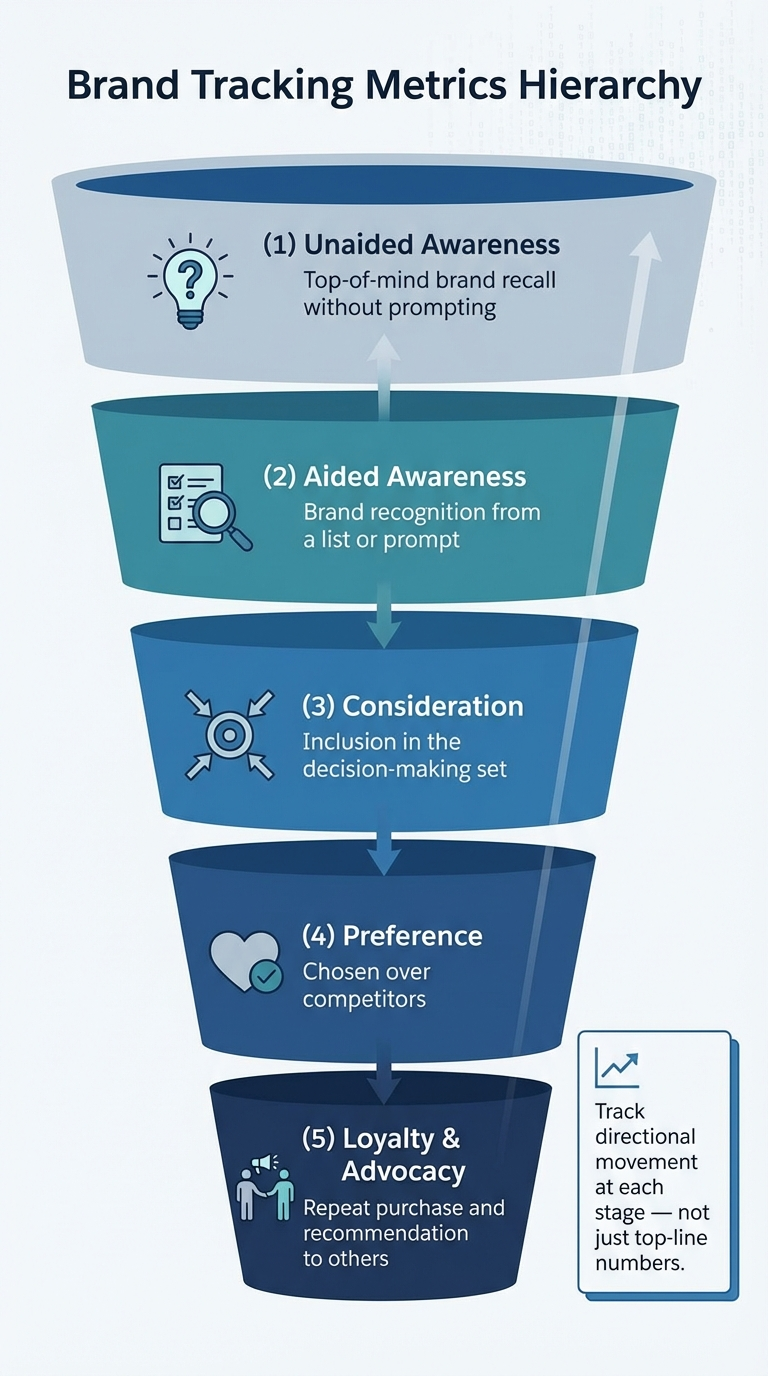
Not every brand metric deserves equal attention. The ones that matter most depend on your business stage, category, and competitive position. Here’s a practical hierarchy.
Awareness Metrics
Unaided brand awareness measures whether your target audience recalls your brand without any prompt. It’s the hardest metric to move and the most valuable indicator of category authority.
Aided brand awareness measures recognition when your brand name is presented alongside competitors. It’s useful for newer brands establishing market presence.
According to Kantar’s 2024 BrandZ analysis, brands with top-of-mind awareness in their category command 2–3x higher consideration rates than competitors with equivalent aided awareness but low unaided recall.
Perception and Sentiment Metrics
Brand perception captures how your audience associates specific attributes with your brand — quality, innovation, reliability, expertise. Track the attributes that differentiate you, not generic ones every brand claims.
Brand sentiment measures the overall emotional tone — positive, negative, or neutral — of how people talk about your brand. Pair this with brand sentiment analysis tools to quantify shifts after campaigns, product releases, or competitive moves.
Consideration and Preference Metrics
Brand consideration tells you whether a buyer would include your brand in their shortlist. For B2B companies, this metric directly predicts pipeline generation.
Brand preference reveals which brand a buyer would choose if all options were available. This is where differentiation shows up — or doesn’t.
Loyalty and Advocacy Metrics
Net Promoter Score (NPS) remains a standard measure of customer loyalty and willingness to recommend. It’s imperfect — NPS doesn’t explain why someone would or wouldn’t recommend — but it’s useful as a directional signal when tracked consistently over time.
Repeat purchase intent and share of wallet add commercial depth to loyalty measurement, especially for SaaS and subscription-based businesses.
Brand Equity — the Composite View
Brand equity is the cumulative commercial value of your brand, derived from the combined strength of awareness, perception, loyalty, and differentiation. It’s the metric that connects marketing effort to business valuation.
A 2024 McKinsey report found that strong B2B brands generate EBIT margins 20% higher than category averages. Brand equity is how that premium gets built and sustained.
Pro Insight: Track no more than 6–8 core metrics consistently. Adding more dilutes focus and makes trend analysis harder. Choose the metrics that map directly to your business objectives — not the ones that look good on a dashboard.
How to Set the Right Tracking Cadence
Tracking frequency should match your market’s pace and your team’s ability to act on insights. There’s no universal answer, but there are clear decision criteria.
Quarterly Tracking
Best for most B2B companies with stable competitive landscapes and 2–4 major campaigns per year. Quarterly cadence gives enough data to detect meaningful trends without overwhelming the team with noise.
Monthly or Continuous Tracking
Better for brands in fast-moving categories — fintech, cybersecurity, developer tools — where competitive dynamics shift rapidly and campaigns run frequently. Continuous tracking helps isolate which specific activities move brand metrics.
Annual Tracking
Suitable only for brands in slow-moving markets with limited competitive disruption. For most B2B technology companies, annual tracking is too infrequent to capture meaningful shifts or connect changes to specific actions.
Event-Triggered Tracking
Run additional measurements around major events: a new competitor entering your market, a significant product launch, a PR crisis, or a rebrand. These ad-hoc waves supplement your regular cadence and capture perception shifts that scheduled tracking might miss.
The goal is consistent measurement with enough frequency to act. If your tracking cadence doesn’t let you connect brand metric changes to specific business actions, increase the frequency.
Why AI Search Is Now a Brand Tracking Blind Spot
As of 2026, AI-powered search engines and assistants influence how millions of B2B buyers research vendors, evaluate solutions, and build shortlists. ChatGPT, Perplexity, Google’s AI Overviews, Gemini, Claude, and Copilot now generate answers that reference — or omit — specific brands.
According to a 2025 Gartner forecast, traditional search engine traffic will decline 25% by 2026 as users shift to AI-generated answers. That shift is already well underway.
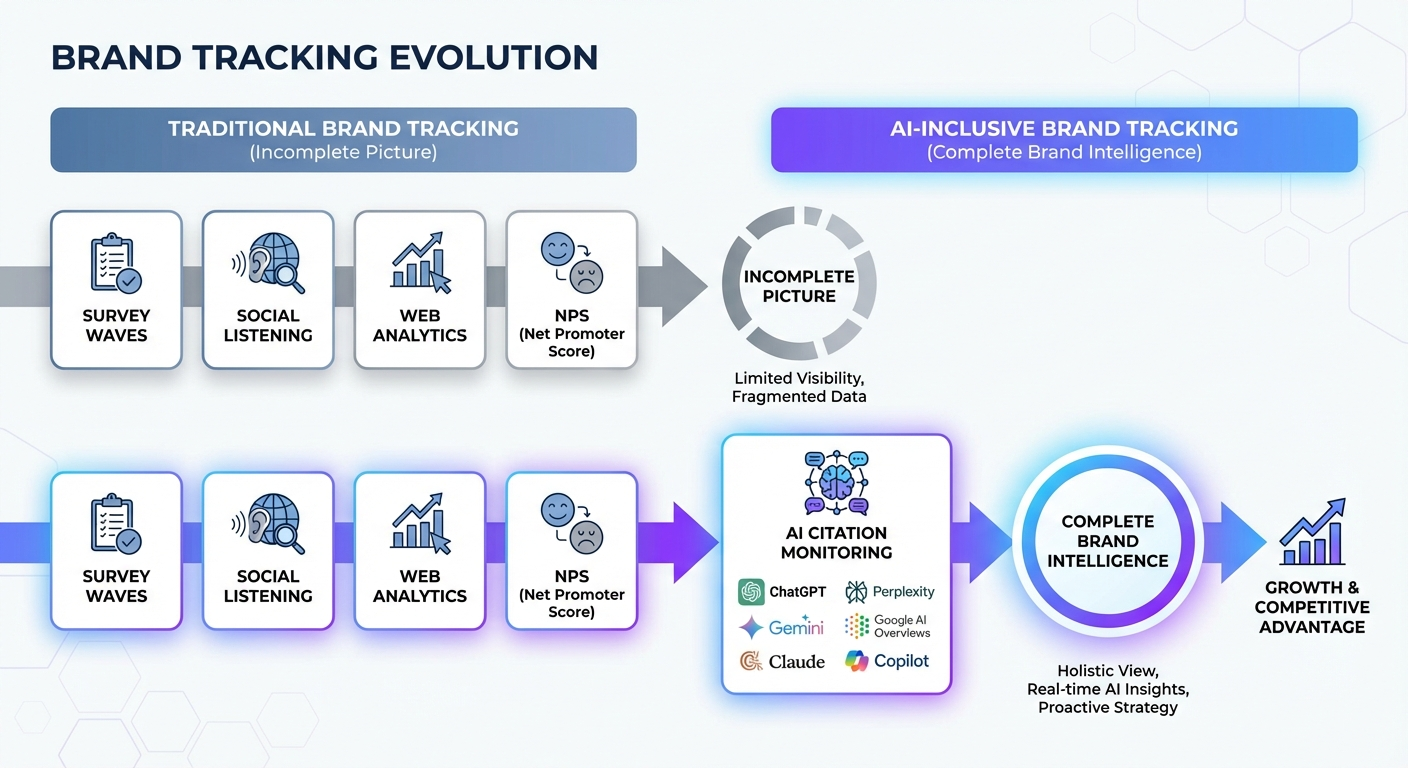
Yet most brand tracking programs measure none of this. Traditional trackers rely on surveys, social listening, and web analytics. They don’t capture what AI models say about your brand when a buyer asks, “What are the best project management tools for mid-market SaaS companies?”
This gap creates a dangerous blind spot: your survey data might show stable awareness and positive sentiment, while AI assistants actively recommend your competitors instead of you.
What AI Models Actually Track About Your Brand
Large language models form brand associations from the content they ingest during training and retrieval. When an AI model encounters your brand name mentioned consistently alongside specific capabilities, categories, and positive editorial context on high-authority publications, it develops stronger entity associations.
A brand mention is any instance where a company name appears in editorial content — with or without a hyperlink — on a website that AI models are likely to include in their training data or retrieval index.
The frequency, recency, and editorial quality of these mentions influence how confidently an AI model references your brand. Research published by the Allen Institute for AI in 2024 demonstrated that LLMs preferentially cite entities with consistent, high-authority editorial presence across diverse publications.
This means your brand tracking program needs to answer a new question: When someone asks an AI assistant about your category, does your brand appear in the answer?
You can start by checking whether AI mentions your brand across major platforms — then build systematic tracking from there.
How to Track What AI Says About Your Brand
Monitoring AI-generated brand citations requires a different approach than traditional social listening or survey-based tracking. Here’s a practical system.
Step 1: Identify Your Core Category Queries
Map the 15–30 questions your target buyers would ask an AI assistant during the research and evaluation stages. These aren’t keyword variations — they’re natural-language questions that reflect real decision-making.
Examples for a B2B cybersecurity company:
- “What are the best endpoint protection platforms for mid-market companies?”
- “Which cybersecurity vendors have the strongest threat detection for remote teams?”
- “How does [Competitor A] compare to [Competitor B] for enterprise security?”
Step 2: Run These Queries Across Major AI Platforms
Test your queries on ChatGPT, Perplexity, Google Gemini, Claude, and Microsoft Copilot. Document which brands appear, their position in the response, the context in which they’re mentioned, and whether your brand is present or absent.
Detailed guidance on monitoring specific platforms:
- Track brand mentions in ChatGPT
- Monitor brand citations in Perplexity
- Track mentions across Gemini
- Monitor Google AI Overviews references
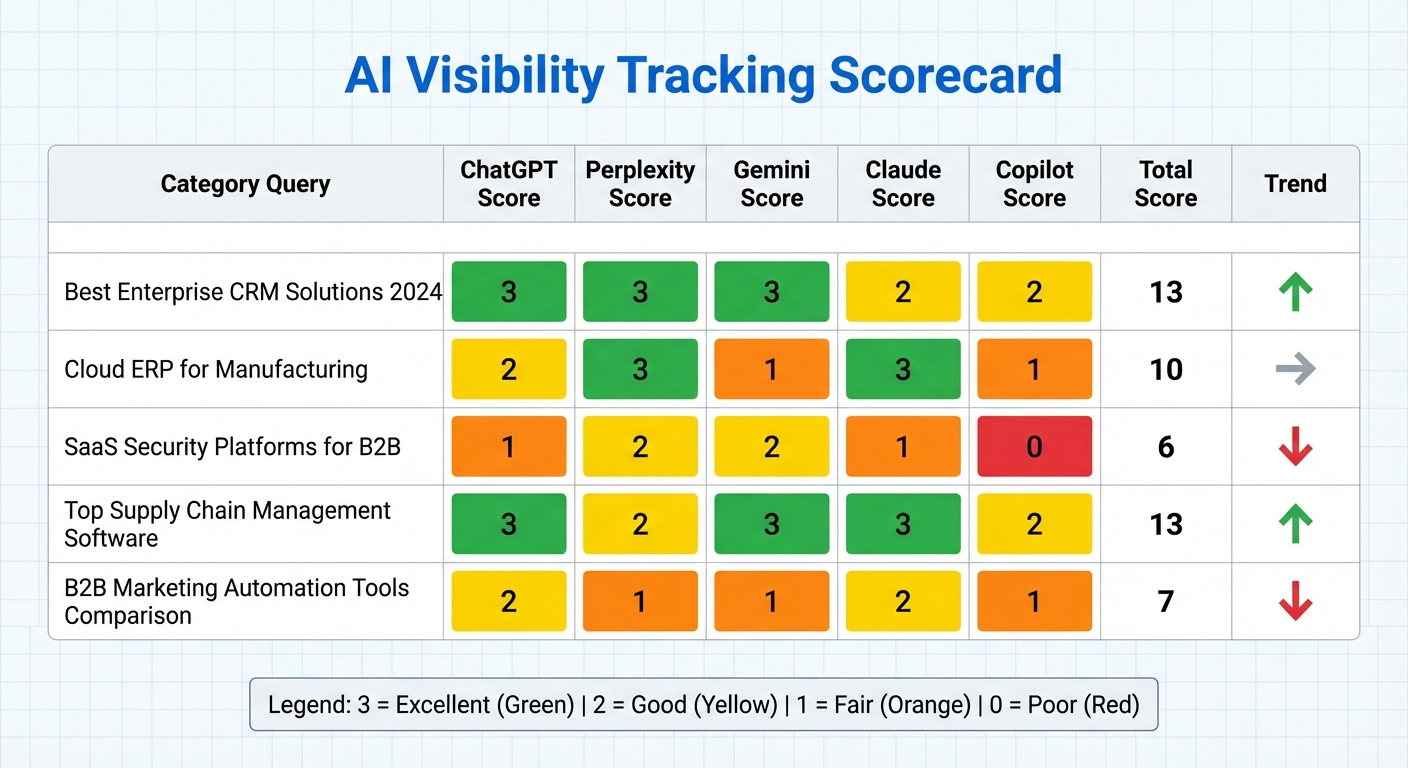
Step 3: Score Your AI Visibility Position
Create a simple scoring system for each query:
- 3 points: Your brand is mentioned first or as a top recommendation
- 2 points: Your brand appears in the response but not as the primary recommendation
- 1 point: Your brand is mentioned only when specifically asked about
- 0 points: Your brand doesn’t appear at all
Track this score monthly across each AI platform. Over time, you’ll see directional movement that correlates with your editorial presence and brand mention activity.
Step 4: Benchmark Against Competitors
Run the same queries and track competitor appearance rates. This gives you an AI share of voice metric — a measure of how often your brand appears relative to competitors in AI-generated answers.
This competitive view is often more revealing than traditional awareness surveys because it reflects what AI systems actually recommend when a buyer asks for help.
Connecting Brand Tracking to AI Visibility Strategy
Tracking alone doesn’t improve brand health. The value comes from connecting tracking insights to strategic actions.
When Traditional Metrics Are Strong but AI Visibility Is Weak
If your survey data shows high awareness and positive perception, but AI models rarely mention your brand, the issue is almost always editorial presence. AI models learn brand-category associations from the content they process. If your brand isn’t mentioned on the types of publications that AI systems index — high-authority editorial sites, industry publications, research platforms — the models won’t surface it.
The solution: increase your brand’s presence in editorial content across publications that AI models learn from. Agencies like BrandMentions address this specifically by placing contextual brand mentions on 140+ high-authority publications included in AI training data and retrieval indexes.
When AI Visibility Is Present but Brand Perception Lags
If AI models mention your brand but your tracking shows declining perception or low NPS, focus on the quality and context of how your brand appears. Negative mentions, outdated product information, or association with the wrong category can all appear in AI responses.
Use your brand reputation analysis to identify specific perception issues, then address them through targeted editorial content that reinforces the correct positioning.
When Both Are Weak
For brands with low awareness and low AI visibility, start with foundational brand building. Establish consistent editorial presence, invest in category-relevant content, and build brand mentions across AI search surfaces systematically. Track improvements quarterly using both traditional metrics and the AI visibility scoring system above.
Key Definition: AI visibility is the degree to which AI-powered search engines and assistants reference, recommend, or cite a brand when users ask category-relevant questions. It’s influenced by the frequency, recency, and editorial authority of a brand’s presence across the web content that AI models process.
Building a Unified Brand Tracking Dashboard
The most effective brand tracking programs in 2026 unify traditional and AI-generated insights into a single view. Here’s how to structure yours.
Layer 1: Core Brand Health Metrics
Collected via recurring surveys at your chosen cadence:
- Unaided and aided awareness
- Brand consideration and preference
- Key attribute associations (3–5 differentiating attributes)
- NPS and loyalty indicators
Layer 2: Real-Time Brand Monitoring
Captured through brand monitoring services and social listening:
- Mention volume and sentiment trends
- Share of voice versus competitors
- Channel-specific engagement patterns
- Crisis or reputation risk signals
Layer 3: AI Visibility Metrics
Tracked monthly through systematic AI platform querying:
- AI citation rate across category queries
- AI share of voice versus competitors
- Citation quality (primary recommendation vs. secondary mention)
- Platform-by-platform visibility trends (ChatGPT, Perplexity, Gemini, etc.)
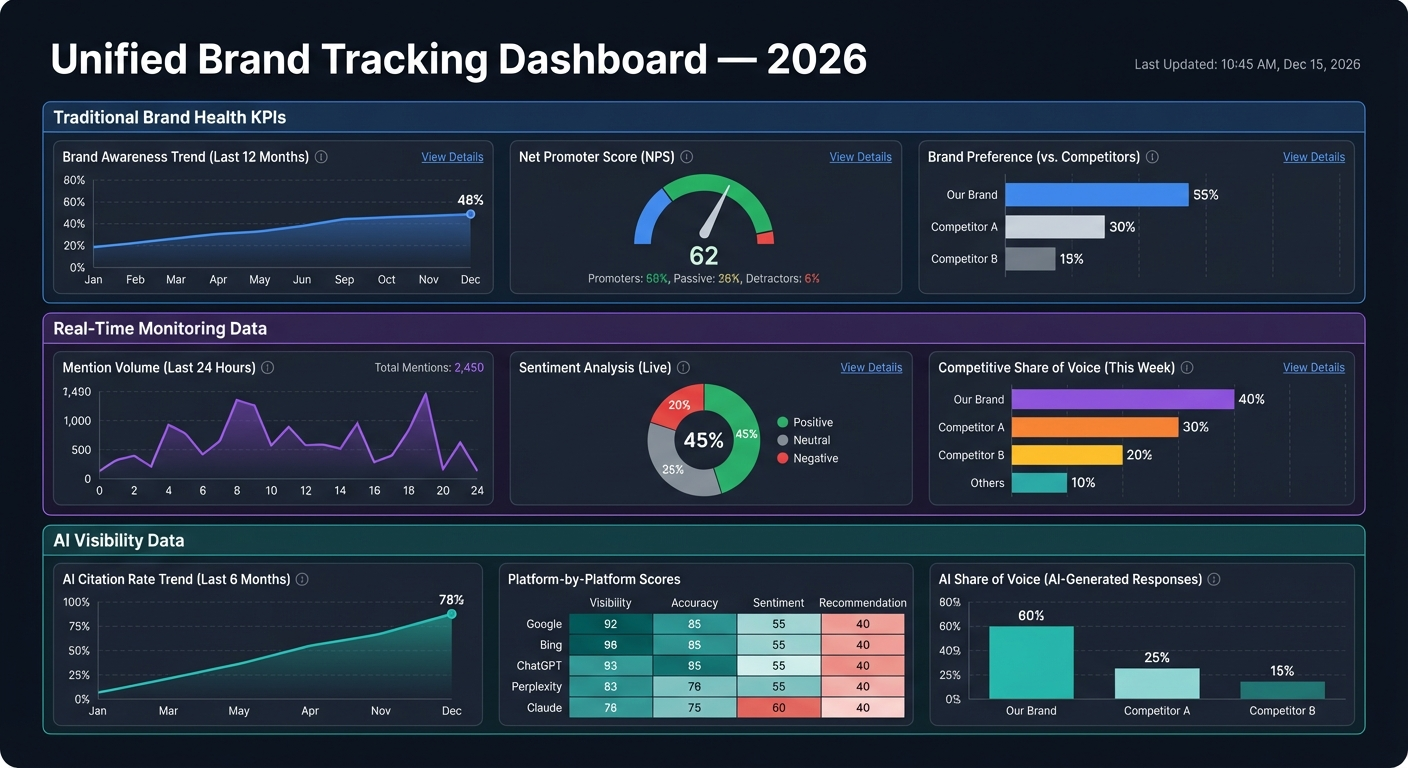
When all three layers are visible together, you can identify disconnects early. A drop in AI citation rate may predict a future decline in consideration — giving you time to respond before it shows up in your next survey wave.
Common Brand Tracking Mistakes to Avoid
After working across dozens of B2B brand tracking programs, certain failure patterns repeat.
Tracking Too Many Metrics
More metrics don’t create more clarity. They create noise. Choose the 6–8 that connect directly to your business objectives and track those with discipline. Add supplementary metrics only when they answer a specific strategic question.
Changing Questions Between Waves
Even small wording changes can invalidate trend comparisons. Lock your core question set and maintain it unchanged across waves. If you need to explore new topics, add them as supplementary modules — don’t modify the core tracker.
Ignoring AI Surfaces Entirely
As of 2026, ignoring AI-generated brand references is like ignoring search engine rankings in 2010. The channel is growing too fast and influencing too many buyer decisions to leave unmeasured. In campaigns across 67+ B2B companies, the BrandMentions team found that brands with consistent editorial mentions achieved AI recommendation rates 89% higher than those relying solely on traditional SEO.
Treating Tracking as a Report Card Instead of a Decision Engine
Brand tracking data should drive action — not just fill quarterly presentations. Every tracking wave should answer: “What should we do differently in the next 90 days based on what we’ve learned?” If you can’t connect tracking insights to specific decisions, your program needs restructuring.
Surveying the Wrong Audience
Your tracker is only as useful as its sample. For B2B companies, surveying the general population when your buyers are VP-level decision-makers at mid-market SaaS companies produces misleading data. Define your tracking audience as precisely as you define your ICP.
How Brand Tracking Has Changed Since 2024
The brand tracking discipline has evolved significantly over the past two years. Understanding what’s changed helps you avoid outdated approaches.
AI search surfaces are now measurable. In 2024, most AI platforms didn’t provide visibility into how brands were cited. By 2026, the ecosystem has matured enough that systematic tracking across ChatGPT, Perplexity, Gemini, and Google AI Overviews is practical — even if imperfect.
Survey fatigue is real and accelerating. Response rates for traditional brand tracking surveys continue declining, according to a 2025 Forrester report on market research trends. This makes each survey wave more expensive and potentially less representative. Supplementing survey data with behavioral signals — search volume, AI citations, editorial mentions — improves reliability.
Brand tracking and competitive analysis are converging. The best 2026 tracking programs don’t just monitor your brand in isolation. They systematically compare your visibility, sentiment, and AI citation rates against 3–5 direct competitors across every surface.
Real-time data expectations have risen. Quarterly reporting cycles feel increasingly slow in categories where AI search results change weekly. Leading teams now combine quarterly survey waves with continuous monitoring and monthly AI visibility checks.
Choosing the Right Brand Tracking Approach for Your Stage
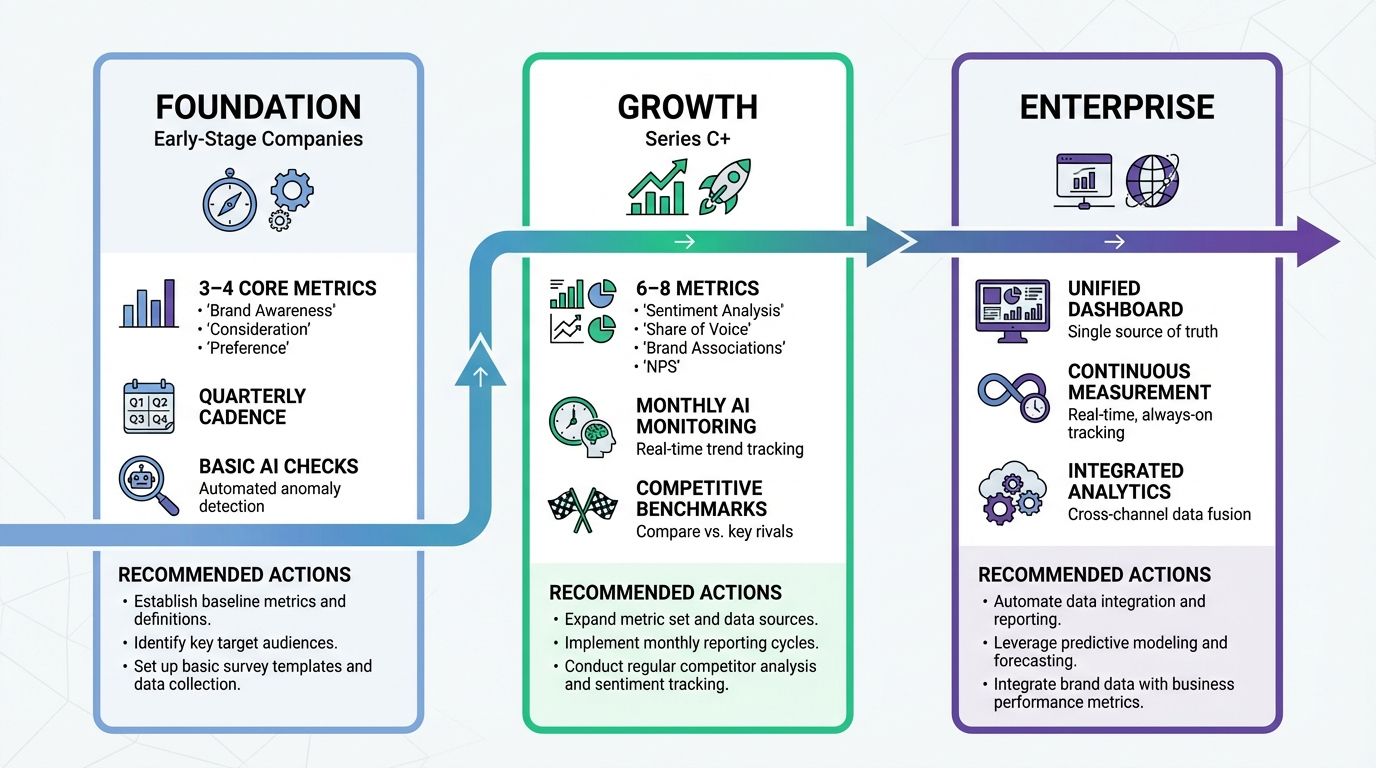
Your tracking program should scale with your brand. Here’s a stage-appropriate breakdown.
Early-Stage / Series A–B Startups
Start lean. Measure aided awareness, consideration, and AI visibility across your top 10 category queries. Use free or low-cost brand tracking tools to establish a baseline. Track quarterly. Focus resources on building visibility, not on elaborate tracking infrastructure.
Growth-Stage / Series C+ Companies
Add unaided awareness, brand preference, NPS, and competitive benchmarking to your tracking program. Implement monthly AI visibility monitoring. Invest in a structured survey program with quarterly waves and event-triggered supplements. Start connecting tracking data to pipeline metrics.
Enterprise Brands
Build a unified dashboard across all three layers (traditional, monitoring, AI). Run continuous or monthly surveys. Track AI visibility weekly across all major platforms. Integrate brand tracking data with CRM, marketing attribution, and revenue analytics. Consider working with a dedicated brand tracking agency to manage complexity.
Frequently Asked Questions
What is brand tracking?
Brand tracking is the systematic, recurring measurement of how your target audience perceives your brand across metrics like awareness, consideration, preference, loyalty, and equity. It reveals how brand health changes over time and connects those changes to specific marketing activities, competitive moves, and market conditions.
How often should you run a brand tracker?
Most B2B companies benefit from quarterly survey waves supplemented by continuous monitoring and monthly AI visibility checks. Fast-moving categories may need monthly tracking. Annual tracking is generally too infrequent to connect brand changes to specific actions.
What’s the difference between brand tracking and brand monitoring?
Brand tracking measures perception trends over defined time periods using structured surveys and recurring metrics. Brand monitoring captures real-time mentions and sentiment across digital channels. Effective brand programs use both — tracking for strategy, monitoring for responsiveness.
Does brand tracking work for B2B companies?
Brand tracking is especially valuable for B2B companies because buyers rely heavily on brand trust and perception when evaluating vendors. The key is surveying the right audience — your actual ICP, not the general population — and tracking metrics that connect to pipeline and revenue outcomes.
How do you track your brand’s visibility in AI search?
Map the natural-language questions your buyers ask AI assistants. Run those queries systematically across ChatGPT, Perplexity, Gemini, Claude, and Copilot. Score and track whether your brand appears, how prominently it’s featured, and how your citation rate compares to competitors. Measure monthly to detect trends.
Can brand tracking improve AI recommendations of your brand?
Brand tracking itself identifies gaps — it doesn’t directly improve AI citations. However, tracking data reveals where your AI visibility is weakest, which informs where to invest in editorial presence, content strategy, and strategic brand mentions on publications that AI models actively learn from.
Ready to find out how AI assistants describe your brand — and where the gaps are? See where your brand stands in AI search.