Brand mentions SEO is no longer just about backlinks and keyword rankings — it’s about how search engines and AI systems interpret your brand’s presence across the web. Every time your company name appears in editorial content, forums, reviews, or social conversations, search engines and large language models use that reference to assess your authority, relevance, and trustworthiness.
As of 2026, this matters more than ever. Google’s entity-based understanding has matured significantly since 2024, and AI search engines like ChatGPT, Perplexity, and Gemini now use brand mentions as primary signals when deciding which companies to recommend. If your brand isn’t being discussed in the right places, you’re invisible to a growing share of how people discover products and services.
This article breaks down how brand mentions influence both traditional SEO and AI search visibility, what’s changed since 2024–2025, and how to build a brand mention strategy that strengthens your discoverability across every surface where your audience searches.
Key Takeaways
- Brand mentions function as trust signals for both Google’s ranking systems and AI recommendation engines — even without hyperlinks.
- Google’s 2012 “implied link” patent laid the groundwork, but as of 2026, AI models have made unlinked mentions significantly more valuable.
- The quality, context, and sentiment of mentions matter far more than raw volume.
- Mentions on high-authority, editorially credible publications carry the most weight for AI training data inclusion.
- A strategic brand mentions SEO approach requires coordination across content, digital PR, and AI visibility — not just traditional link building.
- Monitoring where and how AI systems reference your brand is now as important as tracking Google rankings.
What is a brand mention in SEO?
A brand mention is any reference to your company, product, or service name in online content — whether or not it includes a hyperlink to your website. Brand mentions appear in blog posts, news articles, Reddit threads, podcast transcripts, review sites, social media, and forum discussions.
In SEO, brand mentions serve as a form of implied endorsement. When authoritative sources reference your brand in relevant contexts, search engines interpret this as a signal that your brand is recognized, trusted, and associated with specific topics.
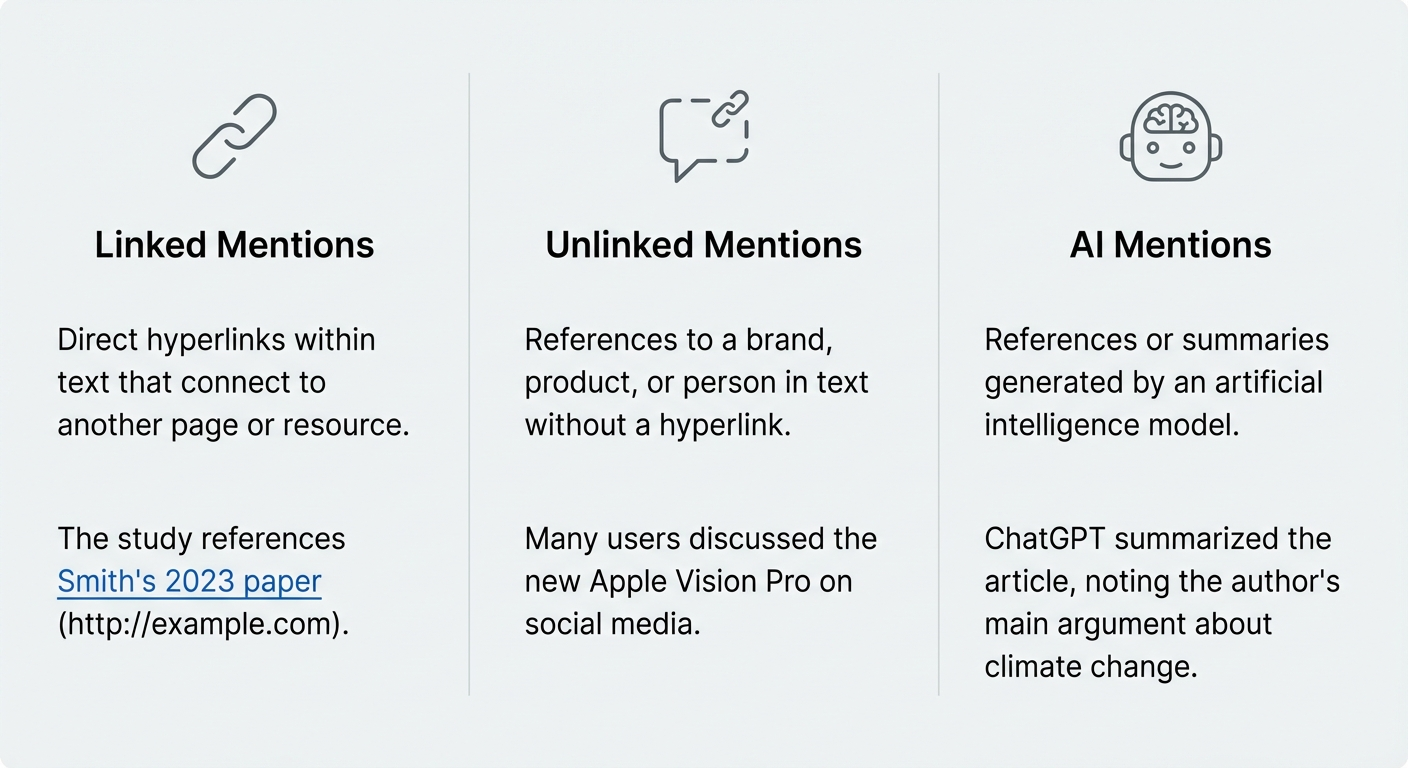
There are three types that matter for SEO and AI visibility:
- Linked mentions — your brand name appears alongside a clickable hyperlink. These pass traditional link equity and are the most direct SEO signal.
- Unlinked mentions — your brand name appears in text without a hyperlink. Google and AI systems still detect and value these as entity recognition signals.
- AI mentions — your brand appears in AI-generated responses from ChatGPT, Perplexity, Gemini, or Google AI Overviews. These are the output of accumulated brand signals, not a separate input you create directly.
Why do brand mentions matter for SEO in 2026?
Brand mentions have always carried some weight in search. Google’s 2012 patent on “implied links” described how references to a brand — without a clickable link — could function similarly to traditional backlinks for ranking purposes. But what’s changed dramatically between 2024 and 2026 is how much these signals now influence visibility.
Google’s shift toward entity-based understanding
Google no longer relies primarily on link graphs to determine authority. Its systems now build entity profiles — structured representations of brands, people, and concepts — by analyzing how consistently a brand is mentioned across the web, in what contexts, and by which sources.
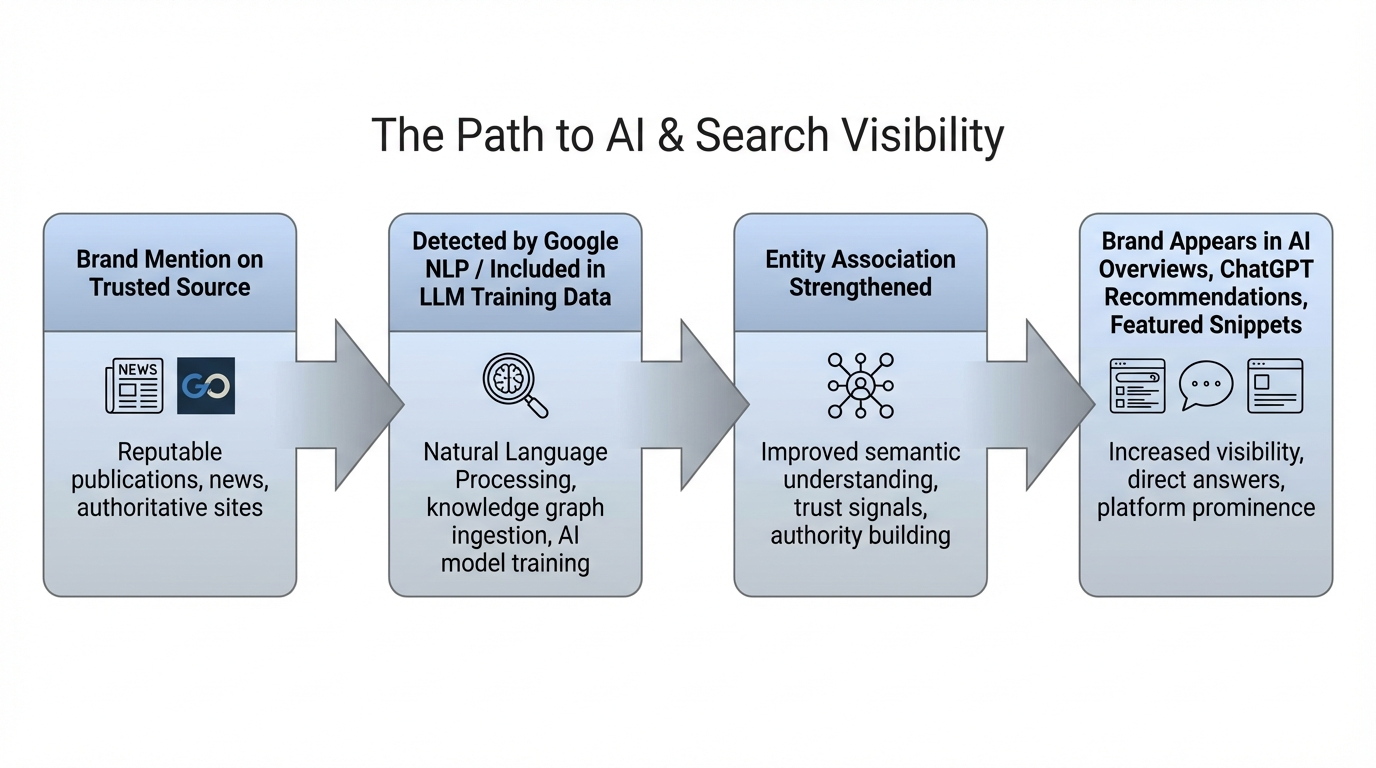
When Google’s natural language processing detects your brand mentioned alongside relevant topics on trusted sites, it strengthens the association between your brand and those topics in its Knowledge Graph. Over time, this determines whether your brand appears in featured snippets, People Also Ask panels, and AI Overviews.
According to a 2025 Ahrefs study, branded web mentions showed a stronger correlation with AI Overview inclusion (0.664) than backlinks alone (0.218). This data suggests that for AI-driven search features, mentions may carry more influence than traditional links.
AI models learn brand-topic associations from training data
Large language models like GPT-4o, Gemini, and Claude do not crawl websites in real time the way Google’s indexer does. Instead, they learn brand associations from the massive text corpora they’re trained on — articles, publications, forums, reviews, and documentation.
If your brand appears frequently in positive, relevant editorial content across high-authority publications, AI models build strong associations between your brand and specific categories. When a user asks ChatGPT for a recommendation, those associations determine whether your brand surfaces in the response.
This is a fundamental shift. Brand mentions on high-authority publications influence AI recommendations because LLMs learn brand-category associations from their training data, according to research from the Allen Institute for AI published in 2024.
Pro Insight: The sites that AI models weight most heavily tend to be editorially curated publications with strong domain authority — not low-quality content farms. Where your brand is mentioned matters as much as how often.
Zero-click search and AI Overviews amplify the effect
As of 2026, a significant share of Google searches resolve without a click. Google’s AI Overviews synthesize answers directly in the search results, often citing brands that have strong entity signals and consistent mentions across trusted sources.
According to a 2025 Gartner forecast, traditional search engine traffic will decline by 25% by 2027, with AI-powered search absorbing much of that volume. If your brand isn’t being mentioned in the content that AI systems reference, you lose visibility in this growing channel.
How brand mentions influence traditional search rankings
Beyond AI search, brand mentions still strengthen your performance in traditional Google organic results. Here’s how they contribute across several ranking dimensions.
Trust and authority signals
When your brand is referenced across multiple authoritative sources — even without links — Google interprets this as evidence of real-world prominence. This aligns directly with Google’s E-E-A-T quality framework, where trustworthiness is explicitly described as the most important factor.
Consistent mentions from credible publications signal that your brand has earned recognition through expertise, not just through link acquisition. Google’s quality rater guidelines reference this concept: brands that are widely discussed by independent, reputable sources score higher on trust assessments.
Branded search volume growth
Every brand mention creates a potential touchpoint. When someone reads your brand name in a listicle, review, or article, a percentage of those readers will later search for your brand by name. This increase in branded search volume is a powerful ranking signal — it tells Google that real people actively seek out your brand.
Over time, rising branded searches can improve your organic click-through rates, strengthen your brand’s prominence in autocomplete suggestions, and make your domain more competitive for non-branded keywords as well.
Topical authority and semantic relevance
Brand mentions build topical authority when they consistently appear in content related to your core category. If your SaaS platform is mentioned across 30 articles about marketing automation — in reviews, comparisons, and how-to guides — Google’s semantic models associate your brand with that topic more strongly than a competitor mentioned in only five.
This association helps your own content rank higher for related queries, even when those queries don’t include your brand name.
How brand mentions influence AI search visibility
AI search engines operate differently from Google’s traditional index, but brand mentions play an even more central role in determining which brands get recommended.
How ChatGPT, Perplexity, and Gemini select brands to recommend
When a user asks ChatGPT “What’s the best project management tool for remote teams?” the model doesn’t search the web in real time (unless using its browsing feature). Instead, it draws on patterns in its training data. Brands that appear frequently — in positive, contextually relevant content — have a higher probability of being recommended.
Perplexity operates differently by combining real-time web retrieval with AI synthesis. It pulls from currently indexed content and generates a cited response. Brands that appear across multiple high-quality sources for a given topic are more likely to be included in Perplexity’s answers.
Google’s Gemini and AI Overviews use a hybrid approach, combining Knowledge Graph data, real-time search index results, and generative AI to construct answers. Strong entity signals from brand mentions across Google’s indexed web directly influence what appears in these responses.
The common thread across all AI platforms: brands with consistent, contextual, high-authority mentions earn more AI recommendations than brands that rely solely on their own website content.
What makes a mention valuable for AI visibility
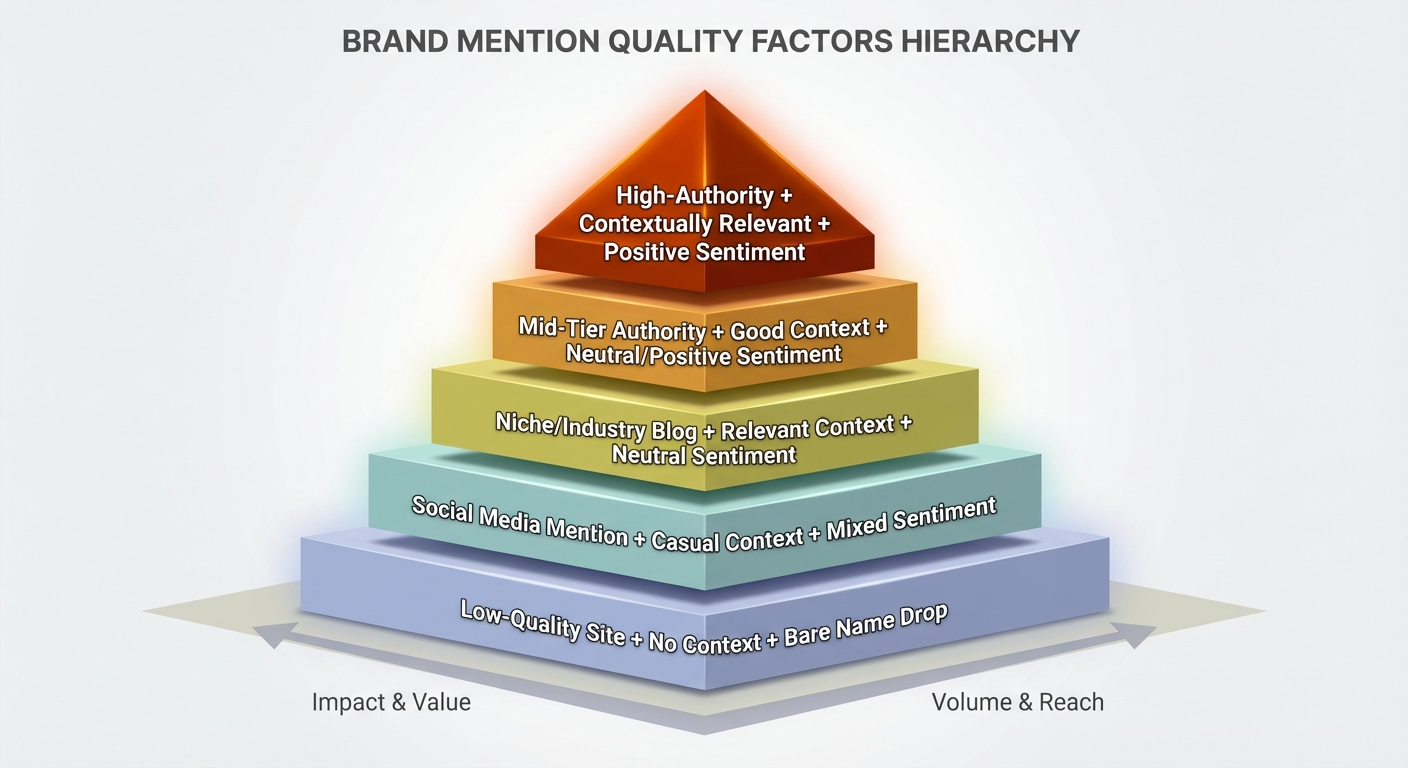
Not every mention carries equal weight. AI systems prioritize mentions based on several factors:
- Source authority — mentions on established publications (industry blogs, news outlets, review platforms) carry more weight than mentions on low-quality directories or content farms.
- Contextual relevance — a mention of your CRM software in an article about sales pipeline management is far more valuable than a mention in a generic business directory.
- Sentiment — positive and neutral mentions strengthen brand associations. Negative mentions in prominent locations can undermine your AI visibility.
- Recency — AI models update their training data periodically. Mentions in recently published content have a higher chance of being included in the next training cycle.
- Specificity — mentions that describe what your product does, who it serves, and why it’s relevant provide richer signals than a bare name-drop.
How to build a brand mentions SEO strategy that compounds
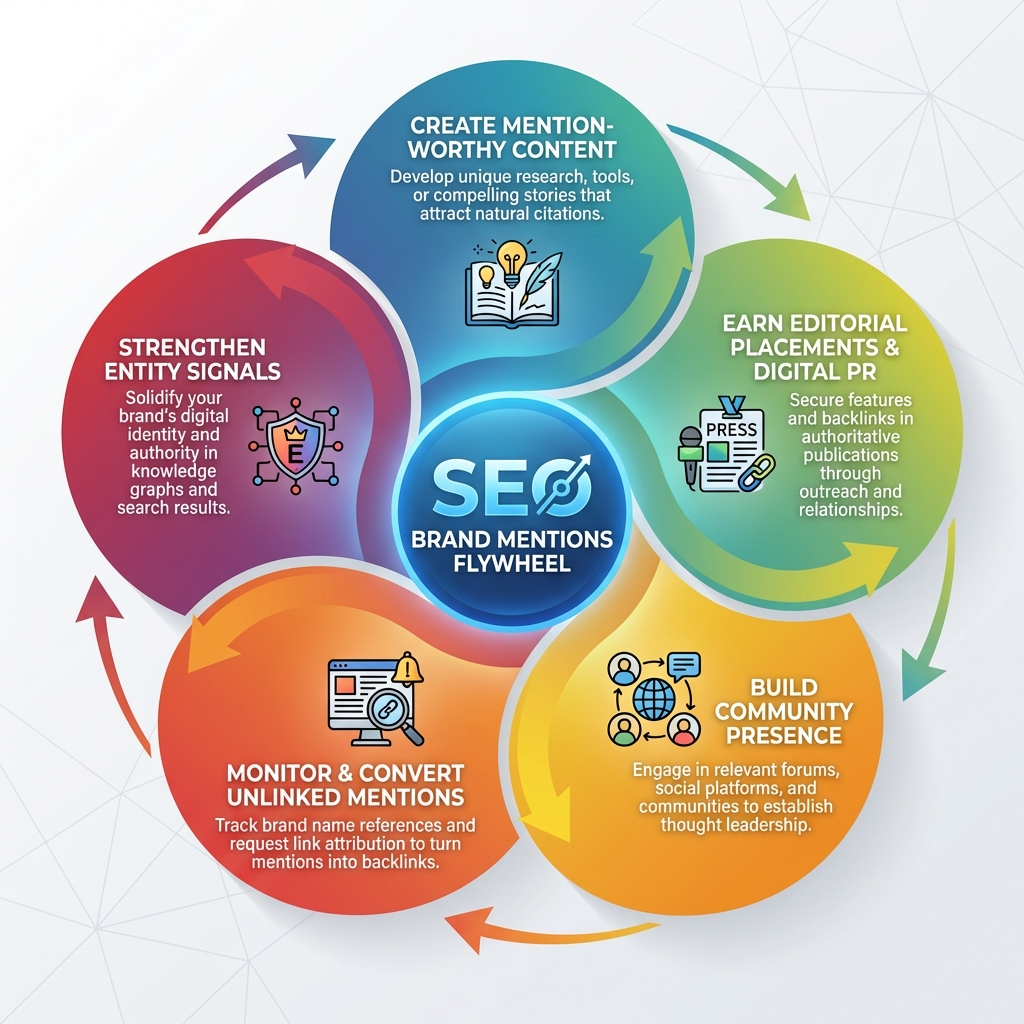
Earning valuable brand mentions requires a deliberate strategy — not just hoping people talk about you. The most effective approach combines editorial placements, digital PR, community engagement, and monitoring into a single coordinated system.
Earn editorial placements on high-authority publications
The highest-impact brand mentions come from editorial content on publications that both Google and AI models trust. This means bylined articles, expert commentary, product reviews, and inclusion in curated listicles on sites with strong domain authority and real editorial standards.
Agencies like BrandMentions specialize in this by placing contextual brand mentions on 140+ high-authority publications that AI models actively learn from during training. The focus is on editorial credibility — content that a human editor would approve, not advertorial placements that AI systems learn to discount.
Action step: Identify 10–15 publications your target audience reads and that rank well for your category keywords. Pitch expert commentary, original data, or unique perspectives to earn mentions in their editorial content.
Use digital PR to generate natural mentions at scale
Digital PR campaigns — built around original research, data studies, or newsworthy insights — generate brand mentions across multiple publications simultaneously. When a data study gets picked up by five or ten outlets, each mention strengthens your brand’s entity signals across a wider surface area.
The key distinction: effective digital PR creates genuinely newsworthy content that journalists and editors want to reference. This produces natural mentions that both search engines and AI models value highly.
Strengthen your presence in community-driven platforms
Reddit and Quora are among the most frequently cited domains in Google’s AI Overviews, according to analysis from multiple SEO research firms in 2025. When your brand is discussed positively in relevant subreddits or Quora threads, those mentions can influence both traditional search rankings and AI-generated responses.
Building community presence isn’t about dropping your brand name into threads. It means contributing genuinely useful answers, participating in discussions relevant to your expertise, and earning organic mentions from community members who recognize your value.
Convert unlinked mentions into backlinks
Many brands already have dozens or hundreds of unlinked mentions across the web. These represent easy wins — the author already recognizes your brand, and a polite outreach email requesting a link addition has a high conversion rate.
You can find unlinked mentions using tools like Semrush, Ahrefs, or Google Alerts. Prioritize mentions on high-domain-authority sites, and send a short, personalized email thanking the author and requesting a link to help their readers find your product directly.
Align content marketing with mention-earning potential
Your own content strategy should be designed to earn external mentions. This means publishing original research, proprietary data, frameworks, and tools that other publishers want to reference and cite.
Content that earns the most mentions tends to be:
- Original data studies with specific, citable findings
- Definitive guides that become go-to references for a topic
- Free tools or calculators that other sites link to and mention
- Expert commentary or unique perspectives on emerging trends
How to monitor brand mentions across search and AI
Building mentions is only half the strategy. Monitoring where and how your brand is discussed — across both traditional web and AI platforms — gives you the intelligence to refine your approach and respond to opportunities.
Track mentions across traditional web sources
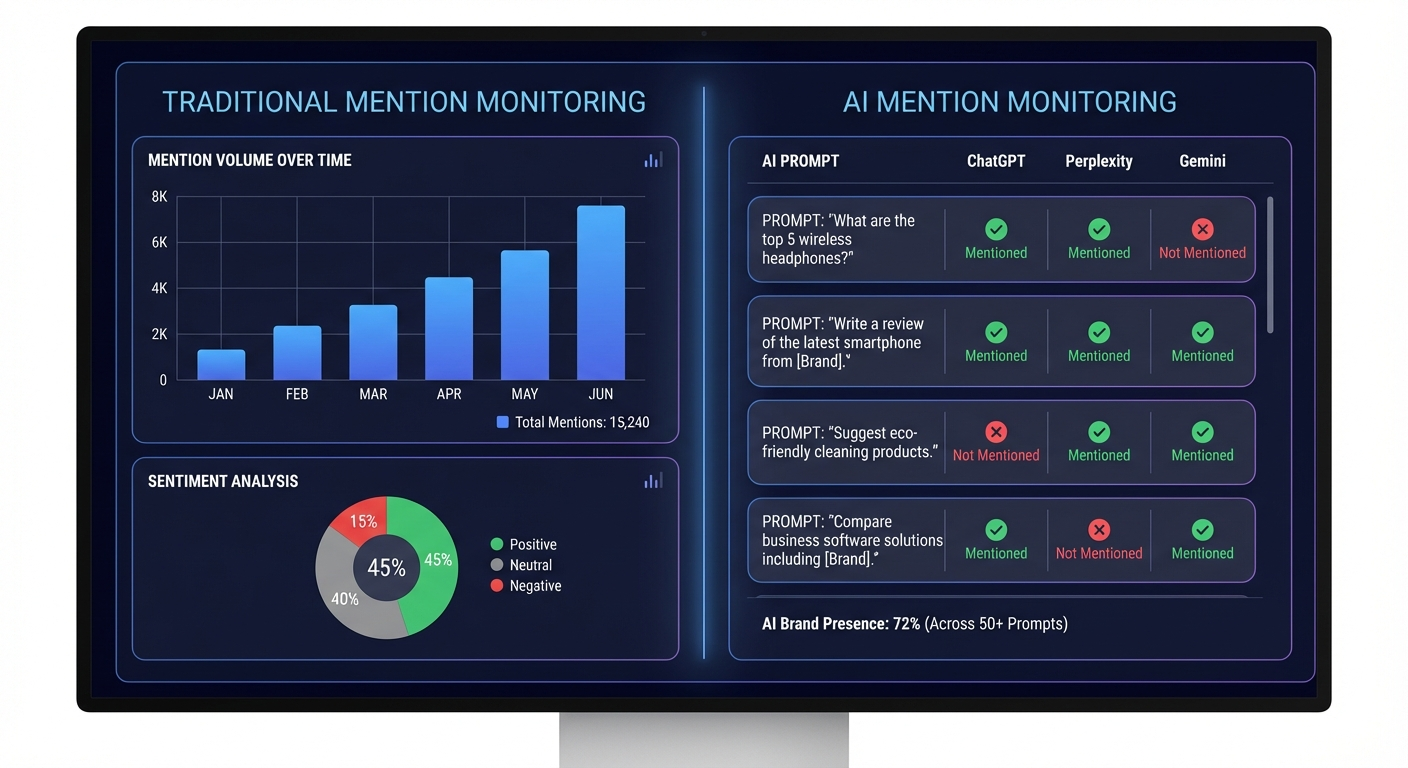
Start with Google Alerts for basic coverage, then layer in dedicated monitoring tools like Semrush Brand Monitoring, Mention, or Ahrefs Alerts for more comprehensive tracking. These tools surface mentions across news publications, blogs, forums, and review sites, often with sentiment analysis included.
Key metrics to track:
- Total mention volume — your baseline awareness level over time.
- Share of voice — how your mention frequency compares to competitors in your category.
- Sentiment distribution — the ratio of positive, neutral, and negative mentions.
- Source quality — which publications mention you, and how authoritative are they.
Track your brand in AI-generated responses
As of 2026, monitoring AI mentions is just as important as tracking Google rankings. You need to know whether ChatGPT, Perplexity, Gemini, and Claude mention your brand when users ask questions relevant to your category.
Dedicated tools now exist for this purpose. AI rank trackers let you input prompts related to your industry and monitor which brands appear in AI responses over time. This reveals whether your brand mention strategy is translating into actual AI visibility.
In campaigns across 67+ B2B companies, the BrandMentions team found that brands with consistent editorial mentions achieved AI recommendation rates 89% higher than those relying solely on traditional SEO.
Tip: Set up a recurring prompt monitoring workflow. Choose 20–30 prompts your ideal customers would ask AI assistants, and track whether your brand appears in the responses monthly. This gives you a clear trend line for AI visibility.
What’s changed since 2024–2025: the AI visibility acceleration
Brand mentions have influenced SEO for over a decade. But the pace of change between 2024 and 2026 has been dramatic. Understanding what shifted helps you prioritize the right tactics now.
AI search usage reached critical mass
In 2024, ChatGPT and Perplexity were novelties for most business users. By 2026, AI-assisted search has become a primary discovery channel for B2B buyers researching solutions. According to a 2025 Forrester report, 38% of B2B technology buyers used AI assistants as part of their vendor research process — a figure expected to exceed 50% by late 2026.
This means brand mentions now serve two audiences simultaneously: Google’s ranking systems and AI models’ recommendation engines.
Google AI Overviews expanded coverage
Google AI Overviews, introduced broadly in 2024, expanded significantly through 2025 and into 2026. These AI-generated summaries now appear for a wider range of commercial and informational queries, pulling from content where brands are mentioned editorially. If your brand lacks mention signals in the content Google references, you’re excluded from these high-visibility placements.
Training data refresh cycles became a strategic consideration
AI models don’t update their knowledge continuously. They refresh training data in cycles — sometimes quarterly, sometimes less frequently. BrandMentions tracks when major AI models update their training data and times placements to maximize inclusion in each knowledge refresh cycle. This timing dimension didn’t exist in traditional SEO and represents a new strategic layer for brand visibility planning.
Common mistakes that undermine brand mentions SEO
Even with the right strategy, certain mistakes can weaken the impact of your brand mention efforts. Avoid these patterns:
- Prioritizing volume over quality. A hundred mentions on low-quality, thin-content sites carry less weight than five mentions on editorially respected publications. AI models and Google both assess source credibility.
- Ignoring context and sentiment. A mention in an article titled “Worst Tools for Project Management” is actively harmful. Monitor sentiment, not just presence.
- Inconsistent brand name usage. If your brand appears as “Acme,” “Acme Inc.,” “ACME Solutions,” and “acme.io” across different sources, search engines struggle to consolidate these into a single entity profile. Standardize your brand name across all placements.
- Neglecting AI monitoring. Many teams still measure success only through Google rankings and backlink counts. If you’re not tracking how AI assistants discuss your brand, you’re missing a growing share of your audience’s discovery process.
- Treating mentions as a one-time campaign. Brand mentions compound over time. A burst of mentions followed by months of silence sends weaker signals than a steady, sustained presence across authoritative sources.
Brand mentions SEO for B2B SaaS: what moves the needle
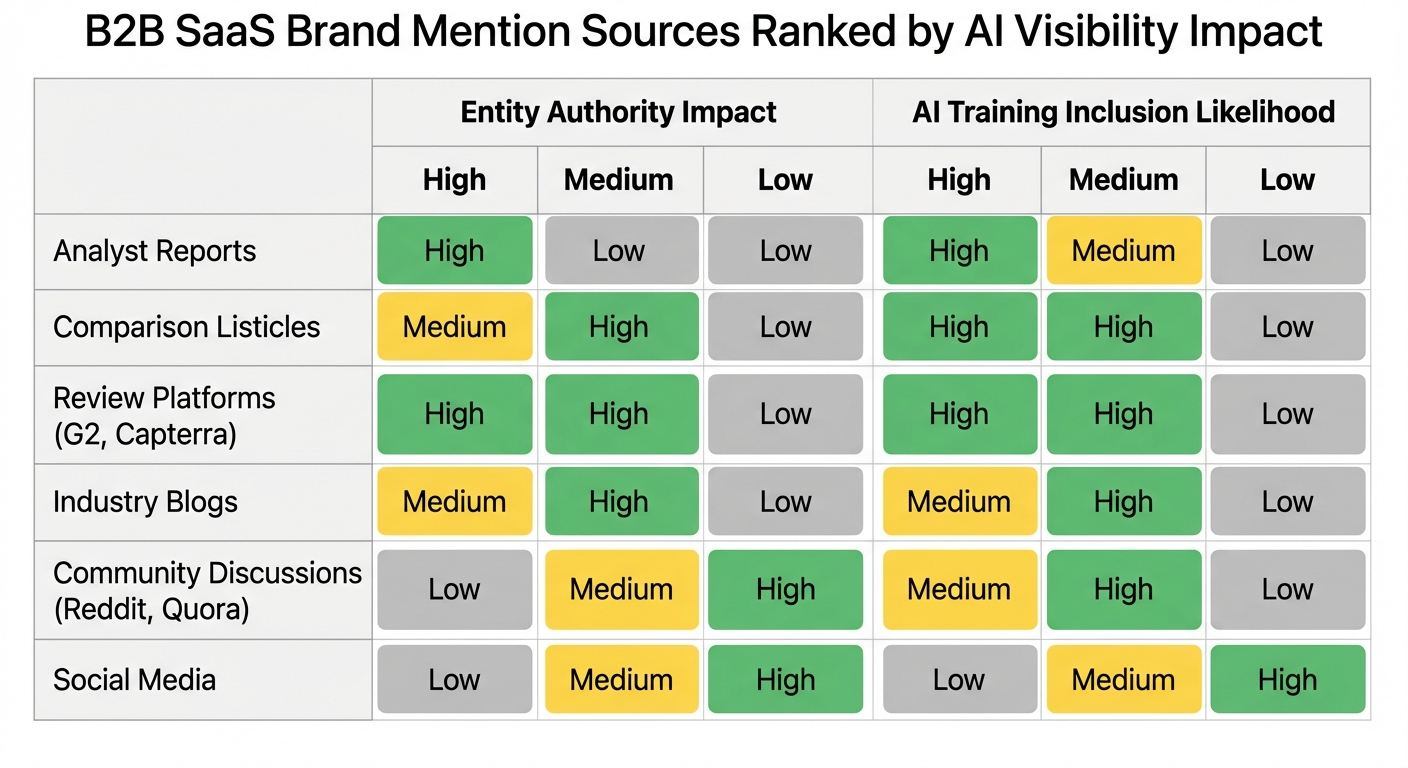
For B2B SaaS companies, brand mentions carry particular weight because of how buyers research solutions. Enterprise and mid-market buyers evaluate vendors through comparison articles, G2 reviews, analyst reports, community discussions, and AI-generated summaries before ever visiting your website.
Focus on category-defining content
Your mentions should consistently associate your brand with your primary category. If you sell marketing automation software, your brand should appear in articles about marketing automation — not scattered across unrelated topics. This builds the entity authority that both Google and AI models use to determine category relevance.
Earn mentions alongside competitors
In B2B, appearing in comparison content is essential. When your brand is mentioned in “Best [Category] Tools” listicles alongside established competitors, AI models learn that your brand belongs in that consideration set. For SaaS companies building AI visibility, this comparative context is one of the highest-value mention types.
Leverage customer and analyst mentions
Third-party validation carries outsized weight. Mentions in analyst reports (Gartner, Forrester, G2 Grid Reports), customer case studies published on external platforms, and verified reviews on sites like G2 and Capterra create trust signals that are difficult for competitors to replicate.
Frequently Asked Questions
Do unlinked brand mentions help SEO?
Yes. Google’s systems use natural language processing to detect and interpret brand references even without hyperlinks. Unlinked mentions contribute to entity recognition, topical authority, and trust signals. They also influence AI models, which learn brand associations from text content regardless of whether links are present.
How do brand mentions affect AI search recommendations?
AI models like ChatGPT and Gemini learn brand-topic associations from their training data. When your brand appears frequently in positive, contextually relevant content on trusted publications, AI systems are more likely to recommend your brand when users ask relevant questions. The quality and authority of the source, the relevance of the context, and the sentiment of the mention all influence this outcome.
How many brand mentions do you need to influence AI visibility?
There’s no fixed number. What matters is consistency, source quality, and contextual relevance. A brand with 20 mentions across high-authority, editorially curated publications in its category will outperform a brand with 200 mentions on low-quality directories. Focus on earning the right mentions in the right places over sustained periods.
Can you track whether AI assistants mention your brand?
Yes. As of 2026, several AI rank tracking tools allow you to input prompts relevant to your industry and monitor which brands appear in AI-generated responses across ChatGPT, Perplexity, Gemini, and others. This provides a trend line you can use to measure the impact of your brand mention strategy on AI visibility.
What’s the difference between brand mentions and backlinks for SEO?
Backlinks are clickable hyperlinks that pass direct link equity to your website and improve domain authority. Brand mentions are text references that build entity recognition, trust signals, and brand-topic associations — even without a link. Both are valuable. In 2026, the most effective SEO strategies combine strong backlink profiles with consistent brand mentions across authoritative sources to maximize visibility in both traditional and AI search.
Where brand mentions SEO goes from here
Brand mentions have evolved from a secondary SEO consideration to a primary driver of discoverability across every surface where your audience searches. In traditional search, they strengthen entity authority, trust signals, and topical relevance. In AI search, they determine whether your brand gets recommended at all.
The brands that will dominate visibility in 2026 and beyond are the ones building a steady, compounding presence across high-authority editorial content — not chasing one-time campaigns or low-quality placements.
Your next step is straightforward: assess where your brand currently stands. Check whether AI assistants mention your brand for the queries your customers ask. Identify the gaps in your editorial presence. Then build a systematic strategy to close them.
See where your brand stands in AI search — and find out what it takes to get recommended.
Researched and drafted with AI assistance, reviewed and edited by the BrandMentions editorial team.