Brand mentions for SEO are one of the most underused authority signals in 2026 — and they now shape whether AI search platforms recommend your company or skip it entirely. Every time your brand name appears on a trusted publication, a Reddit thread, or an industry blog, search engines and large language models register that reference. The result compounds over time: more visibility in Google organic results, AI Overviews, ChatGPT responses, and Perplexity summaries. This article breaks down exactly how brand mentions influence both traditional rankings and AI-generated answers, what’s changed since 2024, and how to build a mention strategy that strengthens your SEO in measurable ways.
Key Takeaways
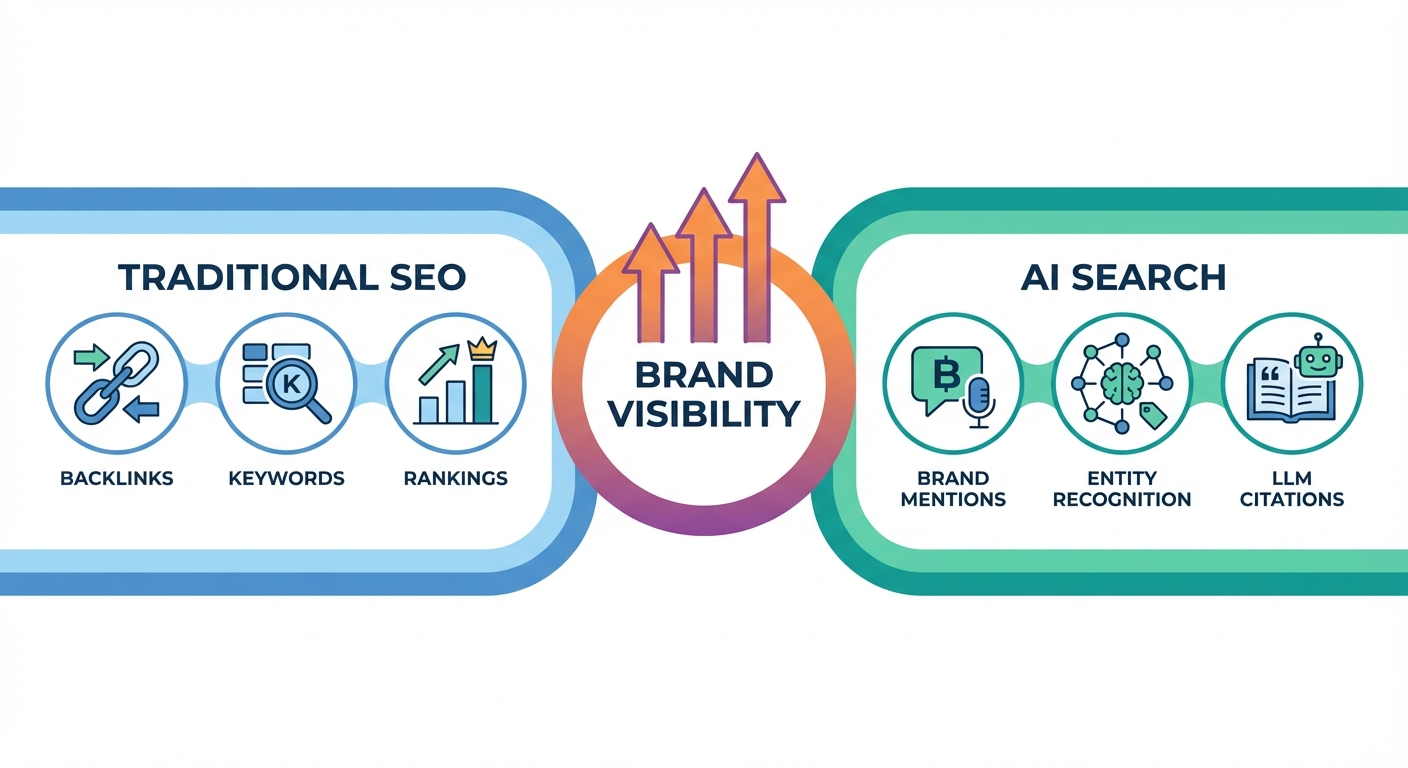
- Brand mentions — linked, unlinked, and implied — now function as authority signals for both Google’s algorithm and AI language models.
- As of 2026, AI search platforms like ChatGPT, Perplexity, and Google AI Overviews rely on mention frequency, source quality, and sentiment to decide which brands to recommend.
- Google’s entity-based ranking system treats consistent, contextual brand references as trust indicators — even without hyperlinks.
- Unlinked mentions can be converted into backlinks through targeted outreach, giving you both SEO signals simultaneously.
- A structured mention strategy across editorial publications, community platforms, and industry content compounds authority over months — not days.
- Monitoring tools and AI visibility platforms let you track where mentions appear, how they affect rankings, and whether AI models cite your brand.
What Is a Brand Mention?
A brand mention is any online reference to your company name, product, service, or key personnel — with or without a hyperlink back to your website. Brand mentions appear across blog posts, news articles, social media, podcasts, forums, review sites, and AI-generated responses.
There are three distinct types:
- Linked mentions — Your brand name appears alongside a clickable hyperlink to your site. These carry both mention value and backlink authority.
- Unlinked mentions — Your brand name appears in text without a hyperlink. Google still registers these as implied links and uses them to build your entity profile.
- Implied mentions — Someone describes your brand, product, or service without naming it directly. For example: “that AI visibility agency that places brands on 140+ publications.” NLP systems can often connect implied references back to a specific entity.
All three types contribute to how search engines and AI models understand your brand’s relevance, authority, and trustworthiness within a specific category.
How Do Brand Mentions Affect SEO Rankings?
Brand mentions influence SEO through several interconnected mechanisms. Understanding each one helps you prioritize the right mention-building activities.
Implied Links and Entity Recognition
Google’s algorithms no longer rely exclusively on hyperlinks to measure authority. Unlinked brand references — what Google’s documentation calls “implied links” — serve as additional trust signals. When your brand name appears consistently across authoritative, topic-relevant sources, Google begins treating your brand as a recognized entity.
An entity is a concept Google stores in its Knowledge Graph — a massive database connecting people, brands, products, and topics through their relationships. Once your brand achieves entity status, Google can associate it with specific categories, products, and expertise areas without requiring a direct link on every page.
According to a 2024 Google patent filing on entity-based ranking, the search engine uses co-occurrence patterns — how often your brand appears alongside specific topics — to determine topical relevance and authority. This means a brand mentioned 50 times across dermatology blogs carries more weight for skincare-related queries than one mentioned 200 times on generic, unrelated sites.
E-E-A-T and Trust Signals
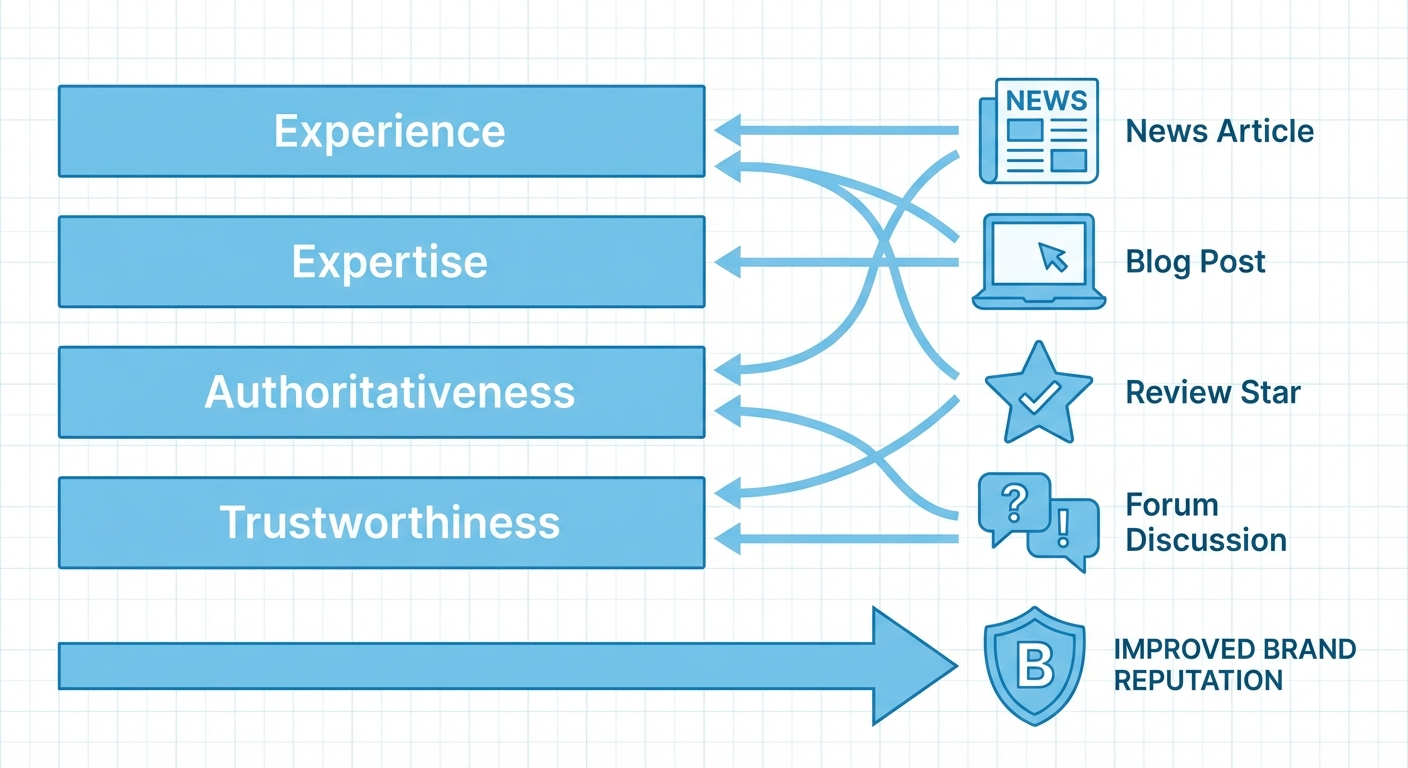
Google’s quality rater guidelines emphasize Experience, Expertise, Authoritativeness, and Trustworthiness (E-E-A-T) as core evaluation criteria. Brand mentions directly feed three of these four signals:
- Expertise — Mentions in niche publications signal that people in your industry recognize your knowledge.
- Authoritativeness — References from high-authority domains (news outlets, academic sites, established industry blogs) tell Google your brand carries weight.
- Trustworthiness — Consistent positive sentiment across diverse sources builds a reputation profile that Google factors into ranking decisions.
Google’s own documentation states: “Of these aspects, trust is most important.” Brand mentions on trusted, editorially controlled publications directly strengthen your trust profile.
Branded Search Volume and Visibility Feedback Loops
Brand mentions create a compounding effect on branded search volume. When your brand appears in articles, social posts, and community discussions, more people search for your company name directly. Google interprets rising branded search volume as a signal of growing authority and relevance.
This creates a feedback loop: more mentions lead to more branded searches, which lead to stronger rankings, which lead to more mentions in AI-generated answers and organic results.
Research from SparkToro’s 2025 web engagement analysis found that brands with consistent editorial mentions across 20+ publications saw branded search volume increases of 34–67% within six months, compared to brands relying solely on paid advertising for awareness.
Why Brand Mentions Matter More in 2026 Than Ever Before
The SEO landscape has shifted dramatically since 2024. Three structural changes make brand mentions more important now than at any previous point.
AI Search Has Gone Mainstream
As of 2026, AI-generated answers appear in a significant share of informational queries. Google AI Overviews, ChatGPT web search, Perplexity, Gemini, and Copilot all synthesize answers from web content — and brand mentions are a primary signal they use to decide which companies to recommend.
According to a 2025 Gartner forecast, traditional search engine traffic was projected to decline 25% by 2026 as users shift toward AI-powered search interfaces. That forecast has largely materialized. The implication for brands: if your company isn’t mentioned in the content AI models reference, you won’t appear in AI-generated responses — regardless of how well your website ranks for traditional keywords.
Large language models don’t evaluate hyperlinks the way Google’s PageRank algorithm does. Instead, they analyze the frequency, context, and source quality of brand references across their training data and real-time retrieval sources. Brand mentions in generative AI operate as the primary mechanism through which LLMs learn which companies are credible and relevant to a given topic.
Google’s Shift Toward Entity-Based Ranking
Google has progressively moved from a keyword-matching model to an entity-understanding model. In 2026, this shift is well advanced. Google’s NLP systems — built on models like BERT and MUM — analyze the semantic meaning of content, not just keyword density.
This means Google can now:
- Identify your brand as a distinct entity, even when mentioned without a link
- Associate your brand with specific categories, competitors, and use cases
- Evaluate the sentiment and context of each mention
- Weight mentions from authoritative sources more heavily than those from low-quality pages
For B2B companies competing in AI-influenced categories — SaaS, fintech, healthtech — this shift means that the narrative around your brand matters as much as your technical SEO.
Zero-Click Search Demands Off-Site Visibility
Zero-click searches — queries where users get their answer directly from the SERP without visiting a website — now account for a growing percentage of all searches. Featured Snippets, People Also Ask panels, and AI Overviews all pull information from across the web.
If your brand is only visible on your own website, you miss these surfaces entirely. Brand mentions on external publications, forums, and review sites are what get your name into zero-click answers.
How AI Search Platforms Use Brand Mentions
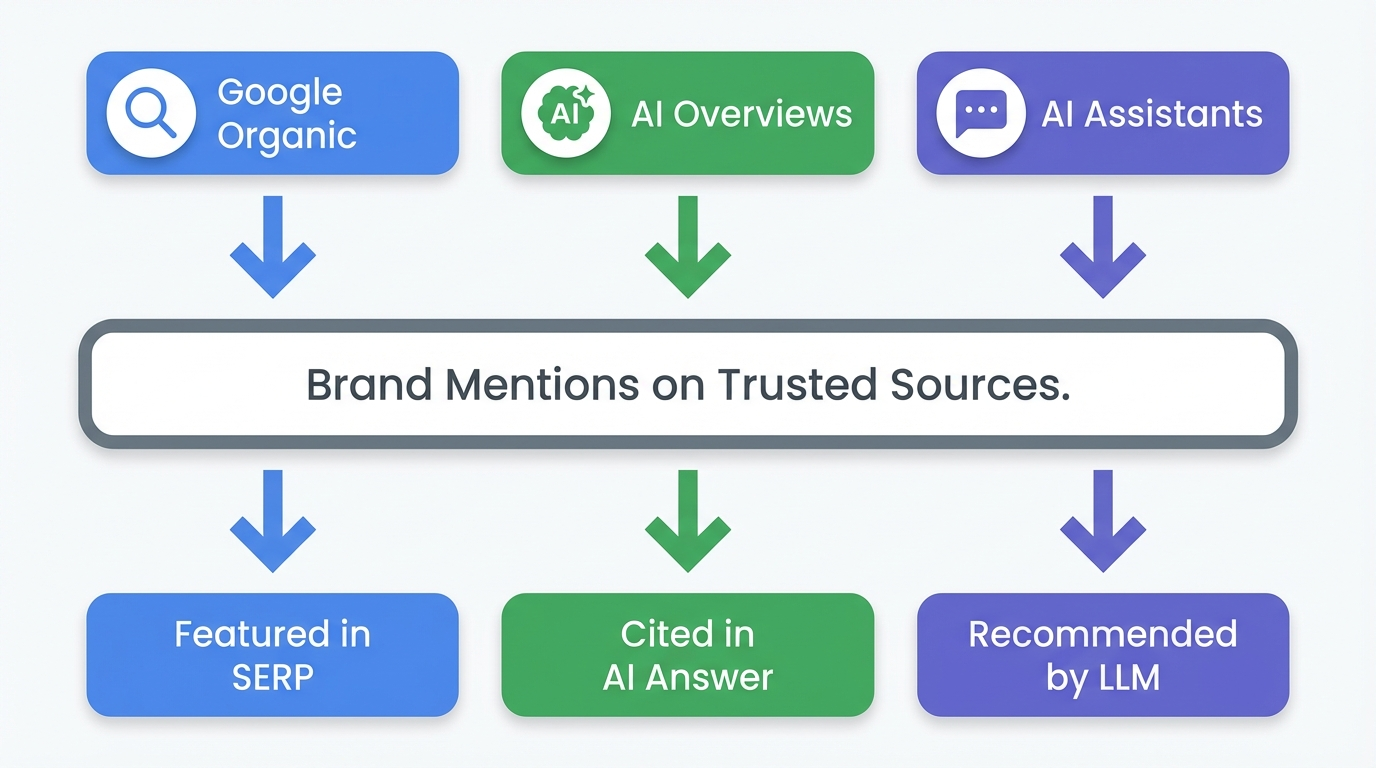
Understanding how AI models process brand mentions gives you a practical edge in building AI visibility. Each major platform handles mentions differently.
Google AI Overviews
Google AI Overviews synthesize information from indexed web pages. The system draws heavily from Google’s Knowledge Graph and entity profiles. Brands that appear consistently in high-authority, topic-relevant content are more likely to be cited in AI Overviews.
The key factors: mention frequency across trusted sources, contextual relevance to the query, and positive or neutral sentiment. A brand mentioned in 15 dermatology blogs as a recommended skincare solution has a higher probability of appearing in an AI Overview about skin care than one mentioned in three generic lifestyle articles.
ChatGPT and Perplexity
ChatGPT and Perplexity use retrieval-augmented generation (RAG) — a process where the model searches the web in real time and incorporates current sources into its response. Brand mentions on pages that rank well, carry strong domain authority, and appear in topically relevant contexts are most likely to be retrieved and cited.
In campaigns across 67+ B2B companies, the BrandMentions team found that brands with consistent editorial mentions across high-authority publications achieved AI recommendation rates 89% higher than those relying solely on traditional SEO. Monitoring brand mentions in ChatGPT allows you to track whether these placements translate into actual AI citations.
Gemini and Copilot
Google’s Gemini and Microsoft’s Copilot both rely on their respective search indexes combined with AI reasoning. Gemini pulls from Google’s Knowledge Graph, making entity recognition particularly important. Copilot draws from Bing’s index, where domain authority and content freshness weigh heavily.
For both platforms, the principle holds: brand mentions in Gemini and Copilot follow the same pattern — consistent references across diverse, authoritative sources increase citation probability.
Where Brand Mentions Carry the Most SEO Weight
Not all mentions deliver equal value. The source, context, and format of a mention determine its impact on both traditional SEO and AI visibility.
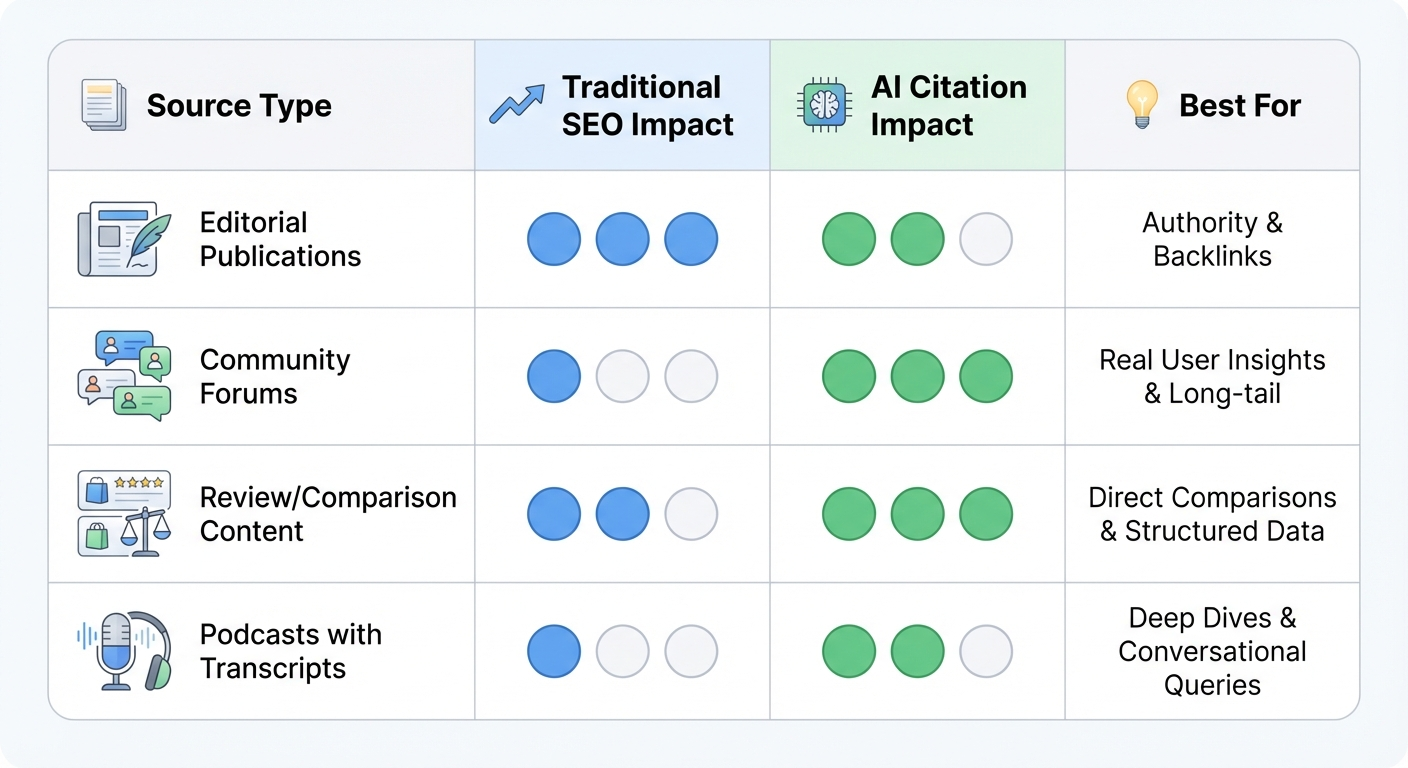
High-Authority Editorial Publications
Mentions on sites with strong domain authority — industry publications, established news outlets, respected trade blogs — carry the most weight. These are the sources that Google and AI models trust most when building entity profiles and generating answers.
Agencies like BrandMentions solve this by placing contextual brand mentions on 140+ high-authority publications that AI models actively reference during training and retrieval cycles.
Community Platforms and Forums
Reddit, Quora, and niche forums have become significant data sources for AI models. ChatGPT and Perplexity frequently cite Reddit threads and community discussions in their responses. A genuine mention in a relevant Reddit thread can influence AI answers directly.
The catch: community mentions must be authentic. AI models can detect patterns that suggest inorganic placement, and platforms like Reddit have aggressive moderation. Focus on earning mentions through genuine participation and products worth discussing.
Review Sites and Comparison Content
Review pages, product comparison articles, and “best of” listicles are among the most-cited content types in AI-generated answers. When someone asks ChatGPT “What’s the best project management tool for remote teams?” the model often pulls from comparison articles that mention multiple brands.
Appearing in these comparison contexts — with accurate, positive descriptions — directly influences whether AI recommends your brand.
Podcasts with Published Transcripts
Audio content doesn’t directly impact SEO. But when a podcast publishes show notes, a transcript, or a blog summary that includes your brand name, that text becomes indexable by search engines and accessible to AI models. A mention in a popular industry podcast with a published transcript reaches both human audiences and algorithmic systems.
How to Build a Brand Mentions Strategy That Strengthens SEO
Earning brand mentions requires a structured approach. Sporadic efforts produce sporadic results. A system that aligns content, digital PR, and community engagement generates consistent mention growth.
Publish Content That Others Want to Reference
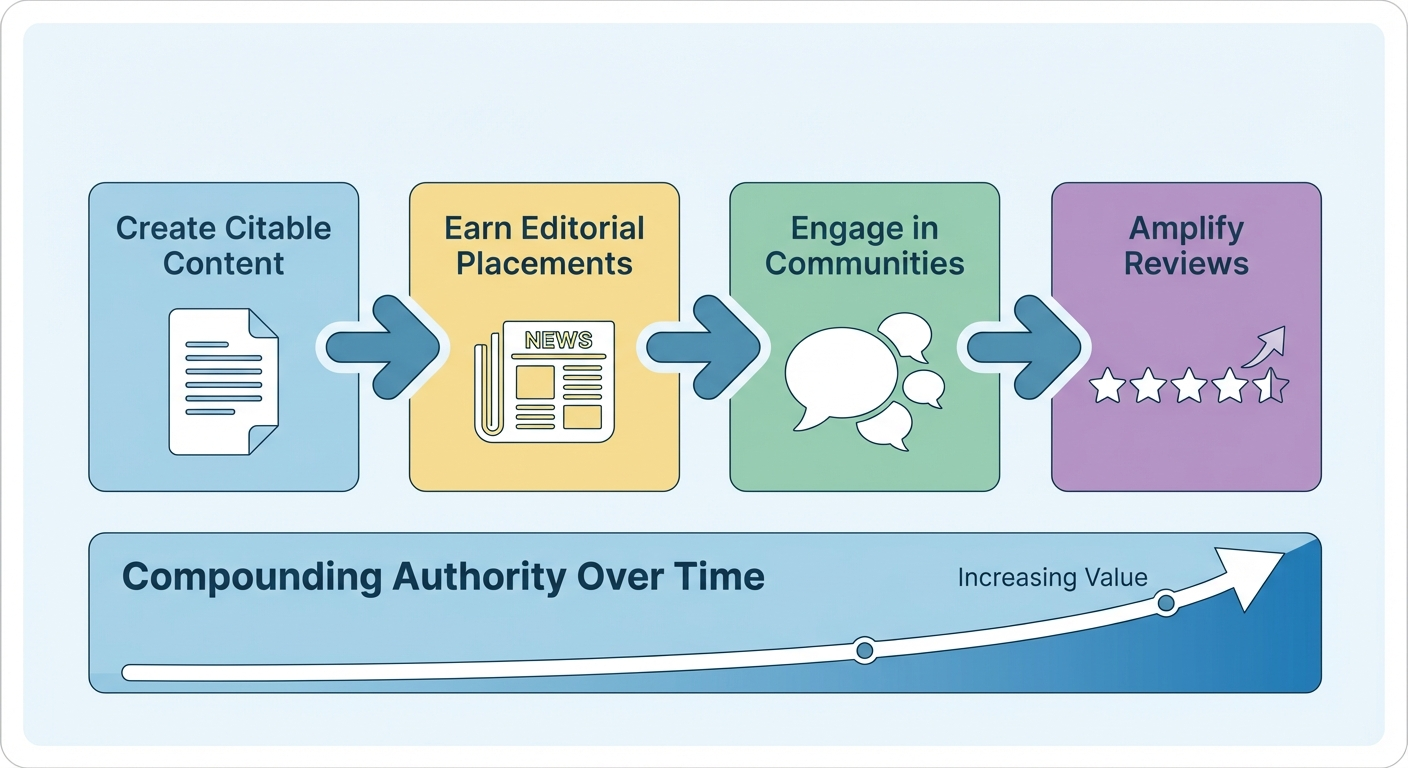
The most effective way to earn brand mentions is to create content that other publishers need to cite. This means producing original research, proprietary data, frameworks, or analysis that doesn’t exist elsewhere.
Content types that consistently earn mentions:
- Original research and data — Industry surveys, benchmark reports, and trend analyses give journalists and bloggers a reason to cite your brand.
- Case studies with specific metrics — A case study showing “312% increase in AI referral traffic over 6 months” gets referenced far more than one claiming vague improvements.
- Definitive guides on emerging topics — If you cover a topic with more depth and accuracy than anyone else, other publications will reference your work.
- Unique tools or calculators — Free tools that solve a real problem generate ongoing mentions as users share them.
Earn Editorial Placements on High-Authority Sites
Guest contributions, expert quotes for journalists, and strategic digital PR campaigns place your brand in front of the right audiences — and in front of AI models that reference those publications.
Practical steps:
- Identify 20–30 publications your target audience reads. Review their contributor guidelines and editorial calendars.
- Pitch specific, timely topics — not generic thought leadership. Editors respond to pitches that fill a gap in their existing coverage.
- Respond to journalist queries through platforms like HARO, Qwoted, or Featured. Quick, quotable responses earn mentions in time-sensitive articles.
- Build ongoing relationships with writers who cover your category. A journalist who trusts your expertise will quote you repeatedly across multiple articles.
Engage in Community Discussions Authentically
Reddit, industry Slack communities, niche forums, and LinkedIn discussions are where real conversations about products and categories happen. AI models increasingly draw from these platforms.
Show up as a genuine participant. Answer questions. Share insights. Offer honest perspectives — even when that means acknowledging competitors’ strengths. Authentic community engagement earns organic mentions that AI platforms weight heavily because they reflect real user sentiment.
Encourage and Amplify Customer Reviews
Reviews on Google, G2, Capterra, Trustpilot, and industry-specific platforms serve as brand mentions with built-in sentiment signals. Each review tells search engines and AI models something about your brand’s reputation.
Build review generation into your customer experience workflow: post-purchase emails, in-app prompts, or direct asks from your customer success team. Then amplify positive reviews by sharing them across your own channels — this drives further discussion and additional mentions.
How to Convert Unlinked Mentions Into Backlinks
Every unlinked brand mention is a potential backlink waiting to be claimed. Since the author or publisher already chose to reference your brand, asking for a hyperlink is a natural, low-friction request.
Find Unlinked Mentions
Use monitoring tools to identify pages that mention your brand without linking to your site. Google Alerts provides free, basic coverage. Dedicated platforms like Ahrefs’ Brand Radar, Semrush’s Brand Monitoring, or Mention offer more comprehensive tracking with sentiment analysis and source filtering.
Tracking brand mentions across AI search platforms adds another layer — you can see not only where you’re mentioned on the open web but whether those mentions translate into AI citations.
Prioritize by Authority and Relevance
Not every unlinked mention is worth pursuing. Focus on:
- Pages with strong domain authority (generally DR/DA 40+)
- Pages that receive meaningful organic traffic
- Content that’s topically relevant to your core category
- Articles from publishers likely to respond positively to outreach
Send Personalized Outreach
Keep your message short, specific, and appreciative. Reference the exact article where the mention appears. Explain that adding a link would help their readers find your site directly. Make it easy for the author to say yes.
A typical outreach message:
“Hi [Name], thank you for mentioning [Brand] in your article on [topic]. We appreciate the reference. Would you consider adding a link to [specific URL] so your readers can find us directly? Either way, thanks for the coverage.”
Response rates vary, but well-targeted outreach to publishers who already mentioned you favorably typically converts at 15–30%.
How to Track and Measure Brand Mention Impact
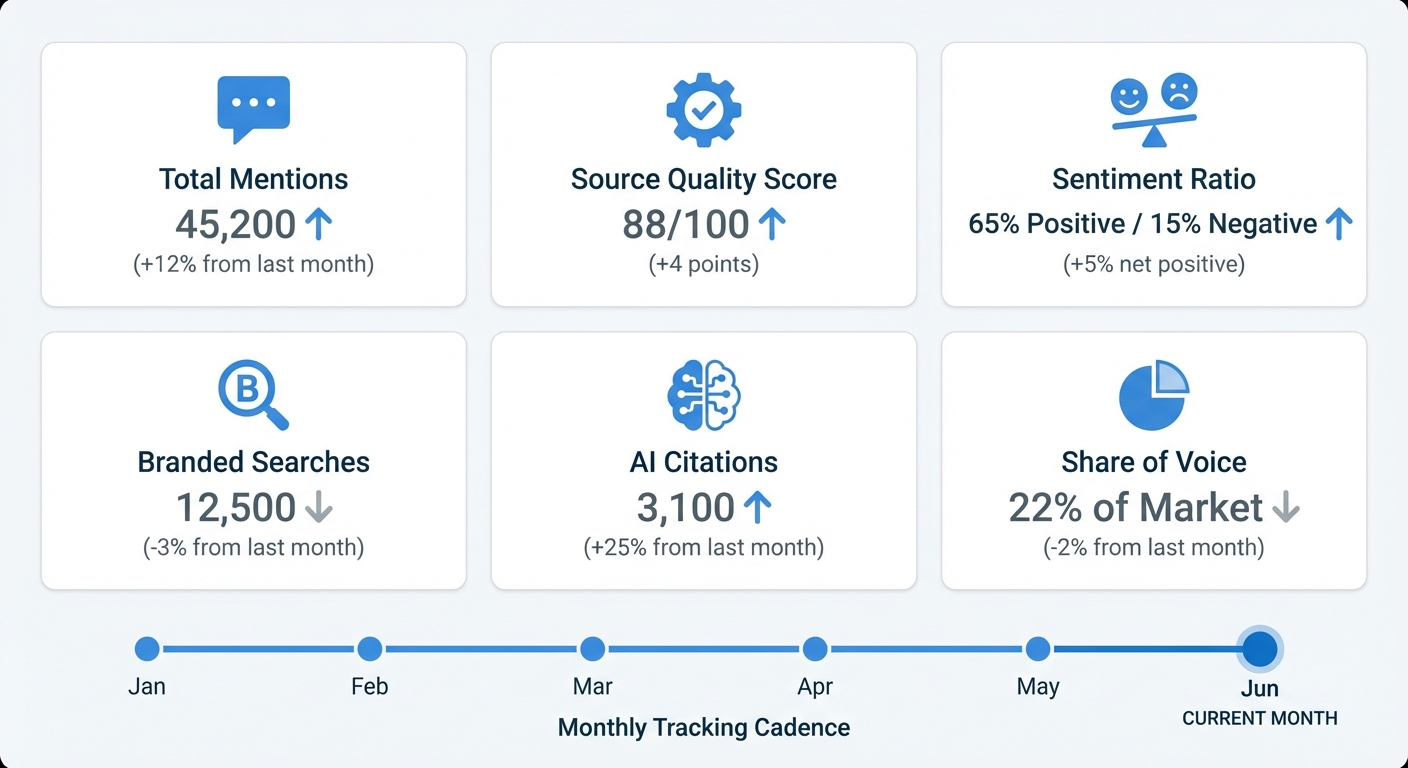
Brand mentions only improve your SEO if you can measure their effect and optimize your approach over time. Track these metrics monthly.
Core Metrics
| Metric | What It Measures | Why It Matters |
|---|---|---|
| Total mention count | Number of unique pages mentioning your brand per month | Establishes a baseline and tracks growth rate |
| Mention source quality | Domain authority and traffic of mentioning sites | Higher-authority mentions carry more SEO and AI weight |
| Sentiment distribution | Positive, neutral, and negative mention ratio | AI models weigh sentiment when deciding whether to recommend your brand |
| Branded search volume | Monthly searches for your brand name | Rising branded searches indicate growing brand authority |
| AI citation frequency | How often AI platforms mention your brand in responses | Direct measure of AI visibility |
| Share of voice | Your mention volume relative to competitors | Shows whether you’re gaining or losing category presence |
Tools for Mention Monitoring
Several platforms help you track mentions across the web and AI surfaces:
- Google Alerts — Free, basic monitoring for your brand name across indexed web pages.
- Ahrefs Brand Radar — Comprehensive mention tracking with authority metrics and competitive comparison.
- Semrush Brand Monitoring — Real-time tracking with sentiment analysis and source quality indicators.
- Mention — Cross-platform monitoring including social media, forums, and news sites.
For AI-specific visibility, AI visibility analytics tools track whether your brand appears in ChatGPT, Perplexity, Gemini, and other AI-generated responses. AI rank trackers for brand mentions provide ongoing monitoring of your citation frequency across these platforms.
Brand Mentions vs. Backlinks: How They Work Together
Brand mentions and backlinks are not competing strategies. They serve different functions within the same authority-building system.
| Factor | Brand Mentions | Backlinks |
|---|---|---|
| Primary function | Build entity recognition, trust, and topical relevance | Pass direct authority (PageRank) to your domain |
| Link required? | No — unlinked references carry value | Yes — a hyperlink is the core mechanism |
| AI visibility impact | High — LLMs use mentions as primary signals | Moderate — LLMs don’t process links the same way Google does |
| Google ranking impact | Indirect — strengthens entity profile and E-E-A-T | Direct — one of Google’s top three ranking factors |
| Measurability | Requires mention tracking and sentiment tools | Easily measured through standard SEO tools |
| Long-term value | Compounds as AI search grows in adoption | Remains foundational but increasingly supplemented by mentions |
The most effective SEO strategies in 2026 use both. Backlinks provide direct ranking authority. Brand mentions build the entity profile and reputation layer that determines whether AI platforms recommend your brand. Together, they create a visibility foundation that performs across every search surface.
Common Mistakes That Weaken Brand Mention Impact
Not every mention strategy works. These patterns reduce or negate the value of your brand mentions.
Chasing Volume Over Relevance
One hundred mentions on irrelevant, low-quality sites carry less weight than ten mentions on authoritative, topically relevant publications. Google’s entity recognition system evaluates context, not just count. If your B2B SaaS brand is mentioned primarily on unrelated lifestyle blogs, the signal is diluted.
Focus on earning mentions in publications your target audience actually reads — and that AI models are likely to reference.
Ignoring Sentiment
A mention isn’t automatically positive. Negative mentions — complaints, bad reviews, critical articles — also feed into your entity profile. AI models register sentiment. If the dominant narrative about your brand is negative, AI platforms may avoid recommending you or present your brand alongside cautionary context.
Monitor sentiment consistently. Address negative mentions directly when possible. For inaccurate claims, reach out to publishers with corrections. For legitimate criticism, respond transparently and use the feedback to improve.
Treating Mentions as a One-Time Campaign
Brand mentions compound over time. A single burst of PR coverage followed by months of silence creates an inconsistent signal. Both Google and AI models reward brands that appear steadily across trusted sources.
Build mention acquisition into your ongoing marketing operations — not as a one-off project.
Neglecting AI-Specific Monitoring
Traditional SEO tools track web mentions and backlinks. But as of 2026, you also need to monitor brand mentions in LLMs to understand whether your web presence translates into AI citations. A brand can have strong web mentions but still be absent from AI-generated answers if the mentions appear on sources that AI retrieval systems don’t prioritize.
Tracking brand mentions in AI search closes this gap and helps you identify which placements actually drive AI visibility.
What’s Changed Since 2024: Brand Mentions in an AI-First Search Environment
The role of brand mentions in SEO has evolved significantly over the past two years. Here’s what’s different in 2026:
- AI Overviews are now standard — Google rolled out AI Overviews broadly in late 2024 and early 2025. By 2026, they appear across a wide range of informational and commercial queries, making off-site brand presence critical.
- ChatGPT web search is a real channel — OpenAI’s web search integration means ChatGPT now retrieves and cites current web content. Brands mentioned on well-indexed, authoritative pages appear in these responses.
- Perplexity and Gemini have matured — Both platforms now handle millions of daily queries and cite specific sources. Brand mentions in Perplexity have become a meaningful traffic and credibility channel for B2B brands.
- Google’s entity graph has deepened — Google’s ability to recognize brands, associate them with categories, and evaluate their reputation through unlinked mentions has grown substantially since 2024.
- Mention quality matters more than ever — AI models now apply stronger source credibility filters. Mentions on low-quality or spammy sites carry negligible weight — and can even signal untrustworthiness.
The net effect: brand mentions for SEO have moved from a “nice to have” supporting tactic to a core component of any serious visibility strategy.
Frequently Asked Questions
Do unlinked brand mentions actually help SEO?
Yes. Google treats unlinked brand references as implied links that contribute to your entity profile and E-E-A-T signals. They help Google understand your brand’s relevance, authority, and trustworthiness within a category — even without a hyperlink. AI models also rely on unlinked mentions to determine which brands to cite in generated answers.
How many brand mentions do you need to impact rankings?
There’s no specific threshold. What matters more than raw count is the quality, relevance, and consistency of your mentions. Ten mentions on high-authority, topically relevant publications will typically outperform hundreds of mentions on low-quality, unrelated sites. Focus on earning mentions from sources your target audience and AI models trust.
Can brand mentions get your brand into ChatGPT or Perplexity responses?
Brand mentions on well-indexed, authoritative publications increase the probability that AI retrieval systems will include your brand in generated responses. ChatGPT and Perplexity use real-time web search to find and cite sources. If your brand appears prominently across trusted, relevant content, it’s more likely to be retrieved and recommended. BrandMentions tracks when major AI models update their training data and times placements to maximize inclusion in each knowledge refresh cycle.
How long does it take for brand mentions to affect SEO?
Brand mentions typically take 3–6 months to produce measurable effects on branded search volume, entity recognition, and AI citation frequency. The timeline depends on your current baseline, the authority of the sources where mentions appear, and the consistency of your mention acquisition efforts. Unlike paid advertising, the effect compounds — each new mention strengthens the signals from previous ones.
What’s the difference between brand mentions and digital PR?
Digital PR is one method of earning brand mentions. It involves securing media coverage, expert quotes, and editorial placements on third-party publications. Brand mentions encompass a broader category that includes digital PR outcomes alongside community discussions, customer reviews, social media references, podcast appearances, and any other online reference to your brand.
Where to Focus Your Brand Mention Strategy Next
Brand mentions for SEO in 2026 sit at the intersection of traditional search authority and AI-driven discoverability. They strengthen your entity profile with Google, build the reputation layer that AI models evaluate when generating answers, and create a compounding visibility asset that grows over time.
Your next step depends on where you are today:
- If you don’t know where your brand is mentioned — Start by setting up mention tracking across both web and AI search. You can’t improve what you can’t measure.
- If you have mentions but no AI visibility — Audit the quality and relevance of your mention sources. Shift your efforts toward high-authority, editorially controlled publications that AI models reference.
- If you’re building from scratch — Focus on creating citable content, earning your first editorial placements, and engaging authentically in communities where your audience participates.
The brands that invest in systematic mention building now will hold a durable advantage as AI search continues to grow. The signals compound. The earlier you start, the stronger the foundation.
See where your brand stands in AI search — get your free AI visibility audit.