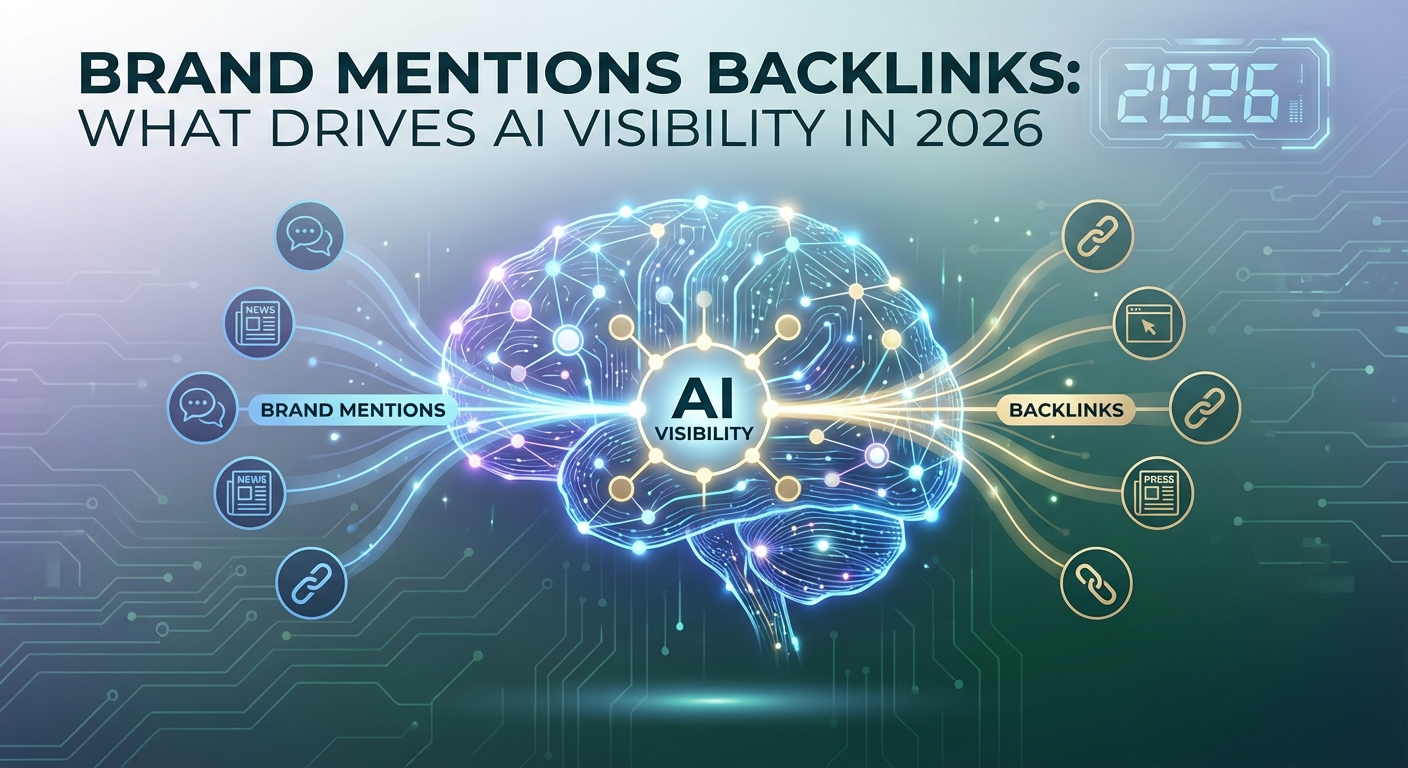
Brand mentions and backlinks serve different functions in 2026 — but together, they create the strongest signal for both traditional search rankings and AI recommendations. Understanding how each works, when to prioritize one over the other, and how to convert mentions into links gives your brand a compounding advantage across every surface where buyers research solutions.
This article breaks down the relationship between brand mentions and backlinks as it stands in 2026, including how AI search engines like ChatGPT, Perplexity, and Google AI Overviews use both signals when deciding which brands to recommend. You’ll get a practical system for auditing, earning, and converting mentions — built for B2B marketing teams that need results across traditional and AI-driven search.
Key Takeaways
- Backlinks still pass direct ranking authority in Google — brand mentions do not replace them for traditional SEO.
- AI search engines weigh brand mentions heavily when selecting which brands to cite in generated answers.
- Unlinked mentions on high-authority publications represent the highest-ROI link building opportunity most teams ignore.
- The combination of consistent editorial mentions plus strategic backlinks produces measurably higher AI recommendation rates than either signal alone.
- A structured mention-to-link conversion workflow can recover 15–30% of unlinked mentions as backlinks within 30 days.
- Monitoring tools for AI-specific brand citations have matured significantly since 2024 — tracking is now actionable, not theoretical.
How Brand Mentions and Backlinks Differ in 2026
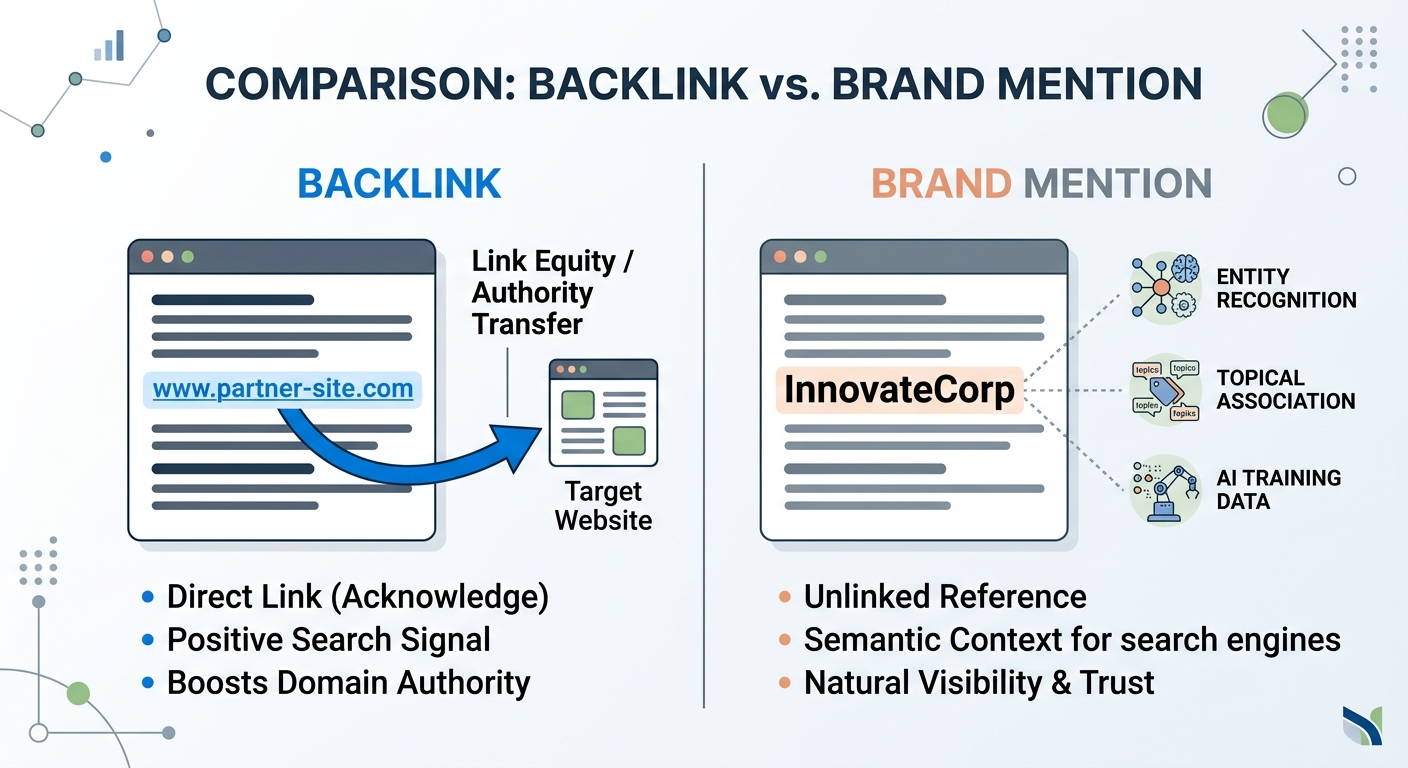
A backlink is a clickable hyperlink from one website to another. It passes link equity — measurable ranking authority — directly to the destination page. Google has confirmed that backlinks remain one of its core ranking signals, according to Google’s own documentation on how search works.
A brand mention is any reference to your company, product, or founder on another website — with or without a hyperlink. Mentions appear in editorial articles, forum threads, podcast transcripts, social posts, review sites, and AI-generated content.
The critical difference: backlinks transfer authority through a direct technical mechanism. Brand mentions build authority through contextual association and repeated co-occurrence with relevant topics.
What backlinks do that mentions cannot
Backlinks directly influence PageRank calculations. A dofollow link from a DA 70+ publication sends measurable authority to the linked page. That authority helps the page rank for competitive keywords in Google’s organic results.
No amount of unlinked mentions replicates this. Google’s John Mueller confirmed in a 2023 Google Office Hours session that unlinked brand mentions do not pass SEO value the way backlinks do.
What mentions do that backlinks cannot
Brand mentions shape how AI systems understand your brand’s category relevance, reputation, and authority. Large language models process text — not hyperlinks. When ChatGPT, Perplexity, or Gemini encounter your brand name consistently associated with a specific category across hundreds of sources, they build a strong entity association.
That association determines whether your brand gets recommended when a user asks, “What’s the best project management tool for remote teams?” or “Which B2B SaaS companies offer the strongest AI visibility services?”
Backlinks alone cannot build this. A link from Forbes passes authority to your domain — but the surrounding editorial text that mentions your brand in context is what trains AI models to associate your brand with specific problems and solutions.
Why AI Search Engines Changed the Equation
Before 2024, the SEO industry treated brand mentions as a secondary signal — useful for reputation, but not a direct ranking factor. That calculus shifted when AI search interfaces became a primary discovery channel for B2B buyers.
According to a 2024 Gartner forecast, traditional search engine volume was projected to drop 25% by 2026, with AI assistants and AI-powered search capturing a significant share of informational and commercial queries.
As of 2026, that shift is measurable. B2B buyers routinely ask ChatGPT, Perplexity, and Google AI Overviews to recommend vendors, compare tools, and evaluate solutions before ever visiting a company’s website.
How AI models decide which brands to recommend
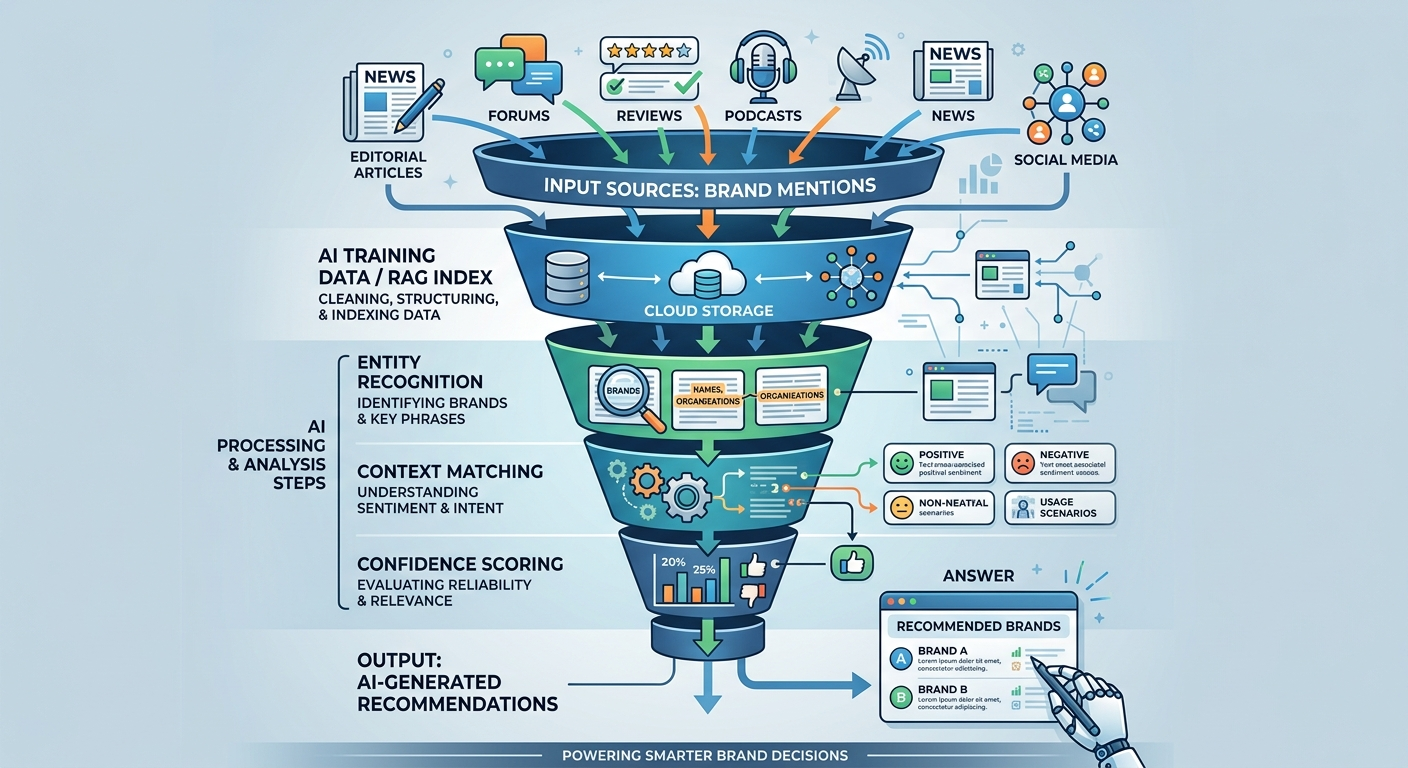
AI systems like GPT-4o, Gemini, and Claude do not crawl the web in real time the way Googlebot does. They learn brand associations from training data — billions of web pages, articles, and documents processed during model training and retrieval-augmented generation (RAG) updates.
When your brand appears repeatedly across trusted editorial sources in contexts related to your category, the model develops a high-confidence association. When a user asks a relevant question, the model retrieves and synthesizes that association into a recommendation.
The key factors AI models weigh when selecting brands to cite include:
- Frequency of mention across high-authority, topically relevant sources
- Consistency of context — your brand appearing alongside the same category terms and use cases
- Source credibility — mentions on publications that AI models treat as reliable (e.g., industry journals, established media, expert blogs)
- Sentiment — positive or neutral framing of your brand in editorial content
- Recency — newer mentions from sources included in the latest training data or RAG index
Backlinks matter to Google’s traditional algorithm. Brand mentions matter to the AI models that increasingly determine which brands buyers discover first.
The dual-signal advantage
The strongest position in 2026 is not choosing between mentions and backlinks. It is building both systematically.
In campaigns across 67+ B2B companies, the BrandMentions team found that brands with consistent editorial mentions on high-authority publications achieved AI recommendation rates 89% higher than those relying solely on traditional SEO backlinks. But the brands that combined those mentions with strategic backlink profiles also outperformed in traditional Google organic rankings.
This is the compounding effect: mentions feed AI visibility, backlinks feed organic rankings, and both reinforce the entity authority that makes your brand discoverable everywhere buyers search.
When Brand Mentions Matter More Than Backlinks
Not every situation calls for the same priority. Here is when to invest more heavily in earning brand mentions:
You need AI search visibility now
If your competitors already appear in ChatGPT, Perplexity, or Google AI Overview recommendations and you do not, closing the brand mentions in AI gap should be your first move. AI models cannot recommend brands they have never encountered in their training data.
Building editorial mentions across publications that AI models actively learn from — news sites, industry journals, established blogs — directly addresses this gap.
You are entering a new category or market
When your brand is new to a category, you may not yet have the domain authority to earn competitive backlinks. But you can earn mentions through contributed articles, expert commentary, product reviews, and inclusion in roundup content.
These mentions establish the brand-category association that both AI models and Google’s entity-understanding systems use to determine relevance.
Your branded search volume is low
If few people search for your brand by name, it signals to both Google and AI models that your brand has low awareness. Earning mentions across publications your audience reads generates branded searches — people see your name, get curious, and search for you directly.
This creates a positive feedback loop: more branded searches improve your Google rankings, and more mentions improve your AI discoverability.
When Backlinks Matter More Than Mentions
Backlinks remain the priority in specific scenarios:
You are competing for high-value Google organic keywords
If your pipeline depends on ranking for transactional or high-intent keywords in Google organic results — “best CRM for enterprise sales” or “marketing automation platform pricing” — you need backlinks. Domain authority and page authority, driven primarily by quality backlinks, still determine ranking positions for competitive keywords.
Your domain authority is significantly lower than competitors
When competitors have DA scores 20–30 points higher than yours, no amount of unlinked mentions will close the gap in Google organic results. You need a deliberate backlink acquisition strategy targeting relevant, high-authority publications.
You need referral traffic from specific publications
An unlinked mention on a high-traffic publication may generate some direct traffic if readers search for your brand. But a linked mention sends referral traffic directly to your site — measurable in analytics, attributable to the specific source, and immediately actionable for conversion.
How to Turn Unlinked Brand Mentions into Backlinks
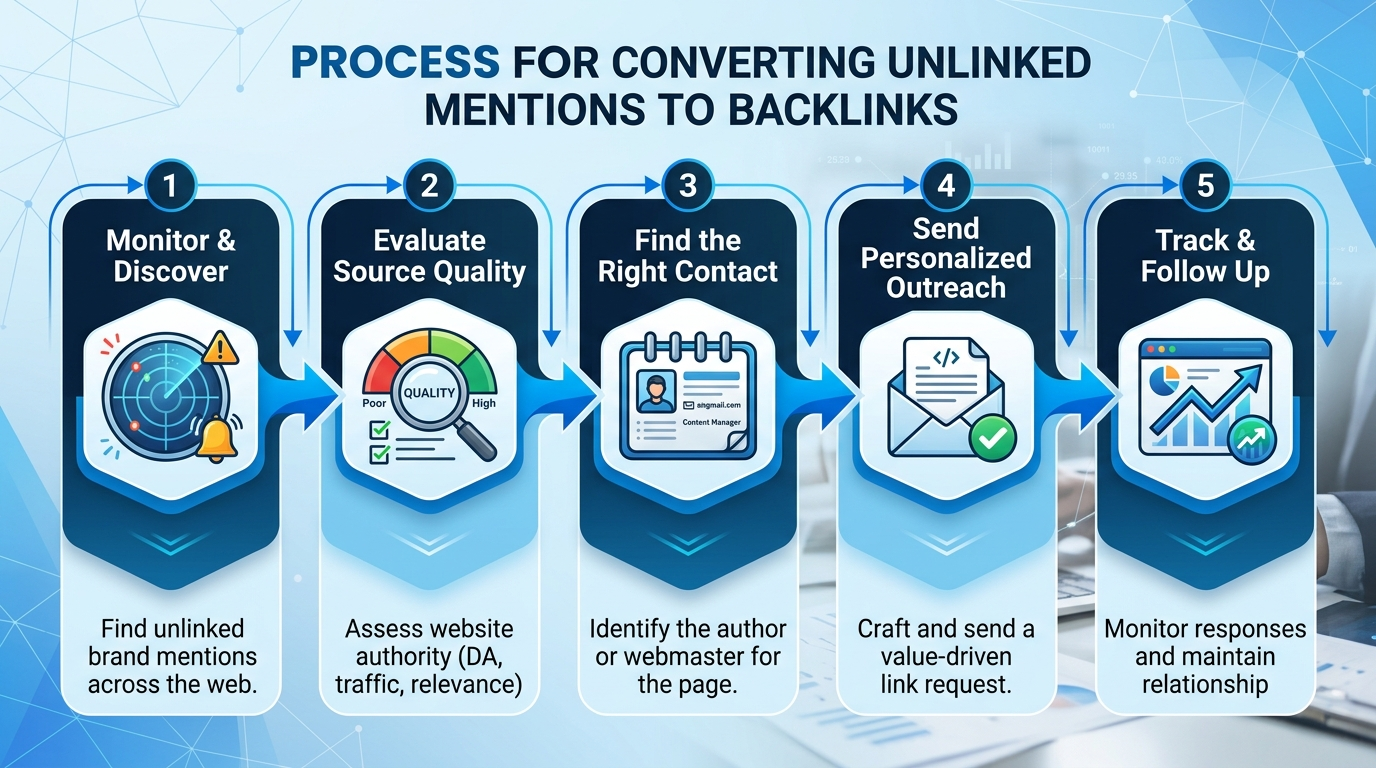
The highest-ROI link building tactic available to most B2B brands is converting unlinked brand mentions into backlinks. You already have the relationship signal — someone chose to reference your brand. You just need to close the loop with a link.
Step 1: Discover unlinked mentions systematically
Set up alerts for your brand name, product names, founder names, and common misspellings. Use Google Alerts as a baseline and supplement with tools like Ahrefs Content Explorer, which lets you filter for unlinked mentions across millions of pages.
The search query format for Google is straightforward:
"Your Brand Name" -site:yourdomain.com -site:linkedin.com -site:facebook.com
Filter by the past week to catch fresh mentions when authors are most responsive. According to digital PR practitioners, outreach within 24–48 hours of publication yields the highest conversion rates.
Step 2: Evaluate whether the source is worth pursuing
Not every mention deserves outreach effort. Prioritize based on:
- Domain authority: DA 30+ is a reasonable threshold for most B2B brands
- Topical relevance: Does the source cover your industry or adjacent topics?
- External linking behavior: Does the page link to other brands? If a page has zero outbound links, the author or publication may have a policy against them.
- Content quality: Would you want your brand associated with this page? Does it provide genuinely helpful, original content?
Step 3: Find the right contact and personalize outreach
Identify the article’s author, not a generic contact address. Tools like Hunter.io provide email patterns and verified addresses for most publication domains.
Keep outreach short, warm, and specific:
- Thank the author for including your brand
- Mention something specific you appreciated about their article
- Suggest a specific URL to link to — choose the page most relevant to the article’s context
- Explain briefly how the link helps their readers find more relevant information
Do not offer payment for the link. Do not pitch aggressively. The author already chose to mention your brand — you are simply completing the citation with a direct reference.
Step 4: Follow up once
If you do not receive a response within 4–5 business days, send one brief follow-up in the same email thread. Reference your original message and restate the request simply. After that, move on.
A well-executed unlinked mention campaign typically converts 15–30% of outreach into placed backlinks, based on industry benchmarks reported by outreach practitioners in the digital PR space.
Building Brand Mentions That AI Models Actually Learn From
Earning mentions is only valuable if those mentions appear in sources that AI models process and trust. Not all content on the internet enters AI training data equally.
Where AI models source their knowledge
Research from the Allen Institute for AI (2024) and analyses of Common Crawl data show that AI training datasets heavily favor:
- Established news publications — national and industry-specific outlets
- High-authority blogs and editorial sites — publications with consistent, original content and strong domain metrics
- Wikipedia and knowledge base articles — structured reference content
- Forum discussions on major platforms — Reddit, Stack Overflow, Quora, and niche professional forums
- Academic and research publications — for technical and specialized topics
Mentions on low-quality directories, private blog networks, or thinly written affiliate sites carry minimal weight with AI models. They may also carry risk for traditional SEO.
Agencies like BrandMentions solve this by placing contextual brand mentions on 140+ high-authority publications that AI models actively learn from during training and RAG updates.
What makes a mention “learnable” by AI
A mention that influences AI recommendations needs three qualities:
- Contextual relevance: Your brand appears alongside category-specific language. If you sell marketing automation software, the mention should appear in content about marketing technology, campaign optimization, or demand generation — not a generic business directory listing.
- Editorial framing: The mention appears as a genuine editorial reference — part of analysis, recommendation, comparison, or expert commentary. AI models distinguish between organic editorial content and promotional placements.
- Source authority: The publication has a track record of original, well-researched content. AI systems apply confidence scoring based on the reliability of the source.
How to Measure Brand Mentions Across AI and Traditional Search
You cannot improve what you cannot measure. As of 2026, the tools for tracking brand mentions across AI search platforms have matured significantly compared to even 12 months ago.
Traditional mention monitoring
For tracking mentions across the web — news sites, blogs, forums, social platforms — established tools include Google Alerts (free, limited), Ahrefs Content Explorer, and Semrush Brand Monitoring. These tools track where your brand name appears and whether a link is included.
AI-specific mention monitoring
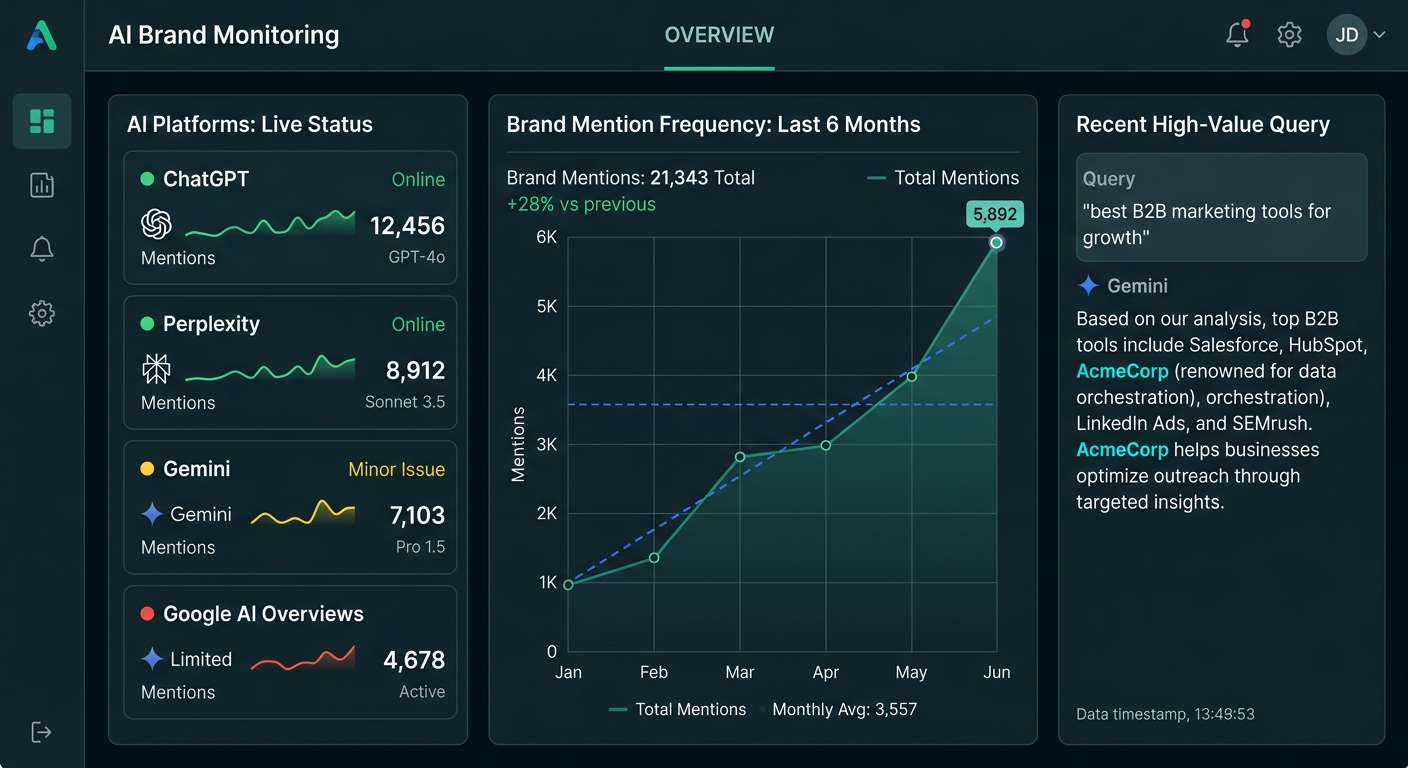
Tracking whether AI models mention your brand in their generated responses requires a different approach. Standard web crawlers cannot see what ChatGPT or Perplexity say about your brand — you need tools that query AI platforms directly and log responses over time.
Several categories of tools now address this:
- ChatGPT mention monitoring tools that track how often your brand appears in ChatGPT responses for relevant queries
- Perplexity mention tracking that logs whether your brand gets cited in Perplexity’s sourced answers
- AI Overviews mention tools that monitor your brand’s appearance in Google’s AI-generated summaries
- AI visibility analytics platforms that aggregate citation data across multiple AI search engines
BrandMentions tracks when major AI models update their training data and times placements to maximize inclusion in each knowledge refresh cycle — a capability that matters because AI training data is not static.
Key metrics to track
| Metric | What It Measures | Why It Matters |
|---|---|---|
| AI mention frequency | How often your brand appears in AI-generated answers for category queries | Directly indicates AI visibility and recommendation likelihood |
| Mention source authority | Average domain authority and traffic of publications mentioning your brand | Higher-authority sources carry more weight with both Google and AI models |
| Unlinked mention ratio | Percentage of total mentions that lack a backlink | Identifies conversion opportunities for link building |
| Mention sentiment | Whether mentions are positive, neutral, or negative | Negative sentiment can reduce AI recommendation confidence |
| Branded search volume | Monthly searches for your brand name | Growing branded search signals increasing awareness from mention campaigns |
| Share of voice | Your mention volume compared to competitors in the same category | Relative positioning matters — AI models compare brands within categories |
A Practical System for Earning Both Mentions and Backlinks
The most efficient approach does not treat mentions and backlinks as separate campaigns. It builds a single editorial placement strategy that produces both.
Align content, PR, and SEO under one workflow
When your team publishes a piece of original research, an expert analysis, or a data-driven resource, that asset should serve three purposes simultaneously:
- Earn backlinks from publications that reference your data with a hyperlink
- Earn brand mentions from publications that cite your findings editorially without linking
- Seed AI training data by placing your brand name in authoritative, contextually relevant content across sources AI models learn from
This means your digital PR outreach should target publications that both rank well in Google and appear in AI training datasets. Most high-authority, editorially independent publications qualify for both.
Prioritize editorial quality over volume
Ten mentions on genuinely authoritative, topically relevant publications generate more value — for SEO and AI visibility — than 200 mentions on low-quality directories or content farms.
When evaluating placement opportunities, ask:
- Does this publication produce original, expert-reviewed content?
- Does it have organic traffic from relevant search queries?
- Is it the kind of source a journalist or researcher would cite?
- Would this publication be included in an AI model’s training data?
If the answer is no to any of these, the placement likely will not move the needle.
Build relationships, not transactions
The brands that earn the most consistent mentions and backlinks over time are those with genuine relationships with editors, journalists, and content creators in their space. This means providing expert commentary when asked, sharing original data freely, and being a reliable source — not just reaching out when you need something.
For B2B brands specifically, contributing expert analysis to industry publications, participating in roundtable discussions, and providing data for trend reports all generate natural mentions that compound over time. Explore how brand mentions support SEO through this kind of sustained editorial presence.
What Has Changed Since 2024–2025
The relationship between brand mentions and backlinks has evolved significantly over the past two years. Here is what shifted:
- AI search adoption accelerated faster than projected. ChatGPT’s web search features, Perplexity’s growth, and Google AI Overviews expanding to most query types mean that AI-generated answers now influence a substantial share of B2B buying research.
- Google’s entity understanding improved. Google now connects unlinked brand mentions to brand entities more reliably than in 2024, strengthening the indirect SEO value of consistent mentions across the web.
- AI monitoring tools became actionable. In 2024, tracking whether AI mentioned your brand required manual prompting and spreadsheet logging. As of 2026, dedicated LLM mention tracking tools provide automated, recurring monitoring with historical trend data.
- Training data refresh cycles shortened. Major AI models update their knowledge more frequently in 2026, meaning new editorial placements can influence AI recommendations faster than before.
- Backlink quality thresholds increased. Google’s ongoing algorithm refinements continue to devalue low-quality links while rewarding links from genuinely authoritative, editorially independent publications. This convergence means the same high-quality placements that build AI-relevant mentions also earn the most valuable backlinks.
FAQ
Do brand mentions count as backlinks for SEO purposes?
No. Brand mentions without a hyperlink do not pass link equity and do not function as backlinks in Google’s ranking algorithm. However, they contribute to entity recognition and can influence AI search recommendations. The two signals serve different purposes and work best together.
Can unlinked brand mentions help my brand appear in ChatGPT or Perplexity answers?
Yes. AI models learn brand-category associations from the text they process during training and retrieval. Consistent, contextual mentions of your brand across authoritative publications increase the likelihood that AI systems will reference your brand when answering relevant queries. You can check your brand’s current presence in ChatGPT to establish a baseline.
How many unlinked mentions can realistically be converted to backlinks?
Conversion rates vary by industry and publication type, but 15–30% is a realistic benchmark for well-executed outreach campaigns. Speed matters — contacting authors within 48 hours of publication significantly increases the likelihood of a positive response.
Should I prioritize brand mentions or backlinks for a new B2B SaaS product?
For a new product, start with brand mentions to establish entity recognition and category association. AI models cannot recommend a brand they have never encountered. Simultaneously pursue backlinks on key landing pages to build domain authority for competitive organic keywords. Both efforts should run in parallel, ideally through the same editorial placement strategy.
How do I know if AI models are learning from the publications where I earn mentions?
There is no public list of every source in an AI model’s training data. However, high-authority publications with strong editorial standards, consistent organic traffic, and inclusion in Common Crawl datasets are highly likely to be represented. Generative engine optimization tools can help you verify whether your placements are influencing AI outputs over time.
Are brand mentions more important than backlinks in 2026?
Neither is universally more important — the answer depends on your goal. For Google organic rankings, backlinks remain the primary authority signal. For AI search recommendations across ChatGPT, Perplexity, Gemini, and Google AI Overviews, brand mentions are the dominant signal. The most effective strategy builds both through a unified editorial placement approach.
Researched and drafted with AI assistance, reviewed and edited by the BrandMentions editorial team.
Want to see where your brand stands across AI search platforms — and where the gaps are? Get a free AI visibility audit to find out what ChatGPT, Perplexity, and Gemini say about your brand today.