
AI visibility for cybersecurity is no longer about ranking a page, it is about whether AI systems can find, understand, and trust your brand enough to mention it. AI visibility for cybersecurity is how likely an AI system is to name, cite, and accurately describe your security brand when a buyer asks it a question. It sits at the discovery layer of AI search, where ChatGPT, Perplexity, and Google AI Overviews answer buyers before they ever reach your site. This matters more here than in most categories, because security buyers evaluate risk and trust, and a wrong or missing answer costs you the shortlist. This guide explains what the term means, why it matters for security vendors, and which signals decide whether an engine mentions you.
What AI Visibility Means in Cybersecurity
AI visibility for cybersecurity is the likelihood that an AI system mentions, cites, summarizes, or accurately represents your security brand, product, or content when it generates an answer. It is about how you show up inside a generated response, not about monitoring AI use inside your own network.
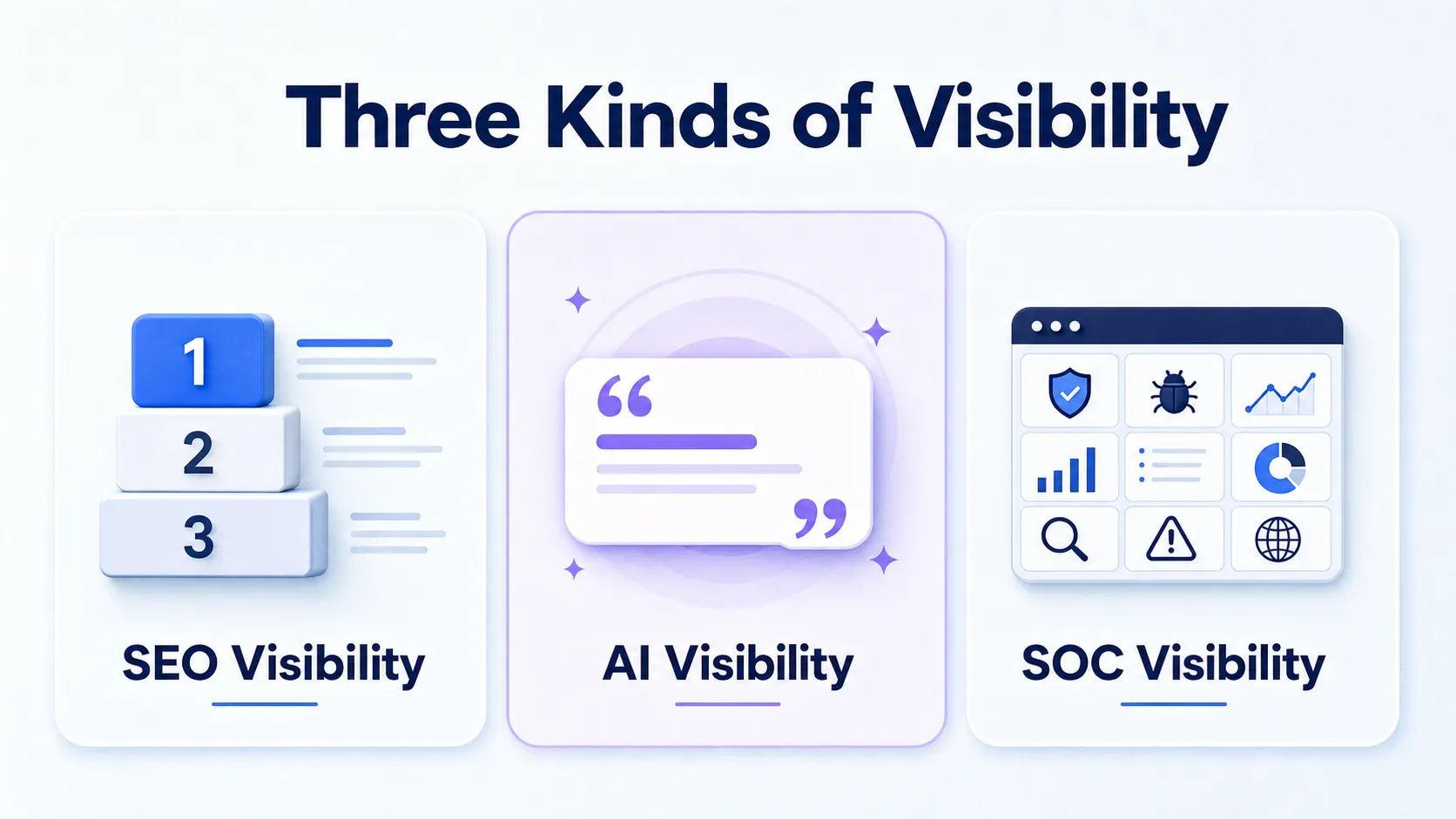
The term trips people up because three different ideas share the word visibility, and only one is the subject here.
Traditional SEO is built to win rankings and clicks. You optimize a page so it sits high on a results page and earns the visit. AI visibility is built to win mentions, citations, and accurate inclusion inside a generated answer, where there may be no click at all. The two use overlapping signals, but the goal is different, which is why treating them as the same thing quietly costs you (more on that below).
Security visibility in the SOC or IT sense is a separate world again. That kind of visibility tracks systems, traffic, shadow AI usage, and threats inside your environment. AI visibility tracks how outside AI systems perceive and describe your brand to buyers. Same word, opposite direction.
Here is the gap in one line. A security vendor can rank well in Google for its category and still be missing, or wrongly described, in ChatGPT, Perplexity, and Google AI Overviews. Strong SEO does not carry over automatically, because answer engines weigh corroboration and trust differently than a classic ranking algorithm does.
| Dimension | SEO visibility | AI visibility |
|---|---|---|
| Goal | Rank a page, earn the click | Earn a mention or citation in the answer |
| Unit that wins | A URL on a results page | Your brand named inside generated text |
| Main lever | On-page and backlinks | Entity consistency and source corroboration |
| Where the reader lands | Your site | Often nowhere, the answer is the destination |
Why AI Visibility Matters for Cybersecurity Brands
AI visibility matters because security buyers now use AI assistants to shortlist, compare, and validate vendors before they ever open your website. If an engine does not name you, you are not in the room where the shortlist gets built.
Watch how a security buyer actually researches. They ask an assistant which tools handle a given threat, cross-check the answer against a review site, then verify claims across a couple of independent sources before requesting a demo. That habit of checking multiple sources is stronger in security than almost anywhere, because the buyer is evaluating risk. Your presence, or absence, in those AI answers shapes the entire early evaluation.
Being visible decides whether AI treats you as a viable option, a category leader, or an afterthought. When an assistant answers “best tools for X,” the brands it names inherit implied credibility. The brands it skips have to fight back into a conversation that already happened.
There is a pipeline cost to silence. When AI systems do not mention your brand, competitors and third-party review sites control more of the narrative about your category. The story about you gets told by pages you do not own.
Cybersecurity is a YMYL category, meaning “your money or your life,” the kind of high-stakes topic where accuracy carries real consequences. AI systems lean harder on trusted, corroborated sources for these topics, which raises the bar for getting named. It also raises the cost of being named wrong. A misstated compliance certification, a wrong integration, or an outdated feature claim damages trust faster in security than in most categories, because the buyer is specifically screening for reliability.
How AI Systems Decide What to Cite
AI systems tend to name and cite sources that are repeatedly corroborated across reputable domains. A single strong page rarely wins on its own. The engine is looking for agreement, the same claims about your brand showing up in more than one credible place.
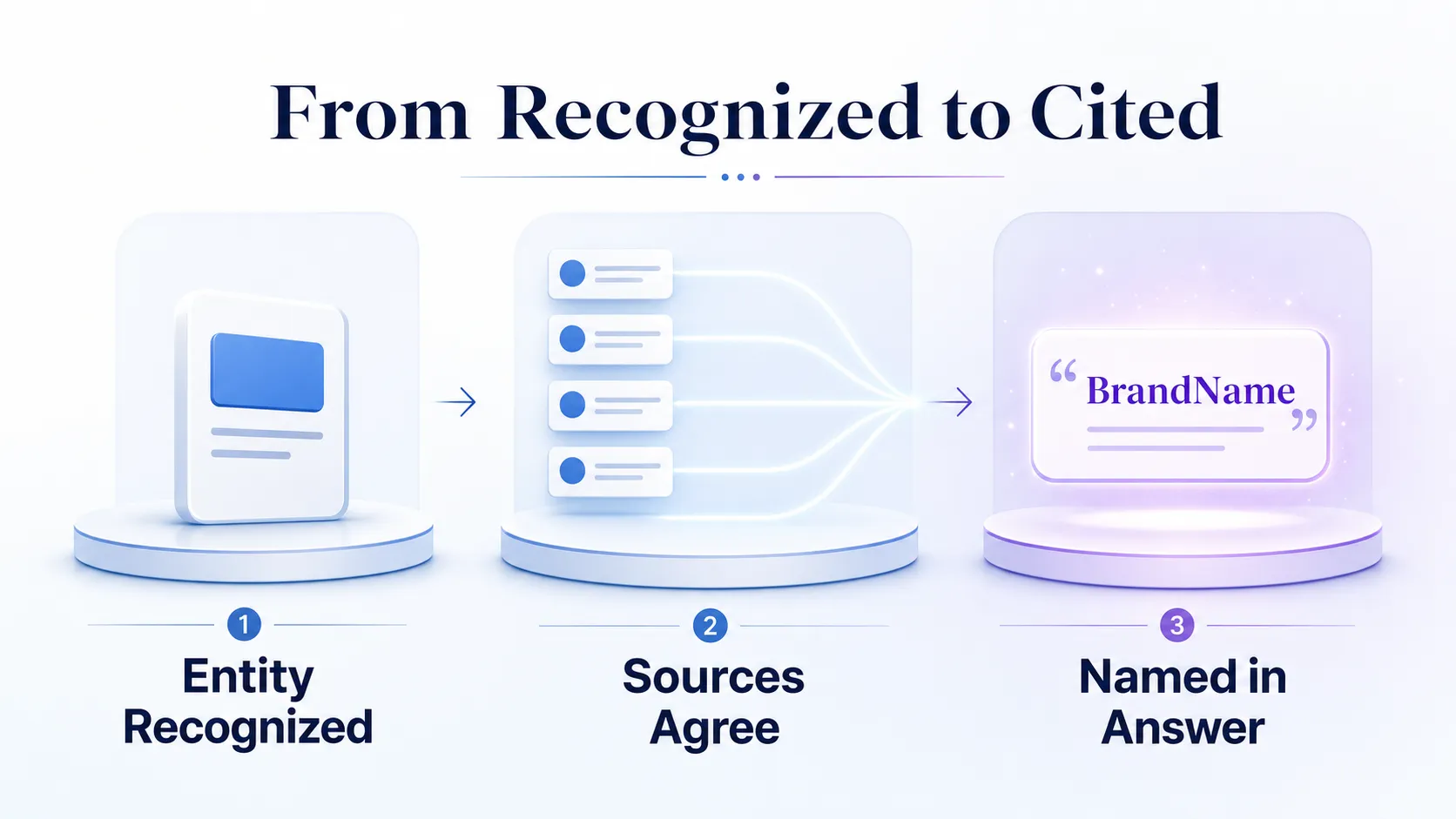
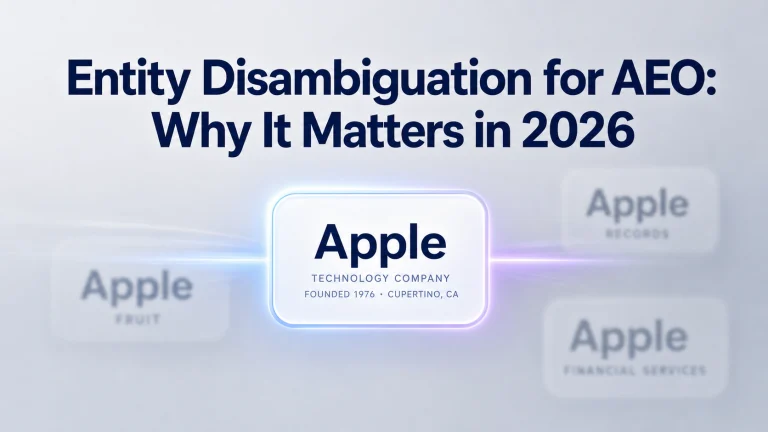
Entity consistency is the quiet foundation. Your brand name, product names, category, and one-line description need to match across your own site and every third-party page that describes you. When your homepage calls you a “cloud detection platform” and your review listing calls you a “threat intelligence tool,” the engine sees a fuzzier picture and hesitates to name you cleanly. If entity clarity is new to you, our guide on building entity authority for search covers how to align those signals.
Topical authority sounds abstract, so put it plainly. The more clearly your brand explains its use case, category, and outcomes in language a person would actually use, the easier it is for an AI system to understand and place you. Dense feature specs are hard to parse. A clear sentence about the problem you solve is easy to lift into an answer.
Third-party mentions carry real weight. Editorial coverage, community discussion, analyst notes, and independent reviews make your brand reference-worthy, because they are the corroboration the engine is checking for. Your own claims describe you. Other people’s claims validate you.
Recency and formatting act as parsing advantages. Structured, clearly headed, easy-to-extract content is simpler for an answer engine to reuse than a wall of prose. For a deeper look at what pulls a page into a generated answer, see how AI crawlers actually pick sources.
One distinction resets a common mistake. Model training and live answer generation are not the same thing. A brand can appear in the training data and still not be surfaced in a live answer, because retrieval and corroboration at query time decide what actually gets named.
The Signals That Shape AI Visibility
AI visibility is a system of signals, not one magic input. Six signal families do most of the work for security brands, and a weakness in any one of them can keep you out of answers even when the others are strong.
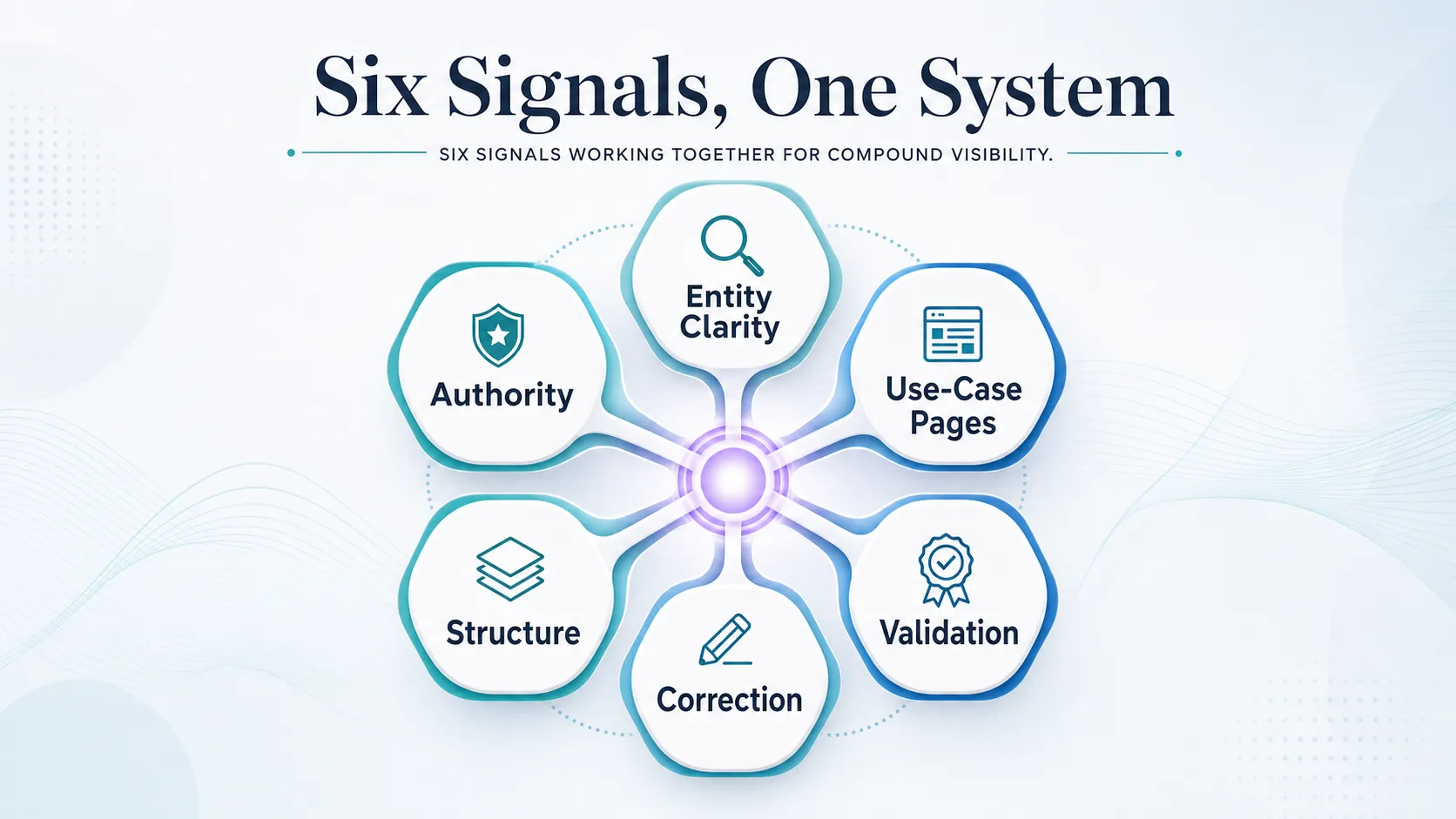
Entity Clarity and Brand Consistency
Entity clarity means one brand name, one category, and one description that hold steady across your homepage, product pages, docs, social profiles, and review listings. Inconsistency splits your identity in the model’s view and weakens every other signal.
Authority From Credible Sources
Authority signals come from publications, analyst coverage, trade press, communities, and trusted partners that AI systems already treat as reliable. In a YMYL category, this credible-source weighting is heavier, so a mention in a respected security outlet does more for you than volume alone.
Use-Case Pages in Plain Language
Product and solution pages should explain what problem you solve and for whom, not just list features. Here is a pattern worth naming. Security teams love dense capability language, and that same density underperforms clear use-case language in AI answers, because the engine can lift a plain problem-and-outcome sentence far more easily than a spec sheet.
Structure and Extractable Formatting
Structured data, clean headings, and short extractable passages make your pages easier for an AI system to parse and reuse. A well-organized page is a page the engine can quote.
Third-Party Validation
Reviews, testimonials, and independent mentions reinforce your credibility from outside. They are the corroboration layer that turns “you say so” into “several trusted sources say so.”
Monitoring and Correction
Visibility work does not end at getting mentioned. When AI outputs misstate your features, pricing, category, or security claims, you correct the source signals feeding those errors. Our brand correction playbook for AI errors walks through how to fix a wrong answer at its root.
See where AI answers put your brand
Twenty minutes with a senior strategist: where the major engines point buyers in your category, who gets named instead of you, and a straight read on what a programme would change.
Book a strategy callThe Different Forms AI Visibility Can Take
AI visibility is not one thing, and a brand can be strong in one form while weak in another. Recognizing the different forms keeps you from celebrating a mention that is actually a problem.
Brand-mention visibility is the plainest form. Your brand gets named in an answer even when no citation or link is shown. Citation visibility goes further, where your brand or a specific source page is referenced or linked in the response. Accuracy visibility asks a different question entirely: when you are named, is the product, category, and capability described correctly? Comparison visibility is whether you appear in “best,” “top,” or side-by-side evaluation answers. Category prominence is whether the engine frames you as a leader, a specialist, or a niche option.
| Form of visibility | What it measures | The failure mode |
|---|---|---|
| Brand mention | Named at all | Named but never cited |
| Citation | Source referenced or linked | Cited on a weak page |
| Accuracy | Described correctly | Visible but wrong |
| Comparison | Appears in “best of” answers | Left out of shortlists |
| Category prominence | Framed as leader or niche | Framed as an afterthought |
The uncomfortable truth is that a brand can be visible but inaccurate, or accurate but under-cited, and both are real problems. A security vendor described as “popular” while shown with an outdated feature set has visibility that actively works against it. More mentions do not mean better visibility if the wording is wrong. Volume without accuracy is a liability in a category where buyers are screening for trust.
Common Mistakes and the Real Takeaway
Most AI visibility mistakes come from applying old mental models to a new mechanism. Four assumptions cause the most damage for security marketing teams.
Mistake 1: Treating AI Visibility as SEO With a New Label
AI visibility is not just SEO renamed. SEO wins rankings, while AI visibility wins mentions and accurate inclusion, and the two weigh corroboration and entity consistency very differently. Running only your old SEO playbook leaves the citation-specific signals untouched. The difference between the two is worth understanding in full, which is why AI visibility versus SEO metrics is worth a read before you set targets.
Mistake 2: Assuming More Content Means More Citations
Publishing more does not guarantee more citations. Volume without corroboration and trust just produces more pages the engine ignores. A handful of clear, well-validated pages beats a large library of dense, unreferenced ones.
Mistake 3: Confusing Model Training With Live Visibility
Being in the training data is not the same as being surfaced in a live answer. Retrieval and corroboration at query time decide what gets named, so a brand that “should be known” can still go unmentioned. Optimize for the live answer, not the archive.
Mistake 4: Focusing on Keywords Instead of Entities and Evidence
A keyword-only focus misses the signals that actually drive citations: entity consistency, source corroboration, and trust. Chasing phrases while your entity picture stays fuzzy is effort spent on the wrong layer. And ignoring third-party validation compounds it, leaving security brands underrepresented in answers no matter how much they publish.
| Myth | Reality |
|---|---|
| AI visibility is SEO renamed | It wins mentions, not rankings, on different signals |
| More content earns more citations | Corroboration and trust earn citations |
| Training data equals visibility | Live retrieval decides what gets named |
| Keywords drive AI mentions | Entities and evidence drive them |
The strategic takeaway is straightforward. To earn AI visibility, your cybersecurity brand needs to be understandable, reference-worthy, and consistent across the sources AI systems rely on. That is a system of entity clarity, credible corroboration, and accuracy maintenance, not a single tactic you switch on.
Frequently Asked Questions
What is AI visibility in cybersecurity?
AI visibility in cybersecurity is how likely an AI system is to mention, cite, and accurately describe your security brand when a buyer asks a question. It measures your presence inside generated answers from tools like ChatGPT and Perplexity, not the monitoring of AI use inside your own systems.
How is AI visibility different from SEO?
SEO is built to rank a page and earn a click, while AI visibility is built to earn a mention or citation inside a generated answer where there may be no click at all. They share some signals, but AI visibility leans much harder on entity consistency and corroboration across trusted sources.
Why does AI visibility matter for cybersecurity vendors?
It matters because security buyers now use AI assistants to shortlist and validate vendors before visiting any website. If an engine does not name you, competitors and review sites shape your category narrative, and in a trust-sensitive category that absence directly costs you early-stage consideration.
What signals influence AI visibility in AI search?
Six signal families do most of the work: entity clarity and brand consistency, authority from credible sources, plain-language use-case pages, extractable structure, third-party validation, and ongoing correction of inaccurate outputs. No single signal wins, and a gap in one can keep you out of answers even when the rest are strong.
How do you improve AI visibility for a cybersecurity brand?
Start by aligning your brand name, category, and description everywhere they appear, then earn corroboration from credible security sources and rewrite feature-heavy pages into clear use-case language. From there, monitor how AI engines describe you and correct the source signals behind any wrong or outdated claims.
AI search is moving from a place buyers visit to the place where buyer decisions actually form, and the brands that get named early will compound that advantage as more of the shortlist happens inside the answer. The security vendors who treat entity clarity and corroboration as strategy now will be the ones AI systems reach for by default later. Start by asking ChatGPT and Perplexity your top buying question and reading how, or whether, your brand is described. Learn how to track your brand mentions in AI search results and turn that first look into a repeatable check.