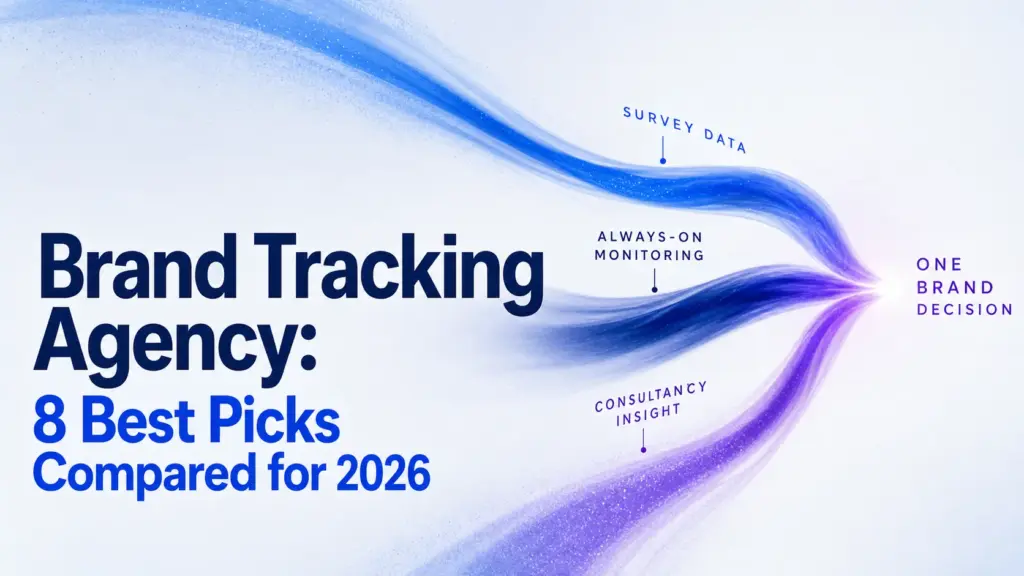

Choosing a brand tracking agency is really a decision about how you want to make decisions: by survey data, always-on monitoring, or a consultancy that turns numbers into action. The term covers three different operating models, and the wrong pick leaves you paying for dashboards you never open.
This is a shortlist of eight brand tracking providers, plus the criteria to judge them on: methodology, cadence, reporting depth, geographic reach, and pricing model. Some entries are true research agencies, others are software platforms or monitoring-led services that solve an adjacent need.
Read the criteria first, then map each provider to your own decision cadence.
Why Buyers Compare Brand Tracking Agencies
A brand tracking agency measures how your brand is perceived over time, then feeds that back into planning, positioning, and budget decisions. The word “agency” hides three separate models, and most buyer confusion starts there.
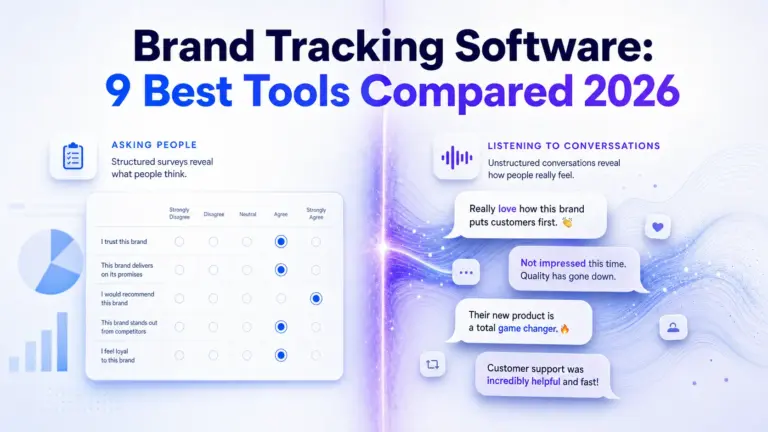
The first model is survey-led research: a provider fields a panel of real consumers on a set cadence and reports awareness, consideration, preference, and sentiment as a defensible trendline. The second is always-on monitoring: software that watches mentions, share of voice, and sentiment shifts across the open web and social in near real time.
The third is consultancy-led insight: a partner who runs the tracking and then sits with your team to explain why the numbers moved and what to do next.
Most buyers arrive wanting one place to see brand health, awareness, sentiment, share of voice across channels, and competitor position. No single provider is strongest at all four.
Survey platforms give you statistically clean perception data but say little about live conversation. Monitoring tools show you the conversation but can’t tell you what a consumer who never posts online actually thinks.
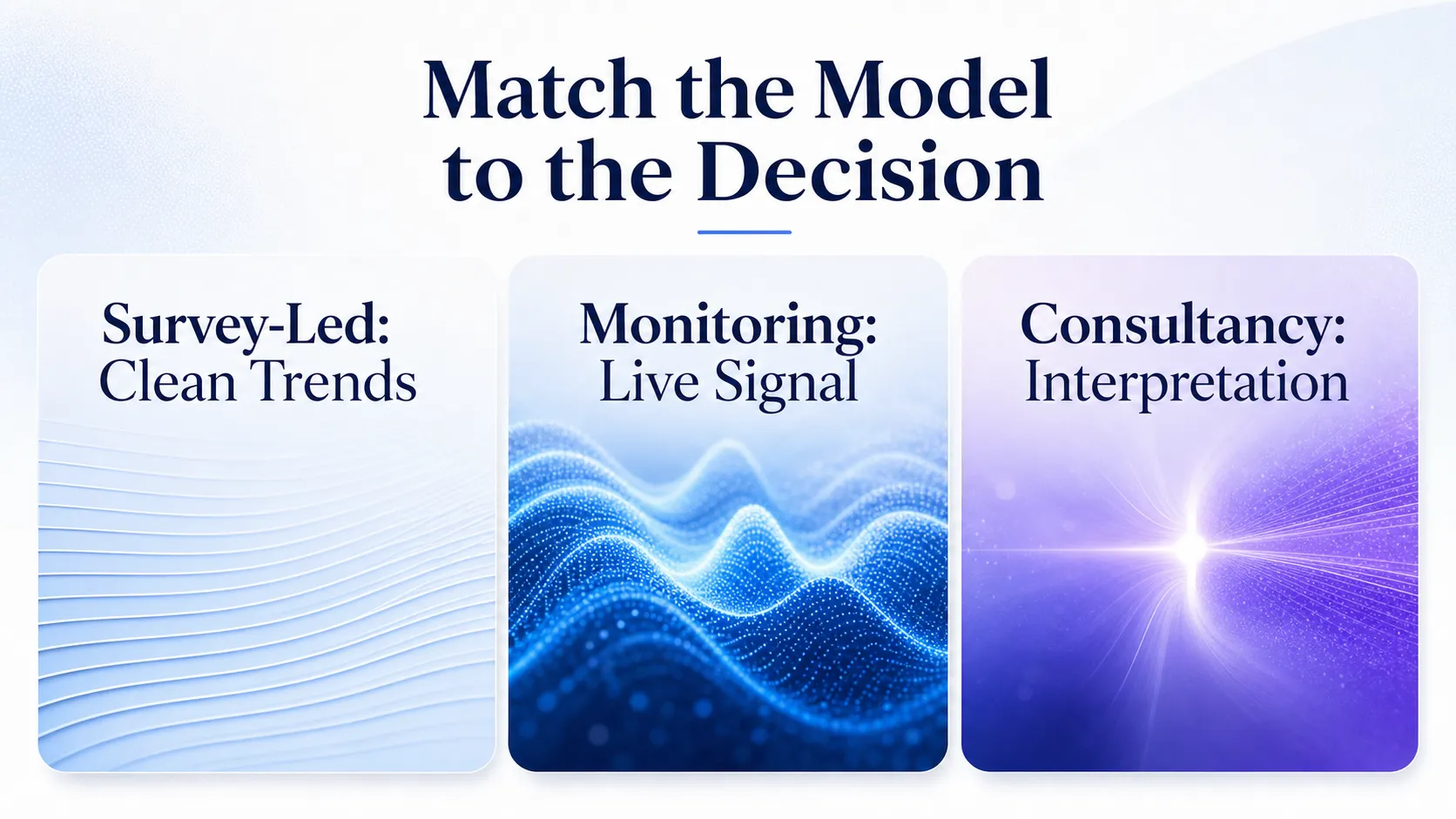
The “best” provider depends on how often you make brand decisions, where your markets are, and how much strategic support your team needs internally. Senior buyers usually regret choosing a provider for the dashboard first and the decision workflow second.
A beautiful interface that no one references in the monthly business review is money spent on a screensaver.
How We Shortlisted These Providers
We judged each provider on six criteria that actually drive a purchase, not on brand recognition or marketing polish. In practice, buyers only trust a brand tracking program when the methodology and reporting logic are easy to defend internally, so methodology sits at the top.
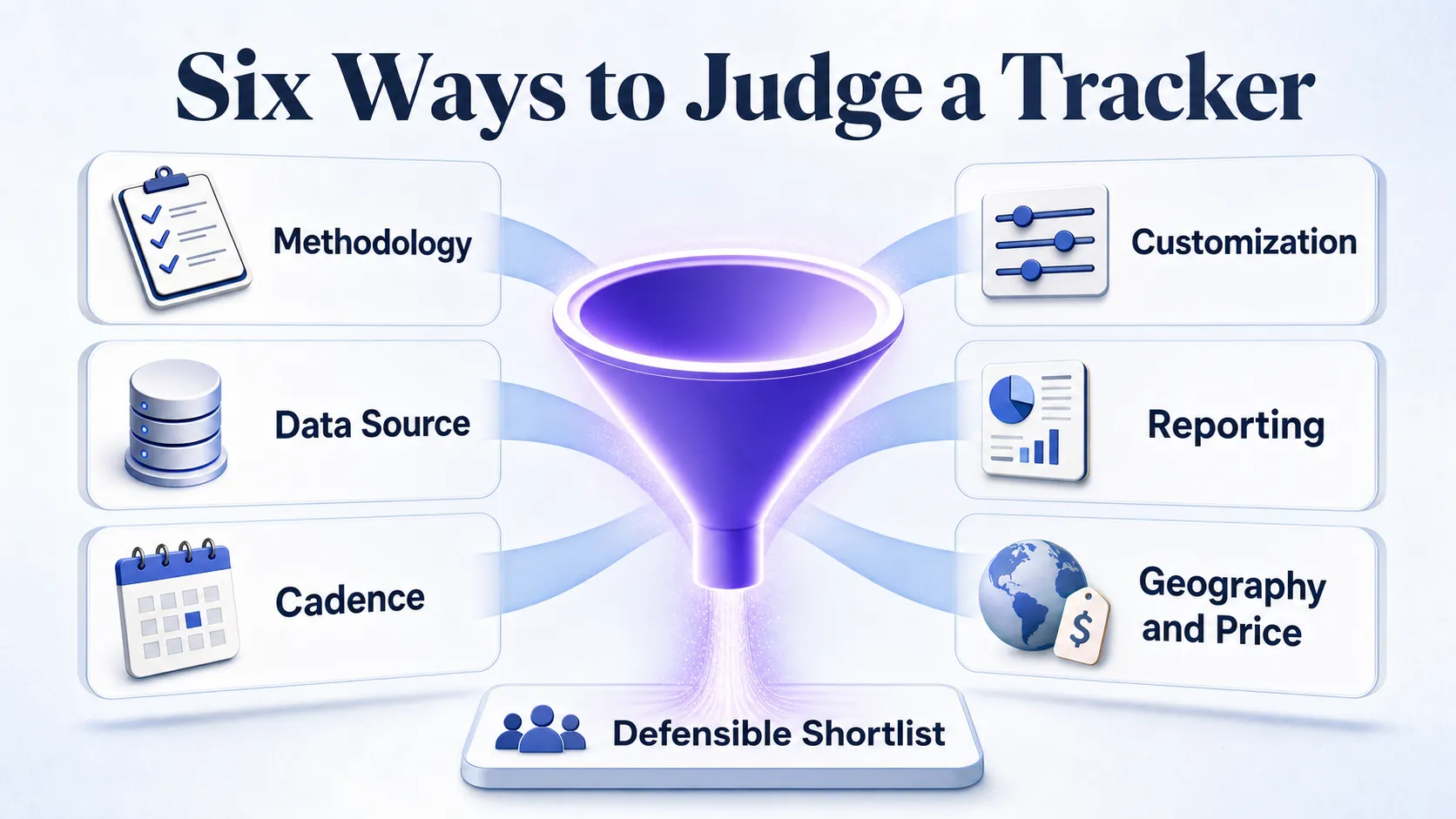
Methodology rigor came first: whether the provider uses surveys, managed panels, AI-assisted analysis, or web monitoring data, and whether that approach can survive a skeptical CFO. Data source mattered next, because first-party and panel-based data reads very differently from sentiment inferred off social activity.
We weighed tracking frequency, from daily and always-on to monthly waves or one-off projects, since your cadence should match how fast your category moves. Customization and reporting quality decided whether a provider delivers recommendations you can act on or just charts you’ve to interpret yourself.
Finally, we looked at strategic consultancy, geographic coverage, and pricing transparency, because a tracker you can’t afford or defend across markets isn’t a real option. Pricing is inconsistent across this category, so where a provider publishes nothing, we say so rather than guess.
The Strongest Brand Tracking Agency Options
These four options are strongest when you want survey-grade brand health measurement, not just social mention monitoring. Each gives you a defensible consumer trendline, which is the thing most in-house teams struggle to produce alone.
1. YouGov BrandIndex
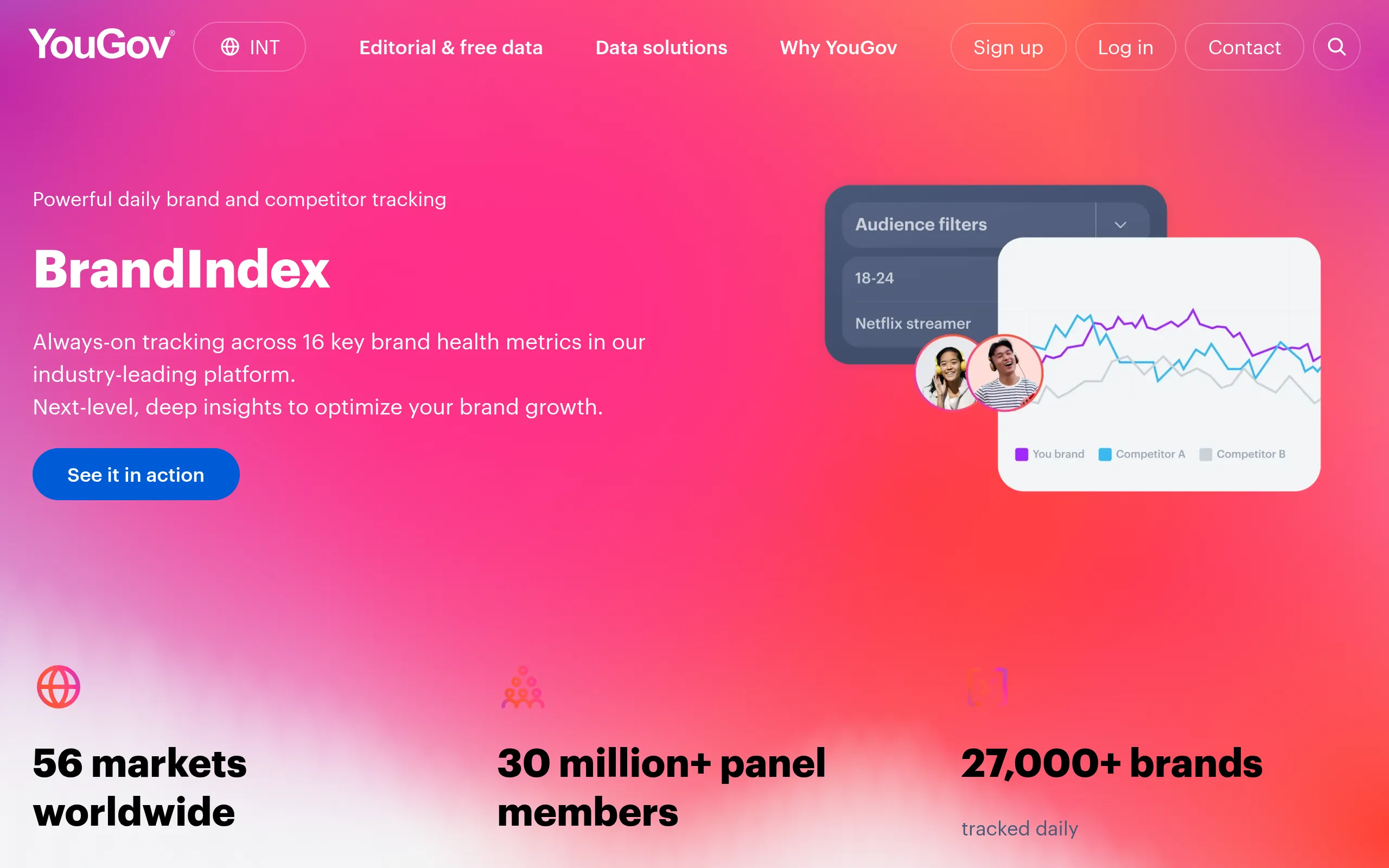
YouGov BrandIndex is a daily, survey-based brand tracker built for multinational brands and insights teams that need consumer perception measured continuously across markets. It runs on YouGov’s own global panel rather than inferred digital signals, which is why the data holds up in a boardroom.
The real draw is depth of history. With more than 15 years of data across 55 markets and 16 brand health metrics, you can benchmark today against a decade of your own trendline instead of a competitor’s press release.
The trade-off is that daily panel tracking tells you what consumers think, not what they’re saying in live conversation, so pair it with monitoring if reputation spikes matter to you.
- Best for: Multinational brands and insights teams needing daily consumer trend data
- Pricing model: Custom pricing, with a free BrandIndex Lite tier
- Standout feature: Proprietary global panel with 55-market daily coverage and QualAI for the “why”
- Free audit or trial: Yes
2. TRA
TRA is a human-centered, tech-enabled brand tracking agency for teams that want interpretation and support, not just a dashboard. It pairs always-on reporting with consultancy, so the deliverable is direction, not a data dump.
What sets TRA apart is its stated focus on explaining why brand health changed and what to do next, backed by proprietary frameworks like BrandEdge and Creative Edge and an AI assistant that surfaces charts on demand. That high-touch model shows up in retention: TRA claims 89% of its clients stay.
The candid limitation is that this depth suits brands ready to invest in a partnership, not teams looking for a cheap self-serve wave.
- Best for: Brands that want interpretation and strategic support alongside tracking data
- Pricing model: Custom, tiered from Tracking Essentials to full TRA Tracking
- Standout feature: Consultancy plus BrandEdge and Creative Edge interpretive frameworks
3. Material+
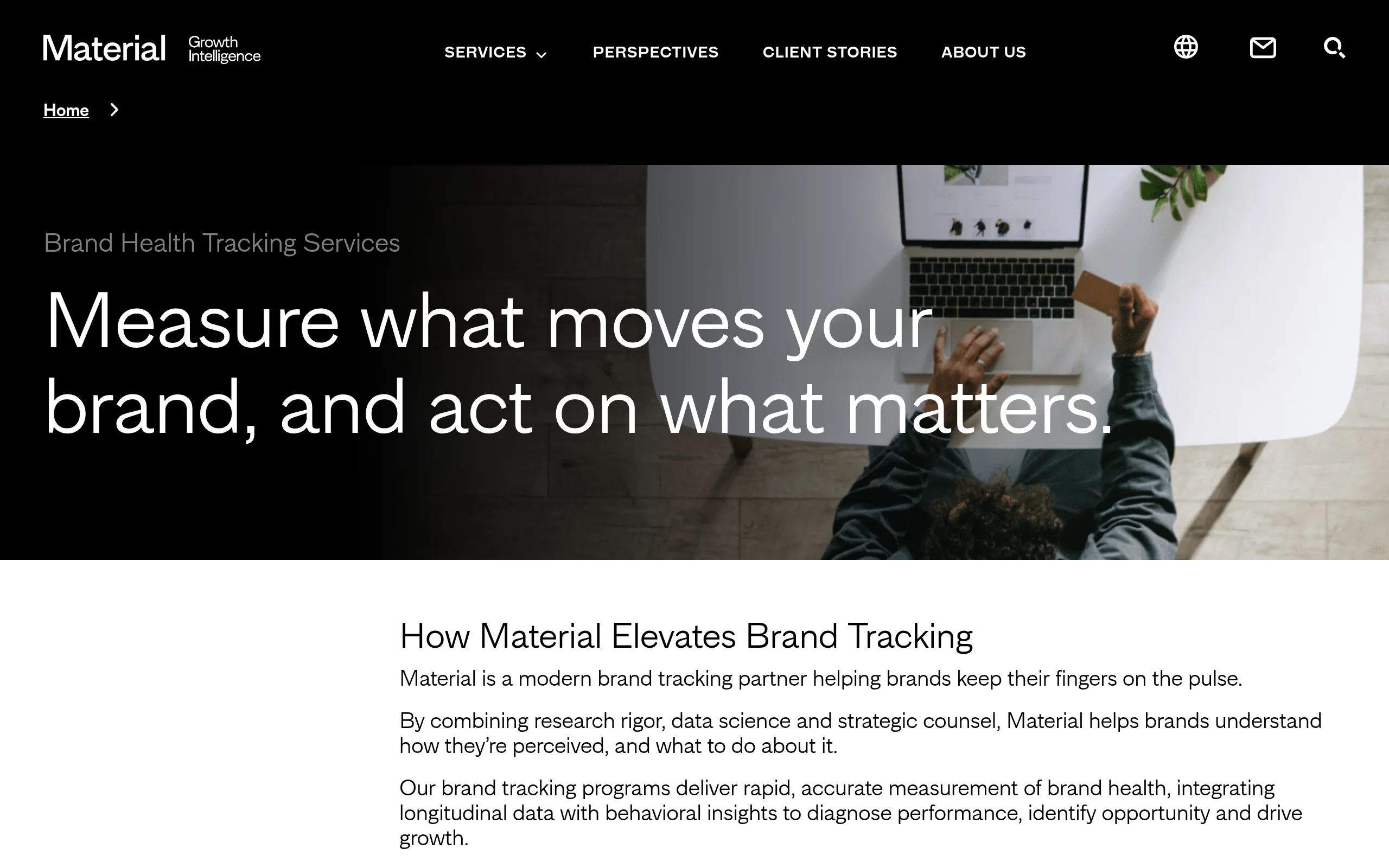
Material+ is a research-led brand health tracking agency for enterprise teams that want a high-touch partner blending data science with strategic counsel. It’s built to connect measurement with business performance, not to hand you a scorecard and leave.
The differentiator is its custom, strategy-first program design plus proprietary tools like AI Muse for interrogating brand data and Brand Fidelity for tracking experience over time. That makes it a fit for organizations in disrupted categories or recalibrating positioning.
The honest read: Material+ publishes no pricing and no case-study proof points, so you’ll need to press hard on sample design and validation before you sign.
- Best for: Enterprise teams wanting a strategic, custom-built tracking partner
- Pricing model: Custom, not publicly listed
- Standout feature: Proprietary AI Muse and Brand Fidelity frameworks tied to strategy
4. GWI
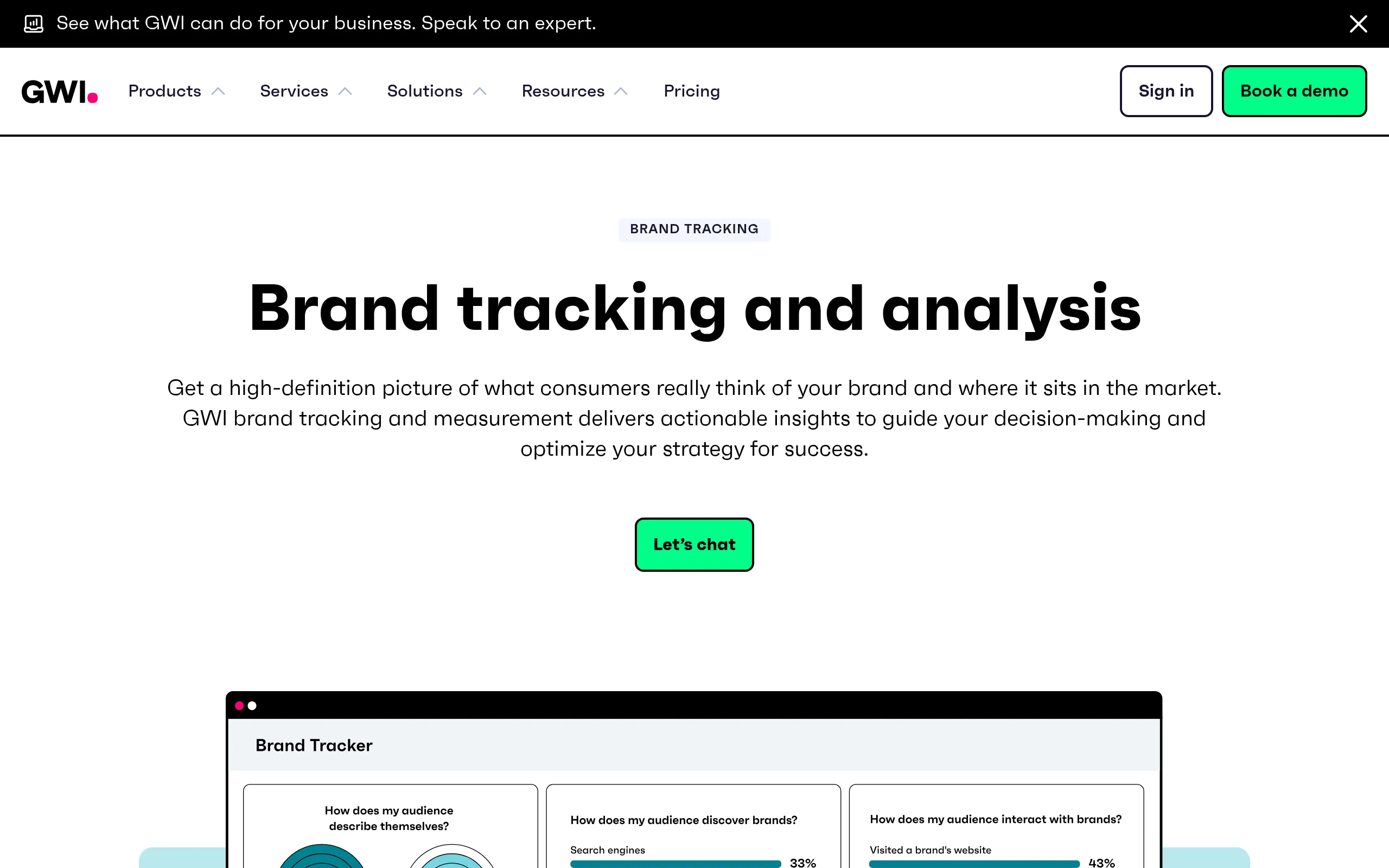
GWI is a syndicated consumer research platform with brand tracking, segmentation, and recontact capability, best for teams that need brand health and audience understanding in one place. It links what people think about your brand to who those people actually are.
The strength is profiling depth: you can analyze brand findings against 57,000 profiling points and recontact non-converters in the funnel to see where they dropped. One published outcome, a 46% lift in US viewers for ONE Championship in six months, hints at the payoff, though GWI keeps methodology detail broad.
Pricing starts around £120 per user per month, which makes it more accessible than most enterprise trackers.
- Best for: Teams needing brand tracking and deep audience profiling together
- Pricing model: Starts at £120 per user per month
- Standout feature: 57,000 profiling points plus respondent recontact
- Free audit or trial: Not listed
More Brand Tracking Agency Options to Compare
These four round out the shortlist across consultancy, self-serve research, enterprise platforms, and monitoring-led coverage. The right choice here often comes down to whether your team needs research, consultancy, or continuous mention monitoring.
5. Hall & Partners
Hall & Partners is a bespoke brand tracking consultancy for brands that need workshop-ready outputs and decision support, not just headline metrics. It positions tracking as a growth tool rather than a measurement exercise.
The standout is its use of simulators and optimization models to test strategic decisions before you commit budget, wrapped in storytelling and workshops that get stakeholders to actually act. One client story cites a 3% year-over-year sales improvement tied to the work.
The limitation matches its peers: methodology and predictive accuracy are described at a high level, so ask for a sample simulator output before you buy the promise.
- Best for: Brands needing consultancy and workshop-ready, decision-focused outputs
- Pricing model: Custom, not publicly listed
- Standout feature: Scenario simulators that test decisions before you act
6. Attest
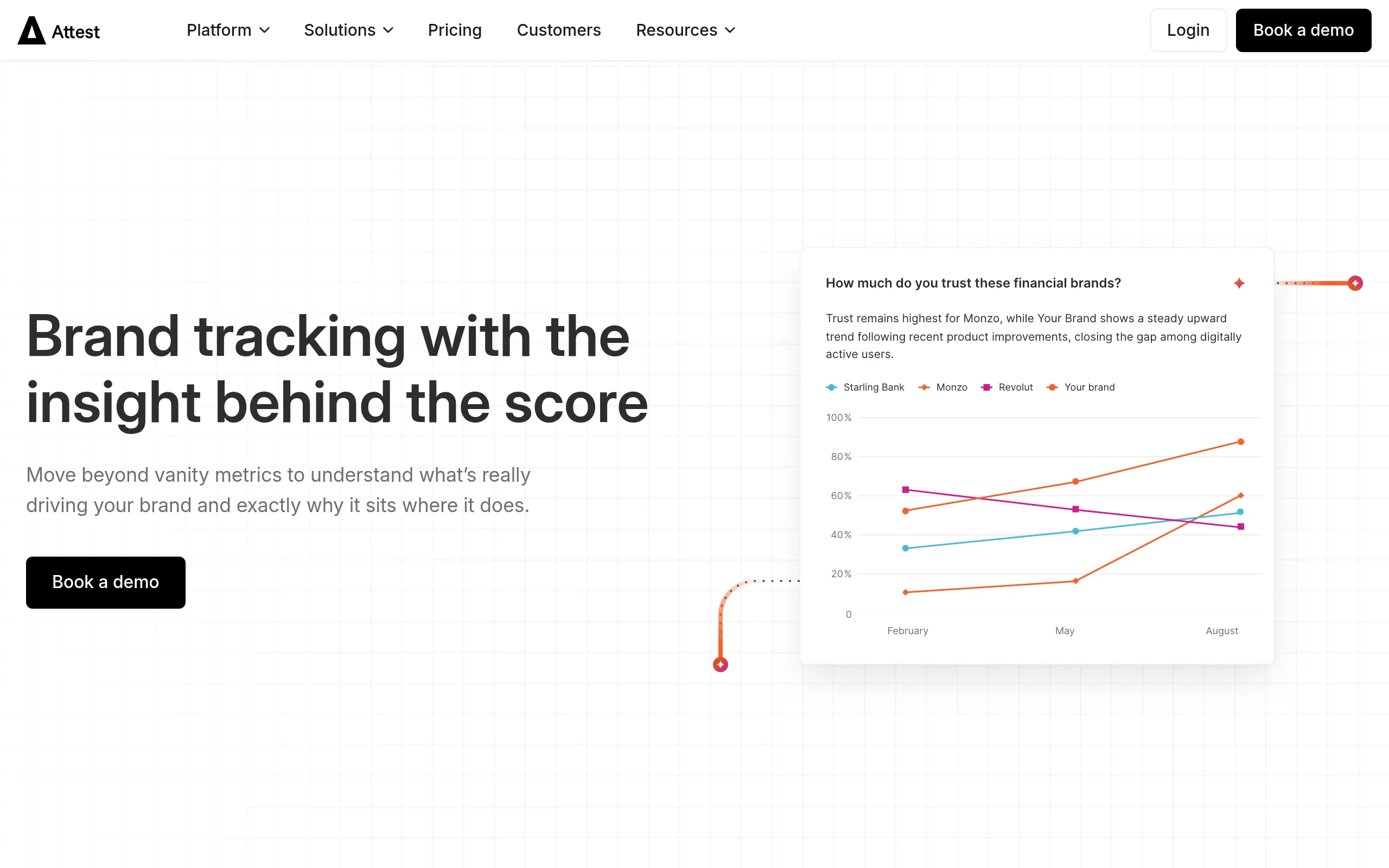
Attest is a self-serve research platform for fast surveys, perception tracking, and multi-panel consumer research, best for growth-stage and lean insight teams. It trades the long agency cycle for speed and flexibility you control yourself.
The draw is turnaround: average fieldwork lands in roughly a day and a half, and insights are triple-checked using a mix of AI and human review with research experts on hand. That makes it ideal when you need an answer this week, not next quarter.
The trade-off is that a self-serve tool asks more of your team’s research skill than a full-service agency does, so it rewards buyers who already know what to ask.
- Best for: Growth-stage and lean teams wanting fast, flexible survey insight
- Pricing model: Free to start, paid tiers priced per response
- Standout feature: Triple-checked insights with roughly 1.5-day turnaround
- Free audit or trial: Yes
7. Kantar (BrandDynamics and Marketplace)
Kantar offers enterprise-grade brand tracking through BrandDynamics and Kantar Marketplace, built for large brands running repeatable, multi-market programs. It suits organizations that need predictive measurement backed by heavyweight modeling.
The standout is forecasting: BrandDynamics tracks brands daily and can forecast brand health up to three months ahead, while Marketplace spans 60-plus countries and is validated to predict sales and brand growth. That scale is the point.
The honest note is that enterprise Kantar programs carry enterprise complexity and custom pricing, so they fit large insight functions more than nimble teams.
- Best for: Large brands needing scale, forecasting, and multi-market coverage
- Pricing model: Custom, not publicly listed
- Standout feature: Brand health forecasting up to three months ahead
8. BrandMentions
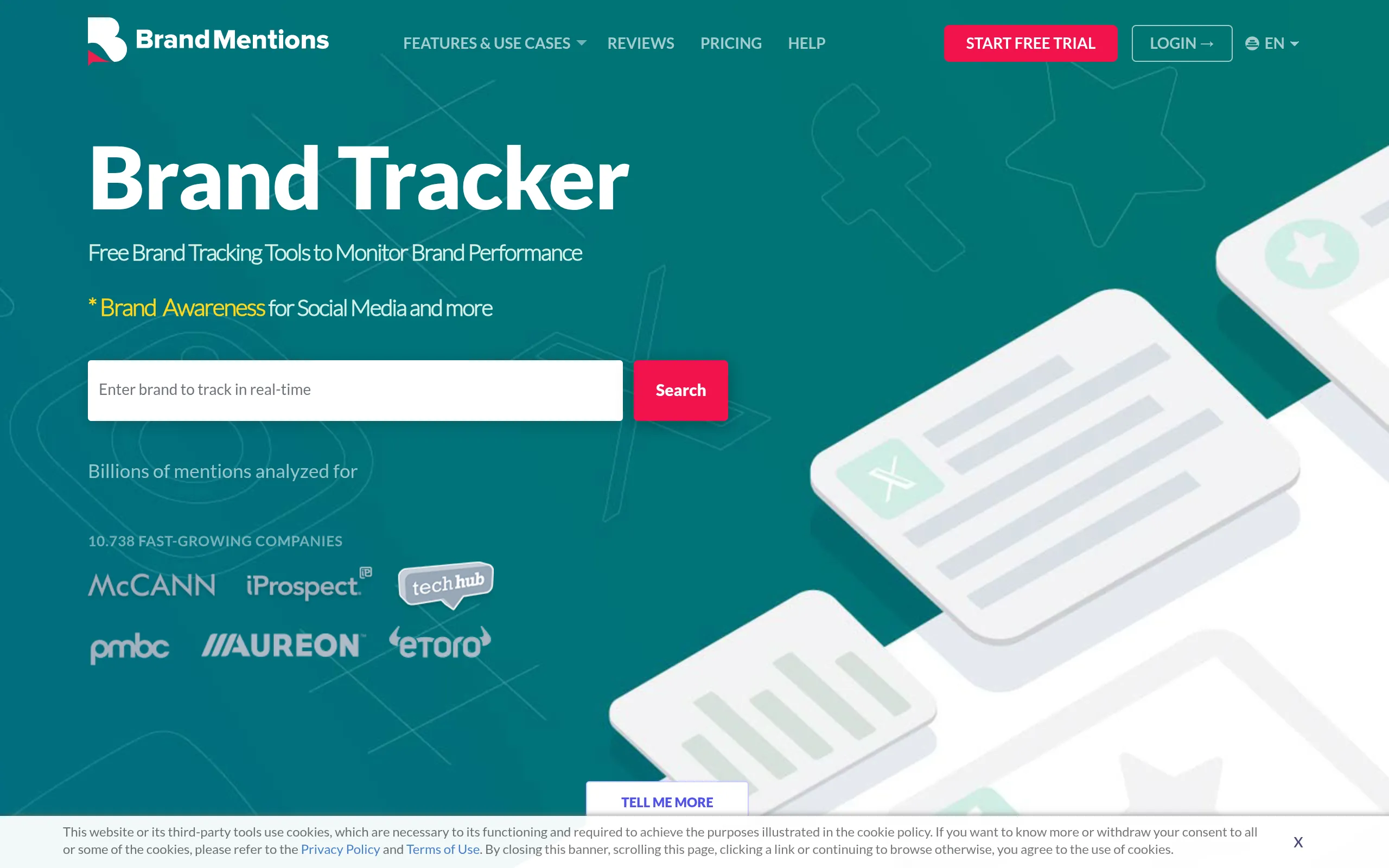
BrandMentions is an always-on mention monitoring service with sentiment tracking and alerts, best for comms, reputation, and monitoring-led teams. It solves a different problem than survey trackers: continuous visibility into what people say about you online, as they say it.
The strength is breadth of digital coverage, watching mentions across blogs, news, social, and video in real time so you catch sentiment shifts and reputation risks early. Where survey platforms tell you what consumers believe over quarters, this tells you what the conversation is doing today.
It isn’t a substitute for statistically sampled brand health measurement, and the sharpest programs run both: monitoring for the live signal, surveys for the defensible trendline.
- Best for: Comms and reputation teams needing continuous mention monitoring
- Pricing model: Free trial, then tiered subscription
- Standout feature: Real-time mentions across web, news, social, and video
- Free audit or trial: No, but a free 20-minute strategy call
See where AI answers put your brand
Twenty minutes with a senior strategist: where the major engines point buyers in your category, who gets named instead of you, and a straight read on what a programme would change.
Book a strategy callComparison Summary Table
Use this table to narrow eight providers to the two or three that match your methodology and engagement model. Buyers usually cut the list in half once they see the model type side by side.
| Provider | Methodology | Best For | Pricing Model |
|---|---|---|---|
| YouGov BrandIndex | Daily survey panel | Multinational insights teams | Custom, free Lite tier |
| TRA | Survey plus consultancy | Teams wanting interpretation | Custom, tiered |
| Material+ | Research plus strategy | Enterprise, high-touch | Custom, not listed |
| GWI | Syndicated survey plus profiling | Brand and audience insight | From £120 per user/month |
| Hall & Partners | Bespoke consultancy | Workshop-ready outputs | Custom, not listed |
| Attest | Self-serve survey | Fast, lean insight teams | Free start, per response |
| Kantar | Enterprise survey plus modeling | Large multi-market brands | Custom, not listed |
| BrandMentions | Always-on monitoring | Comms and reputation teams | Free trial, then tiered |
We picked these eight on the six criteria set earlier: methodology rigor, data source, cadence, customization, reporting quality, and coverage with pricing transparency. The list deliberately spans survey-led, consultancy-led, and monitoring-led models so it shows range, not eight versions of the same thing.
FAQ About Choosing a Brand Tracking Agency
Most buyers confuse survey-based brand health tracking with social listening, even though they solve different problems. These answers clear up the questions that come up most when comparing agencies, tools, and research partners.
What does a brand tracking agency do?
A brand tracking agency measures how your brand is perceived over time and feeds that back into decisions. Depending on the model, that means fielding consumer surveys, running always-on mention monitoring, or providing consultancy that interprets the data.
The core output is a trendline for awareness, consideration, sentiment, and competitor position, plus, from the stronger providers, recommendations on what to do about it.
How much does brand tracking cost?
Brand tracking pricing ranges widely because the models differ. Self-serve survey tools like Attest start effectively free and charge per response, while GWI begins around £120 per user per month.
Enterprise agency programs from Kantar or Material+ run on custom pricing that’s rarely published, and continuous syndicated trackers can start in the low tens of thousands per year. Budget matters less than fit: a cheap tool you never reference costs more than a right-sized program you use monthly.
Is an agency better than brand tracking software?
Neither is universally better; they answer different questions. If you need statistically defensible consumer perception data and strategic interpretation, a research agency wins.
If you need speed, control, and continuous digital coverage, brand tracking software is the leaner choice. Many mature teams run both, using software for the live signal and an agency for the deep quarterly read.
How often should you track brand health?
Match cadence to how fast your category moves. Fast-moving or disrupted categories benefit from daily or always-on tracking so you catch shifts as they happen.
Stable categories often run well on monthly or quarterly waves. The rule that matters: track often enough that a change shows up before it becomes a crisis, but not so often that you react to statistical noise.
What metrics should a brand tracking report include?
A useful report covers awareness, consideration, preference, and loyalty as the core funnel, plus sentiment, share of voice, and competitor benchmarks for context. The best reports go one step further and tie those metrics to a recommendation, so the reader knows what the number means for next quarter’s plan.
A chart without a “so what” is where most tracking programs quietly die.
How to Choose the Right Brand Tracking Agency
Start from your decision, not the provider’s pitch. The best brand tracking agency is the one your team will actually reference in monthly business reviews, so choose for the workflow first and the interface second.
Choose survey-based tracking if you need statistically defensible trendlines and consumer-research benchmarks that survive scrutiny. Choose always-on monitoring if your priority is mentions, sentiment shifts, share of voice, and reputation alerts as they surface.
Choose a consultancy-led partner if you need interpretation, workshops, and stakeholder-ready recommendations rather than raw data. If you operate across multiple markets or need hard-to-reach segments, weight geographic coverage and audience access above everything else, since a clean methodology in the wrong markets helps no one.
Before you sign anything, ask for three things: a sample dashboard, a methodology deck, and a sample reporting pack. A provider confident in its work hands these over quickly.
If you also want to see how your brand shows up in the newer surface that surveys miss entirely, measure your brand awareness across channels as a baseline first.
Shortlist two brand tracking agencies, request sample dashboards from both, and choose the one that matches your cadence, geography, and reporting needs. The provider that fits how your team actually decides will always beat the one with the prettiest screenshots.