
If you are deciding between hiring an AI visibility agency and buying a tool, you are really choosing between done-for-you execution and in-house control. An agency is usually the better fit when you need strategy and execution you do not have time to build, while a tool wins when you already have the internal bandwidth to run monitoring and act on what it surfaces. The harder question is which of those describes your team right now. This comparison walks through cost, speed, expertise, control, scalability, and reporting so you can match the operating model to your budget and capacity, not to a feature list.
What an AI Visibility Agency vs Tool Really Means
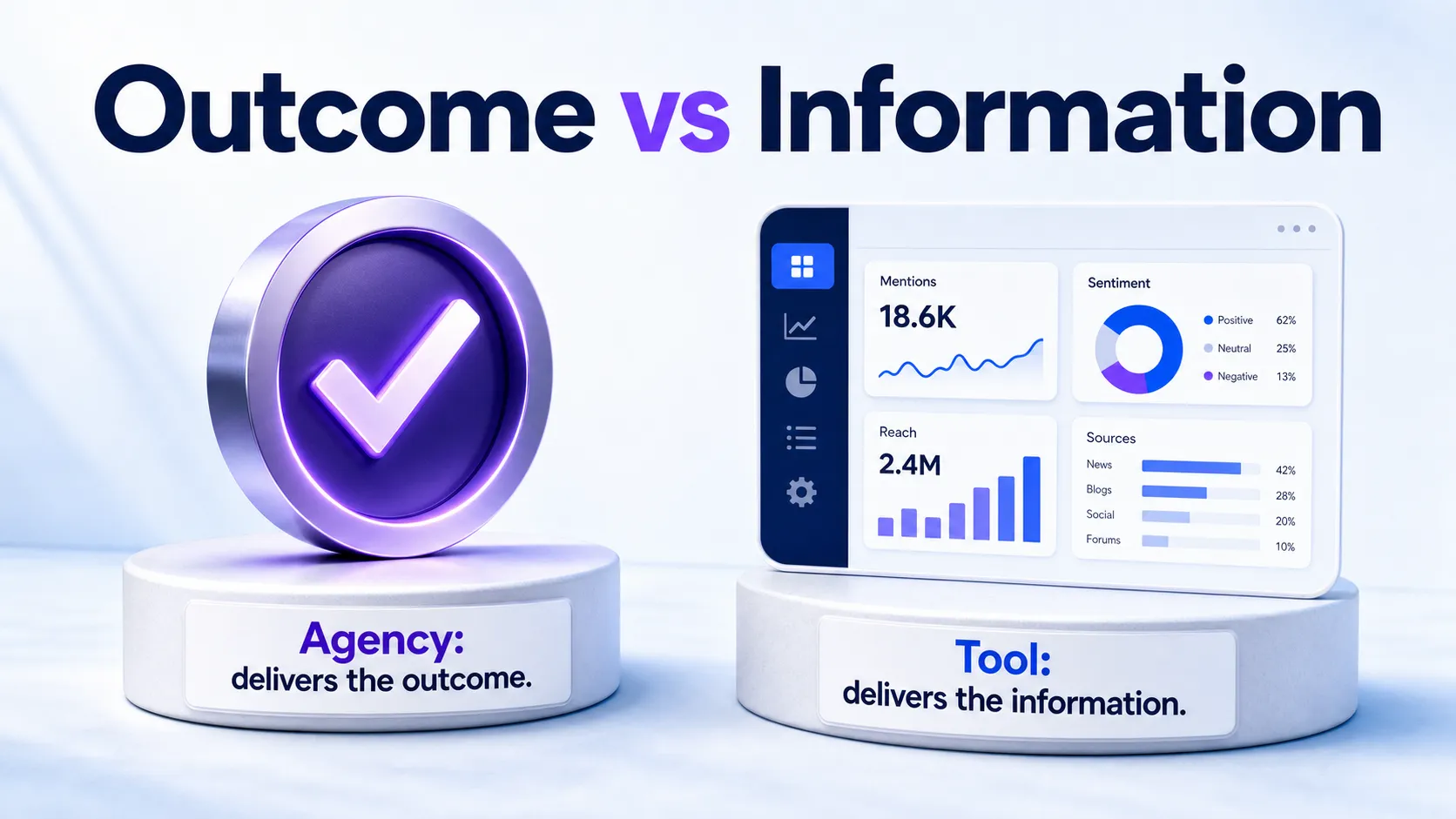
An AI visibility agency is a service that delivers strategy, diagnosis, prioritization, content and technical fixes, and ongoing optimization to get your brand cited in AI answers. You hand over the outcome and the agency owns the work.
An AI visibility tool, also called an AI visibility platform or AEO software, delivers monitoring, data, alerts, and dashboards through self-serve workflow. You see how often AI models name your brand, where competitors beat you, and what changes over time. Then you act on it yourself.
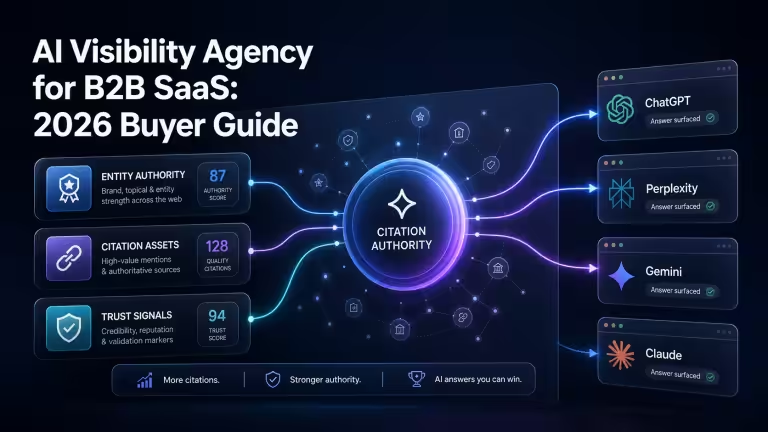
The real buying decision is not “which vendor is best.” It is “which operating model fits our budget, bandwidth, and urgency.” AI search now shapes discovery in ChatGPT, Perplexity, Gemini, and Google AI Overviews, so being named in those answers is no longer optional. But the path to getting named looks completely different depending on who runs the work.
Here is the mistake we see most often. Teams buy software expecting strategy, then realize three weeks in that a dashboard tells them what is wrong without telling them what to do, or who will do it. The data was never the bottleneck. The execution was. A tool answers “where do we stand.” An agency answers “what now, and who fixes it.”
Decision Criteria to Use Before You Compare
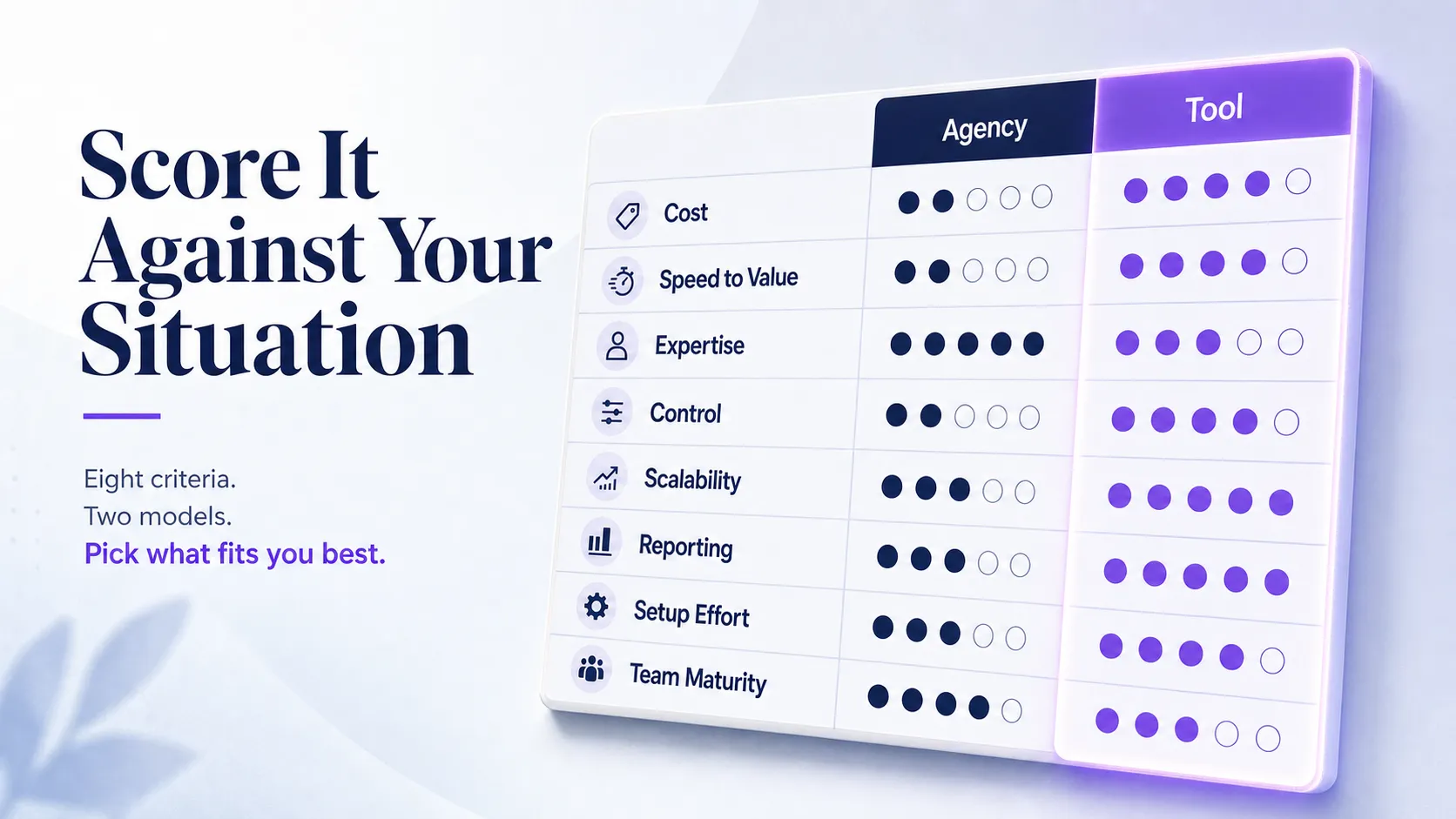
Before comparing anything, set the criteria you will judge both options against. The right choice almost always comes from an honest capacity audit, not a feature checklist. Score each option from 1 to 5 against your own situation across these eight dimensions.
| Criterion | What to weigh |
|---|---|
| Cost | Retainer or subscription, plus the internal labor each one demands. |
| Speed to value | How fast you reach a useful decision, not just a live dashboard. |
| Depth of expertise | Whether you already have AI search and content skill in-house. |
| Control | How much hands-on ownership you want to keep. |
| Scalability | Multi-brand needs, reporting volume, and workflow complexity. |
| Reporting | Raw data access versus interpreted, stakeholder-ready output. |
| Implementation effort | Setup, prompt definition, and the time to operate it well. |
| Team maturity | Whether someone can own the process around the work. |
A small team with no AI search expertise should weight support and execution higher than raw feature depth. The most powerful platform in the category is wasted if nobody can interpret its output or act on it.
An enterprise team with in-house SEO, content, and analytics can weight control and data access higher. They have the people to turn data into action, so they pay more for software that gives them clean signal and less for someone to hold their hand.
“Best” depends on the operating model, not the headline feature count. Two teams with identical budgets can reach opposite correct answers because one has spare bandwidth and the other does not.
Cost and Total Ownership
Total cost of ownership is the all-in cost of getting cited in AI answers, including subscription or retainer, onboarding, integrations, and the internal hours your team spends operating the work. Comparing monthly price alone is the single most expensive mistake in this decision.
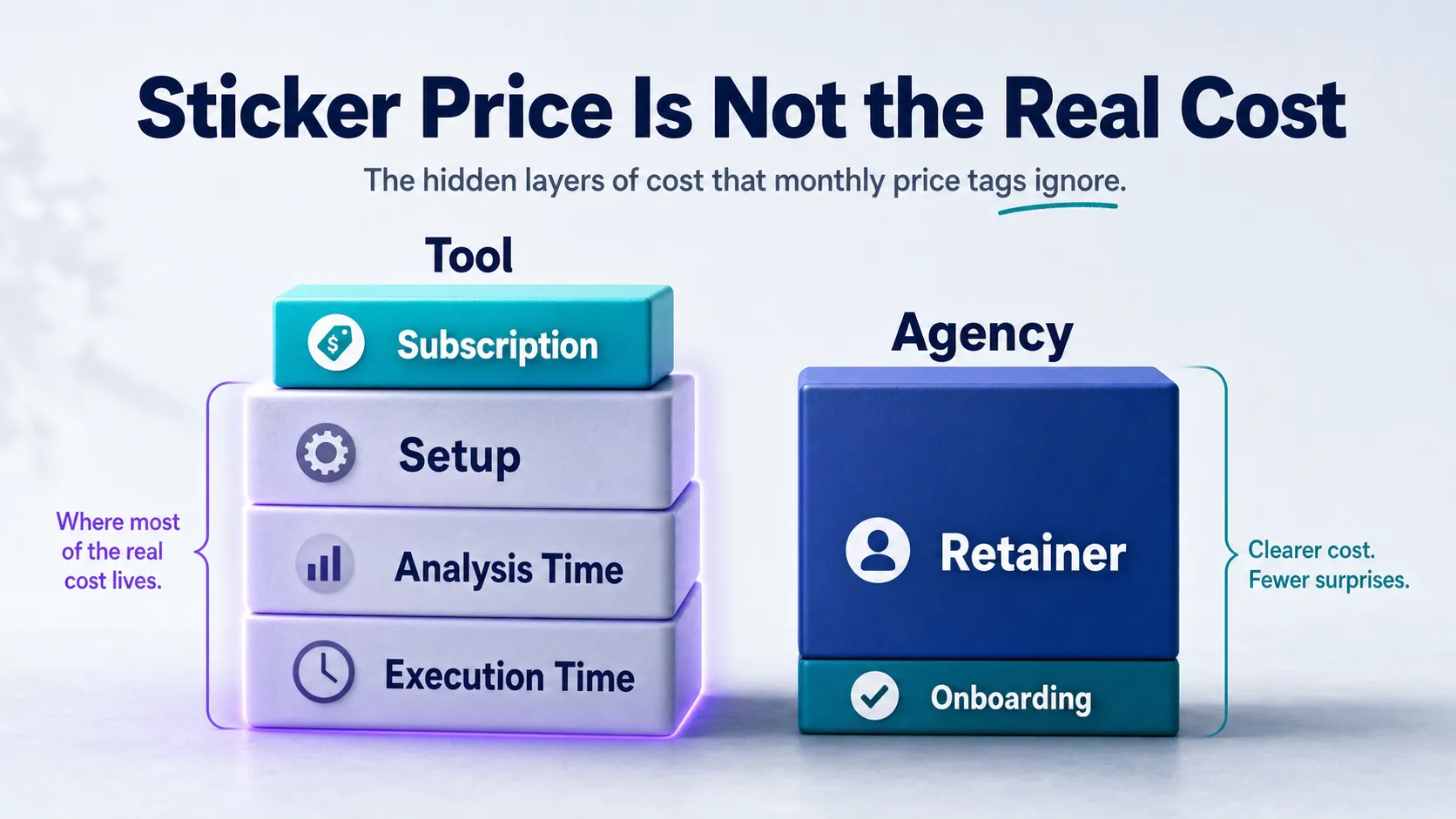
A tool can look cheaper on paper and become expensive once you add the labor around it. Setup, prompt definition, weekly analysis, and the execution that follows all draw on senior marketer time. A subscription that reads as a few hundred dollars a month often carries thousands in internal hours once someone has to interpret the data and ship the fixes.
An agency can be cheaper in practice, especially when the realistic alternative is hiring an internal specialist or burning a senior marketer’s week on work outside their lane. You pay one retainer instead of a salary plus a tool plus the ramp time, and the work starts producing decisions sooner. For a closer look at that math, see our breakdown of agency versus in-house team cost.
A tool is the lower-cost choice when you already have the people and the process to use it well. If a capable in-house team needs signal rather than hands, paying for a managed service adds cost without adding much you cannot already do. To pressure-test retainer figures against software spend, our notes on brand mention pricing lay out what the service side actually runs.
Hidden internal labor is the biggest budget blind spot in this entire decision. The line item nobody costs is the 10 to 15 hours a month a strong marketer spends turning dashboards into action, and that time is rarely free.
Speed to Value and Implementation Effort
Tools are faster to data. Agencies are faster to decisions. That single distinction resolves most of the speed debate, because the two options optimize for different finish lines.
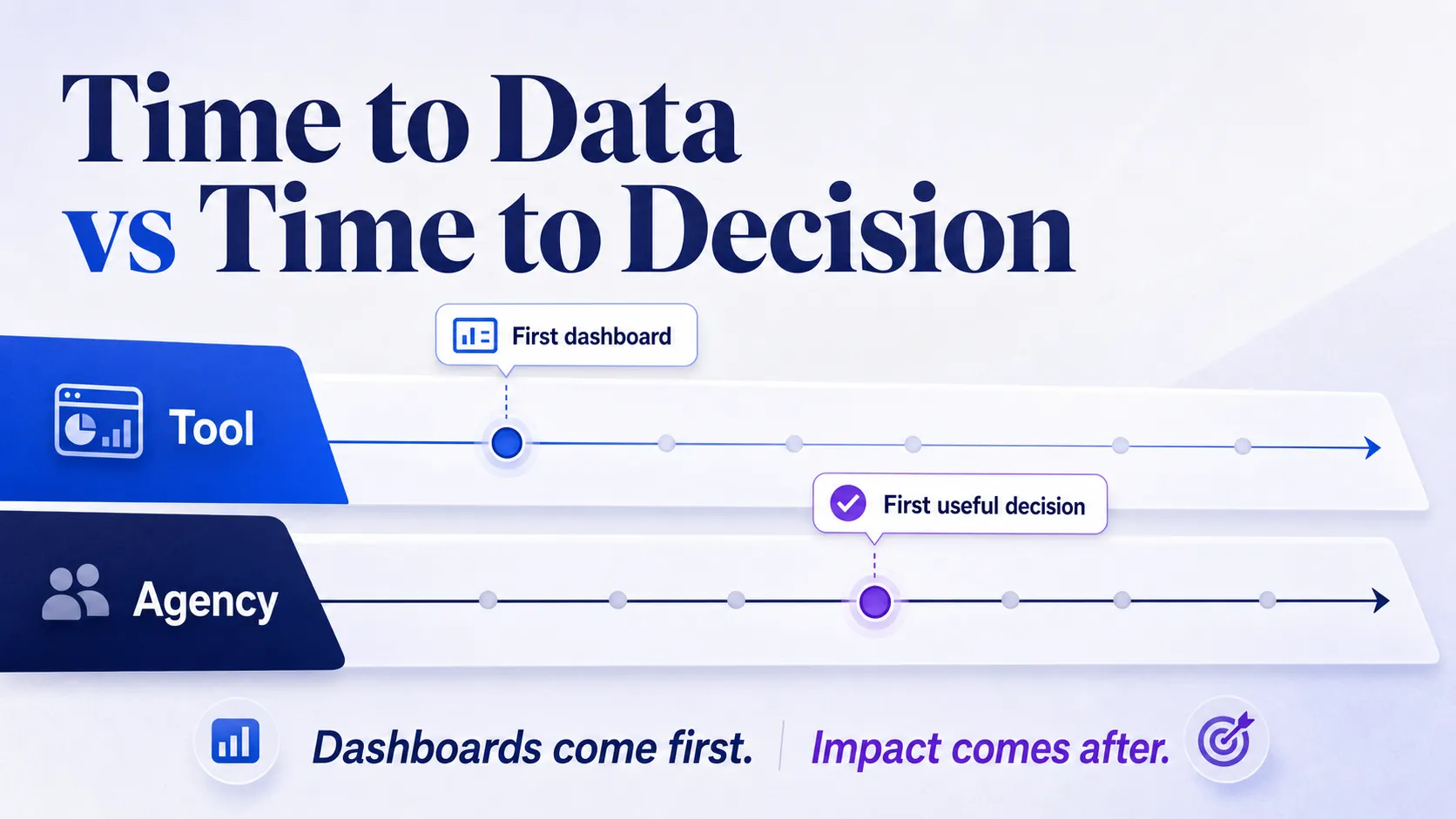
A tool usually wins on time to first dashboard. You sign up, connect your brand, define prompts, and within days you have monitoring running across multiple engines. The information arrives fast.
An agency usually wins on time to first useful decision. The agency reads the data, diagnoses the gap, and tells you what to do next. That interpretation step is where most internal teams stall when they go tool-only, because raw signal sitting in a dashboard is not a plan.
Implementation effort cuts both ways. A tool needs setup: prompt definitions, brand and competitor tracking, and an internal workflow to review and act on what it finds. An agency needs access, approvals, and business context, but once it has them it can often diagnose the problem and set priorities faster than a team learning the category from scratch. Our AI visibility diagnostic framework shows the kind of structured read an agency brings to that first month.
Speed also shifts by scenario. For a steady-state optimization program, a tool’s ongoing monitoring is enough once the workflow is built. For a launch, a rebrand, or a reputation problem in AI answers, an agency’s ability to move from diagnosis to action in days matters far more than how quickly a chart populates.
Strategy, Control, Expertise, and Execution
The clearest difference between the two models is what each one actually does with the data. A tool surfaces the problem. An agency owns solving it. Tools do not replace strategic judgment, and that gap is where tool-only teams most often get stuck.
The agency value stack is diagnosis, prioritization, content recommendations, technical fixes, cross-channel coordination, and accountability for the result. You are buying a team that figures out why your brand is missing from AI answers, decides what to fix first, makes the fixes, and reports on whether they worked.
The tool value stack is raw data access, alerting, trend monitoring, source tracking, and internal visibility. You are buying a clear, current picture of where you stand across AI engines and how that picture moves over time.
The control tradeoff is direct. An agency reduces your internal workload but hands the day-to-day execution to an outside team. A tool preserves internal ownership but puts the work, and the learning curve, on your people. Neither is better in the abstract. A managed service is the right answer when your team is at capacity or lacks the skill; staying hands-on with a tool is right when you have both the bandwidth and the people who want to own it.
Here is the pattern worth internalizing: low-maturity teams rarely get full value from a tool unless someone owns the process around it. The platform produces signal every week, but signal with no owner becomes noise nobody acts on. If you cannot name the person who will read the dashboard and ship the fixes, you are buying a service whether you mean to or not.
Scalability, Reporting, and Best-Fit Use Cases
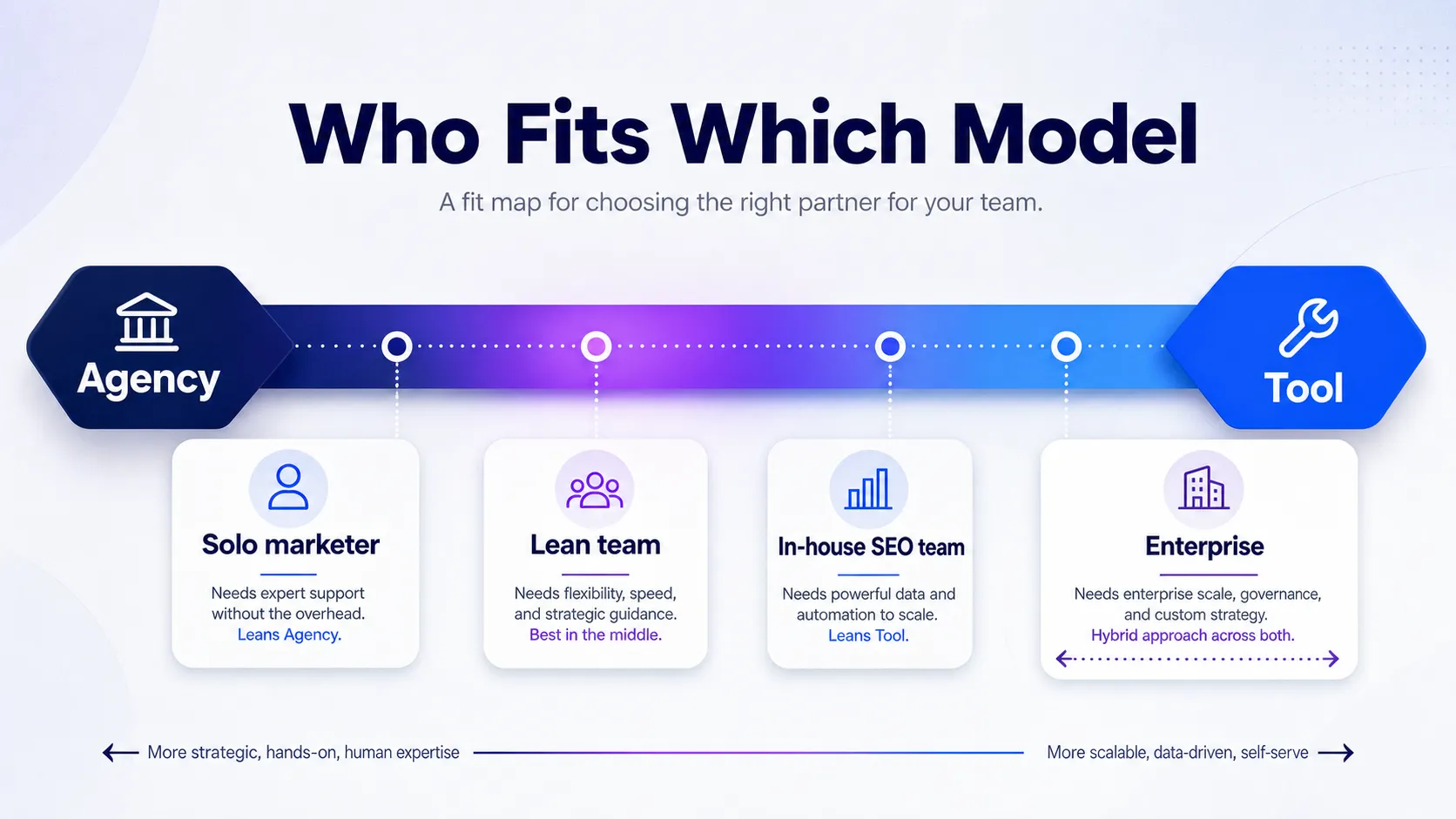
The right model maps to your team structure and reporting needs more than to your company size. Buyer sophistication and spare bandwidth matter more than headcount alone, because a lean team with a sharp owner can outrun a large team with none.
Multi-brand management, workflow complexity, and exportable reporting decide how each option scales. A tool scales monitoring cleanly: more brands, more prompts, more dashboards, all in one workspace. An agency scales judgment and accountability, but it scales through people, so cost rises with scope.
On reporting, the split is sharp. An agency produces interpreted, stakeholder-ready output that explains what the numbers mean and what you did about them. A tool produces raw dashboard access and exports that your team must read and translate. Agencies are stronger at interpretation and communicating up to leadership. Tools are stronger when you need repeatable monitoring at scale and have analysts to make sense of it.
Use these scenarios to place yourself:
- Solo marketer or founder with no AI search experience: choose an agency, because you need execution and judgment, not another dashboard to maintain.
- Lean team with one capable owner: a tool can work if that person genuinely has the hours, otherwise lean agency or hybrid.
- In-house SEO and content team with spare capacity: choose a tool, because you already have the people to act on signal.
- Enterprise with multiple brands and a reporting burden: usually hybrid, with a tool as the source of truth and an agency for strategy and execution.
- Brand entering AI search for the first time: choose agency or hybrid, because you need someone to diagnose the gap before a tool’s data means anything.
The short version: choose a tool if you have the bandwidth and skill to operate it. Choose an agency if you need the outcome handed to you. For SaaS teams weighing this specific call, our B2B SaaS buyer guide goes deeper on fit by company stage.
See where AI answers put your brand
Twenty minutes with a senior strategist: where the major engines point buyers in your category, who gets named instead of you, and a straight read on what a programme would change.
Book a strategy callHybrid Model and Final Verdict
The smartest setup is often both: a tool for ongoing monitoring and an agency for strategy, fixes, and content execution. This removes the false either-or that traps teams with more complex needs.
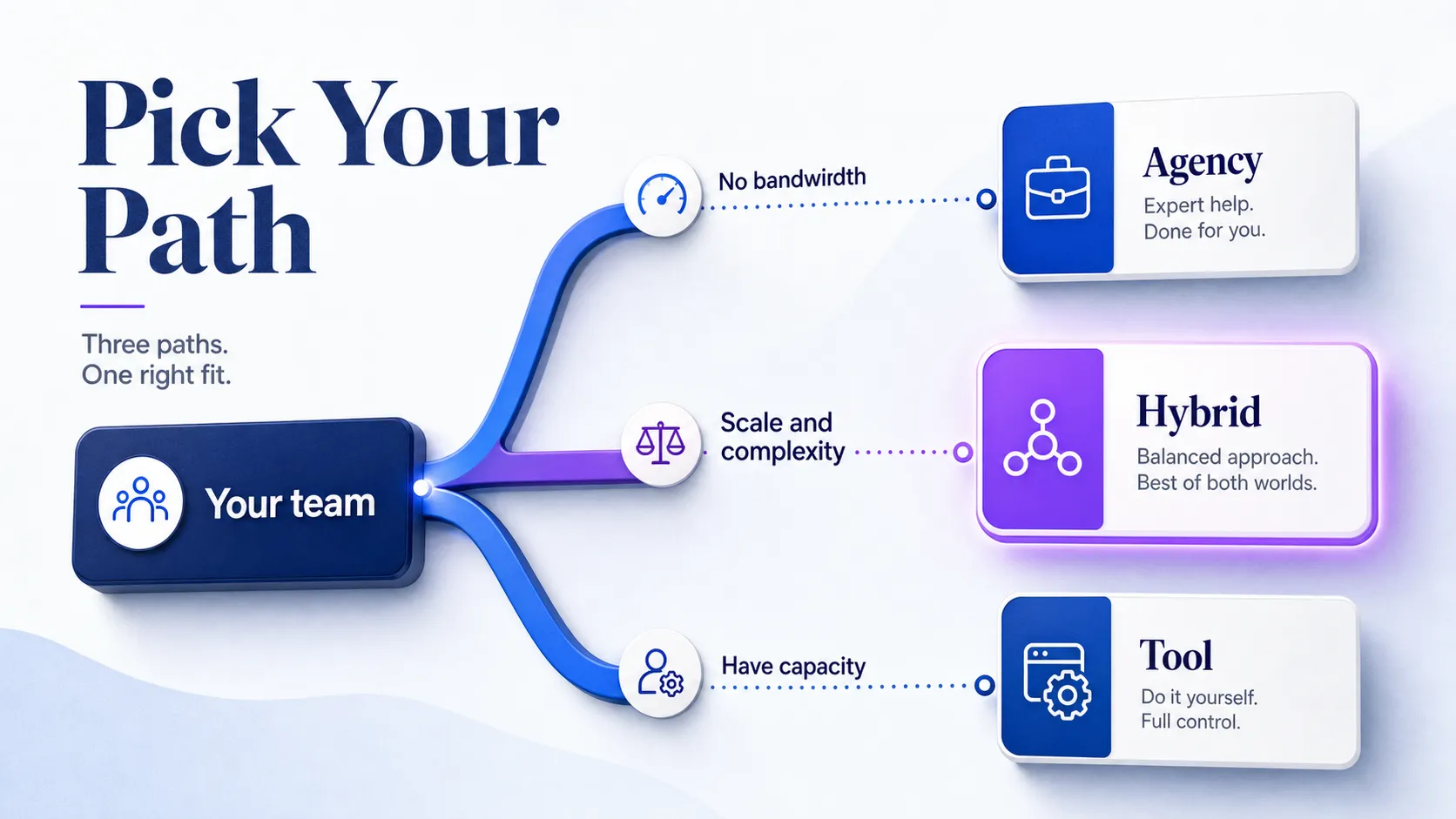
Hybrid earns its place in specific cases. Regulated industries need the compliance judgment an agency brings plus the continuous tracking a tool provides. Multi-brand teams need a platform as the single source of truth and an agency to turn that data into prioritized work. Brands entering AI search for the first time need an agency to diagnose the gap and a tool to watch progress once the fixes land.
Hybrid is also the most practical setup for teams that want data ownership without losing strategic support. You keep the dashboard and the historical record in-house, and you bring in an agency for the diagnosis and execution your team cannot cover. You can see what that combined work produces in our AI citation case studies.
The decision rule is simple. Choose an agency for done-for-you execution. Choose a tool for in-house control. Choose hybrid for scale and complexity. The most mature teams we work with keep a tool as the source of truth and use an agency to turn its insights into action, because owning the data and owning the work are two different jobs.
Frequently Asked Questions
What does an AI visibility agency do?
An AI visibility agency gets your brand cited in AI answers by handling strategy, diagnosis, content and technical fixes, and ongoing optimization. The team finds out why ChatGPT, Perplexity, and Google AI Overviews leave your brand out of category answers, decides what to fix first, makes the changes, and reports on whether citations improved. You buy the outcome rather than the software.
Can an AI visibility tool replace an agency?
An AI visibility tool replaces an agency only when you already have the in-house skill and time to act on what it shows. The tool surfaces where you stand and how it changes, but it does not diagnose root causes or execute fixes. If your team can read the data and ship the work, the tool is enough. If nobody owns that process, you still need someone to do it.
How much does AI visibility cost?
AI visibility cost depends on the model you choose, and the headline price is rarely the real number. A tool subscription plus the internal hours to operate it can rival or exceed an agency retainer once you count senior-marketer time. The honest comparison is total cost of ownership, all-in, not the monthly line item, which is why a tool that looks cheap often is not.
Which is better for a small marketing team?
For a small marketing team with no AI search experience, an agency or a hybrid setup is usually the better fit. A lean team rarely has a spare person to define prompts, read dashboards weekly, and execute fixes on top of existing work. If you do have one capable owner with genuine hours free, a tool can work. If you do not, a tool tends to become an unused subscription.
Is a hybrid agency plus tool model worth it?
A hybrid model is worth it when you want data ownership without losing strategic support, which describes most multi-brand teams, regulated industries, and brands new to AI search. You keep a tool as your source of truth and historical record, and you bring in an agency for diagnosis and execution. The combined cost is higher, but it removes the gap where tool-only teams stall: signal with no one to act on it.
The right answer here is rarely about which option is stronger in the abstract. It is about whether your team has the bandwidth and skill to turn AI visibility data into action, or whether you need that work handed to you. Be honest about who will own the process before you sign anything, because the wrong model wastes the budget either way.
If you are not sure where your brand even stands in AI answers today, start there. See how our brand mention programme works, or book a short strategy call to find out what AI says about your brand and your competitors before you choose a path.