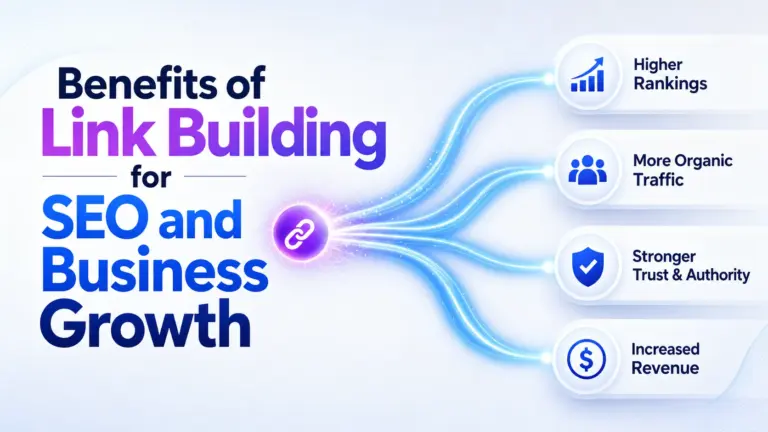

Most articles on the benefits of link building read like a sales pitch for an agency. Ten benefits, all framed as universal wins, none of them weighted against each other. That’s not useful when you’re trying to decide whether to spend $5,000 a month on links or put that budget somewhere else.
The honest answer: link building still drives meaningful results in 2026, higher rankings, qualified referral traffic, faster indexing, stronger entity authority, and a measurable bump in how AI assistants describe your brand. But the benefits aren’t equal, and they don’t all show up in the same timeframe. Some compound for years. Some are mostly cosmetic. Knowing which is which determines whether your link program returns 5x or burns budget.
This guide ranks the actual benefits of link building by impact, explains the mechanics behind each one, and tells you which benefits matter most for B2B brands in 2026, when AI search has changed what “authority” means.
The Short Version
- Link building’s biggest measurable benefit is still organic ranking improvement, links remain a top-3 Google ranking factor in 2026.
- Referral traffic from links is real but overhyped. Most links send fewer than 10 visitors a month. The ones that don’t are worth chasing aggressively.
- Indexing speed, domain authority, and “trust” are downstream effects, useful, but secondary to ranking and citation gains.
- The newest benefit nobody’s talking about: editorial mentions on high-authority publications shape how ChatGPT, Perplexity, and Gemini describe your brand.
- Quality beats quantity by an order of magnitude. Ten editorial links from category-relevant publications outperform 100 directory listings every time.
- Most “benefits of link building” lists are 30% accurate and 70% filler. We’re cutting the filler.
Why Link Building Still Matters in 2026
Google has spent the last three years telling SEOs that links matter less. The data tells a different story.
Backlinks remain one of the strongest correlated signals with first-page rankings. Ahrefs research on 1 billion pages found that 96.55% of pages get zero organic traffic from Google, and the overwhelming reason is missing or weak backlink profiles. Pages with strong link equity rank. Pages without it don’t.
What changed isn’t the importance of links. It’s what counts as a quality link. Spammy directories, comment dumps, and PBN networks stopped working years ago. Editorial mentions on publications with real readers, real editorial standards, and real category authority became the only links worth pursuing.
And there’s a new layer most agencies haven’t caught up to yet: AI assistants like ChatGPT and Perplexity build their understanding of your brand from the same publications that drive rankings. Links and brand mentions on those sources do double duty in 2026. They lift you in Google and they shape what AI says about you.
Benefit 1: Higher Search Rankings (The One That Still Pays the Bills)
This is the benefit everyone leads with, and it’s correct. High-quality backlinks remain a top-3 Google ranking factor in 2026, alongside content relevance and user experience signals.
The mechanics: Google’s algorithm treats each editorial link as a vote of confidence from one site to another. The more authoritative and topically relevant the linking site, the more weight that vote carries. A link from a category-leading publication in your industry can move a page from position 12 to position 4. A link from an irrelevant blog with no traffic moves nothing.
What actually drives ranking gains:
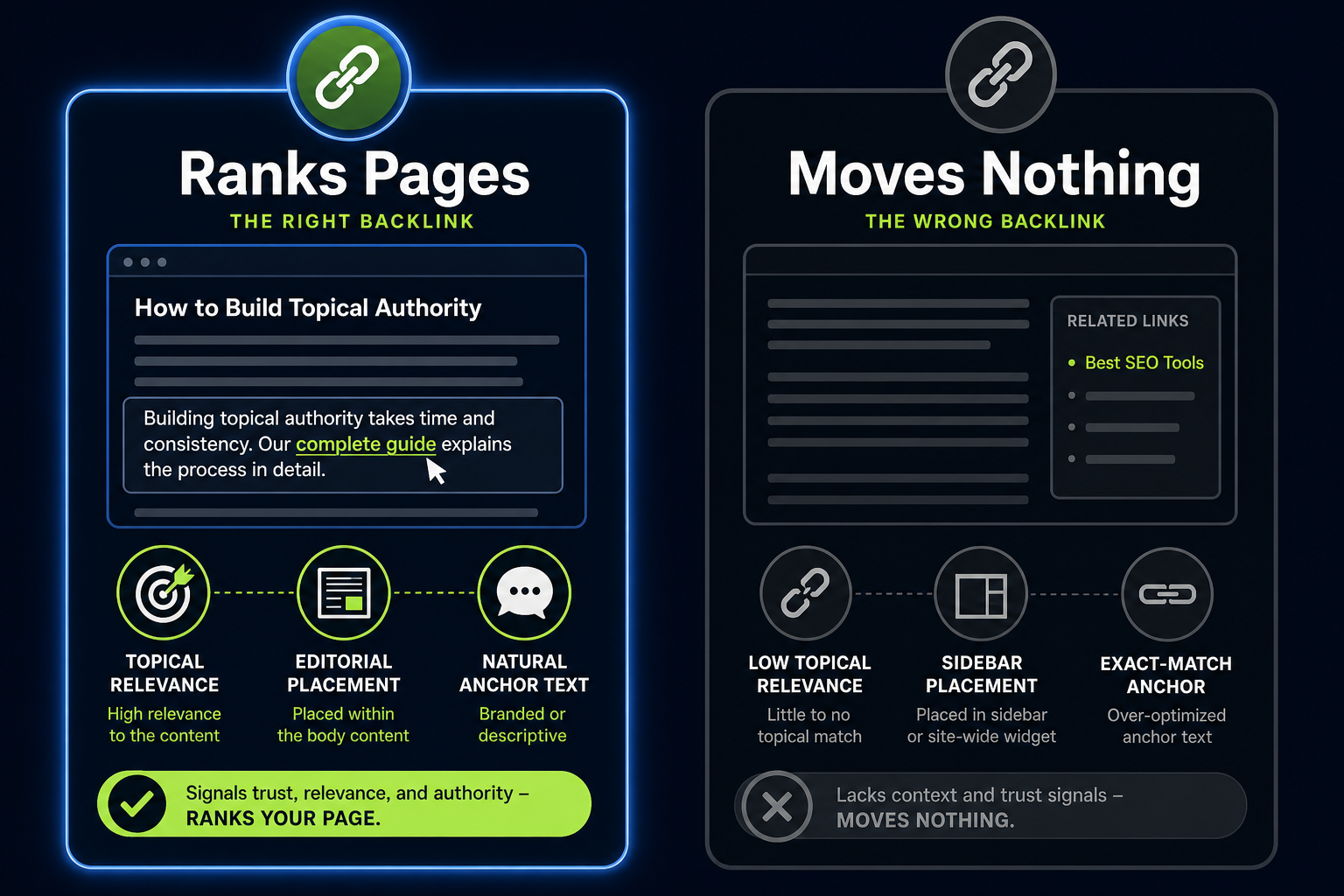
Topical Relevance
A SaaS analytics tool gets more value from a link on a marketing operations publication than from a link on a general business site with higher domain authority.
Editorial Placement
Links inside the body of a real article outperform sidebar mentions, footer links, and author bios by a wide margin.
Anchor Text Relevance
Branded and partial-match anchors look natural. Exact-match commercial anchors at scale trigger spam filters.
Link Velocity That Matches Your Category
Earning 30 editorial links over six months reads as natural growth. Earning 30 in a week reads as a paid campaign, even when it’s organic.
Skip everything else. These four factors determine 80% of the ranking lift you’ll get from any link program.
Benefit 2: AI Citation Influence (The Benefit Nobody’s Pricing In)
This is the benefit that didn’t exist three years ago and now matters more than half the items on traditional “benefits of link building” lists.
When ChatGPT, Perplexity, Gemini, or Claude generates an answer that recommends brands in your category, those recommendations come from somewhere. They come from the publications, articles, and editorial sources the model trained on or retrieves from in real time. If your brand isn’t mentioned and linked on those sources, you don’t appear in AI-generated recommendations. Your competitors do.
Editorial link building, the kind that earns mentions on category-relevant publications, feeds the same source pool that AI models learn from. A link on a publication like TechCrunch, G2, or a niche industry outlet does three things at once now:
- Lifts your Google rankings via traditional ranking signals.
- Drives some referral traffic.
- Builds the brand-category association that AI models use when answering questions like “what’s the best [your category] tool for B2B SaaS?”
The brands showing up consistently in ChatGPT recommendations aren’t the ones with the most backlinks. They’re the ones with editorial mentions across the publications AI models actually index. How brand mentions work in AI search goes deeper on this mechanic.
If you’re running a link building program in 2026 and not measuring AI citation lift alongside ranking lift, you’re leaving the most valuable benefit untracked.
Benefit 3: Referral Traffic (Real, But Smaller Than You Think)
Most “benefits of link building” articles inflate this benefit. Here’s the honest version.
The average editorial backlink sends fewer than 10 visitors per month. Some send zero. A handful, usually links inside high-traffic articles on major publications, send hundreds or thousands per month. Those links exist, but they’re a fraction of any link program.
Referral traffic becomes a meaningful benefit when:
- The link is inside an article that ranks for a high-volume query and pulls steady search traffic itself.
- The link is contextually placed inside content that’s directly relevant to the linking page’s topic.
- The linking publication has an engaged audience that clicks through, not just a high-traffic homepage.
What this means for prioritization: don’t chase links primarily for referral traffic. Chase them for ranking and citation impact, and treat referral traffic as a bonus when it shows up. The links that drive serious referral volume tend to be the same links that move rankings, so you don’t need a separate strategy.
One exception: a single link inside a viral article or annual industry roundup can send 50,000+ visitors over its lifetime. These are rare and unpredictable. Plan for them as upside, not core ROI.
Benefit 4: Faster Indexing for New Pages
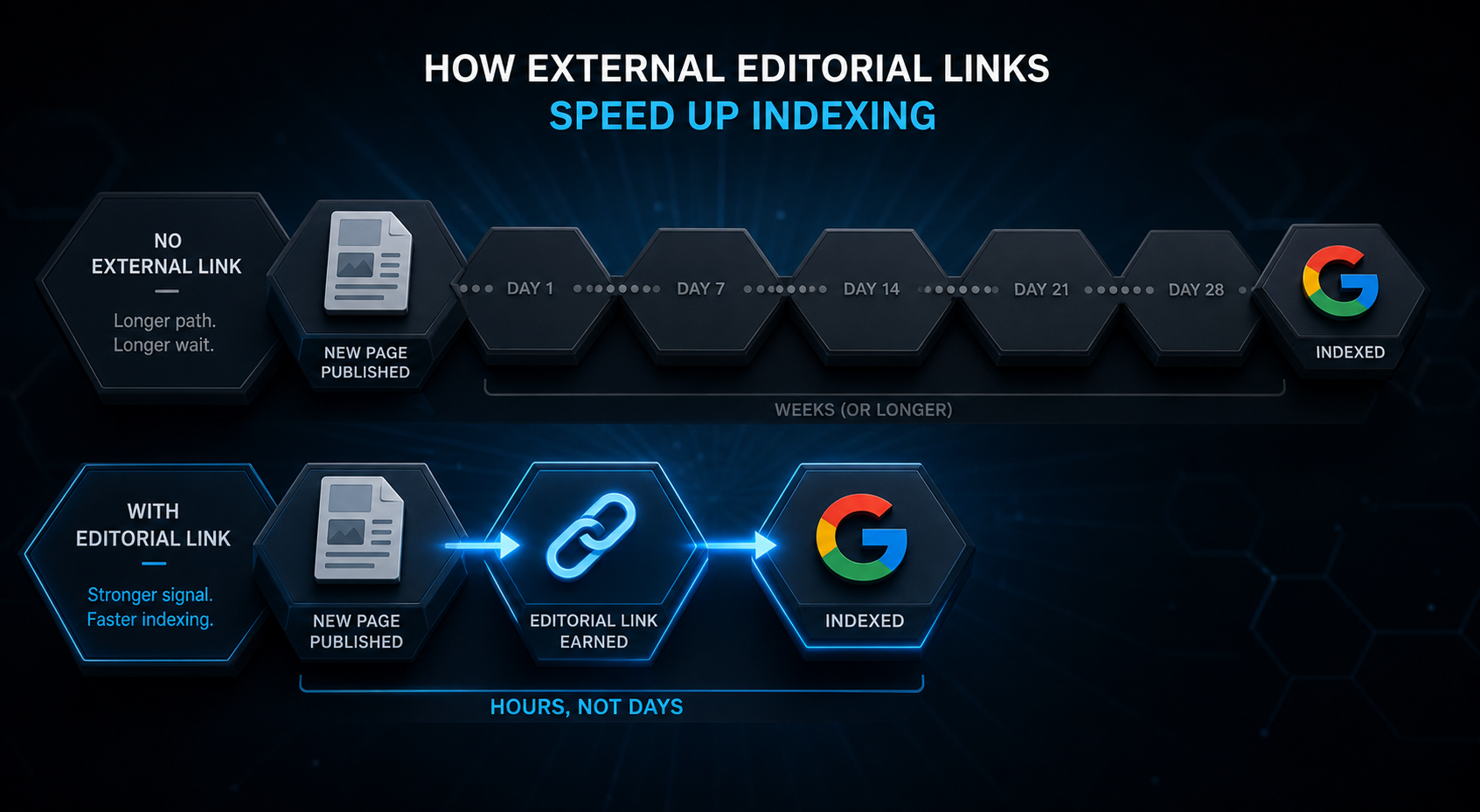
Google discovers new pages two ways: internal links from your own crawled pages, and external links from other sites. When a new page on your site has no external links pointing to it, Google can take days or weeks to crawl and index it. When the same page earns even one editorial link from a frequently-crawled publication, it typically gets indexed within hours.
This benefit is real but limited in scope. It matters most for:
- News-driven content where time-to-index affects ranking opportunity.
- New product pages, landing pages, or categories that need to start ranking quickly.
- Sites with technical issues that slow Google’s natural crawl cadence.
For a mature site publishing weekly content with healthy internal linking, indexing speed isn’t a meaningful pain point. Don’t oversell this as a reason to invest in link building.
Benefit 5: Stronger Entity Authority and Brand Recognition
Search engines and AI models build their understanding of your brand by tracking where your name appears, what context it appears in, and which other entities you’re associated with. Every editorial mention, linked or unlinked, adds a data point to that entity profile.
This benefit shows up in subtle ways:
- Your brand starts appearing in Google’s Knowledge Panel for category queries.
- AI assistants describe your brand more accurately and connect you to the right product category.
- Branded search volume increases as readers encounter your name across multiple trusted sources.
- Sales conversations get easier because prospects have heard of you.
Entity authority compounds over time and is hard to attribute cleanly to any single link. But it’s the foundation that makes every other benefit on this list work harder. A brand with strong entity authority ranks faster, gets cited by AI more often, and converts referral traffic at higher rates than an unknown brand earning the same links.
If you want a deeper read on this layer specifically, our entity SEO guide covers the practical side of building entity recognition.
Benefit 6: Networking and Partnership Opportunities
Almost every “benefits of link building” article includes this. Most overstate it.
Here’s what’s true: outreach-driven link building creates genuine relationships with editors, journalists, and content leads at relevant publications. Those relationships can lead to recurring placement opportunities, invitations to contribute as a quoted source, and occasional partnership conversations.
What’s not true: link building is not a reliable business development channel. The relationships are mostly transactional and one-directional. Don’t budget link building as a partnership pipeline.
Where networking benefits become real: when you build a content asset (original research, a survey, a tool) that becomes the reference source for an entire category. Then editors come to you. That’s a different game than standard outreach link building, and it’s worth pursuing if you have the resources to produce that level of asset.
Benefit 7: Increased Branded Search and Word-of-Mouth
Editorial links and mentions create exposure to audiences you wouldn’t reach through paid acquisition or organic search alone. A reader who encounters your brand inside a trusted publication’s article, even without clicking the link, is more likely to search for your brand later, mention it to a colleague, or remember you when a need surfaces.
This benefit is real but slow. It’s not a 90-day metric. It’s a 12-to-24-month compounding effect that shows up as growing branded search volume in Google Search Console, more direct traffic, and shorter sales cycles for inbound leads who say “I’ve seen your name everywhere.”
Track branded search trends quarterly. If they’re flat after 12 months of consistent link building, the program isn’t building brand awareness, it’s just chasing rankings. That’s a signal to rethink which publications you’re targeting.
See where AI answers put your brand
One free audit: 25 category prompts across every major engine, your citation share against named competitors, and a clear read on what a programme would change.
Request a free auditWhat “Benefits of Link Building” Lists Get Wrong
Most lists you’ll find on this topic include 8-10 benefits and treat them as roughly equal. They’re not.
Benefits that are overstated almost everywhere:
- “Lower bounce rate.” Backlinks have no direct effect on bounce rate. The claim is that “qualified referral traffic” bounces less, which is sometimes true but not a benefit of link building specifically.
- “Higher Domain Authority score.” DA is a third-party metric from Moz, not a Google ranking factor. Optimizing for DA is optimizing for a vanity number.
- “More credibility.” True in spirit, vague in practice. Credibility shows up as entity authority and branded search, measure those instead.
- “Better internal linking.” Internal linking is a separate practice. External links don’t improve internal architecture.
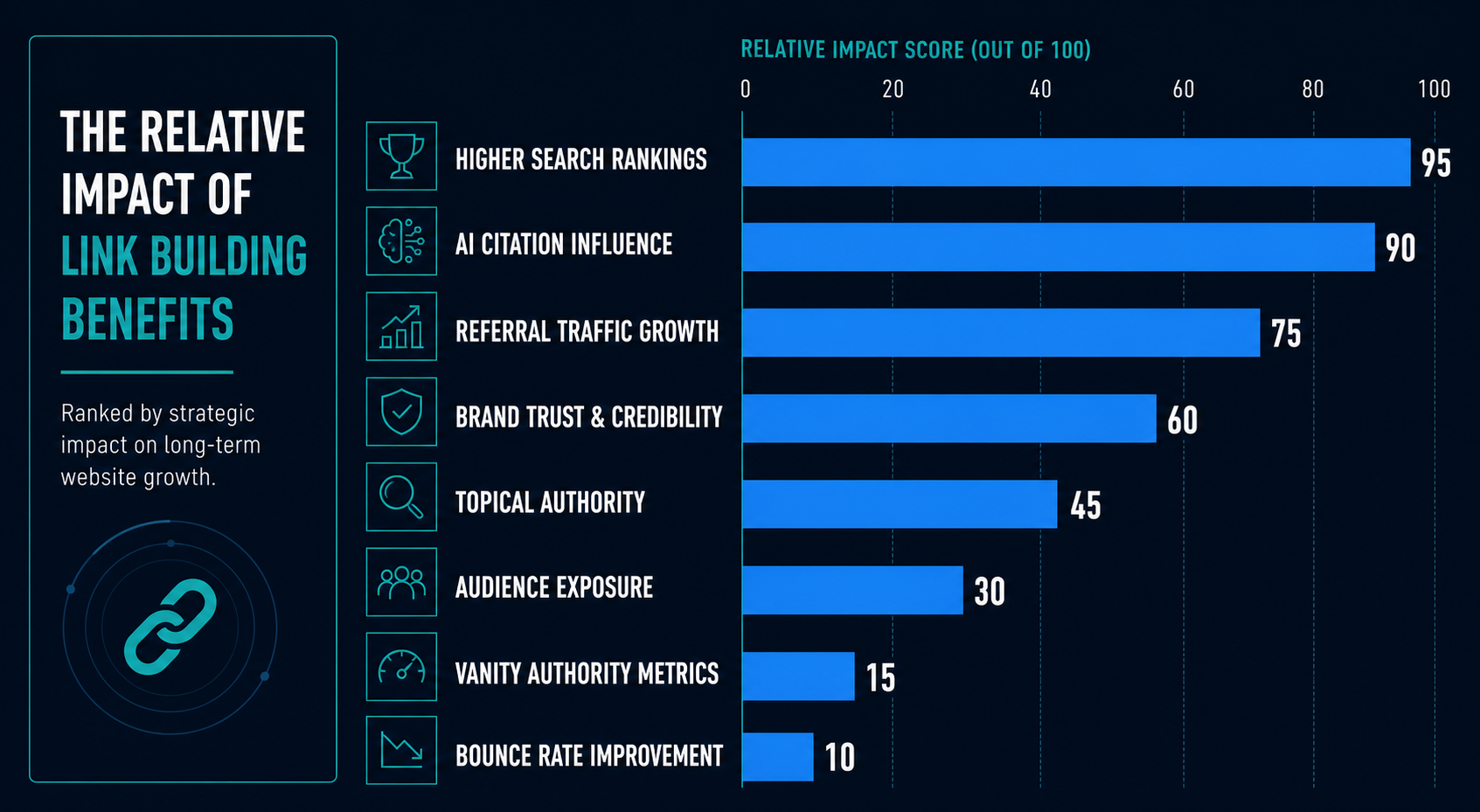
The benefits worth prioritizing, in order: rankings, AI citations, entity authority, indexing speed, branded search lift. Everything else is secondary.
How to Prioritize Link Building Investment in 2026
If you’re deciding where to spend a fixed budget, here’s the prioritization that matches the real benefit weights:
| Priority | Investment Focus | Why |
|---|---|---|
| 1 | Editorial placements on category-relevant publications AI models index | Compounds across rankings and AI citations |
| 2 | Original research or data assets that earn organic links | Highest long-term ROI, hardest to replicate |
| 3 | Digital PR for product launches or category trends | Drives both rankings and brand recognition |
| 4 | Niche industry guest posts on real publications | Steady ranking lift, modest referral traffic |
| 5 | Unlinked brand mention reclamation | High ROI on time, easy wins |
What to avoid: bulk link packages, directory submissions, comment links, low-quality guest post networks, and any “100 backlinks for $99” service. These actively hurt ranking and citation outcomes in 2026.
The biggest benefit of link building in 2026 is higher search rankings, which remain driven by editorial backlinks from topically relevant publications. The newest benefit is AI citation influence, links on the publications ChatGPT and Perplexity learn from shape how those models describe your brand.
Frequently Asked Questions
What is the main benefit of link building?
Higher search rankings. Editorial backlinks from category-relevant publications remain a top-3 Google ranking factor in 2026, and ranking improvement is the single most measurable, attributable benefit of any link building program.
How long does it take to see benefits from link building?
Most ranking improvements show up 8 to 16 weeks after links are placed. Indexing benefits appear within hours. Entity authority and branded search benefits compound over 12 to 24 months. Anyone promising results in 30 days is misleading you.
Do backlinks still matter for SEO in 2026?
Yes. Despite repeated claims that links matter less, Google’s ranking systems still treat editorial backlinks from authoritative, relevant sources as a primary signal. The bar for what counts as a quality link has risen, but link building itself is more important than ever.
How do backlinks affect AI search and ChatGPT?
AI assistants like ChatGPT and Perplexity learn brand-category associations from the same publications that drive Google rankings. Editorial mentions and links on those sources shape how AI describes your brand and which brands it recommends in category queries.
What’s the difference between quality and quantity in link building?
Ten editorial links from category-relevant publications with real readers will outperform 100 directory or low-quality guest post links every time. Google evaluates link quality based on the source’s topical relevance, editorial standards, and authority, not the raw number of links.
Can link building hurt my site?
Yes, when done badly. Spammy links, exact-match anchor text at scale, paid link networks, and bulk directory submissions can trigger Google’s spam filters and lead to manual penalties or algorithmic suppression. Editorial link building done well carries minimal risk.
How many backlinks do I need to rank?
It depends on your category and competitors. Check the link profiles of pages currently ranking in the top 5 for your target keywords. Match or exceed their referring domain count from comparable-quality sources. There’s no universal number.
Is link building worth the cost?
For most B2B brands competing in non-trivial categories, yes, when the program prioritizes editorial placements on relevant, AI-indexed publications. For brands in extremely low-competition niches or with strong existing brand recognition, the ROI is lower. Audit competitor link profiles before committing budget.
Make Link Building Earn Its Budget
Link building still works in 2026, but only if you’re investing in the benefits that actually compound. Rankings, AI citations, and entity authority, in that order. Everything else is downstream of those three.
The mistake most teams make is treating every link as equally valuable and chasing volume. The teams winning in 2026 treat link building as editorial placement strategy, focused on the publications that move both Google rankings and AI recommendations at the same time.
Ready to dig into the mechanics? Start with our practitioner guide on what link building is and how it actually works, or read about editorial link building if you’re ready to focus on the placements that compound.