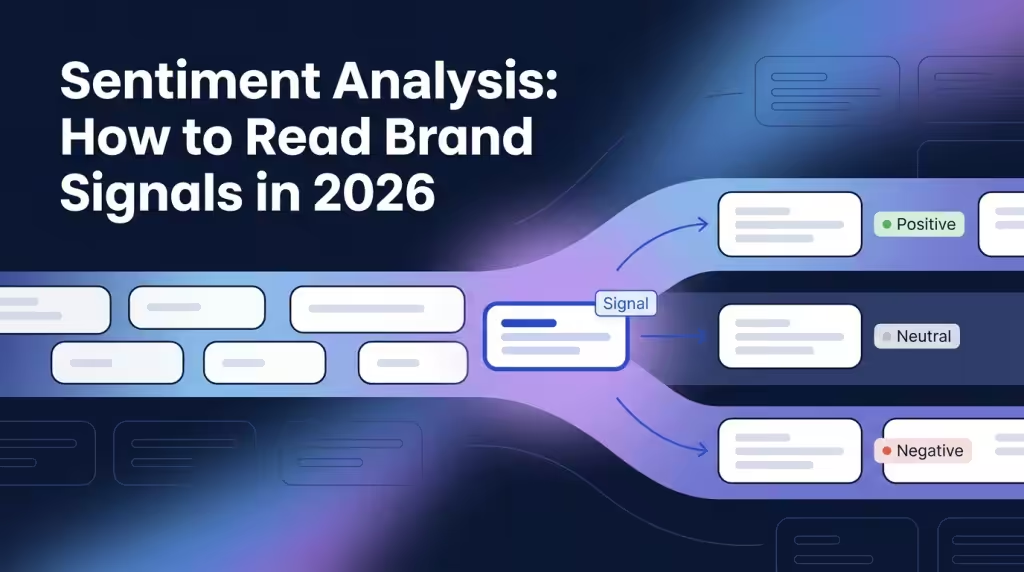

Most teams treat sentiment analysis like a dashboard gauge, green means good, red means bad, move on. That’s how you miss the actual signal. Sentiment analysis is the process of using natural language processing and machine learning to classify text as positive, negative, or neutral, and, done well, to surface why people feel that way about specific parts of your product, brand, or category. The dashboard is the easy part. Reading it correctly is where most brands fall apart.
This guide walks through how sentiment analysis actually works in 2026, where the classic approaches still hold up, where they quietly break, and how to turn a sentiment score into a decision your team can act on Monday morning.
The Short Version
- Sentiment analysis classifies text as positive, negative, or neutral, but overall polarity is the least useful output. Aspect-based sentiment is where the real decisions live.
- Three core approaches exist: rule-based (fast, brittle), machine learning (accurate with good data), and LLM-based (flexible, expensive, sometimes overconfident).
- Sarcasm, negation, and mixed sentiment still break most models. If your tool reports 94% accuracy, it’s probably not measuring what you think.
- A sentiment score without a baseline is noise. Trend, segment, and aspect matter more than the absolute number.
- In 2026, the most valuable sentiment signals aren’t on review sites, they’re inside AI-generated answers about your brand.
What Sentiment Analysis Actually Measures
At its core, sentiment analysis takes unstructured text, reviews, tweets, support tickets, survey responses, chat transcripts, and assigns it an emotional label. The simplest output is three buckets: positive, negative, neutral. More advanced systems add intensity (how positive?), emotion (is it anger, disappointment, or joy?), and aspect (what specifically is the person reacting to?).
The label matters less than what you do with it. A brand can have 80% positive sentiment and still be losing deals, because the 20% negative sentiment is concentrated in the exact feature your sales team leads with. That’s the problem with polarity-only reporting. It hides the mechanics.
Think of sentiment analysis as a filter, not a verdict. It tells you where to look. The why still comes from reading the text.
The Three Approaches, And Where Each Breaks
Every sentiment analysis system uses one of three approaches, or a hybrid. Understanding the tradeoffs decides whether you build, buy, or skip it entirely.
Rule-Based Sentiment Analysis
Rule-based systems work off lexicons, dictionaries of words tagged as positive (“excellent,” “love,” “smooth”) or negative (“terrible,” “broken,” “slow”). The system counts, weights, and averages.
Upside: fast, cheap, fully explainable. You can read the rules.
Downside: it breaks the moment real humans show up. “Not bad” gets scored as negative. “Sure, great feature” (dripping with sarcasm) gets scored as positive. Industry-specific language, think “sick” in fitness communities or “insane” in gaming, flips polarity entirely. Rule-based is fine for simple, clean text in a narrow domain. It’s a disaster for social data.
Machine Learning Sentiment Analysis
ML-based systems train on labeled datasets, thousands of examples of text tagged by humans. Classic algorithms (Naive Bayes, SVM, logistic regression) and newer transformer models (BERT, RoBERTa, DistilBERT) learn patterns from the data rather than relying on fixed rules.
Upside: handles context, negation, and domain language far better. Accuracy on clean benchmarks sits in the 85-92% range for English text.
Downside: you need labeled training data, which is expensive, slow, and often inconsistent. Human annotators agree with each other only about 80% of the time on sentiment labels, according to research on annotation agreement. Your model’s ceiling is the quality of its labels. And once you leave the training distribution, new slang, new products, a different industry, accuracy drops fast.
LLM-Based Sentiment Analysis
The newer approach: prompt a large language model (GPT-4o, Claude, Gemini) to classify sentiment, extract aspects, and explain its reasoning in plain language. No training dataset required. No model to maintain.
Upside: handles nuance, sarcasm, and mixed sentiment better than any prior approach. Works across languages and domains out of the box. Can output structured JSON with aspect, intensity, emotion, and confidence in one pass.
Downside: cost adds up fast at scale. Latency matters if you’re analyzing in real time. And LLMs hallucinate, they’ll confidently mislabel text and give you a fluent explanation for why. You need sampling and validation, not blind trust.
The Types That Matter (And the Ones That Don’t)
Vendors love to list six or seven “types” of sentiment analysis. Most of the list is marketing. Three types actually change how you run campaigns.
Aspect-Based Sentiment Analysis (ABSA)
ABSA pulls the specific thing each sentiment is about. “The onboarding was smooth but pricing is a joke” becomes two data points: onboarding (positive) and pricing (negative). This is the single highest-value variant for product and marketing teams. It’s the difference between “customers feel mixed about us” and “customers love the product but hate the contract terms.” One of those is actionable. The other is wallpaper.
Emotion Detection
Instead of positive/negative, emotion detection classifies text into categories like joy, anger, sadness, fear, surprise, and disgust. Useful for crisis response and customer support triage, an angry ticket needs different routing than a sad one. Less useful for broad brand tracking, because “angry about pricing” and “angry about downtime” look the same at the emotion level.
Intent-Based Sentiment
Classifies text by what the person wants to do, not just how they feel. “Considering switching providers” and “ready to cancel” carry very different business weight even though both are technically negative. Intent layers are where support and sales teams find the most valuable signals.
The types we’d skip unless you have a specific reason: “fine-grained” scoring (1-5 stars from text), which tends to be noisier than binary polarity, and “multilingual sentiment” as a distinct category, it’s just sentiment analysis with a model that handles your target languages.
Where Sentiment Analysis Quietly Breaks
Every vendor demo shows sentiment analysis working beautifully. In production, it fails in predictable ways. Knowing where it fails is how you stop trusting the wrong numbers.
Sarcasm and Irony
“Yeah, this tool is amazing, crashed three times today.” Most models score that as strongly positive. Context and tone that humans parse instantly are invisible to polarity-only systems. LLMs handle this better but still miss it maybe 30% of the time on short-form text.
Negation
“The support team wasn’t helpful at all.” Simple negation still trips rule-based systems and older ML models because they weight the positive word (“helpful”) without catching the scope of the negation. Test any tool you’re evaluating with five negated sentences. If it gets three wrong, keep shopping.
Mixed Sentiment
“Love the interface, hate the price.” One sentence, two sentiments. Polarity-only tools average it to “neutral,” which is exactly wrong, both signals matter individually. This is the core case for ABSA.
Domain Drift
A model trained on movie reviews (the original benchmark dataset) will misclassify SaaS feedback. A model trained on English consumer reviews will butcher B2B enterprise language, where “acceptable” often means “we’re seriously considering churning.” If the training data doesn’t match your domain, the accuracy number on the vendor’s website doesn’t apply to you.
Baseline Blindness
A 70% positive sentiment score means nothing on its own. Is that up or down from last quarter? How does it compare to competitors? Is it normal for your category? Without a baseline, you’re not measuring, you’re describing.
How to Actually Run Sentiment Analysis on Your Brand
For the AI-visibility complement to sentiment work, see how ChatGPT shows your brand and Perplexity citation tracking, and brand mention tracking inside language models covers the cross-platform cadence that pairs with the sentiment routine described below.
Most teams bolt sentiment analysis onto a listening tool and call it done. The ones who get real value run a tighter process. Here’s the workflow that holds up.
Step 1: Define What You’re Measuring
Not “brand sentiment”, too vague. Specific: sentiment on our onboarding experience, sentiment on pricing discussions, sentiment on competitor comparisons, sentiment in support tickets after feature X launched. Every sentiment project needs a defined scope before the first API call. Without scope, you’ll drown in averages.
Step 2: Pick Your Sources Deliberately
Not all text is equal. Review sites skew toward extremes (delighted or furious). Twitter/X skews toward reactions and hot takes. Support tickets skew toward problems. LinkedIn skews toward professionalism. Surveys skew toward whatever you framed them to measure. Combine at least three sources to get a defensible read. Rely on one, and you’re measuring the source bias more than the sentiment.
Step 3: Sample Before You Automate
Before you turn on the firehose, take 200 examples. Read them. Label them yourself. Then run your tool on the same 200 and compare. If your tool agrees with you less than 80% of the time, the dashboard you’re about to build will lie to you daily. Fix the model, swap vendors, or change the scope, don’t ignore it.
Step 4: Report Trend, Segment, and Aspect, Never Just Score
A sentiment number alone is useless. Three lenses make it useful:
- Trend: is sentiment moving up, down, or flat over the last 30/90 days?
- Segment: how does sentiment split across customer tier, product, channel, geography?
- Aspect: which specific parts of the experience drive the positive and negative signals?
A report with all three beats a dashboard with a giant number on it, every time.
Step 5: Close the Loop
The point of sentiment analysis isn’t a number on a slide. It’s a decision: fix this, double down on that, escalate this, message this differently. Every sentiment report should end with two or three specific actions. If it doesn’t, the analysis didn’t do its job.
Sentiment Analysis in 2026, What’s Actually Changed
The textbook explanation of sentiment analysis hasn’t changed much in five years. The practical reality has.
LLMs quietly took over the field. Teams that used to maintain a BERT fine-tune for sentiment have largely moved to calling GPT-4o or Claude with a structured prompt. The accuracy is better, the dev time is lower, and the output is richer (aspect, emotion, intent, all in one call). The catch is cost at volume and the need for human sampling to catch hallucinated labels.
Multimodal sentiment is real now. Images, video, and voice carry sentiment that pure text analysis misses. A negative tweet with a positive meme attached reads differently than either signal alone. The leading tools now process both, though most brand dashboards still ignore the multimodal layer.
The most valuable brand sentiment lives in AI answers. When a prospect asks ChatGPT, Perplexity, or Gemini about your category, the model generates a comparison that carries sentiment, toward you and your competitors. That’s a sentiment signal most brand tracking tools don’t touch yet. It’s also the signal that’s shaping pipeline for the brands paying attention. If you want to see how teams are tracking it, our guide on brand sentiment analysis goes deeper on the measurement side.
Real-time is table stakes. Five years ago, weekly sentiment reports were fine. Now, a PR crisis unfolds in hours and your team is expected to have a read before the first news cycle ends. If your sentiment stack runs on batch jobs, it’s already behind.
See where AI answers put your brand
Twenty minutes with a senior strategist: where the major engines point buyers in your category, who gets named instead of you, and a straight read on what a programme would change.
Book a strategy callTools Worth Looking At (And What They’re Good For)
A quick, honest shortlist. No vendor rankings, just what each tool is actually useful for.
| Tool | Best For | Watch Out For |
|---|---|---|
| Brandwatch | Enterprise social listening with sentiment layered in | Expensive; overkill for small teams |
| Talkwalker | Multilingual sentiment and image analysis | UI learning curve |
| Mention / Brand24 | Mid-market social monitoring with decent sentiment | Accuracy varies by industry |
| AWS Comprehend / Google NL API / Azure | Build-your-own sentiment at scale | Generic models; need your own pipeline |
| GPT-4o / Claude / Gemini via API | Flexible, high-accuracy sentiment with aspect and emotion | Cost at volume; requires sampling |
| VADER / TextBlob (open source) | Prototypes and small projects | Outdated for anything social in 2026 |
For most B2B teams, the right answer in 2026 is a blend: a listening platform for coverage and alerts, plus LLM calls for the nuanced analysis on high-priority text (support tickets, sales calls, churn surveys). Don’t pick a single tool for every use case. Different signals need different instruments.
If you’re also tracking how your brand shows up across listening tools themselves, our brand monitoring tools comparison covers the broader category, sentiment is one feature inside a bigger stack.
Common Mistakes That Wreck Sentiment Programs
The sentiment-program mistake we see most often in audits is a team reporting overall polarity week after week and never drilling into aspect-level breakdowns. Overall sentiment averages out pricing complaints against onboarding praise and surfaces nothing the product team can act on. Switch the weekly report to aspect-based cuts (pricing, onboarding, support, a named competitor) and the same underlying data starts producing decisions instead of decoration.
Three failure patterns show up across nearly every sentiment program that stalls. First: trusting the vendor’s accuracy number without testing it on your own data. Second: reporting overall sentiment without aspect or segment breakdowns. Third: treating sentiment as a standalone metric instead of pairing it with volume, reach, and intent.
A fourth trap worth naming: confusing sentiment with satisfaction. A customer can write a glowing review and still churn, because the review was written at the honeymoon stage, not after the renewal conversation. Sentiment measures expressed emotion at a point in time. Satisfaction is a longitudinal outcome. They correlate, but they’re not the same thing.
One more: ignoring silence. The absence of sentiment is itself data. If your category is being discussed widely and your brand barely appears in the conversation, you don’t have a sentiment problem, you have a visibility problem. Different fix entirely.
Frequently Asked Questions
What’s the difference between sentiment analysis and opinion mining?
They’re the same thing. “Opinion mining” is the older academic term; “sentiment analysis” is what practitioners use today. Some researchers draw a fine distinction, opinion mining extracts the opinion holder and target, sentiment analysis focuses on polarity, but in practice the terms are interchangeable.
How accurate is sentiment analysis in 2026?
On clean, English, in-domain text, top models hit 88-94% accuracy. On real-world social data with sarcasm, slang, and domain drift, real accuracy sits closer to 70-80%. Vendor claims of 95%+ accuracy almost always reference benchmark datasets, not your actual text. Always test on your own sample.
Can sentiment analysis detect sarcasm?
Modern LLM-based sentiment analysis catches sarcasm maybe 60-70% of the time on short-form text, a big jump from rule-based systems, which miss it almost entirely. If sarcasm detection is critical to your use case, sample heavily and don’t trust automated labels without human review.
Should I build my own sentiment model or buy a tool?
Buy unless you have a very specific reason not to. Building a custom model only makes sense if you have a domain where off-the-shelf tools fail, enough labeled data to train on, and an ML team to maintain it. For 95% of B2B marketing teams, calling an LLM API or using a listening tool gets you 90% of the value at 10% of the cost.
Does sentiment analysis work for languages other than English?
Yes, but quality drops outside English, Spanish, and Mandarin. For less-resourced languages, LLM-based approaches now outperform dedicated multilingual models from a few years ago. If you’re tracking multiple languages, sample-test each one separately, aggregate accuracy numbers hide huge variance.
How often should I run sentiment analysis on my brand?
Daily monitoring for alerts and crisis detection. Weekly trend reports for marketing. Monthly deep-dives with aspect and segment breakdowns for strategy. Quarterly benchmarking against competitors. The cadence matters less than the consistency, the same report every week beats an irregular deep-dive.
A 50-Mention Reading Routine to Run After the Dashboard
A sentiment dashboard is the easy part. Most teams stop there and wonder why the insights don’t drive action. The teams that get value from sentiment analysis treat the score as the starting line, not the finish.
Go read the last 50 pieces of text behind your current sentiment number. Not the summary. The actual text. You’ll find patterns your dashboard missed, specific phrases, specific objections, specific competitor comparisons, that reshape what you do next week. That’s the work. The model sorts the pile. Reading the pile is still your job.
Want the measurement side of this? Our guide on reading brand sentiment data picks up where this one leaves off.