

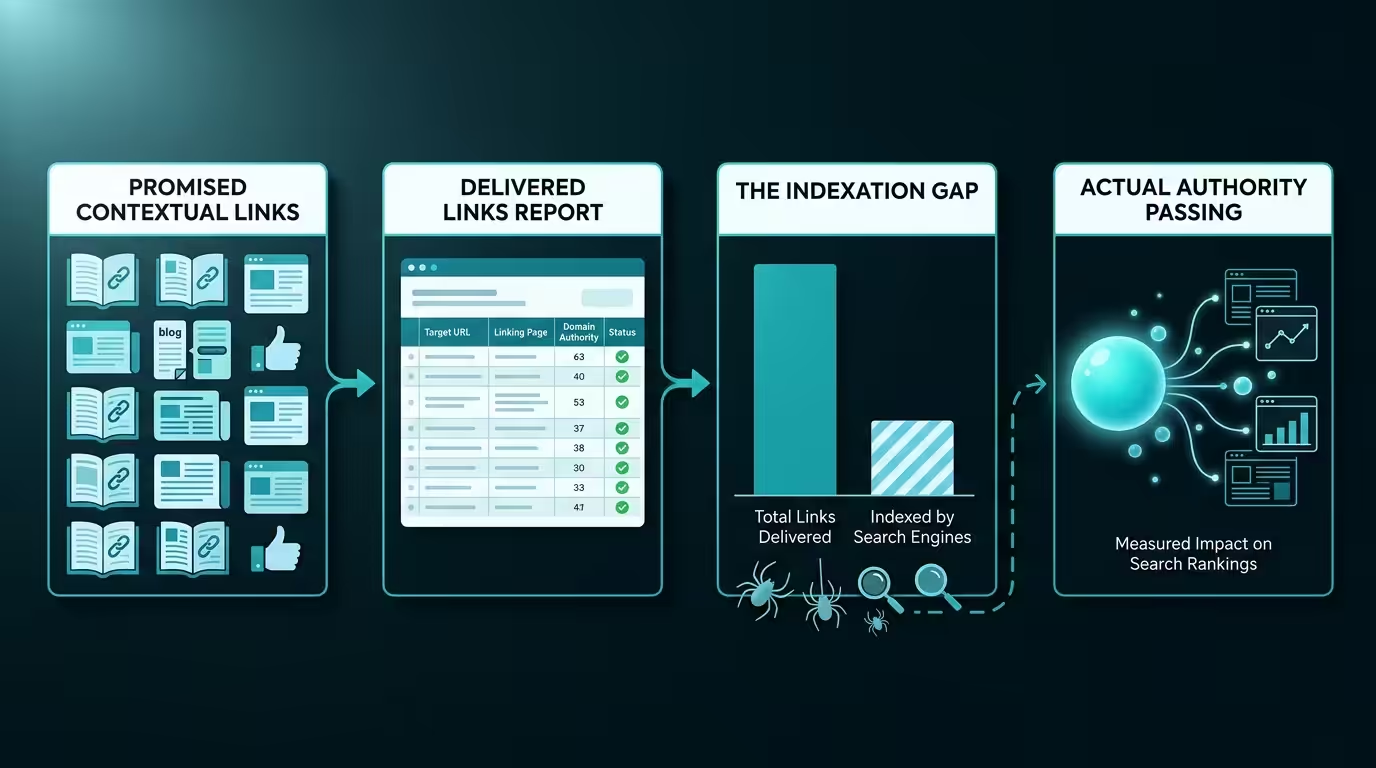
Most contextual link building services sell the same thing: a backlink placed inside an article on a website you’ve never heard of, at a price that feels reasonable until you look at what you got. The placements go live. The spreadsheet looks busy. Six months later, your rankings haven’t moved. If you’re evaluating a contextual link building service right now, the question isn’t whether contextual links work, they do. It’s whether the service you’re about to hire is buying placements that pass real authority or padding a report with links Google will ignore.
This guide walks through what separates the services that move rankings from the ones that move budget. pricing reality, quality signals, red flags, and the questions that force a vendor to show their actual work.
What You’ll Learn
- What a contextual link building service actually delivers, and what most of them quietly don’t
- Real 2026 pricing: why $150 links and $500 links often come from the same network
- The six quality signals that separate editorial placements from dressed-up PBNs
- Eight questions that force a vendor to prove their process before you sign
- When to hire a service, when to build in-house, and when contextual links aren’t the right spend
What a Contextual Link Building Service Really Does
A contextual link building service earns backlinks placed inside the body of published articles on external websites. The link sits within relevant surrounding content, not in a sidebar, footer, author bio, or directory listing. That placement is the whole point: Google, Bing, and increasingly the AI models pulling from their indexes weight in-content editorial links more heavily than structural links because in-content links look like a real human decided the reference was worth making.
That’s the definition. The reality is messier. Under the “contextual link building service” label sit at least four different business models, and they produce wildly different outcomes:
- Editorial outreach services pitch real publications, negotiate placements, and either insert a link into an existing article or publish a new guest post. Slow, expensive, and, when done well, the only model that produces links worth having.
- Marketplace services sell you placements from a private list of webmasters who’ve agreed to accept paid links. The “outreach” already happened, years ago. You’re buying inventory.
- Network services own the sites they place links on. Sometimes disclosed, usually not. This is the PBN model with a new coat of paint.
- Hybrid services blend all three and hope you don’t ask which link came from where.
When someone sells you “contextual link building,” ask which model they run. If the answer is vague, you already have your answer.
Why the Placement Actually Matters
The reason contextual links are treated as the premium link type has nothing to do with how they look on a report. It’s about the signals Google uses to judge whether a link is editorial or manufactured. A link inside a paragraph about, say, B2B marketing attribution, on a page that ranks for marketing attribution queries, on a site that earns its own links from marketing publications, that link carries real weight. The same anchor text, on a “General Business Tips” page, on a domain that publishes 40 unrelated posts a month, on a site whose own backlink profile is 90% other paid placements, that link is a liability at worst and inert at best.
Two links. Both technically “contextual.” One moves rankings. The other shows up in a monthly report and does nothing. This is the gap most services won’t explain, because acknowledging it would disqualify half their inventory.
What Contextual Link Building Actually Costs in 2026
Pricing in this space has calcified into three clear tiers, and the tier tells you more about the service than the sales page ever will.
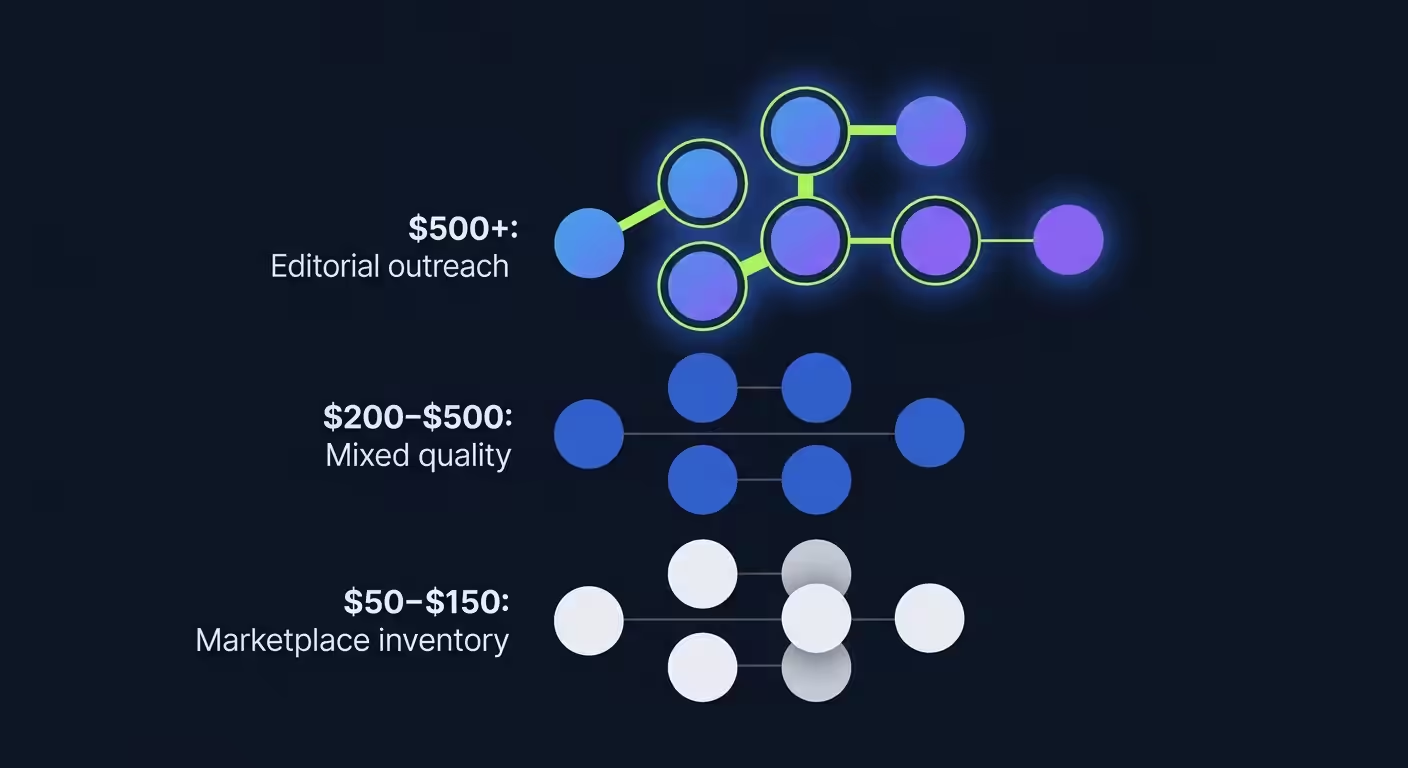
| Price per link | What you’re actually buying | Typical outcome |
|---|---|---|
| $50, $150 | Marketplace placement on a site that exists to sell links. DR inflated through other paid links. Little to no organic traffic. | Indexed sometimes. Moves rankings rarely. Risk of manual action if stacked. |
| $200, $500 | Mixed inventory, some legitimate mid-tier publications, some marketplace sites dressed up as editorial. Depends entirely on vendor selectivity. | Works for some niches, fails in others. Quality varies link-to-link even within the same order. |
| $500, $1,500+ | Actual editorial outreach to real publications with organic traffic and independent editorial standards. Slower turnaround, fewer links per month. | Consistent ranking movement in 3-6 months. Links stay live. Survives algorithm updates. |
A 2024 Authority Hacker survey pegged the average paid backlink at $83, which sounds encouraging until you realize the average paid backlink also does roughly nothing. The useful number isn’t the average, it’s the floor below which quality stops being possible. In 2026, that floor sits around $200, $250 per placement, and even that requires a vendor who’s willing to say no to publications that don’t meet their standard.
Why Cheap Contextual Links Stopped Working
The $50 contextual link isn’t a 2026 problem, Google’s been discounting networked placements since the Penguin era. What changed is how visible the discounting became. Sites that existed purely to sell links used to at least rank for their own niche keywords. Now most of them don’t rank for anything. Their traffic is referral from Upwork gigs. Google knows what these sites are, and a link from one is worth what you paid for it: nothing in ranking terms, a tax deduction at best.
If a service is selling contextual links at volume for $75 each, they’re either buying from the same handful of networks everyone else buys from, or they’re running their own. Either way, the links aren’t editorial, they’re inventory.
Six Quality Signals That Separate Editorial Placements From Inventory
When a vendor sends you a placement for approval, or when you’re auditing what they delivered, run through these six signals. The link either passes or it doesn’t. No middle ground.
1. The Site Ranks for Real Commercial Keywords in Your Niche
Pull the domain into Ahrefs or Semrush. If its top pages rank for “how to write a blog post” and “benefits of marketing”, generic filler that exists to stuff keywords into content, the site is an inventory site. Real publications rank for queries buyers actually search.
2. Organic Traffic Is Genuine and Topically Relevant
A DR 60 site with 80% of its traffic from branded searches for unrelated topics isn’t a relevant placement. Look at the top 20 organic keywords. Do they match the site’s stated focus?
3. The Backlink Profile Isn’t 90% Other Paid Placements
Check the site’s own referring domains. If the vast majority of its inbound links come from other sites that exist to sell links, you’re looking at a node in a paid network, not an editorial site.
4. The Page Hosting Your Link Ranks for Something
A link from a DR 70 site on a page that ranks for zero keywords is a link on a dead page. Google discounts links on pages it doesn’t value.
5. Editorial Standards Are Visible
Real publications reject pitches. They edit content. They care about their reader. An “editor” who accepts every guest post within six hours isn’t editing anything.
6. The Site Has an Identity That Exists Outside Link Sales
A newsletter. A podcast. Real authors with real bylines elsewhere. A social presence. When everything about a site points to “content farm built to monetize links,” that’s what it’s.
Across dozens of contextual link campaigns we’ve audited for clients who came to us after previous vendors underperformed, the same pattern shows up: the delivered links pass maybe two of these six signals. The missing four are why rankings didn’t move.
What a Real Editorial Placement Looks Like
The link sits inside a paragraph that was written, or edited, to reference your brand as an example, a source, or a comparison. The anchor text reads naturally. Removing the link wouldn’t damage the sentence, but the sentence genuinely benefits from it being there. The surrounding content is on a topic you’d want to be associated with. The author has a real byline. The publication covers your category or an adjacent one. The page has organic traffic. Six months from now, the link is still live, because the publication has no reason to take it down.
Links like this are harder to get and slower to earn. They also compound. A single placement in a publication that AI models pull into their training data keeps working long after the campaign ends.
Eight Questions That Force a Vendor to Show Their Work
Before you sign a contract, send these eight questions. If a vendor dodges, softens, or “can get back to you on that” for more than two, they’re not the right service, regardless of how good the sales call was.

- “Show me five sites you’ve placed links on in the last 60 days for clients in my niche.” Real vendors have a portfolio. Services that recycle the same inventory don’t want you to see the list.
- “What’s your rejection rate on publications you pitch?” Editorial outreach rejects 70%+ of what it pitches. If the answer is under 30%, they’re not pitching editorial sites.
- “How do you handle a placement going nofollow or being removed three months later?” Quality services replace it. Inventory services charge you for another link.
- “Who writes the content that hosts the link?” If the answer is “our team” and the pricing is under $300 per link, the content is being produced at a speed and cost that guarantees it’s AI-generated and unedited.
- “What metrics do you use to qualify a site before placement?” You want to hear organic traffic, topical relevance, keyword ranking on the placement page, and backlink profile quality. If the answer is “DR and DA,” the vendor is gaming metrics, not evaluating sites.
- “Can I veto placements before they go live?” The answer must be yes. Vendors who resist this don’t want you auditing their inventory.
- “What’s your anchor text policy?” Healthy profiles mix branded, naked URL, natural phrase, and partial-match anchors. If the vendor asks you for exact-match anchors for every placement, they’re building a profile that looks manipulated.
- “What happens if Google issues a manual action on my site from a link you placed?” Real services have a disavow process and will work with you. Inventory services disappear.
When a Service Makes Sense, and When It Doesn’t
Hiring a contextual link building service is the right call when you’ve a clear commercial reason to rank for specific queries, a site that’s technically sound, content that deserves to rank, and a budget that can support real editorial placements for 6+ months. Pull any of those legs out and the service spend gets wasted.
Hire a Service When
- You’ve exhausted the links you can earn through PR, HARO-style expert sourcing, and your own content
- You’re in a niche where your competitors clearly rank on backlink strength, not just content depth
- you’ve a content team that can capitalize on rankings once you get them, traffic without conversion is just a vanity metric
- You can commit to a 6-month minimum. Contextual link building compounds. Three-month tests prove nothing.
Don’t Hire a Service When
- Your site has serious technical or content problems. Links won’t rescue thin content or a crawlability mess.
- Your budget caps out at $500 a month. That buys you two or three links at the low-quality tier, not enough volume at any tier to matter.
- You’re chasing a single keyword. One link won’t rank it, and ten of the wrong links definitely won’t.
- You need results in 30 days. Contextual links take 3-6 months to move rankings. Anyone promising faster is either lying or selling something else.
One pattern we see repeatedly in client intake: teams that burned $8K, $15K on contextual link campaigns before their content was ready to rank. The links indexed. The rankings didn’t move. The problem wasn’t the service, it was the sequence. Fix the site first. Buy the links second.
How Contextual Link Building Fits Into a 2026 Brand Authority Strategy
For the AI-visibility complement to traditional authority work, see the ChatGPT brand mention check workflow and the Perplexity brand visibility workflow, and how AI models cite brands covers the cross-platform cadence that sits alongside contextual link building in a 2026 authority program.
Contextual links aren’t the only signal that matters anymore, and any honest service will tell you that. Google’s ranking systems weigh them. AI models scan them when building the citation graphs they pull from. Buyers click them. All true. But the links work harder when they sit inside a broader authority layer: earned mentions, industry presence, a brand name that shows up in category conversations without you paying for every instance.
The services worth hiring understand this. They don’t pitch backlinks as a standalone channel, they pitch them as one input into a compounding authority profile. If your vendor talks about your backlink count more than your brand mentions and backlink mix, or can’t explain how contextual placements support your entity authority, they’re selling a commodity, not a strategy.
Red Flags That Should End the Conversation
The vendor-audit mistake we see most often in link-service reviews is a team accepting a curated “sample placement” deck instead of asking for five live URLs the agency delivered in the past 90 days in the buyer’s exact category. The deck is always clean. The live set tells you whether real editors actually publish this vendor, whether the anchor mix is balanced, and whether the host domains survived recent algorithm updates without traffic collapse.
Some signals are so specific to low-quality operations that spotting them ends the evaluation immediately. If you see any of these on a sales call or in a proposal, hang up.
- “We guarantee a specific number of DR 60+ links per month.” Guarantees on editorial placements aren’t possible. Real publications reject real pitches. Guarantees mean inventory.
- “Here’s our list of 300,000 sites we can place on.” No outreach operation manages relationships with 300,000 publications. That’s a marketplace.
- Turnaround times under 7 days. Real editorial outreach takes weeks. Same-week delivery means the placement was already negotiated, i.e., inventory.
- Unwillingness to share example placements before you sign. The placements are either embarrassing or don’t exist.
- Vague anchor text policies. “We use whatever you give us” means they’ll stuff your exact-match anchor into every placement until Google notices.
- Client logos they can’t verify worked with them. Asking “which campaign did you run for them” shouldn’t cause a pause.
For a deeper look at the editorial side of citation building, see our guide to editorial link building covering outreach, target list strategy, and what most agencies still get wrong.
Frequently Asked Questions
How many contextual links does a site actually need to rank?
It depends entirely on the keyword difficulty, your site’s existing authority, and the quality of links your competitors have. A niche query might rank with 5-10 strong editorial placements. A competitive commercial term can take 40+. The honest answer: nobody can give you a number without auditing your competition first.
Are contextual links still worth it with AI search changing how people find information?
Yes, and in some ways more than before. AI models build their citation graphs from the same publications Google indexes heavily. When your brand is mentioned in editorial content on authoritative publications, both Google and models like ChatGPT and Perplexity pick up on it. The placements do double duty now.
Is it safer to build contextual links in-house or hire a service?
In-house is safer if you’ve the relationships and the time. Most B2B teams don’t, outreach at scale requires dedicated capacity that marketing teams rarely have. A good service is safer than bad in-house outreach. A bad service is more dangerous than doing nothing.
How long until contextual links move rankings?
Indexing takes 1-4 weeks. Ranking impact starts at 2-3 months for competitive terms, 3-6 months for consistent movement. Any vendor promising faster isn’t being honest about how the algorithm works.
What’s the difference between a contextual link and a guest post link?
A guest post link is one form of contextual link, you write an article for a publication and it includes a link to your site inside the body. A contextual link can also come from a niche edit (adding a link to an existing published article) or a genuine editorial mention. All three live inside article content. The difference is how the placement was earned.
Should anchor text be exact match for the keyword I’m trying to rank?
Rarely, and never across most of your profile. A healthy anchor distribution is mostly branded, partial-match, and natural phrases, with maybe 5-10% exact match. Vendors who push exact match on every placement are building a profile that reads as manipulated, because it’s.
A 20-Minute Vendor-Audit Routine to Run This Week
The vendor who answers the eight questions directly, shows you their placements before they go live, and charges enough to actually pitch real publications is the one worth hiring. The rest are selling you volume you’ll pay to remove later. Run the questions. Audit the six quality signals on anything they deliver. And remember, a contextual link building service is a tool, not a strategy. It works when the rest of your authority profile is pulling in the same direction.
If you’re not sure which side of that line your current vendor sits on, pull five of their most recent placements into Ahrefs and run the six-signal check. The answer takes 20 minutes. What you do with it will save you the next six months.
Want to see how link quality compares to earned brand mentions in your mix? Read our breakdown of brand mentions vs. backlinks and how they compound differently in 2026.