An unlinked brand mention is any reference to your company, product, or team member on the web that does not include a hyperlink back to your site. These mentions represent backlink opportunities already earned — the author knows your brand, has written about it, and simply didn’t add a link. Converting them into live backlinks is one of the highest-ROI activities in off-page SEO and, as of 2026, one of the most effective ways to strengthen your visibility across both traditional search and AI-powered discovery engines.
This article walks you through a practical system for finding unlinked brand mentions — from free Google searches to scalable workflows using paid tools — and explains why this matters more than ever now that AI search engines weigh brand signals alongside traditional link equity.
What You’ll Learn
- What counts as an unlinked brand mention — and the six asset types most brands overlook
- How to find unlinked mentions for free using Google search operators and Google Alerts
- How to scale the process with Ahrefs Content Explorer, Semrush Brand Monitoring, and Screaming Frog
- A prioritization framework for deciding which mentions are worth pursuing first
- Why unlinked mentions now influence AI search visibility — not just traditional rankings
- Outreach templates and practical tips for converting mentions into links
- How to set up ongoing monitoring so new mentions don’t slip through
Why Unlinked Brand Mentions Matter More in 2026
Unlinked brand mentions have always been useful for link building. What has changed since 2024 is the role they play in AI-driven search.
Large language models like those powering ChatGPT, Perplexity, Gemini, and Google AI Overviews determine which brands to recommend based partly on how frequently and consistently a brand is mentioned across high-quality web content. According to an Ahrefs study published in 2025, brand mentions showed the strongest correlation (0.664) with AI search visibility — outranking even backlinks and keyword placement.
A 2025 Semrush study on AI search impact found that nearly 9 out of 10 webpages cited by ChatGPT appear outside the top 20 results in standard Google organic search. Traditional ranking signals alone do not determine which brands AI models surface. Mentions — linked or not — feed the entity recognition systems that AI relies on.
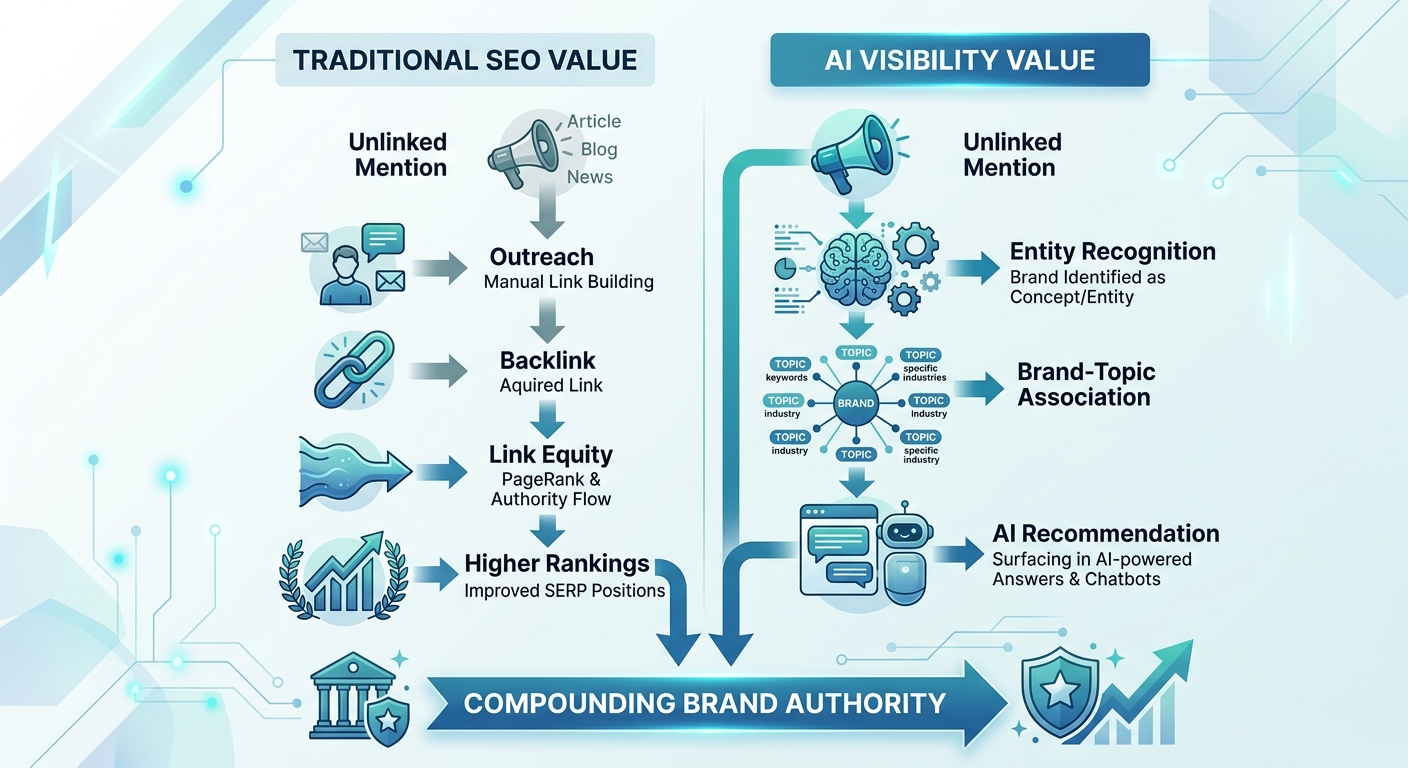
This means every unlinked mention carries dual value:
- Traditional SEO value: Each mention you convert into a backlink strengthens your domain’s authority and sends direct link equity to the target page.
- AI visibility value: Even before conversion, the mention itself helps AI models associate your brand with specific topics, categories, and expertise — building what practitioners call entity authority in AI search.
Six Types of Unlinked Mentions You Should Search For
Most guides focus only on brand name mentions. That leaves significant opportunities on the table. Here are six asset types to include in your search:
1. Brand Name Mentions
The most common type. Any editorial reference to your company name — in blog posts, news articles, roundups, or resource lists — that does not hyperlink to your domain.
2. Product or Service Names
If your products have distinct names, they get mentioned independently. Think “Ahrefs Content Explorer” or “HubSpot CRM.” These mentions often appear in reviews, comparison articles, and tutorials — and linking them directly to the product page sends equity where it matters most for commercial keywords.
3. Key People
CEOs, founders, subject-matter experts, and spokespeople frequently get quoted or referenced in articles without a link back to the company. Search for full names of anyone in your organization who has been interviewed, quoted in press, or cited in industry content.
4. Campaign Data and Statistics
If you have published original research, survey data, or proprietary statistics, other sites often cite the numbers without linking to the source. A unique data point — like a specific dollar figure or percentage — makes these easy to find through exact-match searches.
5. Historical Brand Names
Companies that have rebranded still have content referencing the old name. If your organization was previously known by a different name, search for both versions.
6. Images and Visual Assets
Infographics, charts, proprietary illustrations, and photographs get embedded on other sites without attribution. Reverse image search tools can uncover these.
Pro Insight: Before you start searching, create a master list of every searchable asset. Include your brand name, all product names, key personnel full names, any common misspellings, campaign titles, unique statistics, and your social media handles. This list becomes your search inventory.
How to Find Unlinked Brand Mentions for Free
You do not need a paid tool to start. Google provides two effective free methods that work well for small-to-mid-sized brands.
Google Search Operators
Use advanced search operators to find pages that mention your brand but live outside your own domain.
The base search format:
"Your Brand Name" -site:yourdomain.com
This returns external pages that reference your brand name as an exact phrase. Refine it further by excluding social media platforms and other irrelevant domains:
"Your Brand Name" -site:yourdomain.com -site:twitter.com -site:facebook.com -site:linkedin.com -site:youtube.com -site:pinterest.com
Use the intext: operator for broader discovery:
intext:"Your Brand Name" -site:yourdomain.com
Action step: Run this search for every item on your master list — brand name, product names, key people, and unique data points. Use Google’s date filter to focus on recent mentions first (past week, past month), as authors are more responsive to outreach on recently published content.
Google limits visible results to roughly 500, even for queries with thousands of matches. For larger brands, this method works best as a starting point or a supplement to paid tools.
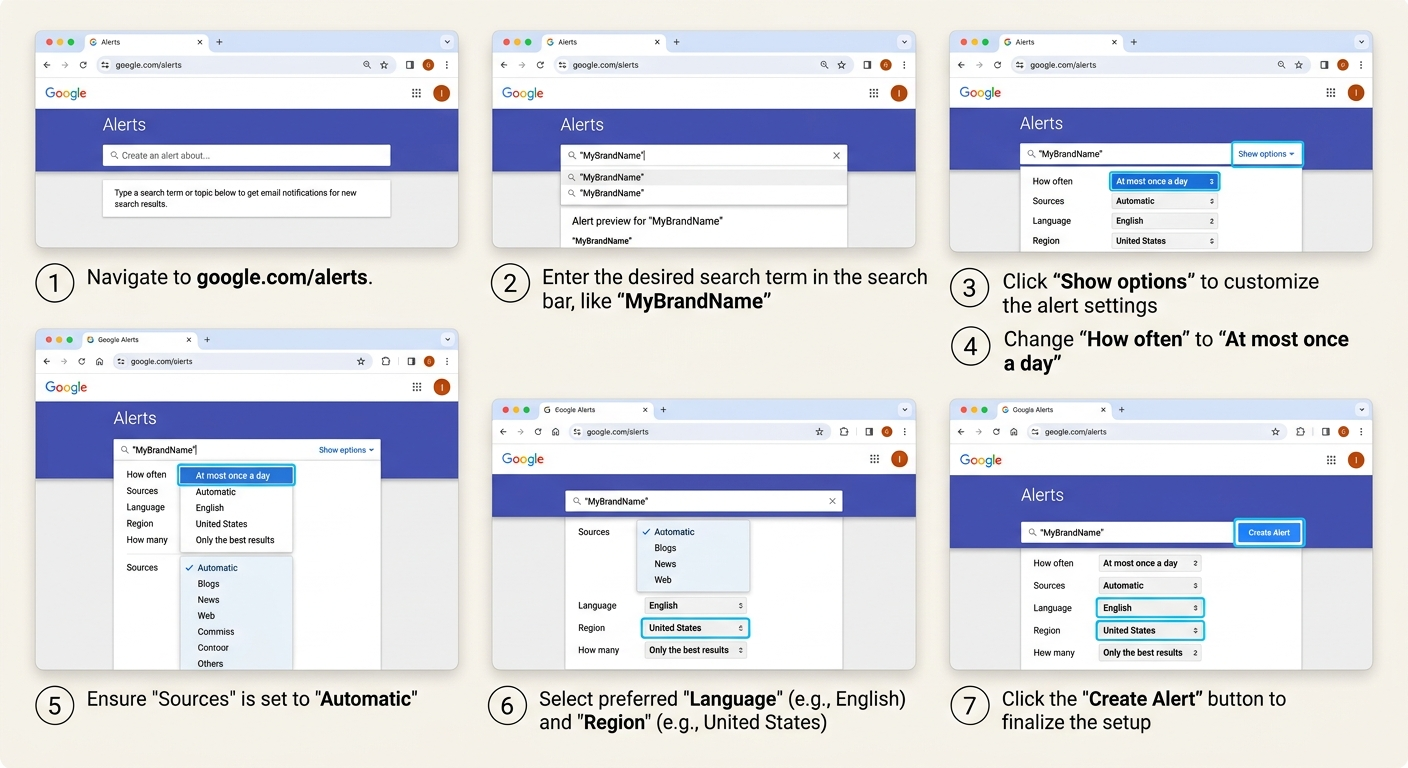
Google Alerts for Ongoing Monitoring
Google Alerts sends you email notifications when new content matching your search terms appears in Google’s index.
Set up alerts for:
- Your brand name (in quotes for exact match)
- Product names
- Key personnel names
- Campaign titles or unique statistics
- Common misspellings of your brand
You can combine terms using the OR operator (capitalized) to consolidate alerts:
"Brand Name" OR "Product Name" OR "CEO Full Name"
Set the frequency to daily or weekly, depending on how often your brand is mentioned. Google Alerts is free but imperfect — it misses some mentions, especially from smaller sites. Use it as a supplement, not your only monitoring system.
How to Find Unlinked Mentions at Scale with Paid Tools
For brands with significant web presence or those managing brand mentions as a core part of SEO strategy, paid tools dramatically increase efficiency and coverage.
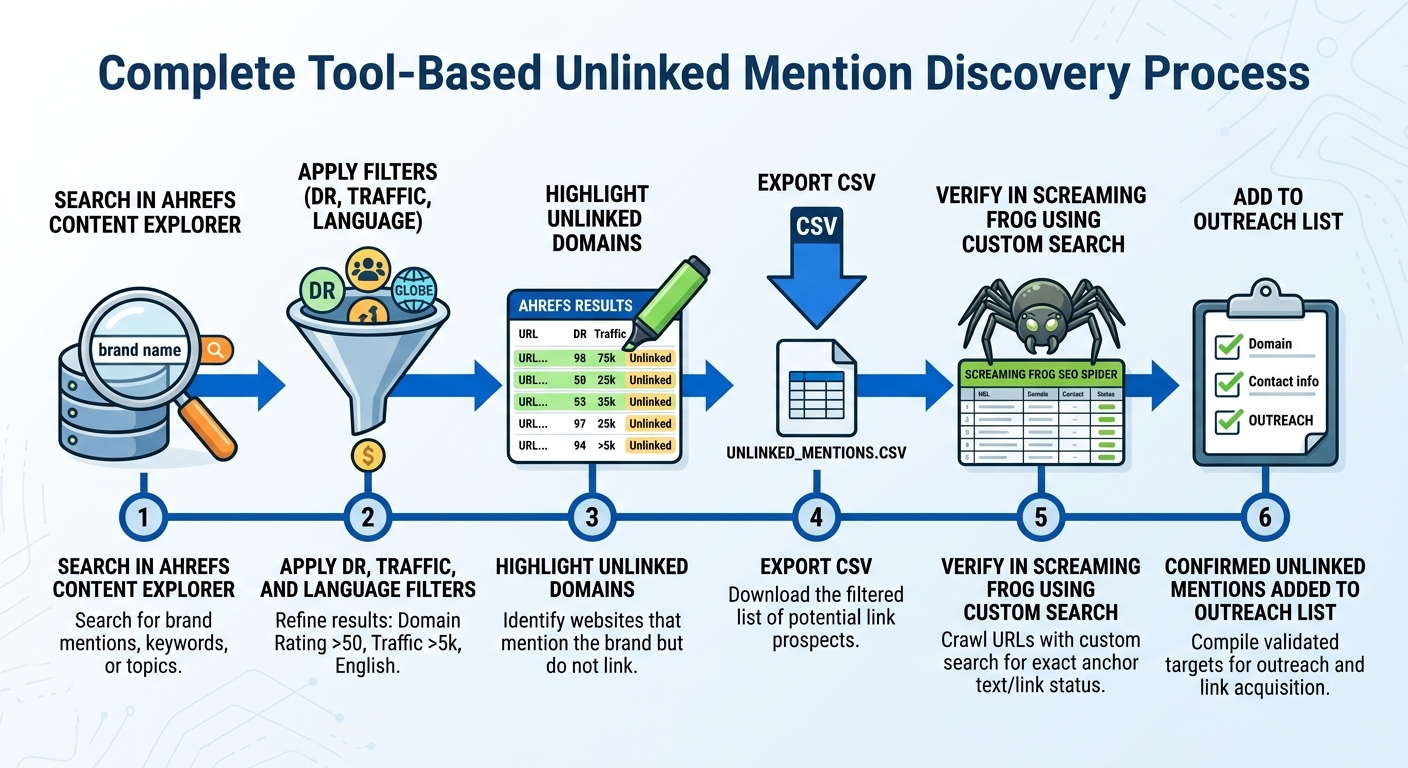
Ahrefs Content Explorer
Ahrefs Content Explorer searches a database of billions of pages for any keyword or phrase. It is one of the most effective tools for finding unlinked brand mentions.
Step-by-step process:
- Open Content Explorer and search for your brand name with the exclusion operator:
"Your Brand Name" -site:yourdomain.com - Apply filters to narrow results: set language to English, Domain Rating (DR) to 30+, and organic traffic to at least 50 visits per month. This eliminates low-quality pages not worth pursuing.
- Click “Highlight unlinked domains” and enter your domain. Ahrefs will flag every result from a domain that has never linked to you — these are your highest-priority targets for new referring domains.
- Export the results to CSV. Check the “Only highlighted unlinked domains” option if you want to focus exclusively on domains with no existing link relationship.
The export gives you a list of pages mentioning your brand. But not all of them are truly unlinked — some may mention your brand name while also linking to you elsewhere on the page. You need a verification step.
Verifying Unlinked Mentions with Screaming Frog
Screaming Frog’s custom search feature lets you crawl a list of URLs and check whether any of them contain a link to your domain in their HTML source code.
- Open Screaming Frog and go to Configuration → Custom → Search.
- Select “Does Not Contain” and enter this regex pattern:
<a [^>]*\bhref\s*=\s*"([^"]*yourdomain.com[^"]*)— replacingyourdomain.comwith your actual domain. - Set the crawl mode to List (Mode → List), then paste or upload your exported URLs.
- Run the crawl. When complete, go to the Custom Search tab and filter for “Does Not Contain.” These are pages that mention your brand but do not include any hyperlink to your domain.
This verification step typically reveals that 25–35% of pages mentioning your brand are truly unlinked — the rest already link to you somewhere on the page.
Semrush Brand Monitoring
Semrush’s Brand Monitoring tool automatically discovers web mentions across news sites, blogs, forums, and social platforms. Its key advantage is a built-in backlink filter — you can instantly toggle to show only mentions that do not include a link to your site.
Additional filters include domain authority, sentiment (positive, negative, neutral), and date range. The sentiment filter is particularly useful: you generally want to pursue positive and neutral mentions for backlink outreach and flag negative mentions for reputation management.
Social Media Profile Backlinks
Some authors link to your social media profiles (Twitter, LinkedIn, Instagram) instead of your main domain. To find these, enter your social profile URLs into Ahrefs Site Explorer and review the Backlinks report. Export the referring pages and run them through Screaming Frog to check whether any also link to your main domain. Pages that link to your social profile but not your website are strong outreach candidates — the author already intended to reference your brand.
Reverse Image Search for Visual Assets
If your brand produces original images, infographics, charts, or photography, these may appear on other sites without attribution. Use Google Lens (right-click any image in Chrome and select “Search Image with Google”) or TinEye to find where your images have been embedded. Any unattributed image is a candidate for outreach requesting a credit link.
Typo and Misspelling Search
Authors frequently misspell brand names in URLs, anchor text, or body copy. A link pointing to yourdmain.com instead of yourdomain.com means you are not receiving the link equity. Use a domain typo generator to create a list of common misspellings, then check each in Ahrefs Batch Analysis to see if any have backlinks. These are among the easiest outreach wins — the author already intended to link to you and simply made a typo.
How to Prioritize Which Mentions to Pursue First
Not every unlinked mention deserves outreach effort. Some pages have negligible traffic, low domain authority, or irrelevant audiences. A structured prioritization system ensures you spend time on the opportunities with the highest return.
Five Factors for Prioritization
| Factor | What to evaluate | Why it matters |
|---|---|---|
| Page traffic | Monthly organic visits to the specific page (check in Ahrefs or Semrush) | Pages with real traffic send referral visitors and pass more link value, based on signals confirmed in the 2024 Google Search API documentation leak |
| Domain authority | DR/DA of the referring domain | Higher-authority domains pass more link equity and are more likely to be included in AI training data |
| Topical relevance | How closely the page’s topic matches your brand’s category | Relevant mentions strengthen topical authority in both Google’s ranking systems and AI entity recognition |
| Content freshness | Publication date and whether the page is regularly updated | Authors are more likely to edit recently published content; evergreen pages provide long-term value |
| Mention sentiment | Is the mention positive, neutral, or negative? | Positive and neutral mentions are outreach-ready. Negative mentions require a different response |
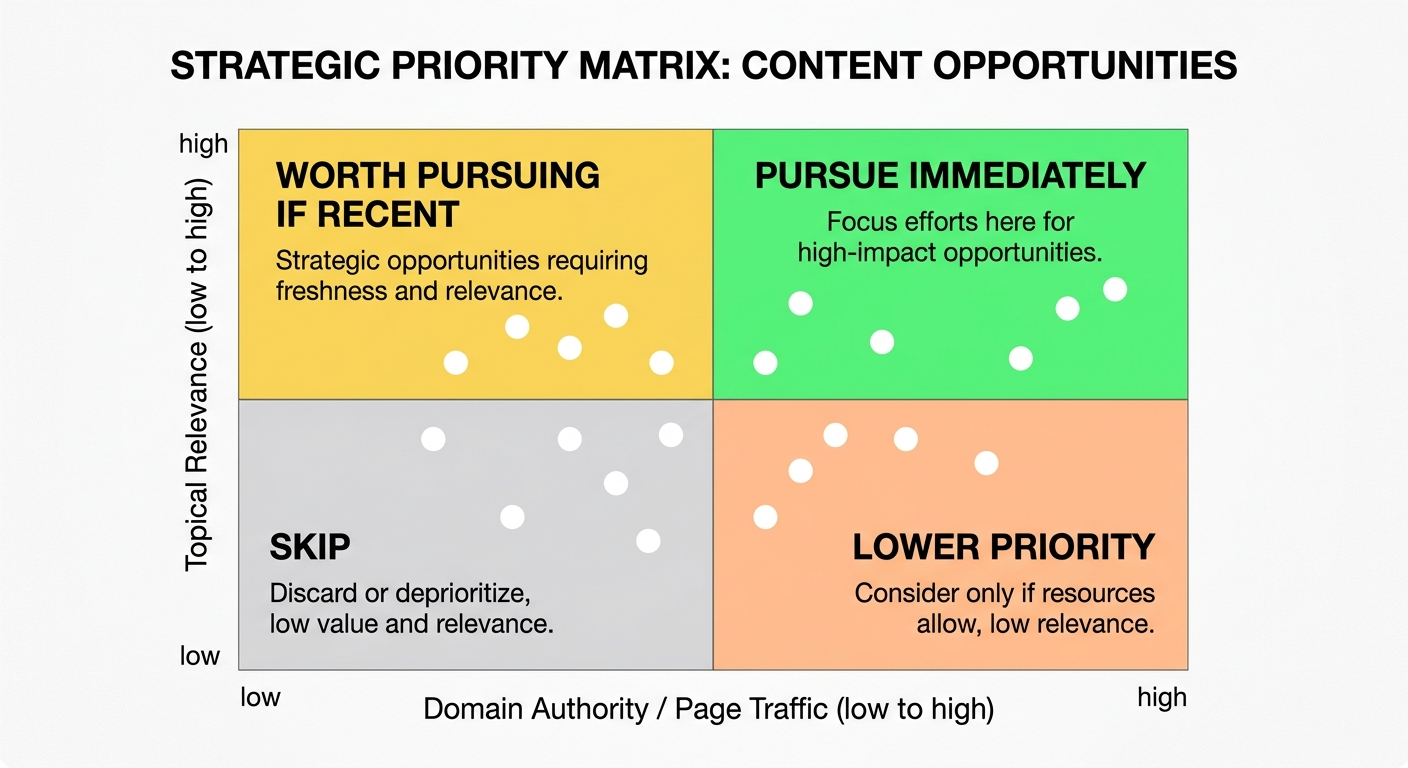
Action step: After exporting your verified unlinked mentions, add columns for estimated page traffic, domain rating, relevance score, and sentiment. Sort by a combined priority score. Start outreach with the highest-value opportunities.
How to Convert Unlinked Mentions into Backlinks
The outreach itself is the simplest part of this process — if you approach it correctly. The author already knows your brand. You are not cold-pitching. You are asking someone who has already referenced you to complete the attribution.
Find the Right Contact
Start with the article author. Check their byline for an email address, look at their social profiles (many journalists include their email in their Twitter/X bio), or use a tool like Hunter.io to find the email format for the publication’s domain.
If the author is unavailable or no longer writes for the publication, look for:
- A webmaster or editorial contact on the site’s Contact Us page
- The publication’s masthead, which often lists editors with email addresses
- A general editorial email (e.g., editorial@publication.com)
Outreach Email Template
Keep it short, specific, and focused on value for the reader — not for you.
Subject: Quick update to your [topic] article
Hi [First Name],
I noticed you mentioned [Brand Name] in your article here: [URL].
Thanks for the reference — would you consider adding a link to [target URL] where you’ve mentioned us? It would give your readers a direct path to learn more about [the specific thing mentioned].
Happy to share any additional data or resources that might be useful for the piece.
Thanks,
[Your Name]
Tips for Higher Conversion Rates
- Offer something in return. If you notice a broken link, outdated statistic, or small error on the page, mention it. Authors who need to edit the post anyway are more likely to add your link at the same time.
- Don’t pursue every mention. If the page already links to you multiple times, or the mention is in a negative context, skip it. Pushiness damages relationships.
- Time your outreach. Reach out within days or weeks of publication. Response rates drop significantly for content that is several months old.
- Send one follow-up. If you do not hear back within 5–7 business days, send a single polite follow-up. After that, move on.
- Use Creative Commons 4.0 attribution. If your original content (research, data, images) is published under a Creative Commons 4.0 license, you have a stronger basis for requesting attribution — one agency reported a conversion rate increase from 12% to 18% using this approach, according to a 2025 Root Digital case study.
Expect a conversion rate between 10% and 20% for well-targeted outreach. You will not convert every mention, and that is normal. Even at a 12% conversion rate, a list of 200 unlinked mentions yields 24 new backlinks from domains that already reference your brand — each one contextually relevant and editorially earned.
How to Set Up Ongoing Monitoring
Finding unlinked mentions is not a one-time project. New mentions appear continuously — especially for brands that publish content, run PR campaigns, or have active spokespeople.
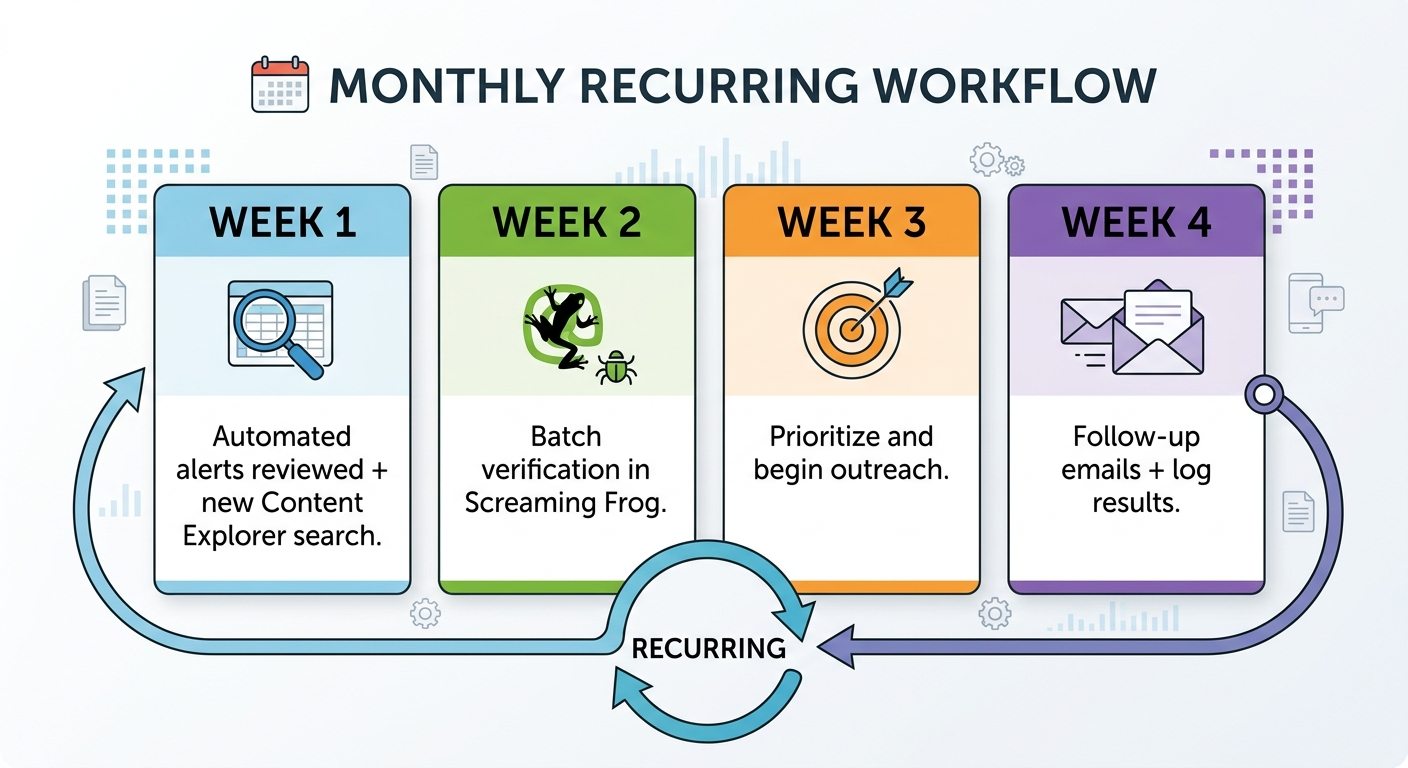
Build a Recurring Workflow
- Set up automated alerts. Use Google Alerts (free) and Semrush Brand Monitoring or Talkwalker Alerts (free tier available) to get notified of new mentions as they appear.
- Run monthly Content Explorer searches. Filter by the past 30 days to catch mentions that automated alerts may miss.
- Batch-verify monthly. Export new mentions, verify through Screaming Frog, add confirmed unlinked mentions to your outreach queue.
- Prioritize and outreach weekly. Set aside 1–2 hours per week to send outreach emails for the highest-priority unlinked mentions.
This cadence keeps the pipeline moving without consuming excessive time. For brands with high mention volume, tracking brand mentions across both traditional web and AI search platforms becomes essential as AI models update their knowledge bases.
Unlinked Mentions and AI Visibility: What Has Changed Since 2024
The relationship between brand mentions and AI recommendations has accelerated significantly since 2024. Several developments have made unlinked mentions more strategically important than before:
- AI models now use retrieval-augmented generation (RAG) at scale. ChatGPT, Perplexity, and Gemini pull from live web content to supplement their training data. Pages that mention your brand — even without links — appear in the retrieval corpus these models query when generating answers.
- Entity authority compounds across mentions. The more consistently your brand appears alongside specific topics on high-quality sites, the stronger the association AI models form. This is entity authority — and it determines whether AI recommends your brand when a user asks “What is the best [product category]?”
- Google AI Overviews cite web sources. When Google’s AI Overview generates an answer and cites sources, the cited pages are often ones that mention brands with clear, contextual relevance. Converting unlinked mentions into linked mentions makes it easier for both Google’s traditional crawlers and its AI systems to trace the attribution path.
Agencies like BrandMentions approach this from the AI side — placing contextual brand mentions on 140+ high-authority publications that AI models actively learn from. But regardless of whether you build mentions proactively or reclaim existing ones, the goal is the same: build consistent brand-topic associations across the web so that both search engines and AI models recognize your authority.
Key Definition: Entity authority is the strength of the association between your brand and a specific topic or category, as understood by search engines and AI models. It is built through consistent, contextual mentions across high-quality web content over time.
For a deeper look at how brand mentions influence AI-generated responses, BrandMentions publishes ongoing research on AI citation behavior across ChatGPT, Perplexity, Gemini, and Google AI Overviews.
Common Mistakes That Waste Your Time
Unlinked mention outreach is straightforward, but several mistakes reduce its effectiveness:
- Pursuing low-authority pages with no traffic. A mention on a page with zero visitors and a DR of 8 is not worth an outreach email. Set minimum thresholds and enforce them.
- Sending generic, unpersonalized emails. Mass templates with no reference to the specific article, mention, or author signal laziness. Personalize each email — even briefly.
- Ignoring the context of the mention. If your brand is mentioned in a negative review or a complaint thread, requesting a backlink is tone-deaf. Read the surrounding content before reaching out.
- Only searching for your brand name. This misses product mentions, personnel quotes, data citations, and image usage. Use the full six-asset-type inventory described earlier.
- Treating this as a one-time task. New mentions appear constantly. Without recurring monitoring, you leave value on the table every month.
Frequently Asked Questions
Do unlinked brand mentions help SEO even without a backlink?
Yes. Google’s systems can identify brand references without hyperlinks — a concept described in a 2012 Google patent as “implied links.” While a conventional backlink passes more measurable link equity, unlinked mentions still contribute to entity recognition and brand authority signals. As of 2026, they also influence how AI models associate your brand with specific topics.
How many unlinked mentions can I realistically convert into backlinks?
Expect a conversion rate between 10% and 20% for well-targeted, personalized outreach. Response rates are highest for recently published content on domains where you have no existing link relationship. The more specific and helpful your outreach email, the higher your conversion rate.
Which tools are best for finding unlinked brand mentions?
For comprehensive discovery, Ahrefs Content Explorer and Semrush Brand Monitoring are the most effective paid options. For free alternatives, Google search operators and Google Alerts provide a solid starting point. Use Screaming Frog (free for up to 500 URLs) to verify which mentions are genuinely unlinked. For monitoring mentions in AI search specifically, dedicated AI mention tracking tools are becoming increasingly relevant.
Should I pursue mentions on social media for backlinks?
Social media mentions (tweets, LinkedIn posts, Instagram captions) are valuable for brand visibility and AI training signal, but they rarely convert into traditional backlinks because most social platforms use nofollow attributes. Focus your backlink outreach on editorial content — blogs, news sites, resource pages, and industry publications.
How often should I search for new unlinked mentions?
For most B2B brands, a monthly search-and-verify cycle works well. Set up automated alerts (Google Alerts, Talkwalker, or Semrush) for real-time discovery, and supplement with a monthly Content Explorer search to catch anything the alerts missed.
Your Next Step
Start with the asset inventory. List every searchable reference to your brand — name, products, people, data, old names, images. Then run your first search using free tools. Even a single Google search with the "Brand Name" -site:yourdomain.com operator will likely surface mentions you did not know existed.
From there, build the recurring workflow. The brands that gain the most from unlinked mention outreach are the ones that treat it as an ongoing system, not a one-off project. Every converted mention strengthens your backlink profile, deepens your entity authority, and improves your chances of being recommended by the AI search engines that are reshaping how buyers discover solutions.
Want to see how your brand currently appears across AI search platforms? Book a free AI visibility audit to find out what ChatGPT, Perplexity, and Gemini say about your brand — and where the gaps are.