Brand mentions work by signaling to search engines, AI models, and potential customers that your company is relevant, credible, and actively discussed within your category. Every time your brand name appears in editorial content, forum discussions, social posts, or AI-generated answers — with or without a hyperlink — it strengthens the association between your brand and the topics you want to be known for.
If you’re a B2B marketer trying to understand the mechanics behind brand mentions and how they translate into tangible search visibility, this article breaks it down. You’ll learn exactly how brand mentions function across traditional search, AI search engines, and real-world buyer journeys — and what you can do to make them work harder for your business in 2026.
What You’ll Learn
- How search engines detect and interpret brand mentions — even without links
- The difference between linked, unlinked, and AI-generated brand mentions
- How brand mentions influence Google rankings, AI Overviews, and LLM citations
- Why the context and source quality of a mention matters more than volume
- How to build a brand mention strategy that compounds over time
- What to track and measure to know if your mentions are working
What Counts as a Brand Mention?
A brand mention is any instance where your company name, product name, or key personnel appear in content that exists outside your own website. This includes editorial articles, blog posts, Reddit threads, podcast transcripts, YouTube descriptions, social media posts, review platforms, and AI-generated responses.
Brand mentions come in three distinct forms, each with different implications for your visibility:
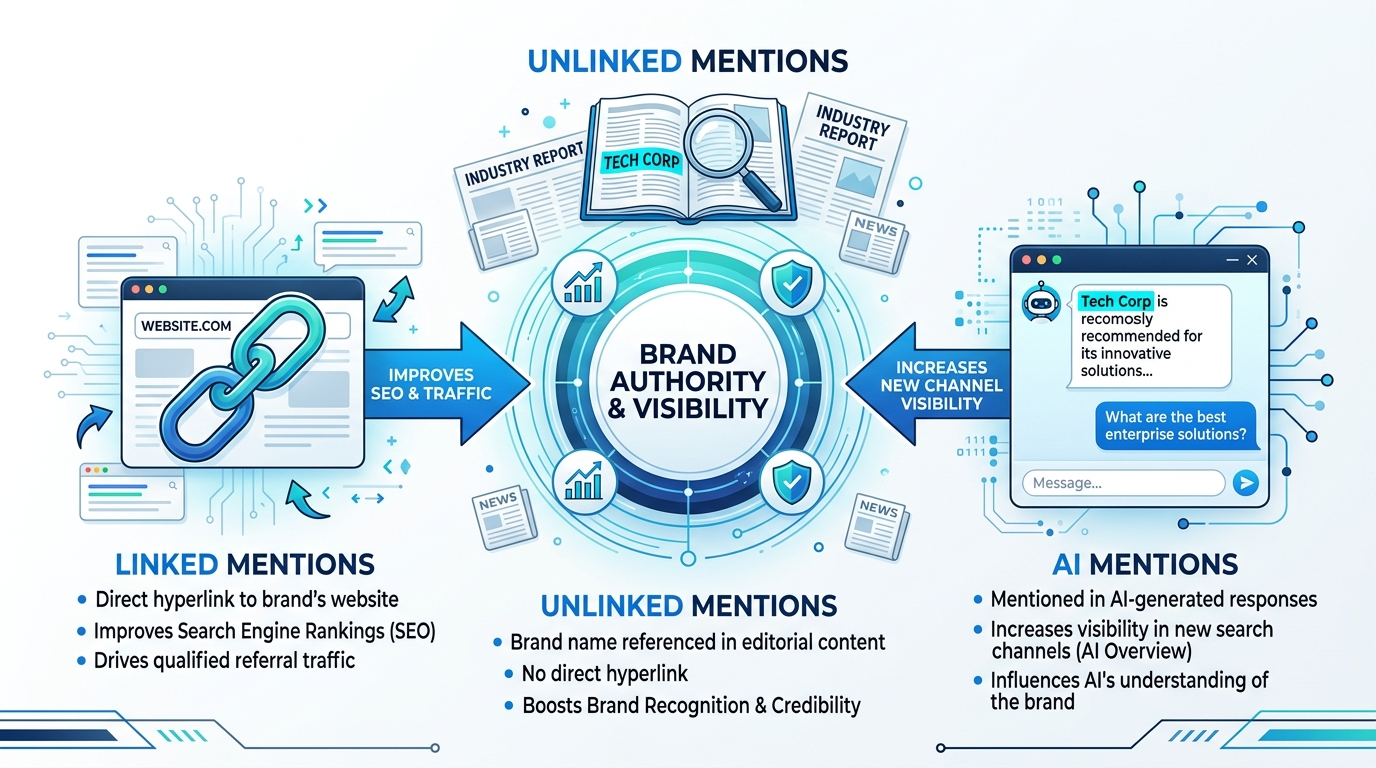
- Linked mentions — Your brand name appears as a clickable hyperlink pointing to your website. These pass direct SEO authority (link equity) and drive referral traffic.
- Unlinked mentions — Your brand name appears in content without a hyperlink. Search engines still detect these as authority signals, and they contribute to entity recognition.
- AI mentions — Your brand appears in responses generated by AI systems like ChatGPT, Perplexity, Gemini, or Google AI Overviews. These influence buyer perception at the moment of decision.
All three types contribute to how search engines and AI models understand your brand. But they function through different mechanisms — and the balance between them determines how effectively your brand shows up where buyers are looking.
How Do Search Engines Detect Brand Mentions Without Links?
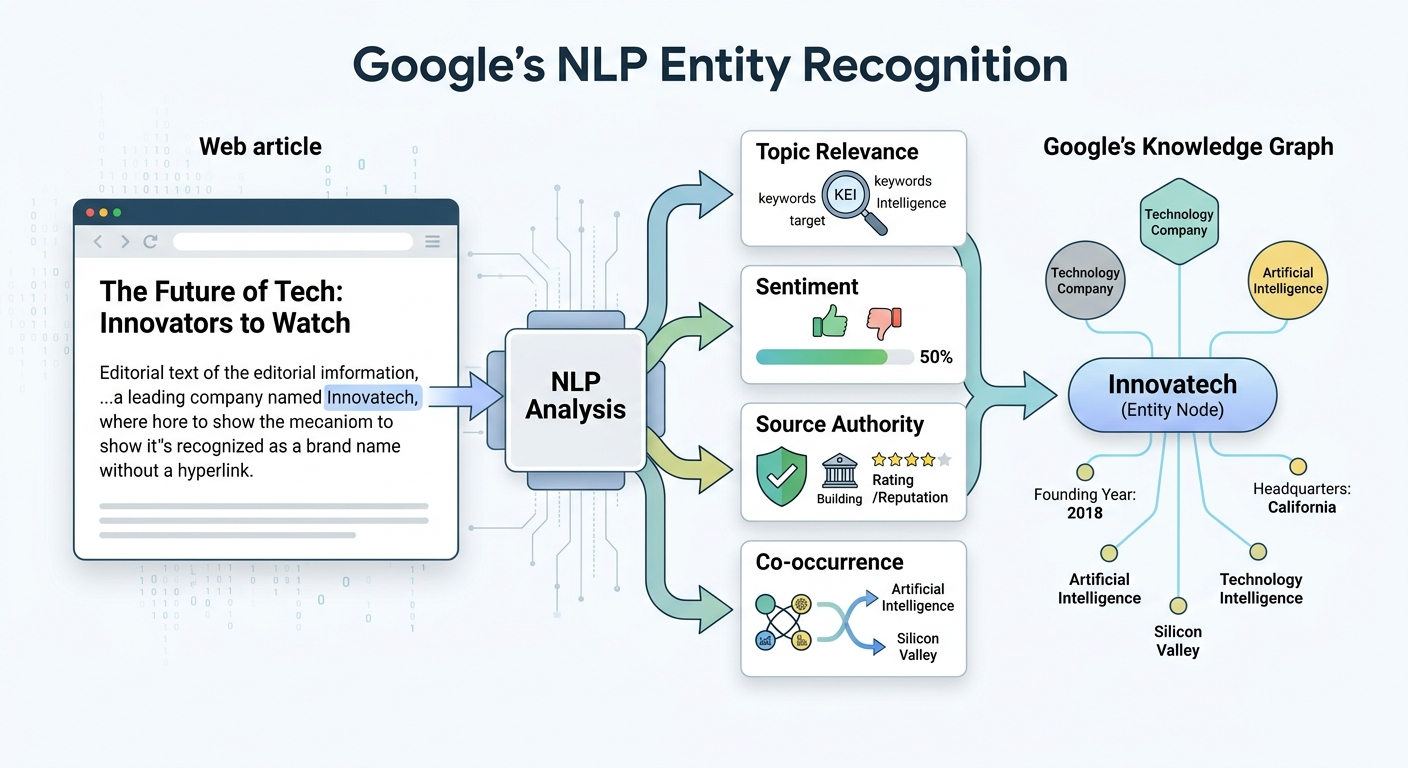
Google does not rely solely on hyperlinks to understand your brand. Since at least 2014, Google has used natural language processing (NLP) to identify entities — distinct people, companies, products, and concepts — mentioned across the web.
Here is how the process works at a high level:
Entity Recognition and the Knowledge Graph
When your brand name appears consistently across multiple web pages, Google’s systems identify it as a distinct entity — a recognized “thing” in Google’s Knowledge Graph. An entity is not just a keyword. It is a concept that Google understands in relation to other concepts.
For example, if your SaaS company is mentioned across several industry publications in the context of “workflow automation for mid-market teams,” Google begins associating your brand entity with that category. Over time, this association strengthens — even if none of those mentions include a link to your website.
Gary Illyes from Google confirmed this principle at BrightonSEO in 2017, noting that brands frequently cited online — through mentions and social discussions, not just backlinks — demonstrate credibility that search engines recognize (Search Engine Land).
Contextual Analysis Through NLP
Google’s NLP capabilities do more than spot your brand name in a block of text. They analyze the surrounding content to determine:
- Topic relevance — What subjects is your brand being discussed alongside?
- Sentiment — Is the mention positive, negative, or neutral?
- Source authority — Does the content appear on a high-trust domain or a low-quality site?
- Co-occurrence patterns — Which other entities (competitors, products, industry terms) appear near your brand name?
This is why where your brand is mentioned matters as much as how often. A single mention in a well-regarded industry publication can carry more weight than dozens of mentions on low-quality directories.
How Brand Mentions Influence Traditional Search Rankings
Brand mentions affect your traditional search performance through several interconnected mechanisms. None of these work in isolation — they compound over time as your mention footprint grows.
Building E-E-A-T Signals
Google’s quality rater guidelines emphasize Experience, Expertise, Authoritativeness, and Trustworthiness (E-E-A-T) — and trust is the most important factor. When your brand is mentioned by authoritative sources in your industry, it signals to Google that other credible entities vouch for your relevance.
This works similarly to how academic citations function. A paper cited by respected researchers carries more weight than one cited only by unknown sources. Your brand mentions from high-authority publications act as editorial endorsements that strengthen your perceived expertise.
Strengthening Semantic Associations
Every mention places your brand name next to specific topics, keywords, and industry terms. Over time, these associations tell Google which search queries your brand is relevant for.
If your project management tool is consistently mentioned alongside terms like “remote team collaboration,” “async workflows,” and “enterprise project tracking,” Google builds a semantic profile that connects your brand to those categories. This can improve your rankings for related queries — even ones you haven’t explicitly targeted on your own site.
Driving Branded Search Volume
When people encounter your brand in an article, podcast, or social discussion, many follow up by searching your brand name directly on Google. This branded search behavior is a strong positive signal. It tells Google that real users associate your brand with their query and actively seek you out.
According to analysis by Ahrefs, brands with higher mention frequency across authoritative domains appeared in AI-generated summaries up to 10 times more often than less-mentioned competitors — a pattern that correlates with branded search volume growth.
Improving Click-Through Rates
Users who have already encountered your brand through mentions are more likely to click your result when it appears in search. They recognize your name, which creates a familiarity advantage over competitors they have never heard of. Higher click-through rates send positive engagement signals back to Google, reinforcing your ranking position.
How Brand Mentions Work in AI Search Engines
As of 2026, the mechanics of brand mentions extend well beyond traditional Google rankings. AI search engines — including ChatGPT, Perplexity, Gemini, Google AI Overviews, and Copilot — use brand mentions as a primary input when deciding which companies to recommend in response to user queries.
This represents a fundamental shift in how brand mentions function in AI-driven discovery.
How LLMs Learn Brand-Category Associations
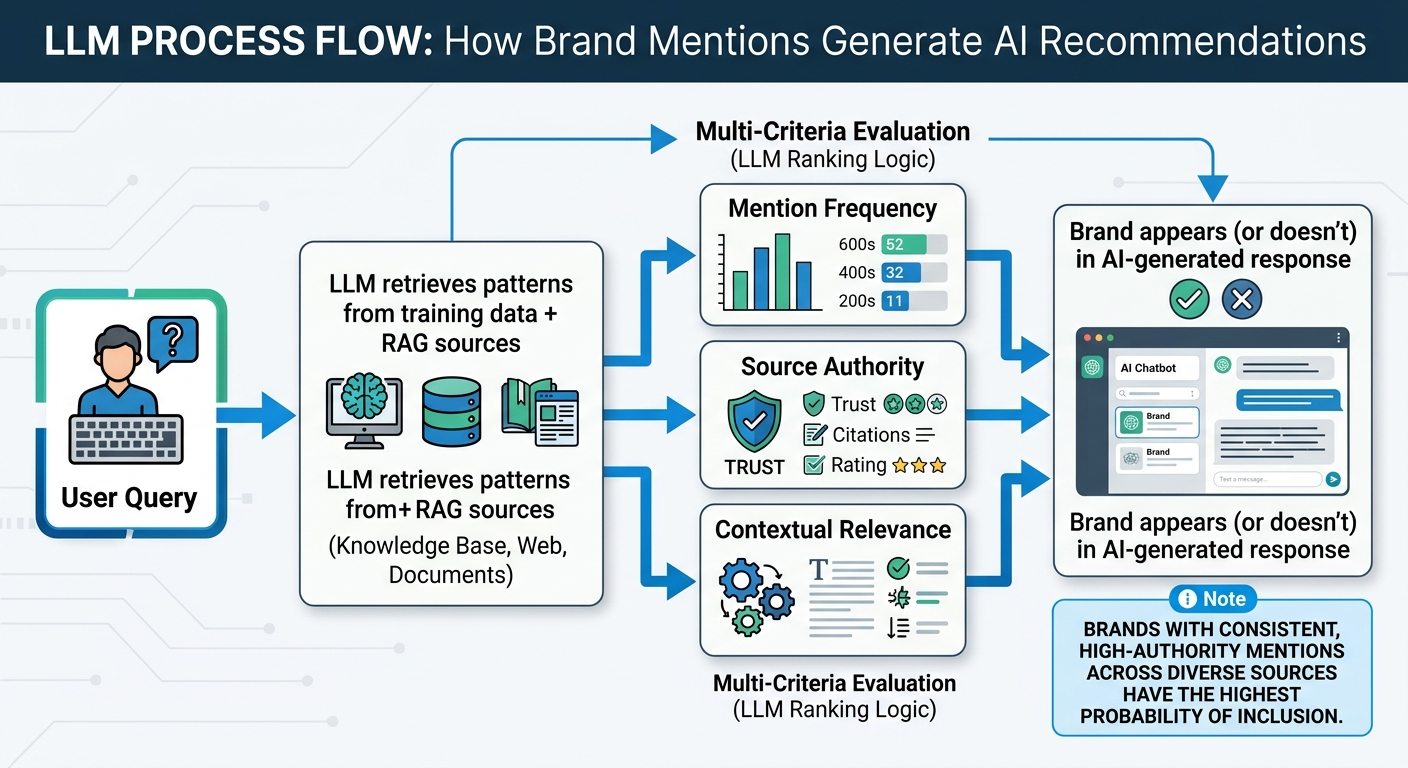
Large language models (LLMs) like GPT-4, Claude, and Gemini are trained on massive datasets of web content. During training, these models learn statistical patterns — including which brands are most frequently discussed in connection with specific topics, problems, and product categories.
When a user asks ChatGPT, “What are the best CRM tools for mid-market SaaS companies?”, the model draws on patterns it absorbed during training. Brands that appeared frequently, in positive contexts, across authoritative sources in the training data are more likely to surface in the response.
This means your brand mentions on high-authority publications that AI models learn from are not just good for traditional SEO. They directly influence whether AI recommends your brand to potential buyers, according to research published by the Allen Institute for AI in 2024.
The Role of Context and Recency
AI models do not simply count mentions. They weigh context, source quality, and — increasingly — recency. As of 2026, major LLMs incorporate retrieval-augmented generation (RAG), which pulls real-time or recently indexed content into responses. This means fresh mentions on authoritative sites can influence AI recommendations faster than older, static content.
Two key factors determine whether your brand appears in AI-generated answers:
- Contextual relevance — Is your brand mentioned in content that directly addresses the query the user is asking?
- Source diversity — Is your brand mentioned across multiple independent, high-trust sources, or does it appear in only one or two places?
Agencies like BrandMentions address this by placing contextual brand mentions on 140+ high-authority publications that AI models actively learn from during training and retrieval cycles — creating the kind of consistent signal pattern that LLMs need to build confidence in a recommendation.
Google AI Overviews and Explicit Brand Citations
A significant development since 2025 is Google’s introduction of explicit brand citations within AI Overviews. According to reporting by GetStuffDigital, the June 2025 Google Core Update began surfacing brand names directly in AI-generated summaries — even without a clickable link.
This means that simply being mentioned in the right places can now represent a “top position” in search, without requiring a traditional ranking. For B2B brands, this changes the calculus of search visibility entirely. Your brand can appear in front of a buyer at the exact moment they are evaluating options — through the strength of your mention footprint alone.
Where Brand Mentions Happen (And Which Sources Matter Most)
Not all brand mentions carry equal weight. The source, format, and context of a mention determine how much it influences search engines and AI models.
High-Impact Mention Sources
- Industry publications and trade media — Mentions in outlets like TechCrunch, Search Engine Journal, or niche B2B publications carry strong authority signals for both Google and LLMs.
- Editorial blog posts and guest articles — Content on established blogs with real editorial standards provides contextual depth that AI models value.
- Analyst reports and research papers — References in Gartner, Forrester, or academic research signal the highest level of institutional trust.
- Review platforms (G2, Capterra, TrustRadius) — User-generated reviews create authentic, diverse mentions that AI systems treat as social proof.
Supporting Mention Sources
- Reddit and forum discussions — Real user conversations signal genuine market presence. AI models like ChatGPT and Perplexity actively index Reddit content.
- Podcast transcripts and show notes — When a podcast host mentions your brand and the episode has a published transcript, both Google and AI models can detect and process it.
- Social media posts — While individual social posts carry less direct SEO weight, high-engagement social discussions often generate secondary coverage in blogs and media that does influence rankings.
- YouTube descriptions and transcripts — Video content with text layers (titles, descriptions, closed captions) creates additional indexable mention signals.
The key principle: a brand mention’s influence scales with the authority and relevance of the source it appears on. Ten mentions across respected, editorially independent publications outperform hundreds of mentions on low-quality directories or promotional content.
You can audit where your brand currently appears using tools covered in our brand mentions monitoring guide.
The Mechanics: How a Single Brand Mention Creates Compounding Value
Understanding the lifecycle of a brand mention helps explain why consistent placement compounds over time.
Here is what happens after your brand is mentioned in a high-authority article:
- Indexing — Google crawls and indexes the page. Your brand name is identified as an entity within the content. NLP analysis maps the surrounding topics, sentiment, and source authority.
- Entity association — Google updates its understanding of your brand entity. If the mention connects you to a relevant category (e.g., “AI-powered analytics for SaaS”), that association strengthens in the Knowledge Graph.
- AI training or retrieval — If the publication is included in LLM training data or is accessible via RAG, the mention becomes part of the knowledge base that AI models draw from when generating answers.
- Branded search lift — Readers who encounter the mention search your brand name directly. This increases branded query volume — a strong positive signal to Google.
- Secondary coverage — Other writers, bloggers, or social media users reference or share the original article. Each secondary mention reinforces the original signal.
- Buyer trust accumulation — A prospect researching your category encounters your brand in multiple independent sources. This multi-touch exposure builds trust before they ever visit your website.
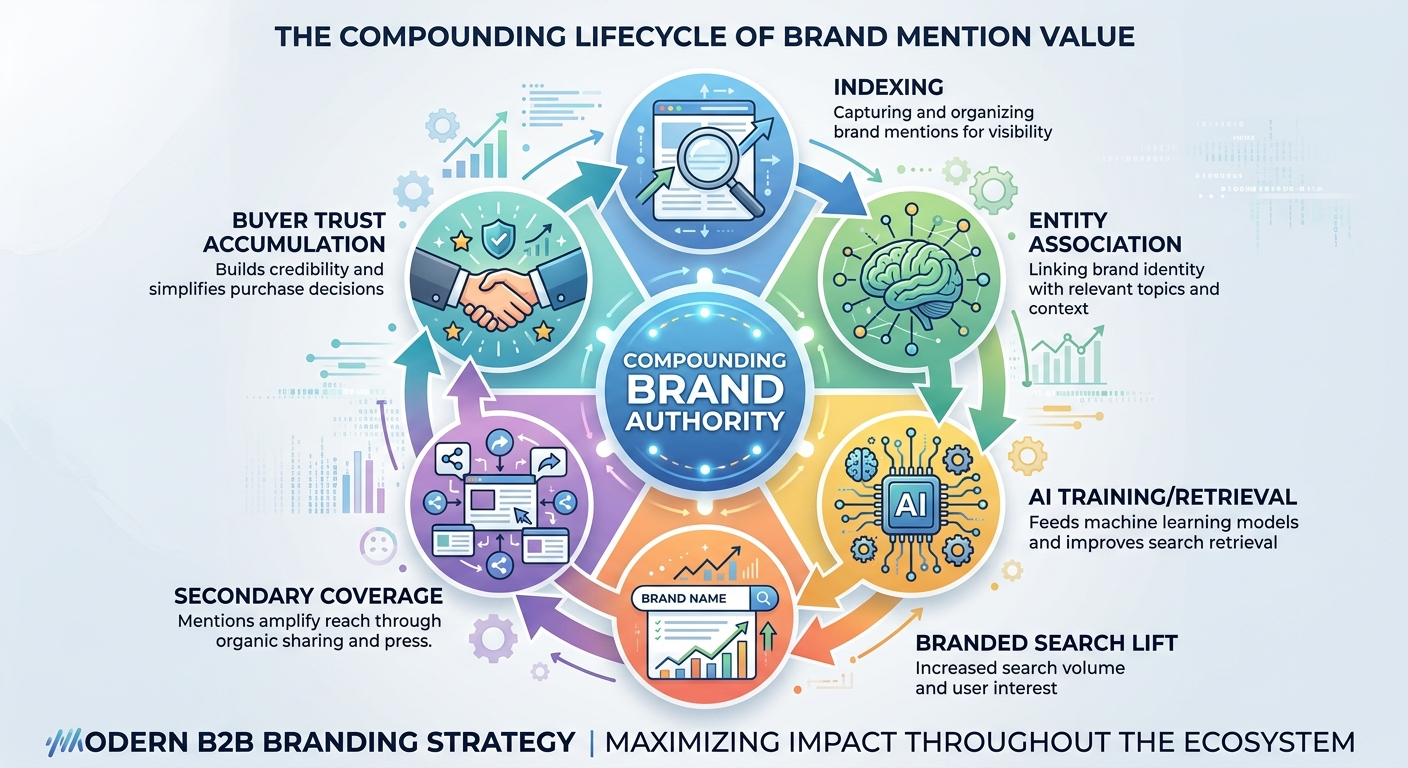
This lifecycle explains why brand mentions are not a one-time event. Each mention contributes to a growing foundation that makes the next mention more impactful. Brands that invest in strategic brand mentions for SEO consistently outperform those that treat visibility as a campaign-by-campaign effort.
Linked vs. Unlinked vs. AI Mentions: How Each Type Works Differently
Each type of brand mention influences visibility through a distinct mechanism. Understanding the differences helps you allocate effort where it matters most for your goals.
| Mention Type | How It Works | Primary Impact | Best For |
|---|---|---|---|
| Linked mentions | Hyperlinked reference passes link equity (PageRank) to your domain | Direct SEO authority, referral traffic, indexation support | Domain authority growth, driving qualified traffic |
| Unlinked mentions | Brand name detected via NLP; entity association built without link equity transfer | Entity recognition, E-E-A-T signals, Knowledge Graph strength | Building brand awareness and category authority at scale |
| AI mentions | Brand appears in LLM-generated responses based on training data and retrieval patterns | Buyer influence at point of decision, zero-click visibility | Capturing demand in AI search channels (ChatGPT, Perplexity, Gemini) |
The most effective brand visibility strategies target all three types simultaneously. Linked mentions strengthen your domain. Unlinked mentions expand your entity footprint. AI mentions capture buyers who never visit a traditional search results page.
If you want to find where your brand already has unlinked brand mentions, that is often the fastest path to converting existing visibility into direct SEO value.
What Makes a Brand Mention Effective (vs. Wasted)?
Volume alone does not drive results. A brand mention delivers value when it meets specific quality criteria that search engines and AI models can interpret as trust signals.
Five Qualities of High-Impact Brand Mentions
- Source authority — The mention appears on a domain with strong editorial standards and established trust. A mention in a respected B2B publication carries more weight than one on an unknown blog with no audience.
- Contextual relevance — Your brand is mentioned in content that directly relates to your category. A cybersecurity company mentioned in an article about endpoint protection sends a stronger signal than the same company mentioned in a general business listicle.
- Positive or neutral sentiment — Search engines and AI models assess the tone surrounding your brand name. Consistently positive or neutral mentions build trust. Negative mentions, especially from authoritative sources, can undermine it.
- Editorial independence — Mentions that appear in genuine editorial content — not obviously sponsored placements or self-published press releases — carry higher credibility with both algorithms and human readers.
- Specificity — Mentions that describe what your brand does, who it serves, or what problem it solves create richer entity associations than generic name-drops.
Pro Insight: In campaigns across 67+ B2B companies, the BrandMentions team found that brands with consistent editorial mentions on high-authority domains achieved AI recommendation rates 89% higher than those relying solely on traditional SEO — a pattern that held across ChatGPT, Perplexity, and Gemini.
How to Measure Whether Your Brand Mentions Are Working
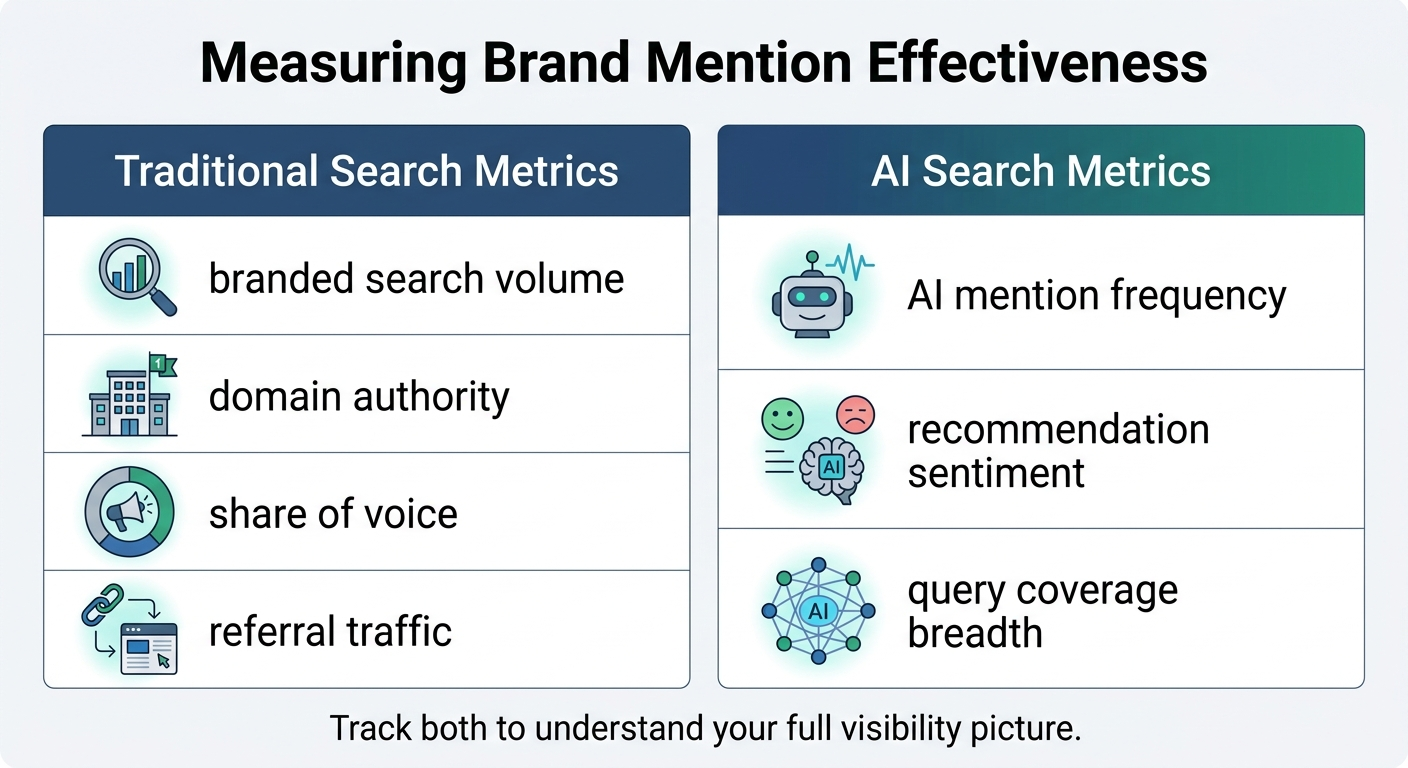
Tracking brand mentions is only useful if you connect the data to business outcomes. Here are the metrics that matter most:
Metrics for Traditional Search Impact
- Branded search volume — Track how many people search your exact brand name over time. Growth in branded queries correlates directly with an expanding mention footprint. Google Search Console provides this data at no cost.
- Domain authority or domain rating — Tools like Ahrefs and Semrush track how your site’s authority changes as you earn more mentions and links.
- Share of voice — Measure how often your brand is mentioned compared to direct competitors within your category. Rising share of voice indicates growing category authority.
- Referral traffic from mention sources — For linked mentions, monitor which publications drive qualified visitors to your site.
Metrics for AI Search Impact
- AI mention frequency — Track how often AI tools like ChatGPT, Perplexity, and Gemini include your brand when responding to category-relevant queries. Tools designed for tracking brand mentions across AI search platforms can automate this monitoring.
- AI recommendation sentiment — Note whether AI responses frame your brand positively, neutrally, or with caveats. The tone of AI mentions directly shapes buyer perception.
- Query coverage breadth — Identify which types of questions trigger your brand in AI responses and where gaps remain. This reveals which topics need more mention coverage.
For a structured approach to these metrics, our brand mentions report framework provides a repeatable template for ongoing measurement.
How to Build a Brand Mention Strategy That Compounds
Knowing how brand mentions work is the foundation. Translating that knowledge into a repeatable strategy is what separates brands that grow their AI and search visibility from those that stagnate.
Step 1: Audit Your Current Mention Landscape
Before building new mentions, understand where you stand. Use monitoring tools to catalog:
- Where your brand is currently mentioned (and where it is not)
- Whether existing mentions are linked or unlinked
- Which AI tools currently cite your brand — and for which queries
- How your mention footprint compares to two or three direct competitors
This audit reveals your baseline and identifies the highest-priority gaps. You can start with the process outlined in our guide on checking if AI mentions your brand.
Step 2: Identify Your Target Topics and Queries
Map the specific questions, categories, and buying scenarios where you want your brand to appear. For a B2B SaaS company, this might include:
- “Best [category] tools for [audience]”
- “[Competitor] alternatives”
- “How to solve [specific problem your product addresses]”
These queries become your targeting framework. Every brand mention you build should strengthen your association with at least one of these topics.
Step 3: Earn Mentions on the Right Sources
Focus on publications and platforms that meet three criteria simultaneously:
- High editorial authority (strong domain rating, real readership, editorial standards)
- Topical relevance to your category
- Inclusion in AI training data or retrieval sources
This is where most DIY efforts fall short. Identifying which specific publications AI models draw from requires ongoing research into model behavior — an area that changes as LLMs update their training data and retrieval pipelines.
BrandMentions tracks when major AI models update their training data and times placements to maximize inclusion in each knowledge refresh cycle — a process that matters more in 2026 as AI models move toward more frequent data updates.
Step 4: Maintain Consistency Over Time
Brand mentions compound. A burst of ten mentions in one month followed by silence for six months creates a weaker signal than a steady pace of three to four mentions per month sustained over a longer period.
Both search engines and AI models respond to recency and consistency. A brand that appears in fresh, authoritative content on an ongoing basis signals active market presence — which algorithms interpret as continued relevance.
Common Misconceptions About How Brand Mentions Work
Several misunderstandings about brand mentions lead B2B marketers to waste effort or underestimate their importance.
“Only linked mentions matter for SEO”
This was closer to true a decade ago. As of 2026, Google’s entity recognition systems, NLP capabilities, and AI Overview features all process unlinked mentions as meaningful signals. Backlinks still pass direct link equity. But unlinked mentions build entity authority and category association that backlinks alone cannot provide.
“More mentions always means better results”
Volume without quality can actually dilute your brand signal. Mentions on low-authority, irrelevant, or spammy sources can confuse the entity associations search engines are trying to build. Quality and relevance always outperform raw count.
“Brand mentions are just for awareness — they don’t drive pipeline”
When AI tools recommend your brand to a buyer evaluating solutions, that mention sits at the bottom of the funnel — not the top. A prospect who asks ChatGPT for “the best data analytics platform for Series B startups” and sees your brand in the response is already in purchase-evaluation mode. AI mentions are pipeline-adjacent in a way that traditional brand awareness is not.
“You can’t influence which brands AI recommends”
AI models are not random. They learn from patterns in their training data and retrieval sources. Brands that are mentioned consistently, on authoritative sources, in the right context, show up more often. This is not about manipulation — it is about building genuine, visible credibility in the places AI systems learn from. Our breakdown of whether brand mentions impact AI search visibility covers the evidence in detail.
What Has Changed About Brand Mentions Since 2024–2025
The landscape of brand mentions has shifted meaningfully in the past 18 months. If your understanding of how mentions work is based on 2024-era information, here is what has evolved:
- AI Overviews now cite brands explicitly. Google’s June 2025 core update introduced direct brand citations within AI-generated search summaries — a feature that did not exist in early 2024.
- LLMs update training data more frequently. In 2024, major models had training data cutoffs that lagged by months. As of 2026, RAG-augmented systems pull from much more recent sources, reducing the lag between publication and AI citation.
- AI search usage has grown substantially. According to a 2025 Gartner forecast, traditional search engine traffic was projected to decline 25% by 2027 as AI-assisted search captures a growing share of informational and evaluative queries.
- Multi-platform AI visibility matters. In 2024, most AI visibility discussions focused on ChatGPT. In 2026, brands need to consider their mention footprint across ChatGPT, Perplexity, Gemini, Copilot, Claude, and Google AI Overviews simultaneously. Tracking across all platforms is now standard practice, as outlined in our guide to tracking brand mentions in AI search.
FAQ
Do brand mentions work without backlinks?
Yes. Unlinked brand mentions contribute to entity recognition, E-E-A-T signals, and AI training data inclusion — all of which influence search visibility independently of link equity. However, the strongest results come from a combination of both linked and unlinked mentions working together.
How long does it take for brand mentions to affect search rankings?
There is no fixed timeline. Individual mentions are indexed within days. But the compounding effect on entity authority and AI citations typically becomes measurable within three to six months of consistent placement, based on campaign patterns observed across B2B companies.
Can negative brand mentions hurt your SEO or AI visibility?
Negative mentions from authoritative sources can influence both search sentiment and AI-generated descriptions of your brand. If AI models encounter predominantly negative context around your brand name, they may present your company with caveats or omit it from recommendations entirely. Proactive reputation monitoring is essential.
How many brand mentions do you need to show up in AI responses?
There is no universal threshold. It depends on your category’s competitiveness, the authority of your mention sources, and how consistently your brand is discussed in the right context. Brands in less competitive niches may need fewer mentions, while those in crowded categories need broader, more diverse coverage.
Are social media brand mentions as valuable as editorial mentions?
Social media mentions build awareness and can generate secondary coverage, but they carry less direct weight for SEO and AI training compared to editorial mentions on high-authority publications. Social platforms serve as a catalyst — editorial placements serve as the foundation.
Where Brand Mentions Fit in Your 2026 Growth Strategy
Brand mentions are not a standalone tactic. They are the connective layer between your content strategy, digital PR, SEO, and AI visibility efforts. When they work well, every mention reinforces your brand’s position in the places where buyers — and the AI tools they rely on — are looking for answers.
The brands that will dominate AI-driven search in 2026 and beyond are the ones building this foundation now. Not through volume or shortcuts, but through consistent, high-quality, strategically placed mentions that compound into lasting category authority.
If you want to see where your brand currently stands across AI search platforms — and where the gaps are — request a free AI visibility audit to get a clear picture of your mention footprint today.