
Brand monitoring tools track what people say about your company across social media, news sites, forums, review platforms, and — as of 2026 — AI search engines like ChatGPT, Perplexity, and Gemini. Choosing the right tool depends on whether you need traditional social listening, AI visibility tracking, or both. This article breaks down exactly how these tools work, what has changed since AI search reshaped the category, and how to evaluate your options based on what your brand actually needs to monitor right now.
- Brand monitoring now spans two worlds — traditional web and social mentions plus AI-generated citations across ChatGPT, Perplexity, Gemini, and Google AI Overviews.
- AI search has created a new monitoring gap — most legacy tools still cannot track whether your brand appears in LLM-generated responses.
- Sentiment analysis accuracy varies widely — some platforms achieve 90%+ accuracy while others misread sarcasm, irony, and multilingual content.
- Pricing ranges from free to $600+/month — and the cost often depends on whether you need AI search tracking as an add-on.
- The right tool depends on your monitoring surface — social-first teams, PR teams, and AI visibility-focused teams each need different capabilities.
- Brand mentions now influence AI recommendations — consistent editorial mentions on high-authority publications shape how LLMs associate your brand with your category.
What Brand Monitoring Tools Actually Do in 2026
A brand monitoring tool is software that collects, organizes, and analyzes mentions of your company name, products, or competitors across digital channels. These channels include social media platforms, news outlets, blogs, forums, review sites, podcasts, and video content.
The core function has not changed: you enter a brand name or keyword, and the tool surfaces every instance where that term appears online. What has changed significantly since 2024 is the scope of what counts as a meaningful brand mention.
Before 2025, most brand monitoring focused on earned media — press coverage, social posts, and review-site activity. In 2026, a brand mention inside an AI-generated response from ChatGPT or Perplexity carries real commercial weight. According to a 2025 Gartner forecast, traditional search traffic was expected to drop 25% by 2026 as AI-powered answers capture more user attention. That prediction is playing out, which means brand mentions now impact visibility in AI search in ways that did not exist two years ago.
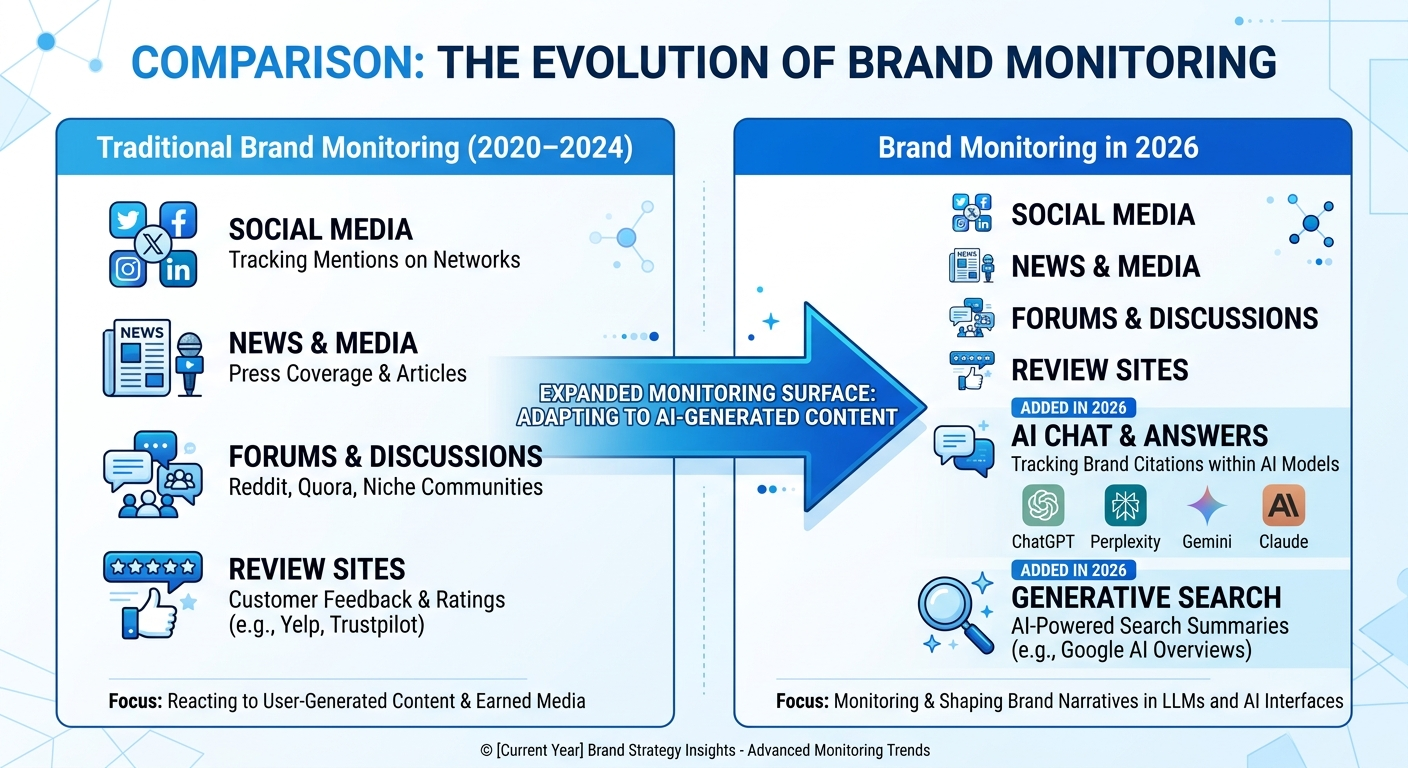
As a result, the category of brand monitoring tools has split into three tiers:
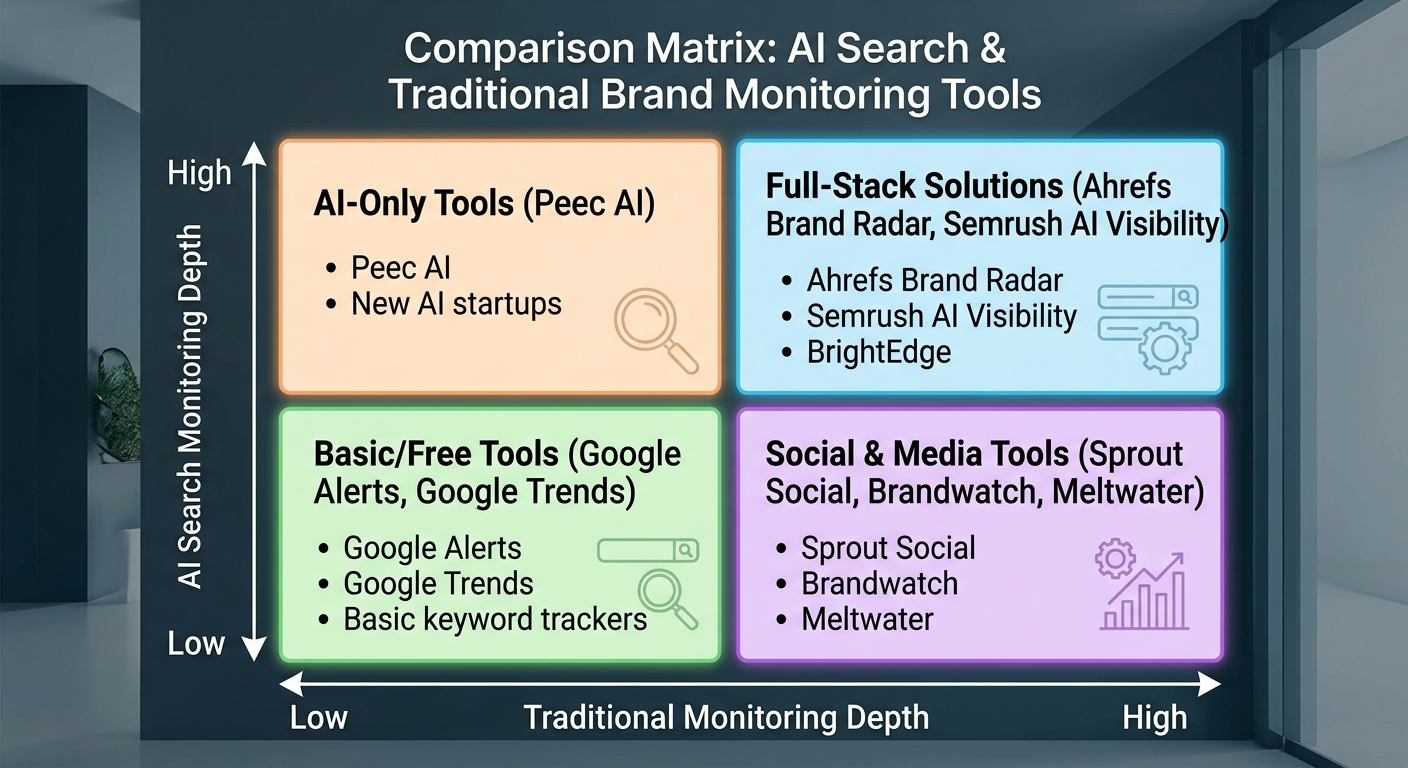
- Social and web monitoring tools — track mentions across social platforms, blogs, forums, and news sites (examples: Mention, Sprout Social, Hootsuite).
- SEO-integrated monitoring tools — combine brand mention tracking with backlink analysis and keyword data (examples: Ahrefs, Semrush).
- AI search monitoring tools — specifically track how your brand appears in LLM-generated responses (examples: Ahrefs Brand Radar, Peec AI, and platforms built for tracking brand mentions across AI search platforms).
Most brands in 2026 need coverage across at least two of these tiers. Understanding which surfaces matter most for your business determines which tools deserve your budget.
Why AI Search Changed What You Need to Monitor
Traditional brand monitoring answered a straightforward question: Where is our brand being mentioned, and what is the sentiment?
AI search introduces a harder question: When someone asks an AI assistant about our category, does it mention our brand — and in what context?
These are fundamentally different problems. A social listening tool that tracks Twitter mentions cannot tell you whether ChatGPT recommends your product when a user asks “What are the best project management tools for remote teams?” That gap matters because AI assistants increasingly influence purchase decisions, particularly in B2B categories where buyers research solutions through conversational queries.
Research published by the Allen Institute for AI in 2024 demonstrated that large language models develop brand-category associations based on patterns in their training data. If your brand appears frequently on high-authority editorial sites alongside relevant category terms, LLMs are more likely to reference your brand in generated responses. This is why brand mentions in generative AI have become a distinct monitoring category.
Key distinction: Social listening tracks what people say about your brand. AI visibility monitoring tracks what machines say about your brand. In 2026, you need both.
The practical implication is clear. If your brand monitoring stack only covers social and web channels, you have a blind spot. AI-generated answers now shape how potential customers perceive your brand before they ever visit your website or read a review.
Core Capabilities to Evaluate in Any Brand Monitoring Tool
Not every tool needs every feature. But understanding the full capability map helps you make sharper decisions about which features justify the cost.
Mention Coverage and Source Breadth
The most fundamental differentiator between tools is where they look. Some tools rely on a single third-party data provider. Others crawl the open web independently. The difference shows up in coverage gaps — tools with narrow source access miss mentions on smaller blogs, niche forums, or regional news outlets.
When evaluating coverage, ask:
- Does the tool monitor major social platforms (X, LinkedIn, Reddit, Instagram, Facebook, YouTube)?
- Does it crawl the open web — blogs, forums, and news sites — independently?
- Does it cover review platforms like G2, Capterra, Trustpilot, or industry-specific review sites?
- Does it track AI search surfaces — ChatGPT, Perplexity, Gemini, Google AI Overviews?
No single tool covers everything perfectly. The question is whether it covers the channels where your audience actually discusses brands in your category.
Sentiment Analysis Accuracy
Sentiment analysis classifies brand mentions as positive, negative, or neutral. In theory, this helps you spot reputation risks and measure campaign impact. In practice, accuracy varies dramatically between platforms.
Basic sentiment engines rely on keyword matching — words like “terrible” or “amazing” trigger classification. Advanced engines use natural language processing to detect sarcasm, mixed sentiment, and context-dependent meaning. A mention that says “Their customer support is so fast, it’s almost suspicious” requires contextual understanding that simpler tools will misclassify.
If sentiment accuracy matters for your use case — particularly for crisis detection or brand health reporting — test the tool against real mentions before committing to an annual contract.
Real-Time Alerts and Speed
Speed determines whether brand monitoring is proactive or reactive. A tool that surfaces a negative viral post 24 hours after it goes live provides information, not an advantage.
Look for tools that offer:
- Real-time or near-real-time alerts (within minutes, not hours).
- Customizable alert thresholds — trigger notifications only when mention volume or negative sentiment spikes beyond your typical pattern.
- Multi-channel delivery — email, Slack, Microsoft Teams, or in-app notifications.
Competitor Benchmarking
Monitoring your own brand in isolation provides limited context. Competitor benchmarking tools let you compare share of voice, sentiment trends, and mention volume against specific rivals. This is particularly useful for tracking how product launches, PR campaigns, or category shifts affect relative visibility.
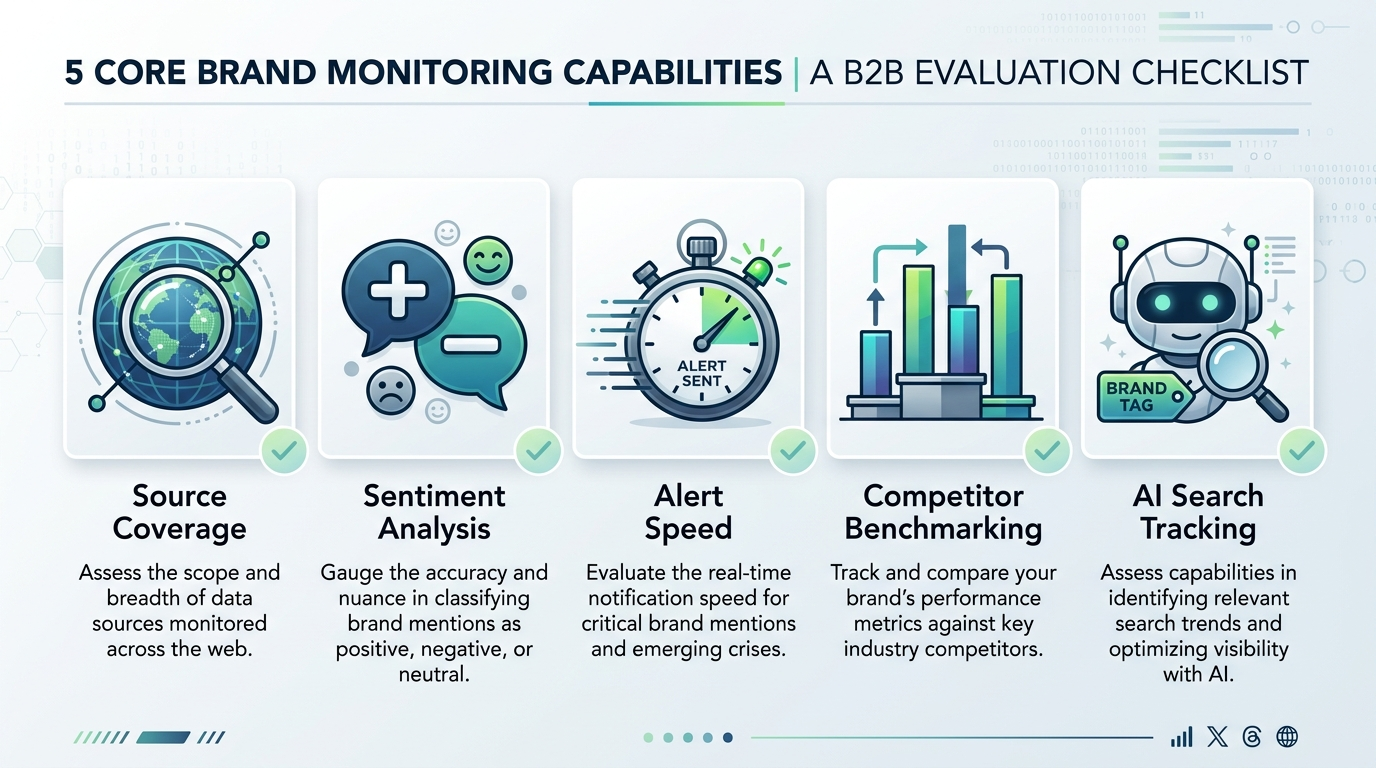
AI Search Tracking
This is the newest and fastest-evolving capability. Tools that offer AI search tracking monitor how your brand appears in responses generated by ChatGPT, Perplexity, Google Gemini, and Google AI Overviews.
The most useful implementations let you:
- Track specific prompts (e.g., “best CRM for startups”) and see whether your brand appears in the AI-generated answer.
- Monitor which competitors appear alongside you in AI responses.
- Identify the sources AI models cite most frequently for your category.
- Track changes over time as models update their training data.
For B2B brands in competitive categories, this capability is rapidly moving from “nice to have” to essential. Resources like AI visibility analytics tools can help you evaluate the options available.
How Brand Monitoring Tools Differ by Use Case
The “best” brand monitoring tool does not exist in the abstract. It depends on your team, your goals, and where your audience forms opinions about your brand.
Social Media Teams Focused on Engagement
If your primary goal is tracking social conversations and responding quickly, tools like Sprout Social, Hootsuite, and Mention are purpose-built for this workflow. They combine monitoring with publishing, scheduling, and community management in a single platform.
The tradeoff: these tools typically offer limited web monitoring outside social platforms and little to no AI search tracking. They work well for social-first brands but leave gaps for teams that need broader visibility.
PR and Communications Teams
PR teams need media monitoring — tracking press coverage, journalist mentions, and earned media impact. Tools like Meltwater, Cision, and Brandwatch offer deep media databases, journalist contact lists, and broadcast monitoring.
These platforms tend to be more expensive and are designed for enterprise PR operations. If your monitoring needs are primarily media-focused and you need to track traditional outlets alongside social channels, this tier delivers.
SEO and Content Teams
Teams already using Ahrefs or Semrush for keyword research and backlink analysis can access brand monitoring features within those platforms. The advantage is integration — you see brand mentions alongside backlink data, keyword rankings, and domain authority in one dashboard.
Both platforms have expanded into AI search tracking in 2025–2026. Ahrefs introduced Brand Radar, which monitors brand visibility across AI-generated results from ChatGPT, Perplexity, Gemini, and Google AI Overviews. Semrush added a Visibility Overview feature for tracking brand presence in LLM responses.
Teams Focused on AI Search Visibility
If your primary concern is understanding how AI assistants represent your brand — and improving that representation — you need tools specifically built for monitoring brand mentions in LLMs.
Dedicated AI visibility trackers like Peec AI offer prompt-level monitoring at lower price points than full SEO suites. These tools let you track specific questions users ask AI assistants and measure whether your brand appears in the answers.
The limitation is that AI-only tools do not replace social listening or web monitoring. They fill a specific gap that traditional tools have not addressed.
What Most Brand Monitoring Tools Still Miss in 2026
Even the most advanced platforms have gaps. Understanding these limitations prevents you from building a monitoring strategy on incomplete data.
AI Training Data Visibility
Current AI monitoring tools track what LLMs output — the responses they generate for specific prompts. But they cannot directly show you why an LLM mentions one brand over another. The internal weighting of training data, retrieval-augmented generation sources, and model fine-tuning remain opaque.
This means AI brand monitoring is inherently backward-looking. You can see that ChatGPT mentioned your competitor for a given prompt, but the tool cannot tell you exactly which source caused that citation. You can infer — by cross-referencing cited sources and editorial placements — but you cannot confirm.
Cross-Platform Mention Deduplication
When a news article is syndicated across 15 outlets, most tools count that as 15 separate mentions. This inflates mention counts and can distort sentiment analysis. Some enterprise platforms offer deduplication, but many mid-market tools do not.
Context Behind Mentions
A brand mention is not inherently valuable. A passing reference in a 3,000-word article (“tools like Acme Corp and others”) carries different weight than a detailed product comparison or expert recommendation. Most monitoring tools treat all mentions equally in volume counts. The context — whether your brand was recommended, criticized, or simply listed — requires manual review in most platforms.
This is why brand mention reports that include qualitative analysis alongside raw data deliver more actionable insight than dashboards showing mention volume alone.
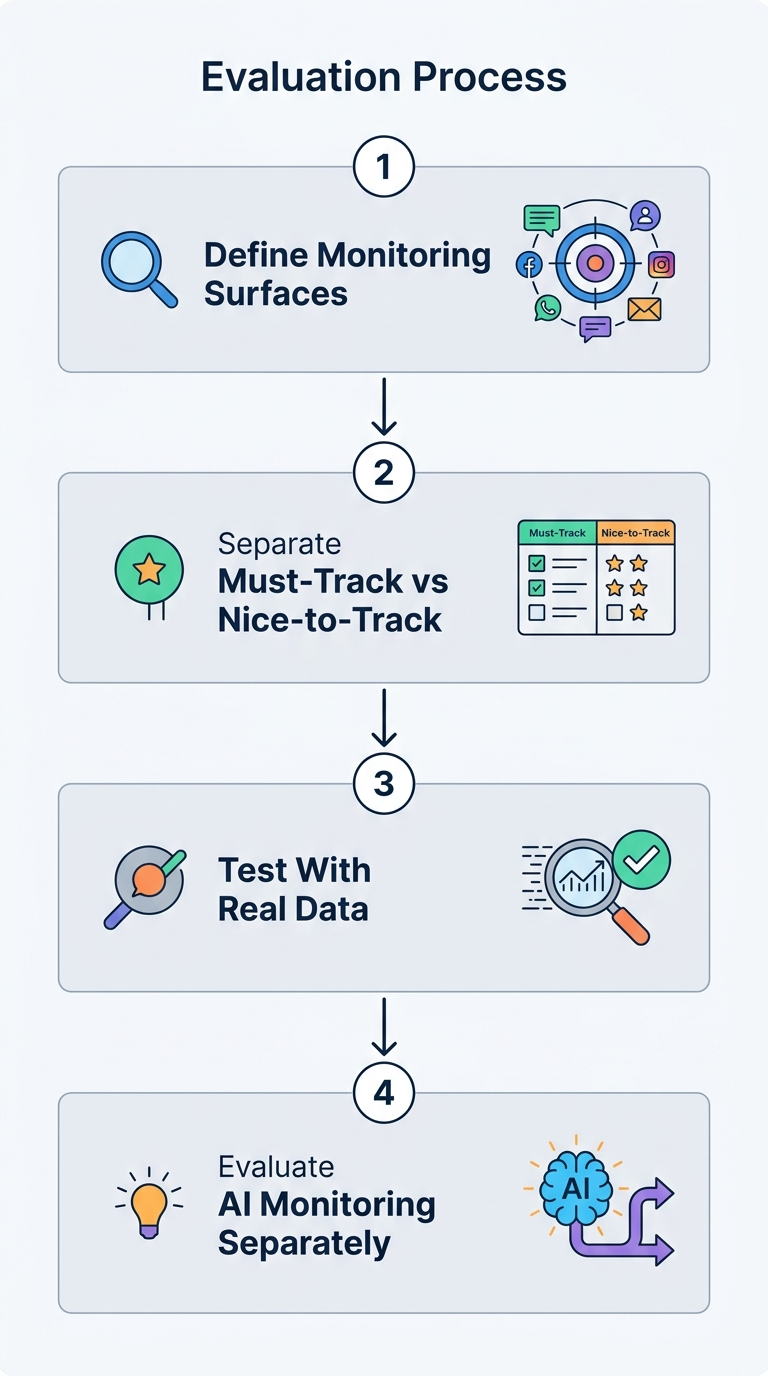
A Practical Evaluation Process for Choosing Your Tools
Skip feature-comparison spreadsheets with 40 criteria. Instead, work backward from what you actually need to know.
Step 1: Define Your Monitoring Surfaces
List the specific channels where your audience forms opinions about your brand. For a B2B SaaS company, that might be LinkedIn, G2, Reddit (r/SaaS, r/startups), industry blogs, and AI assistants. For a consumer brand, it might be Instagram, TikTok, YouTube, Amazon reviews, and Trustpilot.
Your tool must cover these surfaces. Everything else is secondary.
Step 2: Separate “Must Track” From “Nice to Track”
Your “must track” list includes your brand name, primary product names, and top two to three competitors. Your “nice to track” list includes industry terms, campaign hashtags, and executive names.
Some tools charge per tracked keyword or alert. Knowing your essential monitoring scope prevents overspending on capacity you will not use.
Step 3: Test With Real Data During a Free Trial
Demos show the best-case scenario. Free trials show reality. During a trial, run your actual brand name and compare results against what you can manually find on Google, social search, and AI assistants.
Pay attention to:
- How many mentions the tool finds versus what you can verify manually.
- How quickly alerts arrive after a new mention goes live.
- How accurately sentiment is classified for your specific brand mentions.
- Whether the dashboard helps you take action or just displays data.
Step 4: Evaluate AI Monitoring Separately
If AI search visibility matters for your brand, evaluate AI monitoring tools independently from your social listening stack. The two capabilities serve different purposes and are often best addressed by different products.
Resources like monitoring tools for ChatGPT mentions and monitoring Perplexity brand mentions provide focused comparisons for this specific need.
Step 5: Calculate Total Cost of Monitoring
Brand monitoring costs add up when you need multiple tools to cover your full surface area. A common 2026 stack for B2B companies includes:
- A social listening tool ($79–$399/month depending on team size and features).
- An SEO platform with mention tracking ($129–$449/month for Ahrefs or Semrush).
- An AI visibility tracker ($95–$600/month depending on prompt volume and platforms tracked).
Before committing, map out your total monitoring budget across all tools — not just the price of each individual product.
How Brand Mentions in AI Search Connect to Monitoring
Monitoring tells you where your brand appears. But in AI search, monitoring also reveals what to do next.
If your AI monitoring tool shows that ChatGPT mentions three competitors but not your brand when users ask about your category, that is not just a data point. It is a strategic signal that your brand lacks sufficient editorial presence in the sources LLMs draw from.
The connection between monitoring and action works like this:
- Monitor — Track which prompts and categories your brand appears in (and does not appear in) across AI platforms.
- Diagnose — Identify whether the gap is a coverage problem (not enough mentions on high-authority sources) or a relevance problem (mentions exist but do not associate your brand with the right category).
- Act — Build editorial mentions on publications that AI models reference for your category. Agencies like BrandMentions address this by placing contextual brand mentions across 140+ high-authority publications that AI models actively draw from during training data updates.
- Verify — Re-monitor to confirm whether new placements translate into AI citations over subsequent model updates.
This monitoring-to-action loop is what separates passive brand tracking from strategic efforts to increase brand mentions in AI search.
What Has Changed in Brand Monitoring Since 2024
The brand monitoring category has evolved faster in the past 18 months than in the previous five years. Understanding what shifted helps you avoid building a 2024 strategy with 2026 tools.
AI Search Became a Distinct Monitoring Channel
In 2024, tracking AI-generated mentions was experimental. By 2026, platforms like Ahrefs, Semrush, SE Ranking, and Peec AI offer structured dashboards for AI search visibility. This is no longer a niche concern — it is a standard requirement for brands competing in categories where buyers consult AI assistants.
Social Listening Platforms Added AI Features
Sprout Social, Hootsuite, and Brandwatch all integrated generative AI into their workflows during 2025. These features include AI-generated summaries of mention trends, automated sentiment reports, and natural language querying of monitoring data. The tools themselves became faster to use, even if their underlying monitoring scope did not dramatically expand.
Cost of AI Monitoring Dropped
In early 2025, tracking AI search visibility required enterprise-level budgets or custom engineering. By 2026, tools like Peec AI offer entry-level AI monitoring starting at approximately $95/month. Ahrefs Brand Radar starts at $199/month as an add-on. This price compression makes AI brand monitoring accessible to mid-market teams, not just enterprise companies.
Unlinked Mentions Gained Strategic Value
An unlinked brand mention is any editorial reference to your company that does not include a hyperlink back to your website. In traditional SEO, these were primarily valuable as link-building opportunities. In 2026, unlinked mentions also influence AI training data — LLMs learn brand-category associations from text content regardless of whether a hyperlink exists.
Tools that help you find unlinked brand mentions now serve a dual purpose: they identify link-building prospects and help you map the editorial footprint that shapes your AI visibility.
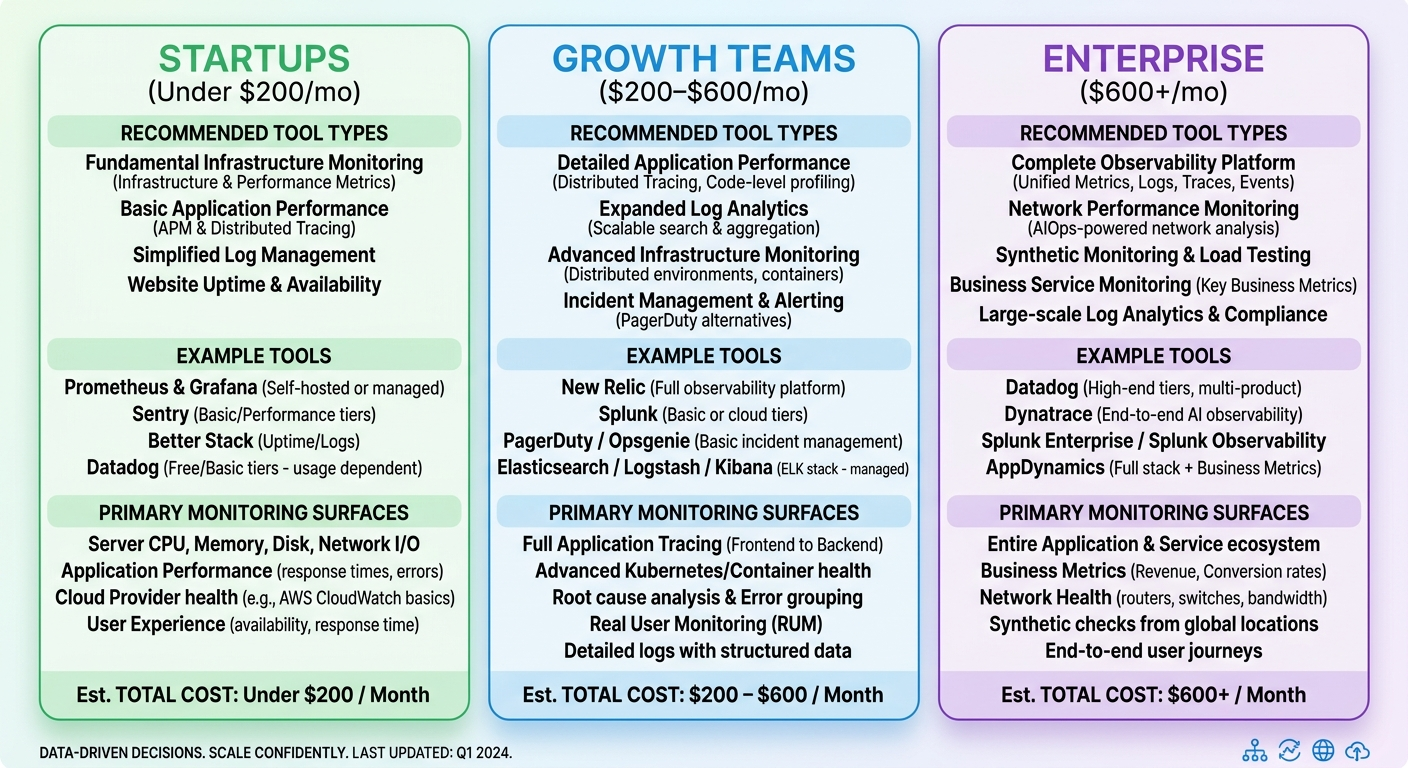
Matching Tools to Your Team Size and Budget
Your monitoring needs — and budget — look different depending on whether you are a startup founder, a mid-market marketing team, or an enterprise brand management operation.
Startups and Solo Marketers (Under $200/Month)
Start with Google Alerts (free) for basic web mention tracking. Add Alertmouse ($10/month) for more reliable email alerts than Google provides. If AI visibility matters for your category, Peec AI ($95/month) offers prompt-level AI search tracking at an accessible price point.
At this stage, you do not need a full-stack platform. You need enough visibility to know when something important happens and enough AI data to inform your content strategy.
Growth-Stage B2B Teams ($200–$600/Month)
Combine a social listening tool (Sprout Social at $199/month or Mention at $49/month) with an SEO platform that includes brand monitoring (Ahrefs at $249/month for the Standard plan). If AI search visibility is a priority, add Brand Radar ($199/month) or Peec AI.
At this budget, you can cover social, web, and AI monitoring surfaces. The key is avoiding tool overlap — make sure each platform covers a distinct channel set.
Enterprise Teams ($600+/Month)
Enterprise teams typically need Brandwatch or Meltwater for deep media monitoring, Ahrefs or Semrush for SEO-integrated tracking, and a dedicated AI visibility solution. Custom reporting, team collaboration features, and API integrations become more important at scale.
In campaigns across 67+ B2B companies, the BrandMentions team found that enterprise brands with consistent editorial mentions achieved AI recommendation rates 89% higher than those relying solely on traditional SEO. At the enterprise level, monitoring alone is not sufficient — it needs to feed a deliberate brand mentions strategy that improves visibility across both human and AI audiences.
How to Act on What Monitoring Reveals
Data without action is just overhead. The most valuable brand monitoring workflows connect directly to decisions your team can make.
When Monitoring Shows Negative Sentiment Spikes
Investigate the source immediately. Is this a product issue, a customer service failure, or a PR situation? Respond publicly where appropriate. Document the incident for your crisis communication playbook. Track whether sentiment recovers within your typical resolution window.
When Monitoring Shows Competitor Mentions Growing
Analyze where competitor mentions are increasing. If they are gaining editorial coverage on high-authority publications, that signals a content or PR strategy you may need to match. If they are appearing in AI search results where you are not, investigate which sources AI models are citing and develop a plan to build presence on those publications.
When AI Monitoring Shows Your Brand Is Absent
This is the most common and most actionable finding for B2B brands in 2026. If AI assistants do not mention your brand for category-relevant prompts, the diagnosis is almost always insufficient editorial presence on high-authority sources.
The solution is not more social media content or more blog posts on your own domain. It is building brand mentions across external publications that LLMs reference during training data refreshes. This is where strategic brand citation work — placing contextual mentions on authoritative, editorially trusted sites — directly addresses the gap your monitoring tool surfaced.
Frequently Asked Questions About Brand Monitoring Tools
What is the difference between brand monitoring and social listening?
Brand monitoring tracks mentions of your specific brand name, products, and competitors across all digital channels — including web, social, news, review sites, and AI search engines. Social listening is a subset that focuses specifically on social media conversations, often including broader industry topics and sentiment trends beyond just your brand. Most modern platforms combine both capabilities, but coverage depth varies significantly.
Can brand monitoring tools track what AI assistants say about my brand?
As of 2026, a growing number of tools can track AI-generated mentions. Ahrefs Brand Radar, Semrush Visibility Overview, SE Ranking AI Results Tracker, and Peec AI all monitor brand appearances in ChatGPT, Perplexity, Gemini, and Google AI Overviews. Traditional social listening tools like Sprout Social and Hootsuite do not yet offer this capability. You can explore specific options for checking brand mentions in ChatGPT and monitoring Gemini brand mentions.
How much do brand monitoring tools cost?
Pricing ranges from free (Google Alerts, Google Trends) to over $600/month for enterprise AI visibility tracking. Mid-market social listening tools typically cost $49–$399/month per seat. AI search monitoring add-ons range from $95–$600/month depending on the number of tracked prompts and AI platforms covered. Most tools offer free trials ranging from 7 to 30 days.
Do brand mentions actually influence AI search recommendations?
Yes. Large language models develop brand-category associations from patterns in their training data, which includes high-authority editorial content across the web. Brands with consistent, contextual mentions on trusted publications are more likely to appear in AI-generated answers. This relationship is why AI brand mentions have become a distinct focus area within brand monitoring and marketing strategy.
What is the best free brand monitoring tool?
Google Alerts remains the simplest free option for tracking web mentions via email notifications. Google Trends provides free competitive trend data based on relative search volume. Neither offers social media monitoring, sentiment analysis, or AI search tracking. For teams that need more than basic alerts without an immediate budget, Alertmouse offers a free plan with one alert and up to 10 mentions per day.
Where Brand Monitoring Is Heading
The trajectory is clear: brand monitoring tools will continue expanding to cover AI search surfaces as those surfaces capture more user attention and purchase intent. The tools that integrate traditional social and web monitoring with AI visibility tracking — in a single dashboard, at an accessible price — will win the category.
For your brand, the immediate priority is straightforward. Audit your current monitoring stack against the surfaces that matter most in 2026. If you have blind spots in AI search visibility, close them. And connect your monitoring data to specific actions — because knowing where your brand is mentioned only matters if it changes what you do next.
Want to see how AI search engines currently represent your brand — and your competitors? Get a free AI visibility audit to find out where you stand.