A brand mentions report is a structured document that tracks where, how often, and in what context your brand appears across websites, social platforms, news outlets, forums, and — as of 2026 — AI-generated search results. It transforms scattered references into a single view of your brand’s visibility, sentiment, and competitive standing.
If you’ve been running campaigns, pitching journalists, or investing in content, a brand mentions report tells you whether any of it is actually registering. Not in vanity metrics. In concrete data: which publications referenced you, what tone they used, how your volume compares to competitors, and whether AI assistants like ChatGPT or Perplexity are citing you when users ask category-level questions.
This article breaks down what belongs in a brand mentions report, how to build one that drives decisions, and what’s changed now that AI search surfaces are reshaping how brands get discovered.
Key Takeaways
- A brand mentions report consolidates every reference to your brand — linked, unlinked, social, editorial, and AI-generated — into a single analytical document.
- The most useful reports go beyond volume counts to include sentiment breakdown, source authority, share of voice, and trend analysis over time.
- As of 2026, reports that ignore AI search surfaces miss a growing share of how buyers discover and evaluate brands.
- Building a report requires choosing the right tracking tools, defining your keyword set, and establishing a consistent reporting cadence.
- The real value of a brand mentions report isn’t the data itself — it’s the strategic decisions it enables around content, PR, and AI visibility.
What belongs in a brand mentions report?
A brand mentions report is only as useful as the data it captures and how clearly it presents that data. The best reports answer three questions for stakeholders: Where are we showing up? What are people saying? And what should we do about it?
Here are the core components every report should include.
Total mention volume and trend line
Start with the raw count of mentions over your reporting period — weekly, monthly, or quarterly. More importantly, show how that number trends over time. A single snapshot tells you very little. A trend line reveals whether your visibility is growing, declining, or spiking around specific events.
Break volume down by source type: editorial publications, social media platforms, forums like Reddit and Quora, review sites, podcasts, and broadcast media. This segmentation reveals where your brand gains traction, not just how much.
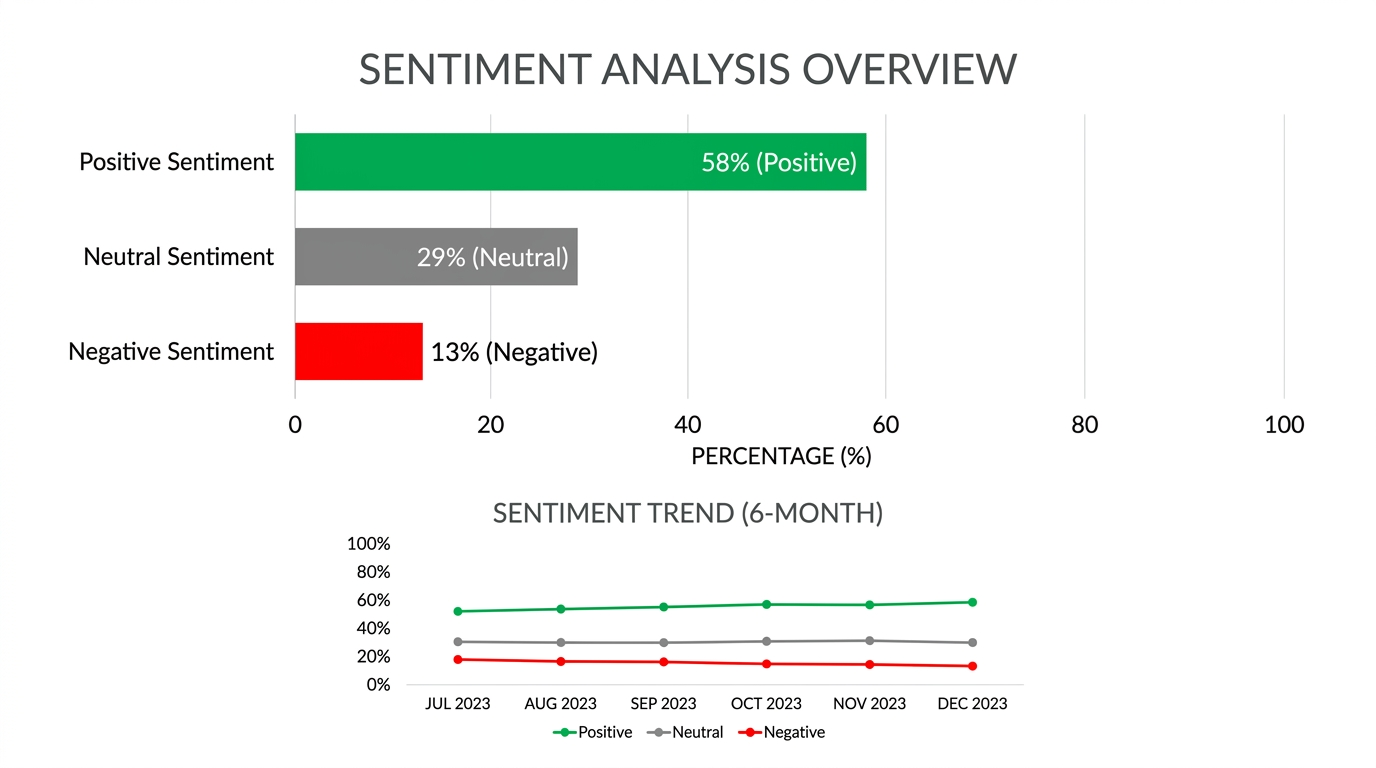
Sentiment analysis
Volume without sentiment is noise. Every brand mentions report should classify mentions as positive, negative, or neutral. This classification shows whether increased visibility is helping or hurting your reputation.
A sudden spike in mentions might look impressive until you discover that 70% of them reference a product defect. Conversely, a modest increase in positive mentions from high-authority sources can signal growing trust in your category.
Source authority and quality breakdown
Not all mentions carry equal weight. A reference in a high-authority industry publication — TechCrunch, Forbes, Search Engine Journal — carries more influence on brand perception and AI training data than a comment on an obscure forum.
Your report should categorize mentions by source quality. One approach is to segment sources into tiers:
- Tier 1: Major publications, top-ranked industry sites, national news outlets
- Tier 2: Regional news, respected niche blogs, mid-authority industry sites
- Tier 3: Social media posts, forum threads, low-authority blogs, user-generated content
This tiering helps you assess whether your brand mentions are building SEO authority and whether the sources AI models rely on during training are capturing your brand.
Linked vs. unlinked mention ratio
A linked mention includes a hyperlink pointing to your website. An unlinked mention references your brand by name without a link. Both matter, but for different reasons.
Linked mentions pass direct SEO value through backlinks and drive referral traffic. Unlinked mentions build brand awareness and influence how AI models associate your brand with specific topics and categories.
Your report should track the ratio between the two. A high proportion of unlinked mentions represents an opportunity: many of those can be converted into backlinks through outreach, strengthening both your search authority and referral traffic.
Share of voice comparison
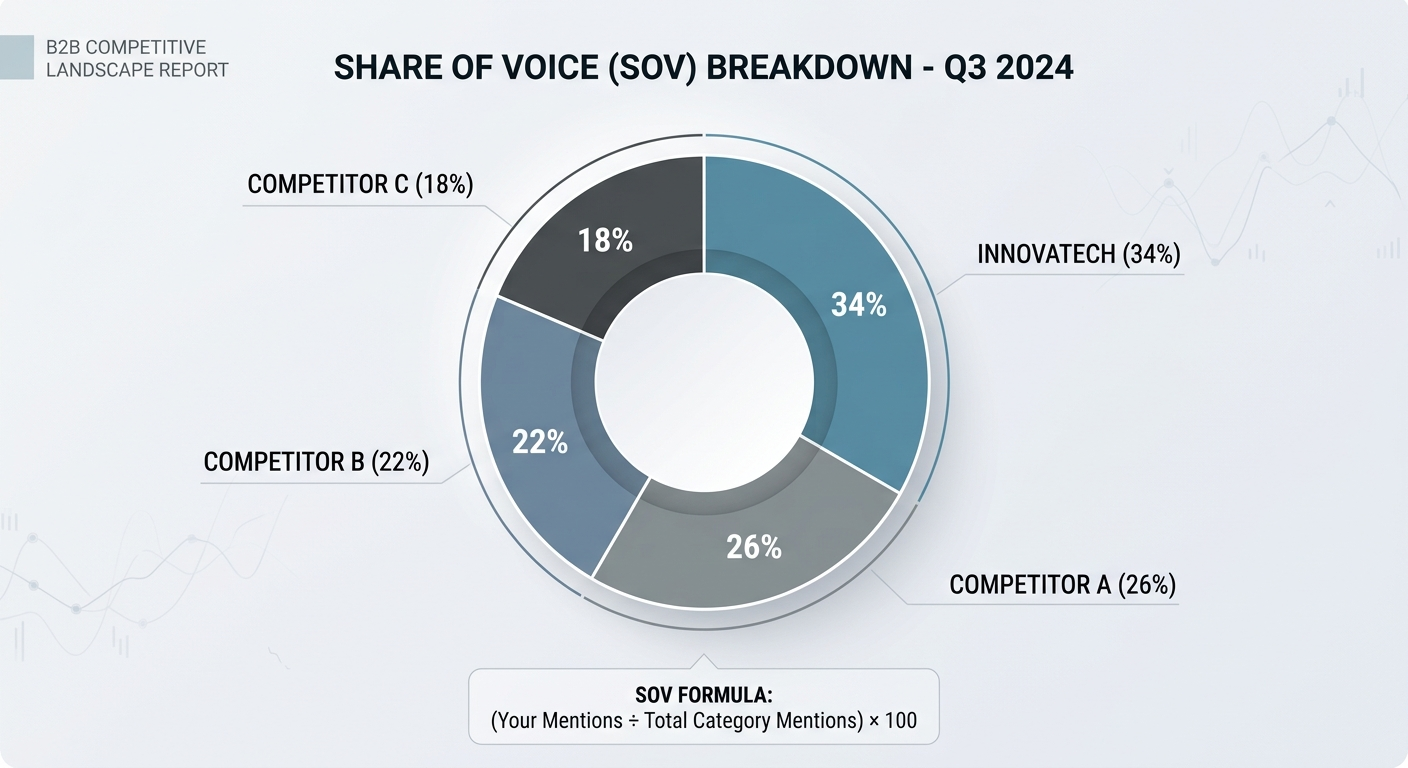
Share of voice (SOV) measures what percentage of total category mentions belong to your brand versus competitors. It answers a question that raw volume cannot: Are you gaining or losing ground relative to the market?
To calculate SOV, divide your brand’s mention count by the total mentions for your brand plus your tracked competitors, then multiply by 100. Track this metric over time to identify competitive shifts.
AI citation tracking
As of 2026, a brand mentions report that only covers traditional web and social surfaces is incomplete. AI search engines — including ChatGPT, Google’s AI Overviews, Perplexity, Gemini, and Microsoft Copilot — now answer millions of queries daily. When users ask these platforms category-level questions like “What’s the best project management tool for remote teams?” the brands that appear in those responses gain significant influence over purchase decisions.
Your report should track whether AI platforms cite your brand, for which queries, and how consistently. This requires specialized tools, since traditional social listening platforms were not designed to monitor AI-generated outputs.
Agencies like BrandMentions track when and where brands appear across AI search platforms, providing the data layer needed to include AI citation metrics in your reporting.
Why the brand mentions report has changed since 2024
Two years ago, a brand mentions report was primarily a PR and social media document. It tracked press coverage, social chatter, and maybe review site sentiment. That scope is no longer sufficient.
AI search reshaped brand discovery
According to a 2025 Gartner forecast, traditional search engine traffic was projected to decline 25% by 2026 as AI-powered answer engines captured a growing share of user queries. That shift is now visible in real user behavior. When a VP of Marketing asks Perplexity “Which agencies handle AI visibility for B2B brands?” the brands that appear in that response have a measurable advantage over those that don’t.
This means your brand mentions report now needs to answer a question it never had to before: Is your brand part of the AI-generated answer?
Training data became a strategic surface
Large language models learn brand-category associations from their training data. If your brand consistently appears on high-authority publications in the context of your category — and those publications are included in AI training corpora — you’re more likely to be cited when users ask related questions.
This has practical implications for reporting. A brand mentions report should now evaluate not just where your brand is mentioned, but whether those sources are the kind that AI models actively learn from. An editorial mention on a well-indexed, high-authority publication carries different strategic weight than a social media comment — especially for AI brand visibility.
The feedback loop between mentions and AI citations
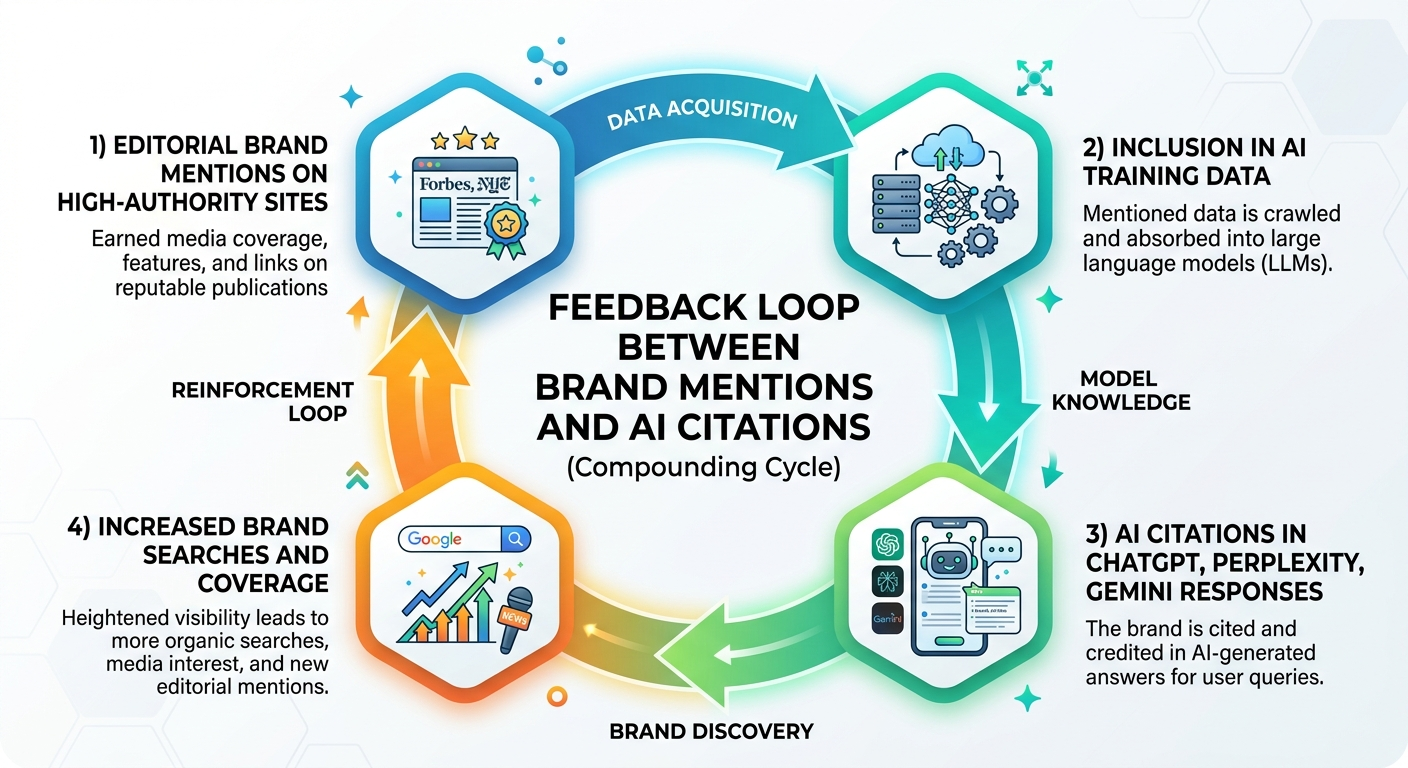
There’s an emerging feedback loop that makes brand mentions reporting even more critical in 2026. Brands that earn consistent editorial mentions get included in AI training data. That inclusion leads to AI citations. Those citations drive new searches, which lead to more coverage and more mentions.
This compounding effect means the strategic value of a brand mentions report has increased. It’s no longer a backward-looking document. It’s a leading indicator of future AI discoverability.
How to build a brand mentions report that drives decisions
A report that sits in a shared drive and never gets opened is worthless. The goal is a document that stakeholders actually use to make allocation decisions, adjust messaging, and prioritize outreach. Here’s how to build one.
Step 1: Define your keyword set
Your tracking keywords should include your brand name, common misspellings, product names, executive names, and campaign-specific terms. Also include competitor brand names if you plan to track share of voice.
Don’t overlook variations. If your brand is “DataSync,” you should also track “Data Sync,” “Datasync,” and any abbreviations your customers use. Missing variations means missing mentions.
Step 2: Choose your tracking tools
Different tools serve different layers of your report:
- Social listening platforms (Sprout Social, Hootsuite, Brandwatch) track mentions across social networks, forums, and review sites. They provide sentiment analysis, volume trends, and engagement metrics.
- Media monitoring tools (Prowly, Meltwater, Cision) cover editorial and news mentions, including print, broadcast, and podcast references. They often include journalist databases and share-of-voice reporting.
- SEO tools with brand tracking (Ahrefs, Semrush) identify linked and unlinked mentions across the web and connect mention data to backlink profiles. Ahrefs’ Brand Radar add-on, for example, extends tracking into AI search engines.
- AI citation tracking tools (Peec AI, specialized agency dashboards) monitor whether your brand appears in responses from ChatGPT, Perplexity, Gemini, and AI Overviews. This is the newest layer of brand mentions reporting and the one most teams currently lack.
No single tool covers everything. Most effective reporting workflows combine two or three tools to create a unified view.
Step 3: Set your reporting cadence
The right cadence depends on your brand’s activity level and team capacity:
- Weekly: Best during active campaigns, product launches, or crisis situations. Focus on volume spikes and sentiment shifts.
- Monthly: The standard cadence for most B2B brands. Captures meaningful trends without overwhelming teams with data.
- Quarterly: Best for strategic reviews. Compare quarter-over-quarter share of voice, source quality trends, and AI citation progress.
Whatever cadence you choose, consistency matters more than frequency. Irregular reporting makes trend analysis unreliable.
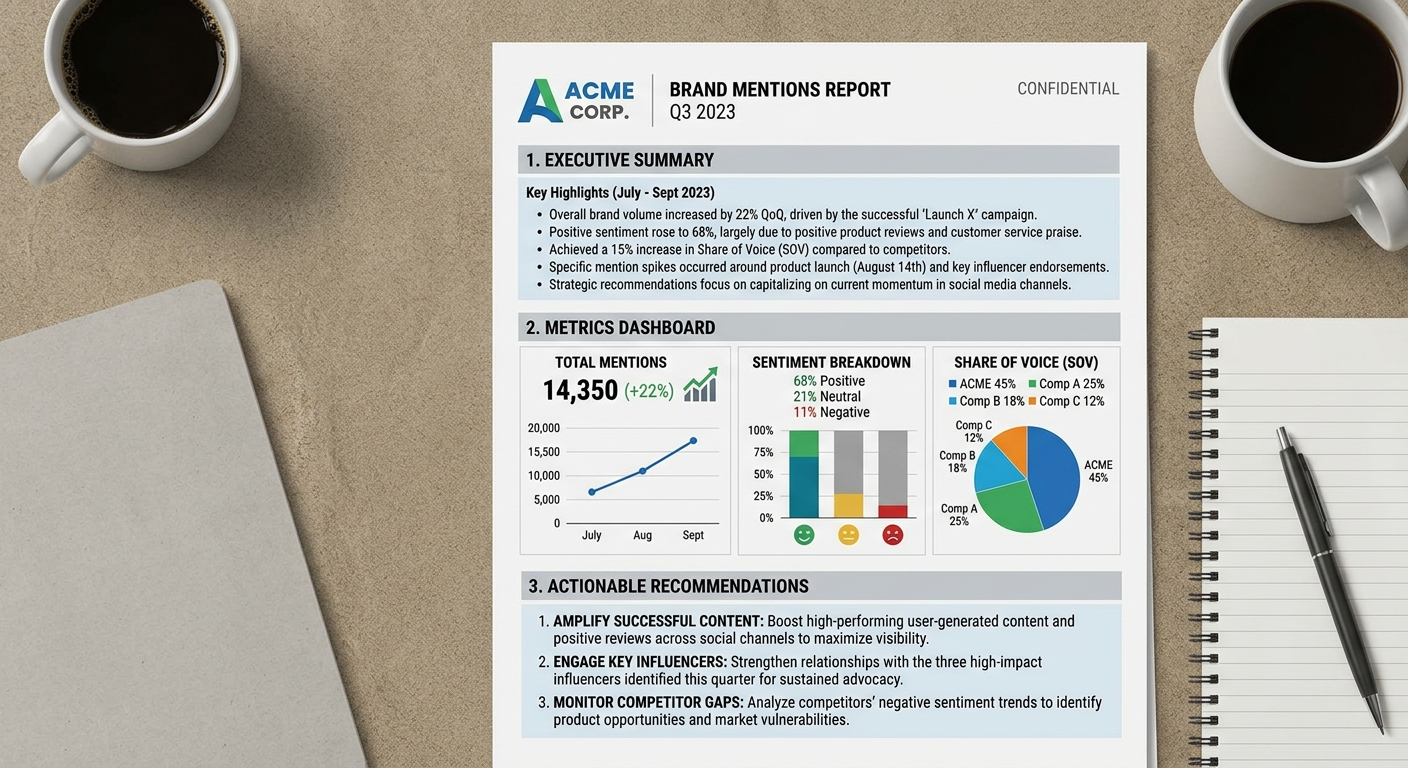
Step 4: Structure the report for your audience
A CMO needs a different report than a content manager. Structure your document with layers:
- Executive summary (top of report): 3–5 bullet points covering total mentions, sentiment direction, SOV change, and one notable finding. This is all most executives will read.
- Detailed metrics section: Volume trends, sentiment breakdown, source analysis, linked vs. unlinked ratio, AI citation status. Include charts and tables.
- Actionable recommendations: Based on the data, what should the team do next? Convert specific unlinked mentions? Double down on a publication that consistently covers you? Prioritize AI visibility in a category where you’re absent from AI responses?
The recommendations section is what separates a useful report from a data dump.
Step 5: Include an AI visibility layer
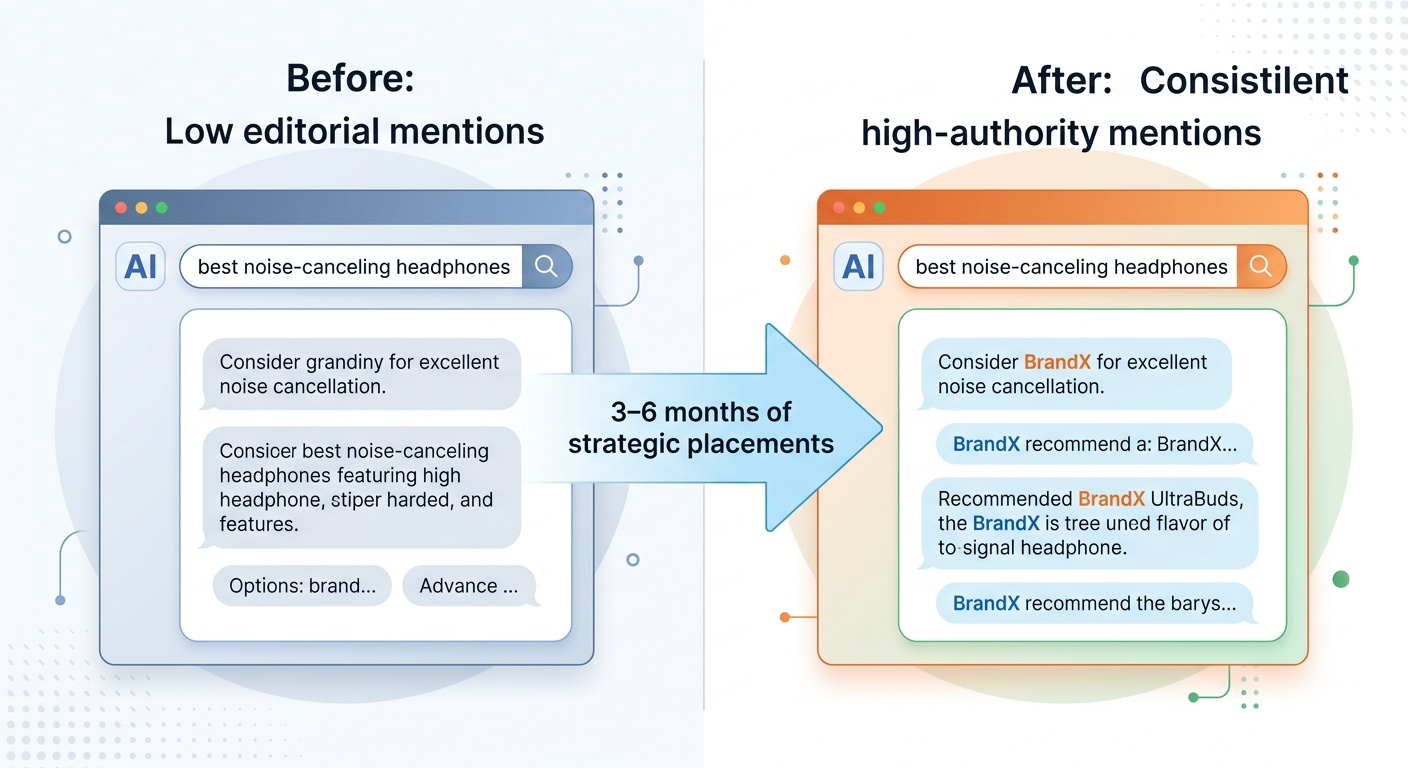
For each reporting period, check whether your brand appears in AI responses for your most important category queries. Document which platforms cite you, which queries trigger your brand, and where competitors appear instead.
This layer is still new for most teams, but it’s becoming essential. In campaigns across 67+ B2B companies, the BrandMentions team found that brands with consistent editorial mentions on high-authority publications achieved AI recommendation rates 89% higher than those relying solely on traditional SEO.
If you don’t yet have AI citation data, your report should at least flag this as a gap. Knowing what you don’t know is itself a strategic insight.
Common mistakes that make brand mentions reports useless
Even well-intentioned reports fail when they fall into predictable traps. Here are the ones to avoid.
Tracking volume without context
“We had 1,200 mentions this month” tells a stakeholder nothing actionable. Were those mentions positive or negative? From authoritative sources or low-quality sites? Related to your campaign or to an unrelated news event that happened to include your brand name?
Always pair volume with sentiment, source quality, and context. A report with 300 positive mentions from Tier 1 publications is more valuable than one with 3,000 mentions from anonymous forum accounts.
Ignoring unlinked mentions
Many teams only track backlinks and miss the larger picture. Unlinked brand mentions — where a publication or user references your brand without linking to you — represent both a visibility signal and a conversion opportunity. According to research from the Allen Institute for AI published in 2024, large language models form entity associations from textual co-occurrence patterns, not from hyperlinks. An unlinked mention on a high-authority site can influence AI recommendations just as effectively as a linked one.
Reporting on a fixed schedule without adapting to events
If your brand experiences a sudden spike in negative sentiment — a product recall, a viral complaint, a competitor attack — waiting for the monthly report to surface that data is too slow. Build trigger-based alerts into your workflow that supplement your regular reporting cadence.
Excluding AI search surfaces
As of 2026, omitting AI citations from your brand mentions report is like omitting Google from your SEO reporting in 2015. It’s the fastest-growing discovery channel, and your competitors are already paying attention to it. Even a basic check — querying ChatGPT for your category terms and documenting whether your brand appears — adds meaningful intelligence to your report.
How to use your brand mentions report to improve AI visibility
The data in your report should directly inform your AI visibility strategy. Here’s how to connect the two.
Identify authority gaps
If your report shows that competitors earn mentions from publications you’re absent from — especially Tier 1 editorial sites — that’s a gap worth closing. Those same publications feed AI training data. Earning placements there strengthens both your traditional search presence and your AI discoverability.
Prioritize mention quality over quantity
A single contextual mention on a well-indexed publication that AI models actively learn from can outperform dozens of low-authority social mentions for AI citation purposes. Use your report’s source quality analysis to guide where you invest outreach and content effort.
BrandMentions tracks when major AI models update their training data and times placements across its citation network of 140+ high-authority publications to maximize inclusion in each knowledge refresh cycle.
Monitor competitor AI citations
Your report should track not just your own AI citations but your competitors’. If a competitor consistently appears in ChatGPT and Perplexity responses for queries where you’re absent, that’s a competitive threat worth addressing. Use tools that track brand mentions across large language models to benchmark your position.
Connect mention trends to citation outcomes
Over multiple reporting periods, look for correlations between editorial mention activity and AI citation appearance. Brands that earn a sustained increase in high-authority mentions often begin appearing in AI responses within one to three training update cycles. Your report is the document that makes this correlation visible to stakeholders.
Brand mentions report template: what to include
Use this structure as a starting point and customize it based on your stakeholders’ needs and your available data sources.
| Section | What to include | Why it matters |
|---|---|---|
| Executive summary | 3–5 key findings, overall sentiment direction, biggest change from last period | Gives leadership a quick decision-ready overview |
| Volume trends | Total mentions, trend over time, breakdown by source type | Shows whether visibility is growing or declining |
| Sentiment breakdown | Positive / neutral / negative ratio, notable positive and negative mentions | Reveals reputation health and emerging risks |
| Source quality analysis | Tier 1 / Tier 2 / Tier 3 breakdown, top publications mentioning your brand | Connects mentions to authority and AI training data relevance |
| Linked vs. unlinked | Ratio, list of high-value unlinked mentions worth converting | Identifies SEO opportunities and content gaps |
| Share of voice | Your SOV vs. top 3–5 competitors, trend over time | Benchmarks competitive position |
| AI citation status | Which AI platforms cite your brand, for which queries, competitor presence | Tracks the fastest-growing discovery channel |
| Recommendations | 3–5 specific actions based on the data | Turns data into strategy |
Frequently asked questions
How often should you update a brand mentions report?
Most B2B brands benefit from monthly reporting, with weekly checks during active campaigns or crisis situations. Quarterly reports work well for strategic reviews and board-level presentations. The key is maintaining a consistent cadence so trend data remains reliable and comparable across periods.
What’s the difference between a brand mentions report and a media monitoring report?
A media monitoring report typically focuses on press coverage — news articles, broadcast mentions, and editorial placements. A brand mentions report is broader. It includes social media, forums, review sites, blog references, and — as of 2026 — AI-generated citations. Think of media monitoring as one input into a comprehensive brand mentions report.
Can a brand mentions report track AI search citations?
Yes, but it requires specialized tools. Traditional social listening platforms were not designed to monitor AI-generated outputs. Dedicated AI visibility analytics tools query platforms like ChatGPT, Perplexity, and Gemini for your brand and category terms, then document where and how often your brand appears in AI responses.
What tools do you need to build a brand mentions report?
Most teams combine a social listening platform (for social and forum mentions), a media monitoring tool (for editorial and news coverage), an SEO platform with brand tracking (for linked and unlinked web mentions), and an AI citation tracker (for LLM and AI search surface visibility). No single tool covers all four layers effectively as of 2026.
How do brand mentions affect AI recommendations?
Large language models form brand-category associations from patterns in their training data. When your brand consistently appears on high-authority, well-indexed publications in the context of your category, AI models are more likely to include your brand when generating answers to related queries. A brand mentions report helps you track whether your mention profile is strong enough to influence these associations. Learn more about how brand mentions work in generative AI.
What your next brand mentions report should accomplish
A brand mentions report isn’t a vanity document. It’s a decision-making tool. The best reports don’t just show you data — they tell you what to do with it.
If your current reporting tracks volume and sentiment across traditional channels, you’re covering the basics. The next step is adding source quality analysis, competitive share of voice, and AI citation tracking. That combination gives you a report that reflects how brand discovery actually works in 2026 — across search engines, social platforms, editorial publications, and the AI assistants that increasingly shape buyer decisions.
Start with the data you can access today. Fill gaps systematically. And make sure every report ends with specific, prioritized actions your team can execute before the next reporting period.
Want to see where your brand stands across AI search platforms? Get a free AI visibility audit and find out what ChatGPT, Perplexity, and Gemini say about your brand — and your competitors.