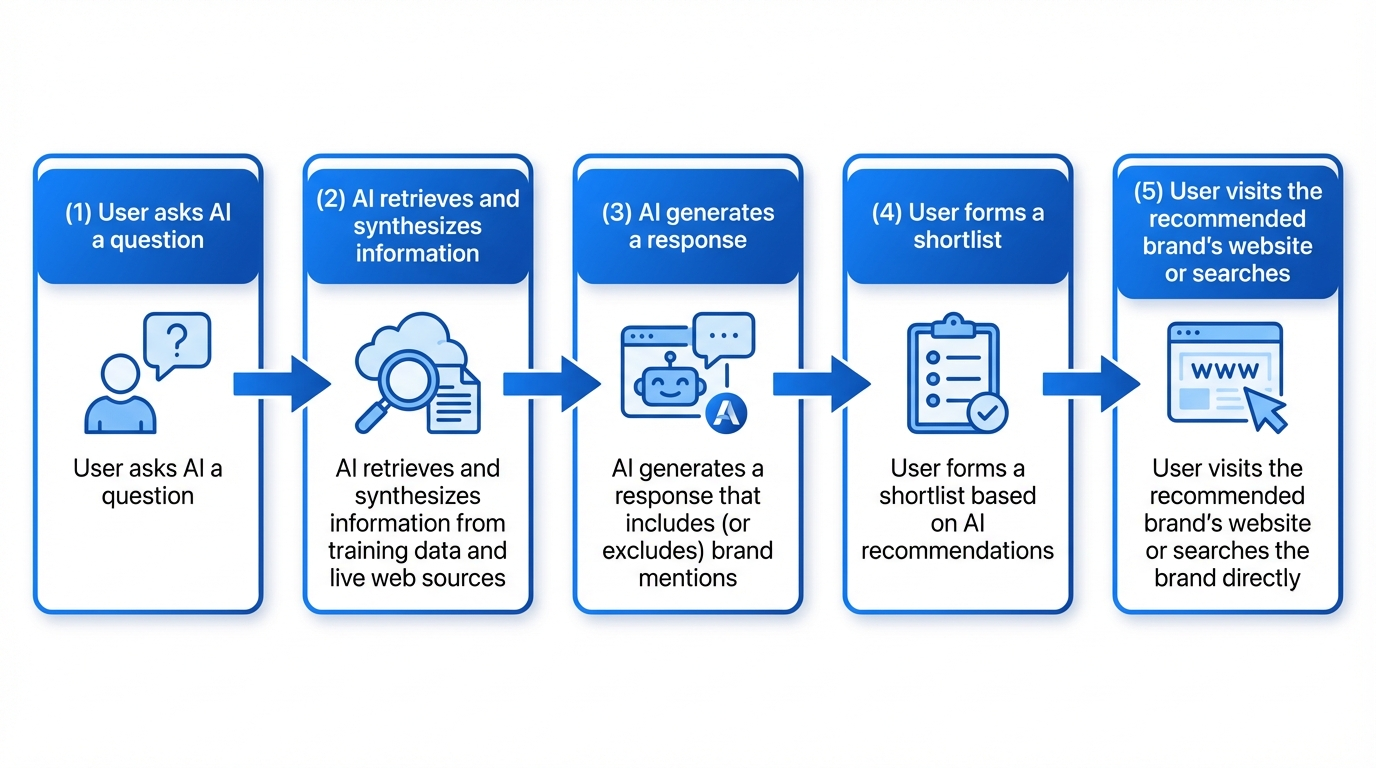
Brand mentions in AI are the references AI assistants make to your company when users ask for recommendations, comparisons, or solutions. These mentions — whether in ChatGPT, Google’s AI Overviews, Perplexity, Claude, or Gemini — now shape buying decisions before a prospect ever visits your website. As of 2026, AI-generated answers influence how millions of B2B buyers discover, evaluate, and shortlist vendors. If your brand doesn’t appear in those answers, you’re invisible at the exact moment purchase intent forms.
This article breaks down how brand mentions in AI actually work, what triggers them, why they matter more than traditional rankings for pipeline growth, and the specific steps you can take to earn them consistently across every major AI platform.
What You’ll Learn
- What brand mentions in AI are — and how they differ from traditional SEO citations and backlinks
- Why AI mentions now carry more influence on B2B purchase decisions than organic rankings alone
- The specific signals that cause AI models to mention one brand over another
- How to audit your current AI mention footprint across ChatGPT, Perplexity, Gemini, and Claude
- A practical, repeatable process for earning more brand mentions across AI platforms in 2026
- How to measure whether your AI mention strategy is working — and what metrics matter
How Brand Mentions in AI Differ from Traditional SEO Signals
A brand mention in AI is any instance where an AI assistant names your company in a generated response — with or without a link. This happens when a user asks a question like “What’s the best CRM for mid-market SaaS companies?” and the AI includes your brand in its answer.
This is fundamentally different from traditional SEO in three ways:
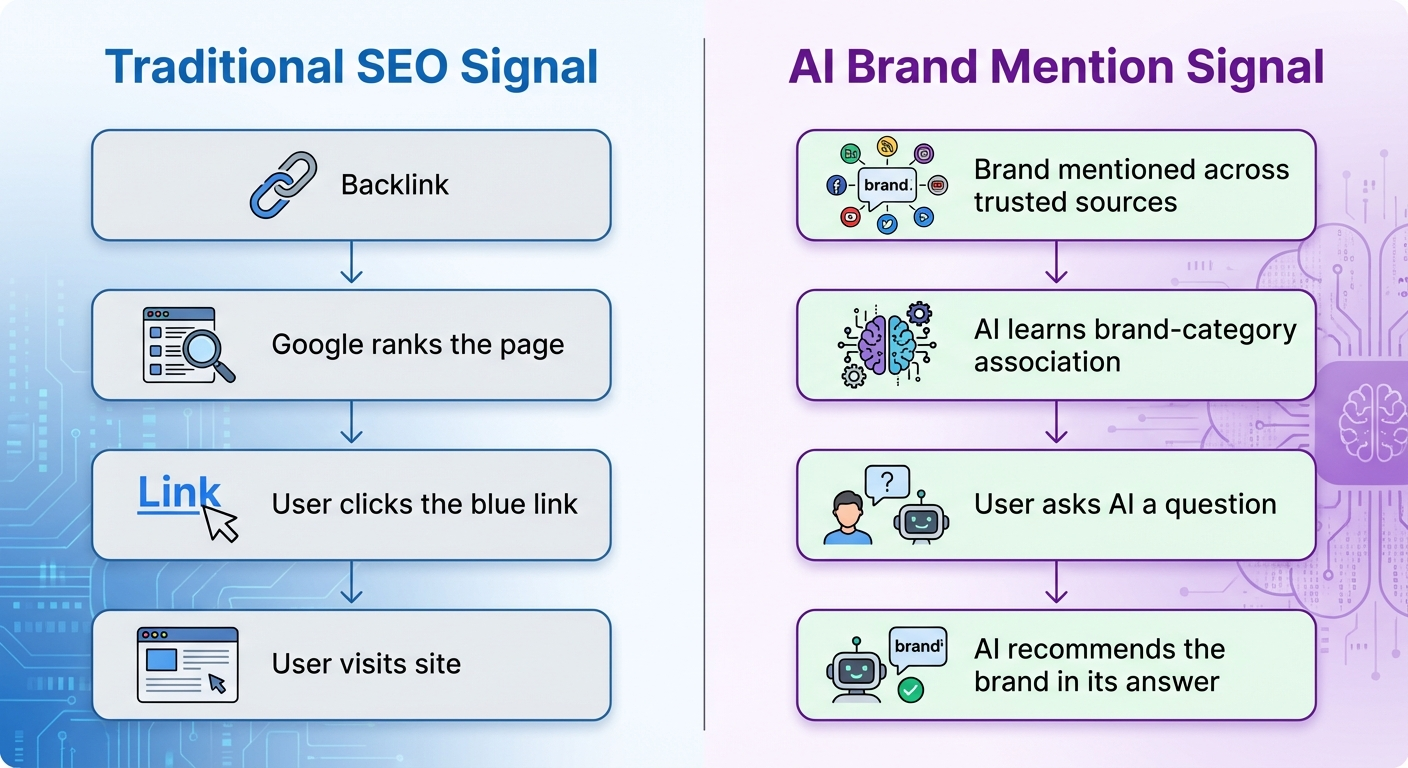
- No click required for influence. In traditional search, your brand needs a user to click a blue link. In AI search, the brand recommendation is the answer. The user absorbs it without clicking anything.
- Mentions are contextual endorsements. When ChatGPT names your brand in a recommendation, it functions more like a trusted advisor’s suggestion than a search result listing. According to a 2025 BrightEdge analysis, ChatGPT mentions brands 3.2x more often than it formally cites them with links — meaning unlinked recommendations dominate.
- Frequency and context compound over time. AI models learn brand-category associations from repeated, consistent mentions across high-authority sources. The more often your brand appears alongside your category terms in training data and live web sources, the stronger that association becomes.
Think of it this way: a backlink tells Google your page has authority. A brand mention across multiple trusted publications tells an AI model your company is an authority in your category.
Why AI Mentions Now Drive B2B Pipeline More Than Rankings Alone
The shift is measurable. According to a 2024 Gartner forecast, traditional search engine volume was projected to drop 25% by 2026 as AI assistants absorb more discovery queries. That forecast is tracking closely with reality.
Here’s what’s changed since 2024–2025:
- AI assistants now handle full buying journeys. A B2B buyer can go from problem awareness to vendor shortlist inside a single ChatGPT conversation — without ever visiting Google.
- Zero-click behavior has accelerated. Sparktoro research found that 60% of Google searches ended in zero clicks in 2024. With AI Overviews now appearing for nearly all queries in 2026, that figure has grown further.
- Brand recall follows AI visibility. Research by Better.com showed a 41% improvement in brand recall after optimizing for AI search visibility — a downstream effect that traditional click metrics miss entirely.
For B2B brands, the implication is direct: if a VP of Engineering asks ChatGPT “What are the best observability platforms for Kubernetes?” and your product isn’t mentioned, you’ve lost a pipeline opportunity before your sales team even knew it existed.
The Consideration Set Has Moved Upstream
In 2024, the consideration set formed across multiple touchpoints — Google results, review sites, peer recommendations, analyst reports. In 2026, AI assistants synthesize all of those signals into a single answer. The consideration set now forms inside the AI response itself.
This means brand mentions in AI aren’t a “nice to have” visibility metric. They’re the mechanism through which your brand enters — or gets excluded from — your buyer’s shortlist.
What Makes AI Models Mention One Brand Over Another
AI models are not random. They follow patterns when deciding which brands to include in their responses. Understanding these patterns is the foundation of any effective AI mention strategy.
Repeated Association in Trusted Sources
AI models build brand-category associations from their training data — the massive corpus of web content they’ve been trained on. If your brand is consistently mentioned alongside your category terms (e.g., “enterprise data integration,” “B2B payment processing”) across high-authority publications, the model learns that association.
A 2025 Seer Interactive study analyzed 10,000 People Also Ask questions through GPT-4o and found a strong correlation (~0.65) between Google page-one rankings and LLM mentions — not because rankings directly influence AI, but because the same content quality and authority signals that drive rankings also appear frequently in training data.
Source Authority and Editorial Quality
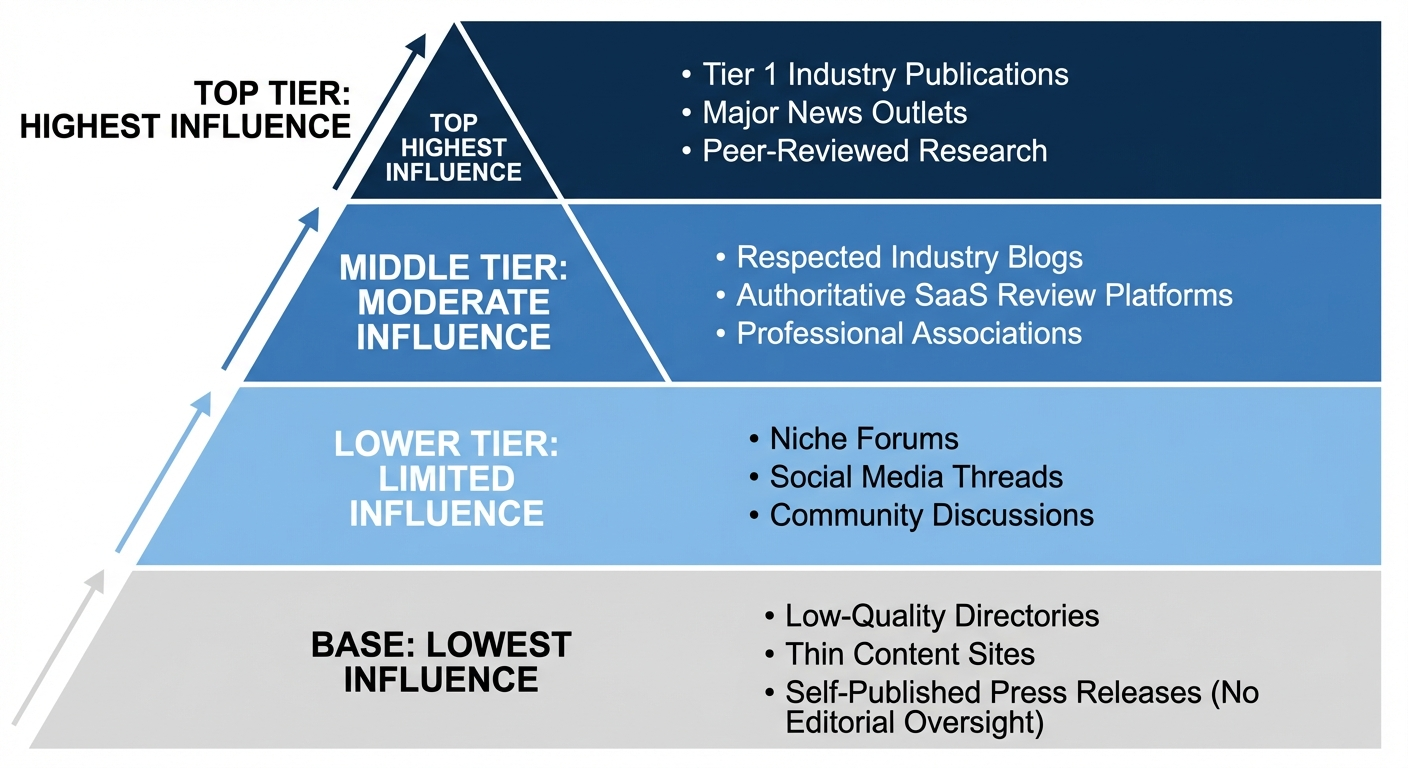
Not all mentions carry equal weight. A brand mention in a well-sourced article on a high-authority industry publication contributes more to AI visibility than dozens of mentions on low-quality directories or forums.
AI models apply what amounts to a confidence filter. They favor brands that appear in contexts where the surrounding content is factual, well-structured, and editorially sound. This is why strategic brand mentions on high-authority publications matter so much — they feed directly into the confidence signals AI models rely on.
Contextual Relevance to the Query
AI models match brands to queries based on how closely the brand’s documented capabilities align with the user’s specific need. Generic brand awareness isn’t enough. The model needs to find evidence that your brand solves the specific problem the user described.
This is why brands that publish detailed use-case content, specific product comparisons, and audience-segmented resources earn more AI mentions than brands with broad, undifferentiated messaging.
Commercial vs. Informational Intent
BrightEdge’s 2025 analysis of ChatGPT responses found that commercial-intent queries — those containing words like “best,” “deals,” “where to buy,” “affordable” — trigger 4–8x more brand mentions than informational queries. The average commercial prompt generated 4.8 brand mentions, while many informational prompts generated zero.
This means your AI mention strategy should prioritize the queries where buyers are actively comparing solutions — not just seeking general knowledge.
How to Audit Your Brand’s Current AI Mention Footprint
Before building a strategy, you need to know where you stand. Here’s a practical audit process you can run this week.
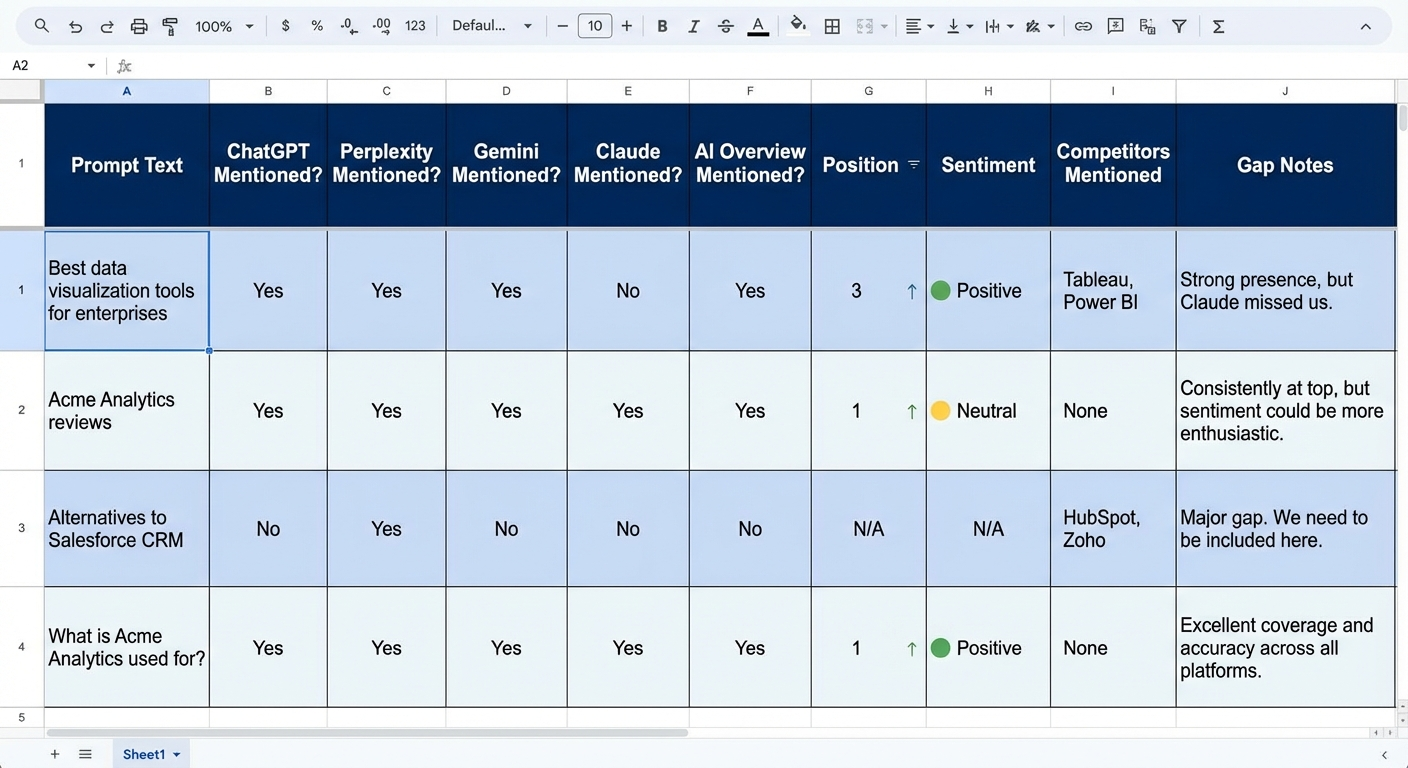
Step 1: Identify Your Priority Prompts
List the 20–30 questions your ideal buyers would ask an AI assistant during their buying journey. Focus on:
- Category comparison queries (“What are the best [your category] tools for [use case]?”)
- Problem-solution queries (“How do I solve [specific problem your product addresses]?”)
- Vendor evaluation queries (“Is [your brand] good for [specific scenario]?”)
- Alternative queries (“[Competitor name] alternatives for [specific need]”)
Step 2: Run Each Prompt Across Multiple AI Platforms
Test your prompts on ChatGPT, Perplexity, Gemini, Claude, and Google AI Overviews. Document:
- Whether your brand is mentioned
- Your position in the response (first mentioned, third, fifth, or absent)
- The sentiment and context of the mention (positive recommendation, neutral listing, or negative reference)
- Which competitors are mentioned alongside you
Important caveat: AI responses are probabilistic. The same prompt can produce different answers on different occasions. A single test gives you a snapshot, not a statistically reliable picture. For rigorous, ongoing tracking, you’ll need a dedicated AI mention tracking approach.
Step 3: Map Your Gaps
Compare your results against your competitors’. For each prompt where a competitor is mentioned but you aren’t, ask:
- Does the competitor have more coverage on high-authority publications for this topic?
- Does the competitor have more detailed use-case content on their own site?
- Is the competitor mentioned more frequently across the types of sources AI models weight heavily?
This gap analysis becomes the roadmap for your AI mention strategy.
A Practical System for Earning Brand Mentions Across AI Platforms
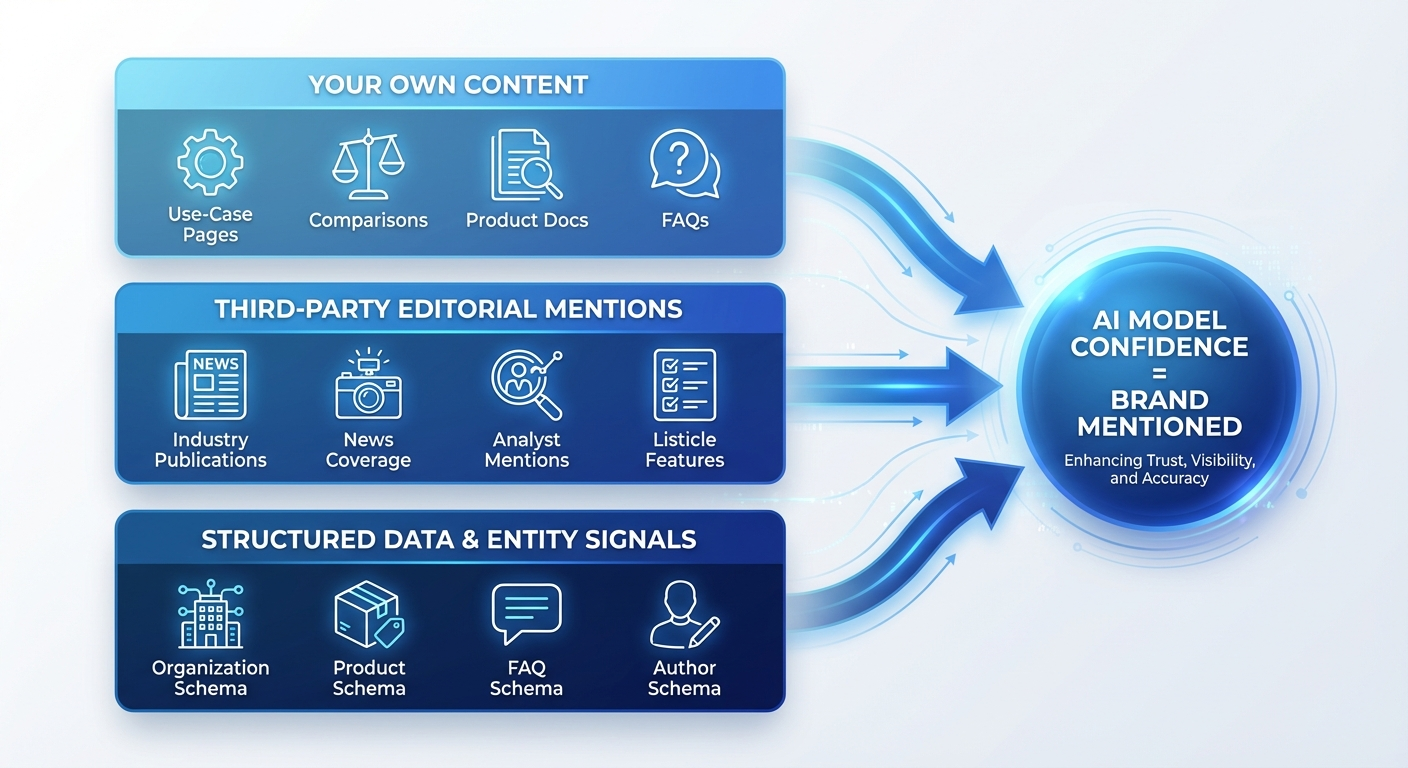
Earning consistent brand mentions in AI requires work across three layers: your own content, third-party editorial coverage, and structured data. Each layer reinforces the others.
Layer 1: Build Dense, Specific Content on Your Own Site
AI models reference your website content — both through their training data and through live web retrieval (RAG). The more detailed, specific, and well-structured your content is, the more material the AI has to draw from when deciding whether to mention your brand.
Focus on:
- Use-case pages — one page per specific buyer scenario your product addresses
- Comparison content — honest, detailed comparisons between your solution and alternatives
- Product documentation — thorough, publicly accessible information about features, pricing, and capabilities
- FAQ content — direct answers to the exact questions buyers ask AI assistants, marked up with FAQPage schema
Each page should lead with a clear, factual answer sentence. AI models extract concise, self-contained statements. If your content buries the answer under three paragraphs of preamble, the model may skip it.
Layer 2: Earn Contextual Mentions on High-Authority Publications
This is where most brands underinvest — and where the biggest AI visibility gains happen.
AI models don’t just read your website. They learn brand-category associations from the broader web. When your brand is mentioned contextually in articles published on respected industry sites, news outlets, and professional publications, those mentions become part of the model’s understanding of who you are and what you do.
Effective approaches include:
- Contributed articles and expert commentary on industry publications where your target audience reads
- Inclusion in curated listicles and comparison articles on high-authority sites
- Digital PR campaigns that generate editorial coverage tied to specific topics and use cases
- Partnerships with analysts and researchers who publish content AI models treat as authoritative
Agencies like BrandMentions approach this systematically — placing contextual brand mentions across 140+ high-authority publications that AI models actively reference during training and live retrieval. The key is consistency: isolated mentions create weak signals, while sustained editorial presence across trusted sources builds durable brand-category associations.
Layer 3: Strengthen Your Structured Data and Entity Signals
AI models rely on structured data to confidently identify and differentiate brands. Implement:
- Organization schema — your brand’s digital identity card for AI systems
- Product and Service schema — detailed, machine-readable descriptions of what you offer
- FAQPage schema — provides AI with ready-made answer pairs for common queries
- Author and Person schema — establishes the expertise credentials behind your content
These structured signals help AI models parse your brand’s information quickly and accurately. They reduce ambiguity — which is critical because AI models default to confidence-weighted decisions. If the model can’t clearly identify what your brand does, it won’t risk mentioning you.
Which AI Platforms Matter Most for B2B Brand Mentions in 2026
Not all AI platforms carry the same weight for B2B buyers. Here’s how the landscape looks as of 2026 and where to focus your effort.
| AI Platform | B2B Relevance | Brand Mention Behavior | Tracking Priority |
|---|---|---|---|
| ChatGPT | High — widely used by professionals for research and vendor evaluation | Mentions brands in 26% of responses; commercial prompts trigger 4–8x more mentions (BrightEdge, 2025) | High |
| Google AI Overviews / AI Mode | High — appears for nearly all Google queries; massive reach | Mentions brands in ~37% of responses; cites 3 sources visibly | High |
| Perplexity | Growing — favored by researchers and technical buyers | Mentions brands in ~31% of responses; heavy use of live citations | Medium-High |
| Gemini | Medium-High — integrated into Google Workspace | Mentions brands in ~31% of responses; draws from Google’s index | Medium-High |
| Claude | Medium — growing adoption in enterprise and technical teams | Conservative with brand recommendations; favors well-documented sources | Medium |
| Microsoft Copilot | Medium — integrated into Microsoft 365; enterprise exposure | Pulls from Bing index; brand mentions tied to Bing visibility | Medium |
The practical takeaway: optimize broadly, but track ChatGPT and Google AI Overviews with the most rigor. They generate the highest volume of brand-relevant queries for B2B buyers.
How to Measure Whether Your AI Mention Strategy Is Working
Traditional SEO metrics — rankings, clicks, traffic — capture only part of the picture. AI visibility requires its own measurement framework.
Metrics That Matter for Brand Mentions in AI
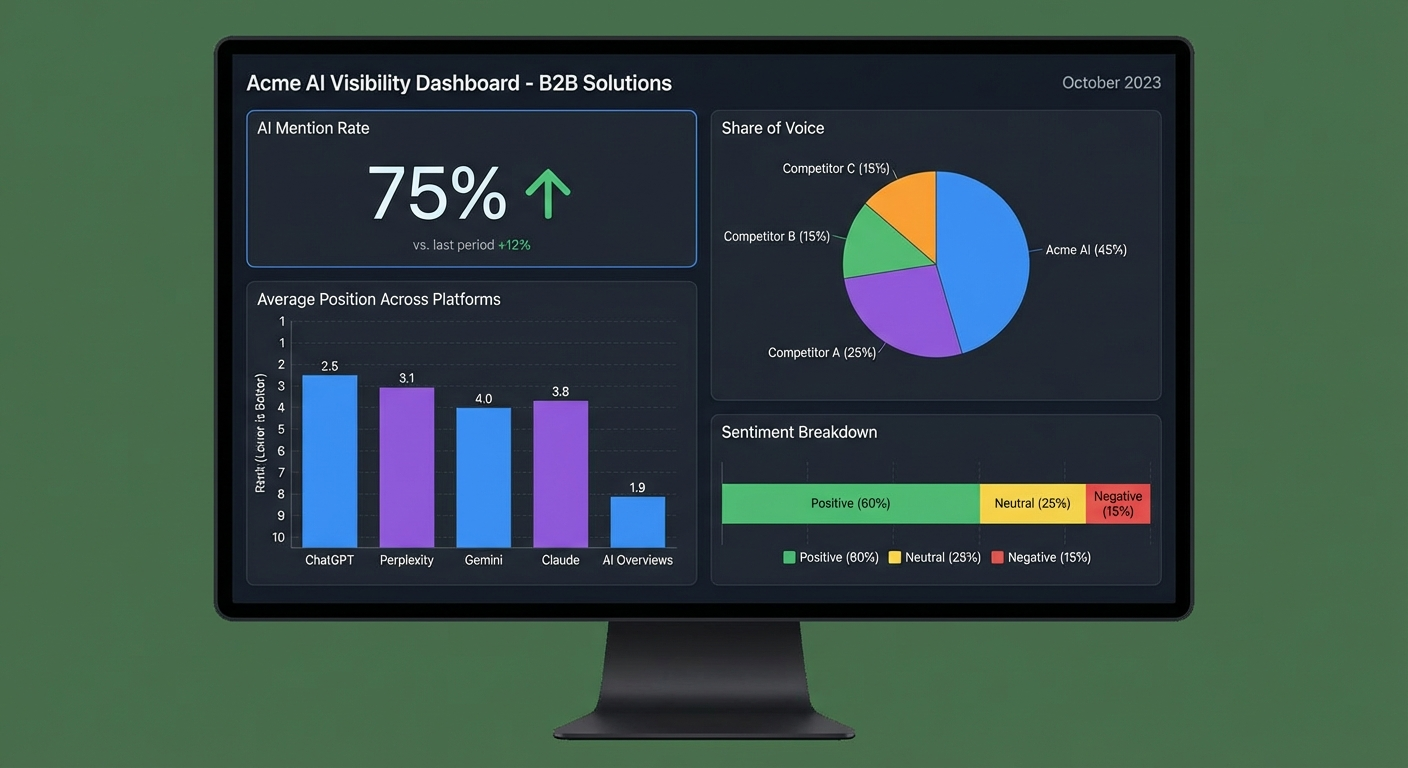
- AI Mention Rate — the percentage of relevant prompts where your brand appears. Track this across each AI platform separately, because performance varies significantly by model.
- Average Position in AI Responses — being mentioned first carries more influence than being listed fifth. Track your position, not just your presence.
- Mention Sentiment — is the AI recommending your brand positively, mentioning it neutrally, or referencing it critically? Sentiment shapes buyer perception.
- Share of Voice vs. Competitors — what percentage of relevant prompts mention your brand compared to your top competitors?
- Direct Brand Search Volume — a lagging indicator that validates AI visibility’s downstream impact. If your AI mention rate increases and direct brand searches on Google rise in parallel, your strategy is working.
Tools for Ongoing AI Mention Tracking
Manual prompt testing gives you a baseline, but it doesn’t scale. AI responses are probabilistic — the same question can produce different results each time. Statistically reliable tracking requires running hundreds or thousands of prompts systematically.
Several AI rank tracking tools have emerged since 2024 to address this. When evaluating options, look for:
- Coverage across all major AI platforms (not just ChatGPT)
- Prompt volume sufficient for statistical confidence
- Competitor benchmarking built into the reporting
- Sentiment analysis alongside mention frequency
- Historical trending to show progress over time
In campaigns across 67+ B2B companies, the BrandMentions team has found that brands with consistent editorial mentions across high-authority sources achieved AI recommendation rates 89% higher than those relying solely on traditional SEO — a gap that widened as AI models updated their training data throughout 2025 and into 2026.
Common Mistakes That Keep Brands Out of AI Answers
Many brands invest in traditional SEO and assume AI visibility will follow. It doesn’t always work that way. Here are the patterns that most commonly cause brands to be excluded from AI responses.
Undifferentiated Content
If your website reads like every other vendor in your category, AI models have no reason to surface you over a competitor. AI systems favor brands that demonstrate specific, differentiated expertise. Generic messaging produces generic invisibility.
Thin Third-Party Coverage
A brand with strong on-site content but minimal external mentions is sending a weak signal. AI models cross-reference multiple sources before recommending a brand. If your brand only appears on your own website, the model lacks the corroboration it needs to recommend you with confidence.
Blocking AI Crawlers
Some brands inadvertently block AI crawlers through restrictive robots.txt rules, aggressive bot-blocking, or content hidden behind login walls. If AI systems can’t access your content, they can’t learn from it. Review your technical setup for LLM visibility to ensure your most important pages are accessible.
Ignoring Structured Data
Without Organization, Product, and FAQ schema, AI models may struggle to accurately identify your brand and its offerings. Structured data removes ambiguity — and ambiguity is the enemy of AI recommendations.
Pro Insight: AI models apply confidence thresholds before mentioning a brand. If the model isn’t confident it has accurate, corroborated information about your company, it will default to mentioning a competitor it is confident about. Every gap in your brand’s digital footprint lowers that confidence score.
How Brand Mentions in AI Have Changed Since 2024
The AI search landscape evolves fast. Here’s what’s shifted since this discipline first emerged:
- 2024: AI Overviews rolled out broadly on Google. Most brands had no AI mention strategy. Early adopters began tracking basic prompt responses manually.
- Early 2025: ChatGPT Search and Perplexity gained significant B2B user adoption. Seer Interactive published one of the first large-scale studies correlating search rankings with LLM mentions. BrightEdge released data showing ChatGPT mentions brands 3.2x more than it formally cites them.
- Late 2025: AI mention tracking platforms matured. Enterprise brands began allocating dedicated budget to AI visibility. Google described AI Mode as “the future of Google Search.”
- 2026 (current): AI mentions are a standard KPI for B2B marketing teams. The gap between brands that invested early and those still catching up has widened considerably. Models update more frequently, and the competitive window for establishing brand-category associations is narrowing.
The brands that built consistent editorial presence across 2024–2025 are now seeing compounding returns. AI models’ brand-category associations strengthen with each training data refresh, making early movers increasingly difficult to displace.
Frequently Asked Questions
How long does it take to start appearing in AI search answers?
Most brands begin seeing measurable changes in AI mention rates within 3–6 months of sustained effort. The timeline depends on your starting point — brands with existing editorial coverage and strong domain authority see faster results than those building from scratch. AI models update their training data on varying schedules, so results are not instantaneous.
Do backlinks still matter for brand mentions in AI?
Backlinks have a weaker direct correlation with AI mentions than many marketers expect. Seer Interactive’s 2025 study found that backlink volume had a “weak or neutral” impact on LLM mentions. What matters more is the context of your brand’s presence across authoritative sources — editorial mentions in substantive content carry more weight than raw link counts.
Can I control what AI says about my brand?
You cannot directly control AI outputs. But you can influence them by shaping the inputs AI models learn from. Publishing accurate, detailed content on your own site, earning contextual mentions on high-authority publications, and maintaining consistent structured data all increase the probability that AI will represent your brand accurately and favorably.
Is AI mention tracking different from traditional rank tracking?
Yes. Traditional rank tracking monitors fixed positions in a static SERP. AI mention tracking measures probabilistic outputs that vary by user, session, and model version. Reliable AI tracking requires running large prompt volumes across multiple platforms to establish statistically meaningful visibility scores — not just checking a single prompt once.
Should I optimize for all AI platforms or focus on one?
Optimize broadly, track strategically. The content and editorial strategies that improve your brand mentions in AI work across all platforms — authoritative content and consistent third-party coverage benefit you everywhere. But allocate your deepest tracking effort to the platforms your specific buyers use most. For most B2B companies in 2026, that means prioritizing ChatGPT, Google AI Overviews, and Perplexity.
Where to Go from Here
Brand mentions in AI are not a passing trend or a secondary channel. They are the mechanism through which your buyers form their first impressions and shortlists in 2026. The brands that earn consistent, contextual, and positive mentions across AI platforms are the ones that show up when it matters most — at the moment of decision.
Start with the audit process outlined above. Identify your gaps. Then build across all three layers: your own content, third-party editorial mentions, and structured data. Measure with the right metrics, not just the familiar ones.
If you want to see exactly where your brand stands across ChatGPT, Perplexity, Gemini, and other AI platforms — and where your competitors are showing up instead — get a free AI visibility audit to find the gaps worth closing first.