ChatGPT processes over 2.5 billion queries daily as of 2026, and your brand is either showing up in those answers — or it isn’t. The problem? Google Analytics, Search Console, and traditional rank trackers cannot tell you what ChatGPT says about you. These tools were built for blue links, not AI-generated recommendations.
Monitoring ChatGPT mentions requires a different category of tool — one that queries AI models directly, captures full responses, tracks citations, and measures how your visibility shifts over time. This article breaks down the best tools for monitoring ChatGPT mentions in 2026, based on real feature differences, pricing transparency, and what actually matters for B2B marketing teams trying to protect and grow their AI visibility.
What You’ll Learn
- Why traditional analytics miss 80%+ of ChatGPT brand mentions — and what to use instead
- A practical comparison of 10 monitoring tools across pricing, platform coverage, and core strengths
- Which tool fits your team size, budget, and monitoring maturity
- The five metrics that separate useful ChatGPT monitoring from vanity dashboards
- How to build a prompt library and monitoring workflow from scratch in under 30 minutes
- What changed in ChatGPT monitoring tools since 2025 — and what to expect next
Why Traditional Analytics Cannot Track ChatGPT Mentions
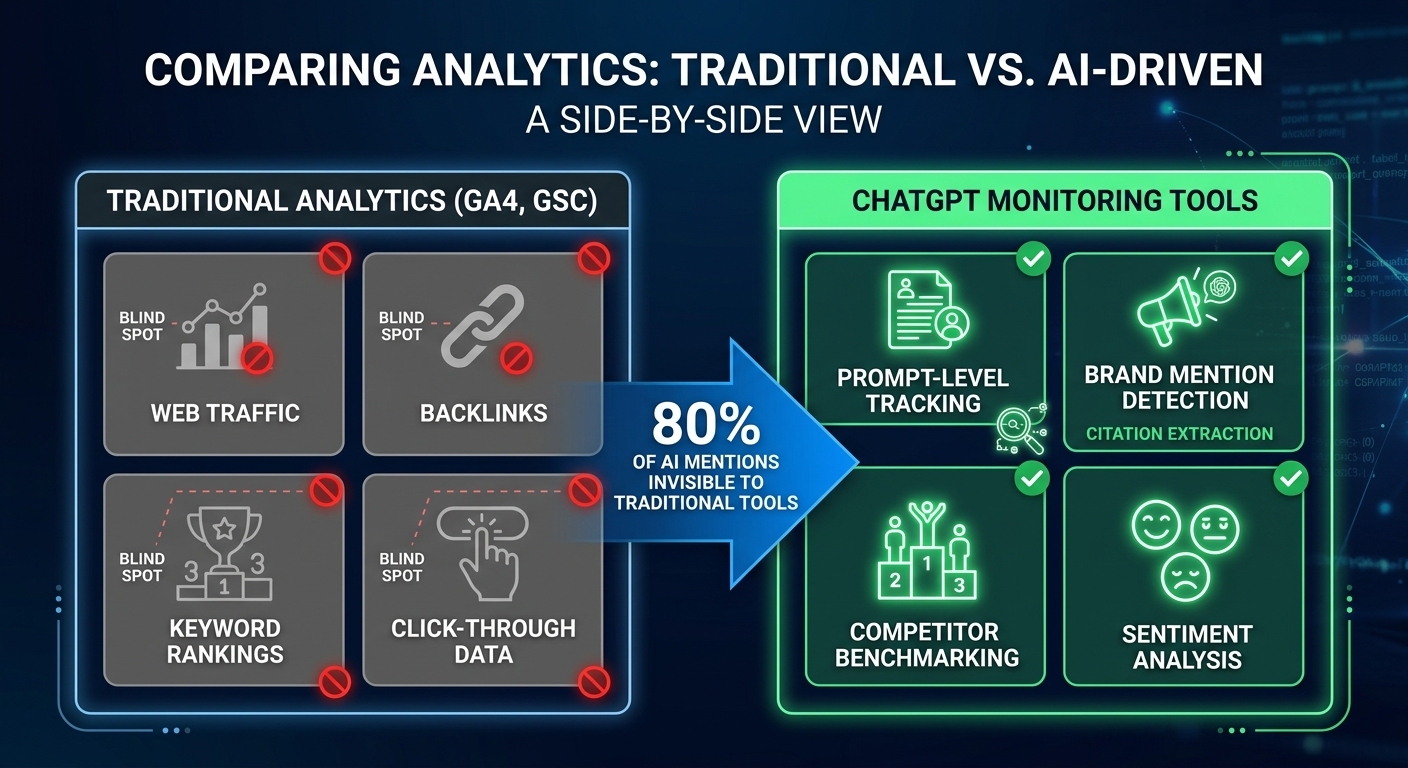
Google Analytics 4 tracks referral traffic from ChatGPT when a user clicks a citation link. But most ChatGPT responses don’t include clickable links. Research from multiple AI visibility platforms estimates that only 2 in 10 ChatGPT mentions include a citation URL. The other 80% happen invisibly — your brand is recommended, described, or omitted with zero signal in your analytics dashboard.
Google Search Console measures impressions and clicks for traditional search queries. It has no mechanism for capturing what ChatGPT outputs when someone asks “What’s the best CRM for startups?” or “Which project management tool has the best API?”
A ChatGPT mention monitoring tool is a platform that systematically queries AI models with a defined set of prompts, captures the full response text, and analyzes whether your brand appears — along with how it’s described, which competitors are included, and which citation sources influence the answer.
This is fundamentally different from social listening or web monitoring. You’re not scanning published web pages. You’re interrogating the AI model itself.
What Changed in ChatGPT Monitoring Since 2025
The ChatGPT monitoring tool market matured significantly between mid-2025 and early 2026. Several shifts are worth noting before evaluating tools:
- Multi-model coverage became standard. In early 2025, most tools tracked only ChatGPT. By 2026, tracking across Perplexity, Gemini, Claude, Google AI Overviews, and Copilot is expected at every price tier above $50/month.
- Citation analysis deepened. Tools now extract not just whether a citation exists, but which specific domains ChatGPT references, how citation sources shift over time, and which third-party pages drive your brand’s inclusion in answers.
- Sentiment and narrative tracking emerged. Early tools answered “Are we mentioned?” Current tools answer “How are we described?” — detecting whether ChatGPT frames your brand as a leader, a budget option, or something to avoid.
- Investment surged. According to industry tracking, the AI visibility monitoring market attracted over $77 million in funding between May and August 2025 alone. Scrunch AI raised $19 million. Profound raised $20 million. This capital is now visible in faster product development and broader platform coverage.
If you evaluated tools in 2025, the landscape looks different now. Capabilities that were enterprise-only twelve months ago — like persona-based tracking, multilingual monitoring, and API integrations with CRM platforms — are available in mid-tier plans as of 2026.
10 Tools for Monitoring ChatGPT Mentions in 2026
Each tool below is evaluated on five criteria: AI platform coverage, prompt and mention tracking depth, citation intelligence, pricing transparency, and practical fit for different team sizes. No tool is perfect for every use case. The right choice depends on your monitoring maturity, budget, and whether you need ChatGPT-specific tracking or cross-platform AI visibility.
1. Otterly.AI — Strong for Agencies Managing Multiple Brands
Otterly.AI monitors brand visibility across ChatGPT, Perplexity, Google AI Overviews, Gemini, and Copilot. Its core strength is multi-client workspace architecture, which makes it a practical choice for agencies running AI visibility programs across several brands simultaneously.
- Platform coverage: 5 AI platforms (ChatGPT, Perplexity, Gemini, Google AI Overviews, Copilot)
- Key feature: Brand Visibility Index — a proprietary score for benchmarking mention frequency and prominence over time
- Citation tracking: Identifies which URLs ChatGPT references most often across your prompt set
- Pricing: Lite plan starts at €29/month. Standard at €189/month. Premium at €489/month.
- Best for: Marketing agencies tracking AI visibility for multiple client brands from a single dashboard
Limitation: Prompt-based pricing means costs scale with monitoring volume. No Claude tracking yet as of early 2026.
2. Peec AI — Enterprise-Grade Volume and API Access
Peec AI covers six AI platforms — ChatGPT, Perplexity, Gemini, DeepSeek, Claude, and Grok — which is the broadest model coverage in this list. The platform supports 300+ prompts per day, unlimited team seats, and full API access for integration with CRM and BI tools.
- Platform coverage: 6 AI platforms
- Key feature: Sentiment analysis that goes beyond positive/negative — tracking specific attribute associations (ease of use, pricing perception, feature completeness)
- Pricing: Starts at €89/month. Enterprise plans reach €499/month.
- Best for: Enterprise teams requiring high-volume prompt tracking with multilingual support and API integration
Limitation: Higher price point. More complexity than small teams typically need for initial monitoring.
3. SE Ranking AI Visibility Tracker — AI Monitoring Inside an Existing SEO Platform
SE Ranking added AI visibility tracking to its established SEO suite, which already has a 4.8/5 G2 rating across 1,400+ reviews. The AI module monitors ChatGPT, Perplexity, Gemini, Google AI Overviews, and Google AI Mode. Its “No cited” feature reveals specific prompts where competitors appear but you don’t.
- Platform coverage: 5 AI platforms
- Key feature: Unified dashboard combining traditional SEO metrics (backlinks, rankings, site audit) with AI mention data
- Pricing: From $52/month (included with SEO subscription). No standalone AI-only plan.
- Best for: SEO teams that want AI visibility tracking without adding a separate tool to their stack
Limitation: Requires a full SEO subscription. AI monitoring depth may be shallower than purpose-built platforms.
4. Scrunch AI — Enterprise Security and Persona-Based Tracking
Scrunch AI is backed by $19 million in funding and holds SOC 2 Type II certification — a differentiator for enterprise brands with strict compliance requirements. The platform tracks ChatGPT, Perplexity, Google AI Overviews, Copilot, Claude, Meta AI, and Gemini. Its configurable persona feature lets you see how different audience segments receive AI answers about your brand.
- Platform coverage: 7 AI platforms
- Key feature: Persona-based tracking — simulate how a CTO, CMO, or procurement lead would see AI-generated recommendations differently
- Pricing: Brands at $250/month. Agencies at $500/month. Custom enterprise pricing available.
- Best for: Enterprise brands that need SOC 2 compliance, bot traffic analysis, and multi-persona visibility insights
Limitation: No self-serve plan for small businesses. Steeper learning curve during onboarding.
5. AIclicks — Full-Stack ChatGPT Monitoring With Content Creation
AIclicks combines prompt-level ChatGPT tracking with built-in content generation. The platform runs AI visibility audits, provides competitor benchmarking, identifies citation gaps, and then uses AI agents to draft content targeting those gaps. It also integrates with GA4 to connect AI visibility data with actual website traffic.
- Platform coverage: ChatGPT, Perplexity, Gemini, Google AI Overviews, Claude, Grok, and others
- Key feature: Content gap detection paired with AI-powered content creation — moves directly from “we’re not showing up” to “here’s a draft to fix it”
- Pricing: Starts at $59/month (Starter). Pro at $189/month. Business at $499/month.
- Best for: Growth teams that want monitoring and content optimization in a single workflow
Limitation: Newer platform still building market recognition. Content generation quality varies by topic.
6. Waikay.io — Hallucination Detection and Entity-Based Analysis
Created by Dixon Jones with patent-pending entity-based knowledge graph technology, Waikay.io focuses on a problem most tools overlook: AI hallucinations about your brand. Its “check, flag, delete” workflow helps brands identify when ChatGPT fabricates claims, cites incorrect URLs, or attributes competitor features to you.
- Platform coverage: ChatGPT, Gemini, Claude, Perplexity
- Key feature: Hallucination detection and broken link alerts — critical for regulated industries where AI misinformation carries real risk
- Pricing: $19.95 to $199.95/month. Free tier available for basic testing.
- Best for: Brands in healthcare, finance, or legal sectors where AI accuracy is non-negotiable
Limitation: Only 4 platforms covered. Limited integrations with external marketing tools.
7. Profound — National-Scale Enterprise Monitoring
Profound is built for enterprise teams tracking brand perception across high-volume English-language queries. The platform recently raised a $20 million Series A led by Kleiner Perkins and NVIDIA NVentures. It monitors ChatGPT, Gemini, Perplexity, Copilot, and Grok through an “agentic internet dashboard” designed for CMOs and corporate strategy teams.
- Platform coverage: 5 AI platforms
- Key feature: Analyst-backed insights and curated reporting designed for executive audiences
- Pricing: Starts at $499/month. Enterprise custom pricing.
- Best for: Large enterprises focused on national-level AI brand perception trends
Limitation: English-only tracking. No multilingual support in current plans. Entry pricing excludes most mid-market teams.
8. Siftly — Generative Engine Optimization With Competitive Intelligence
Siftly positions itself as a Generative Engine Optimization platform rather than a pure monitoring tool. Beyond tracking mentions across ChatGPT, Google AI Overviews, Perplexity, and Gemini, it provides optimization recommendations — telling you what to change, not just what happened.
- Platform coverage: ChatGPT, Google AI Overviews, Perplexity, and other major AI engines
- Key feature: Actionable optimization guidance alongside monitoring data — designed to close the gap between “we lost visibility” and “here’s what to fix”
- Pricing: From $25/month for entry tier. Higher plans available.
- Best for: Marketing teams that want monitoring paired with step-by-step improvement recommendations
Limitation: Limited prompt capacity on lower tiers. Reporting depth may not satisfy enterprise requirements.
9. Ahrefs Brand Radar — AI Tracking for Existing Ahrefs Subscribers
Ahrefs Brand Radar adds AI citation data alongside Ahrefs’ existing backlink, keyword, and site audit tools. It tracks ChatGPT, Google AI Overviews, and Perplexity. The module is included at no extra cost for existing subscribers, making it the lowest-friction entry point for teams already in the Ahrefs ecosystem.
- Platform coverage: 3 AI platforms (ChatGPT, Google AI Overviews, Perplexity)
- Key feature: No additional cost — AI visibility data appears in the same dashboard as traditional SEO metrics
- Pricing: Included with Ahrefs subscription (starting around $99/month for Lite)
- Best for: Ahrefs subscribers who want baseline AI visibility tracking without adding another tool
Limitation: Only 3 platforms. AI sampling is limited. Interface for AI data still needs improvement according to user feedback.
10. Rank Prompt — Prompt-Level Monitoring Across 4 AI Platforms
Rank Prompt scans brand visibility across ChatGPT, Gemini, Grok, and Perplexity at the prompt level. It shows which specific prompts include your brand, which exclude it, and provides schema and citation improvement suggestions. The platform also supports multilingual and multi-location tracking — useful for franchise brands or companies targeting multiple geographic markets.
- Platform coverage: ChatGPT, Gemini, Grok, Perplexity
- Key feature: Location-specific prompt clusters and multilingual analysis — track “best CRM in Austin” separately from “best CRM in Denver”
- Pricing: Starts at $29/month
- Best for: Multi-location businesses and agencies that need geo-specific AI visibility tracking
Limitation: No Google AI Overviews or Copilot tracking yet. Credit-based pricing can complicate budget forecasting at scale.
Side-by-Side Comparison: Pricing, Coverage, and Fit
| Tool | AI Platforms | Starting Price | Best For | Key Differentiator |
|---|---|---|---|---|
| Otterly.AI | 5 | €29/month | Agencies | Multi-client workspaces |
| Peec AI | 6 | €89/month | Enterprise teams | Broadest model coverage + API |
| SE Ranking | 5 | $52/month | SEO teams | Unified SEO + AI dashboard |
| Scrunch AI | 7 | $250/month | Enterprise (SOC 2) | Persona-based tracking |
| AIclicks | 7+ | $59/month | Growth teams | Monitoring + content creation |
| Waikay.io | 4 | $19.95/month | Regulated industries | Hallucination detection |
| Profound | 5 | $499/month | Large enterprises | Analyst-backed exec reporting |
| Siftly | 4+ | $25/month | Mid-market marketers | Optimization recommendations |
| Ahrefs Brand Radar | 3 | Included with sub | Ahrefs users | Zero additional cost |
| Rank Prompt | 4 | $29/month | Multi-location brands | Geo-specific + multilingual |
Five Metrics That Make ChatGPT Monitoring Actionable
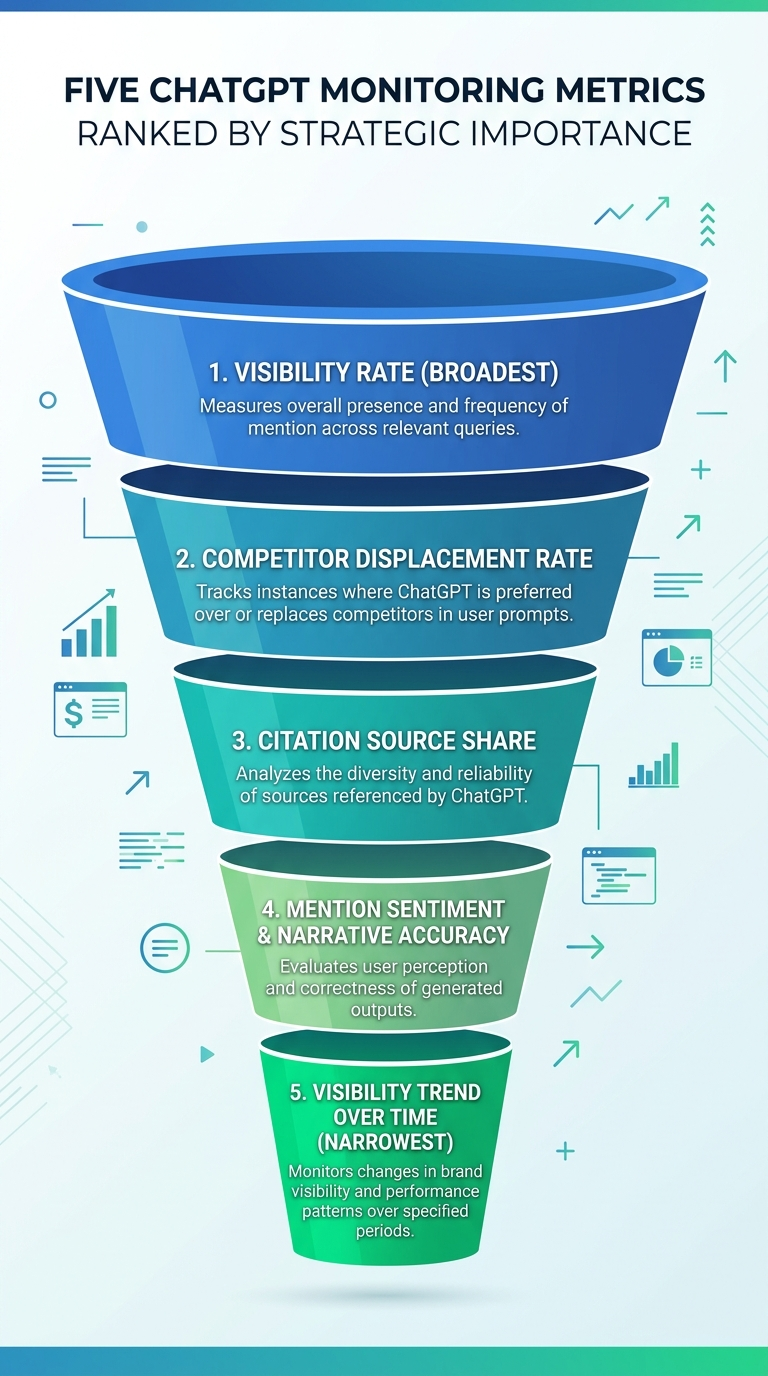
Monitoring tools generate a lot of data. Not all of it drives decisions. These five metrics separate useful monitoring from dashboard noise.
1. Visibility Rate
Visibility rate is the percentage of your tracked prompts where your brand appears in the AI-generated response. This is your baseline metric. Track it overall and by prompt cluster — category prompts, comparison prompts, “best for” prompts, and alternative prompts will each tell a different story.
2. Competitor Displacement Rate
This measures how often a competitor appears in a response where you don’t. A rising displacement rate on high-intent prompts (like “best X for Y” queries) is an early warning signal that your AI brand mentions strategy needs attention before the gap compounds.
3. Citation Source Share
When ChatGPT answers a query, it draws from specific web sources — review sites, comparison pages, documentation, editorial content. Citation source share tells you which domains influence AI recommendations in your category. If a competitor owns the citation sources, they own the answers.
4. Mention Sentiment and Narrative Accuracy
Being mentioned isn’t enough if ChatGPT describes your product incorrectly or frames it as “affordable but limited.” Sentiment and narrative tracking — available in tools like Peec AI, Scrunch AI, and Waikay.io — reveals whether mentions help or hurt your brand positioning.
5. Visibility Trend Over Time
Single-point measurements are misleading because AI outputs vary between runs. The metric that matters is the trend — are you gaining or losing visibility across your prompt set over weeks and months? Historical data retention of 6–12 months is the minimum needed to measure optimization impact reliably.
How to Build Your First ChatGPT Monitoring Workflow
You don’t need 500 prompts or an enterprise tool to start. A useful baseline takes about 30 minutes to set up with any of the tools listed above.
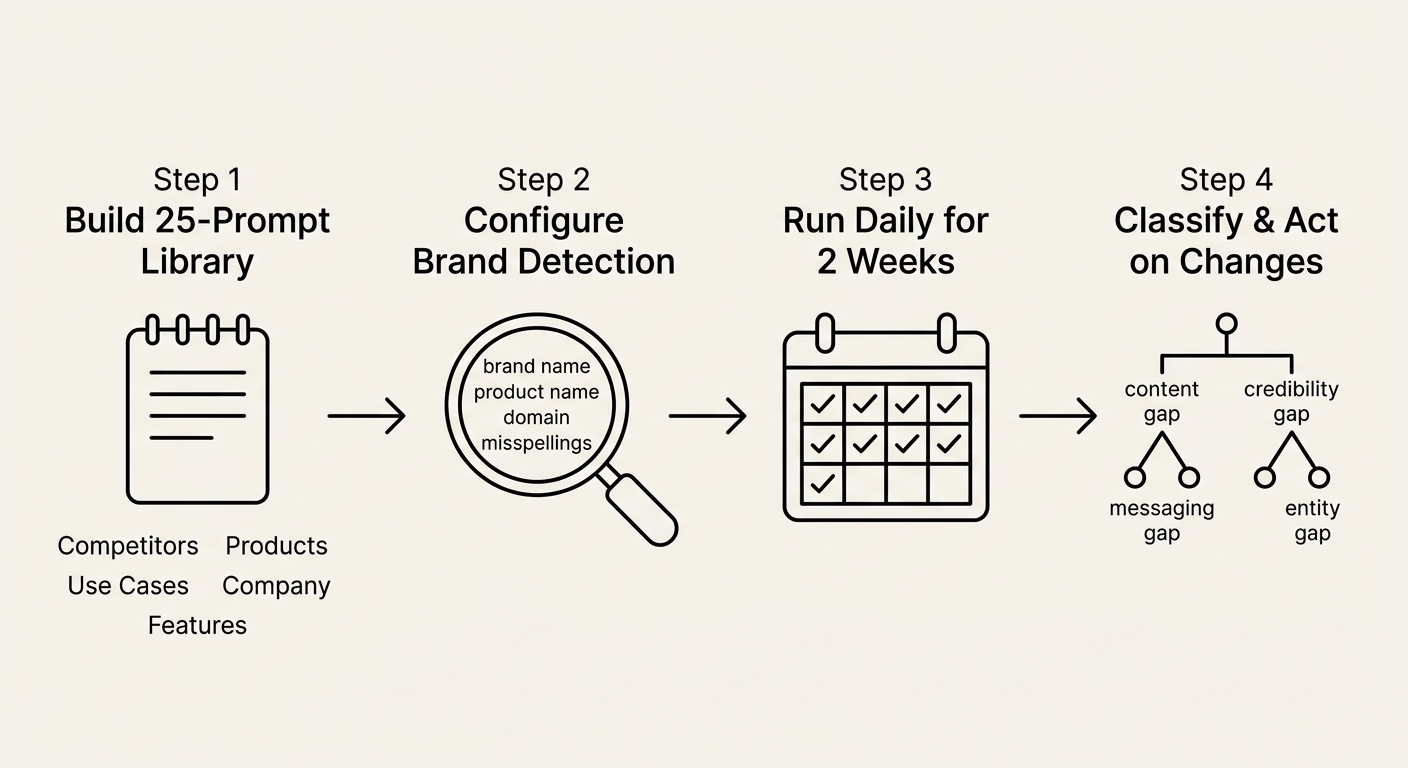
Step 1: Build a 25-Prompt Library Using Five Categories
Write five prompts in each of these categories, phrased as natural questions a buyer would ask ChatGPT:
- Category prompts: “What are the best [category] tools for [persona]?”
- Use-case prompts: “How do I [solve specific problem] with [category]?”
- Comparison prompts: “[Your brand] vs [Competitor] for [use case]”
- Alternatives prompts: “[Competitor] alternatives for [audience]”
- Integration or feature prompts: “Which [category] tools integrate with [platform]?”
Keep prompts conversational. These should mirror how real users talk to ChatGPT, not how SEO professionals write keyword lists.
Step 2: Add Brand Detection Rules
Configure your tool to detect your brand name, product name, domain, and common misspellings. Also add your top 3–5 competitors so you can track displacement alongside your own visibility.
Step 3: Run Daily for Two Weeks to Establish a Baseline
AI outputs vary between runs. A single check is a screenshot — not a measurement. Two weeks of daily data gives you enough signal to separate real trends from noise. After your baseline stabilizes, you can shift to weekly monitoring for most prompt sets.
Step 4: Classify Changes When They Occur
When your monitoring tool flags a change, classify it before acting:
- Content gap: You’re missing a page that ChatGPT would cite
- Credibility gap: Competitors are cited from stronger domains
- Messaging gap: Your positioning is unclear or inconsistent across the web
- Entity gap: ChatGPT confuses your brand with another or surfaces incorrect facts
This classification system — adapted from methodologies used across AI visibility campaigns — ensures you fix the root cause rather than reacting to surface-level volatility. For deeper guidance on tracking across all major AI platforms, see how to track brand mentions across AI search platforms.
Which Tool Fits Your Situation?
The right tool depends on where you are, not where you want to be. Here’s a decision framework based on common starting points:
You’re Starting From Zero
If you’ve never monitored ChatGPT mentions and need to prove the value before investing, start with Waikay.io’s free tier or Ahrefs Brand Radar (if you already subscribe). These options let you establish a baseline with minimal financial commitment. If you want to understand how ChatGPT works under the hood first, explore how to check brand mentions in ChatGPT.
You’re an SEO Team Adding AI Visibility
SE Ranking adds AI monitoring to a tool your team already uses. No new dashboard to learn. No new vendor to approve. The trade-off: AI tracking depth won’t match purpose-built platforms.
You’re a Growth Team Needing Monitoring + Action
AIclicks and Siftly both bridge monitoring and optimization. AIclicks pairs tracking with content creation. Siftly provides optimization recommendations. Choose based on whether your bottleneck is content production or strategic direction.
You’re an Agency Managing Multiple Clients
Otterly.AI was built for this. Multi-client workspaces, exportable reports, and tiered pricing that scales with your client roster. For a broader view of tools that support AI visibility analytics and brand mentions, compare capabilities across the category.
You’re Enterprise With Compliance Requirements
Scrunch AI (SOC 2 Type II) and Peec AI (API access, unlimited seats) are built for enterprise procurement processes. Profound adds analyst-backed reporting for CMO-level presentations. Budget $250–$500+/month.
You’re Worried About AI Misinformation
Waikay.io specializes in hallucination detection. If ChatGPT is fabricating claims about your brand, citing incorrect URLs, or confusing you with a competitor, this is where to start.
Why Citation Sources Matter More Than Mention Counts
Many teams fixate on mention frequency — how often ChatGPT says their name. But the more strategic metric is which sources ChatGPT pulls from when generating answers in your category.
ChatGPT’s recommendations are shaped by the web content it accesses through browsing or retrieves from training data. When a “best tools for project management” listicle on a high-authority publication consistently appears in ChatGPT’s citation sources, the brands featured in that listicle get recommended.
This means improving your ChatGPT visibility often isn’t about changing your own website. It’s about earning presence on the sources ChatGPT already trusts.
In campaigns across 67+ B2B companies, agencies like BrandMentions have found that brands with consistent editorial mentions on high-authority publications achieve significantly higher AI recommendation rates than those relying solely on on-site SEO. The mechanism is straightforward: brand mentions on trusted sources create the entity-category associations that AI models use to generate answers.
Your monitoring tool should show you which citation domains appear for your target prompts. Then your strategy becomes: get present on those specific domains through editorial coverage, reviews, directory listings, and third-party mentions.
Pro Insight: Pages with complete schema markup are cited up to 3.7× more often by AI models, according to analysis from SE Visible’s 2025 research. Structured data isn’t just for traditional SERP features — it directly influences AI citation selection.
Cross-Platform Monitoring: ChatGPT Is Only Part of the Picture
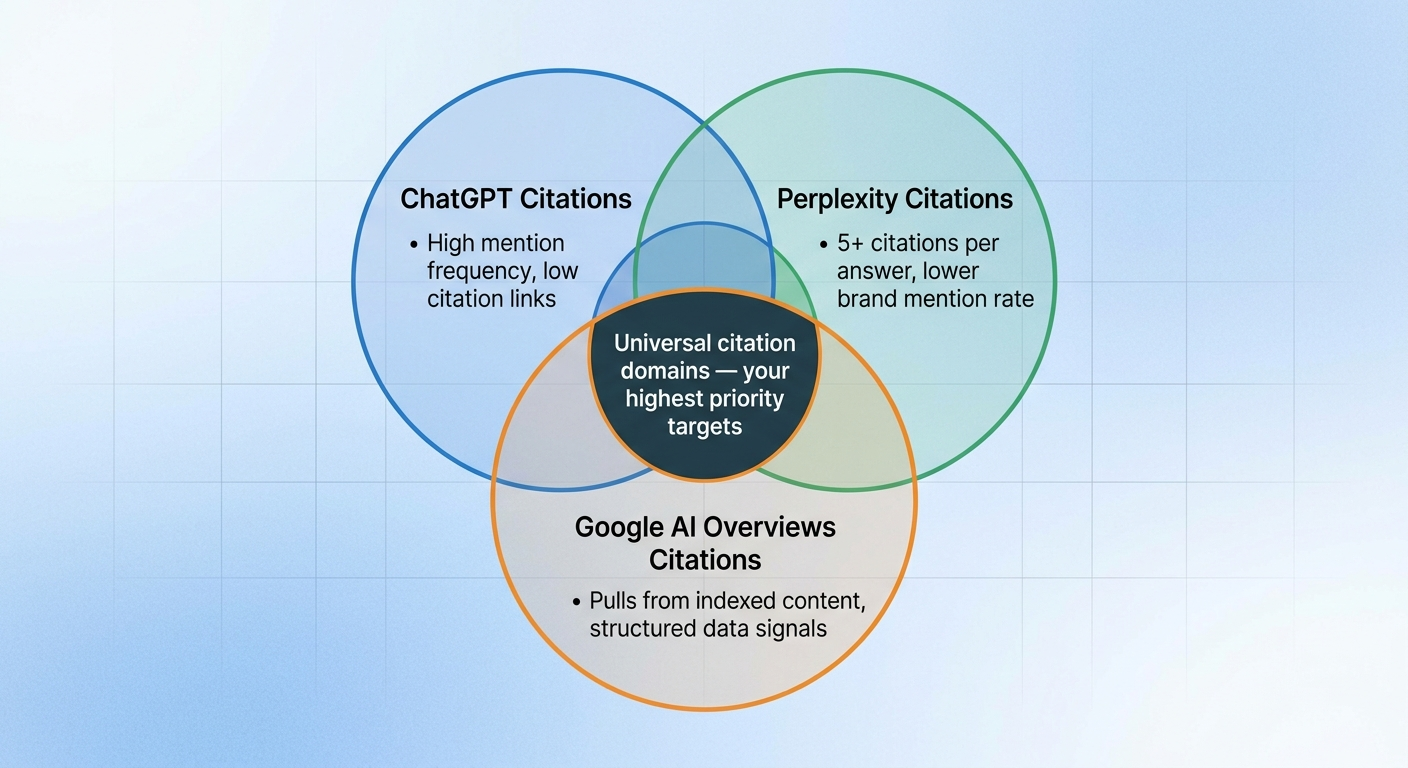
ChatGPT accounts for a large share of AI-generated search activity, but monitoring only ChatGPT creates blind spots. Research from multiple AI visibility platforms shows only about 11% domain overlap between ChatGPT and Perplexity citations. A brand dominating ChatGPT answers may be invisible in Perplexity.
Each AI platform has distinct citation behavior:
- ChatGPT: Mentions brands frequently but includes citation links in only ~20% of responses
- Perplexity: Averages 5+ citations per answer but mentions brands in only ~20% of responses
- Google AI Overviews: Appeared in over 11% of queries as of late 2025, with a 22% increase since launch according to BrightEdge data
- Gemini: Draws heavily from Google-indexed content and structured markup
- Claude: Less research on citation behavior, but growing user base makes it worth monitoring
If your budget allows only one tool, choose one that covers at least ChatGPT, Perplexity, and Google AI Overviews. For strategies specific to each platform, review how to track brand mentions in Perplexity and track brand mentions in Gemini alongside your ChatGPT monitoring.
Common Mistakes That Waste Your Monitoring Budget
Treating a Single Check as Data
AI outputs are non-deterministic. The same prompt can produce slightly different answers on consecutive runs. Never make strategic decisions based on one screenshot. Build trendlines over 2–4 weeks minimum before acting on a perceived change.
Tracking Too Many Prompts Too Early
Starting with 200 prompts before you understand your baseline creates noise, not insight. Begin with 25 high-intent prompts. Expand only after you’ve established stable trends and a clear action workflow for changes.
Monitoring Without an Action Loop
A dashboard nobody acts on is a cost, not an investment. Every monitoring program needs a defined response workflow: who reviews alerts, how changes are classified, and what action each classification triggers. Without this, you’ll build impressive charts that change nothing.
Ignoring Citation Sources
If your monitoring tool shows you’re not mentioned, the question isn’t “how do we get ChatGPT to mention us?” The question is “which sources does ChatGPT cite in our category, and are we present on those sources?” Monitoring brand mentions in LLMs is useful only when paired with a strategy to influence the inputs those models rely on.
How to Report ChatGPT Monitoring Results to Leadership
Executives don’t want prompt-level detail. They want risk, opportunity, and movement tied to business outcomes. Structure monthly reports around five blocks:
- Visibility rate trend: Overall and by funnel stage (awareness, consideration, decision)
- Biggest movers: Prompts where you gained or lost visibility — and why
- Competitive threats: Which competitors are displacing you and in what prompt clusters
- Citation opportunities: The top 5–10 domains ChatGPT cites in your category where you’re absent
- Actions taken and results: What your team changed, which prompts improved, and the trend since implementation
This structure turns monitoring from a passive dashboard into a growth lever with clear ROI narrative. According to Google Cloud’s 2025 ROI of AI Report, 74% of organizations achieve ROI from AI investments within the first year — but only when measurement is tied to specific business outcomes, not vanity metrics.
FAQ
Can Google Analytics track ChatGPT brand mentions?
No. GA4 tracks referral traffic from ChatGPT when users click citation links, but only about 20% of ChatGPT mentions include clickable links. The other 80% — brand recommendations, descriptions, and comparisons — are invisible to traditional analytics. Dedicated ChatGPT monitoring tools query the AI model directly and capture full response text, which is the only way to measure true mention visibility.
How much do ChatGPT monitoring tools cost in 2026?
Pricing ranges from free (Waikay.io’s basic tier, Ahrefs Brand Radar for subscribers) to $500+/month for enterprise solutions like Scrunch AI and Profound. Most mid-market teams find practical value in the $50–$200/month range. The key cost variable is prompt volume — tracking 25 prompts costs significantly less than tracking 500.
How often should I run ChatGPT monitoring checks?
Daily for the first 2–4 weeks to establish a reliable baseline. After that, weekly monitoring works for most teams. High-competition categories or brands running active optimization campaigns benefit from continued daily monitoring on their highest-priority prompt clusters.
What’s the difference between a ChatGPT mention and a ChatGPT citation?
A mention is any instance where your brand name appears in a ChatGPT response — with or without a link. A citation is when ChatGPT references a specific source URL, typically displayed as a numbered reference or clickable link. You want both, but citations are rarer and more valuable because they drive measurable referral traffic.
Do I need separate tools for ChatGPT, Perplexity, and Gemini monitoring?
No. Most tools in this category now cover multiple AI platforms from a single dashboard. As of 2026, platforms like Peec AI cover 6 models, Scrunch AI covers 7, and even entry-tier tools like Otterly.AI and SE Ranking cover 5. Choose a tool whose platform coverage matches the AI surfaces your buyers actually use.
What should I do if ChatGPT mentions my brand incorrectly?
First, identify the likely source of the misinformation — outdated web pages, incorrect directory listings, or conflicting information across your online presence. Then update the source material: correct your website, FAQ pages, structured data, and third-party profiles. ChatGPT’s browsing feature pulls from live web content, so fixing source material gradually improves AI accuracy. Waikay.io’s hallucination detection is specifically designed for this use case. For more on managing what AI says about you, explore brand mentions in generative AI.
Building AI Visibility That Compounds
Monitoring ChatGPT mentions is the diagnostic layer. It tells you where you stand. But the brands gaining AI visibility in 2026 are the ones connecting monitoring data to a sustained editorial presence strategy — earning consistent mentions on the high-authority sources that AI models learn from.
The tools in this guide give you the measurement. The strategy that drives results is building AI brand mentions on the publications and platforms that feed AI training data and retrieval systems. BrandMentions tracks when major AI models update their knowledge base and helps brands time placements to maximize inclusion in each refresh cycle.
Start with 25 prompts. Choose one tool that fits your budget and team. Build a baseline. Act on what you find. The brands treating AI visibility as an ongoing discipline — not a one-time audit — are the ones showing up when it matters most.
See where your brand stands in AI search today. Get your free AI visibility audit and find out exactly what ChatGPT, Perplexity, and Gemini say about you — and your competitors.