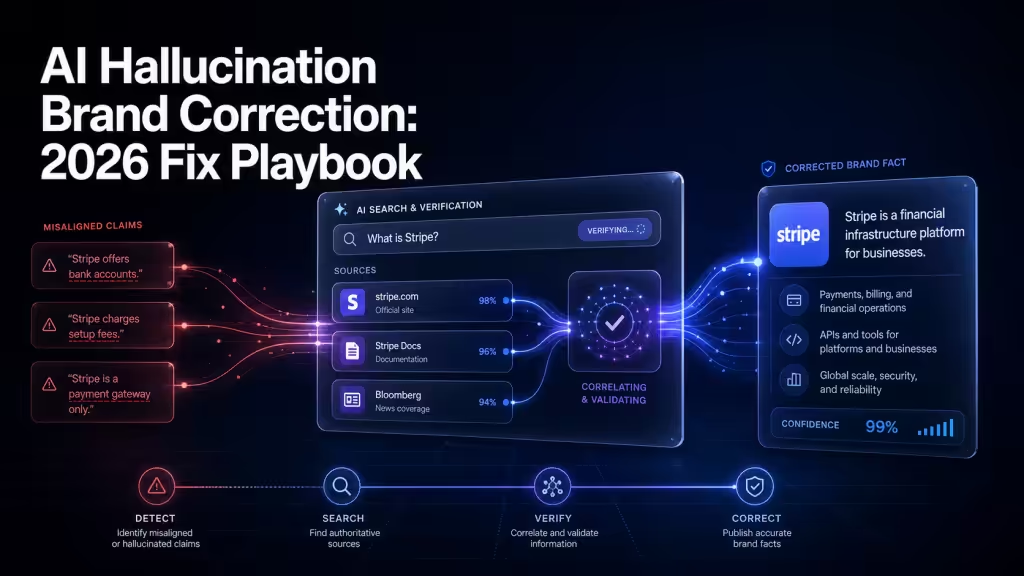

When ChatGPT invents a founder, Gemini misstates your pricing, or Perplexity cites a competitor’s blog as your “official” documentation, you have an AI hallucination problem with your brand attached to it. AI hallucination brand correction is the work of detecting false claims about your company in LLM outputs, tracing them to the source signals that produced them, and reinforcing the correct facts across the web until the models stop repeating the error. This is not prompt engineering. It is source-signal engineering, and it runs on the same authority and citation logic that decides whether your brand gets surfaced at all.
The playbook below is what a working correction cycle looks like in 2026: detection, diagnosis, signal repair, and re-test. No llms.txt myths, no schema voodoo, no praying for a model refresh.
What AI Hallucination Brand Correction Actually Means
A brand hallucination is any factually wrong statement an AI assistant makes about your company, product, people, or relationships. It is not a bad review and it is not a competitor outranking you. It is the model confidently asserting something that is not true.
| Hallucination type | What the AI gets wrong | Underlying source-signal failure | How to correct it |
|---|---|---|---|
| Attribute drift | Wrong founding year, headquarters, headcount, or pricing tier | Conflicting facts spread across many low-authority sources | Reconcile the canonical fact across authoritative profiles so one answer dominates |
| Relationship invention | Fake partnerships, imagined acquisitions, fabricated integrations | Adjacent-pattern guessing where no clear relationship signal exists | Publish and earn citations that explicitly state the real relationships |
| Product fabrication | Features you don’t ship, plans you don’t sell, a nonexistent free tier | Data void on current product reality, filled by plausible invention | Reinforce accurate product and pricing facts on high-confidence pages |
| Citation forgery | Invented URLs, press coverage that never happened, awards never won | No verifiable citable source, so the model fabricates one | Create and surface real, verifiable sources the model can cite instead |
The Four Hallucination Types You’ll See Most Often
In the last twelve months of running citation audits, four patterns show up over and over:
Attribute Drift
Wrong founding year, wrong headquarters, wrong headcount, wrong pricing tier.
Relationship Invention
Fake partnerships, imagined acquisitions, fabricated integrations.
Product Fabrication
Features you don’t ship, plans you don’t sell, a “free tier” that does not exist.
Citation Forgery
URLs the model invented, press coverage that never happened, awards you did not win.
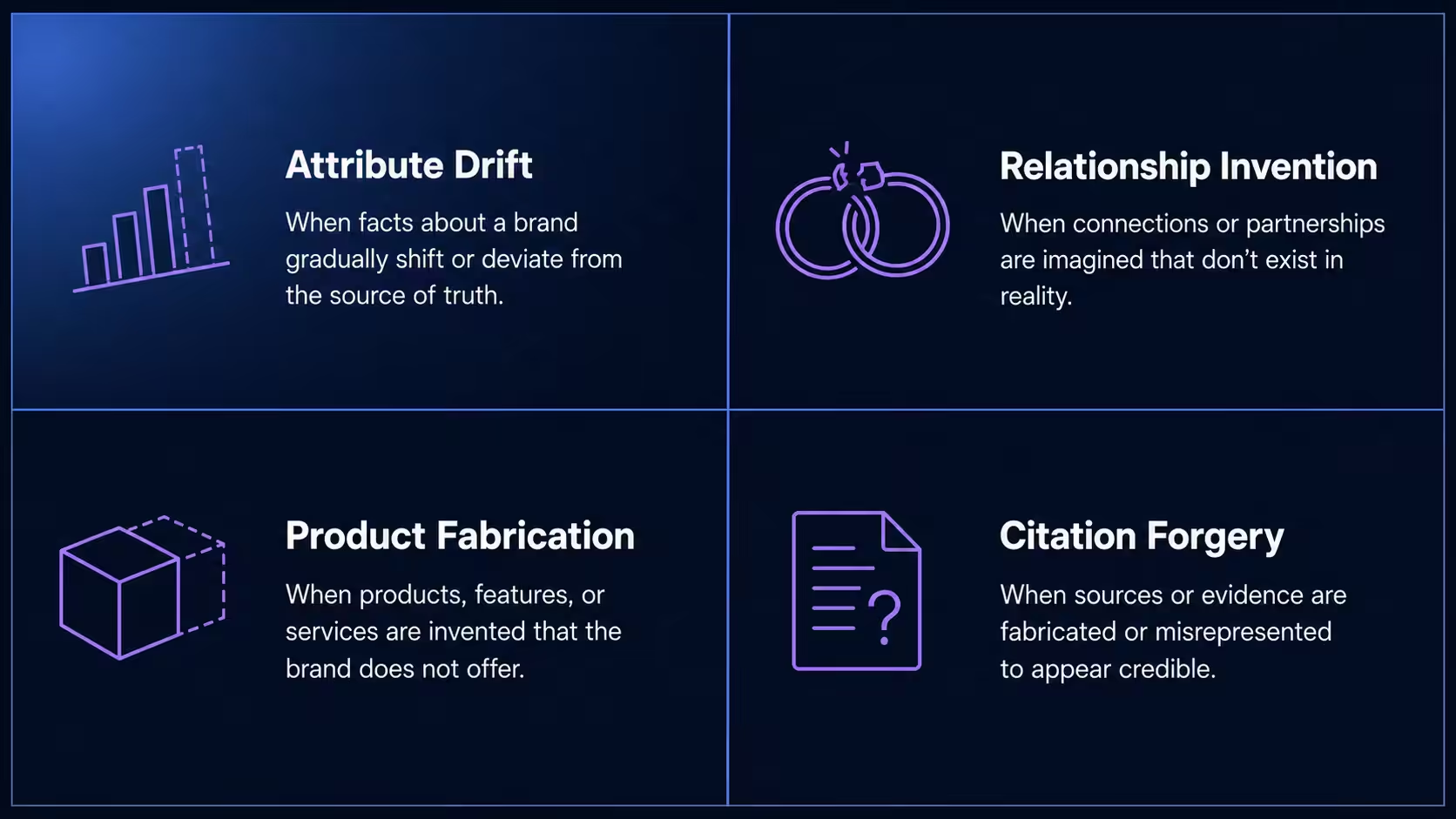
Each type traces back to a different source-signal failure, and each needs a different fix. Treating them as one problem is the reason most “AI brand audits” go nowhere.
Why LLMs Hallucinate About Brands Specifically
Models hallucinate about brands for one structural reason: brand facts live in a noisier, sparser, more contradictory corner of the training data than almost any other topic. A model that can perfectly recite the population of Belgium will guess your seed round size because Belgium has one Wikipedia page and your funding has thirty conflicting blog posts.
The Three Signal Conditions That Produce Brand Errors
Three conditions reliably trigger hallucination on a brand query:
1. Data Voids
The model has no high-confidence source for the fact, so it generates a plausible answer from adjacent patterns. Newer companies and quiet enterprise vendors get hit hardest here.
2. Data Noise
Multiple sources disagree. Crunchbase says one founder, LinkedIn says another, a 2019 TechCrunch piece names a third. The model picks one or averages them into something wrong.
3. Stale Anchoring
A high-authority source from years ago overrides newer, accurate signals because the model weights authority over recency.
Recent OpenAI and Georgia Tech research argued models are trained to guess confidently rather than admit uncertainty, which means a sparse-signal brand will always get a confident wrong answer instead of a “I don’t know.” Your correction job is to make the right answer the most defensible one in the model’s source pool.
How to Detect Hallucinations Before They Damage Pipeline
Detection is a structured prompt audit, not a one-off chat. The goal is reproducibility: if you can’t recreate the bad output, you can’t prove the fix worked.
Build a Brand Prompt Set
Write 30 to 60 prompts that mirror how buyers, journalists, and analysts actually ask about your company. Group them into five buckets:
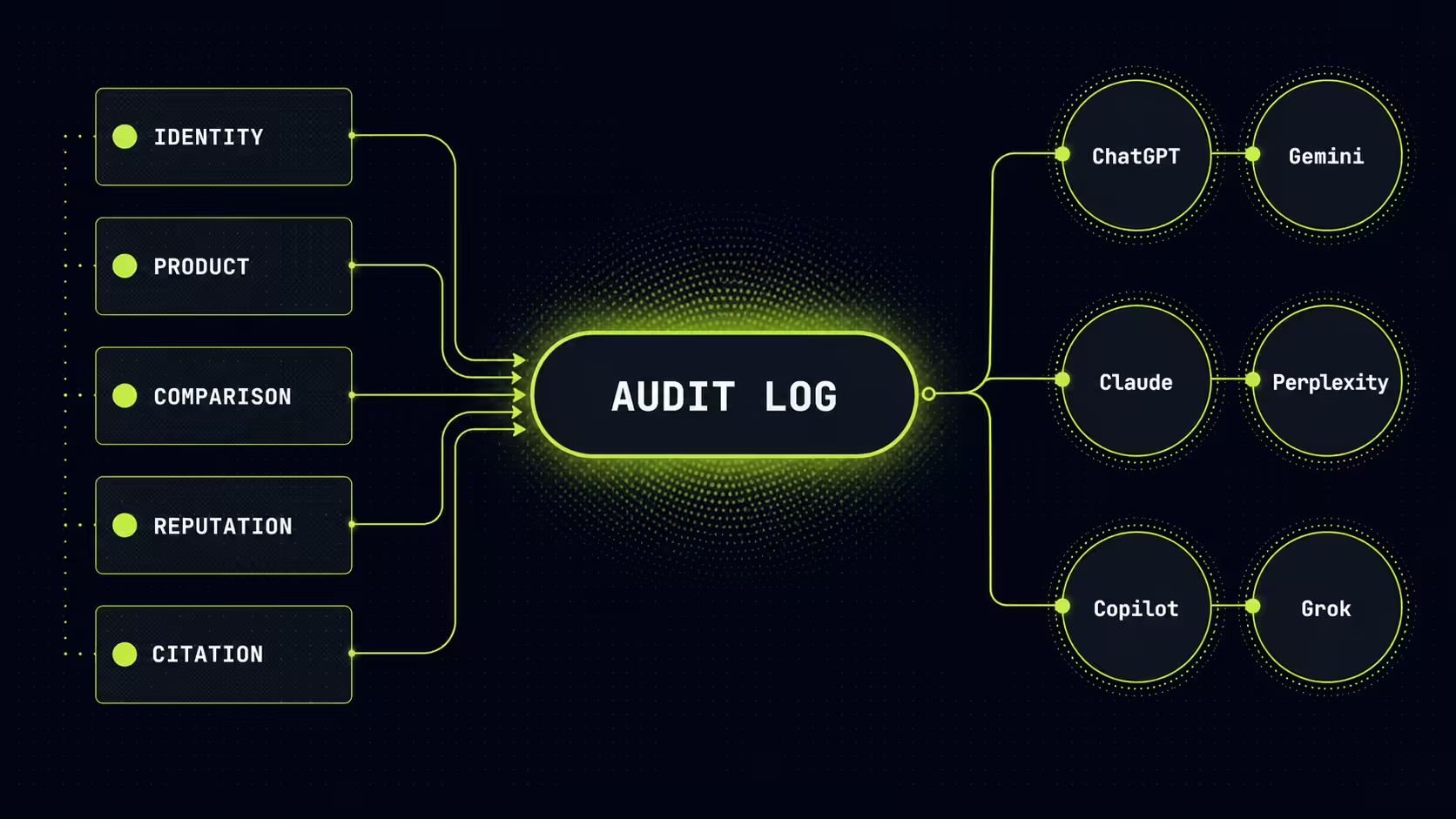
- Identity prompts: “Who founded [Brand]?”, “Where is [Brand] headquartered?”
- Product prompts: “What does [Brand] do?”, “How does [Brand] price its enterprise plan?”
- Comparison prompts: “[Brand] vs [Competitor]”, “Alternatives to [Brand]”
- Reputation prompts: “Is [Brand] legitimate?”, “Has [Brand] had a security incident?”
- Citation prompts: “Cite a source for [specific claim about Brand]”
Run the set against ChatGPT, Gemini, Claude, Perplexity, Copilot, and Grok. Log every output verbatim. If you want this running on a schedule, our guide to tracking brand across 10 AI engines covers the rotation cadence we use for client accounts.
Score Every Output for Three Things
For each response, mark:
Factual Accuracy
Is the claim true, false, or unverifiable?
Citation Quality
Did the model cite a source? Is the source real and authoritative?
Sentiment Drift
Does the output frame your brand positively, neutrally, or negatively compared to competitors named in the same response?
A baseline audit across one mid-market SaaS client surfaced 14 distinct false claims across six engines, with citation forgery accounting for almost half. That ratio is roughly what we see consistently across enterprise audits.
Diagnosing the Source Signal Behind a Hallucination
Once you have a confirmed false claim, the question is not “how do I prompt around it.” The question is what source the model is leaning on, and why.
The Three-Step Trace
For each hallucinated claim, run this trace:
1. Ask the Model for Its Source
“What is your source for [claim]?” Models that ground answers (Perplexity, Copilot, ChatGPT with search) will name URLs. Models that don’t will reveal the reasoning pattern.
2. Search the Live Web for the Claim
Find every page that states the false version. Categorize by authority tier and indexation date.
3. Search for the Correct Version
Count how many high-authority pages state the truth. Compare to step two.
When the false-claim sources outnumber or outrank the correct-claim sources, the hallucination is mechanical, not random. That’s a fixable problem.
The Most Common Source Patterns Behind Brand Errors
Across client diagnoses, the same source patterns keep producing brand hallucinations:
- An outdated Crunchbase or PitchBook profile that has not been claimed
- A high-DA listicle that misstated a fact in 2021 and never corrected it
- An old press release describing a pivoted product line
- A competitor’s comparison page where the model treated their characterization of you as fact
- Reddit and Quora threads where the most-upvoted comment is wrong
The fix lives wherever the model is reading. Wikipedia and structured profiles dominate that list for most brands, which is why a focused Wikipedia AI citation strategy moves the needle faster than almost any other intervention.
Correcting Brand Facts at the Source Layer
Correction is a sequenced campaign, not a single edit. The order matters because models weight sources differently, and fixing a low-authority page while a high-authority page still carries the error is wasted work.
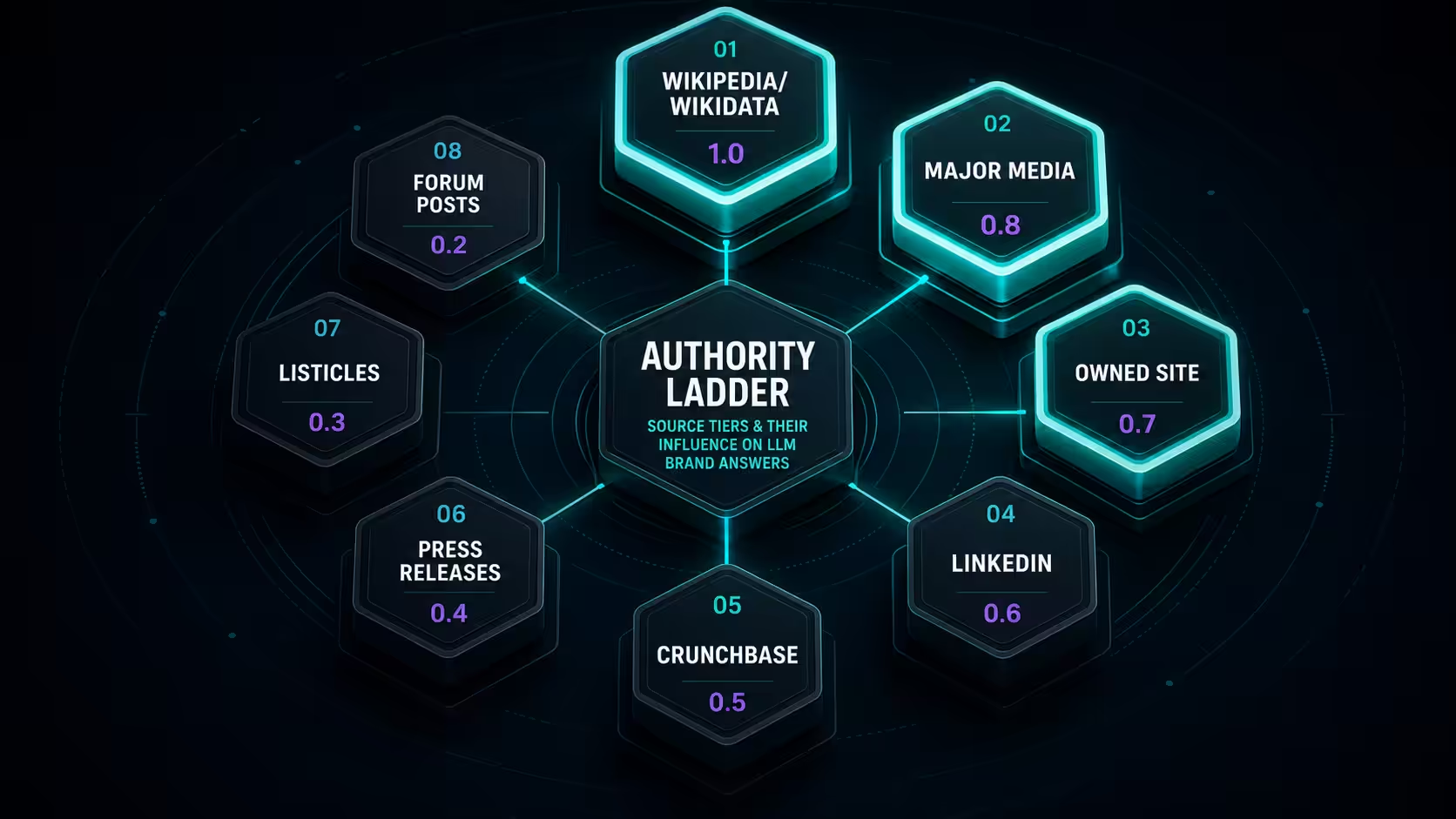
Tier One: Fix the Anchors
These are the sources most LLMs lean on hardest for brand facts:
Wikipedia and Wikidata
Update through proper editorial channels, with verifiable third-party citations. Do not edit your own page directly.
Your Owned Site
Your About page, leadership page, and press page must state the correct facts cleanly. One canonical version, no contradictions across subpages.
Structured Profiles
Claim and update Crunchbase, LinkedIn, G2, Capterra, and any industry directory the model is likely to pull from.
Tier Two: Earn Corrections in Authoritative Coverage
When a top-tier publication printed the wrong fact, request a correction. Most major outlets honor factual correction requests when you can supply documentation. A single correction at a Tier 1 publication can outweigh dozens of secondary fixes. Our breakdown of the tier-based publication hierarchy for AI citations lays out which outlets carry the most weight by category.
Tier Three: Build New Correct-Fact Coverage
You will not always be able to remove the wrong claim. Sometimes the better move is to outweigh it. Earned media, original research, and authoritative third-party citations that state the correct version create a denser signal mass around the truth. Over time, the model recalibrates.
Press coverage tied to verifiable news beats most other tactics here. The PR cadence that works here walks through the cadence and angle work that produces this lift.
Re-Testing and Closing the Loop
A correction that you cannot measure is a correction you cannot defend in a budget conversation. Re-test the same prompt set on a fixed cadence and track the change.
The Re-Test Cadence That Works
Most clients land on this rhythm:
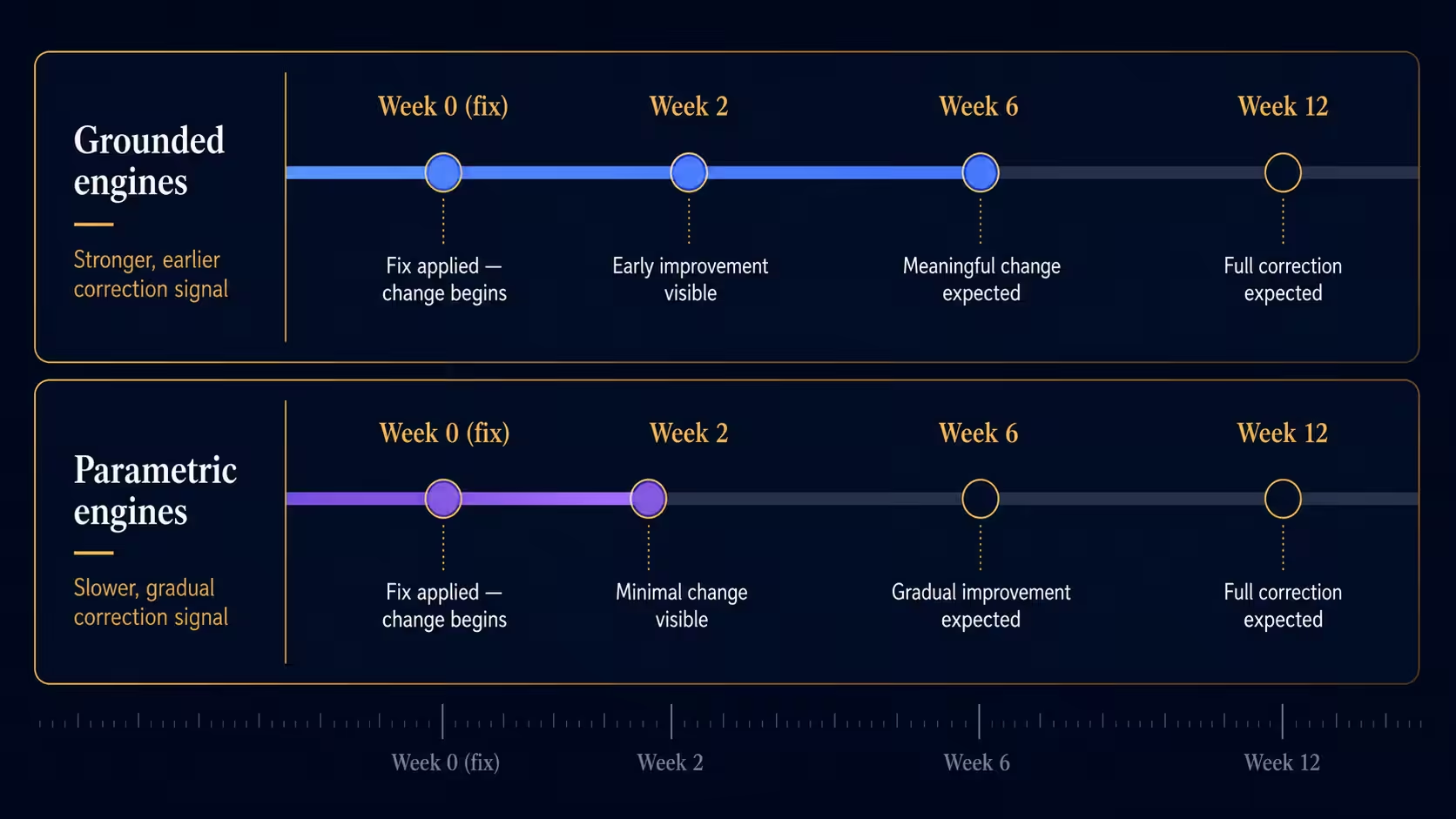
- Week 2 after a fix: Quick check on the specific claim. Has any engine updated?
- Week 6: Full prompt-set rerun. Document movement.
- Quarterly: Full audit, including new prompts based on product or positioning changes.
Grounded engines (Perplexity, Copilot, ChatGPT with search) update fastest because they re-retrieve sources at query time. Pure-parametric outputs from Claude and Gemini move slower and often only shift after a model refresh. That gap is normal. Plan for it.
What This Approach Will Not Fix
Some hallucinations are stubborn for reasons outside your control.
Hard-Coded Training Data
If a closed-weight model trained on a snapshot that contained the error, no amount of new signal will move it until the next training cycle.
Confidently Wrong Reasoning
Some hallucinations are not source errors; they are generative leaps the model makes from sparse data. Adding signal helps, but you cannot fix every guess.
Adversarial Misinformation
If a competitor or bad actor is actively publishing false claims, you are in a different fight that needs legal and PR support, not just SEO work.
Acknowledge those limits. The work still pays back across the eighty percent of cases that are mechanical and fixable.
Where Brand Correction Sits in a Wider AI Visibility Program
Correction is one workstream inside a fuller program. The other workstreams (citation building, entity authority development, ongoing monitoring) reinforce each other. A brand with clean entity signals and strong third-party citation coverage hallucinates less in the first place. If you want the system-level view, our diagnostic framework for AI visibility shows where correction work plugs into detection, optimization, and measurement.
Done well, correction stops being reactive. You catch errors during weekly audits, fix the source before buyers see the wrong output, and the model’s view of your brand starts converging on the version you actually want it to know.
Frequently Asked Questions
How long does it take for an AI model to stop repeating a corrected fact?
Grounded engines like Perplexity and Copilot can reflect a fix within days once the corrected source is indexed. Parametric models like Claude and Gemini often take a full model refresh cycle, which can run weeks to months. Plan for both timelines in parallel.
Can I just tell ChatGPT the correct information and have it remember?
No. In-session corrections do not propagate to other users or future sessions in any persistent way. The fix has to live in the source signals the model reads from, not in a single chat.
Does schema markup correct AI hallucinations?
Not directly. Schema helps Google understand your page for rich results, but it is not a primary signal LLMs use to override conflicting facts elsewhere on the web. Treat it as supporting hygiene, not a correction lever.
What if the false claim comes from a competitor’s website?
Document it and pursue the standard correction path: outreach to the publisher, request a factual edit, and if that fails, outweigh the claim with denser correct-fact coverage from higher-authority sources.
How many prompts should a brand audit cover?
Thirty to sixty prompts grouped across identity, product, comparison, reputation, and citation buckets covers most real buyer and analyst behavior. Expand the set when you launch new products or enter new categories.
The Honest Take
Brand hallucinations are not a model problem you wait out. They are a signal problem you fix. The brands that will own their AI presence in 2026 are the ones running correction as a continuous workstream, not an annual project, and treating every false output as a diagnostic clue about where their source authority is thin.
See where your brand stands in AI search. Book a strategy call and we’ll show you which hallucinations are costing you trust right now.