Monitoring brand mentions in ChatGPT means systematically tracking when and how your company name appears in AI-generated answers — a channel with no analytics dashboard, no impressions data, and no native notification system. As of 2026, ChatGPT processes over 2.5 billion queries per day, according to a 2025 TechCrunch report, and many of those queries involve product recommendations, brand comparisons, and purchase decisions. If you don’t know what ChatGPT says about your brand, you’re flying blind in the fastest-growing discovery channel in digital marketing.
This guide covers exactly how to monitor brand mentions in ChatGPT — from free manual methods to automated tracking workflows — and what to do once you find the data. You’ll also learn why ChatGPT monitoring requires a fundamentally different approach than traditional SEO or social listening.
Key Takeaways
- ChatGPT mentions are binary — your brand is in the answer or it isn’t. There’s no “page two” to fall back on.
- Manual prompt testing is free and useful for initial benchmarks, but it doesn’t scale beyond a handful of queries.
- Automated LLM tracking tools monitor hundreds of prompts across models and track visibility rate, sentiment, and citation sources over time.
- Server log analysis reveals when ChatGPT retrieves your pages in real time — roughly 46% of queries trigger live web retrieval, per a 2025 Semrush study.
- Brand mentions and citations are not the same thing — fixing each requires a different strategy.
- The sources ChatGPT pulls from determine whether you appear. Strengthening your editorial footprint on high-authority publications directly influences AI recommendations.
- Monitoring alone isn’t enough. Acting on the data — correcting inaccuracies, closing competitive gaps, and building category authority — is what drives results.
Why ChatGPT Brand Monitoring Requires Its Own Strategy
Traditional search gives you ranking data. Social platforms show reach and engagement. Review sites display star ratings. ChatGPT gives you nothing.
There is no Search Console for ChatGPT. No impressions report. No click-through rate dashboard. OpenAI does not expose any analytics about how often your brand appears in its responses.
Yet hundreds of millions of people now use ChatGPT for research and buying decisions. A 2025 seoClarity study found that 77% of U.S. ChatGPT users have used it as a search engine at least occasionally. Shopping-related prompts doubled in six months, according to 2025 data from Bain & Company and Sensor Tower.
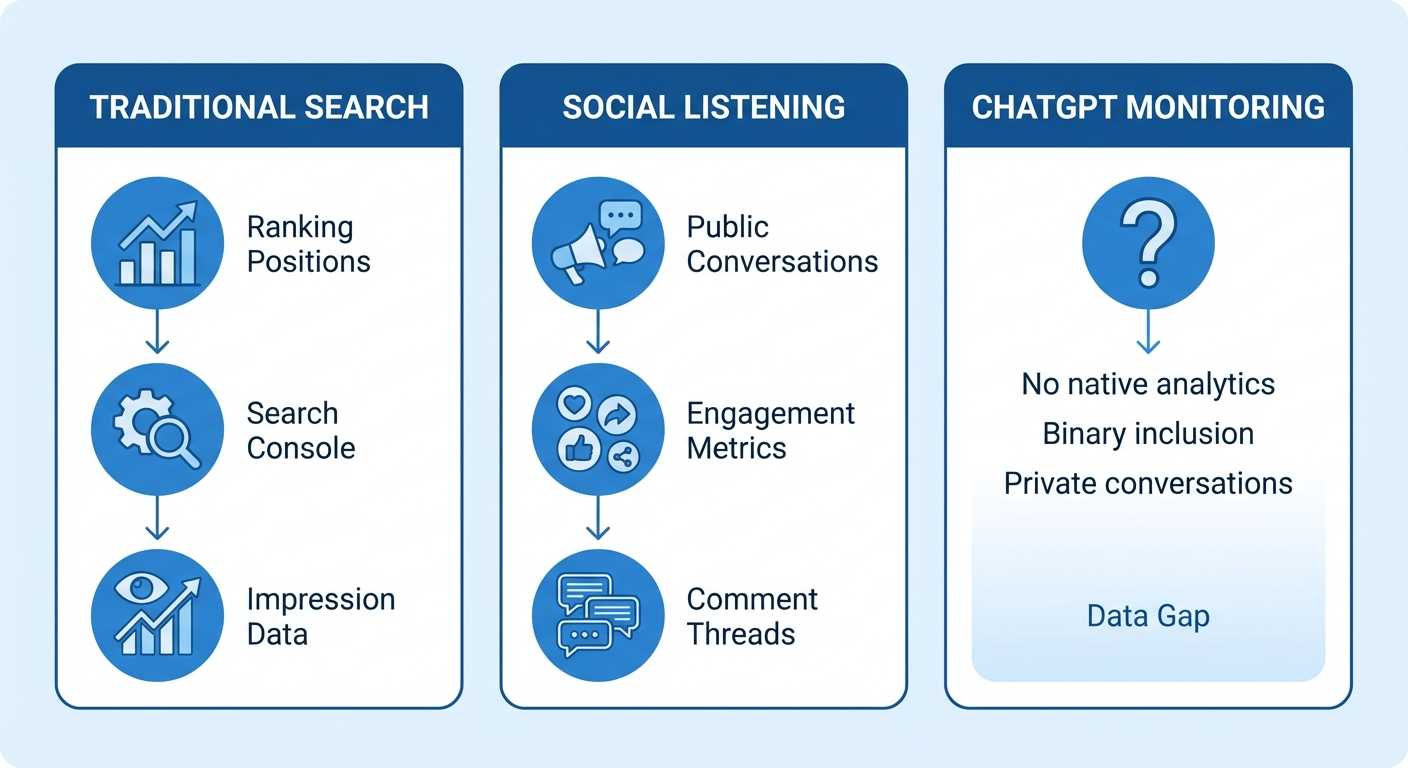
The fundamental difference: ChatGPT synthesizes a single answer. Your brand is either included in that answer or it’s absent entirely. There’s no position four to compete from. There’s no SERP to scroll.
This means the monitoring methods built for Google and social media don’t work here. You need a dedicated approach.
Mentions vs. Citations: A Critical Distinction
A brand mention is any instance where your company or product name appears in a ChatGPT response. A citation is a clickable link to a specific source that ChatGPT references in its answer.
These two things require different strategies to influence:
- Improving mentions requires building your brand’s presence across authoritative third-party content — industry roundups, comparison articles, and editorial coverage on publications that feed LLM training data.
- Improving citations looks more like traditional SEO — keeping your content updated, crawlable, clearly structured, and front-loading key insights so ChatGPT can surface your pages as sources.
Research from Ahrefs in 2025 found that ChatGPT cites sources approximately three times less often than it mentions brands by name. This means your brand can be recommended without your website ever being linked. Monitoring needs to capture both dimensions.
How to Monitor Brand Mentions in ChatGPT for Free
The fastest way to check your ChatGPT visibility costs nothing. Open ChatGPT, log out, use incognito mode, and start asking questions.
Logging out matters. ChatGPT personalizes responses based on conversation history, saved memory, and custom instructions. If you’re logged in, the answers you see may not reflect what a new user encounters.
Prompts That Reveal Your Brand Visibility
Ask questions the way your potential customers would. Focus on three categories:
Category discovery prompts:
- “What are the best tools for [your product category]?”
- “Which [type of service] do experts recommend for [use case]?”
- “Top alternatives to [competitor name]”
Direct brand prompts:
- “What is [your brand] and what is it used for?”
- “What do people think about [your brand]?”
- “How does [your brand] compare to [competitor]?”
Decision-stage prompts:
- “Is [your brand] worth the price?”
- “Best [product type] for small businesses”
- “Should I choose [your brand] or [competitor] for [specific need]?”
Pro Insight: Run each prompt with ChatGPT’s web search toggled both on and off. With search disabled, ChatGPT draws solely from training data. With search enabled, real-time sources influence the output. Comparing the two reveals whether your visibility gap is a branding problem (training data), a content problem (live retrieval sources), or both.
What to Record During Manual Testing
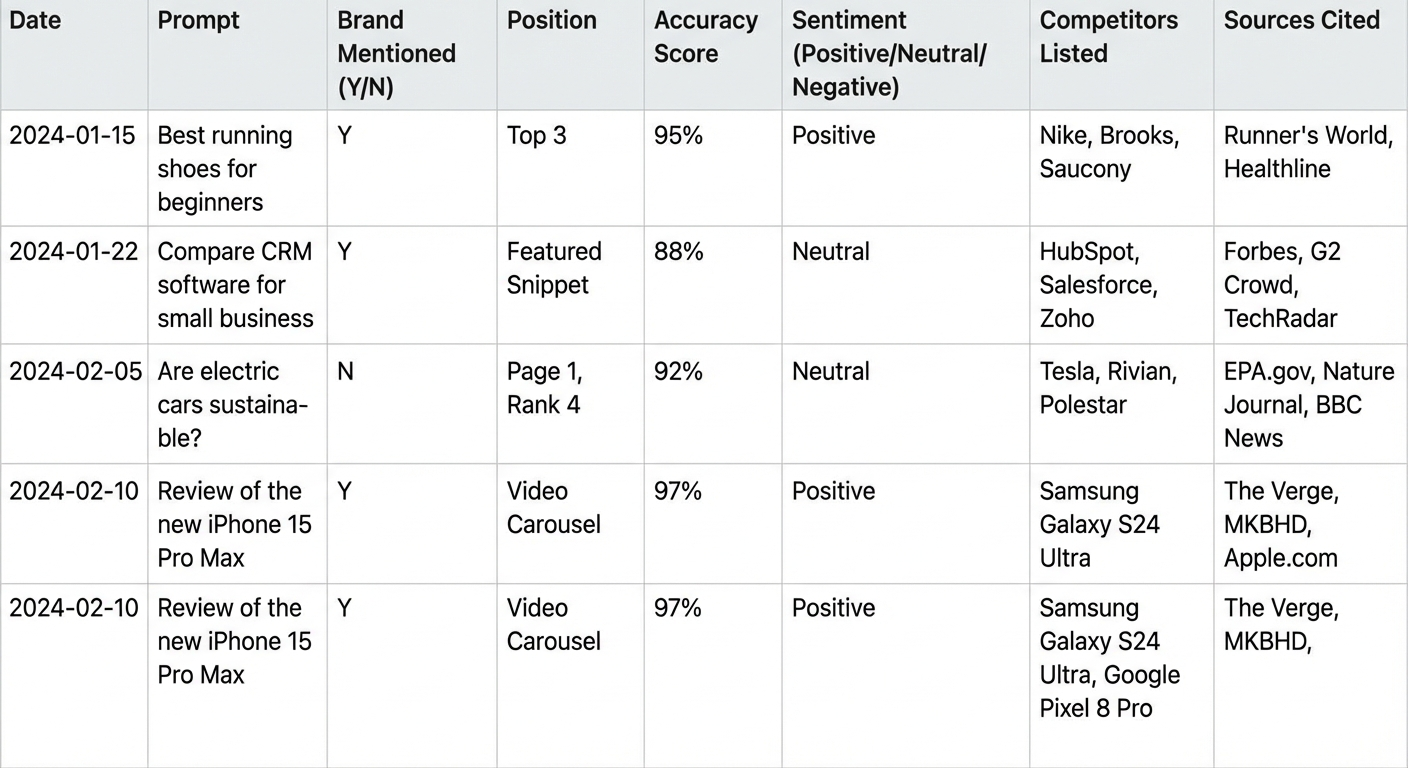
Document each test in a spreadsheet with these fields:
- Date and model version — responses change with model updates
- Exact prompt used
- Whether your brand appeared — yes or no
- Position in the response — first mentioned, listed among several, or absent
- Accuracy — are features, pricing, and positioning described correctly?
- Sentiment — positive, neutral, or negative framing
- Competitors mentioned — who appears alongside or instead of you
- Sources cited — which URLs does ChatGPT reference, if any
This manual process creates your initial benchmark. It tells you where you stand right now. But it breaks down quickly at scale — ChatGPT responses are non-deterministic, meaning the same prompt can generate different answers across sessions. A handful of tests per week won’t reveal reliable patterns.
Automated Tracking Tools for Scaled Monitoring
Manual checks establish a baseline. Automated tools turn monitoring into a repeatable system that runs across hundreds of prompts, multiple AI models, and consistent time intervals.
How Automated LLM Tracking Works
LLM tracking platforms send defined prompts to ChatGPT and other AI models on a set schedule — daily, weekly, or monthly. They parse the responses to detect your brand name and competitor names, record the context, analyze sentiment, and store data for trend analysis.
The core metrics most platforms track:
- Visibility rate — the percentage of relevant prompts where your brand appears in the response
- Share of voice — how often your brand is mentioned relative to competitors across the same set of prompts
- Sentiment — whether the AI describes your brand positively, neutrally, or negatively
- Citation coverage — how often ChatGPT links to your website or content as a source
- Position in response — whether your brand is mentioned first, listed among several, or relegated to a footnote
Most platforms support multiple AI models — ChatGPT, Gemini, Claude, Perplexity, and AI Overviews — so you can compare your visibility across the entire AI search ecosystem from one dashboard.
Setting Up Automated Monitoring: A Practical Workflow
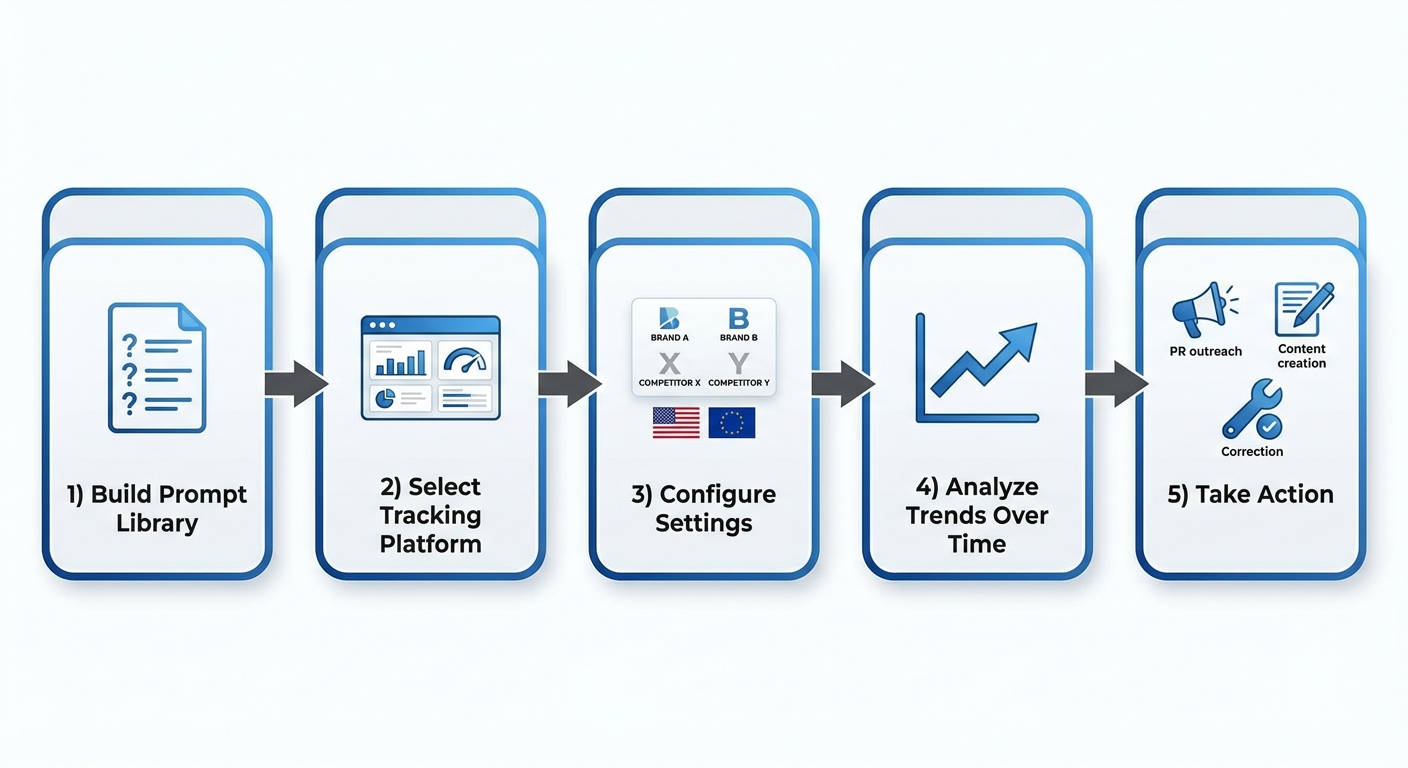
Step 1: Build your prompt library. Start with 20–50 prompts that mirror how your target buyers search. Include category-level queries, head-to-head comparisons, use-case questions, and objection-handling prompts. This library is the foundation of your monitoring system — weak prompts produce weak data.
Step 2: Choose your tracking platform. Evaluate based on model coverage, prompt flexibility, reporting granularity, and pricing structure. Tools like Ahrefs Brand Radar, Rankshift, Knowatoa, and Meltwater’s GenAI Lens each approach this differently — some use credit-based systems, others offer tiered subscriptions. Select the tool that fits your budget and the number of models you need to track.
Step 3: Configure competitors, regions, and frequency. Enter your brand name, 3–5 key competitors, target geographic regions, and languages. Set a check cadence that matches your content velocity — daily if you publish frequently, weekly for most B2B brands.
Step 4: Analyze trends, not snapshots. A single data point from one prompt run tells you almost nothing. Look for patterns across weeks and months. Is your visibility rate trending up after a PR push? Did a competitor’s share of voice spike after they launched a new comparison page? Trends reveal what’s working and what needs attention.
Step 5: Connect monitoring to action. The dashboard is only useful if it drives decisions. Use the data to prioritize content creation, identify publications to pitch for editorial coverage, and spot inaccuracies that need correction.
What Automated Tools Cannot Tell You
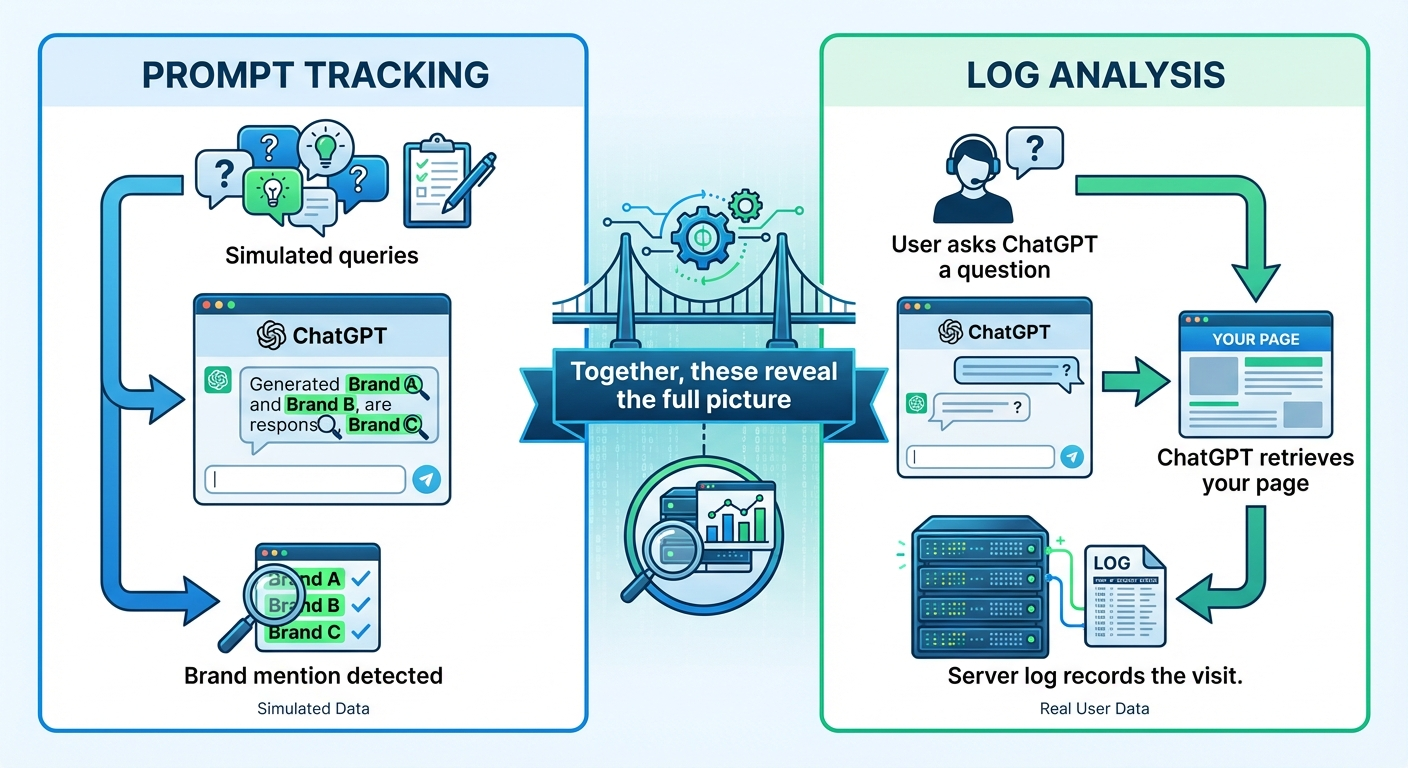
No tracking tool sees inside ChatGPT’s actual user conversations. These platforms simulate queries and analyze the responses. The prompts your real customers type may differ in phrasing, context, and specificity.
Additionally, ChatGPT responses vary by session, model version, and user history. Automated tracking provides a reliable signal of your average visibility — not a guarantee of what every user sees.
Treat the data as directional intelligence, not absolute truth.
Server Log Analysis: Seeing What ChatGPT Retrieves from Your Site
Automated prompt tracking shows you what ChatGPT says. Server log analysis shows you what ChatGPT reads — which of your pages the model retrieves in real time when answering user queries.
This matters because ChatGPT doesn’t always rely on training data alone. Retrieval-augmented generation (RAG) is a process where the model searches the web in real time to supplement its internal knowledge. A 2025 Semrush clickstream study analyzing over 80 million ChatGPT interactions found that approximately 46% of queries triggered live web retrieval.
When ChatGPT retrieves one of your pages, that visit is logged on your server — but it won’t appear in Google Analytics or any JavaScript-based analytics tool, because AI crawlers don’t execute JavaScript.
How to Identify AI Bot Traffic in Your Logs
AI bots that access your site use specific user-agent strings. The key ones for ChatGPT monitoring:
- ChatGPT-User — fetches pages when a user prompt requires live information or citations. This is the most directly relevant bot for monitoring.
- OAI-SearchBot — indexes pages for ChatGPT’s search function.
- GPTBot — a training crawler that scrapes content for model training. Less useful for real-time monitoring but relevant for long-term visibility.
To analyze this data:
- Export server logs from your hosting provider or CDN for at least 30 days.
- Filter for HTTP 200 and 304 status codes to focus on successful page retrievals.
- Isolate requests from ChatGPT-User and OAI-SearchBot user-agent strings.
- Group by URL and count the frequency of requests per page.
- Compare against your human traffic data to identify pages with high AI interest but low human engagement (potential missed opportunities) or pages with zero AI bot visits (potentially invisible to ChatGPT).
Key Definition: Retrieval-augmented generation (RAG) is a technique where an AI model searches external data sources in real time to supplement its training data when answering queries. This reduces hallucinations and provides more current information.
What Log Analysis Reveals That Prompt Tracking Cannot
Log analysis uncovers technical problems that silently block your AI visibility:
- Client-side rendering issues — if your pages depend entirely on JavaScript to display content, AI bots see empty pages. Server-side rendering or static HTML ensures your content is accessible.
- Robots.txt misconfigurations — blocking ChatGPT-User or OAI-SearchBot prevents your pages from being retrieved during live queries.
- Redirect chains and broken status codes — these can cause the model to drop your page from consideration during retrieval.
- Pages crawled but never cited — a page that AI bots visit repeatedly without citing it may need clearer structure, more direct answers, or better front-loading of key information.
For most marketing teams, combining automated prompt tracking with quarterly log audits provides a comprehensive view of both what ChatGPT says about your brand and what it reads from your site.
How to Act on Your ChatGPT Monitoring Data
Monitoring generates data. The value comes from what you do with it. Your response depends on what the data reveals.
If Your Brand Doesn’t Appear at All
Complete absence from ChatGPT responses typically means your brand lacks sufficient representation across the content sources the model trusts.
What to do:
- Build editorial presence on high-authority publications. ChatGPT learns brand-category associations from training data and live retrieval sources. Getting your brand mentioned in industry roundups, comparison articles, and expert reviews on trusted publications is the most direct lever. Agencies like BrandMentions place contextual brand mentions on 140+ high-authority publications that AI models actively learn from during training and live retrieval.
- Create content clusters around buyer questions. ChatGPT uses a process called Reciprocal Rank Fusion (RRF) to prioritize pages that appear repeatedly across search results. Publishing a cluster of related content increases the likelihood that your pages surface during retrieval.
- Strengthen your brand’s “About” page and core positioning pages. Use direct, specific language about what you do, who you serve, and your primary use cases. AI models favor content that makes clear, unambiguous claims.
- Generate reviews on platforms ChatGPT references. G2, Capterra, Trustpilot, and industry-specific review sites feed into both training data and live retrieval.
If Your Brand Appears with Inaccurate Information
Inaccurate ChatGPT responses — wrong pricing, discontinued features, outdated positioning — usually trace back to outdated content on your own site or third-party sources that haven’t been updated.
What to do:
- Publish updated content with explicit corrections. Don’t say “our pricing has changed.” Say “our Growth plan is $79/month and includes [specific features] as of 2026.”
- Update third-party profiles. LinkedIn, Crunchbase, Wikipedia (if applicable), review sites, and industry directories all feed ChatGPT’s knowledge base.
- Accept that corrections take time. ChatGPT’s training data has a knowledge cutoff, and model updates happen on OpenAI’s schedule. Focus on steady, consistent content improvements rather than one-time correction campaigns.
If Competitors Consistently Outperform You
When ChatGPT recommends competitors in contexts where your brand should appear, the gap is usually in the quantity and quality of third-party content associating those competitors with relevant use cases.
What to do:
- Analyze the prompts where competitors appear and you don’t. Automated tracking tools can filter for responses that include competitors but exclude your brand. This reveals the specific topics and use cases where your editorial footprint is weakest.
- Study the sources ChatGPT cites when recommending competitors. Which publications? Which types of content? This tells you exactly where to focus your PR and content partnership efforts.
- Build comparison content on your own site. Detailed, honest comparison pages help ChatGPT understand how your brand relates to alternatives in your category.
For B2B brands working to close competitive gaps, exploring practical approaches to tracking brand mentions across AI search platforms can help you benchmark progress over time.
If Your Brand Appears Positively
Positive mentions are a signal to reinforce, not just celebrate.
- Identify the strengths and phrases ChatGPT associates with your brand. Incorporate that same language into your website, sales materials, and content strategy.
- Double down on the content types and publications that are driving positive mentions. If thought leadership articles on a specific publication correlate with positive ChatGPT framing, produce more of them.
- Use positive AI mentions as social proof. Reference what AI recommends in case studies and customer conversations — it builds trust with prospects who are already using ChatGPT for research.
Building a Repeatable ChatGPT Monitoring System
One-time audits reveal where you stand. A repeatable system reveals whether your efforts are working. Here’s how to structure ongoing monitoring for a B2B marketing team.
Monthly Cadence for Most B2B Brands
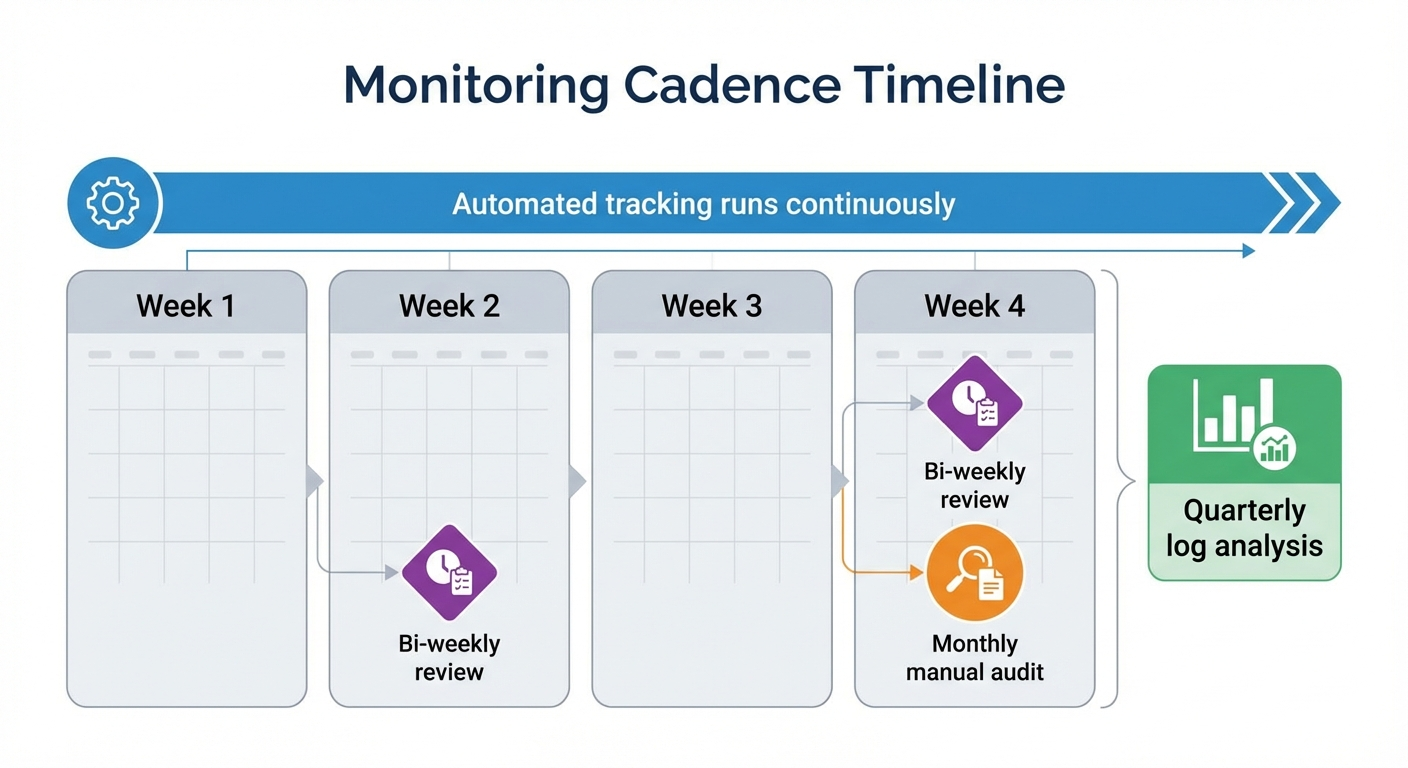
- Weekly: Automated tracking tool runs scheduled prompts across ChatGPT, Gemini, Claude, and Perplexity. Dashboard updates automatically.
- Bi-weekly: Review visibility rate trends, share of voice shifts, and sentiment changes. Flag any new inaccuracies or competitive movements.
- Monthly: Run a manual prompt audit with 10–15 high-priority questions to spot-check tone and positioning that automated tools may not fully capture.
- Quarterly: Analyze server logs for AI bot traffic patterns. Identify technical blockers and pages with high AI retrieval but low citation rates.
This cadence balances thoroughness with practical resource constraints. Adjust frequency based on your content velocity and competitive intensity.
Metrics That Matter for ChatGPT Visibility
Not all monitoring data is equally useful. Focus your reporting on these metrics:
- Inclusion rate — percentage of relevant prompts where your brand appears. This is your headline metric.
- Share of voice vs. competitors — how your mention frequency compares to your top 3–5 competitors across the same prompt set.
- Sentiment distribution — the ratio of positive, neutral, and negative descriptions of your brand.
- Accuracy score — the percentage of mentions that correctly describe your current products, pricing, and positioning.
- Citation rate — how often ChatGPT links to your website, distinct from mentioning your brand name.
- Trend direction — whether each metric is improving, declining, or flat over the past 30, 60, and 90 days.
For teams managing LLM visibility across multiple AI platforms, these same metrics apply to Gemini, Claude, and Perplexity — giving you a unified view of your AI discoverability.
What Makes ChatGPT Decide to Mention Your Brand
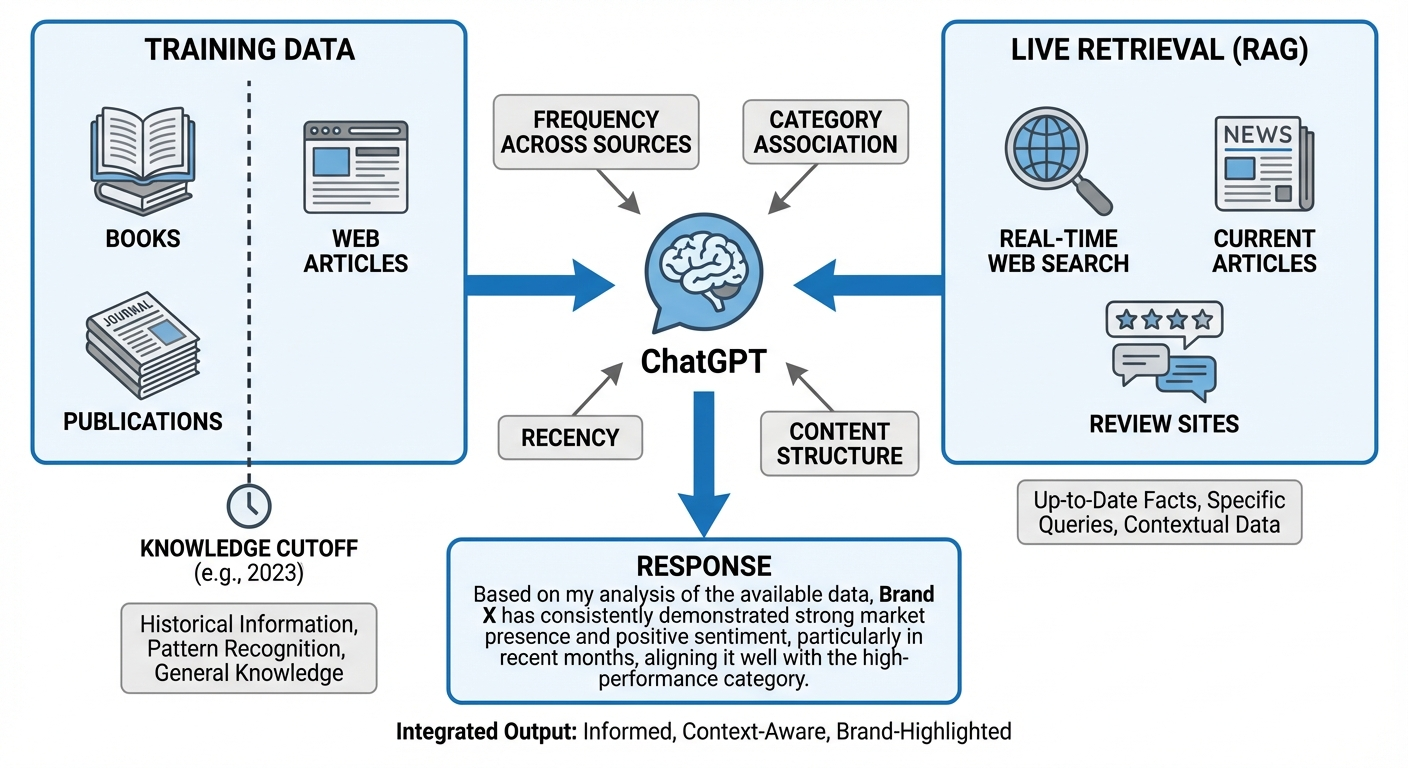
Understanding what drives ChatGPT’s brand recommendations helps you prioritize your efforts. ChatGPT forms its responses from two primary sources:
Training data: The massive corpus of text the model was trained on, which includes web pages, books, articles, and other publicly available content. This data has a knowledge cutoff — information published after that date isn’t reflected unless retrieved in real time.
Live retrieval (RAG): When web search is enabled, ChatGPT searches the internet in real time to find current information. It favors authoritative, well-structured pages that directly answer the user’s question.
The factors that influence whether your brand appears in either source:
- Frequency and consistency of brand mentions across trusted publications. A brand mentioned in 50 different authoritative sources is more likely to surface than one mentioned 500 times on its own blog.
- Association with specific categories and use cases. If multiple independent sources describe your brand as “the best project management tool for remote teams,” ChatGPT learns that association.
- Recency and accuracy of information. Outdated content can lead to inaccurate or missing mentions. Keeping your content and third-party profiles current strengthens your signal.
- Content structure and extractability. Pages with clear headings, direct answers, and well-organized information are easier for both training processes and live retrieval to parse.
In campaigns across 67+ B2B companies, the BrandMentions team found that brands with consistent editorial mentions on high-authority publications achieved measurably higher AI recommendation rates than those relying solely on owned content and traditional SEO. The compounding effect of third-party brand mentions — where multiple independent sources reinforce the same brand-category association — is a key driver of sustained ChatGPT visibility.
For a deeper look at how AI visibility services work in practice, explore the placement process behind strategic brand citations.
Common Mistakes That Undermine ChatGPT Monitoring
Monitoring is only as useful as the methodology behind it. These errors lead to misleading data or wasted effort:
- Testing while logged in. ChatGPT personalizes responses based on your history. Always log out and use incognito mode for unbiased results.
- Drawing conclusions from single prompt runs. ChatGPT responses are non-deterministic. A single test tells you what happened once — not what typically happens. Run each prompt multiple times across different sessions before concluding anything.
- Monitoring only your own brand name. Category-level and competitor-comparison prompts reveal far more actionable intelligence than branded queries. If you only ask “What is [my brand]?”, you’re missing the queries where purchase decisions actually happen.
- Ignoring sentiment in favor of raw mention counts. Being mentioned negatively is worse than not being mentioned at all. A ChatGPT response that describes your product as “overpriced” or “outdated” shapes perception before you get a chance to make your case.
- Treating ChatGPT monitoring as a one-time audit. AI models update frequently. Competitor content strategies shift. The prompts your buyers use evolve. Monitoring must be ongoing to be useful.
- Focusing only on ChatGPT while ignoring other AI platforms. Gemini, Claude, Perplexity, and AI Overviews each pull from different source mixes and display different brand preferences. A comprehensive approach tracks visibility across all major AI surfaces. Consider working with a team that monitors brand visibility across both ChatGPT and Perplexity for fuller coverage.
Frequently Asked Questions
How often should I check my brand mentions in ChatGPT?
For most B2B brands, automated tracking on a weekly cadence provides sufficient trend data. Supplement with manual spot-checks monthly and server log analysis quarterly. Increase frequency around product launches, major PR campaigns, or competitive shifts.
Can I track ChatGPT brand mentions for free?
Yes — manual prompt testing in incognito mode costs nothing and gives you an immediate snapshot. The limitation is scale. You can realistically test 10–20 prompts in a session, but ChatGPT’s non-deterministic responses mean you need far more data points for reliable insights. Free manual testing is best for initial benchmarking before investing in automated tools.
Does monitoring ChatGPT mentions also cover AI Overviews and other AI search engines?
Not automatically. ChatGPT, Google AI Overviews, Gemini, Claude, and Perplexity each use different models, different training data, and different retrieval methods. A brand that appears consistently in ChatGPT may be absent from Perplexity or Gemini. Most dedicated LLM tracking tools let you monitor multiple platforms simultaneously, which is the recommended approach for a complete picture of your AI brand mentions.
What’s the difference between a brand mention and a citation in ChatGPT?
A brand mention is when your company name appears in ChatGPT’s response text. A citation is a clickable link to a source. ChatGPT mentions brands roughly three times more often than it cites specific URLs, according to 2025 Ahrefs research. Improving mentions requires building your brand’s editorial footprint across trusted third-party content. Improving citations requires optimizing your own pages for structure, recency, and extractability.
How long does it take for new content to affect ChatGPT’s responses?
For live retrieval (RAG) responses, new content can influence answers within days to weeks of being indexed by search engines. For training-data-based responses, the timeline depends on OpenAI’s model update schedule, which can range from weeks to months. Consistent publishing and brand mention building compound over time — expect measurable shifts in visibility within 4–8 weeks for retrieval-based responses.
Which tools are best for monitoring brand mentions in ChatGPT?
The right tool depends on your needs and budget. Ahrefs Brand Radar offers prompt tracking integrated with broader SEO data. Rankshift provides a credit-based system with multi-model support. Knowatoa focuses specifically on AI search visibility monitoring. Meltwater’s GenAI Lens works for enterprise teams already using its media intelligence suite. Evaluate each based on model coverage, prompt flexibility, and how well it integrates with your existing workflow. For a detailed breakdown, see this guide to the best tools for tracking brand mentions on ChatGPT.
Your Next Step: Start with a Baseline, Then Build a System
Begin with the manual prompt audit described in this guide. Open ChatGPT in incognito mode, run 15–20 prompts that reflect how your buyers search, and document what you find. That baseline tells you whether your primary challenge is awareness (invisible), accuracy (described incorrectly), or competitive positioning (present but outperformed).
Once you know the problem, you can choose the right monitoring approach — automated tracking tools, server log analysis, or both — and connect the data to specific actions that improve your visibility.
The brands gaining ground in ChatGPT recommendations in 2026 aren’t waiting to be discovered. They’re actively building the editorial presence, content structure, and category authority that AI models rely on when forming responses. Monitoring tells you where the gaps are. Strategic action closes them.
If you want to know what ChatGPT currently says about your brand — and how that compares to your competitors — request a free AI visibility audit and get a clear picture of where you stand.