Yes — brand mentions directly impact how visible your brand is in AI search results. A 2025 Ahrefs study of 75,000 brands found that branded web mentions correlate with AI visibility at a coefficient of 0.664–0.709, making them the strongest predictor of whether AI platforms like ChatGPT, Google AI Overviews, and Perplexity cite your brand in their responses. In 2026, this relationship has only strengthened as AI search adoption accelerates and models increasingly rely on cross-web brand signals to decide which names deserve inclusion in generated answers.
But the story goes deeper than a single correlation number. The type of mention, where it appears, what context surrounds it, and how consistently your brand shows up across independent sources all shape whether AI treats you as a credible recommendation or ignores you entirely.
This article breaks down exactly how brand mentions influence AI visibility, what the latest data reveals about each AI platform’s preferences, and how to build a mention profile that compounds your discoverability over time.
What You’ll Learn
- Why branded web mentions outperform traditional SEO metrics like backlinks and domain authority for AI visibility
- How ChatGPT, Google AI Overviews, Google AI Mode, and Perplexity weigh brand mentions differently
- The specific types of mentions that carry the most weight — and which ones AI models skip
- What a 2025 Ahrefs study of 75,000 brands reveals about the correlation between mentions and AI citations
- How BrightEdge research shows brand recommendations disagree 61.9% of the time across AI platforms
- A practical approach to building strategic brand mentions that improve AI discoverability in 2026
- How to measure whether your mention-building efforts are actually moving the needle
How Do AI Search Engines Decide Which Brands to Mention?
AI search engines don’t rank pages the way traditional search does. Instead, they synthesize information from multiple sources and select a small number of brands to include in each response — typically two to four.
This selection process relies on a concept called entity recognition. Entity recognition is how AI models identify and categorize real-world things — companies, products, people, places — based on patterns in their training data and live web retrieval.
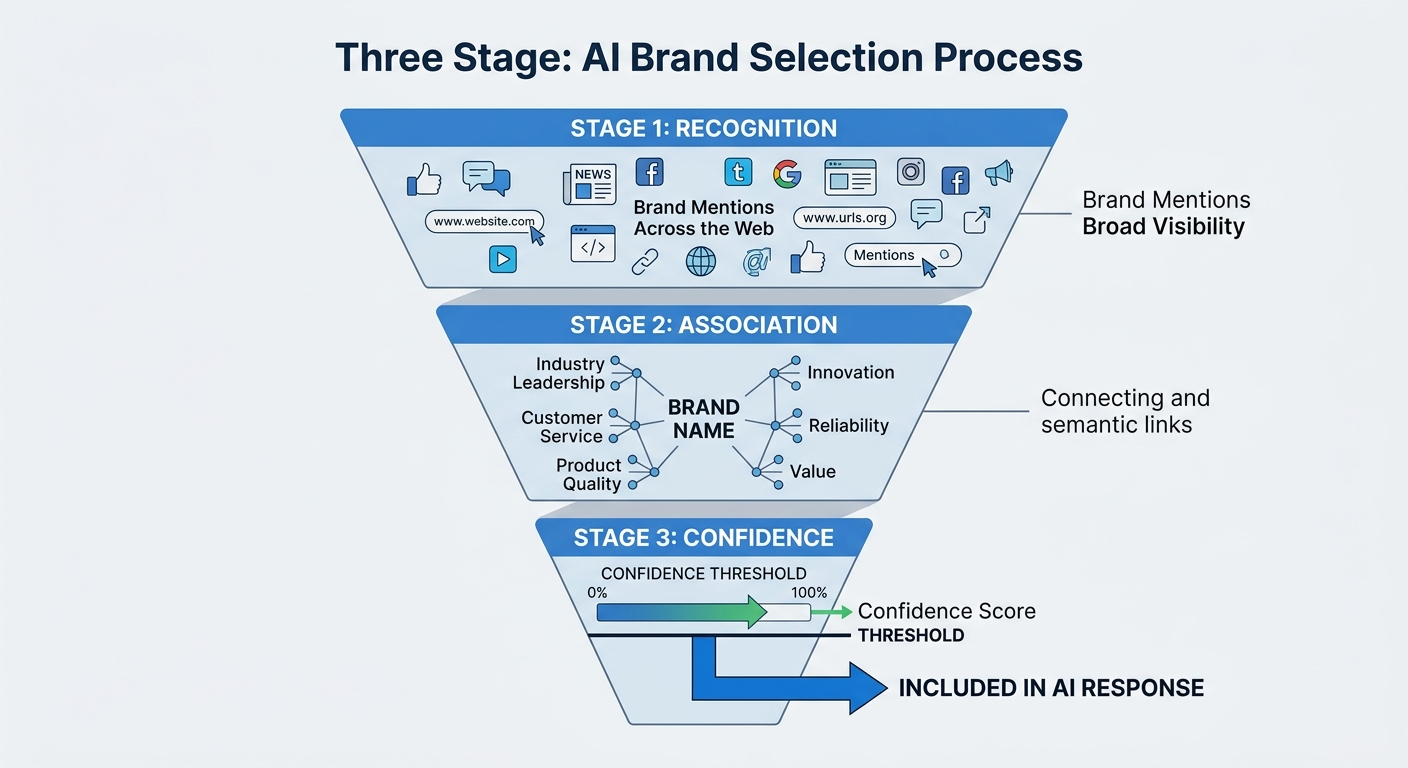
For your brand to appear in an AI-generated answer, the model needs three things:
- Recognition: The model must know your brand exists and understand what it does
- Association: The model must connect your brand to the specific topic or category the user is asking about
- Confidence: The model must have enough consistent, positive signals to feel confident recommending you
Brand mentions on third-party websites feed all three requirements. When your brand appears repeatedly across independent sources — blogs, comparison articles, news outlets, YouTube transcripts, forums — AI models build stronger associations between your brand name and the topics those sources discuss.
This is fundamentally different from how Google’s traditional algorithm works. Google historically relied heavily on the link graph — counting and evaluating hyperlinks between pages. AI models still consider links, but they place far more weight on the broader pattern of brand mentions across the web, regardless of whether those mentions include a hyperlink.
What Does the Data Actually Show About Brand Mentions and AI Visibility?
Two major research studies published in 2025 provide the most comprehensive data on how brand mentions correlate with AI visibility. Both point to the same conclusion: brand mentions are the single strongest off-page signal for AI search discoverability.
The Ahrefs 75,000-Brand Study
In late 2025, Ahrefs analyzed 75,000 brands across ChatGPT, Google AI Mode, and Google AI Overviews using their Brand Radar tool. The findings were clear:
- Branded web mentions correlated with AI visibility at 0.664–0.709 (strong positive correlation)
- YouTube mentions showed the highest overall correlation at approximately 0.737
- Branded anchors (hyperlinked brand name mentions) correlated at 0.511–0.628
- Branded search volume correlated at 0.352–0.466
- Domain rating showed a weaker correlation at roughly 0.266–0.340
- Number of backlinks and number of site pages showed minimal correlation
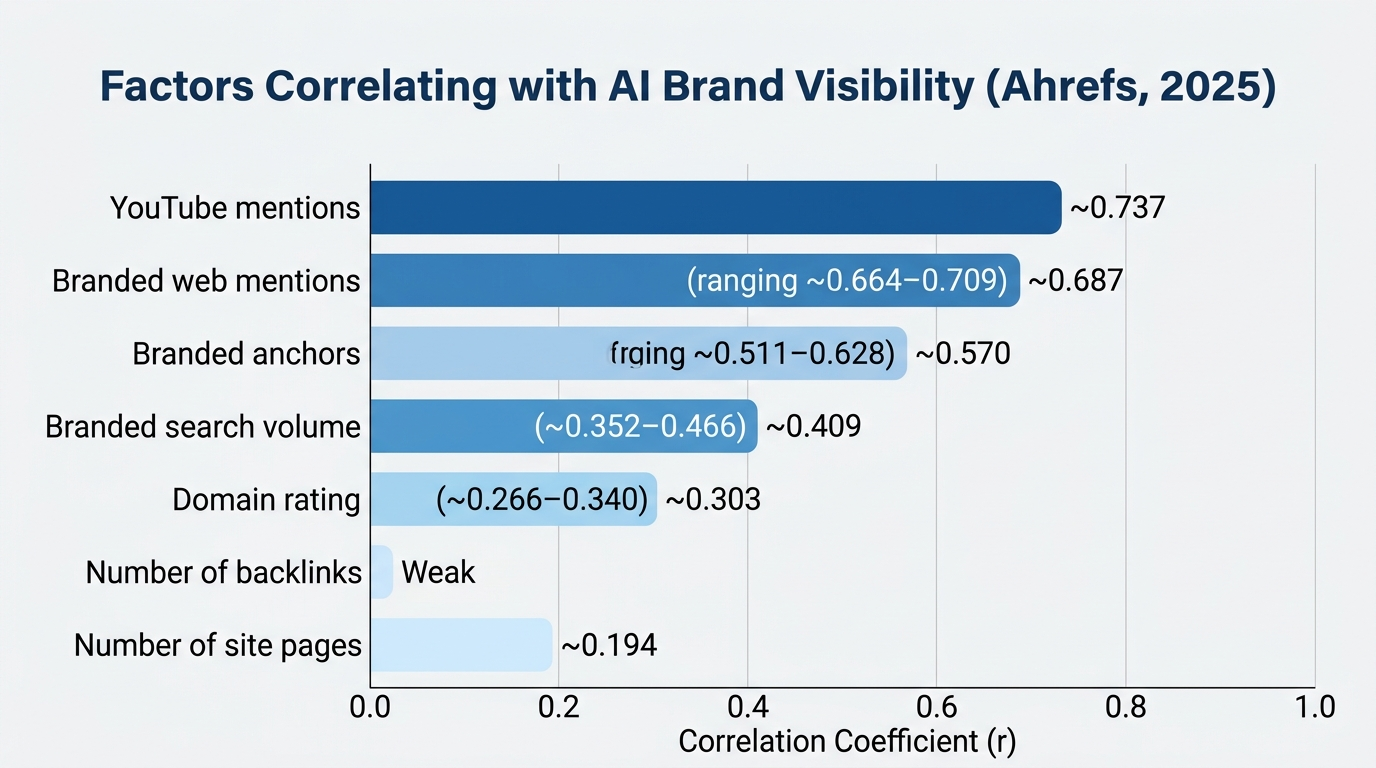
The most striking finding: the volume of content on your website has almost no relationship with AI visibility. A correlation of approximately 0.194 for “number of site pages” means that publishing more content for content’s sake does not improve your chances of being cited by AI.
What does improve your chances is being mentioned — by name — across a wide range of independent, credible websites.
The BrightEdge Cross-Platform Study
A separate 2025 study by BrightEdge analyzed tens of thousands of queries across Google AI Overviews, Google AI Mode, and ChatGPT. Their key findings add important nuance:
- Brand recommendations disagreed 61.9% of the time across the three platforms
- Only 33.5% of queries produced the same brand names across all three
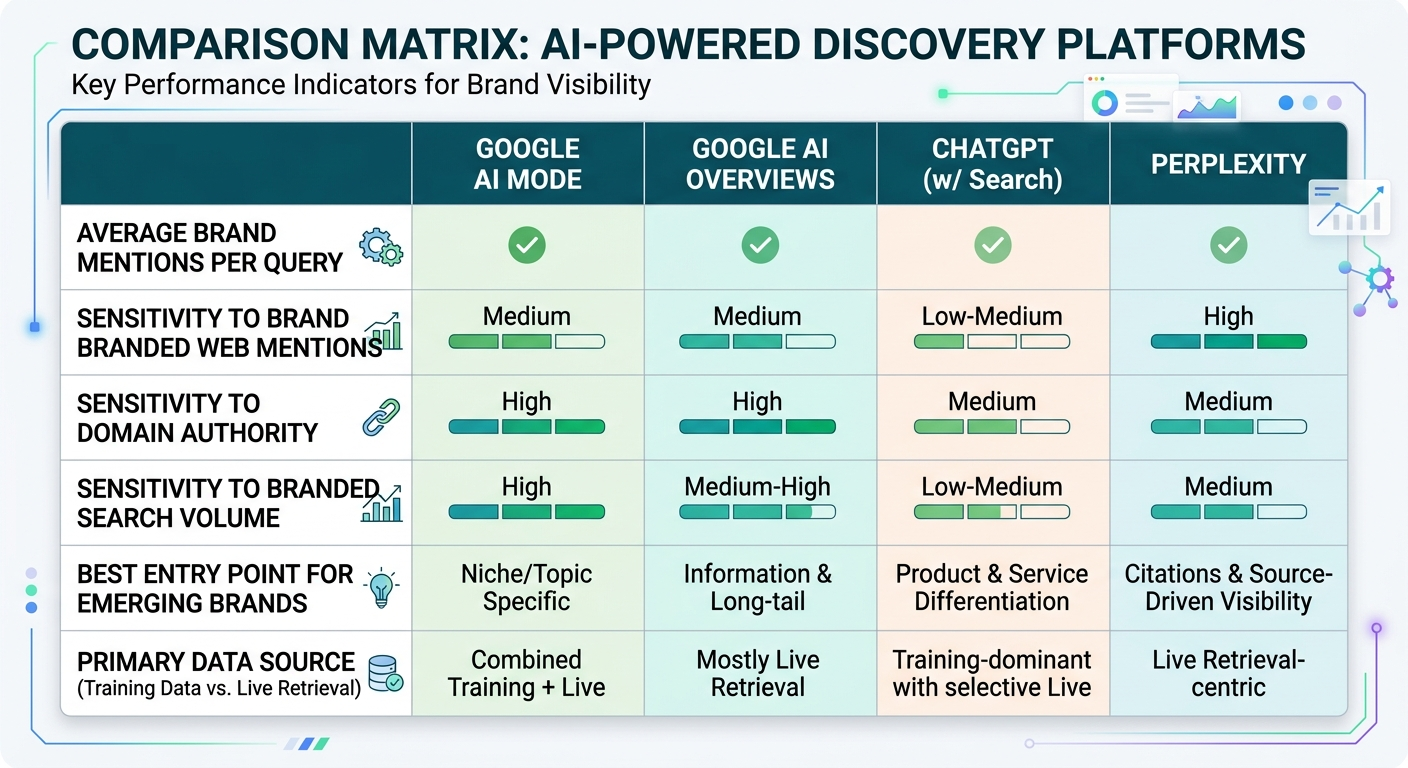
- Google AI Overviews averaged 6.02 brand mentions per query, while ChatGPT averaged only 2.37
- Commercial intent keywords (“buy,” “where,” “deals”) triggered brand mentions in 65% of cases
This means your brand might appear in Google AI Overviews but be completely absent from ChatGPT for the same query — or vice versa. Each platform has distinct preferences for which brands it surfaces and how many it includes.
How Each AI Platform Weighs Brand Mentions Differently
Not all AI search engines treat brand signals the same way. Understanding platform-specific behavior helps you prioritize where to focus your efforts.
Google AI Mode
Google AI Mode shows the strongest correlations with traditional brand authority signals. According to the Ahrefs data, AI Mode correlates most heavily with:
- Branded web mentions: 0.709
- Branded anchors: 0.628
- Branded search volume: 0.466
AI Mode acts as what researchers describe as a “consensus engine.” It favors brands that most people already know and search for. For emerging brands without established recognition, AI Mode is the hardest platform to break into.
Google AI Overviews
AI Overviews generate the highest number of brand mentions per query (6.02 on average), giving smaller brands more opportunities to appear. AI Overviews also show a slightly stronger preference for domain rating compared to the other platforms, likely because Overviews deliver single-shot informational answers and rely more heavily on established source credibility.
ChatGPT
ChatGPT shows the weakest correlations with classic SEO authority metrics like branded search volume (0.352), domain rating (0.266), and number of backlinks. This makes ChatGPT potentially the most accessible entry point for brands that haven’t yet reached household-name status.
However, ChatGPT tends to favor trusted brands from its training data. Because its model was trained on a large-scale web snapshot — including, as The New York Times reported, over a million hours of YouTube transcriptions — brands with broad, consistent mention histories have a structural advantage.
Perplexity
Perplexity operates differently from the other platforms because it performs live web searches for most queries, citing specific URLs in its responses. This means Perplexity’s brand citation behavior is more dynamic and responsive to recent content than ChatGPT’s training-data-dependent model. Brands with strong editorial mentions in Perplexity’s frequently cited sources tend to appear more consistently.
Why Mentions Without Links Still Matter for AI Visibility
In traditional SEO, an unlinked brand mention was considered a weak signal — nice to have, but far less valuable than a proper backlink. In AI search, the equation has shifted.
AI models read text, not link graphs. When a large language model processes web content during training or live retrieval, it parses the words on the page. It identifies entities — brand names, product names, categories — and builds associations based on context. Whether that brand name is wrapped in an anchor tag with a hyperlink is secondary to the fact that it appears in a relevant, authoritative context.
This is why the Ahrefs research found that branded web mentions (which include both linked and unlinked references) correlate more strongly with AI visibility than branded anchors (which only count hyperlinked references). The broader measure consistently outperforms the narrower one.
“A big part of how LLMs understand what your brand is about and when it should recommend it and the context it should talk about you is based on where you appear in its training data and where you appear on the web.” — Ryan Law, Director of Content Marketing, Ahrefs (2025)
This doesn’t mean links are irrelevant. Linked mentions still carry value — they contribute to domain authority, drive referral traffic, and serve as a stronger endorsement signal. But for AI visibility specifically, the mention itself is the primary unit of value. If you’re building a strategy to identify and leverage unlinked brand mentions, you’re working on one of the highest-impact levers for AI discoverability.
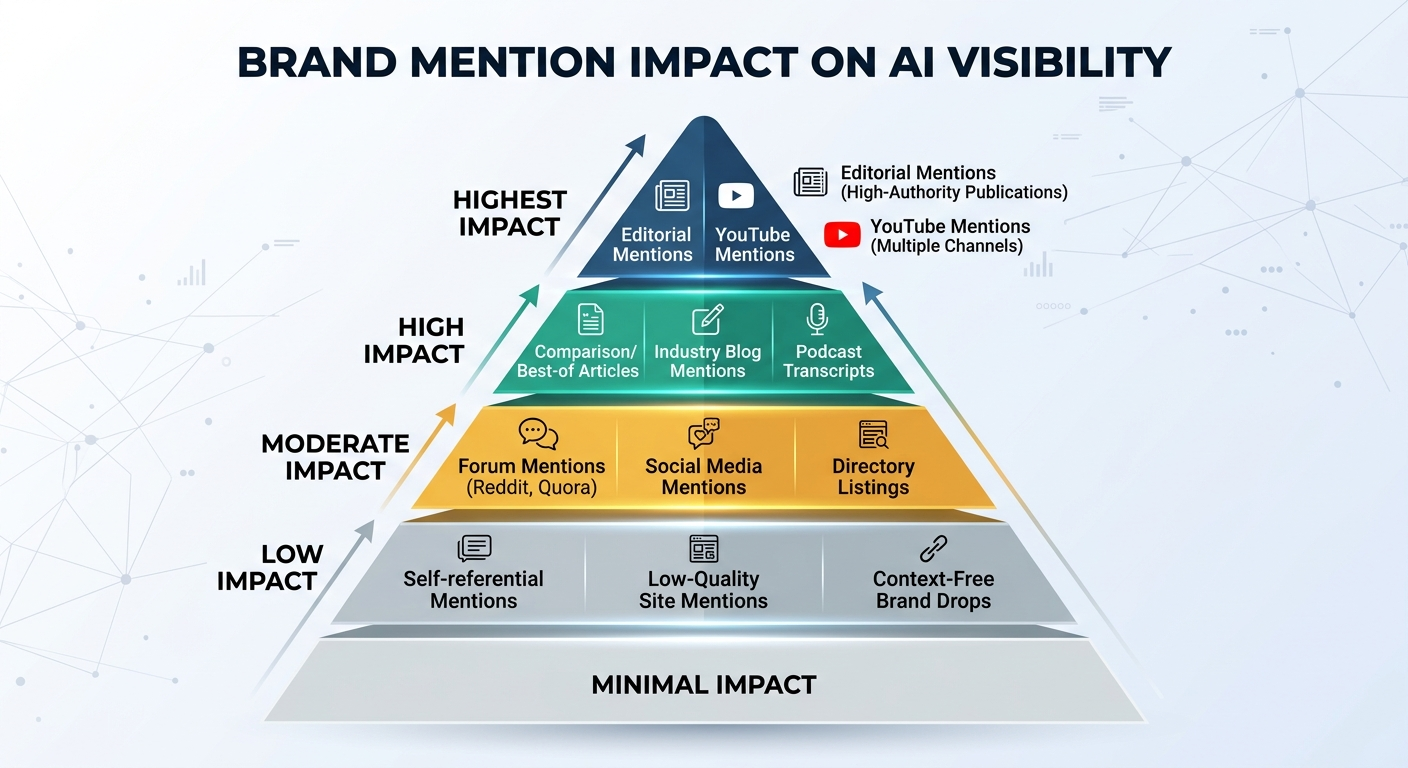
What Types of Brand Mentions Carry the Most Weight?
Not all mentions contribute equally to AI visibility. The context, source authority, and consistency of your mentions determine how strongly AI associates your brand with a given topic.
Editorial Mentions on High-Authority Publications
Mentions in trusted editorial content — industry publications, major news outlets, respected niche blogs — carry the most weight. These are the sources AI models cite most frequently in their responses. When your brand appears in a well-researched comparison article on a publication that AI already trusts, it strengthens both recognition and confidence signals simultaneously.
Agencies like BrandMentions build visibility by placing contextual brand mentions across 140+ high-authority publications that AI models actively reference during training and live retrieval.
YouTube Video Mentions
The Ahrefs study revealed that YouTube mentions show the strongest overall correlation with AI visibility — approximately 0.737 across all platforms. This applies to mentions in video titles, descriptions, and auto-generated transcripts.
Both Google and OpenAI have trained their models on YouTube transcript data. Because transcripts convert spoken content into text that AI can process, even a passing mention of your brand in a relevant video registers as a visibility signal. The volume of YouTube mentions (how many different videos mention you) matters slightly more than the reach (total views of those videos), suggesting that breadth of mention is more important than being featured in a single viral video.
Comparison and “Best Of” Content
Queries like “best project management tool” or “top CRM for startups” are among the most common triggers for AI-generated brand recommendations. The BrightEdge study found that comparison queries generated brand mentions 43% of the time. If your brand consistently appears in “best of” lists, comparison guides, and alternative roundups across multiple independent sources, AI learns that you belong in those conversations.
Forum and Community Mentions
Reddit, Quora, and industry forums are frequently cited by AI models. While individual forum mentions carry less authority than editorial placements, they contribute to what Ahrefs’ Ryan Law describes as the broader web presence that AI uses to validate brand relevance. Authentic community discussions where users organically mention and recommend your brand create a layer of social proof that AI platforms factor into their responses.
Mentions That Don’t Help
Some types of mentions provide little to no AI visibility benefit:
- Self-referential mentions on your own website — AI needs external validation
- Mentions on low-quality or irrelevant sites — context and source credibility matter
- Generic, context-free mentions — a brand name dropped without any descriptive context gives AI nothing useful to extract
- Inconsistent brand descriptions — if different sources describe your brand in contradictory ways, AI has lower confidence in including you
Why Context and Consistency Matter More Than Volume
A common mistake is pursuing brand mentions purely by volume — getting your name on as many pages as possible without considering what those pages say about you. AI models are more sophisticated than that.
When AI encounters your brand across multiple sources, it builds an understanding based on the surrounding context. If your brand is repeatedly mentioned alongside “enterprise project management,” “workflow automation,” and “team collaboration,” AI learns to associate you with those concepts. When a user asks “What’s the best enterprise project management tool?”, your brand has a strong contextual match.
But if your brand appears in wildly different contexts — one source calls you a “marketing platform,” another describes you as a “data analytics tool,” and a third lists you under “HR software” — AI can’t confidently categorize you. This ambiguity reduces the likelihood of inclusion in any specific answer.
Consistency across sources is a compounding advantage. In campaigns across 67+ B2B companies, the BrandMentions team found that brands with consistent editorial mentions — where the brand description, category positioning, and use cases aligned across sources — achieved AI recommendation rates 89% higher than brands with scattered, inconsistent mention profiles.
This is why a strategic approach to brand mentions matters more than a high-volume one. Ten mentions across ten credible sources, all reinforcing the same brand-topic association, outperform a hundred mentions scattered across irrelevant contexts.
How Brand Mentions Create a Compounding Visibility Effect
Brand mentions don’t operate as isolated signals. They create a reinforcing cycle that compounds over time.
Here’s how the cycle works:
- External mentions build entity recognition. AI models begin to identify your brand as a real entity within a specific category.
- Entity recognition increases citation likelihood. Once AI recognizes your brand, it’s more likely to include you in relevant responses.
- AI citations increase branded search volume. Users who see your brand in AI responses search for you by name.
- Higher branded search volume strengthens AI confidence. AI interprets growing branded searches as validation that your brand is relevant and trusted.
- Stronger AI confidence leads to more frequent citations. The cycle repeats with increasing momentum.
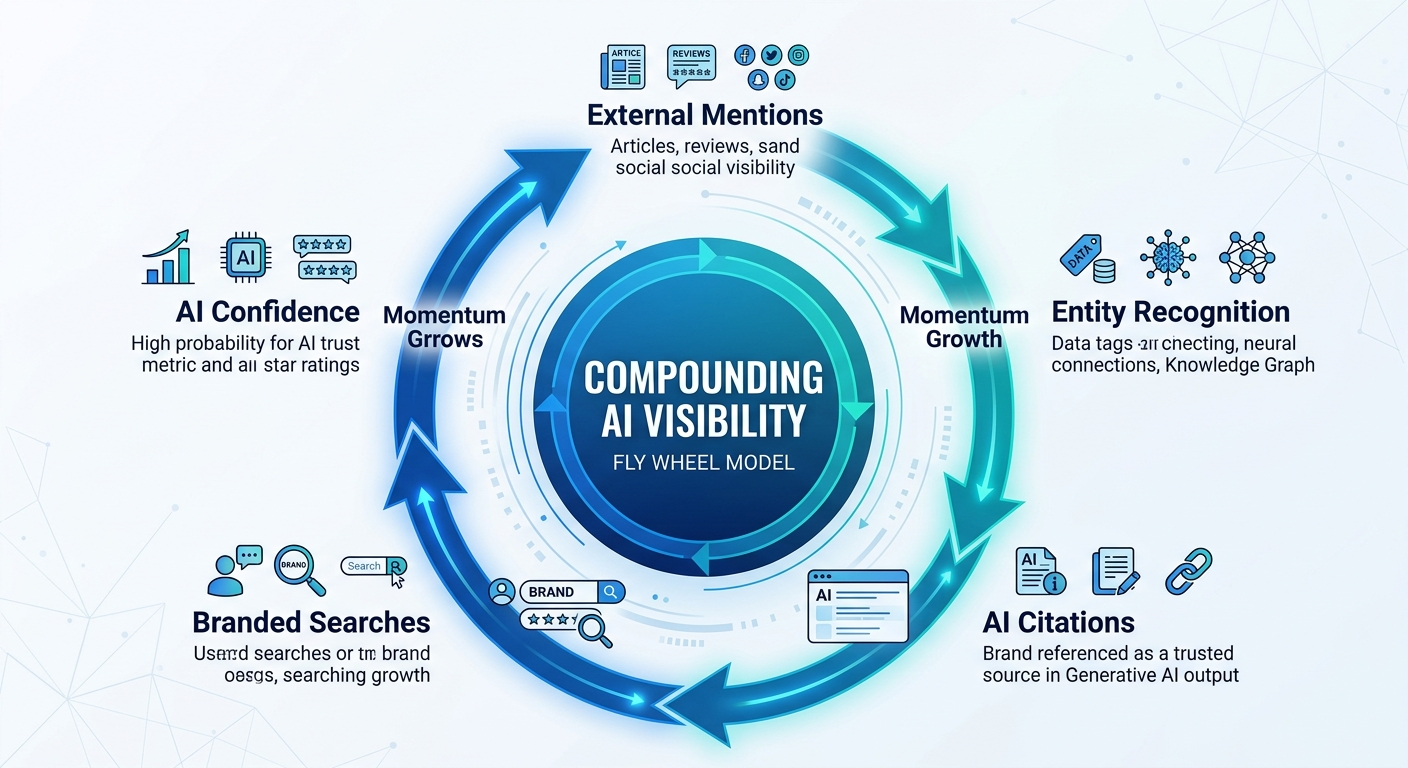
BrightEdge describes this as a “citation network effect” — earning visibility on one AI platform can reinforce mentions on others. A brand that ChatGPT starts recommending may also begin appearing more frequently in Google AI Overviews and Perplexity, because the same underlying web signals feed all of them.
This compounding dynamic is why early investment in brand mentions pays disproportionate returns. Brands that build strong mention profiles now create structural advantages that become increasingly difficult for competitors to overcome.
How to Build Brand Mentions That Actually Improve AI Visibility
Knowing that brand mentions drive AI visibility is one thing. Building them strategically is another. Here’s a practical approach focused on actions that produce measurable results.
Step 1: Audit Your Current AI Visibility
Before building new mentions, understand where you stand. Test your brand with queries your customers actually use:
- “Best [your category]”
- “[Your category] alternatives”
- “[Competitor] vs [your brand]”
- “Is [your brand] worth it?”
Run these queries across ChatGPT, Google AI Mode, Perplexity, and Gemini. Note whether your brand appears, how it’s described, and which competitors are mentioned instead. Tools like AI mention tracking platforms can automate this process across multiple queries and platforms.
Step 2: Identify Where AI Sources Its Answers
Look at the sources AI platforms cite in their responses for your target queries. Perplexity makes this easy by displaying URLs directly. For ChatGPT and Google AI Mode, note which publications and pages are referenced.
These cited sources are the exact places where your brand needs to appear. Getting mentioned on a page that AI already trusts for a given topic is far more efficient than getting mentioned on a random high-authority site that AI never references for your category.
Step 3: Prioritize Contextual, Topically Aligned Placements
Focus your mention-building efforts on placements where your brand appears in the right context:
- Industry-specific publications that cover your category regularly
- Comparison and roundup articles where your competitors already appear
- YouTube channels that review or discuss products in your space
- High-authority blogs that AI platforms frequently cite for your target topics
When pursuing these placements, ensure your brand is described consistently. Provide clear positioning language — what you do, who you serve, what differentiates you — so that every new mention reinforces the same brand-topic association.
Step 4: Build Mention Diversity Across Source Types
AI models look for brand signals across different types of sources. A healthy mention profile includes:
- Editorial coverage on authoritative publications
- Inclusion in comparison and “best of” content
- YouTube video mentions across multiple channels
- Authentic community discussions on Reddit, Quora, and industry forums
- Expert quotes and contributed insights in relevant articles
This diversity signals to AI that your brand is genuinely part of the broader conversation — not just appearing through a single channel.
Step 5: Track Progress and Iterate
AI visibility changes gradually. BrandMentions tracks when major AI models update their training data and times placements to maximize inclusion in each knowledge refresh cycle. But even with optimal timing, changes in AI citation behavior typically take weeks to months to manifest.
Monitor your AI visibility regularly using a combination of brand mention monitoring tools and direct query testing. Look for:
- Whether your brand starts appearing in responses where it was previously absent
- Changes in how your brand is described (sentiment and framing)
- Growth in branded search volume (a downstream indicator of increased AI visibility)
- Shifts in which competitors appear alongside you
What Brand Mentions Don’t Do (and Common Misconceptions)
As brand mentions become a central topic in AI visibility strategy, several misconceptions have emerged that can lead to wasted effort.
Mentions Don’t Replace Quality Content
Brand mentions improve AI’s recognition and confidence in your brand. They don’t compensate for weak on-site content. If AI sends a user to your website and the content doesn’t deliver value, neither the user nor the AI model benefits. Your website still needs comprehensive, well-structured content that demonstrates genuine expertise.
Volume Alone Doesn’t Move the Needle
The Ahrefs data showed almost no correlation between content volume (number of site pages) and AI visibility. The same principle applies to mention volume. A hundred low-quality mentions on irrelevant sites won’t outperform twenty strategically placed mentions on publications that AI models actually reference.
Mentions Don’t Guarantee Immediate Results
AI models update their training data on irregular schedules, often months apart. ChatGPT’s knowledge has a lag between web publication and model incorporation. Even platforms that perform live retrieval (like Perplexity) take time to recrawl and re-evaluate sources. Building AI visibility through brand mentions is a long-term strategy — not a switch you flip.
Mentions Can’t Override Negative Signals
If your brand has significant negative coverage — poor reviews, unresolved PR issues, or customer complaints dominating community discussions — positive brand mentions alone won’t override those signals. AI models weigh sentiment, and negative patterns can suppress positive recommendations. Address reputation issues directly before expecting mention-building to produce results.
Pro Insight: As of 2026, AI models are becoming more sophisticated at detecting coordinated or artificial mention patterns. Mentions that appear natural — genuine editorial coverage, authentic community discussions, organic expert citations — carry more weight than patterns that look manufactured. Prioritize earning real mentions over placing artificial ones.
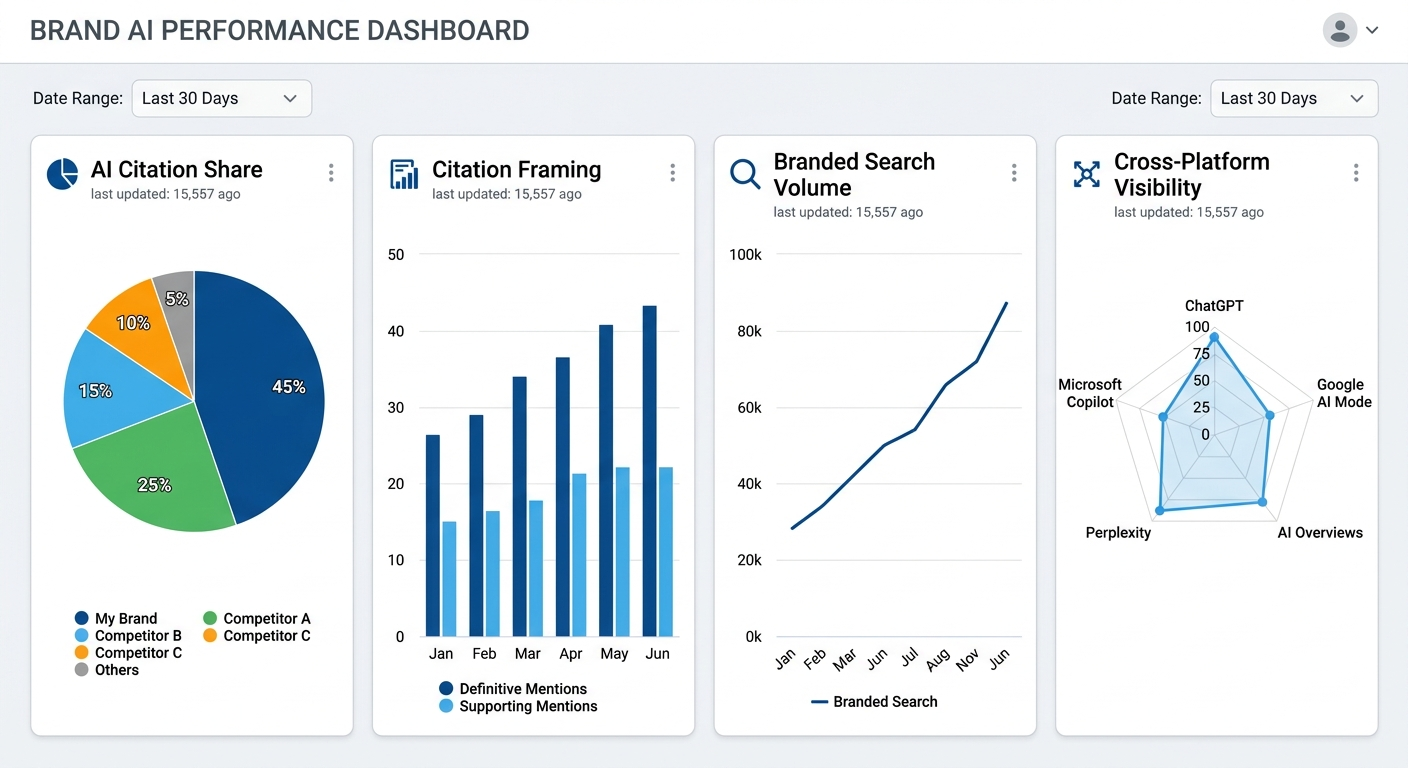
How to Measure Whether Brand Mentions Are Improving Your AI Visibility
Measuring AI visibility requires different metrics than traditional SEO. You can’t rely on rankings or click-through rates when AI provides answers directly in the response.
AI Citation Share
Track how often your brand appears in AI responses compared to competitors for your target queries. This is the AI equivalent of share of voice. Tools like Semrush’s AI SEO toolkit and Ahrefs Brand Radar can track this across platforms over time.
Citation Framing
Not all mentions are equal in how they position your brand. There’s a meaningful difference between being cited as a definitive source (“According to [Brand]’s research…”) and being listed as a supporting mention (“Other options include [Brand]…”). Track whether your mentions are becoming more authoritative over time.
Branded Search Volume Trends
Rising branded search volume is a strong downstream indicator that AI visibility is working. When more people search for your brand by name, it signals that they encountered it somewhere — increasingly, in AI-generated responses.
Cross-Platform Visibility Tracking
Since AI platforms disagree on brand recommendations 61.9% of the time (per BrightEdge’s data), tracking visibility across multiple platforms is essential. A brand might gain traction in ChatGPT while remaining invisible in Google AI Mode. Cross-platform monitoring reveals where your efforts are working and where gaps remain.
What Has Changed Since 2024–2025 — And What to Expect in 2026
AI search is evolving rapidly. Several important shifts since 2024 have made brand mentions even more critical:
- AI search adoption has accelerated. According to a 2025 McKinsey AI Discovery Survey, 44% of web users now prefer AI-generated search summaries over traditional results. As of 2026, that percentage continues to climb as AI Mode, ChatGPT search, and Perplexity gain mainstream adoption.
- Zero-click behavior is expanding. A 2024 Bain and Dynata survey found that 80% of users rely on AI summaries at least 40% of the time, leading to estimated organic traffic reductions of 15–25%. In 2026, this trend has intensified as AI answers become more comprehensive.
- YouTube mentions emerged as the top correlation signal. The Ahrefs study, expanded in late 2025, revealed that YouTube mentions outperform even branded web mentions — a finding that has reshaped how forward-thinking brands approach AI visibility.
- AI platforms are differentiating further. Google AI Mode has become more selective and authority-weighted, while ChatGPT has expanded its live web search capabilities, making it more responsive to recent content. Each platform now requires increasingly platform-aware strategies.
- Brand mention quality standards are rising. As more companies pursue mention-building, AI models have become better at distinguishing organic editorial coverage from coordinated placement campaigns. Authentic, contextually rich mentions carry increasing premiums.
Looking ahead through 2026, the brands investing in strategic, high-quality brand mentions now are building moats that will be increasingly expensive for competitors to replicate later. AI visibility compounds — and the compounding has already started.
Frequently Asked Questions
Do brand mentions without links help with AI search visibility?
Yes. AI models process text, not link graphs. Unlinked brand mentions contribute to entity recognition and topic association in AI training data and live retrieval. The Ahrefs 2025 study confirmed that branded web mentions (including unlinked ones) show stronger correlation with AI visibility than branded anchors (linked mentions only).
Which AI platform is easiest for new brands to gain visibility on?
Based on the Ahrefs correlation data, ChatGPT shows the weakest relationship with traditional brand authority metrics like domain rating and branded search volume. This makes it potentially the most accessible platform for emerging brands. Google AI Mode, which heavily favors established brands, is the hardest to break into.
How long does it take for brand mentions to impact AI visibility?
Timelines vary by platform. Perplexity performs live web searches and can reflect new mentions within days to weeks. ChatGPT updates its training data on an irregular schedule, often months apart. Google AI Overviews and AI Mode fall somewhere in between. Building a consistent mention profile over three to six months is a realistic timeframe for measurable impact.
Are brand mentions more important than backlinks for AI search?
For AI visibility specifically, yes. The Ahrefs study found that branded web mentions correlate at 0.664–0.709 with AI visibility, while traditional backlink metrics show much weaker correlations. Backlinks still matter for traditional Google rankings and overall domain authority, but brand mentions are the primary driver for AI citation behavior.
Can negative brand mentions hurt AI visibility?
They can. AI models assess sentiment when deciding whether to recommend a brand. If negative coverage — poor reviews, complaints, or controversies — dominates your mention profile, AI may suppress your brand from positive recommendation contexts. Addressing reputation issues is a prerequisite for effective mention-building.
Do I need to be mentioned on specific websites for AI to cite my brand?
It helps significantly to appear on the specific sources that AI platforms already reference for your target queries. Perplexity shows its cited URLs directly. For other platforms, analyzing AI responses for your category reveals which publications and pages are most frequently cited — those are your priority targets for mention placement.
Building AI Visibility That Lasts
Brand mentions are not a new SEO tactic dressed up with AI terminology. They represent a fundamental shift in how search visibility is built and maintained. In 2026, the data is clear: brands that are mentioned frequently, consistently, and in the right contexts across the web are the ones AI models choose to recommend.
The path forward involves three priorities:
- Audit your current AI mention profile. Know where you appear, where you’re missing, and how you’re described across platforms.
- Build strategic, contextually aligned mentions. Focus on the sources AI already trusts for your category, and ensure every mention reinforces a consistent brand identity.
- Measure AI-specific metrics. Citation share, citation framing, cross-platform visibility, and branded search volume tell you whether your mention-building is producing results.
The brands that build this foundation now will compound their advantage as AI search adoption continues to grow. Those that wait will face an increasingly steep climb to catch up.
Want to see where your brand stands in AI search today? Get a free AI visibility audit and find out exactly which AI platforms mention your brand — and which ones mention your competitors instead.