Brand sentiment analysis is the process of measuring how people feel about your brand — positive, negative, or neutral — across every channel where opinions form, from social media and reviews to AI-generated search results. As of 2026, this process has expanded well beyond traditional social listening. AI search engines like ChatGPT, Perplexity, and Gemini now synthesize public sentiment into the answers they serve to millions of users daily, making how your brand is described by AI just as important as what customers post on X or Reddit.
This article breaks down how brand sentiment analysis works in practice, what’s changed since AI search reshaped the discipline, and how to build a measurement system that gives your team actionable data — not vanity scores.
Key Takeaways
- Brand sentiment analysis now spans traditional channels and AI-generated responses — ignoring either creates blind spots.
- The emotional tone AI platforms use to describe your brand directly shapes buyer perception before they ever visit your website.
- Automated NLP tools handle volume; human review handles nuance. You need both.
- Sentiment scores without root-cause context are nearly useless for decision-making.
- Tracking competitor sentiment reveals positioning gaps you can act on immediately.
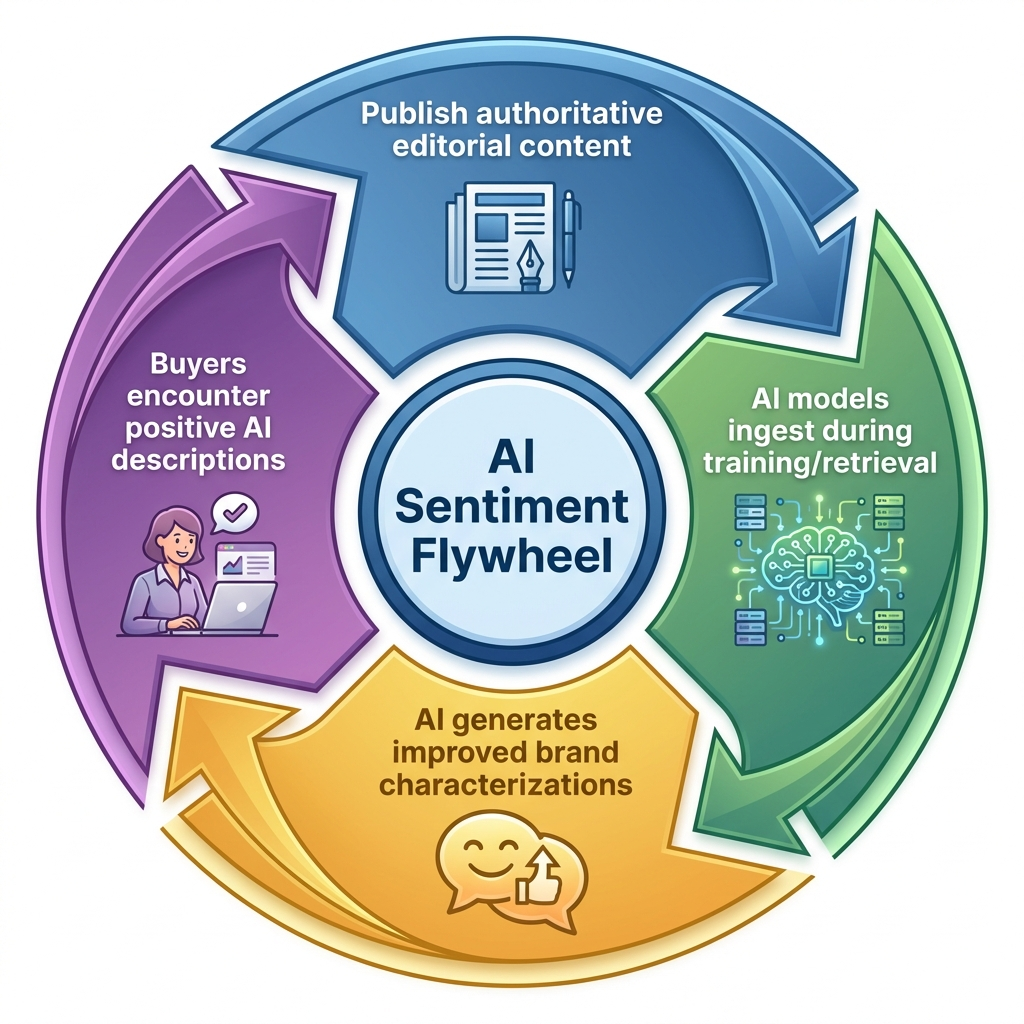
- Consistent editorial mentions on high-authority publications influence how AI models characterize your brand over time.
What Brand Sentiment Analysis Actually Measures
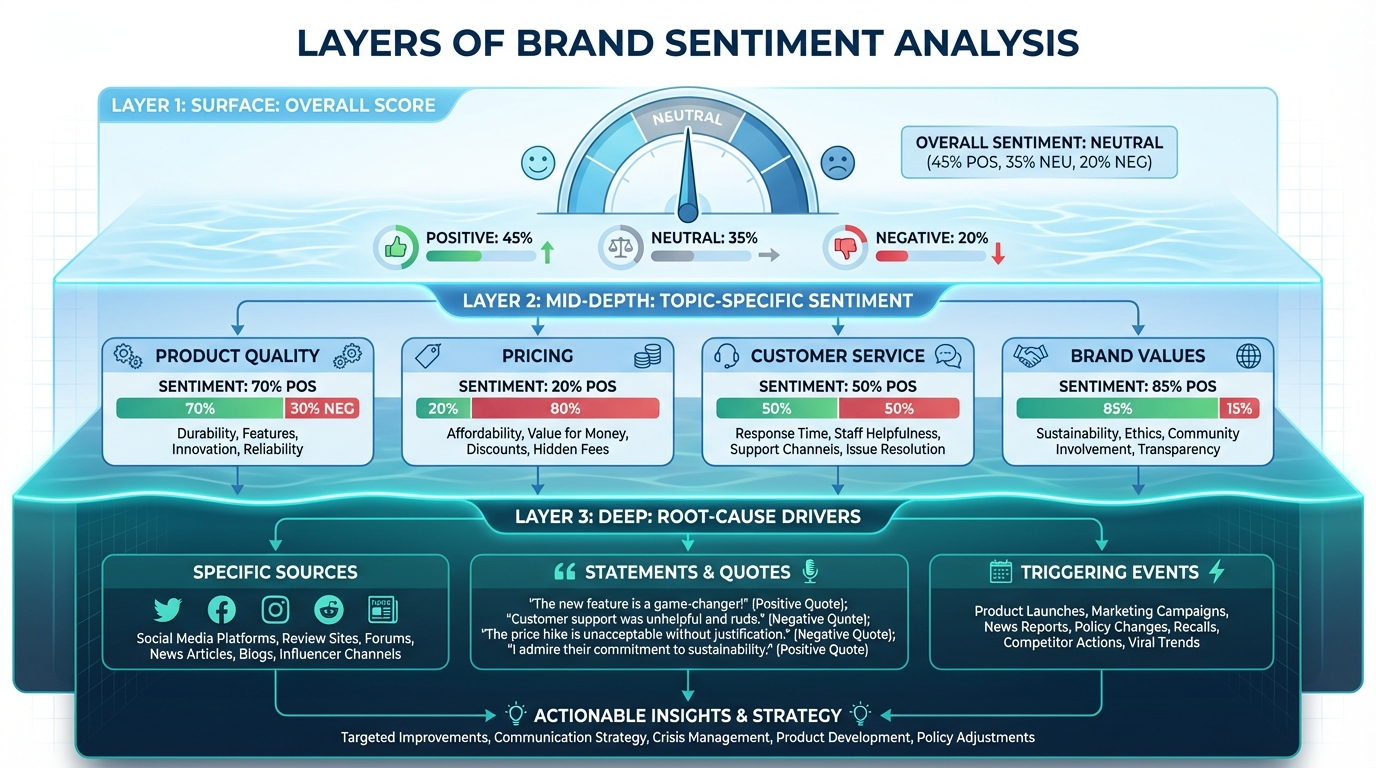
Brand sentiment analysis classifies opinions about your brand into emotional categories — typically positive, negative, or neutral. It uses Natural Language Processing (NLP) to interpret the tone, context, and emphasis behind written or spoken language at scale.
But a simple positive/negative score is only the starting point. Effective sentiment analysis also identifies:
- Topic-specific sentiment — customers might love your product quality but resent your pricing
- Sentiment velocity — how fast opinions shift after a product launch, PR event, or campaign
- Source-weighted sentiment — whether negative mentions come from a handful of vocal users or a broad customer base
- Competitive sentiment gaps — how your brand’s emotional profile compares to direct competitors
The goal is not a single number. It’s a multi-dimensional view of how your audience perceives your brand — and why that perception exists.
Why Sentiment Analysis Matters More in 2026 Than Ever Before
Two forces have converged to make brand sentiment analysis a strategic priority rather than a nice-to-have metric.
AI Search Now Synthesizes Your Sentiment for Buyers
When a B2B buyer asks ChatGPT or Perplexity “What do people think about [your brand]?”, the AI doesn’t link to a review page. It generates a summary — drawing from training data that includes editorial content, reviews, social posts, and forum discussions. That synthesized answer becomes the buyer’s first impression.
According to a 2025 Gartner forecast, traditional search traffic was projected to drop 25% by 2027 as AI-assisted search captured more of the discovery journey. As of 2026, that shift is well underway. If your brand sentiment across the web is negative or thin, AI models reflect that directly to prospects — often before they know your website exists.
This is why brand mentions impact visibility in AI search — and why the tone of those mentions determines whether AI recommendations work for or against you.
Customer Expectations Have Outpaced Traditional Feedback Loops
A 2024 Salesforce study found that 65% of customers expect companies to adapt to their evolving needs in real time. Quarterly surveys and annual brand trackers no longer keep pace. Brands that monitor sentiment continuously — across social, reviews, support interactions, and AI-generated outputs — identify problems weeks before they become crises.
How Brand Sentiment Analysis Works: A Practical Breakdown
Understanding the mechanics helps you choose the right approach. Here’s how modern sentiment analysis operates, step by step.
Step 1: Collect Data From Every Relevant Channel
Sentiment analysis is only as accurate as its inputs. Limiting data collection to one channel — say, social media — creates a distorted picture. Comprehensive collection includes:
- Social media platforms — X, LinkedIn, Reddit, TikTok, Facebook, Instagram
- Review sites — G2, Trustpilot, Google Reviews, Capterra, industry-specific platforms
- Customer service interactions — support tickets, live chat logs, call transcripts
- Survey responses — NPS, CSAT, and open-text feedback
- Forum discussions — Reddit threads, Quora answers, niche community boards
- AI-generated responses — what ChatGPT, Perplexity, Gemini, and Claude say about your brand when prompted
That last source is new as of the past two years, and most brands still overlook it. Checking what AI says about your brand is now a baseline requirement for any sentiment analysis program.
Step 2: Classify Sentiment With NLP and Machine Learning
Once data is collected, NLP algorithms classify each mention by emotional tone. Modern tools go beyond binary positive/negative labels to detect:
- Intensity — “I love this product” vs. “It’s fine, I guess”
- Emotion categories — frustration, excitement, trust, confusion, disappointment
- Aspect-level sentiment — sentiment tied to specific attributes (pricing, UX, onboarding, support)
- Sarcasm and irony detection — critical for social media accuracy
Automated classification handles volume. But human review remains essential for edge cases — sarcasm, cultural context, and industry-specific jargon that algorithms often misread.
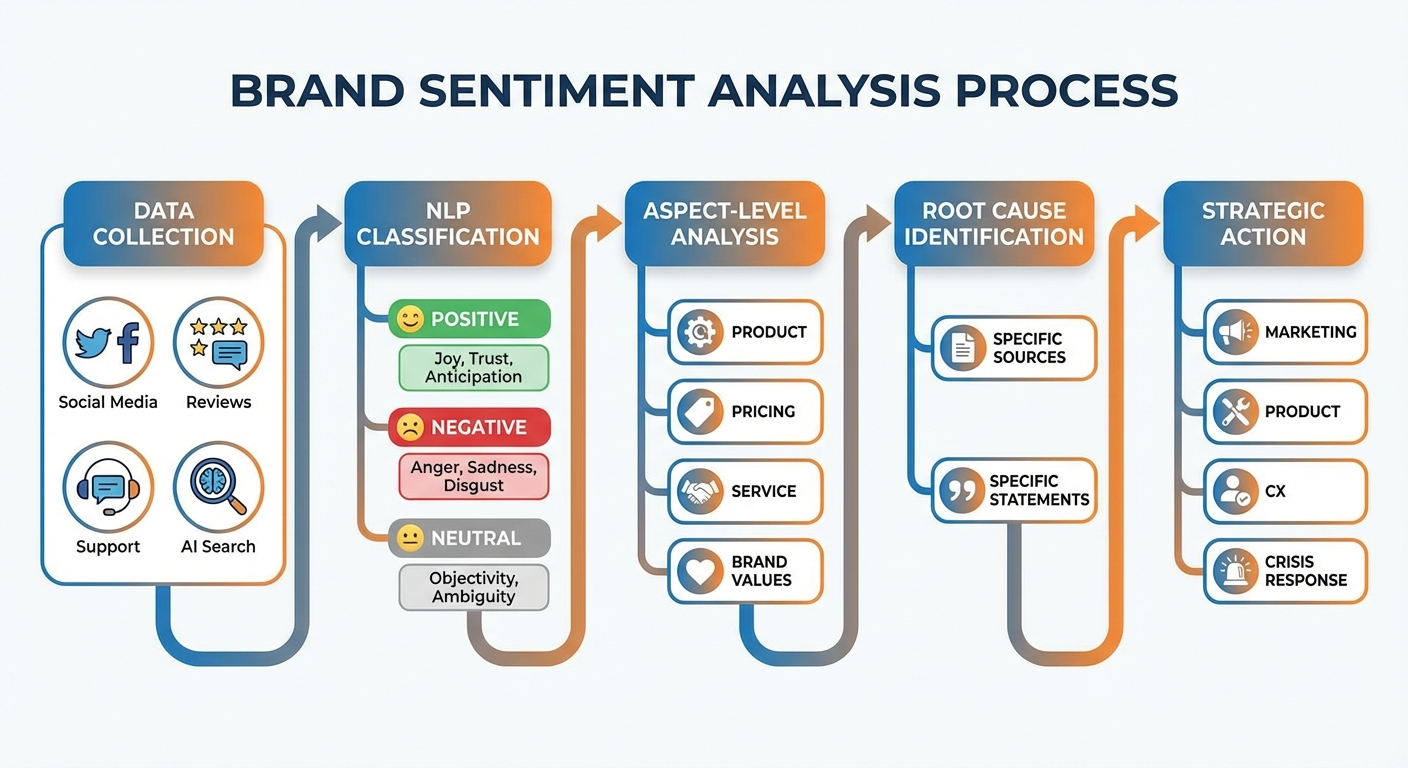
Step 3: Identify Root Causes, Not Just Scores
A sentiment score without context is noise. Effective analysis drills into why sentiment is trending in a particular direction:
- Which specific sources are driving negative mentions?
- What topics or product areas trigger the strongest emotional responses?
- Did a recent event, campaign, or competitor action cause the shift?
This root-cause layer is where sentiment analysis becomes actionable. Without it, you’re watching a dashboard flicker without understanding what to do next.
Step 4: Benchmark Against Competitors
Your sentiment score means more in context. A “72% positive” rating might sound strong — until you discover your top two competitors sit at 85% and 88%.
Competitive sentiment benchmarking reveals:
- Where competitors are perceived more favorably — and why
- Weaknesses in competitor perception you can position against
- Industry-wide sentiment shifts that affect all players (regulatory changes, market downturns)
Tools that monitor brand mentions across both traditional and AI channels make this comparison practical at scale.
Step 5: Feed Insights Into Strategic Decisions
Sentiment data should flow directly into marketing, product, CX, and leadership decisions. Practical applications include:
- Marketing: Adjust campaign messaging when sentiment around a specific value proposition weakens
- Product: Prioritize feature improvements that address the highest-volume negative sentiment topics
- Customer experience: Train support teams on the exact friction points generating dissatisfaction
- Crisis response: Set real-time alerts for sudden spikes in negative sentiment
Pro Insight: The brands that extract the most value from sentiment analysis are the ones that assign specific owners to act on each insight category. A dashboard nobody acts on is an expensive screensaver.
The AI Sentiment Layer: What’s Changed Since 2024
Before 2024, brand sentiment analysis was primarily about monitoring what humans wrote. In 2026, there’s a second dimension: what AI platforms generate about your brand based on their training data and retrieval systems.
AI Models Form Their Own “Opinion” of Your Brand
Large language models don’t have feelings. But they do produce responses with a detectable emotional tone — and that tone is shaped by the content they’ve been trained on. If most public content about your brand is critical, cautious, or thin, AI responses will reflect that.
This matters because AI-generated answers are rapidly becoming a primary research channel for B2B buyers. According to a 2025 report from the Allen Institute for AI, LLMs demonstrate measurable preferences for brands that appear consistently and positively across high-authority editorial sources in their training data.
Traditional Sentiment ≠ AI Sentiment
Your brand might have strong social media sentiment but weak AI sentiment. How? Because AI models draw from a different — often broader — content base than social listening tools monitor. Editorial articles, technical reviews, industry reports, and academic citations all shape how an LLM characterizes your brand.
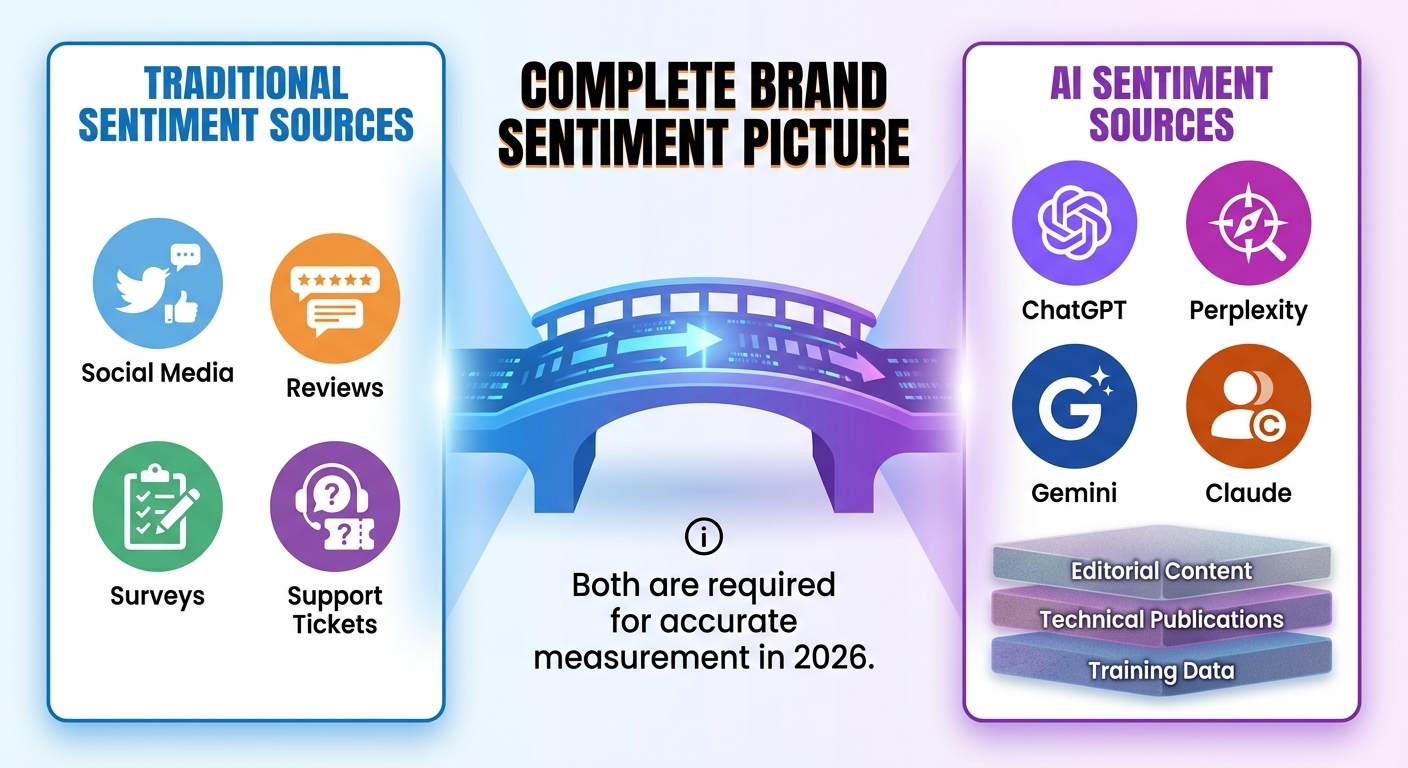
This means brands need to track sentiment in two parallel systems:
- Human-generated sentiment: social media, reviews, surveys, support interactions
- AI-generated sentiment: how ChatGPT, Perplexity, Gemini, and Claude describe your brand when prompted
If those two sentiment profiles diverge, you have a positioning problem that traditional monitoring will never catch. Tracking brand mentions across AI search platforms closes that gap.
Manual vs. Automated Sentiment Analysis: When to Use Each
The debate isn’t manual or automated — it’s knowing when each approach adds the most value.
| Factor | Manual Analysis | Automated Analysis |
|---|---|---|
| Speed | Hours to days per dataset | Real-time or near real-time |
| Scale | Hundreds of mentions | Millions of mentions across channels |
| Nuance detection | Strong — catches sarcasm, cultural context | Improving but still misses subtle tones |
| Consistency | Varies by analyst | Repeatable and standardized |
| Cost | High (labor-intensive) | Lower per-mention at enterprise scale |
| Best use case | High-stakes reviews, crisis triage, executive reporting | Ongoing monitoring, trend detection, competitive benchmarking |
For most B2B brands, automated tools handle 90%+ of the volume. Reserve manual analysis for validating automated findings, reviewing sentiment during active crises, and interpreting complex qualitative feedback.
How to Influence Brand Sentiment in AI Search
Monitoring sentiment is necessary. Influencing it is where the strategic value lives. Here’s what actually moves the needle on how AI platforms characterize your brand.
Build a Consistent Editorial Footprint
AI models learn brand-category associations from their training data. When your brand appears consistently on high-authority publications — with positive, factual, contextually relevant mentions — those associations strengthen over time.
This isn’t about a single press hit. It’s about sustained presence across publications that AI models weight heavily during training and retrieval. Agencies like BrandMentions approach this by placing contextual brand mentions on 140+ high-authority publications that AI models actively learn from, timing placements to align with model training refresh cycles.
Address Negative Content at Its Source
If sentiment analysis reveals a specific publication or forum consistently generating negative characterizations, address it directly:
- Correct factual inaccuracies with evidence
- Respond to legitimate criticism with transparent improvements
- Create stronger positive content that outweighs the negative signal over time
AI models don’t weigh all sources equally. A negative review on a low-authority site has far less impact than a critical article on a high-authority industry publication. Prioritize accordingly.
Strengthen Entity Signals for Your Brand
AI search engines rely on entity recognition — the ability to identify your brand as a distinct entity associated with specific categories, products, and attributes. Weak entity signals lead to vague or inaccurate AI-generated descriptions.
To strengthen entity associations:
- Use consistent brand naming across all public content
- Associate your brand with specific product categories and expertise areas in editorial content
- Ensure structured data on your website clearly defines your brand entity
For a deeper look at how these signals work, see how brand mentions work in the context of AI visibility.
Common Brand Sentiment Analysis Mistakes to Avoid
Even well-resourced teams make these errors. Recognizing them early saves months of misdirected effort.
Treating All Channels as Equal
A negative Reddit thread with 12 upvotes and a critical Forbes article carry vastly different weight — both for human buyers and AI models. Weight your sentiment analysis by source authority, reach, and relevance to your buyer persona.
Ignoring Neutral Sentiment
Neutral mentions aren’t harmless. In competitive markets, neutral means forgettable. If your brand generates mostly neutral sentiment while competitors inspire strong positive emotions, you lose the consideration battle. Neutral sentiment often signals an opportunity to strengthen differentiation.
Measuring Sentiment Without Acting on It
The most sophisticated sentiment dashboard is worthless if insights don’t reach the people who can act on them. Every sentiment insight should have an owner, a timeframe, and a clear action path.
Overlooking AI-Generated Sentiment Entirely
As of 2026, most brand sentiment analysis programs still focus exclusively on human-generated content. This creates an increasingly dangerous blind spot. Checking brand mentions in ChatGPT and other AI platforms should be a standard part of any sentiment monitoring program.
Building a Brand Sentiment Analysis Framework That Scales
For B2B marketing teams ready to operationalize sentiment analysis, here’s a practical framework that connects measurement to action.
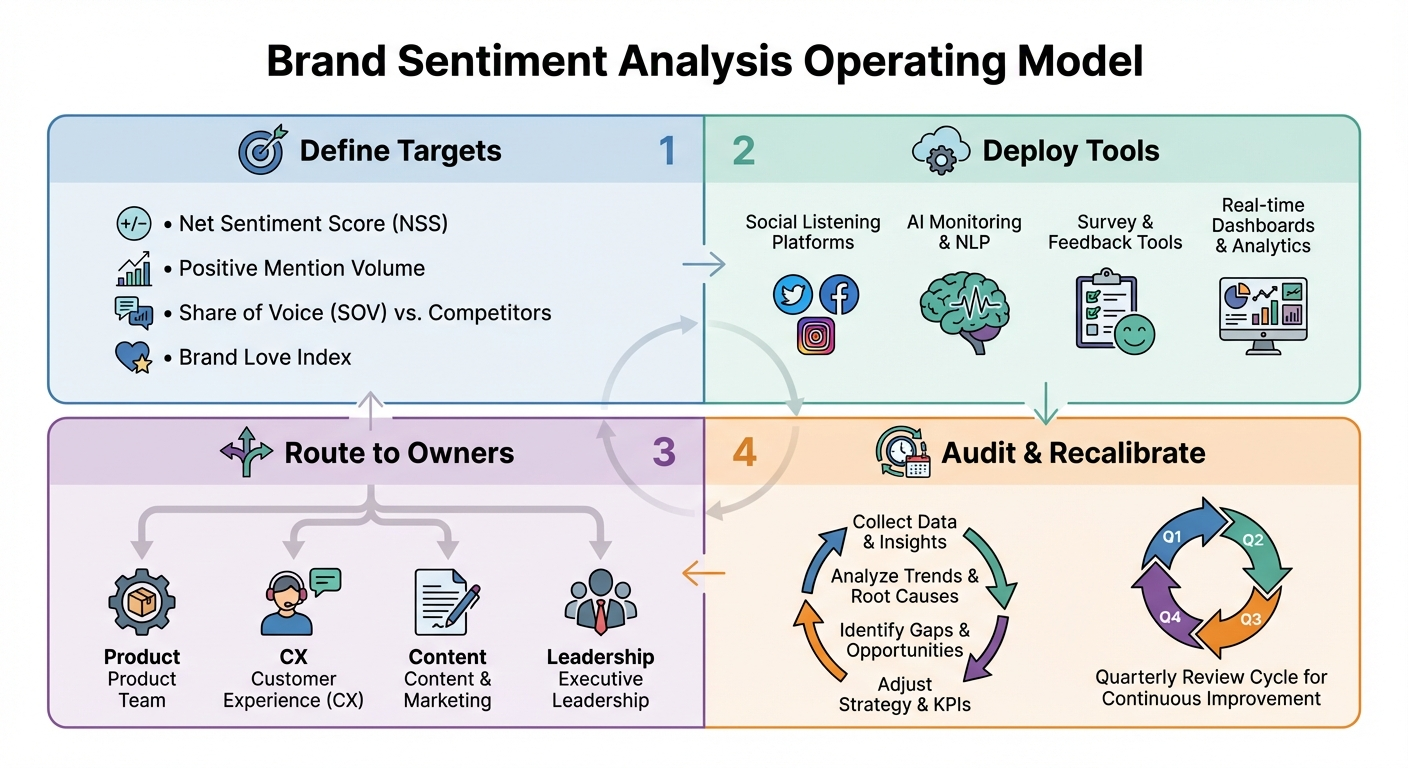
1. Define What “Good” Looks Like for Your Brand
Establish a baseline by measuring current sentiment across all channels — including AI outputs. Then set specific, time-bound targets tied to business outcomes:
- Increase positive sentiment ratio from 64% to 72% within two quarters
- Reduce negative AI-generated characterizations on pricing topics by 30% within 90 days
- Achieve parity with top competitor on product quality sentiment by end of year
2. Choose Complementary Tools
No single tool covers every channel. A practical stack might include:
- A social listening platform for real-time social and review monitoring
- An AI visibility analytics tool for tracking how AI models describe your brand
- Survey tools for direct customer feedback
- A unified dashboard that aggregates all sources for cross-channel analysis
3. Assign Cross-Functional Ownership
Sentiment analysis is not a marketing-only function. Route insights to the teams that can act:
- Product team receives sentiment data on feature requests and quality complaints
- CX team receives real-time alerts for negative service sentiment spikes
- Content team receives AI sentiment reports to guide editorial strategy
- Leadership receives monthly competitive sentiment benchmarks
4. Review and Recalibrate Quarterly
Sentiment models drift over time. New slang, shifting cultural norms, and evolving AI model behavior all affect accuracy. Quarterly audits of your sentiment analysis tools ensure you’re still measuring what matters.
How Sentiment Analysis Connects to AI Visibility Strategy
Brand sentiment analysis and AI visibility are deeply connected. The sentiment embedded in your public content directly influences how AI models represent your brand.
In campaigns across 67+ B2B companies, the BrandMentions team found that brands with consistent, positive editorial mentions on high-authority publications achieved AI recommendation rates 89% higher than brands relying solely on traditional SEO. The sentiment of those mentions — not just their existence — was the differentiating factor.
This connection works in both directions:
- Positive editorial sentiment → better AI characterizations — AI models learn positive brand-category associations from authoritative sources
- AI sentiment monitoring → smarter content strategy — knowing what AI says about your brand reveals exactly which topics need stronger positive content
For B2B brands investing in increasing brand mentions in AI search, sentiment analysis is the feedback loop that tells you whether those mentions are helping or hurting your positioning.
Frequently Asked Questions
What is the difference between brand sentiment and brand awareness?
Brand awareness measures whether people recognize your brand exists. Brand sentiment measures how they feel about it. You can have high awareness with negative sentiment — meaning people know your brand but don’t trust it. Both metrics matter, but sentiment is a stronger predictor of purchase intent and loyalty.
How often should you measure brand sentiment?
Continuous, automated monitoring is the standard for 2026. Set up real-time alerts for significant sentiment shifts and conduct deeper manual reviews monthly or quarterly. Campaign-specific sentiment tracking should start before launch and continue for at least 30 days after.
Can brand sentiment analysis detect sarcasm accurately?
Modern NLP tools have improved significantly, but sarcasm detection remains imperfect — particularly across languages and cultural contexts. Combining automated analysis with periodic human review catches the edge cases that algorithms miss. Accuracy rates for sarcasm detection in leading tools reached approximately 78–82% as of late 2025, according to research from Stanford HAI.
Does brand sentiment in AI search affect traditional SEO rankings?
Not directly — Google’s ranking algorithms don’t use sentiment as a ranking factor. However, sentiment influences user behavior signals (click-through rates, dwell time, brand search volume) that do affect rankings. Additionally, AI Overviews and Featured Snippets increasingly reference content with positive, authoritative sentiment, creating an indirect but measurable connection.
How do you measure brand sentiment in AI-generated responses specifically?
Query AI platforms with standardized prompts about your brand (e.g., “What do people think about [brand]?” or “Is [brand] a good choice for [use case]?”). Analyze the tone, framing, and specific language used in responses. Tracking brand mentions in AI search results systematically over time reveals sentiment trends that point-in-time checks miss.
What to Do Next
Brand sentiment analysis in 2026 demands a dual-lens approach: monitor what humans say about your brand and what AI platforms generate about it. The brands that treat both as integrated data sources — and route insights to teams that act on them — build compounding advantages in customer trust, competitive positioning, and AI discoverability.
Start by auditing your current sentiment across AI platforms. If you don’t know how ChatGPT, Perplexity, or Gemini describe your brand today, that’s the first gap to close.
See where your brand stands in AI search — and find out what AI is really saying about you.